You are currently viewing a new version of our website. To view the old version click .
Energies
  • Review
  • Open Access

8 December 2025

Evaluating Fuel Properties of SAF Blends: From Component-Based Estimation to Molecular Dynamics

,
,
and
1
School of Engineering, Swinburne University of Technology, Melbourne, VIC 3122, Australia
2
National Computational Infrastructure, Australian National University, Canberra, ACT 2601, Australia
3
School of Science, Computing and Emerging Technologies, Swinburne University of Technology, Melbourne, VIC 3122, Australia
*
Authors to whom correspondence should be addressed.
This article belongs to the Section I1: Fuel

Abstract

The transition to sustainable aviation fuel (SAF) is critical for reducing the carbon footprint of the aviation sector while ensuring compatibility with current engines and infrastructure. Regulatory constraints, such as ASTM D7566, currently limit SAF blending to 50% in commercial flights, emphasizing the need for accurate evaluation of SAF properties to enable broader adoption. This review presents an updated overview of fuel studies evaluating key thermophysical and transport properties of hydrocarbon-based SAFs—including density, viscosity, specific energy, flash point, and thermal stability—with particular emphasis on molecular dynamics (MD) simulations. Among the MD simulations, the OPLS-AA force field demonstrates high accuracy in modeling liquid-phase hydrocarbons and shows strong agreement with experimental data. Coupled with MD engines like LAMMPS and GROMACS, it enables scalable and efficient simulations of SAF blends. Emerging research trends highlight integrative approaches that combine classical MD and machine learning (ML) in fuel property prediction, and force-field optimization to improve predictive capability. Future research in fuel is moving toward multi-force-field coupling using reactive frameworks such as ReaxFF for studying pyrolysis and oxidation, and data-driven experiments with in situ simulation feedback loops to accelerate SAF design and facilitate wider implementation in aviation.

1. Introduction

The demand for sustainable aviation fuel (SAF) is projected to increase significantly in the coming years because there are no alternative fueling options for medium-to-long-haul commercial aircraft [1,2,3]. The adoption of SAF has been recognized as a crucial strategy for achieving the aviation sector’s environmental goals [4,5,6]. The aviation industry set the first global climate targets in 2009 and exceeded its initial goal of 1.5% annual fuel efficiency improvement, achieving over 2% per year between 2009 and 2019 [7]. In 2021, the industry committed to the Fly Net Zero target—net-zero carbon emissions by 2050—aligning with the Paris Agreement’s 1.5 °C goal. The Australian Government recently updated its climate commitment (10 November 2025), pledging to reduce national greenhouse gas (GHG) emissions to 62–70% of 2005 levels by 2035 [8].
SAF is identified at the COP30 congress [9] as the target for aviation emission reduction, as it is projected to account for up to 65% of GHG reduction. Despite growing efforts, global SAF production in 2025 is expected to reach merely 2 million tons, which is still under 1% of aviation’s total fuel use—with prices up to five times higher than Jet-A due to limited supply and regulatory pressures [10]. Major industry players are increasing SAF adoption. Boeing, for example, recently purchased 9.4 million gallons for its 2024 U.S. operations—its largest SAF buy to date [11]. Airbus has committed to reducing its Scope 1 and 2 emissions by 63% by 2030, and Scope 3 aircraft emissions intensity by 46% by 2035, compared to 2015 levels [12]. However, scaling SAF production poses significant technical, economic, and regulatory challenges. These include the need for major investment in biorefineries, sustainable feedstock supply chains, and compliance with strict ASTM certification standard [5,13,14,15,16]. To achieve deep, sustained GHG reductions, long-term commitments to low-carbon fuel innovation and supportive policy frameworks remain essential—regardless of short-term political fluctuations.
Jet fuels (ASTM D1655) are complex mixtures of hydrocarbons, including n-alkanes, iso-alkanes, cyclo-alkanes, and aromatic compounds, with the relative proportions of these groups of hydrocarbons determining critical performance properties, such as combustion efficiency, thermal stability, storage stability, and fluidity at low temperatures [16]. Jet-A fuel usually consists of a mixture of four main hydrocarbon families containing aromatics, cyclo-alkanes, iso-alkanes, and n-alkanes [17]. The composition of conventional aviation fuels such as Jet-A, RP-3 and hydrogenated RP-3-t fuels [18] is shown in Figure 1 This composition provides a comprehensive profile for modeling and evaluating fuel properties and performance in aviation applications [19].
Figure 1. Dominant composition of Jet-A fuel [17], and RP-3 and hydrogenated RP-3-t fuels [18]. The figure is regenerated based on estimated data from references [17,18].
N-alkanes and iso-alkanes provide higher specific energy and thermal stability but face challenges in low-temperature handling and high production costs, respectively [20,21]. Cyclo-alkanes, due to their lower hydrogen-to-carbon (H/C) ratios, exhibit higher densities and lower freezing points (FPs) compared to linear or branched alkanes. These properties make them particularly valuable for improving specific energy (by weight) and energy density (by volume) when blended with iso-alkanes, thereby enhancing the overall performance of aviation fuels [22]. Specific ratios of iso-alkanes/cyclo-alkane can enhance both specific energy and energy density of jet fuel blends [5,23,24].
To ensure SAFcan be effectively integrated into existing aviation infrastructure, it is essential to understand how its molecular composition influences key thermophysical and performance properties, especially when blended with conventional jet fuels with varied percentages of up to 50% [25,26]. While substantial advancements have been achieved in developing SAF production pathways, comparatively less focus has been placed on understanding the molecular-level interactions between SAF and conventional jet fuel components. These interactions are crucial, as they can significantly influence the resulting fuel’s physical properties, combustion behaviors, and overall performance in aviation applications. This review critically examines the current state of research on SAF blends using MD simulations, intending to evaluate key findings, methodologies, and limitations. It identifies existing knowledge gaps related to fuel compatibility, efficiency, and performance under realistic operating conditions, thereby guiding future research directions in the field.
In this study, we provide a critical review focusing on methods and techniques developed for the evaluation of key thermophysical and transport properties of aviation fuel when blended into conventional jet fuels in various percentages of up to 50% by volume. We also explore potentials to integrate MD simulations into the fuel property evaluation toolkit, in order to develop recipes for optimal fuel properties. These key aviation fuel properties examined include specific energy, density, viscosity, thermal stability, and energy density, which play a critical role in determining overall fuel performance and compatibility [25]. Particular attention will focus on non-linear behaviors of the properties arising from molecular interactions when blending SAF into conventional jet fuels. Methodological approaches using MD simulations in fuel studies, in particular, computational models, force fields, and simulation protocols, with their strengths and limitations for predicting SAF blend fuel properties, are discussed. Emerging integrative approaches that couple classical MD with machine-learning (ML) techniques to accelerate fuel formulation and property prediction are highlighted. Finally, key challenges and knowledge gaps in current SAF blends fuel research, particularly the need for experimentation and advanced simulation nexus in SAF development, will be addressed.

Recent Advances in SAF Blend Studies

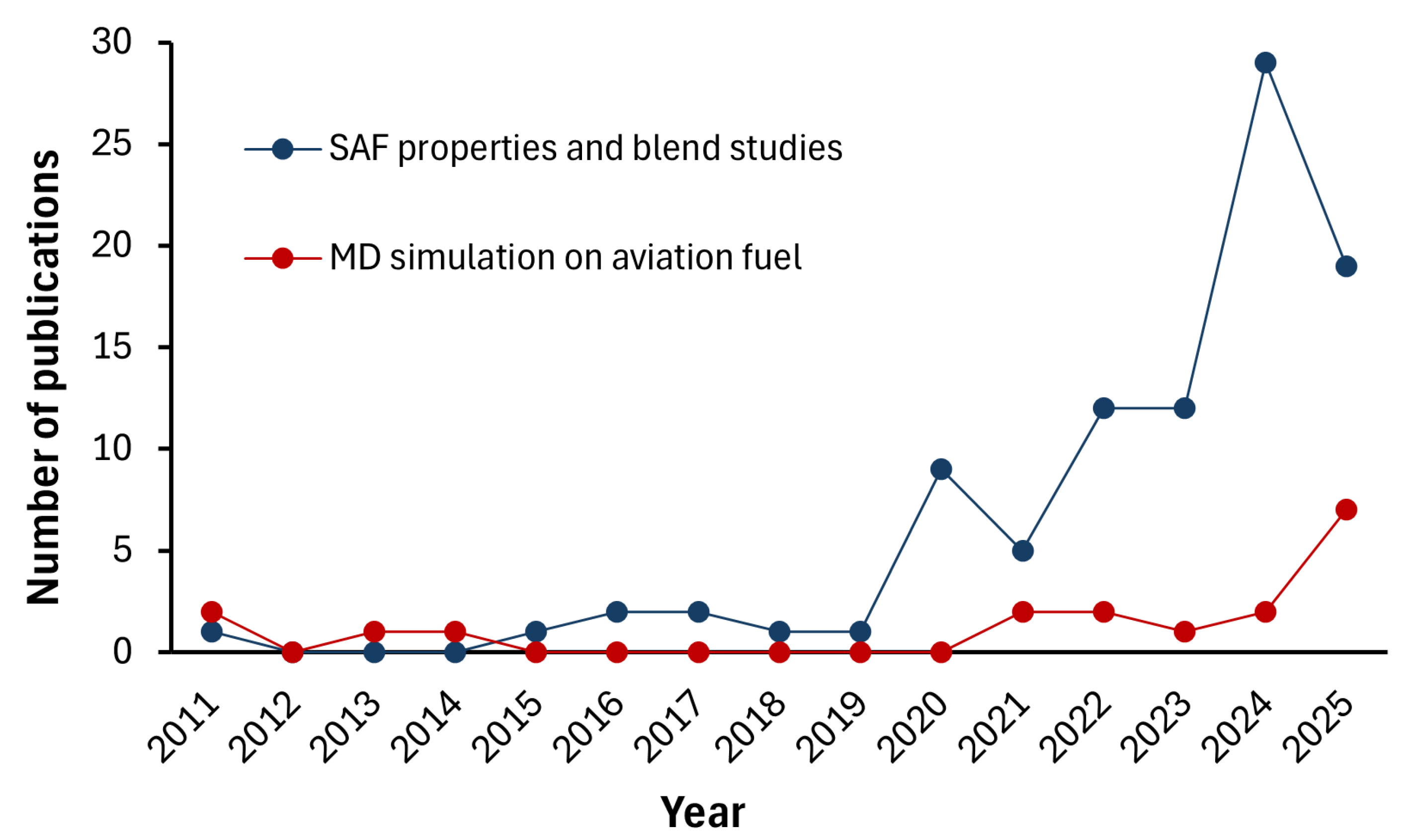
To comprehensively map the research landscape regarding the thermophysical properties of SAFs and fuel blends, two distinct datasets were retrieved from the Scopus database as of 28 October 2025, as shown in Figure 2. The first dataset targeted broader property studies using the search query: “properties AND of AND sustainable AND aviation AND fuel AND blend”, retrieving 84 publications in the past 15 years between 2011 and 2025. The second dataset specifically focused on molecular dynamic simulation using the query: “molecular dynamics AND properties AND of AND aviation AND fuel”, which produced 18 documents over the same period (2011–2025). No limitations on publication years were implied to achieve a full historical overview of the development of the field.
Figure 2. Publication trend on properties of SAF blends and MD simulations of aviation fuel properties (date of access: 28 October 2025).
The information reveals distinct yet complementary trends. Research on general SAF properties remained low-profile with less than five articles per year for nearly ten years until 2020, when it experienced a sharp rise, peaking in 2024 with 29 publications, underscoring the sector’s growing commitment to low-carbon aviation solutions. However, although relatively few studies on SAF using MD simulations have been conducted, there has been a steady increase since 2021, reaching five publications by 2025. This emerging trend highlights a growing reliance on atomistic modeling to support experimental approaches and accelerate the development of optimized SAF formulations.

2. SAF and Fuel Properties

2.1. SAF and Its Approved Production Pathways

According to a recent National Energy Research Laboratory (NREL) report, SAF is a type of drop-in (blends) liquid hydrocarbon jet fuel made from waste or renewable resources that is designed to work with present engines and aircraft without modification while achieving at least 50% reduction in lifecycle greenhouse gas (GHG) emissions [20,26]. Drop-in hydrocarbon fuels can be produced from a diverse conversion pathway, not simply from oil-based pathways. In the US, SAF is a Jet A fuel blend stock that [20]
  • Lowers the net lifecycle of CO2 emissions from aviation operations.
  • Improves aviation sustainability by outperforming petroleum-based jet fuel in economic, environmental and social impacts.
  • Allows flexibility to produce drop-in jet fuel from numerous feedstocks and conversion technologies, without any modification in the existing engine and aircraft fuel systems, storage facilities or distribution infrastructure. As a result, SAF can be blended with traditional jet fuels.
SAF is currently the only feasible alternative for existing aircraft in the mid-term and plays a vital role in reducing carbon emissions from long-distance commercial flights. When produced at stand-alone facilities, SAF must comply with ASTM D7566, the “Standard Specification for Aviation Turbine Fuel Containing Synthesized Hydrocarbons”, which ensures that SAF meets the required safety, performance, and compatibility criteria for use in aviation engines [20]. Although Airbus A350 successfully completed its first commercial flight powered entirely by 100% SAF in 2021 [27], the ASTM D7655 specification currently approves drop-in SAFs for blending at levels of up to 50% with fossils for Jet A fuel to comply with the ASTM D1655 jet fuel specification and to be compatible with the existing jet A fuel supply chain and infrastructure [28,29].
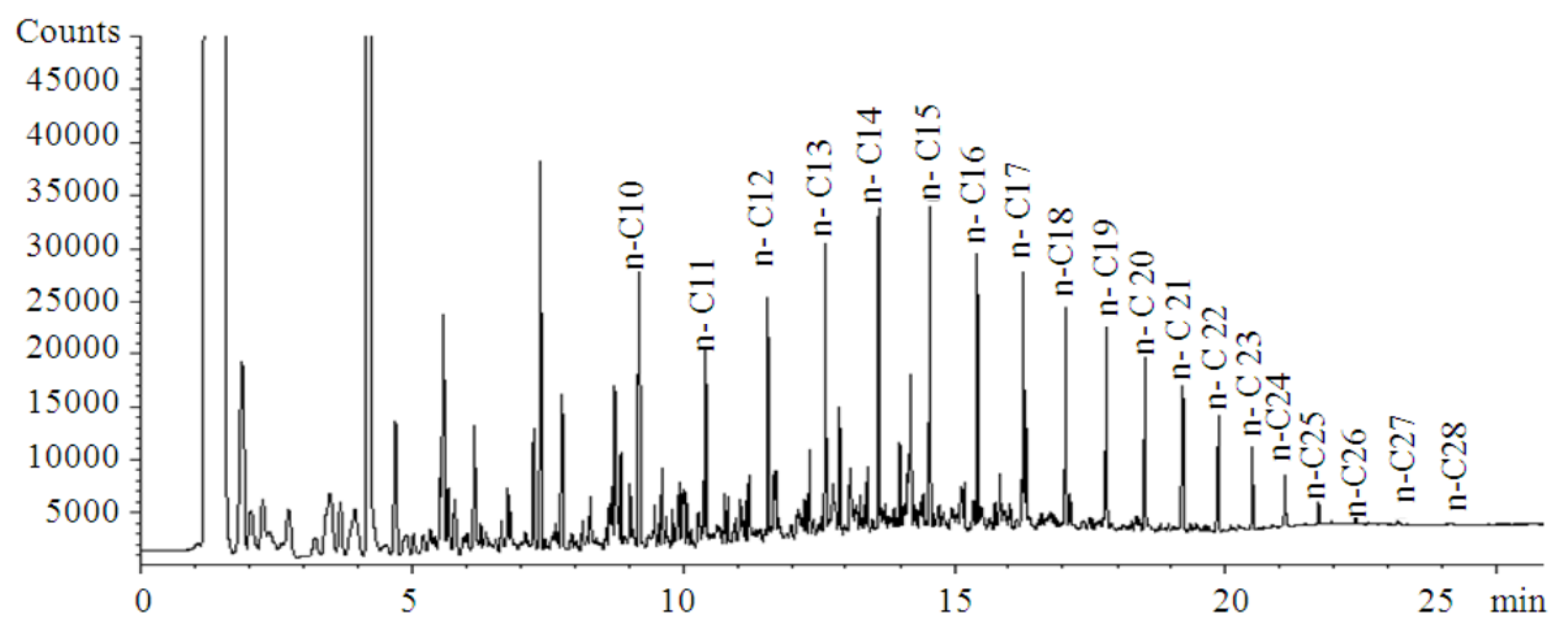
Fuels (including drop-in fuels) are complex mixtures of various hydrocarbon compounds [30]. Figure 3 presents the profile of a 1:1 mixture of gasoline and diesel, analyzed using gas chromatography (GC) with flame ionization detector (GC–FID). It shows a GC profile of a hydrocarbon mixture, with retention time (in minutes) on the x-axis and signal intensity (counts) on the y-axis. The peaks correspond to normal alkanes (n-C10 to n-C28), which are clearly labeled. The distribution indicates a broad range of chain lengths, with the most intense peaks occurring between n-C12 and n-C18, suggesting that these components dominate the mixture. The gradual decrease in peak intensity toward longer chains (n-C28) reflects lower concentrations of heavier hydrocarbons.
Figure 3. Hydrocarbon distribution in a 1:1 gasoline–diesel sample by GC–FID chromatography [30]. Copyright 2012 by the authors. Published by Science Publications under the Creative Commons Attribution License (CC BY 4.0).
The properties of drop-in fuels are not simply additive or superposition, as they are influenced by intricate interactions among the hydrocarbon molecules, particularly for key performance metrics such as density, viscosity, specific energy, and energy density [16]. To understand and predict these often-non-linear effects, MD simulations offer a powerful tool, providing atomic-level insights into the structural, thermodynamic, and dynamic behaviors of fuel mixtures. Such simulations are particularly valuable for investigating the properties of SAF and conventional jet fuel blends, facilitating the design and optimization of tailored fuel blend formulations [20]. Ultimately, these studies support the development of high-performance SAF alternatives—potentially exceeding the current 50% blending threshold—that align with sustainability goals and meet stringent aviation performance standards.
SAF can be produced through a variety of certified conversion technologies, each with its own process and feedstock sources. Currently, several approved pathways, such as Fischer–Tropsch hydroprocessed synthesized paraffinic kerosene (FT-SPK) and paraffinic kerosene synthesized from hydroprocessed esters and fatty acids (HEFA-SPK), are the most established pathways due to their proven efficacy and compatibility [2,15]. Other certified pathways include synthesized iso-paraffins from the hydroprocessing of the fermentation of sugar-based biomass (SIP), synthesized kerosene with aromatics derived from non-petroleum sources (FT-SKA or FT-SPK/A), alcohol-to-jet-derived synthetic paraffinic kerosene (ATJ-SPK), catalytic hydro thermolysis jet fuel (CHJ), and synthesized paraffinic kerosene from hydrocarbon-hydroprocessed esters and fatty acids (HC-HEFA-SPK) [2,25]. Additionally, SAF can also be produced by co-processing synthetic crude oil in petroleum refineries by the integration of renewable feedstocks into conventional jet fuel [2]. Furthermore, Power-to-Liquid (PtL) or e-Fuels represent an innovative and sustainable approach by converting captured CO2 into synthetic hydrocarbons using renewable electricity [31].
These emerging pathways aim to increase SAF availability and optimize fuel properties for improved sustainability and efficiency. Table 1 summarizes the key technologies, including their blending ratios, potential feedstocks, and average minimum selling price (MSP). The MJSP values are consolidated from published techno-economic analyses and harmonized to USD/L using consistent assumptions for plant scale, feedstock costs, hydrogen price, and conversion efficiency.
Table 1. Summary of SAF conversion processes *.
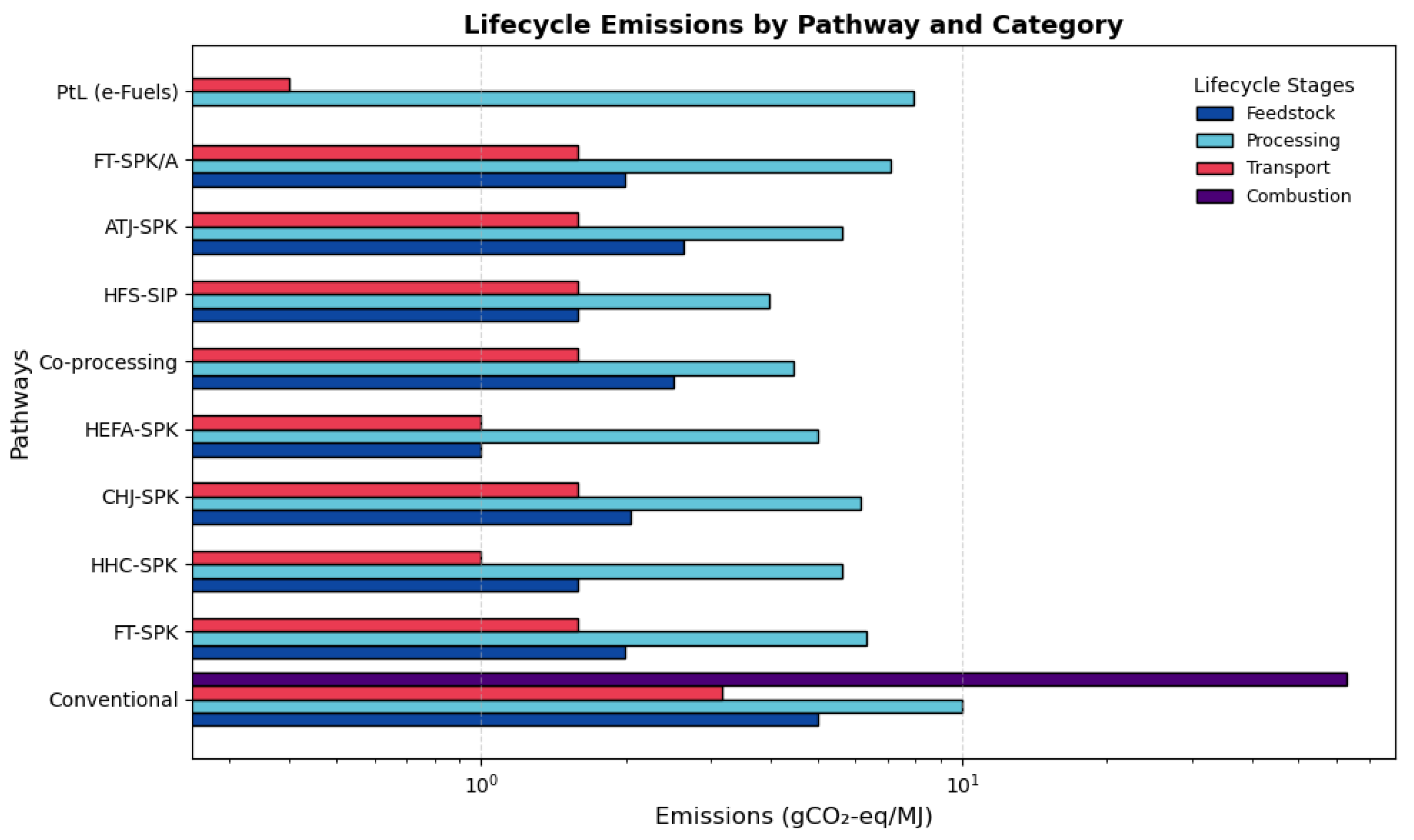
The environmental impact of SAF production is assessed through lifecycle emissions, which include all stages from feedstock acquisition and processing to transportation and final combustion. Figure 4 provides an overview of predicted emissions in several SAF production techniques in Table 1 and conventional jet fuel. As can be seen in Figure 4, the conventional fuel exhibits the largest emission in g(CO2-eq)/MJ in every single phase of the production lifecycle, particularly from the combustion phase [35]. The most obvious phase of conventional jet fuel is combustion, which is over 10 times larger than other phases, such as feedstock acquisition, processing and transportation, although those phases of the lifecycle are significantly larger than the phases in SAF pathways. Note that the y-axis of Figure 4 is log-scaled, not linear.
Figure 4. Estimated lifecycle emissions about various SAF production pathways. The figure is regenerated from data in reference [35].
All the ASTM-approved SAF pathways offer significant lifecycle emission reductions, though the degree and source of emissions vary. FT-SPK and FT-SPK/A use biomass or municipal solid waste as feedstocks. However, an additional step of producing aromatic compounds in FT-SPK/A can slightly increase processing emissions. HEFA-SPK produced from lipid-rich feedstocks such as used cooking oil or algae stands out as one of the most efficient pathways, with notably low emissions in both feedstock and processing phases. In contrast, ATJ-SPK and CHJ-SPK require more complex processing steps, leading to elevated emissions. HFS-SIP is less efficient overall due to limited process optimization. Co-processing, which blends bio-based oils with crude oil in existing refinery infrastructure, delivers moderate emission reductions [35].
HHC-SPK, derived from engineered feedstocks, achieves emission reductions comparable to HEFA-SPK. Meanwhile, Power-to-Liquid (PtL) or e-Fuels differ markedly from other pathways: they reduce feedstock-related emissions and lack a feedstock acquisition phase altogether, as they utilize CO2 and water via electrolysis, rather than biomass and fossils feedstock. This makes PtL fuels the cleanest in terms of feedstock-related emissions, though their processing phase remains energy-intensive [36]. Importantly, most SAF lifecycle analyses do not account for emissions from the combustion phase, which tends to be similar across all SAF types—except for PtL fuels, which may benefit from cleaner upstream processes and carbon-neutral synthesis [35].
Early research on SAF established a foundational understanding by assessing the fundamental thermophysical and combustion behavior of alternative hydrocarbons relative to conventional Jet-A. Foundational studies characterized chemical composition, thermal stability, and emissions performance of Fischer–Tropsch and HEFA fuels [37,38,39], while early reviews evaluated alternative jet-fuel pathways and their compatibility with gas-turbine engines [40]. Concurrently, major experimental initiatives by organizations like NASA and FAA documented the emissions, sooting behavior and contrail effects of early SAF blends [41]. These early studies established the critical empirical baseline that enabled the subsequent shift toward molecular-level modeling and MD-based research. With this foundation, researchers started using molecular dynamics to probe intermolecular interactions, mixture behavior, and the thermophysical trends of n-alkanes, cyclo-alkanes, and surrogate SAF blends.
The diversification and development of new alternative fuels, particularly SAFs, introduce challenges for liquid hydrocarbon fuel performance and optimization. The basic properties of hydrocarbon fuels must be carefully measured and enhanced to meet increased operational demands. The variation in physicochemical properties of aviation fuels arise from differences in their chemical compositions [42]; understanding the connection between chemical composition and properties of fuel is essential for advancing alternative fuel technologies and improving the performance characteristics of current aviation fuels.
SAFs are currently produced through several certified pathways, like HEFA, Fischer–Tropsch SPK, and ATJ-SKA, alongside emerging routes such as catalytic pyrolysis oils and power-to-liquids. Despite this technological advancement, global SAF production remains limited, supplying less than 1% of commercial aviation fuel demand, with availability strongly dependent on regional feedstock accessibility and policy incentives [20,34]. These production pathways form the upstream foundation for the molecular-level studies discussed in this review, where accurate prediction of fuel properties supports future SAF formulation, engine compatibility, and wider implementation in the aviation industry.
While previous reviews have covered SAF production pathways and certification requirements, a detailed examination from a molecular-simulation perspective is lacking. This review fills that gap by focusing on application of MD simulations, particularly those using OPLS-based force fields, to predict thermophysical properties of hydrocarbon SAFs. In addition to summarizing recent MD advances, this work also provides an integrated overview of fundamental SAF properties, widely used MD methods, and major simulation software packages, offering a complete technical foundation for the field. Furthermore, by synthesizing recent advances in classical MD and machine-learning-assisted modeling, this review highlights emerging computational tools for the future design and optimization of SAF blends.

2.2. Fuel Properties

Fuel specifications primarily serve as quality control measures for procurement purposes. Chemical composition of aviation fuels directly influences the physicochemical properties, making it crucial to explore the fundamental relationship between composition and properties. Measuring fuel properties, however, remains a time-intensive and costly process, often constrained to specific operational conditions [43] and geographic locations. Obtaining this insight is essential for both the development of advanced fuels and the accurate prediction of their performance across a range of operational scenarios in jet fuel properties. Critical fuel properties, such as density, viscosity, thermal stability, energy density, specific energy, and flash point will be discussed in this Section.

2.2.1. Density

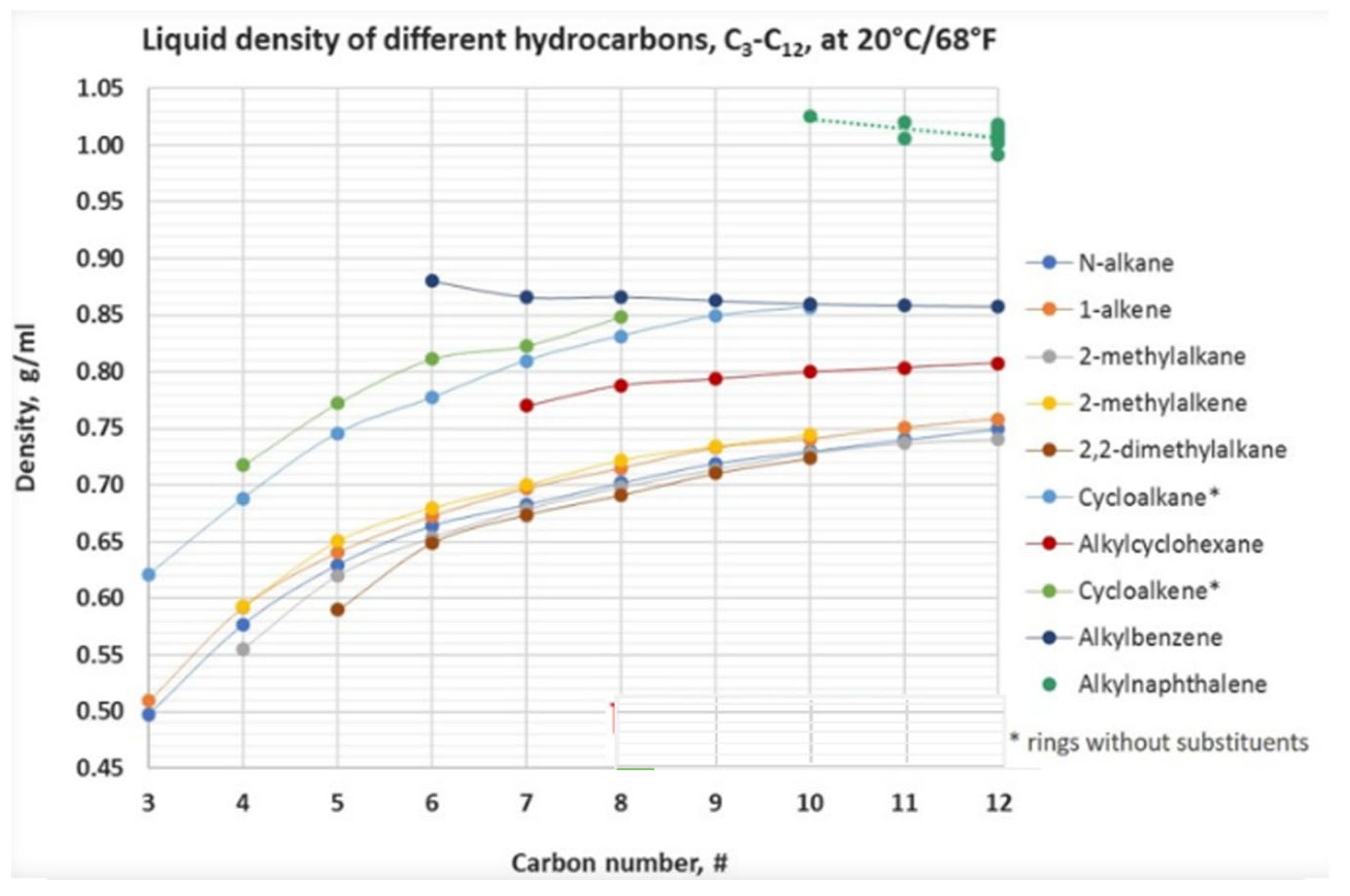
Fuel density affects the loaded fuel weight and operational range of aircraft, which are significant for the capacity of aircraft, particularly for limited fuel volume capacity [43]. It also affects the calculations of flow rate and the design of the fuel metering system and fuel storage tank [44]. According to ASTM D7566-18 [45] and D1655-18 [46], density of aviation turbine fuels such as Jet A and Jet A-1 must be 0.775–0.840 g/cm3 (0.775–0.800 g/cm3) at 15 °C. It is influenced by the chemical composition of hydrocarbon fuel. The hydrocarbon fuels’ density reduces in the following order: aromatics > cyclo-paraffins > paraffins when comparing with the same amount of carbon atoms; that means fuels with a lower hydrogen-to-carbon molar ratio exhibit higher density [43]. A correlation exists between density and carbon number for alkanes, cyclo-alkanes and aromatics, as illustrated in Figure 5 [47]. N-alkanes and iso-alkanes exhibit the lowest density, which rises by adding ring structures such as mono-, di-, and tri-cyclo-alkanes, as well as aromatics. The lower density of alkanes and the greater density of aromatics usually balance each other; however, many hydrocarbons within the jet fuel carbon range still fall outside the ASTM-specified density limits. Synthetic fuels with a greater percentage of n- and iso-alkanes, such as FT-SPK and HEFA, need to be blended with higher-density fuels with aromatics like Jet-A to meet specifications [48,49].
Figure 5. Impact of carbon number of different hydrocarbon classes on the fuel density. * Rings without substituents. # Carbon number of the hydrocarbon. Reproduced with permission from reference [47]. Copyright 2025 Toolbox.
Fuel density largely depends on its chemical composition, with molecular structure influencing the density and temperature of the fuel. For example, cyclo-paraffins with cis configuration generally exhibit a higher density than their trans configurations due to a more twisted and compact molecular structure, such as cis-decalin, which has a density of 0.897 g/cm3 while trans-decalin has a density of 0.870 g/cm3 [50]. Wang et al. established a refined predictive model with stronger correlation by studying a set of hydrocarbon fuels experimentally. Densities of hydrocarbon fuels are interrelated with their hydrogen-to-carbon ratio (H/C) and molecular weight (M) values. An increase in (H/C)/M0.1 decreases the densities of hydrocarbon fuels, showing that fuels with higher H/C and lower M of hydrocarbon fuels exhibit lower densities, as summarized in Table 2. The linear regression equation for fuels can be described in Equation (1) [51]:
ρ = 1.555 0.615   ×   H / C / M 0.1 R 2 = 0.97    
Table 2. Relationship between density and (H/C)/M0.1 and their fitted results from Equation (1).

2.2.2. Viscosity

Viscosity is a key physical property of jet fuel that demonstrates the resistance of the fuel to flow. This parameter is used to assess the combustibility of aviation fuel, design of fuel transfer control systems and the computation of pipeline pressure drop [52]. Viscosity is paramount in maintaining the safe operations and efficient engine functioning of the fuel at different temperatures, specifically, at higher altitudes where low temperatures can result in high fuel viscosity. High-viscosity fuels eventually lead to severe operational issues, such as engine deposits, poor spray atomization, and low-temperature pumping challenges [53]. Viscosity specifications of aviation fuels like Jet A and Jet A-1 ensure that they remain fluid under a broad range of operating conditions, including enormously cold temperatures at high altitudes. Too-high viscosity leads to improper fuel flow through filters and fuel lines, which will affect engine performance or potentially result in engine failure. Aviation fuels like Jet A and Jet A-1 have a maximum kinematic viscosity of 8.00 mm2/s (cst) at −20 °C, according to ASTM D7566-18. ASTM D1655 shows a viscosity limit at −20 °C of 8 mm2/s for Jet A/Jet A-1, and 8.5 mm2/s for JP-5 [54].
Varieties of hydrocarbons (n-alkanes, iso-alkanes, cyclo-alkanes and aromatics) greatly influence the viscosity of jet fuel [55]. The viscosity of jet fuels tends to rise with higher total carbon number. With the same number of carbon atoms, cyclo-alkanes and aromatics possess higher viscosity than alkanes due to their rigid molecular structure and strong intermolecular interactions. Among cyclo-alkanes, the trans configuration of decline has low viscosity, while the cis configuration decline possesses high viscosity due to the twisted structure of the cis configuration [56]. N-alkanes usually increase the viscosity of the jet fuel as compared to iso-alkanes due to their stronger intermolecular forces, which make the structure more compact and tightly packed to restrict the flow, while branched alkanes decrease the viscosity of jet fuel, making them good for high altitude [49]. Aromatics participate in increasing the viscosity depending on the size and structure of the molecule. The lowest viscosities are found in n- and iso-alkanes, followed by mono-, cyclo- and polycyclo-aromatics when compared with the average values. An obvious relationship is present between the viscosities and the carbon number for each family [49]. In this review, ηD is used to represent dynamic (shear) viscosity. The dynamic viscosity of a liquid can be determined by multiplying its kinematic viscosity by its density [57].
Numerous studies applied molecular structure to determine viscosity [55,58,59]. A Quantitative Structure–Property Relationships (QSPR) model was presented by Cai et al. [55] to estimate the viscosity of hydrocarbons depending on the fuel’s basic groups and unified groups. Yue et al. [51] used an exponential regression model to connect viscosity with both the H/C molar ratios and M of hydrocarbon fuels to make the correlation between viscosity and fuel composition simpler. Yue et al. describe the correlation between the viscosities of hydrocarbon fuels and their H/C and M values. As illustrated in Table 3, the viscosities tend to decrease with higher H/C ratio and lower molecular weight. The literature contains similar findings [60]. The viscosity of hydrocarbons is greatly influenced by molecular weight, and an increase in M typically leads to higher viscosity. The exponential equation for these fuels is
η D = 113.69 e 25.92 ( H / C ) / M 0.5 R 2 = 0.98
Table 3. Relationship between viscosity and ( H / C ) / M 0.5 for various hydrocarbon fuels and their fitted results from Equation (2).

2.2.3. Thermal Stability

Thermal stability describes a fuel’s ability to resist degradation or decomposition when exposed to elevated temperatures. It is a critical parameter for engine manufacturers, as poor thermal stability can compromise engine performance [44,61,62]. Chemically unstable fuels can form gums and carbonaceous deposits, which may clog fuel filters and disrupt the spray pattern of fuel injector nozzles [63]. These thermal decomposition products can cause operational issues and lead to increased maintenance requirements [64].
Different variables such as composition, temperature, pressure, heteroatom content and metal surface catalytic activity can affect the thermal stability of fuels. Hydrocarbon fuels with significant levels of aromatic and heteroatom-containing compounds generally have a strong tendency to form deposits. For example, JP-8 fuels containing heteroatoms are less thermally stable than paraffinic fuels made by FT synthesis or hydrogenation [37], while synthetic fuels with low levels of aromatics and heteroatom components are more thermally stable than crude fuels [65].
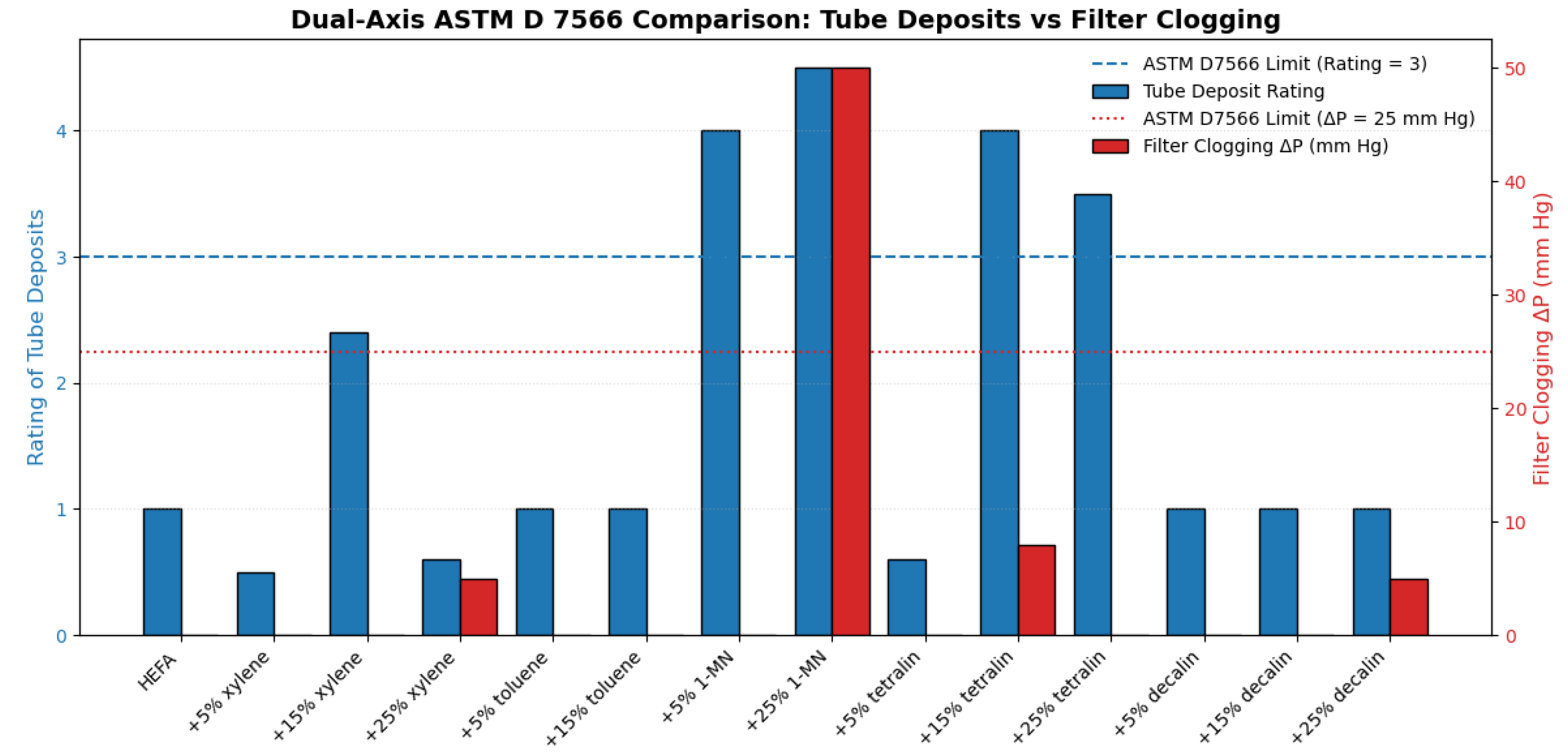
The Jet Fuel Thermal Oxidation Test (JFTOT) is commonly used to measure the thermal stability of aircraft fuels by evaluating their tendency to form deposits under high-temperature conditions [61,66]. The surface deposit on the test tube was assessed by visual tube-rating (VTR) techniques and the filter pressure drop after testing [67,68]. Based on ASTM D7566-18 and D1655-18 standards, the pressure drop of the filter should be below 25 mmHg, and the VTR color code should be below 3 (range: 0–4; with higher numbers indicating heavier deposits). The thermal stability of HEFA-SPK fuel and cyclic molecule blend (5–25 vol.%) measured using the JFTOT at 325 °C (ASTM D3204) shows excellent performance with a tube deposit rating and filter clogging by varying the pressure gradient after the JFTOT. The VTR color code and pressure drop of HEFA can meet ASTM D7566-18 requirements, as shown in Figure 6. The tube deposit rating rises over 3 when xylene (25%), 1-methylnaphthalene (≥5%), and tetralin (≥15%) are added. Surprisingly, HEFA with a VTR color code below 1 can have its thermal stability improved by adding 5% xylene and tetralin. The only pressure drop that exceeds 25 mmHg is that of 1-methylnaphtalene (25%), as shown in Figure 6. These results indicate that diaromatics can considerably lower the thermal stability of aircraft fuels. Consequently, the thermal stability of HEFA-SPK is maintained at low concentrations of toluene and xylene (5%), whereas it is significantly reduced at higher concentrations, particularly of 1-methylnaphthalene [69].
Figure 6. Test tube deposit rating and filter clogging by pressure drop of the thermal stability of HEFA fuel and its aromatic blends. This figure is regenerated based on results from reference [69].
The thermal stability of fuel calculated by bond dissociation enthalpy (BDE), as shown in Equation (3) [70].
H B D E = i = 1 n H i / r a d i c a l H f u e l
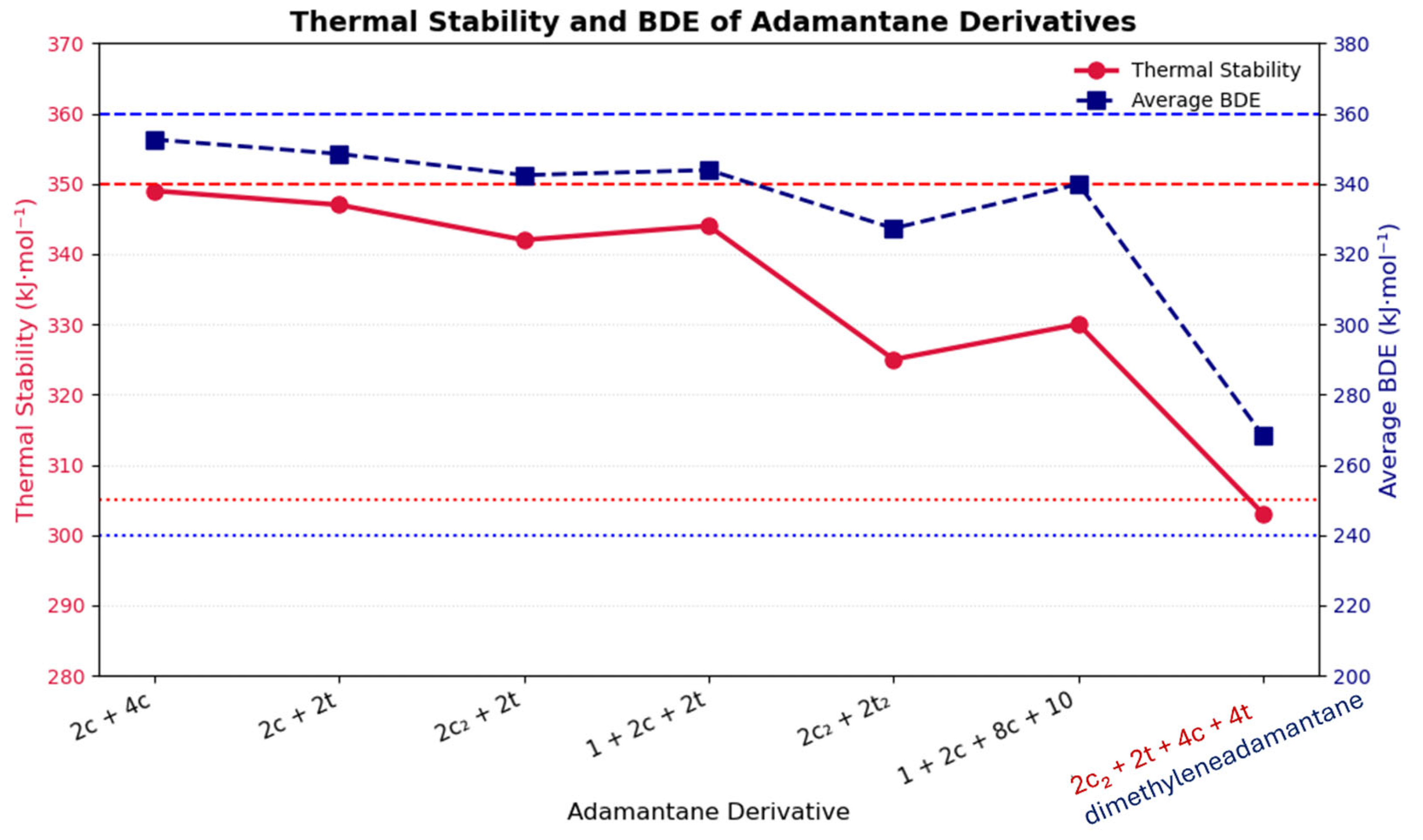
Bond dissociation energy (BDE) is used to evaluate the thermal stability of some adamantane compounds, such as methyleneadamantane (3cycle), dimethyleneadamantane (4cycle), 2c, 4c-dimethyladamantane (2c + 4c), 2c, 2t-dimethyladamantane (2c + 2t), 2c-ethyl-2t-methyladamantane (2c2 + 2t), 1, 2c, 2t-trimethyladamantane (1 + 2c + 2t), 2c, 2t-diethyladamantane (2c2 + 2t2), and 1, 2c, 8c,10-tetramethyladamantane (1 + 2c + 8c + 10). The minimum values of BDE (skeleton and side chain) define thermal stability as reported in Figure 7 for the eight different adamantane molecules. 4cycle has better thermal stability because of higher BDE values, although 3cycle has greater combustion qualities. The horizontal dotted line represent the minimum skeleton BDE of the 3-cycle adamantane framework, used as reference stability threshold. In contrast to other adamantane derivatives, cyclo-alkanes (such as 3-cycle and 4-cycle) that form between side chains and skeletons demonstrate lower thermal stability [70]. The thermal stability of most adamantane derivatives, except 2c2 + 2t + 4c + 4t is better than that of JP-10. The red upper and lower dot lines represent thermal stability of 1,3-dimethyladamantane and JP-10 respectively. However, thermal stability decreases as the number of carbon atoms in the side chain increases [70].
Figure 7. The BDE and thermal stability of some adamantane derivatives. This figure is regenerated based on results from reference [70].

2.2.4. Energy Density and Specific Energy

The energy content of jet fuels is a critical property that directly affects an aircraft’s performance, efficiency, and range. High specific energy reduces the amount of fuel required for long-haul flights, while high energy density minimizes the fuel tank volume, thereby increasing payload capacity and extending flight range [71]. Energy density—also known as volumetric energy density—is the amount of energy per unit volume of fuel (MJ/L), whereas specific energy—or gravimetric energy density—is the energy per unit mass of fuel (MJ/kg). For instance, Jet-A fuel has an energy density of approximately 34.7 MJ/L and a specific energy of around 43.15 MJ/kg [72].
Blending SAF with conventional jet fuel at varying proportions alters the overall energy content of the resulting fuel, as different hydrocarbon classes contribute differently to energy characteristics. Generally, energy density increases with fuel density, while specific energy tends to be higher in less dense fuels. This relationship becomes more apparent when comparing different fuel types (see Table 4) [73]. Among hydrocarbons with the same carbon number, the trend in increasing specific energy is paraffins > aromatics > naphthenes. Conversely, the energy density trend is reversed, with aromatics exhibiting the highest energy density and paraffins the lowest. Additionally, longer alkyl chains tend to raise energy density, while specific energy remains relatively constant. In cyclic hydrocarbons, specific energy increases with the number of carbon atoms, whereas energy density decreases. For example, lighter, less dense fuels like gasoline typically have higher specific energy, whereas heavier, denser fuels such as diesel exhibit higher energy density [27].
Table 4. Typical energy content of fuels *.
The hydrogen-to-carbon ratio in a molecule primarily determines the specific energy of the fuel. In the absence of bond strain, higher ratios in the fuel mean higher specific energies. Since liquid densities change more than specific energies, the energy density of fuels mostly determines the liquid density of fuel. Energy density rises with alkyl chain length while specific energy remains almost constant, but energy density decreases, and specific energy increases with an increasing number of carbon atoms in cyclic compounds. Table 5 summarizes the correlation between the heating values (specific energy and energy density) and H/C ratios. The net heating values per unit mass slowly rise as H/C increases, while those per unit volume decreases [51]. The linear regression formula for weight energy content is
N H V = 4.596 × H C + 34.197 R 2 = 0.98
Table 5. Correlation between weight energy contents and volumetric energy contents of different hydrocarbon fuels vs. H/C values [51].
Specific energy (SE) of molecule blends was estimated by adding the mass fractions (mi) and the neat SE value of each molecule as represented in Equation (5) [74]:
S E b l e n d = m i S E i
Density followed a linear blending rule with volume fractions, i, as explained in Equation (6):
ρ b l e n d = φ i ρ i
Blend Energy density (ED) was determined after the calculation of SE blend and blend as shown in Equation (7):
E D b l e n d = S E b l e n d ρ b l e n d
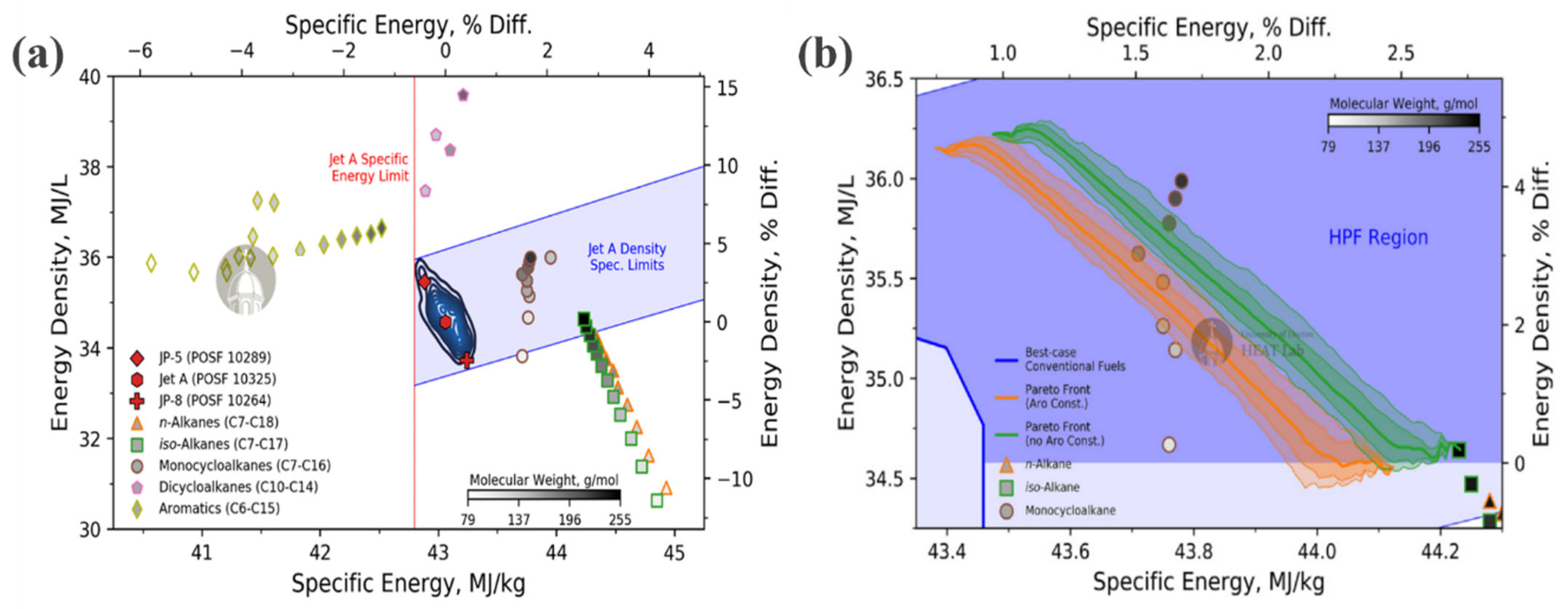
The relationship of specific energy and energy with each class of hydrocarbon is depicted in Figure 8a. The composition of Jet A fuel includes n-alkanes, iso-alkanes, cyclo-alkanes, and aromatics. The resulting energy density and specific energy as a mixture are displayed in red (the standard energy density and specific energy for Jet A is represented by the red hexagon). A closer look at the Pareto fronts that were optimized with and without aromatic constraint is represented in Figure 8b. The High-Performance Fuel (HPF) is represented by light blue shaded area, as per Jet-A specification limits for specific energy and energy density. This background highlights the target property space for the optimized fuel [74].
Figure 8. (a) Energy density and specific energy of different hydrocarbon fuels in relation to Jet-A specification [74], (b) Pareto-front visualization of energy density and specific energy of aromatic and non-aromatic constraints [74]. Copyright 2020 by the authors. Published by Elsevier Ltd. under Creative Commons Attribution License (CC BY 4.0).

2.2.5. Flash Point

Flash point is the lowest temperature at which a fuel’s vapor pressure is sufficient to create the vapor required for the fuel to ignite spontaneously in the presence of an external ignition source like a spark or flame [75,76,77]. It is the key physical property that determines how volatile and flammable jet fuels are. Higher vapor pressure fuels have lower flash points and are thought to be more volatile. The elevated flash point ensures fuel safety during production, transportation, storage, and use [78]. Both closed-cup and open-cup methods can be used to determine the flash point of the hydrocarbon fuels [75,79]. According to ASTM D7566-18 [80] and D1655-18 [46] standards, flash point for aviation fuels obtained using closed-cup methods must be above 38.0 °C.
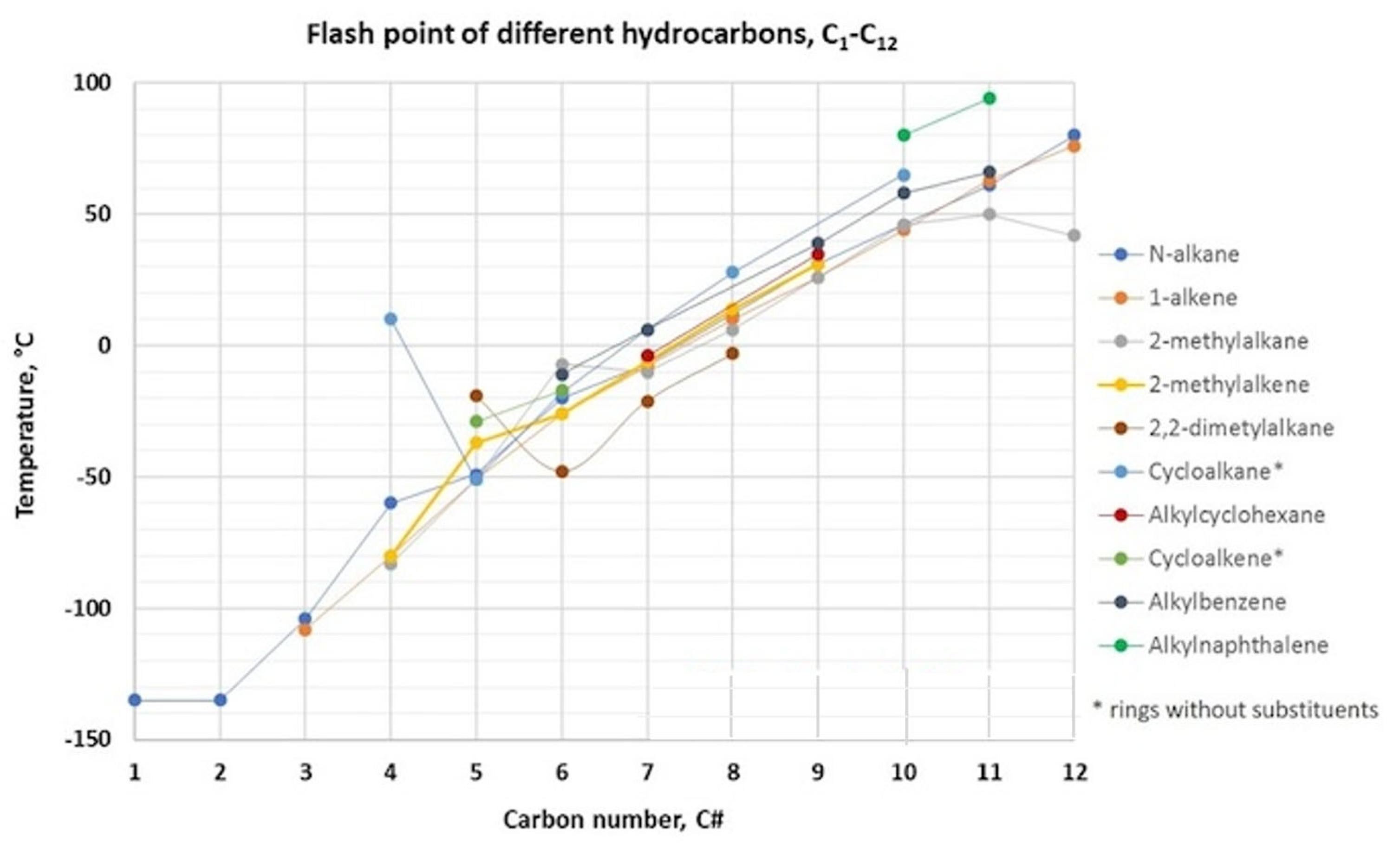
The flash point of hydrocarbon fuels is significantly affected by their chemical composition, particularly components with low flash points [43,49,81]. The flash point increases as the carbon number increases, as shown in Figure 9 [82], with the variation observed in different hydrocarbon classes. According to Elmalik et al. [83], the high concentration of n-alkanes leads to a linear reduction in the overall flash point of a hydrocarbon mixture containing n-alkanes, iso-alkanes, and cyclo-alkanes. Aromatic compounds containing a low boiling point decrease the flash point, while high-boiling-point aromatic hydrocarbon fuels increase the flash point [84]. Flash points of iso-paraffins exhibit greater variations at the same carbon number between different branching structures, which do not completely follow the trend of increasing flash points with increasing carbon number. These variations can be explained by the influence of intramolecular bond energy, which varies depending on the structure, position and length of the branch chain. The other categories containing n-paraffin, cyclo-paraffin, and aromatics fall within the range observed for iso-paraffins. The aromatics exhibit a higher flash point compared to n-paraffins and cyclo-paraffins, primarily due to higher bond energy boiling point [85].
Figure 9. Relationship between flash point and total carbon number of various hydrocarbon classes. * Rings without substituents. # Carbon number of the hydrocarbon. Reproduced with permission from ref. [82]. Copyright 2025 Toolbox.
Determining the experimental flash point of fuels, particularly for recently synthesized fuels, is very time-consuming and expensive. However, techniques for calculating and assessing the flash point of aviation fuels are highly desirable [75]. The correlation between the flash point Tf and the (H/C)/M2 values of hydrocarbon fuels is illustrated in Table 6 [51]. The flash points decrease when (H/C)/M2 increases, although not all the data entirely follow this pattern. It is challenging to precisely expect the flash points of hydrocarbon blends because even a small amount of the component with the lower flash point can cause an obvious reduction in the overall flash points of mixtures [50]. The linear regression model for this trend is given by Equation (8) [51]:
T f = 114.94 6.213 × 10 5 ( H / C ) / M 2   R 2 = 0.85
Table 6. Relationship between the flash points and their ( ( H / C ) / M 2 ) for hydrocarbon fuels and their fitted results from Equation (8) [51].

3. MD Simulation for Hydrocarbon Fuel Properties

The properties of drop-in fuels arise from complex molecular interactions between blending components, rather than simple additive effects. These interactions can significantly influence key characteristics, highlighting the need for molecular-level tools such as MD simulations to accurately evaluate fuel behavior. MD simulations are a powerful, versatile tool in fuel research, complementing experiments and accelerating the development of advanced fuels like SAFs by providing reliable predictions and mechanistic insights. It is particularly useful for studying the properties of complex systems due to its ability to model atomic-scale interactions and predict macroscopic thermophysical behaviors [86]. By numerically integrating the equations of motion for particle systems typically comprising hundreds to millions of particles over multiple timesteps, MD simulations provide a detailed understanding of thermophysical, transport, and structural properties at the atomic scale. The accuracy of MD simulations often depends on various force descriptions, ranging from basic Lennard–Jones (LJ) potentials to advanced quantum mechanical techniques [87,88]. In the context of hydrocarbon-based aviation fuels, MD simulations enable the calculation of critical properties under extreme thermodynamic conditions.

3.1. MD Software for Hydrocarbon Fuel Simulation

Available MD simulation software includes both commercial and open-source packages, many offering user-friendly graphical interfaces. Notable examples include LAMMPS [89,90], GROMACS [91,92], Materials Studio (MS) [93], CHARMM [94], AMBER [95], Quantum ESPRESSO [96] and CP2K [97]. These tools differ in computational precision, efficiency, and suitability, depending on the system studied and the properties or applications being targeted. Table 7 showed the comparative summary of MD simulation software for hydrocarbon fuels.
Table 7. Comparative summary of MD simulation programs for hydrocarbon fuels.
LAMMPS (Large-scale Atomic/Molecular Massively Parallel Simulator) [90] is a highly efficient and scalable open-source software designed for large-scale molecular dynamics simulations [89,98]. It supports a wide variety of materials, including hydrocarbon systems, and integrates external packages that expand its applicability to both non-reactive and reactive simulations [99]. It facilitates both equilibrium (EMD) and non-equilibrium (NEMD) simulations, allowing the calculation of essential transport properties like viscosity and thermal conductivity [100]. Wen et al. employed EMD simulations using LAMMPS to determine the dynamic viscosity and thermal conductivity of hydrocarbon systems under equilibrium conditions [101]. The software also includes built-in tools for calculating transport coefficients via the Green–Kubo formalism, further enhancing its value in SAF research [102]. Yang et al. used LAMMPS with the TraPPE-UA force field to evaluate the density and thermal conductivity of two surrogate fuel mixtures and the results showed strong agreement with both National Institute of Standards and Technology (NIST) reference data and experimental RP-3 jet fuel measurements [103].
A comprehensive MD study was conducted using LAMMPS with the COMPASS, OPLS-AA, and TraPPE force fields to evaluate the density, viscosity, and thermal conductivity of JP-10 aviation fuel across temperatures ranging from 250 to 900 K and pressures of 1.48, 3.06, and 6.00 MPa [104]. The results demonstrate that LAMMPS, particularly with the OPLS-AA force field, reliably captures both structural and transport properties of aviation fuels. LAMMPS has emerged as a powerful tool for simulating complex hydrocarbon blends and associated chemical processes, particularly due to recent advancements such as GPU acceleration and the integration of machine learning-driven force fields [105,106].
GROMACS (Groningen MAchine for Chemical Simulation) originated from the Berendsen Laboratory at the University of Gottingen, [107]. It is an extremely quick program for simulating molecular dynamics because of its meticulous optimization of inner loop speed and neighbor finding. It includes robust tools (e.g., pdb2gmx, gmx rdf, gmx msd) for setting up and analyzing hydrocarbon simulations. Farhadi et al. used the OPLS-AA force field in GROMACS to simulate transport properties—density, viscosity, self-diffusion, and thermal conductivity—of methane and benzene across 110–328 K and up to 1180 bar. These results demonstrate the effectiveness of GROMACS with OPLS-AA in accurately capturing hydrocarbon behavior under various thermodynamic conditions, offering valuable insights for jet fuel design. Its high efficiency, scalability, and support for force fields like GROMOS, OPLS-AA, AMBER, and CHARMM make it suitable for simulating alkanes, aromatics, and complex mixtures [108,109].
Other common MD simulation packages for hydrocarbon fuels include Materials Studio [93], AMBER [110,111], CHARMM [94,112], Quantum ESPRESSO [96] and CP2K [97]. Materials Studio [93] combines quantum mechanics, molecular dynamics, and mesoscale tools within an intuitive GUI. AMBER (Assisted Model Building with Energy Refinement) [95] and CHARMM (Chemistry at HARvard Macromolecular Mechanics) [94] use force fields like GAFF (General Amber Force Field) and CGenFF (CHARMM General Force Field) for the simulation of small organic molecules such as hydrocarbons, making it suitable for dynamic simulation. They require broad customization and parameterization for long-chain hydrocarbon simulations [113,114]. For example, Nikitin et al. used AMBER in simulating alkane properties but reported difficulty in the precise simulation of hydrocarbon fuels [115]. Furthermore, CHARMM’s computational cost and its steep learning curve further limit its applicability in large-scale hydrocarbon fuel studies. Quantum ESPRESSO (QE) [96] supports ab initio MD (AIMD) via Car–Parrinello and Born–Oppenheimer (CPMD) methods, making it valuable for studying electronic properties and reaction mechanisms at the quantum level. CP2K supports DFT, semi-empirical methods, and classical MD [97]. It excels in mixed quantum/classical (QM/MM) simulations and offers both Born–Oppenheimer and CPMD, making it suitable for studying hydrocarbon systems at quantum and classical levels.

3.2. Force Fields for Hydrocarbon Fuel Applications

In MD simulations, force fields (FFs) are fundamental components that define how atoms and molecules interact within a system. FFs are essentially a collection of mathematical functions and associated parameters that describe the potential energy of a molecular system based on atomic coordinates [116]. These energy terms allow the calculation of the forces, influencing atomic motion throughout the simulation. Selection of an appropriate FF is essential for accurate representation of intermolecular interactions and reliable property predictions of a complex system. Several FFs have been developed in MD simulations for mixed liquid hydrocarbon fuels, which include COMPASS (Condensed-phase Optimized Molecular Potentials for Atomistic Simulation Studies) [117], OPLS-AA (Optimized Potentials for Liquid Simulations—All Atom) [118], CHARMM [114,119], TraPPE (Transferable Potentials for Phase Equilibria) [120] and ReaxFF (Reactive Force Field) [121].
The suitability of force fields such as OPLS-AA, COMPASS, CHARMM, TraPPE, and ReaxFF in MD simulations were critically evaluated based on their accuracy, versatility, and computational efficiency for hydrocarbon related to sustainable aviation fuels. The OPLS-AA force field is particularly effective for hydrocarbon-based systems and has demonstrated reliable agreement with experimental densities, enthalpies of vaporization, and viscosity in both neat and blended fuels [118]. On the other hand, the TraPPE force field is optimized for vapor–liquid equilibrium with reduced computational demand [120] but does not represent explicit hydrogen. CHARMM, although originally developed for biomolecular systems, has been extended to include hydrocarbons and can be used to explore SAF interactions, especially when blended with bio-derived components [114,119]. The COMPASS force field is widely used for its high accuracy in predicting thermophysical properties for condensed-phase organic systems [117], but depends on unique parameterization, while ReaxFF involves combustion, oxidation, or degradation mechanisms in SAFs. ReaxFF provides a robust framework, enabling dynamic bond formation and breaking [121], but is less accurate for equilibrium thermophysical properties. Considering these constraints, OPLS-AA offers the best balance between accuracy, parameter availability, and computational cost.
Numerous MD and quantitative-structure investigations showed that subtle differences in hydrocarbon molecular design have significant impact on intermolecular interactions and macroscopic blend properties. For instance, MD simulations of binary n-hexane/n-hexadecane mixtures revealed that non-ideal mixing behavior, stemming from chain-alignment under shear and non-random short-range clustering of the shorter chains, significantly affects both viscosity and diffusivity [122]. A more recent investigation utilized a hybrid MD and ML framework for the computation of physiochemical properties in complex fuel systems. The methodology involved generating a high-fidelity dataset of fuel densities under varying temperatures and pressures via MD simulations. This dataset was subsequently used to train two distinct ML surrogate models: Gaussian Process (GP) regression and a probabilistic conditional generative model, both of which attained excellent predictive accuracy (R2 > 0.99). The analysis confirmed a strong correlation between cohesive intermolecular forces and macroscopic behavior, with systems of higher interaction energy demonstrating increased viscosities. This approach successfully reproduced key MD insights while drastically reducing computational expenses [123]. In parallel, quantitative-structure–property (QSPR) modeling of 261 pure hydrocarbons, including n-paraffins, iso-paraffins, cyclo-alkanes and aromatics, established that structure-dependent molecular features such as branching, cyclic structures and aromatic content exhibit strong predictive capability for viscosity [53]. Collectively, these findings underscore the critical influence of molecular microstructure on the macroscopic properties of blended hydrocarbon systems, including surrogate aviation fuels.

3.2.1. OPLS FFs

The Optimized Potentials for Liquid Simulations (OPLS) force field [118] is a widely used atomistic force field for simulating organic molecules, hydrocarbons and biomolecules in solvent. OPLS is a robust program for molecular interaction in condensed-phase systems. The general parametrization of OPLS-AA force fields involve the potential function incorporated in bonds, angles, dihedral angles and non-bonded interactions [124,125]. There are different versions of OPLS, such as OPLS-UA, parameters for united atom representations for large-scale simulations by simplifying molecular geometry and treating nonpolar hydrogen atoms implicitly. On the other hand, OPLS-AA exists for all atoms for more accurate modeling of polar and complex molecular systems such as hydrocarbons [126], lipids [127] and biomolecules [128]. An extension called L-OPLS has been specifically reparametrized for long-chain hydrocarbons for precisely determining the thermodynamic properties and phase behavior [129].
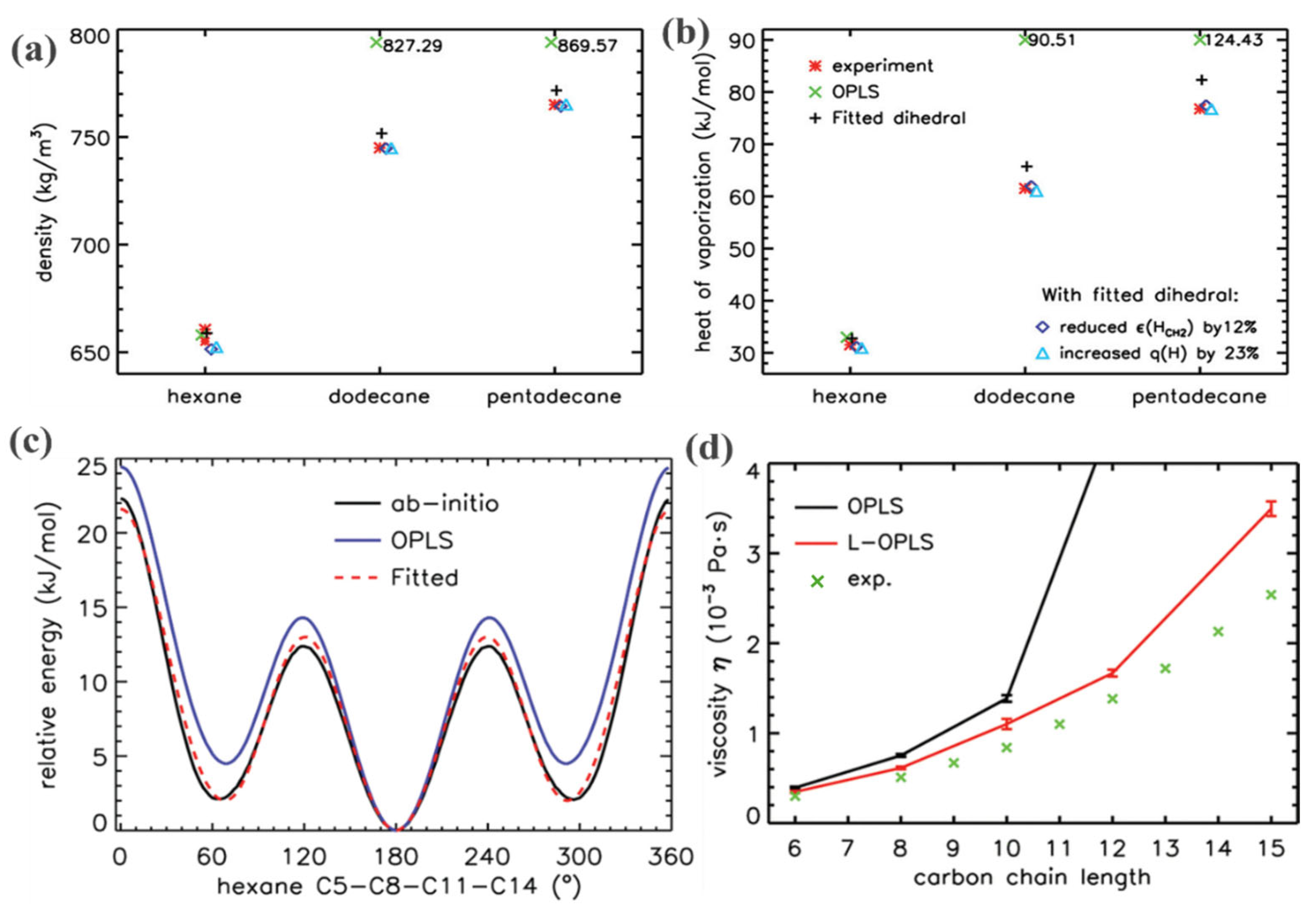
OPLS-AA has undergone several advancements to more accurately predict the transport and thermodynamic properties of both short- and long-chain hydrocarbons. Initial versions of OPLS-AA were accurate for small hydrocarbons but deviated for long hydrocarbons. The introduction of L-OPLS and OPLS/2020 [130] improved its precision by using high (MP2/aug-cc-pVTZ) quantum mechanics to revise torsional potentials and adjusting Lennard–Jones parameters to better match experimental results [129]. Figure 10 compares the MD simulation of various properties such as density (a), heats of vaporization (b), relative energy (c) and viscosity (d) of long hydrocarbons, with experimental data. The modifications to the OPLS force field enhanced viscosity and phase-transition temperatures predictions, making it effective for modeling complex hydrocarbon blends such as fuels and lubricants [124,129,130].
Figure 10. (a,b) Densities and heats of vaporization of alkanes, respectively; (c) relative energy of the dihedral angle scan of hexane; (d) liquid viscosities of alkanes at 298.15 K. Reproduced with permission from reference [129]. Copyright 2012 American Chemical Society.
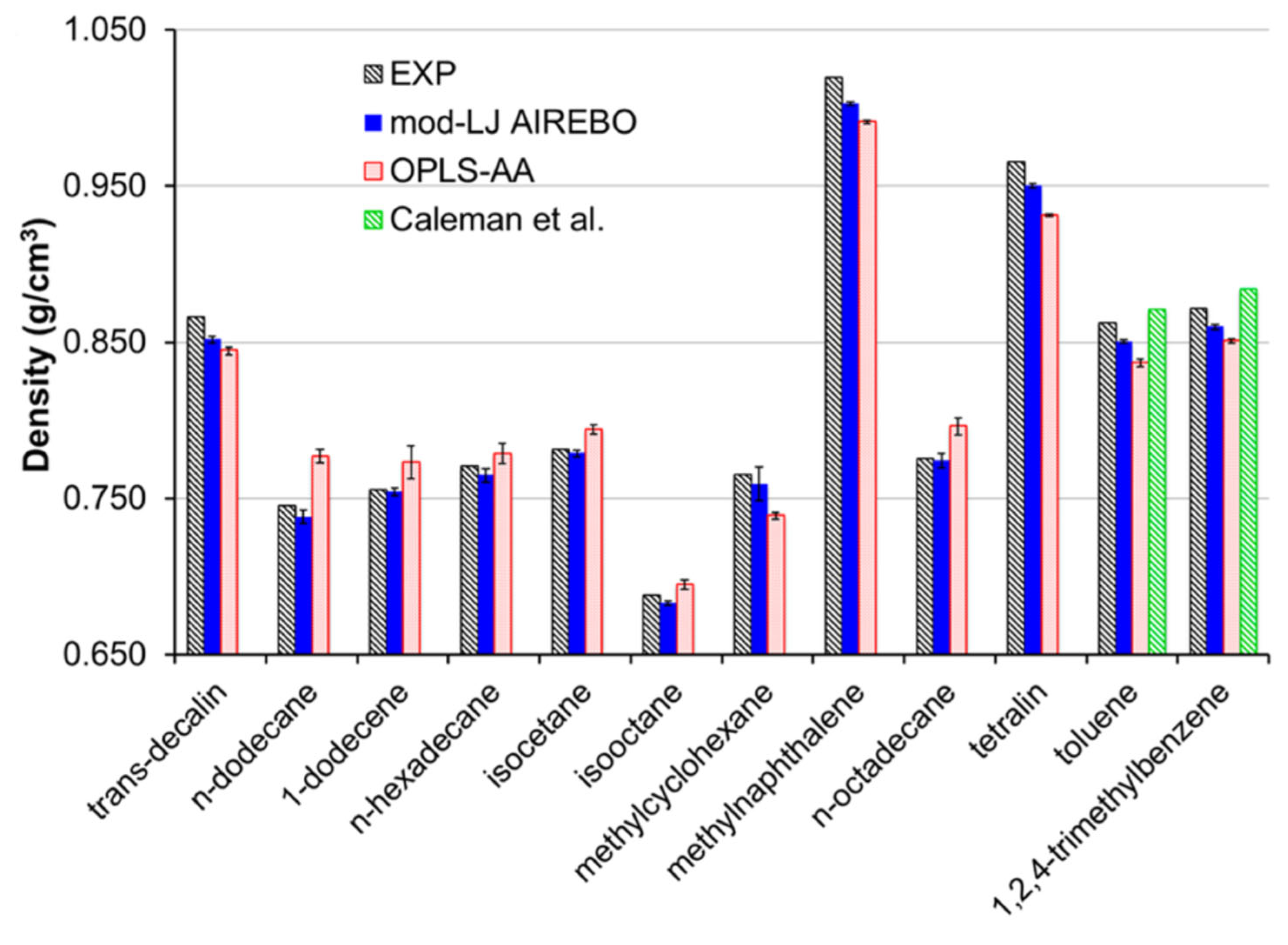
Researchers often design surrogate fuel systems [131,132,133] for their studies, which have a complex mixture of various hydrocarbons and may include unknown components [131,134]. Mooney et al. [135] considered two distinct binary surrogates made up of two unique types of hydrocarbons for available thermophysical data to understand the behaviors of liquids as having several hydrocarbon types. Even though there are several techniques for predicting the physical behavior of hydrocarbons, they do not offer insight into a molecular understanding of mixing behavior, chemical degradation, or other dynamic interactions. A wide range of fuel properties can be accurately predicted using all-atom MD simulations. Figure 11 compares the accuracy produced using various force fields at standard conditions (25 °C and 1 atm) with experimental values. The densities of the straight-chain and branched alkanes can be reliably predicted by the mod-LJ AIREBO potential when the error bars are considered. However, it somewhat underestimates the densities of aromatic and cyclic hydrocarbons. The OPLS-AA underpredict the density of aromatic hydrocarbons and cyclic alkanes like decalin and tetralin, while it overpredicts the density of straight-chain and branched alkanes. The strong correlation between experimental and simulated data demonstrates the OPLS-AA and mod-LJ AIREBO force fields’ accuracy in predicting the densities of hydrocarbons [135].
Figure 11. Densities of various hydrocarbons measured by OPLS-AA and the mod-LJ AIREBO force fields using LAMMPS. Reproduced with permission from reference [135]. Copyright 2016 American Chemical Society.
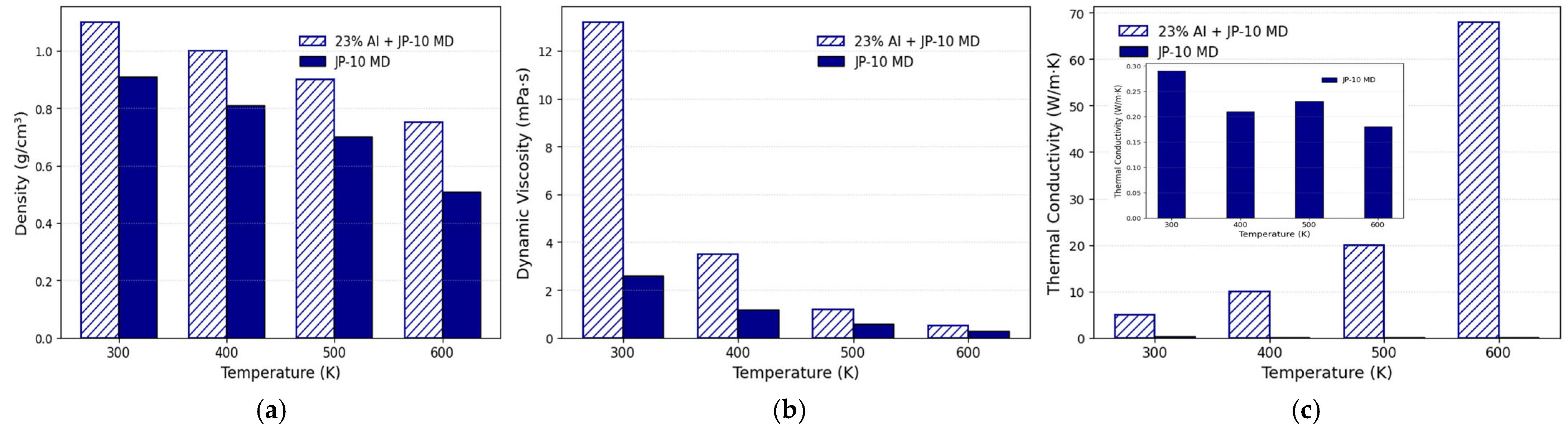
The thermophysical properties of JP-10 fuel blended with aluminum (Al) nanoparticles were evaluated using MD simulations with the OPLS-AA force field over a temperature range of 300–600 K [101]. This approach enabled detailed atomistic modeling, capturing the nuanced interactions between the fuel molecules and the dispersed nanoparticles. As illustrated in Figure 12a, the density of the Al/JP-10 system showed a decreasing trend with rising temperature. The interaction between JP-10 molecules and aluminum particles intensifies with the increase in temperature, leading to more frequent collisions and interactions. This stronger bonding makes it more challenging for liquid molecules to separate from the aluminum particles and affects the overall density trend of the mixture. This effect is especially visible at elevated temperatures, where the increase in particle–molecule interactions prevents the free movement of the liquid and results in a more gradual decrease in density. Figure 12b illustrates that the dynamic viscosity of the Al/JP-10 nanofluid exhibited a noticeable increase with temperature. This trend is attributed to the intensified internal friction and enhanced intermolecular collisions caused by the suspended Al nanoparticles. These solid particles introduce localized resistance within the fluid matrix, particularly under thermal agitation at elevated temperatures, thereby increasing the overall viscosity. Such behavior indicates the importance of understanding the rheological properties of nanoparticle-enhanced fuels, especially under high-temperature engine conditions [101]. Figure 12c presents the thermal conductivity of the Al/JP-10 mixture, which shows a substantial enhancement compared to the base fuel. This improvement is due to the high intrinsic thermal conductivity of aluminum particles, which act as efficient thermal bridges, facilitating faster heat transfer throughout the fluid. The dispersed metal nanoparticles reduce thermal resistance and enable quicker dissipation of heat, a property highly desirable in high-performance propulsion systems where thermal management is critical.
Figure 12. (a) Density, (b) dynamic viscosity and (c) thermal conductivity simulation of JP-10 with aluminum particles using OPLS-AA force field. These figures are regenerated based on the results from reference [101].
These findings highlight the capability of the OPLS-AA force field to accurately capture both fluid–fluid and fluid–solid interactions, offering a reliable framework for simulating nanofluid systems. The improved predictive accuracy in assessing the thermophysical behavior of nanoparticle-laden fuels makes OPLS-AA an excellent choice for investigating the influence of nanoscale additives on the performance, efficiency, and thermal stability of advanced aviation fuels like JP-10 [101].
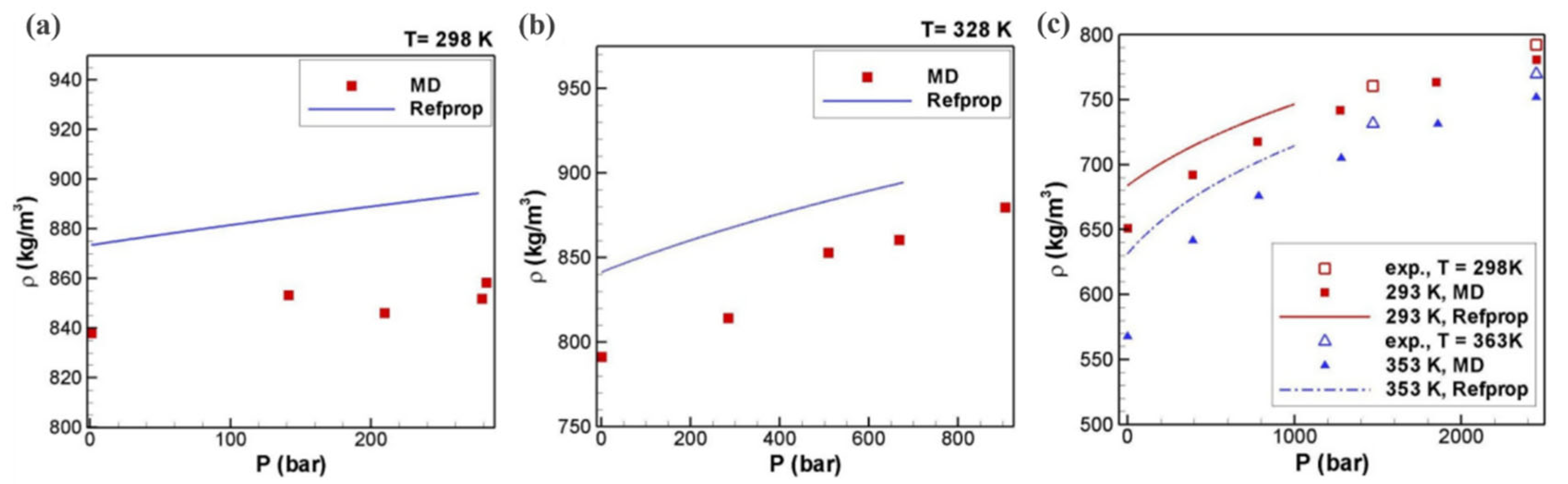
The mass densities of benzene and heptane at various temperatures and pressures were simulated using the OPLS-AA force field by Smolyanitsky et al. [136], as illustrated in Figure 13. For heptane, the simulated densities at 293 K and 353 K showed notable deviations from experimental and Refprop values at low pressures, with errors of approximately 5% at 293 K and up to 10% at 353 K at 1 bar [136]. These deviations decreased to around 2–3% at higher pressures, indicating improved agreement and suggesting that OPLS-AA provides more reliable results for heptane under high-pressure conditions.
Figure 13. (a,b) Mass density of benzene at 298 K and 328 K, respectively, and (c) mass density of heptane at 293 K and 353 K simulated using the OPLS-AA force field [136]. This work is in the public domain in the United States and freely reproduced with proper attribution.
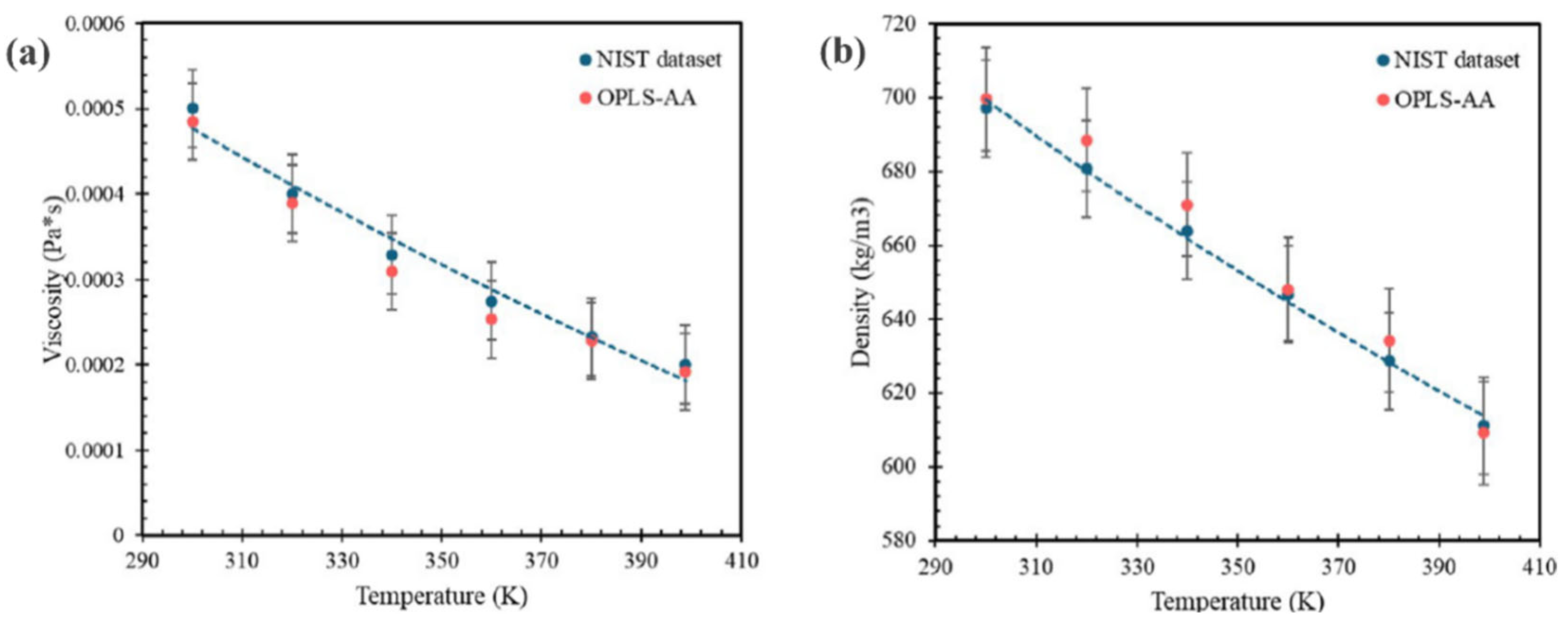
Similarly, the simulated densities of benzene at 298 K deviated by about 5% from Refprop data, with a slightly larger deviation of 6% observed at 328 K under low-pressure conditions. However, as pressure increased, the accuracy of the simulations improved significantly. These results are valuable for evaluating the performance of force fields like OPLS-AA under varying thermodynamic conditions and underscore the importance of pressure in enhancing the predictive accuracy of molecular simulations for hydrocarbon fuels [136]. To further validate the simulation results of OPLS-AA, the shear viscosity and density of octane were calculated over a temperature range of 300–400 K at 1 atm and compared with NIST reference data. Figure 14a represents density, while Figure 14b demonstrates shear viscosity. The blue dashed lines represent the linear trendlines of the NIST dataset, showing the expected temperature dependent trend. This comparison shows that both density and shear viscosity decreased as the temperature increases, demonstrating the good alignment with NIST data, which confirms the accuracy of the OPLS-AA force field for determining the thermophysical properties of octane [137].
Figure 14. Relationship of (a) shear viscosity and (b) density of octane between OPLS-AA (red dots) force field and NIST (blue dots) reference data. Reproduced with permission from ref. [137]. Copyright 2025 American Chemical Society.
The variation in saturation density of m-cresol with temperature was simulated using Gibbs Ensemble Monte Carlo-NVT simulations employing the OPLS-AA and TraPPE-UA force fields, as reported by Kapadiya and Adhikari [138]. Both force fields were able to accurately reproduce key vapor–liquid coexistence (VLE) properties—including heat of vaporization, vapor pressure, boiling point, and critical temperature—when compared with experimental data. Table 8 shows the density variation in m-cresol with temperature from the OPLS-AA and TraPPE-UA force fields [138] and the difference between them as well.
Table 8. Temperature-dependent density difference between OPLS-AA and TraPPE-UA [138].
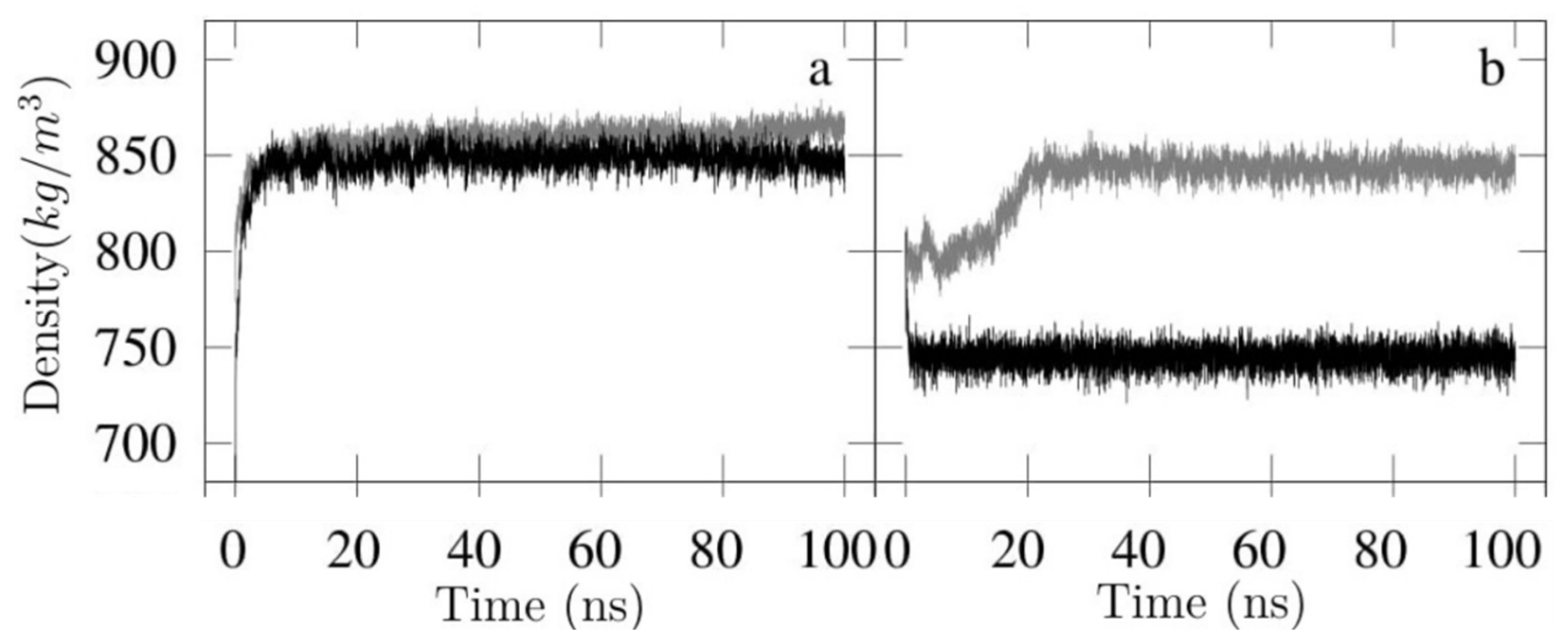
The OPLS-RAW and OPLS-MP force fields exhibit distinct behaviors in reproducing the thermophysical properties of n-pentadecane, particularly in simulating density and phase transitions. In their MD simulations, Bratek et al. [139] discovered that at 298 K, the OPLS-RAW force field significantly overestimates the density (848.55 kg/m3) compared to the experimental value (765.00 kg/m3), indicating a tendency to transition the system into a solid phase under ambient conditions. This overprediction reflects limitations in the OPLS-RAW parameterization for liquid-phase hydrocarbons. In contrast, the OPLS-MP force field yields a density at 298 K that deviates by −2.6% from the experimental reference, demonstrating much better agreement and aligning with the established benchmark criteria (i.e., within 2–3% deviation). While slightly outside the strict 2% threshold, this level of accuracy is still considered acceptable in the context of large-scale force field evaluations [138]. Figure 15 reports the density in NPT simulations of n-pentadecane with (a) OPLS-RAW and (b) OPLS-MP force fields at 277K (gray) and 298K (black).
Figure 15. Time development of density in NPT simulations of n-pentadecane with various FF at 277K (gray) and 298K (black) using (a) OPLS-RAW and (b) OPLS-MP force fields [139]. Copyright 2020 by the authors. Published by Frontiers Media SA on behalf of the Polish Biochemical Society under the Creative Commons Attribution License (CC BY 4.0).
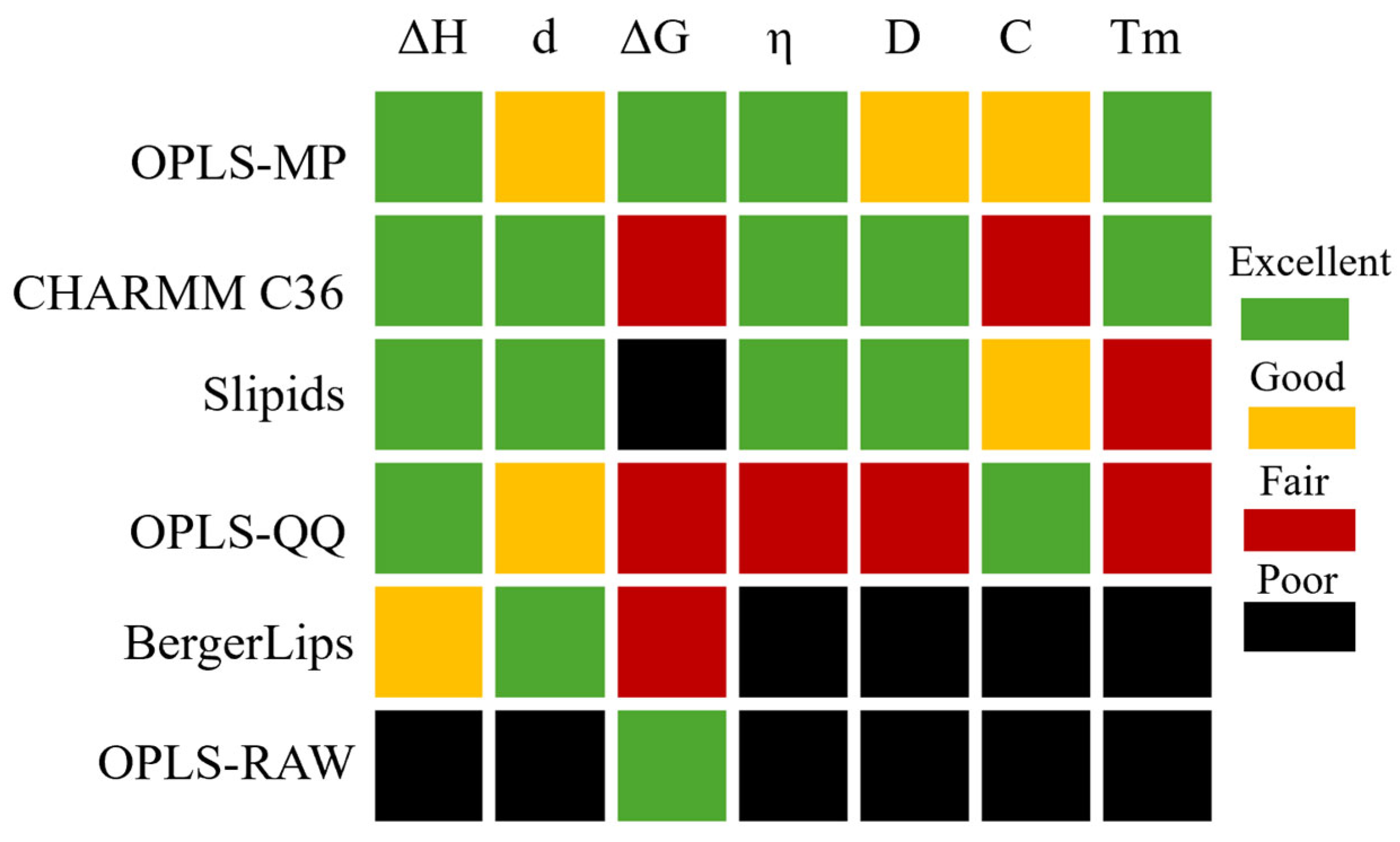
As shown in Figure 15, at 277 K, both OPLS-RAW and OPLS-MP correctly predict the formation of the solid phase for n-pentadecane, in agreement with experimental phase behavior [139]. However, only OPLS-MP produces correct densities at 298K, in comparison with the experimental value of 765.00 kg/m3 measured by Lide [140]. The OPLS-MP force field strikes a better balance between liquid-state accuracy and solid-phase predictability, making it a more versatile choice for simulating long-chain alkanes like n-pentadecane across a range of thermodynamic conditions [139]. Bratek et al. [139] evaluated the performance of various force fields—including OPLS-RAW, OPLS-MP, OPLS-QQ, BergerLips, Slipids, and CHARMM C36—in predicting key fuel properties of n-pentadecane, as illustrated in Figure 16. The accuracy of each force field was classified into four categories: excellent (green), good (orange), acceptable (red), and poor (black). Among all tested models, OPLS-MP demonstrated the most consistent and reliable performance across all condensed-phase properties, particularly for density, enthalpy of vaporization, and conformational distributions [139].
Figure 16. Performance of various force fields in simulation of fuel properties [139]. These properties encompassed enthalpy of vaporization (ΔH), density (ρ), Gibbs free energy of hydration (ΔG), shear viscosity (η), self-diffusion coefficient (D), number of chain conformation defects (C), and melting point (Tm). Copyright 2020 by the authors. Published by Frontiers Media SA on behalf of the Polish Biochemical Society under the Creative Commons Attribution License (CC BY 4.0).
The OPLS-AA force field provides numerous advantages for MD simulations, particularly in accurately modeling complex molecular systems. Its validation across various studies underscores its reliability in predicting structural and dynamical properties, making it a preferred choice among researchers. One notable advantage of the OPLS-AA force field is its accurate representation of molecular interactions, which makes the OPLS-AA force field particularly suitable for properties of fuels and fuel blends. Table 9 summarizes the recent literature on MD simulation using OPLS force fields.
Table 9. Recent literature updates on MD simulation using OPLS force fields for fuels and fuel blends.

3.2.2. COMPASS FF

The COMPASS force field is a highly effective tool for atomistic simulations of condensed-phase substances [117,145]. It is the first force field to be systematically parameterized and validated against both ab initio calculations and experimental data for a wide range of condensed-phase properties. COMPASS enables precise and simultaneous predictions of molecular structure, conformation, vibrational characteristics, and thermophysical properties across diverse molecular systems in both isolated and condensed states under varying pressures and temperatures [117,145]. Table 10 presents a comparison between simulated and experimental values of the heat of vaporization (Hv) for various hydrocarbons.
Table 10. Comparison of heat of vaporization (Hv) for organic liquids between experimental and NVT-simulated (50 ps) *.
The performance of force fields in MD simulations depends on several factors, including the nature of the target system. Kashyap et al. evaluated three widely used force fields—COMPASS, OPLS-AA, and TraPPE-UA—to predict the density and viscosity of methanol, n-octane, and their binary blends (M15 and M85) under engine-relevant conditions using LAMMPS [146]. A comparative summary of these force fields is presented in Table 11. Among them, COMPASS demonstrated the highest accuracy, with errors of less than 1% for density and under 5% for viscosity compared to both experimental data and NIST REFPROP values. In contrast, OPLS-AA slightly overestimated both properties, with density and viscosity errors reaching up to 8.95% for n-octane. TraPPE-UA showed better agreement than OPLS-AA but was still less accurate than COMPASS in predicting both properties. Based on these results, COMPASS was identified as a reliable force field for simulating transport properties in methanol–octane blends, particularly under high-pressure and high-temperature conditions [146].
Table 11. Comparison of error percentages for the prediction of density and viscosity using different force fields [146].

3.2.3. ReaxFF

ReaxFF (Reactive Force Field) [121] is a sophisticated atomistic simulation method specifically developed to model reactive systems involving chemical reactions, including bond formation and dissociation. This makes it particularly well-suited for studying complex fuel mixtures and processes such as combustion, pyrolysis, and oxidation—key mechanisms in understanding the behavior and degradation of hydrocarbon fuels. Its unique bond-order formalism allows ReaxFF to dynamically capture chemical reactivity under extreme conditions with high accuracy. As a result, ReaxFF has seen widespread application across disciplines, including hydrocarbon fuel research [121,147,148,149], energetic materials [150], propellants [151], polymers [152], metals [153] and oxides [154]. Its ability to simulate real-time reactive environments has provided critical insights into fuel decomposition pathways and performance, making it a valuable tool in the development and optimization of sustainable aviation fuels (SAFs) and other advanced energy systems [155].
ReaxFF simulation of S1 surrogate fuel for RP-3 jet fuel containing 51 mol% n-decane and 49 mol% 1,2,4-trimethylbenzene provide insight into thermal and kinetic behavior at elevated temperatures. A sharp rise in potential energy during combustion, followed by a gradual decline, reflects the transition from an endothermic to an exothermic process due to bond dissociation and oxidation reactions. The temporal decay of reactant molecules reveals a consistent decrease in the number of fuel components, where complete decomposition occurs more rapidly at higher temperatures through the use of short-time simulation windows for kinetic assessment. Furthermore, first-order reaction kinetics yields an activation energy of 36.40 kcal/mol, consistent with experimental ranges for hydrocarbon fuels for Arrhenius analysis. The correlation between the calculated and fitted values of ln(k) as a function of 1000/T are presented in Table 12. These results show ReaxFF’s capability to accurately capture the early-stage kinetics of RP-3 jet fuel and highlight its applicability for simulating combustion behavior at high pressures and temperatures [156].
Table 12. Arrhenius analysis of the S1 surrogate fuel at different temperatures using ReaxFF simulations [156].
Liu et al. simulated the pyrolysis process of n-decane and focused on the formation of soot nanoparticles through ReaxFF molecular dynamics simulations [157]. It begins with C–C bond dissociation and dehydrogenation, which produce reactive intermediates. These change into unsaturated chains to form cyclic structures and ultimately polycyclic aromatic hydrocarbons (PAHs), which are the primary precursors to soot. The dimerization of PAHs leads to soot nucleation, followed by surface growth and graphitization into carbon nanoparticles. The study indicates that inhibiting the formation of long unsaturated chains, particularly by controlling low-carbon species like C2, is an effective approach for reducing soot, potentially through targeted fuel additives [157]. Yu et al. presented the kinetic parameters and combustion mechanism of multi-component models of RP-3 jet fuel using ReaxFF MD to study C–C bond dissociation, H-abstraction and isomerization [156].
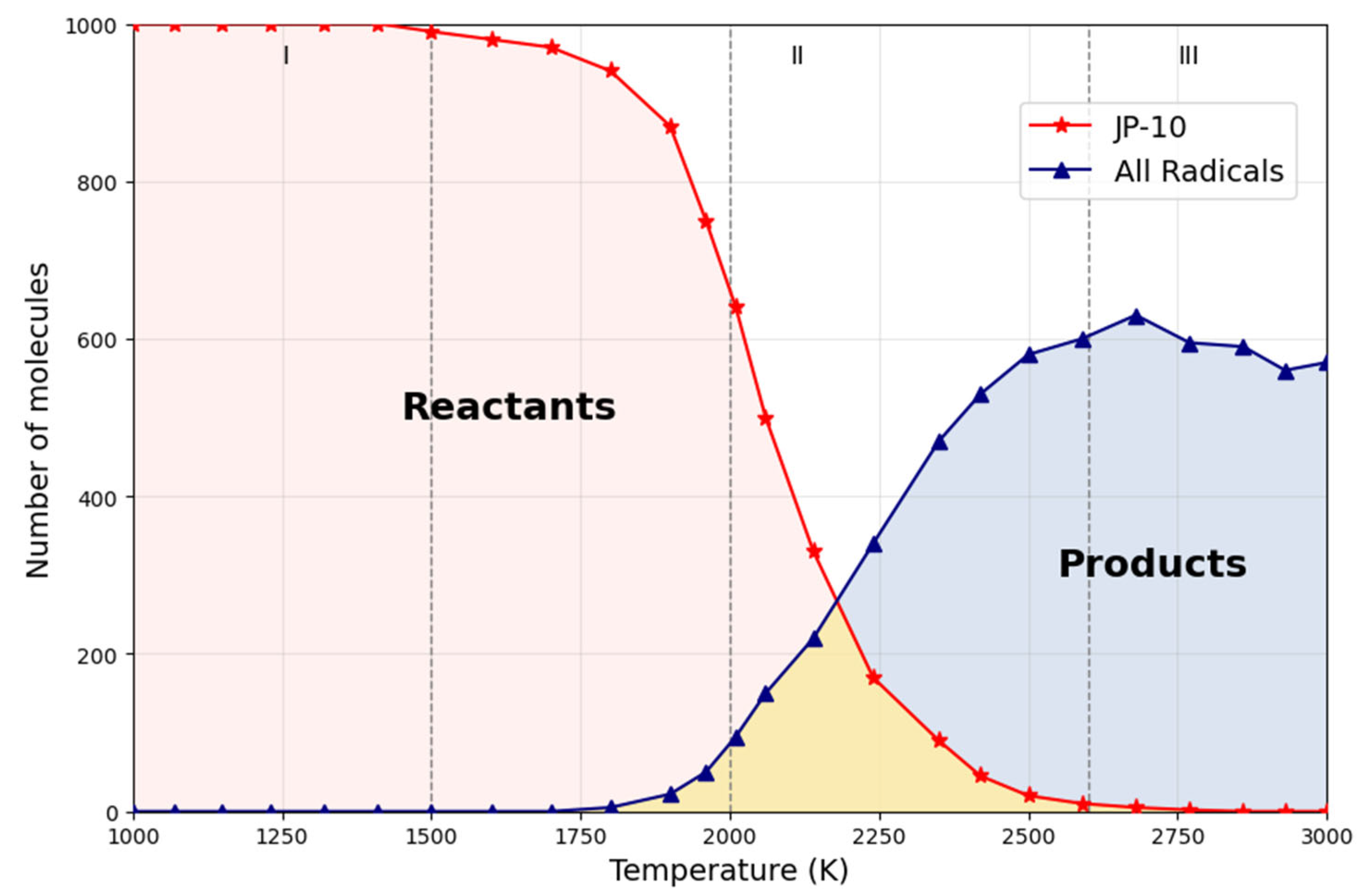
In the examination of the pyrolysis mechanism of JP-10, Liu et al. conducted large-scale ReaxFF MD simulations for the aviation fuel with a gradual heat-up strategy, as illustrated in Figure 17 [158]. The simulation revealed the overall decomposition behavior of JP-10 and formation of radical species during thermal cracking. The number of JP-10 molecules decreased as the temperature increased, while the concentration of radicals increased. This inverse relationship between JP-10 consumption and radical production displays the decomposition behavior of the fuel. The simulation results are closely aligned with the experimental data, validating the effectiveness of ReaxFF in modeling complex decomposition pathways in high-energy-density fuels like JP-10 to understand the temperature-dependent evolution of intermediates [158].
Figure 17. Thermal decomposition of JP-10 and evolution of all radicals in the ReaxFF MD simulation. The triangular shape represents the overlap area. The figure is regenerated based on results from reference [158].
The study of single-component pyrolysis systems using ReaxFF molecular dynamics (MD) provides detailed insights into pyrolysis mechanisms and the resulting reaction products. Aviation paraffins are composed of a mixture of linear, branched, and cyclo-alkanes, as well as aromatic hydrocarbons. Unlike single-component pyrolysis, multi-component pyrolysis involves interactions between various reactants, where the initial decomposition products can influence subsequent reaction pathways. These interactions can significantly alter the overall reaction mechanisms and final products. To gain a more complete understanding of aerospace paraffin combustion, comparing single- and multi-component pyrolysis systems helps reveal the effects of component interactions. Therefore, integrating both single- and multi-component models within ReaxFF MD offers a comprehensive understanding of aviation fuel reaction mechanisms, providing a strong foundation for engine design and optimization [159].
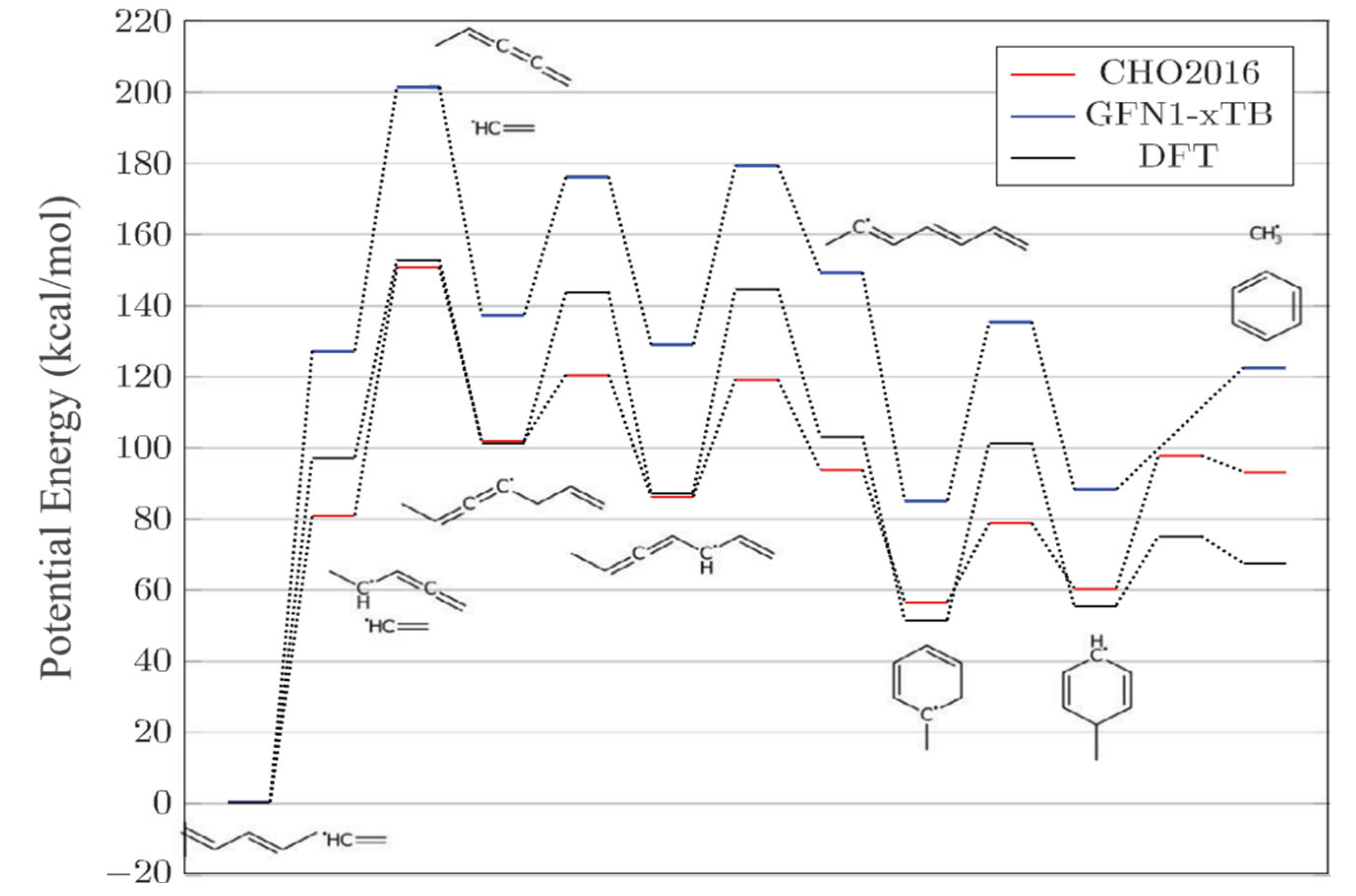
MD simulations, particularly reactive force field methods, have been generally used to study the thermal degradation of hydrocarbons, providing valuable insights into reaction pathways and energy barriers. Figure 18 illustrates the potential energy surface (PES) of the reaction network from 1,3-pentadiene to benzene with the energy barriers and intermediates at several theoretical levels, including CHO2016, GFN1-xTB, and DFT. The black dotted line represents the DFT calculated reaction pathway that links the DFT energy points. One of the main pathways in hydrocarbon pyrolysis and soot generation is the synthesis of benzene from precursors obtained from n-heptane, such as 1,3-pentadiene. At high temperatures, vinyl addition and many hydrogen migrations lead to the synthesis of 1,2,3-pentatriene, which is followed by benzene through a series of hydrogen dissociation processes. The PES analysis demonstrates that energy barriers determined by ReaxFF (CHO2016) are consistently lower than those calculated by DFT, resulting in accelerated reaction kinetics in MD simulations. This discrepancy highlights a common constraint of force-field-based methods, where hydrogen migration barriers are often underestimated, making reaction steps kinetically more promising than quantum-chemistry-based approaches [160].
Figure 18. Potential energies of 1,3-pentadiene to benzene reaction network. Reproduced with permission from reference [160]. Copyright 2024 by the authors. Published by Wiley-VCH GmbH under the terms of the Creative Commons Attribution License (CC-BY-NC 4.0).
ReaxFF MD simulations applied to large molecular systems enhance simulation realism by giving a more detailed level of complexity. However, these simulations also pose significant challenges to the computational capabilities of modern computers. ReaxFF MD can be around 10–50 times slower than classical MD because of its explicit modeling of bond formation and breaking, dynamic charge equilibration at each timestep, and a smaller timestep of ~0.1 fs compared to ~1 fs in classical MD. High-performance computing is a straightforward approach to upgrading the efficiency of ReaxFF MD [161].
Recent research increasingly integrates artificial intelligence with molecular simulation to accelerate sustainable aviation fuel formulation and property prediction. Machine-learning models trained on MD-generated data can accurately predict key thermophysical properties, like density, viscosity and diffusion, enabling rapid screening under diverse operating conditions [123]. This MD–ML workflow has been successfully applied to aviation kerosene surrogates, where ML models achieved sub-2% deviations in predicting properties such as density, thermal conductivity and viscosity from TraPPE-UA and OPLS MD simulations of n-decane and n-propylcyclohexane [162]. In parallel, hybrid QM/MM methods provide quantum-level accuracy for modeling critical combustion events like hydrogen abstraction, bond cleavage, and radical rearrangement at a feasible computational cost [163]. Collectively, these strategies demonstrate the power of an integrative AI, MD and QM/MM framework for the molecular-level design of SAFs.
Molecular dynamics predictions of hydrocarbon properties often exhibit significant deviations from experimental data, and these discrepancies depend strongly on the simulation techniques and force-field quality. A comparative analysis of seven primary hydrocarbon force fields reveals distinct trends. While most models reproduce liquid densities reasonably well, CHARMM-UA tends to overestimate densities for long-chain alkanes, and CHARMM-AA and NERD exhibit noticeable inaccuracies in melting behavior. For density and heat of vaporization, L-OPLS (optimized OPLS) and TRAPPE-EH perform well, whereas viscosity and surface tension remain challenging for all models, with GROMOS generally offering the best performance for these properties. In contrast, PYS and NERD demonstrate the lowest overall accuracy. This analysis underscores that reliable MD predictions for sustainable aviation fuel hydrocarbons require careful force-field selection and, where necessary, targeted re-optimization of OPLS parameters [164].
The literature recommends several strategies to enhance simulation reliability: (i) using force fields validated for branched, cyclic, and aromatic hydrocarbons; (ii) refining parameters against high-quality experimental viscosity and density data; (iii) ensuring sufficiently long production runs, particularly for transport properties; (iv) increasing system size to minimize finite-size artifacts; and (v) using ensemble averaging across multiple simulations. Collectively, these approaches reduce systematic errors and improve the predictive robustness of MD techniques for SAF analysis.
Finally, to address these challenges, recent studies have explored diverse molecular dynamics (MD) approaches and hybrid techniques to improve the accuracy and efficiency of aviation fuel simulations. Table 13 provides a consolidated summary of these efforts, outlining the fuel systems investigated, the MD methodologies employed, the primary research objectives, and the key findings relevant to hydrocarbon behavior and sustainable aviation fuel (SAF) analysis.
Table 13. Summary of key studies on aviation fuels and hydrocarbon simulations using MD approaches.

4. Conclusions and Future Work

Sustainable aviation fuels (SAFs) are poised to play a key role in decarbonizing hard-to-electrify sectors like aviation due to their compatibility with existing fuel infrastructure. However, challenges remain in optimizing blending, performance properties, and long-term stability. This review highlights the importance of molecular dynamics simulations in evaluating SAFs, offering atomic-level insights into key thermophysical properties, such as density, viscosity, and thermal stability across varying conditions.
The density, viscosity, and thermal-stability behavior of SAF blends vary significantly with the production pathway and blend ratio. Although detailed quantitative data are presented in the respective sections of this review, the overall trends suggest that HEFA- and FT-derived fuels generally provide lower viscosity and excellent thermal stability, while ATJ pathways show greater variation in both high-density and high-temperature behavior. These findings underscore that the physicochemical performance of SAF blends is directly influenced by the feedstock and conversion process, highlighting the need for pathway-specific optimization and greater standardization in future research.
Among various force fields and MD tools, the OPLS-AA force field—implemented in LAMMPS and GROMACS—was identified for its accuracy, efficiency, and proven ability to simulate hydrocarbon mixtures. The OPLS-AA force field effectively models non-reactive systems. AI-based methods will also be used to optimize SAF-fossil blend ratios before MD simulations, enabling faster and smarter screening of candidate formulations. These predictive techniques will bridge the gap between molecular-level interactions and real-world engine performance.
This review has direct implications for the development of sustainable aviation fuels and related technologies. A fundamental understanding of how molecular structure governs key properties such as density, viscosity, thermal stability, energy density, specific energy and flash point enables more targeted SAF blend design and screening. MD simulations, particularly those using OPLS force fields, provide a fast and cost-effective method for identifying suitable fuel candidates prior to investing in more expensive engines. These modeling tools can also assist in identifying property differences early in the development process, enhance optimization of blend ratios, and reduce experimental burdens by predicting behavior across wide temperature and pressure ranges. Such computational methods can support certification testing and assist developers in designing fuels that meet operational, safety, and performance requirements with greater efficiency. Ultimately, these capabilities accelerate industrial R&D initiatives by enabling faster evaluation of fuel molecules, improving understanding of emission-related behavior, and facilitating large-scale deployment of SAFs.
Although SAF research has advanced significantly, several critical gaps remain. Most classical force fields still struggle with high-temperature behavior, polar components, and multifunctional bio-derived molecules, while reactive simulations of pyrolysis, coking and oxidation are limited by the accuracy of existing ReaxFF parameters. Furthermore, weak experimental–simulation links and a scarcity of property data at extreme conditions hinder progress. Key areas for refinement include improving force-field parameterization, establishing more consistent experimental datasets for model validation, and using machine learning to accelerate property prediction. Addressing these challenges is essential for developing and engineering a predictive and relevant SAF modeling framework.
Looking ahead, integrating machine learning (ML) with MD simulations can enhance both accuracy and scalability. Experimental validation remains critical for refining force fields and confirming simulation predictions. Expanding MD applications to reactive environments and combining them with data-driven tools will accelerate SAF development, helping aviation transition toward a more sustainable future. Future work will incorporate ReaxFF within LAMMPS to investigate reactive processes like combustion, pyrolysis, and thermal degradation. This dual approach will provide a more holistic understanding of SAF behavior, from bulk transport properties to reaction dynamics under extreme conditions.
To overcome current limitations, future work should focus on multi-force-field coupling, such as integrating TraPPE/OPLS for thermophysical properties with ReaxFF for reactivity, and the establishment of experiment–simulation closed-loop frameworks where MD, ML models, and experimental data iteratively refine one another. These strategies are critical for accelerating SAF development and strengthening the predictive capacity of simulation-guided fuel design.
This optimistic pathway depends on sustained policy support and continued investment in clean energy. Recent shifts in U.S. federal energy policy present challenges to this trajectory. Nevertheless, the long-term decarbonization of aviation hinges on the large-scale adoption of SAFs. Achieving meaningful GHG reductions will require ongoing innovation, stable policy frameworks, and enduring commitment—regardless of short-term political fluctuations.

Funding

F.B. would like to thank Swinburne University Postgraduate Research Award (SUPRA) for financial support. This research received no external funding.

Data Availability Statement

The original contributions presented in the study are included in the article, further inquiries can be directed to the corresponding authors.

Acknowledgments

The authors express their thanks for the supercomputing facilities provided by Swinburne University of Technology Supercomputing Facilities (OzSTAR and Ngarrgu Tindebeek (which means “Knowledge of the Void” in the Moondani Toombadool language).

Conflicts of Interest

The authors declare no conflict of interest.

References

  1. Wang, B.; Ting, Z.J.; Zhao, M. Sustainable aviation fuels: Key opportunities and challenges in lowering carbon emissions for aviation industry. Carbon Capture Sci. Technol. 2024, 13, 100263. [Google Scholar] [CrossRef]
  2. Marszałek, N.; Lis, T. The future of sustainable aviation fuels. Combust. Engines 2022, 61, 29–40. [Google Scholar] [CrossRef]
  3. Rodriguez, H. Sustainable Aviation Fuel Implementation Strategies for European Airports. Master’s Thesis, Utrecht University, Utrecht, The Netherlands, 2023. [Google Scholar]
  4. O’Connell, A.; Kousoulidou, M.; Lonza, L.; Weindorf, W. Considerations on GHG emissions and energy balances of promising aviation biofuel pathways. Renew. Sustain. Energy Rev. 2019, 101, 504–515. [Google Scholar] [CrossRef]
  5. Wang, F.; Rijal, D. Sustainable Aviation Fuels for Clean Skies: Exploring the Potential and Perspectives of Strained Hydrocarbons. Energy Fuels 2024, 38, 4904–4920. [Google Scholar] [CrossRef]
  6. Chen, X.-Y.; Gao, J.-J.; Lu, Y.-Z.; Meng, H.; Li, C.-X. Acylation desulfurization of heavy cracking oil as a supplementary oil upgrading pathway. Fuel Process. Technol. 2015, 130, 7–11. [Google Scholar] [CrossRef]
  7. IATA Association. Resolution on Net-Zero Carbon Emissions by 2050; IATA: Montreal, QC, Canada, 2021; Available online: https://www.iata.org/contentassets/dcd25da635cd4c3697b5d0d8ae32e159/iata-agm-resolution-on-net-zero-carbon-emissions.pdf (accessed on 23 May 2025).
  8. Australian Government, Department of Climate Change, Energy, the Environment and Water. Energy, the Environment and Water. International Climate Action. Available online: https://www.dcceew.gov.au/climate-change/international-climate-action (accessed on 20 November 2025).
  9. Forum, W.E. Quadrupling Clean Fuels by 2035: COP30 Pledge to Scale Sustainable Aviation Fuels. Available online: https://www.weforum.org/stories/2025/11/quadrupling-clean-fuels-by-2035/ (accessed on 20 November 2025).
  10. Epstein, C. IATA Report Urges SAF Policy Changes: SAF Output Still Not Enough to Meet Needs. 2025. Available online: https://www.ainonline.com/aviation-news/aerospace/2025-06-10/iata-report-urges-saf-policy-changes (accessed on 9 June 2025).
  11. Boeing. Boeing Makes Its Largest Purchase of Blended Sustainable Aviation Fuel. Available online: https://investors.boeing.com/investors/news/press-release-details/2024/Boeing-Makes-its-Largest-Purchase-of-Blended-Sustainable-Aviation-Fuel/default.aspx (accessed on 23 May 2025).
  12. Airbus. Pioneering Sustainable Aerospace. 2025. Available online: https://www.airbus.com/sites/g/files/jlcbta136/files/2025-04/2025_Airbus_Pioneering_sustainable_aerospace_publication.pdf (accessed on 27 May 2025).
  13. Yang, Z.; Bell, D.C.; Cronin, D.J.; Boehm, R.; Heyne, J.; Ramasamy, K.K. Volatility Measurements of Sustainable Aviation Fuels: A Comparative Study of D86 and D2887 Methods. ACS Sustain. Chem. Eng. 2024, 12, 7414–7420. [Google Scholar] [CrossRef]
  14. Doliente, S.S.; Narayan, A.; Tapia, J.F.D.; Samsatli, N.J.; Zhao, Y.; Samsatli, S. Bio-aviation fuel: A comprehensive review and analysis of the supply chain components. Front. Energy Res. 2020, 8, 110. [Google Scholar] [CrossRef]
  15. Chiaramonti, D. Sustainable Aviation Fuels: The challenge of decarbonization. Energy Procedia 2019, 158, 1202–1207. [Google Scholar] [CrossRef]
  16. Caceres-Martinez, L.E.; Lopez, J.S.; Dagle, R.A.; Gillespie, R.; Kenttämaa, H.I.; Kilaz, G. Influence of blending cycloalkanes on the energy content, density, and viscosity of Jet-A. Fuel 2024, 358, 129986. [Google Scholar] [CrossRef]
  17. Díaz-Pérez, M.A.; Serrano-Ruiz, J.C. Catalytic production of jet fuels from biomass. Molecules 2020, 25, 802. [Google Scholar] [CrossRef]
  18. Jia, T.; Gong, S.; Pan, L.; Deng, C.; Zou, J.-J.; Zhang, X. Impact of deep hydrogenation on jet fuel oxidation and deposition. Fuel 2020, 264, 116843. [Google Scholar] [CrossRef]
  19. Calderon, O.R.; Tao, L.; Abdullah, Z.; Talmadge, M.; Milbrandt, A.; Smolinski, S.; Moriarty, K.; Bhatt, A.; Zhang, Y.; Ravi, V. Sustainable Aviation Fuel State-of-Industry Report: Hydroprocessed Esters and Fatty Acids Pathway; National Renewable Energy Laboratory (NREL): Golden, CO, USA, 2024. [Google Scholar]
  20. Calderon, O.R.; Tao, L.; Abdullah, Z.; Moriarty, K.; Smolinski, S.; Milbrandt, A.; Talmadge, M.; Bhatt, A.; Zhang, Y.; Ravi, V. Sustainable Aviation Fuel (SAF) State-of-Industry Report: State of SAF Production Process; National Renewable Energy Laboratory (NREL): Golden, CO, USA, 2024. [Google Scholar]
  21. Uddin, M.; Wang, F. Fuelling a clean future: A systematic review of Techno-Economic and Life Cycle assessments in E-Fuel Development. Appl. Sci. 2024, 14, 7321. [Google Scholar] [CrossRef]
  22. Ramos-Fernandez, E.V.; Santos, J.L.; Alsaadi, D.K.; Bavykina, A.; Gallo, J.M.R.; Gascon, J. Potential pathways for CO 2 utilization in sustainable aviation fuel synthesis. Chem. Sci. 2025, 16, 530–551. [Google Scholar] [CrossRef]
  23. Kosir, S.; Heyne, J.; Graham, J. A machine learning framework for drop-in volume swell characteristics of sustainable aviation fuel. Fuel 2020, 274, 117832. [Google Scholar] [CrossRef]
  24. Rijal, D.; Vasilyev, V.; Wang, F. Machine Learning for High Energy Density Hydrocarbons for Sustainable Aviation Fuel. ChemRxiv 2024. [Google Scholar] [CrossRef]
  25. Kurzawska, P. Overview of Sustainable Aviation Fuels including emission of particulate matter and harmful gaseous exhaust gas compounds. Transp. Res. Procedia 2021, 59, 38–45. [Google Scholar] [CrossRef]
  26. Service, I.R. Inflation Reduction Act of 2022 (IRA)—Sustainable Aviation Fuel Credit Guidance; U.S. Department of the Treasury: Washington, DC, USA, 2022. [Google Scholar]
  27. Holladay, J.; Abdullah, Z.; Heyne, J. Sustainable Aviation Fuel: Review of Technical Pathways; Office of Energy Efficiency and Renewable Energy (EERE): Washington, DC, USA, 2020. [Google Scholar] [CrossRef]
  28. Moriarty, K.; Kvien, A. US Airport Infrastructure and Sustainable Aviation Fuel; National Renewable Energy Lab (NREL): Golden, CO, USA, 2021. [Google Scholar]
  29. Miller, B.; Johnson, D.; Thompson, T.; Rosenberg, F.L.; Driver, J.; Biscardi, G.P.; Mohtadi, M.K.; Mohtadi, N.J. R&D Control Study: Plan for Future Jet Fuel Distribution Quality Control and Description of Fuel Properties Catalog; Federal Aviation Administration. Office of Environment and Energy: Washington, DC, USA, 2014. [Google Scholar]
  30. Cortes, J.; Suspes, A.; Roa, S.; González, C.; Castro, H. Total petroleum hydrocarbons by gas chromatography in Colombian waters and soils. Am. J. Environ. Sci. 2012, 8, 396. [Google Scholar] [CrossRef]
  31. Mueller, T.; Winter, E.; Grote, U. Economic impacts of power-to-liquid fuels in aviation: A general equilibrium analysis of production and utilization in Germany. Energy Convers. Manag. X 2024, 23, 100632. [Google Scholar] [CrossRef]
  32. Watson, M.; Machado, P.; Da Silva, A.; Saltar, Y.; Ribeiro, C.; Nascimento, C.; Dowling, A. Sustainable aviation fuel technologies, costs, emissions, policies, and markets: A critical review. J. Clean. Prod. 2024, 449, 141472. [Google Scholar] [CrossRef]
  33. Wang, M.; Yu, X. An Overview of the Sustainable Aviation Fuel: LCA, TEA, and the Sustainability Analysis. Eng. Proc. 2024, 80, 3. [Google Scholar]
  34. IEA Bioenergy Task 39. Progress in Commercialization of Biojet/Sustainable Aviation Fuels (SAF): Technologies and Policies; IEA Bioenergy: Wellington, New Zealand, 2024. [Google Scholar]
  35. Wandelt, S.; Zhang, Y.; Sun, X. Sustainable aviation fuels: A meta-review of surveys and key challenges. J. Air Transp. Res. Soc. 2025, 4, 100056. [Google Scholar] [CrossRef]
  36. Ozkan, M.; Narappa, A.B.; Namboodiri, T.; Chai, Y.; Babu, M.; Jennings, J.S.; Gao, Y.; Tasneem, S.; Lam, J.; Talluri, K.R. Forging a sustainable sky: Unveiling the pillars of aviation e-fuel production for carbon emission circularity. IScience 2024, 27, 109154. [Google Scholar] [CrossRef]
  37. Corporan, E.; Edwards, T.; Shafer, L.; DeWitt, M.J.; Klingshirn, C.; Zabarnick, S.; West, Z.; Striebich, R.; Graham, J.; Klein, J. Chemical, thermal stability, seal swell, and emissions studies of alternative jet fuels. Energy Fuels 2011, 25, 955–966. [Google Scholar] [CrossRef]
  38. DeWitt, M.J.; Corporan, E.; Graham, J.; Minus, D. Effects of aromatic type and concentration in Fischer−Tropsch fuel on emissions production and material compatibility. Energy Fuels 2008, 22, 2411–2418. [Google Scholar] [CrossRef]
  39. Pires, A.P.; Han, Y.; Kramlich, J.; Garcia-Perez, M. Chemical Composition and Fuel Properties of Alternative Jet Fuels; Federal Aviation Administration. Center of Excellence for Alternative Jet Fuels and Environment: Washington, DC, USA, 2018. [Google Scholar]
  40. Blakey, S.; Rye, L.; Wilson, C.W. Aviation gas turbine alternative fuels: A review. Proc. Combust. Inst. 2011, 33, 2863–2885. [Google Scholar] [CrossRef]
  41. National Aeronautics and Space Administration (NASA). ASA–DLR Study Finds Sustainable Aviation Fuel Can Reduce Contrails. NASA. Available online: https://www.nasa.gov/news-release/nasa-dlr-study-finds-sustainable-aviation-fuel-can-reduce-contrails/ (accessed on 30 November 2025).
  42. Billingsley, M.; Edwards, T.; Shafer, L.; Bruno, T. Extent and impacts of hydrocarbon fuel compositional variability for aerospace propulsion systems. In Proceedings of the 46th AIAA/ASME/SAE/ASEE Joint Propulsion Conference & Exhibit, Nashville, TN, USA, 25–28 July 2010; p. 6824. [Google Scholar]
  43. Wang, X.; Jia, T.; Pan, L.; Liu, Q.; Fang, Y.; Zou, J.-J.; Zhang, X. Review on the relationship between liquid aerospace fuel composition and their physicochemical properties. Trans. Tianjin Univ. 2021, 27, 87–109. [Google Scholar] [CrossRef]
  44. Moses, C.A.; Roets, P.N. Properties, characteristics, and combustion performance of sasol fully synthetic jet fuel. J. Eng. Gas Turbines Power. 2009, 131, 041502. [Google Scholar] [CrossRef]
  45. ASTM D7566-18; Standard Specification for Aviation Turbine Fuel Containing Synthesized Hydrocarbons. ASTM International: West Conshohocken, PA, USA, 2018.
  46. ASTM D1655-18; Standard Specification for Aviation Turbine Fuels. ASTM International: West Conshohocken, PA, USA, 2018.
  47. The Engineering ToolBox. Hydrocarbons, Linear Alcohols and Acids–Densities. Available online: https://www.engineeringtoolbox.com/density-alkane-alkene-benzene-carbon-number-alcohol-acid-alkyl-alkyne-d_1939.html (accessed on 27 May 2025).
  48. Feldhausen, J.; Bell, D.C.; Yang, Z.; Faulhaber, C.; Boehm, R.; Heyne, J. Synthetic aromatic kerosene property prediction improvements with isomer specific characterization via GCxGC and vacuum ultraviolet spectroscopy. Fuel 2022, 326, 125002. [Google Scholar] [CrossRef]
  49. Hall, C.; Bell, D.C.; Feldhausen, J.; Rauch, B.; Heyne, J. Quantifying isomeric effects: A key factor in aviation fuel assessment and design. Fuel 2024, 357, 129912. [Google Scholar] [CrossRef]
  50. Chi, H.; Li, G.; Guo, Y.; Xu, L.; Fang, W. Excess molar volume along with viscosity, flash point, and refractive index for binary mixtures of cis-decalin or trans-decalin with C9 to C11 n-alkanes. J. Chem. Eng. Data 2013, 58, 2224–2232. [Google Scholar] [CrossRef]
  51. Yue, L.; Li, G.; He, G.; Guo, Y.; Xu, L.; Fang, W. Impacts of hydrogen to carbon ratio (H/C) on fundamental properties and supercritical cracking performance of hydrocarbon fuels. Chem. Eng. J. 2016, 283, 1216–1223. [Google Scholar] [CrossRef]
  52. Shen, J.; Astrath, N.G.; Pedreira, P.R.; Guimarães, F.B.; Gieleciak, R.; Wen, Q.; Michaelian, K.H.; Fairbridge, C.; Malacarne, L.C.; Rohling, J.H. Correlations among thermophysical properties, ignition quality, volatility, chemical composition, and kinematic viscosity of petroleum distillates. Fuel 2016, 163, 324–333. [Google Scholar] [CrossRef]
  53. Garcia Tobar, M.; Cabrera Ojeda, O.; Crespo Montaño, F. Impact of Oil Viscosity on Emissions and Fuel Efficiency at High Altitudes: A Response Surface Methodology Analysis. Lubricants 2024, 12, 277. [Google Scholar] [CrossRef]
  54. Benavides, A.; Benjumea, P.; Cortés, F.B.; Ruiz, M.A. Chemical composition and low-temperature fluidity properties of jet fuels. Processes 2021, 9, 1184. [Google Scholar] [CrossRef]
  55. Cai, G.; Liu, Z.; Zhang, L.; Zhao, S.; Xu, C. Quantitative structure–property relationship model for hydrocarbon liquid viscosity prediction. Energy Fuels 2018, 32, 3290–3298. [Google Scholar] [CrossRef]
  56. Zéberg-Mikkelsen, C.K.; Baylaucq, A.; Barrouhou, M.; Boned, C. The effect of stereoisomerism on dynamic viscosity: A study of cis-decalin and trans-decalin versus pressure and temperature. Phys. Chem. Chem. Phys. 2003, 5, 1547–1551. [Google Scholar] [CrossRef]
  57. ASTM D445-12; Standard Test Method for Kinematic Viscosity of Transparent and Opaque Liquids (and Calculation of Dynamic Viscosity). ASTM International: West Conshohocken, PA, USA, 2012.
  58. Morris, R.E.; Hammond, M.H.; Cramer, J.A.; Johnson, K.J.; Giordano, B.C.; Kramer, K.E.; Rose-Pehrsson, S.L. Rapid fuel quality surveillance through chemometric modeling of near-infrared spectra. Energy Fuels 2009, 23, 1610–1618. [Google Scholar] [CrossRef]
  59. Cramer, J.A.; Morris, R.E.; Rose-Pehrsson, S.L. Use of genetic algorithms to improve partial least squares fuel property and synthetic fuel modeling from near-infrared spectra. Energy Fuels 2010, 24, 5560–5572. [Google Scholar] [CrossRef]
  60. Yousefi, S.H.; Azamifard, A.; Hosseini, S.-A.; Shamsoddini, M.-J.; Alizadeh, N. Toward a predictive model for predicting viscosity of natural and hydrocarbon gases. J. Nat. Gas Sci. Eng. 2014, 20, 147–154. [Google Scholar] [CrossRef]
  61. Sarnecki, J.; Gawron, B. A method of assessing the tendency of aviation fuels to generate thermal degradation products under the influence of high temperatures. J. KONES 2017, 24, 377–384. [Google Scholar]
  62. Hamilton, J.; Sadat, Y.; Dwyer, M.; Ghali, P.; Khandelwal, B. Thermal stability and impact of alternative fuels. In Aviation Fuels; Elsevier: Amsterdam, The Netherlands, 2021; pp. 149–218. [Google Scholar]
  63. Song, C.; Eser, S.; Schobert, H.H.; Hatcher, P.G. Pyrolytic degradation studies of a coal-derived and a petroleum-derived aviation jet fuel. Energy Fuels 1993, 7, 234–243. [Google Scholar] [CrossRef]
  64. Khan, S. A Parametric Study of Jet Fuel Thermal Stability; University of Toronto: Toronto, ON, Canada, 2019. [Google Scholar]
  65. van der Westhuizen, R.; Ajam, M.; De Coning, P.; Beens, J.; de Villiers, A.; Sandra, P. Comprehensive two-dimensional gas chromatography for the analysis of synthetic and crude-derived jet fuels. J. Chromatogr. A 2011, 1218, 4478–4486. [Google Scholar] [CrossRef]
  66. Dzięgielewski, W.; Gawron, B. Problem stabilności termicznej współczesnych paliw do turbinowych silników lotniczych–badania wstępne. J. KONBIN 2012, 21, 121–130. [Google Scholar] [CrossRef]
  67. Yang, J.; Xin, Z.; Corscadden, K.; Niu, H. An overview on performance characteristics of bio-jet fuels. Fuel 2019, 237, 916–936. [Google Scholar] [CrossRef]
  68. DeWitt, M.J.; West, Z.; Zabarnick, S.; Shafer, L.; Striebich, R.; Higgins, A.; Edwards, T. Effect of aromatics on the thermal-oxidative stability of synthetic paraffinic kerosene. Energy Fuels 2014, 28, 3696–3703. [Google Scholar] [CrossRef]
  69. Amara, A.B.; Kaoubi, S.; Starck, L. Toward an optimal formulation of alternative jet fuels: Enhanced oxidation and thermal stability by the addition of cyclic molecules. Fuel 2016, 173, 98–105. [Google Scholar] [CrossRef]
  70. Ma, J.; Yin, L.; Ling, L.; Zhang, R.; Yan, G.; Wang, J.; Lu, W.; Li, Y.; Wang, B. The prediction and assessment of properties for high energy density fuel–Adamantane derivatives: The combined DFT and molecular dynamics simulation. Fuel 2023, 343, 127975. [Google Scholar] [CrossRef]
  71. Hileman, J.I.; Stratton, R.W.; Donohoo, P.E. Energy content and alternative jet fuel viability. J. Propuls. Power 2010, 26, 1184–1196. [Google Scholar] [CrossRef]
  72. Hu, S. Life Cycle Analysis of the Production of Aviation Fuels Using the CE-CERT Process; UC Riverside: Riverside, CA, USA, 2012. [Google Scholar]
  73. Company, C.P. Aviation Fuels—Technical Review; Chevron Products Company: San Ramon, CA, USA, 2007; Available online: https://www.chevron.com/-/media/chevron/operations/documents/aviation-tech-review.pdf (accessed on 30 November 2025).
  74. Kosir, S.; Stachler, R.; Heyne, J.; Hauck, F. High-performance jet fuel optimization and uncertainty analysis. Fuel 2020, 281, 118718. [Google Scholar] [CrossRef]
  75. Phoon, L.Y.; Mustaffa, A.A.; Hashim, H.; Mat, R. A review of flash point prediction models for flammable liquid mixtures. Ind. Eng. Chem. Res. 2014, 53, 12553–12565. [Google Scholar] [CrossRef]
  76. Khalili, T.; Moghaddam, A.Z. Measurement and calculation of flash point of binary aqueous–organic and organic–organic solutions. Fluid Phase Equilibria 2011, 312, 101–105. [Google Scholar] [CrossRef]
  77. Shepherd, J.; Nuyt, C.; Lee, J.; Woodrow, J. Flash Point and Chemical Composition of Aviation Kerosene (Jet A); Report FM99-4; Graduate Aeronautical Laboratories California Institute of Technology Pasadena, Explosion Dynamics Laboratory: Pasadena, CA, USA, 2000. [Google Scholar]
  78. Do Nascimento, D.C.; Carareto, N.D.D.; Neto, A.M.B.; Gerbaud, V.; da Costa, M.C. Flash point prediction with UNIFAC type models of ethylic biodiesel and binary/ternary mixtures of FAEEs. Fuel 2020, 281, 118717. [Google Scholar] [CrossRef]
  79. Lakzian, K.; Liaw, H.-J. Flash point study of ternary mixtures comprising binary constituents that exhibit maximum flash point behavior and minimum flash point behavior. Thermochim. Acta 2022, 713, 179246. [Google Scholar] [CrossRef]
  80. ASTM D7566-19; Standard Specification for Aviation Turbine Fuel Containing Synthesized Hydrocarbons. ASTM International: West Conshohocken, PA, USA, 2019. [CrossRef]
  81. Chuck, C.J.; Donnelly, J. The compatibility of potential bioderived fuels with Jet A-1 aviation kerosene. Appl. Energy 2014, 118, 83–91. [Google Scholar] [CrossRef]
  82. ToolBox, T.E. Hydrocarbons—Autoignition Temperatures and Flash Points. Available online: https://www.engineeringtoolbox.com/flash-point-autoignition-temperature-kindling-hydrocarbons-alkane-alkene-d_1941.html (accessed on 27 May 2025).
  83. Elmalik, E.E.; Raza, B.; Warrag, S.; Ramadhan, H.; Alborzi, E.; Elbashir, N.O. Role of hydrocarbon building blocks on gas-to-liquid derived synthetic jet fuel characteristics. Ind. Eng. Chem. Res. 2014, 53, 1856–1865. [Google Scholar] [CrossRef]
  84. Keshavarz, M. Estimation of the flash points of saturated and unsaturated hydrocarbons. Indian J. Eng. Mater. Sci. 2012, 19, 269–278. [Google Scholar]
  85. Liu, Z.; Yang, X. Insight of low flammability limit on sustainable aviation fuel blend and prediction by ANN model. Energy AI 2024, 18, 100423. [Google Scholar] [CrossRef]
  86. Miyagawa, H.; Kitamura, K. An introduction of molecular dynamics simulation. J. Synth. Org. Chem. 1997, 55, 402–409. [Google Scholar] [CrossRef]
  87. Rapaport, D. Molecular dynamics simulation. Comput. Sci. Eng. 1999, 1, 70–71. [Google Scholar] [CrossRef]
  88. Lee, J.G. Computational Materials Science: An Introduction; CRC Press: Boca Raton, FL, USA, 2016. [Google Scholar]
  89. Thompson, A.P.; Aktulga, H.M.; Berger, R.; Bolintineanu, D.S.; Brown, W.M.; Crozier, P.S.; In’t Veld, P.J.; Kohlmeyer, A.; Moore, S.G.; Nguyen, T.D. LAMMPS-a flexible simulation tool for particle-based materials modeling at the atomic, meso, and continuum scales. Comput. Phys. Commun. 2022, 271, 108171. [Google Scholar] [CrossRef]
  90. LAMMPS Molecular Dynamics Simulator. Sandia National Laboratories. Available online: https://www.lammps.org (accessed on 27 October 2025).
  91. Berendsen, H.J.; van der Spoel, D.; van Drunen, R. GROMACS: A message-passing parallel molecular dynamics implementation. Comput. Phys. Commun. 1995, 91, 43–56. [Google Scholar] [CrossRef]
  92. Hess, B.; Kutzner, C.; Van Der Spoel, D.; Lindahl, E. GROMACS 4: Algorithms for highly efficient, load-balanced, and scalable molecular simulation. J. Chem. Theory Comput. 2008, 4, 435–447. [Google Scholar] [CrossRef] [PubMed]
  93. Shankar, U.; Gogoi, R.; Sethi, S.K.; Verma, A. Introduction to materials studio software for the atomistic-scale simulations. In Forcefields for Atomistic-Scale Simulations: Materials and Applications; Springer: Berlin/Heidelberg, Germany, 2022; pp. 299–313. [Google Scholar]
  94. Brooks, B.R.; Brooks, C.L., III; Mackerell, A.D., Jr.; Nilsson, L.; Petrella, R.J.; Roux, B.; Won, Y.; Archontis, G.; Bartels, C.; Boresch, S. CHARMM: The biomolecular simulation program. J. Comput. Chem. 2009, 30, 1545–1614. [Google Scholar] [CrossRef] [PubMed]
  95. Salomon-Ferrer, R.; Case, D.; Walker, R. An overview of the Amber biomolecular simulation package. Wiley Interdiscip. Rev. Comput. Mol. Sci. 2013, 3, 198–210. [Google Scholar] [CrossRef]
  96. Giannozzi, P.; Baroni, S.; Bonini, N.; Calandra, M.; Car, R.; Cavazzoni, C.; Ceresoli, D.; Chiarotti, G.L.; Cococcioni, M.; Dabo, I. QUANTUM ESPRESSO: A modular and open-source software project for quantumsimulations of materials. J. Phys. Condens. Matter 2009, 21, 395502. [Google Scholar] [CrossRef]
  97. Kühne, T.D.; Iannuzzi, M.; Del Ben, M.; Rybkin, V.V.; Seewald, P.; Stein, F.; Laino, T.; Khaliullin, R.Z.; Schütt, O.; Schiffmann, F. CP2K: An electronic structure and molecular dynamics software package-Quickstep: Efficient and accurate electronic structure calculations. J. Chem. Phys. 2020, 152, 194103. [Google Scholar] [CrossRef]
  98. Grindon, C.; Harris, S.; Evans, T.; Novik, K.; Coveney, P.; Laughton, C. Large-scale molecular dynamics simulation of DNA: Implementation and validation of the AMBER98 force field in LAMMPS. Philos. Trans. R. Soc. Lond. Ser. A Math. Phys. Eng. Sci. 2004, 362, 1373–1386. [Google Scholar] [CrossRef]
  99. Gowthaman, S. A review on mechanical and material characterisation through molecular dynamics using large-scale atomic/molecular massively parallel simulator (LAMMPS). Funct. Compos. Struct. 2023, 5, 012005. [Google Scholar] [CrossRef]
  100. Zhang, R.; Zhang, X.; Qing, S.; Luo, Z.; Liu, Y. Investigation of nanoparticles shape that influence the thermal conductivity and viscosity in argon-based nanofluids: A molecular dynamics simulation. Int. J. Heat Mass Transf. 2023, 207, 124031. [Google Scholar] [CrossRef]
  101. Wen, M.; Jin, H.; Wang, S.; Fan, J. Molecular dynamics simulation study on the dynamic viscosity and thermal conductivity of high-energy hydrocarbon fuel Al/JP-10. Fuel 2025, 386, 134236. [Google Scholar] [CrossRef]
  102. Singh, S.; Mandal, A. Overview of LAMMPS. In Molecular Dynamics Simulation of Nanocomposites Using BIOVIA Materials Studio, Lammps and Gromacs; Elsevier: Amsterdam, The Netherlands, 2019; p. 56. [Google Scholar]
  103. Yang, X.; Tao, J.; Liu, Q.; Zhang, X.; Cao, B. Molecular dynamics simulation of thermophysical properties of binary RP-3 surrogate fuel mixtures containing trimethylbenzene, n-decane, and n-dodecane. J. Mol. Liq. 2022, 359, 119258. [Google Scholar] [CrossRef]
  104. Wang, Y.; Gong, S.; Li, L.; Liu, G. Sub-to-supercritical properties and inhomogeneity of JP-10 using molecular dynamics simulation. Fuel 2021, 288, 119696. [Google Scholar] [CrossRef]
  105. Kondratyuk, N.; Nikolskiy, V.; Pavlov, D.; Stegailov, V. GPU-accelerated molecular dynamics: State-of-art software performance and porting from Nvidia CUDA to AMD HIP. Int. J. High Perform. Comput. Appl. 2021, 35, 312–324. [Google Scholar] [CrossRef]
  106. Glaser, J.; Nguyen, T.D.; Anderson, J.A.; Lui, P.; Spiga, F.; Millan, J.A.; Morse, D.C.; Glotzer, S.C. Strong scaling of general-purpose molecular dynamics simulations on GPUs. Comput. Phys. Commun. 2015, 192, 97–107. [Google Scholar] [CrossRef]
  107. Scott, W.R.P.; Hünenberger, P.H.; Tironi, I.G.; Mark, A.E.; Billeter, S.R.; Fennen, J.; Torda, A.E.; Huber, T.; Krüger, P.; van Gunsteren, W.F. The GROMOS Biomolecular Simulation Program Package. J. Phys. Chem. A 1999, 103, 3596–3607. [Google Scholar] [CrossRef]
  108. Van Der Spoel, D.; Lindahl, E.; Hess, B.; Groenhof, G.; Mark, A.E.; Berendsen, H.J. GROMACS: Fast, flexible, and free. J. Comput. Chem. 2005, 26, 1701–1718. [Google Scholar] [CrossRef]
  109. Abraham, M.J.; Murtola, T.; Schulz, R.; Páll, S.; Smith, J.C.; Hess, B.; Lindahl, E. GROMACS: High performance molecular simulations through multi-level parallelism from laptops to supercomputers. SoftwareX 2015, 1, 19–25. [Google Scholar] [CrossRef]
  110. Mermelstein, D.J.; Lin, C.; Nelson, G.; Kretsch, R.; McCammon, J.A.; Walker, R.C. Fast and flexible gpu accelerated binding free energy calculations within the amber molecular dynamics package. J. Comput. Chem. 2018, 39, 1354–1358. [Google Scholar] [CrossRef] [PubMed]
  111. Kaus, J.W.; Pierce, L.T.; Walker, R.C.; McCammon, J.A. Improving the efficiency of free energy calculations in the amber molecular dynamics package. J. Chem. Theory Comput. 2013, 9, 4131–4139. [Google Scholar] [CrossRef]
  112. Kern, N.R.; Lee, J.; Choi, Y.K.; Im, W. CHARMM-GUI multicomponent assembler for modeling and simulation of complex multicomponent systems. Biophys. J. 2022, 121, 529a. [Google Scholar] [CrossRef]
  113. Chakravorty, A.; Hussain, A.; Cervantes, L.F.; Lai, T.T.; Brooks III, C.L. Exploring the limits of the generalized CHARMM and AMBER force fields through predictions of hydration free energy of small molecules. J. Chem. Inf. Model. 2024, 64, 4089–4101. [Google Scholar] [CrossRef] [PubMed]
  114. Croitoru, A.; Kumar, A.; Lambry, J.-C.; Lee, J.; Sharif, S.; Yu, W.; MacKerell Jr, A.D.; Aleksandrov, A. Increasing the Accuracy and Robustness of the CHARMM General Force Field with an Expanded Training Set. J. Chem. Theory Comput. 2025, 21, 3044–3065. [Google Scholar] [CrossRef] [PubMed]
  115. Nikitin, A.M.; Milchevskiy, Y.V.; Lyubartsev, A.P. A new AMBER-compatible force field parameter set for alkanes. J. Mol. Model. 2014, 20, 2143. [Google Scholar] [CrossRef]
  116. Kashurin, O.V.; Kondratyuk, N.D.; Lankin, A.V.; Norman, G.E. Force field comparison for molecular dynamics simulations of liquid membranes. J. Mol. Liq. 2024, 416, 126347. [Google Scholar] [CrossRef]
  117. Sun, H. COMPASS: An ab initio force-field optimized for condensed-phase applications overview with details on alkane and benzene compounds. J. Phys. Chem. B 1998, 102, 7338–7364. [Google Scholar] [CrossRef]
  118. Dodda, L.S.; Cabeza de Vaca, I.; Tirado-Rives, J.; Jorgensen, W.L. LigParGen web server: An automatic OPLS-AA parameter generator for organic ligands. Nucleic Acids Res. 2017, 45, W331–W336. [Google Scholar] [CrossRef]
  119. Huang, J.; Rauscher, S.; Nawrocki, G.; Ran, T.; Feig, M.; De Groot, B.L.; Grubmüller, H.; MacKerell Jr, A.D. CHARMM36m: An improved force field for folded and intrinsically disordered proteins. Nat. Methods 2017, 14, 71–73. [Google Scholar] [CrossRef]
  120. Eggimann, B.L.; Sunnarborg, A.J.; Stern, H.D.; Bliss, A.P.; Siepmann, J.I. An online parameter and property database for the TraPPE force field. Mol. Simul. 2014, 40, 101–105. [Google Scholar] [CrossRef]
  121. Chenoweth, K.; Van Duin, A.C.; Goddard, W.A. ReaxFF reactive force field for molecular dynamics simulations of hydrocarbon oxidation. J. Phys. Chem. A 2008, 112, 1040–1053. [Google Scholar] [CrossRef]
  122. Kioupis, L.I.; Maginn, E.J. Rheology, dynamics, and structure of hydrocarbon blends: A molecular dynamics study of n-hexane/n-hexadecane mixtures. Chem. Eng. J. 1999, 74, 129–146. [Google Scholar] [CrossRef]
  123. Freitas, R.S.; Lima, A.P.; Chen, C.; Rochinha, F.A.; Mira, D.; Jiang, X. Towards predicting liquid fuel physicochemical properties using molecular dynamics guided machine learning models. Fuel 2022, 329, 125415. [Google Scholar] [CrossRef]
  124. Bernardes, C.E.; Joseph, A. Evaluation of the OPLS-AA force field for the study of structural and energetic aspects of molecular organic crystals. J. Phys. Chem. A 2015, 119, 3023–3034. [Google Scholar] [CrossRef]
  125. Hu, X.; Amin, K.S.; Schneider, M.; Lim, C.; Salahub, D.; Baldauf, C. System-Specific Parameter Optimization for Nonpolarizable and Polarizable Force Fields. J. Chem. Theory Comput. 2024, 20, 1448–1464. [Google Scholar] [CrossRef] [PubMed]
  126. Rego, T.; Silva, G.M.; Goldmann, M.; Filipe, E.J.; Morgado, P. Optimized all-atom force field for alkynes within the OPLS-AA framework. Fluid Phase Equilibria 2022, 554, 113314. [Google Scholar] [CrossRef]
  127. Maciejewski, A.; Pasenkiewicz-Gierula, M.; Cramariuc, O.; Vattulainen, I.; Rog, T. Refined OPLS all-atom force field for saturated phosphatidylcholine bilayers at full hydration. J. Phys. Chem. B 2014, 118, 4571–4581. [Google Scholar] [CrossRef] [PubMed]
  128. Xu, Z.; Luo, H.H.; Tieleman, D.P. Modifying the OPLS-AA force field to improve hydration free energies for several amino acid side chains using new atomic charges and an off-plane charge model for aromatic residues. J. Comput. Chem. 2007, 28, 689–697. [Google Scholar] [CrossRef]
  129. Siu, S.W.; Pluhackova, K.; Böckmann, R.A. Optimization of the OPLS-AA force field for long hydrocarbons. J. Chem. Theory Comput. 2012, 8, 1459–1470. [Google Scholar] [CrossRef]
  130. Ghahremanpour, M.M.; Tirado-Rives, J.; Jorgensen, W.L. Refinement of the Optimized Potentials for Liquid Simulations Force Field for Thermodynamics and Dynamics of Liquid Alkanes. J. Phys. Chem. B 2022, 126, 5896–5907. [Google Scholar] [CrossRef]
  131. Maurice, L.Q.; Lander, H.; Edwards, T.; Harrison Iii, W. Advanced aviation fuels: A look ahead via a historical perspective. Fuel 2001, 80, 747–756. [Google Scholar] [CrossRef]
  132. Prak, D.J.L.; Trulove, P.C.; Cowart, J.S. Density, viscosity, speed of sound, surface tension, and flash point of binary mixtures of n-hexadecane and 2, 2, 4, 4, 6, 8, 8-heptamethylnonane and of algal-based hydrotreated renewable diesel. J. Chem. Eng. Data 2013, 58, 920–926. [Google Scholar] [CrossRef]
  133. Luning Prak, D.J.; Cowart, J.S.; Hamilton, L.J.; Hoang, D.T.; Brown, E.K.; Trulove, P.C. Development of a surrogate mixture for algal-based hydrotreated renewable diesel. Energy Fuels 2013, 27, 954–961. [Google Scholar] [CrossRef]
  134. Edwards, T. “Kerosene” Fuels for Aerospace Propulsion-Composition and Properties. In Proceedings of the 38th AIAA/ASME/SAE/ASEE Joint Propulsion Conference & Exhibit, Indianapolis, IN, USA, 7–10 July 2002; p. 3874. [Google Scholar]
  135. Mooney, B.L.; Morrow, B.H.; Van Nostrand, K.; Luning Prak, D.; Trulove, P.C.; Morris, R.E.; Schall, J.D.; Harrison, J.A.; Knippenberg, M.T. Elucidating the properties of surrogate fuel mixtures using molecular dynamics. Energy Fuels 2016, 30, 784–795. [Google Scholar] [CrossRef]
  136. Smolyanitsky, A.; Kazakov, A.F.; Bruno, T.J.; Huber, M.L. Mass Diffusion of Organic Fluids: A Molecular Dynamics Perspective; NIST Technical Note 2013; National Institute of Standards and Technology: Gaithersburg, MD, USA, 2013. [Google Scholar]
  137. Shateri, A.; Yang, Z.; Xie, J. Machine learning-based molecular dynamics studies on predicting thermophysical properties of ethanol–octane blends. Energy Fuels 2025, 39, 1070–1090. [Google Scholar] [CrossRef]
  138. Kapadiya, P.; Adhikari, J. Prediction of thermodynamic properties of m-cresol: Comparison of TraPPE-UA and OPLS-AA force fields. J. Mol. Liq. 2025, 425, 127211. [Google Scholar] [CrossRef]
  139. Bratek, M.; Wójcik-Augustyn, A.; Kania, A.; Majta, J.; Murzyn, K. Condensed phase properties of n-pentadecane emerging from application of biomolecular force fields. Acta Biochim. Pol. 2020, 67, 309–318. [Google Scholar] [CrossRef]
  140. Lide, D.R. Handbook of Chemistry and Physics, Internet Version; CRC Press: Boca Raton, FL, USA, 2005. [Google Scholar]
  141. Zhang, C.; Zhang, Z.; Xiong, W.; Yang, Y.; Wang, Y. Molecular dynamics investigation on structural and interfacial characteristics of aerosol particles containing mixed organic components. Atmos. Environ. 2024, 319, 120305. [Google Scholar] [CrossRef]
  142. Jorgensen, W.L.; Ghahremanpour, M.M.; Saar, A.; Tirado-Rives, J. OPLS/2020 force field for unsaturated hydrocarbons, alcohols, and ethers. J. Phys. Chem. B 2023, 128, 250–262. [Google Scholar] [CrossRef]
  143. Rajabpour, A.; Abbasi, M. Thermodynamic Properties of Monatomic, Diatomic, and Polyatomic Gaseous Natural Refrigerants: A Molecular Dynamics Simulation. J. Heat Mass Transf. Res. 2021, 8, 61–69. [Google Scholar] [CrossRef]
  144. Morrow, B.H.; Harrison, J.A. Evaluating the ability of selected force fields to simulate hydrocarbons as a function of temperature and pressure using molecular dynamics. Energy Fuels 2021, 35, 3742–3752. [Google Scholar] [CrossRef]
  145. Sun, H.; Ren, P.; Fried, J. The COMPASS force field: Parameterization and validation for phosphazenes. Comput. Theor. Polym. Sci. 1998, 8, 229–246. [Google Scholar] [CrossRef]
  146. Kashyap, R.; Saha, K.; Subramanian, K. Molecular dynamics simulation of the transport and structural properties for methanol-octane blends at engine-relevant conditions. Int. J. Green Energy 2025, 60, 1–25. [Google Scholar] [CrossRef]
  147. Chenoweth, K.; Van Duin, A.C.; Dasgupta, S.; Goddard Iii, W.A. Initiation mechanisms and kinetics of pyrolysis and combustion of JP-10 hydrocarbon jet fuel. J. Phys. Chem. A 2009, 113, 1740–1746. [Google Scholar] [CrossRef] [PubMed]
  148. Wang, Q.-D.; Wang, J.-B.; Li, J.-Q.; Tan, N.-X.; Li, X.-Y. Reactive molecular dynamics simulation and chemical kinetic modeling of pyrolysis and combustion of n-dodecane. Combust. Flame 2011, 158, 217–226. [Google Scholar] [CrossRef]
  149. Li, X.; Zheng, M.; Ren, C.; Guo, L. ReaxFF molecular dynamics simulations of thermal reactivity of various fuels in pyrolysis and combustion. Energy Fuels 2021, 35, 11707–11739. [Google Scholar] [CrossRef]
  150. Shan, T.-R.; Van Duin, A.C.; Thompson, A.P. Development of a ReaxFF reactive force field for ammonium nitrate and application to shock compression and thermal decomposition. J. Phys. Chem. A 2014, 118, 1469–1478. [Google Scholar] [CrossRef]
  151. Liu, Y.; Zybin, S.V.; Guo, J.; Van Duin, A.C.; Goddard, W.A., III. Reactive dynamics study of hypergolic bipropellants: Monomethylhydrazine and dinitrogen tetroxide. J. Phys. Chem. B 2012, 116, 14136–14145. [Google Scholar] [CrossRef]
  152. Hong, D.; Li, P.; Si, T.; Guo, X. ReaxFF simulations of the synergistic effect mechanisms during co-pyrolysis of coal and polyethylene/polystyrene. Energy 2021, 218, 119553. [Google Scholar] [CrossRef]
  153. Ojwang, J.; Van Santen, R.; Kramer, G.J.; Van Duin, A.C.; Goddard, W.A. Predictions of melting, crystallization, and local atomic arrangements of aluminum clusters using a reactive force field. J. Chem. Phys. 2008, 129, 244506. [Google Scholar] [CrossRef]
  154. Han, S.S.; Choi, S.-H.; Van Duin, A.C. Molecular dynamics simulations of stability of metal–organic frameworks against H2O using the ReaxFF reactive force field. Chem. Commun. 2010, 46, 5713–5715. [Google Scholar] [CrossRef]
  155. Wang, Q.; He, Q.; Xiao, B.; Zhai, D.; Shen, Y.; Liu, Y.; Goddard, W.A., III. Detailed Reaction Kinetics for Hydrocarbon Fuels: The Development and Application of the ReaxFFCHO-S22 Force Field for C/H/O Systems with Enhanced Accuracy. J. Phys. Chem. A 2024, 128, 5065–5076. [Google Scholar] [CrossRef]
  156. Yu, Y.; Song, L.; Jiang, J.; Zhao, F.-Q.; Xu, S.-Y.; Ju, X.-H. Reactive molecular dynamics simulations of multicomponent models for RP-3 jet fuel in combustion at supercritical conditions: A comprehensive mechanism study. Chem. Phys. 2023, 573, 112008. [Google Scholar] [CrossRef]
  157. Liu, L.; Xu, H.; Zhu, Q.; Ren, H.; Li, X. Soot formation of n-decane pyrolysis: A mechanistic view from ReaxFF molecular dynamics simulation. Chem. Phys. Lett. 2020, 760, 137983. [Google Scholar] [CrossRef]
  158. Liu, H.; Liang, J.; He, R.; Li, X.; Zheng, M.; Ren, C.; An, G.; Xu, X.; Zheng, Z. Overall mechanism of JP-10 pyrolysis unraveled by large-scale reactive molecular dynamics simulation. Combust. Flame 2022, 237, 111865. [Google Scholar] [CrossRef]
  159. Chen, M.; Li, W.; Zhang, H.; Liu, M.; Zhang, J.; Li, X.; Han, Y. Recent ReaxFF MD studies on pyrolysis and combustion mechanisms of aviation/aerospace fuels and energetic additives. Energy Adv. 2023, 2, 54–72. [Google Scholar] [CrossRef]
  160. Schmalz, F.; Kopp, W.A.; Goudeli, E.; Leonhard, K. Reaction path identification and validation from molecular dynamics simulations of hydrocarbon pyrolysis. Int. J. Chem. Kinet. 2024, 56, 501–512. [Google Scholar] [CrossRef]
  161. Zheng, M.; Li, X.; Guo, L. Algorithms of GPU-enabled reactive force field (ReaxFF) molecular dynamics. J. Mol. Graph. Model. 2013, 41, 1–11. [Google Scholar] [CrossRef] [PubMed]
  162. Liao, L.; Yang, M.; Gao, Y.; Cheng, L.; Ren, H. Molecular dynamics simulations coupled with machine learning for investigating thermophysical properties of binary surrogate aviation kerosene. J. Mol. Liq. 2025, 424, 127170. [Google Scholar] [CrossRef]
  163. Rahnamoun, A.; Kaymak, M.C.; Manathunga, M.; Götz, A.W.; Van Duin, A.C.; Merz Jr, K.M.; Aktulga, H.M. ReaxFF/AMBER—A framework for hybrid reactive/nonreactive force field molecular dynamics simulations. J. Chem. Theory Comput. 2020, 16, 7645–7654. [Google Scholar] [CrossRef]
  164. da Silva, G.C.; Silva, G.M.; Tavares, F.W.; Fleming, F.P.; Horta, B.A. Are all-atom any better than united-atom force fields for the description of liquid properties of alkanes? 2. A systematic study considering different chain lengths. J. Mol. Liq. 2022, 354, 118829. [Google Scholar] [CrossRef]
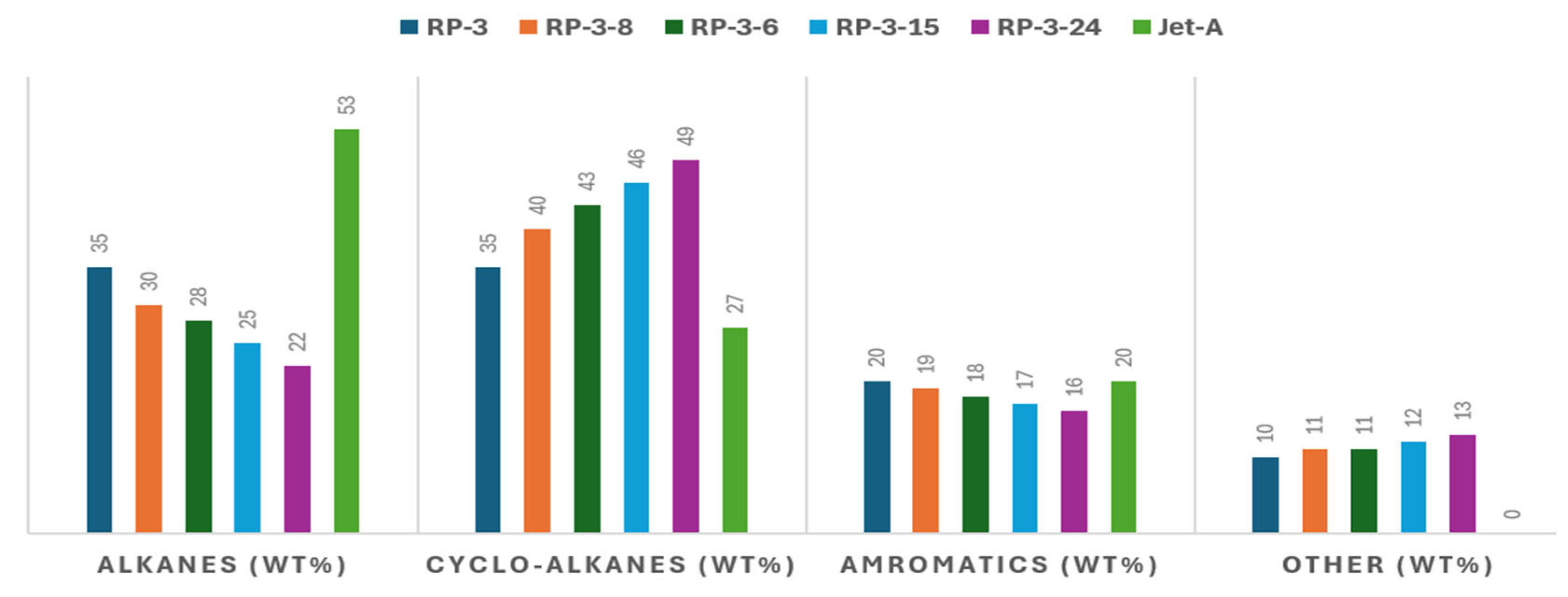
Disclaimer/Publisher’s Note: The statements, opinions and data contained in all publications are solely those of the individual author(s) and contributor(s) and not of MDPI and/or the editor(s). MDPI and/or the editor(s) disclaim responsibility for any injury to people or property resulting from any ideas, methods, instructions or products referred to in the content.

Article Metrics

Citations

Article Access Statistics

Article metric data becomes available approximately 24 hours after publication online.