Article

Comparing Ecuadorian Cocoa Mucilage-Based Bio-Ethanol and Commercial Fuels Toward Their Performance and Environmental Impacts in Internal Combustion Engines


by
Cristian Laverde-Albarracín
1,*,
Juan Félix González González
2,
Beatriz Ledesma Cano
2,
Silvia Román Suero
2,
José Villarroel-Bastidas
1,
Diego Peña-Banegas
1,2,3,
Samantha Puente-Bosquez
1,2 and
Sebastian Naranjo-Silva
4,5
1
Faculty of Engineering Sciences, Technical State University of Quevedo, Quevedo 120301, Ecuador
2
Department of Applied Physics, University of Extremadura, 06006 Badajoz, Spain
3
Department of Electrical Engineering, Universidad de Jaén, 23700 Jaén, Spain
4
Sustainability Department, Polytechnic University of Catalonia, 08034 Barcelona, Spain
5
Faculty of Sciences, Instituto Superior Tecnológico Lendan, Quito 170147, Ecuador
*
Author to whom correspondence should be addressed.
Energies 2025, 18(24), 6378; https://doi.org/10.3390/en18246378 (registering DOI)
Submission received: 17 October 2025 / Revised: 29 November 2025 / Accepted: 1 December 2025 / Published: 5 December 2025
(This article belongs to the Special Issue Conversion and High-Value Utilization of Biomass Resources)

Abstract

In response to Ecuador’s need for sustainable and locally sourced transport fuels, this study evaluates the energetic and environmental performance of a biofuel (bioethanol-based) derived from the mucilage of the CCN51 cocoa variety, analyzed under controlled operating conditions in an internal combustion engine. Bioethanol obtained from this feedstock was blended with Ecuador’s commercial Extra gasoline to produce an E5 formulation, experimentally compared with Extra (85 RON) and Super (92 RON) fuels. Physicochemical analysis following NTE INEN 2102 revealed a research octane number of 85.8 and a lower heating value of 45.22 MJ/kg. Static tests performed on a Hyundai i10 engine (2021) at 700 and 2500 rpm showed that the E5 blend achieved higher energy and exergy efficiencies (21.17% and 64.12%, respectively) than Extra gasoline, approaching Super performance. Environmentally, the E5–CCN51 blend reduced carbon monoxide (CO) by ~10–15% and unburned hydrocarbons (HC) by ~5–8%, while maintaining λ ≈ 1. Variations in O2 and CO2 confirmed enhanced oxidation and more complete combustion. Overall, these findings demonstrate the technical feasibility and environmental relevance of CCN51 cocoa mucilage as a sustainable ethanol source, contributing to cleaner combustion, circular bioeconomy promotion, and energy resilience in tropical developing regions.

1. Introduction

Transport is one of the most challenging sectors for climate mitigation worldly, with emissions reaching about 8.9 Gt CO2-eq in 2019, representing between 23% and 24% of global energy-related CO2 [1]. These emissions not only account for a substantial share of the global inventory but also show an increasing trend that contrasts with reductions achieved in other energy sectors, such as electricity generation. According to the Global Carbon Budget 2024, fossil fuel emissions grew by 0.8% in 2024, reaching a new historical maximum and pushing atmospheric CO2 concentrations to 422.5 ppm, the highest ever recorded in the instrumental era [2].
In this context, complete electrification strategies in transport face limitations linked to the speed of infrastructure deployment, dependence on clean power mixes [3], and high upfront investment. By contrast, ethanol–gasoline blends (E5–E30) are positioned as an immediate, cost-effective, and scalable alternative to reduce the carbon intensity per kilometer traveled [4], while preserving the existing vehicle fleet and avoiding major structural changes in the short term. Whereas full electrification remains constrained in the near term by infrastructure and clean energy availability, ethanol–gasoline blends provide a pragmatic and rapidly deployable mitigation pathway [5,6].
At the regional level, Latin America has consolidated itself as a hub for biofuel production and consumption, contributing nearly 27% of global bioethanol and biodiesel output, with Brazil leading worldwide ethanol use, producing more than 30 billion liters annually and enforcing E25–E27 mandates [7]. Colombia, with a mandatory E10, and Peru, with E7.8, have implemented programs that demonstrate both environmental benefits and agricultural development impacts [8]. However, the region faces structural energy challenges: more than 50% of its electricity generation relies on hydropower, which makes it highly vulnerable to climate variability [9]. These recurrent crises lead to electricity rationing, greater reliance on thermal backup, and higher marginal system emissions, which reduce the climate effectiveness of electromobility in the short term. Recent national assessments have reinforced this concern, projecting significant declines in hydropower efficiency in Ecuador under multiple climate scenarios, with reductions of up to 18% by 2050 [10]. Such projections highlight that the country’s energy security is increasingly threatened by climate variability, as prolonged droughts can drastically reduce reservoir inflows and compromise electricity generation capacity.
Recent life-cycle studies emphasize that, under unstable or fossil-dependent grids during droughts, ethanol–gasoline blends can achieve climate performances comparable or even superior to BEVs. Therefore, biofuels not only mitigate direct engine emissions but also provide a systemic resilience strategy, reducing dependence on electricity in hydrologically fragile contexts and diversifying transport energy supply in an increasingly insecure regional landscape [11].
The development of electric and hybrid powertrain systems, such as those integrating fuel cells and battery storage, demonstrates the critical role of electromobility in achieving long-term decarbonization targets [12]. These technologies underline the potential for significant CO2 emission reductions when supported by stable and low-carbon electricity grids. Nevertheless, in Latin America, recurrent energy crises, strong dependence on hydropower, and the frequent use of fossil-based backup during droughts constrain the feasibility of a rapid and widespread electrification of transport [13]. Thus, complementary strategies, particularly ethanol–gasoline blends, emerge as essential pathways to secure short-term mitigation while reinforcing energy system resilience.
Moreover, Ecuador is endowed with unique agro-industrial residues, such as the CCN51 cocoa shell, whose thermochemical valorization potential has been recently demonstrated across combustion, pyrolysis, and gasification routes [14]. The study reports heating values up to ~24.97 MJ/kg and syngas production capacities that suggest cocoa residues could serve as a viable local feedstock for energy generation. In a context of electrical grid instability and drought-induced rationing, such biomass resources offer a complementary buffer to mitigate energy and carbon risks.
In Ecuador, structural barriers are even more pronounced. Since the 1970s, the country has maintained a system of fossil fuel subsidies that has accounted for between 3% and 7% of GDP, creating significant economic and environmental distortions [15]. In 2023, Ecuador’s fossil fuel subsidies reached USD 3.1 billion, a policy that, while aimed at social stability, has hindered biofuel adoption and delayed energy price reform. The 2023–2024 drought exposed the fragility of this model: with hydropower supplying over 70% of the electricity mix, declining reservoir inflows caused nationwide blackouts and widespread diesel generator use, sharply deteriorating air quality in Quito. These conditions underscore that, without grid resilience or adequate backup capacity, rapid electromobility expansion could further strain the national energy system [16].
Overall, no previous studies have evaluated the energetic and environmental behavior of ethanol derived from cocoa mucilage in Ecuador’s conditions. In this scenario, the novelty of low-level ethanol blends (E5–E10) represents a practical and realistic alternative for Ecuador. These formulations can be integrated immediately into the current vehicle fleet without modifications, providing direct benefits in local emission reductions and decreasing the carbon intensity of transport. The adoption of biofuels derived from national agro-industrial residues would not only reduce emissions but also strengthen circular economy practices and lower dependence on gasoline imports. Experimental evaluation of energy performance, exergy efficiency, and pollutant emissions of these blends under controlled and real-world driving conditions is therefore essential to inform public policy decisions that support carbon-neutrality commitments. In this way, biofuels emerge as a bridge strategy in a country where full electrification still faces significant obstacles.
Cocoa mucilage from Theobroma cacao L., the liquid exudate surrounding cocoa beans, contains up to 10–15% fermentable sugars, mainly sucrose, glucose, and fructose [17], and has been identified as an abundant by-product with promising biotechnological potential [18]. Its high sugar content makes it particularly suitable for ethanol fermentation, while also containing proteins, organic acids, and pectins that may influence microbial dynamics during processing [19]. Despite these attributes, industrial applications remain scarce, limited mostly to small-scale fermentations or experimental uses in beverages [20]. Considering Ecuador’s annual cocoa production exceeding 300,000 tons, the conversion of mucilage waste into bioethanol could supply more than 20 million liters per year.
Therefore, this study investigates the energetic and environmental performance of bioethanol derived from the mucilage of the CCN51 cocoa variety, an Ecuadorian endemic cultivar with high mucilage yield. Using an integrated experimental approach that combines physicochemical characterization, thermodynamic modeling, and emission analysis, the research evaluates the feasibility of cocoa mucilage bioethanol as a sustainable additive for spark-ignition engines in tropical developing regions.
This research also aligns with the United Nations Sustainable Development Goals, particularly SDG 7 (Affordable and Clean Energy) and SDG 12 (Responsible Consumption and Production), by promoting renewable alternatives and the valorization of agro-industrial residues

2. Materials and Methods

2.1. Raw Material and Experimental Methodological Scheme

The cocoa mucilage (CCN51 variety) was collected in the city of Quevedo, Los Ríos Province, Ecuador (1.0285° S, 79.4635° W), where the cocoa-processing facility is located, one of the country’s main cocoa-producing regions. The mucilage was obtained during the initial aerobic fermentation stage of the cocoa beans (Figure 1), prior to the final drying of the seeds, thus preserving its physicochemical integrity. This sourcing was chosen due to the agricultural representativeness of the region, where CCN51 is among the most widely cultivated varieties for export, ensuring the relevance of the findings at both local and national levels [21,22].
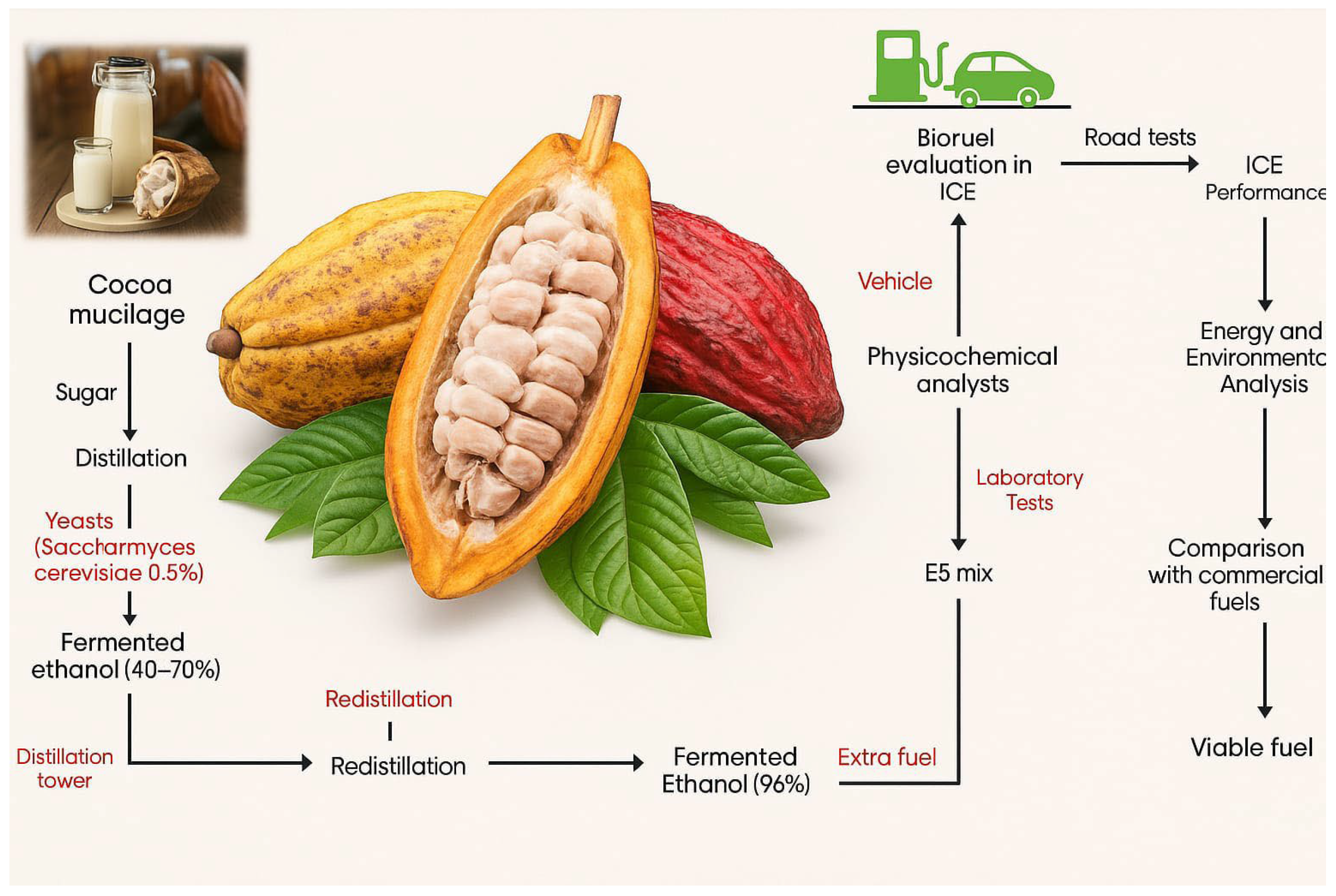
Figure 2 summarizes the experimental workflow, from cocoa mucilage (CCN51) collection and fermentation to bioethanol distillation, E5–CCN51 blend preparation, and engine testing. The process followed a quantitative experimental design, ensuring replicability and representativeness of samples across all stages.

2.2. Fermentation, Distillation, and Physicochemical Preparation of the E5–CCN51 Blend

A laboratory-scale stainless-steel batch distillation column custom-built at the Unit Operations Laboratory of the Technical State University of Quevedo (UTEQ), Ecuador, was used. The system consisted of a 20 L total capacity column equipped with eight stainless-steel sieve trays (tray spacing 15 cm), a 2 kW electric reboiler, and a Liebig condenser fabricated in copper with a cooling water flow of 1.5–2.0 L/min at 18–20 °C. Two sampling outlets were installed (top ethanol outlet and bottom stillage outlet). The feed was introduced at the third tray from the top, maintaining a head temperature of 78–80 °C.
The second distillation was performed using the same custom-made equipment under identical operating conditions to increase the purity of the distillate, yielding ethanol at 96% v/v. Both batch runs were conducted at atmospheric pressure with a controlled reflux ratio of 3:1. Ethanol purity was confirmed by densimetry using an Anton Paar DMA 4500 digital density meter (Anton Paar GmbH, Graz, Austria), following ASTM D1298 [23,24].
The purified ethanol was blended with Ecuadorian Extra gasoline in a 95:5 v/v proportion to formulate the E5–CCN51 blend, following standardized laboratory protocols, including ASTM D4814-22 [25] for gasoline specifications and ASTM D7794-21 [26] for ethanol–gasoline blending. All experimental steps were documented to ensure full reproducibility and verification by other authors [23].
The fermentation process was monitored every 24 h by °Brix measurements. A one-factor experimental design was applied, where fermentation time was considered, the main factor influencing the response variable (°Brix reduction). Each condition was performed in triplicate (n = 3) to quantify experimental variability. Statistical analysis was conducted using repeated-measures ANOVA to evaluate temporal variation and the significance of differences among sampling days, employing IBM SPSS Statistics v.29. This approach ensured the validity of the results and reproducibility of the procedure. The endpoint was established when the °Brix value reached ≤2 for three consecutive daily measurements. The fermented broth was then filtered and subjected to fractional distillation using standard laboratory-scale equipment, yielding ethanol concentrations between 40 and 70% v/v. To obtain fuel-grade quality, a subsequent tower redistillation was performed, achieving a final ethanol concentration of 96% v/v [27].
The ethanol obtained from the tower redistillation (96% v/v) was used to formulate an E5–CCN51 blend by mixing it with Ecuadorian commercial Extra gasoline at a 5% volumetric ratio. The blending process was conducted in hermetically sealed glass containers under controlled laboratory conditions to minimize evaporation losses and ensure homogeneity. The prepared fuels were stored at ambient temperature (20–25 °C) in dark, dry conditions, and fresh batches were prepared for each experimental stage to prevent degradation effects [28].
The E5–CCN51 blend, together with the reference fuels (Extra and Super gasoline), underwent physicochemical characterization according to internationally recognized standards (ASTM, ISO) to ensure compliance with quality requirements and to establish comparability with commercial fuels. The analyses included determination of the Higher and Lower Heating Values (ASTM D4809, bomb calorimetry) [29], Distillation Profile (ASTM D86, including initial boiling point, T10, T50, T90, and final boiling point) [30], Reid Vapor Pressure (ASTM D323) [31], Density and Specific Gravity (ASTM D4052, oscillating U-tube) [32], Kinematic Viscosity (ASTM D445) [33], Sulfur Content (ASTM D4294) [34], Existing Gum Content (ASTM D381) [35], and Oxygen Content for ethanol blends (ASTM D4815) [36]. Each test was performed in triplicate, and results were reported as mean ± standard deviation.
Each physicochemical test was performed in triplicate, and results were expressed as mean ± standard deviation. The obtained values were evaluated against the Ecuadorian fuel quality standard NTE INEN 2102 [37], which serves as the regulatory benchmark for commercial gasoline in the country [38].
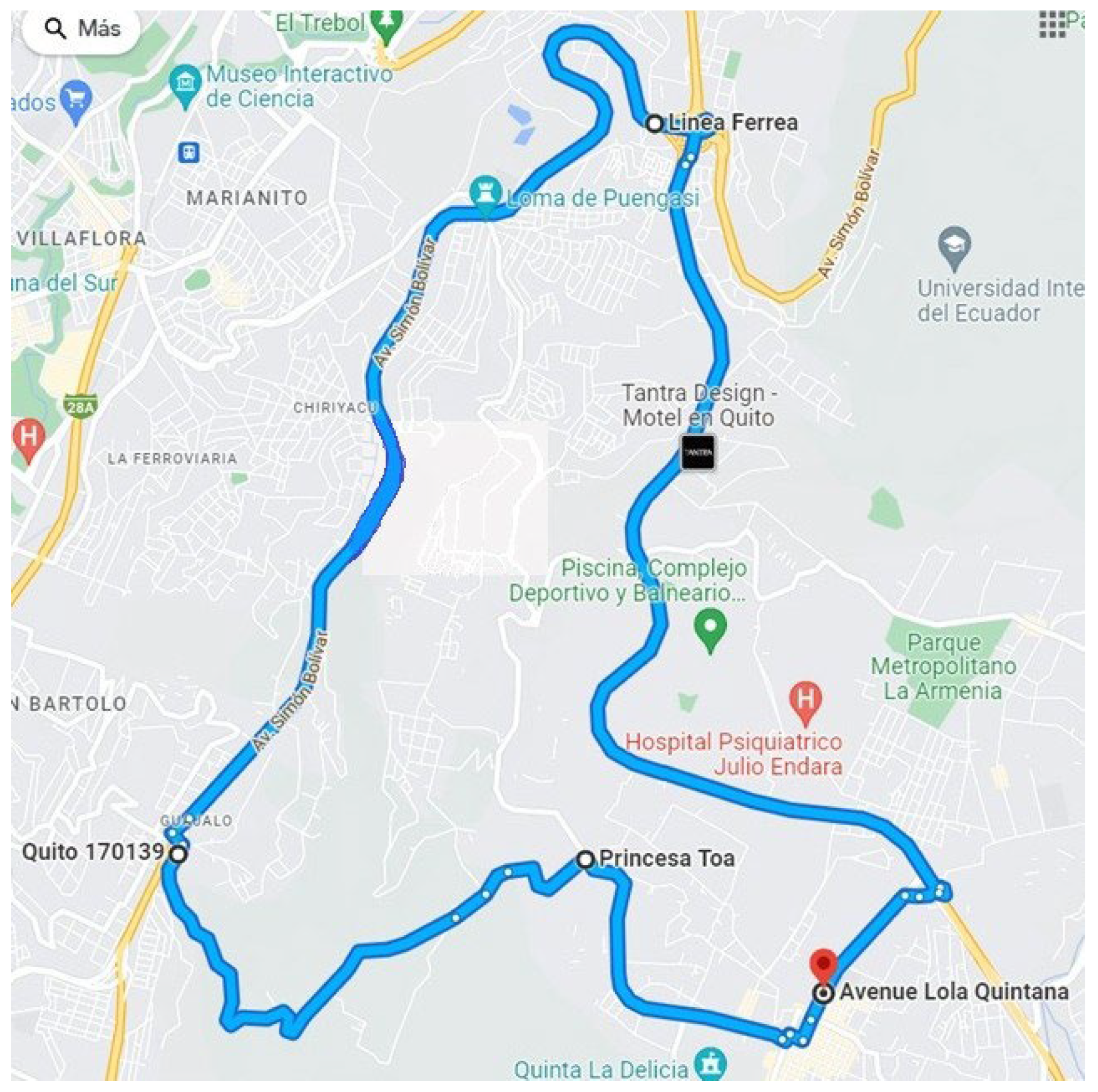
To evaluate the energetic and exergetic performance of the E5–CCN51 blend under real driving conditions, a test route was randomly selected within the city of Quito, Ecuador, as shown in Figure 3. The trials were conducted using a Hyundai i10 (Hyundai Motor Company, Seoul, Korea, model year 2021), a compact vehicle powered by a four-cylinder, 1.1 L spark-ignition engine with 12 valves, multipoint fuel injection, and a maximum output of 66 HP at 5500 rpm.
This vehicle model, widely employed in Ecuadorian urban environments due to its efficiency and reliability, represents an appropriate benchmark for assessing the performance of alternative fuels under representative operating conditions. The driving route began at Avenue Lola Quintana (approx. 2720 m a.s.l.), continued through Avenue Gran Rumiñahui and Avenue Simón Bolívar Sur, reaching elevations of up to 2900 m a.s.l. in hilly sections. The trajectory then descended slightly along Conocoto Road (≈2600 m a.s.l.) before ascending again toward Avenue Princesa Toa and Avenue Camilo Ponce Enríquez, which are located between 2750 and 2850 m a.s.l. The total distance covered was 24.8 km, incorporating steep gradients, sharp curves, and sections with varying traffic density, thus ensuring a representative combination of urban and extra-urban driving conditions within the high-altitude context of Quito [39].
Each test was carried out in two repetitions per fuel (Extra gasoline, Super gasoline, and E5–CCN51 blend), ensuring the reliability of the results and enabling a direct comparison of the E5–CCN51 blend against commercial fuels under real operating conditions.
For the instrumentation and data acquisition, specialized automotive testing equipment was employed to ensure accurate, traceable, and synchronized data throughout the on-road dynamic tests. Vehicle operating parameters, including engine speed (rpm), vehicle speed, intake manifold pressure, throttle position, fuel system status, and coolant temperature, were recorded using a ScanGauge II OBD-II data acquisition interface (Linear Logic, Mesa, AZ, USA) installed on the vehicle’s standard diagnostic port. Concurrently, geolocation and elevation profiles were monitored using a Garmin GPSMAP 64sx receiver (Garmin Ltd., Olathe, KS, USA), allowing precise spatial mapping of driving conditions. Ambient meteorological variables (air temperature and relative humidity) were measured with a Testo 410-2 handheld anemometer–thermohygrometer (Testo SE & Co., Titisee-Neustadt, Germany).

2.3. Energy and Exergy Analysis Model Applied to the Internal Combustion Engine

The engine performance under both commercial fuels and the E5–CCN51 blend was evaluated through a thermodynamic model that integrates energy (first law) and exergy (second law) analyses, providing a comprehensive characterization of fuel utilization. The energy analysis focused on conventional indicators, such as brake power, brake-specific fuel consumption, and thermal efficiency, while the exergy analysis quantified the quality of energy flows, identifying irreversibilities and losses inherent to the conversion process [40].
Additionally, in the exergy formulation, the terms associated with potential and kinetic exergy were examined. Since the experiments were performed under steady-state operating conditions on a controlled road segment, the variations in altitude and vehicle speed were negligible. Therefore, the contributions of potential and kinetic exergy were considered insignificant when compared to the chemical and thermal exergy terms, and were consequently omitted from the final exergy balance, following standard ICE exergy analysis practice.
The employed equations include the calculation of torque, brake power, fuel mass flow rate, heat release during combustion, thermal efficiency, exergy flow of the fuel and exhaust gases, and overall exergy efficiency. For the latter, the chemical exergy of ethanol and gasoline was considered, with thermodynamic reference conditions set at 25 °C and 1 atm. This framework provides a robust tool for objectively comparing the E5–CCN51 blend against fossil fuels, assessing both its energy performance and its sustainability.
The governing equations applied in this study are presented below (Equations (1)–(11)). These equations describe the energy and exergy balances required to evaluate the performance of the internal combustion engine under both fossil fuels and the E5–CCN51 blend.
The brake torque was calculated from the applied force and the crank radius
T = F     r
where T is the brake torque (N·m), F is the applied force (N), and r is the crank radius (m). The brake power was obtained from the relationship between torque and angular velocity:
P = T     ω = M     n 60 2 π
where P is the brake power (kW), ω is the angular velocity (rad/s), M is the torque moment, and n is the engine speed (rpm).
The brake-specific fuel consumption was determined as:
b e =   m c ˙ P
where be is the brake-specific fuel consumption (g/kWh), ṁc is the fuel mass flow rate (kg/s), and P is the brake power (kW).
The energy balance of the internal combustion engine is expressed as:
Q a = H i n   H o u t
where ΣQa is the total heat released to the environment (kJ), ΣHin is the enthalpy input, and ΣHout is the enthalpy output.
The fuel mass flow rate was obtained by:
m c ˙ =   ρ V t
where ρ is the fuel density (kg/m3), V is the injected volume (m3), and Δt is the injection time (s).
The heat released by the fuel is given by:
Q ˙ c = m ˙ c · L H V
where Q ˙ c is the heat released (kW), and LHV is the lower heating value (kJ/kg).
The thermal efficiency of the system was calculated as:
η t h =   P m á x Q ˙ c
where Pmax is the maximum brake power (kW), and Q ˙ c is the released heat (kW).
The chemical exergy of the fuel was determined as:
E X c = m c ˙ L H V
where Exc is the fuel exergy (kW), and LHV is the lower heating value (kJ/kg).
The exhaust gas exergy flow was obtained by:
E ˙ X g = m ˙ g C p T 0 T T 0 1 ln T T 0
where ṁg is the exhaust gas flow rate (kg/s), Cp is the specific heat at constant pressure (kJ/kg·K), T0 is the reference temperature (K), and T is the exhaust gas temperature (K).
The total mass flow of exhaust gases was calculated as:
m g ˙ = m ˙ a i r + m ˙ c
where ṁair is the air mass flow rate (kg/s), and ṁc is the fuel mass flow rate (kg/s).
The exergy efficiency of the system was expressed as:
η e x = E x i n E x o u t E x i n
where ηex is the exergy efficiency, ΣExin is the exergy of inputs, and ΣExout is the exergy of outputs.
The exergy analysis is conducted with the engine as the defined system boundary, where brake power constitutes the useful work output. This controlled-comparison methodology isolates the fuel conversion process, ensuring that the exergy efficiency quantifies and compares the intrinsic thermodynamic quality of each fuel under identical operating conditions. While kinetic and potential energy variations are relevant at the vehicle system level, their inclusion would introduce route-specific dynamics that are external to the core objective of evaluating fuel performance within the engine.

2.4. Static Exhaust Emission Tests

These tests aimed to quantify the combustion efficiency and pollutant formation of the E5–CCN51 blend relative to Ecuadorian commercial fuels. Emission measurements were conducted on a Hyundai i10 under idle (700 rpm) and mid-load (2500 rpm) conditions, with three repetitions per fuel (Extra, Super, and E5–CCN51 blend).
The GasBox Autopower analyzer (Capelec, Montpellier, France) was calibrated with certified reference gases before each measurement campaign. Emission testing procedures followed internationally recognized standards, specifically UNECE Regulation No. 83 for pollutant emissions from light-duty vehicles and ISO 3930/OIML R 99 [41] for gas analyzer performance requirements, both widely applied in regulatory automotive testing and referenced by Ecuadorian environmental authorities. After the engine reached its normal operating temperature, tailpipe gases were measured over a 30 s steady-state period at a 1 s sampling frequency. The recorded data were post-processed using a second-order moving average filter to minimize transient noise and ensure robust measurements [42].
The evaluated parameters included carbon monoxide (CO), carbon dioxide (CO2), unburned hydrocarbons (HC), oxygen (O2), and the air–fuel equivalence ratio (λ). Results were expressed as mean ± SD, and one-way ANOVA (p < 0.05) was applied to assess significant differences among fuels [43].
This setup enabled a robust and reproducible comparison of the environmental performance of the E5–CCN51 blend with Ecuador’s commercial gasoline standards. All experiments were conducted under controlled conditions, with measurements performed in triplicate to ensure repeatability and accuracy. Instruments were calibrated prior to each test, and results were statistically validated using ANOVA at a 95% confidence level, ensuring the reliability of the findings.

3. Results and Discussion

3.1. Fermentation and Distillation Performance of Cocoa Mucilage

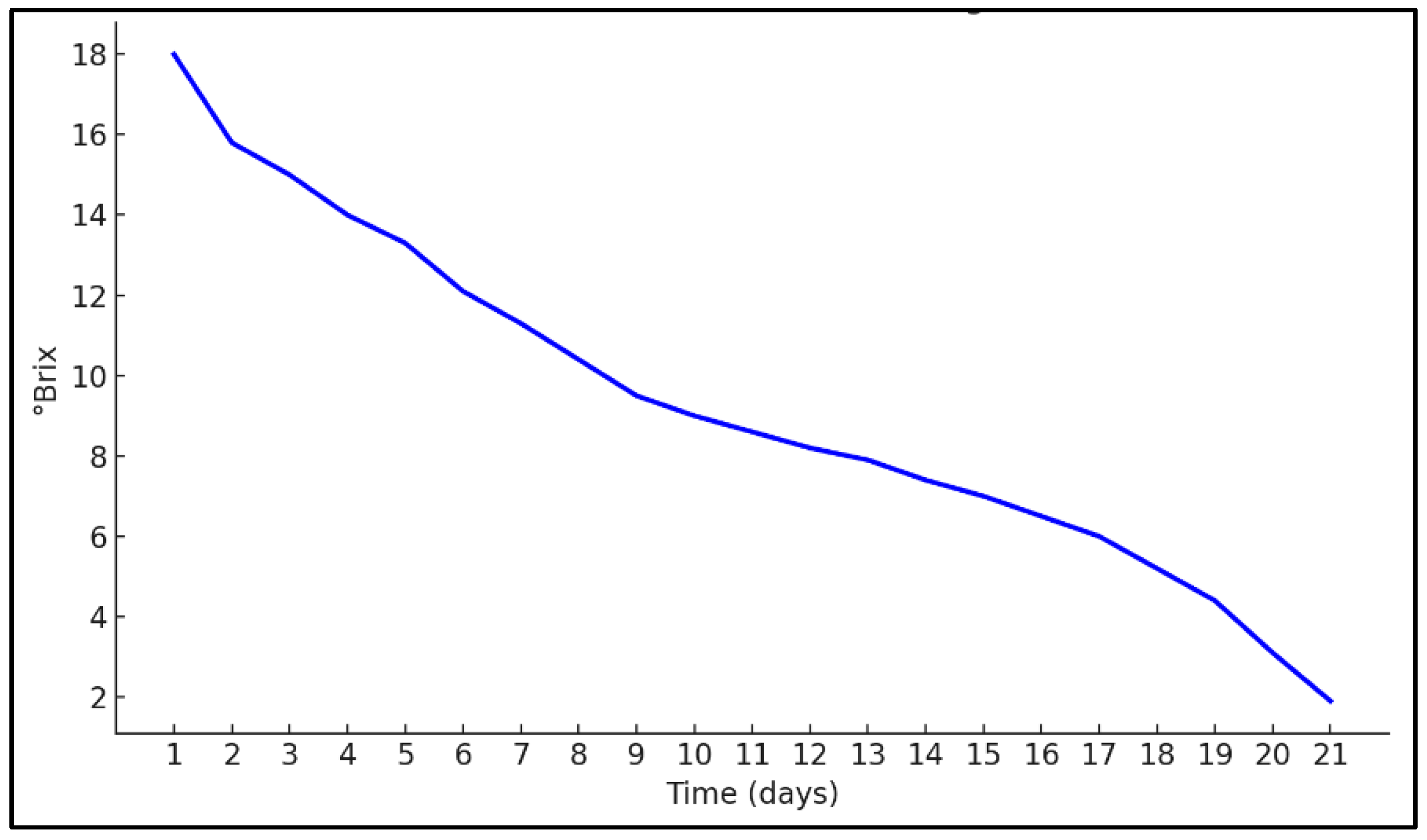
The fermentation curve shown in Figure 4 reflects the typical behavior of sugar-to-ethanol conversion in carbohydrate-rich substrates, such as cocoa mucilage. A progressive decrease in °Brix was observed from 18 down to residual values of approximately 2 by day 21, indicating an almost complete fermentation. The initial stage (days 1–7) showed a steeper decline, attributable to the high availability of fermentable sugars and the elevated metabolic activity of Saccharomyces cerevisiae. Subsequently, between days 8 and 17, the slope decreased as a result of nutrient limitation and the inhibitory effect of accumulated ethanol. Finally, in the last days (18–21), residual sugars were consumed, stabilizing the curve at ≤2 °Brix. These results, which are consistent with previous studies on extended fermentations of similar substrates [17], confirm that the experimental period of 21 days was sufficient to achieve a complete and reproducible fermentation, as supported by statistical analysis (ANOVA) of experimental replicates.
Based on the initial soluble solids content of the cocoa mucilage (18 °Brix), 1 kg of fresh mucilage contains approximately 180 g of fermentable sugars. Considering the stoichiometric conversion of sugars to ethanol and the complete fermentation observed in our experiments (≤2 °Brix), this corresponds to an actual ethanol yield of approximately 78–83 g per kg of mucilage, equivalent to 95–105 mL of ethanol at 96% v/v. This yield is consistent with typical sugar-to-ethanol conversion efficiencies reported for Saccharomyces cerevisiae in high-carbohydrate substrates.
The fermentation curve exhibited a typical sugar-to-ethanol conversion pattern: an initial rapid decrease in °Brix due to the high availability of fermentable sugars, followed by a slower decline associated with nutrient limitation and ethanol accumulation, and finally reaching a stable residual value around 2 °Brix. This behavior aligns with previous studies on extended cocoa mucilage fermentations and confirms that the 21-day period was sufficient to achieve complete fermentation [44].
Nevertheless, achieving ethanol purities above 96% v/v remains a technical challenge, since international biofuel standards require levels close to or above 99% v/v (98.8% in the EU, 99% in the U.S., and 99.6% in Brazil) [45]. This limitation is mainly due to the ethanol-water azeotrope (95.63 wt%), which restricts conventional distillation. Advanced research has shown that extractive distillation using high-boiling solvents, such as ethylene glycol, can overcome this barrier, delivering up to 99.8% v/v ethanol. Furthermore, hybrid schemes like pass-through distillation (PTD), when combined with heat pumps or multi-effect distillation, have achieved remarkable energy savings, reducing the energy demand to as low as 1.72–1.83 kWh/kgEtOH, compared to 2.11 kWh/kgEtOH in conventional processes [46].
These findings suggest that, although cocoa mucilage already demonstrates outstanding distillation yields, industrial-scale deployment will require the integration of advanced separation technologies (extractive, azeotropic, or hybrid) to overcome the azeotrope constraint and reduce energy intensity. Comparisons with intensified processes confirm that solvent-based separations and heat-integration strategies are key to positioning cocoa mucilage ethanol as a competitive candidate in the global biofuel landscape [47].

3.2. Comparative Evaluation of the Physicochemical Properties of E5–CCN51 Blend and Commercial Fuels in Ecuador

Within the framework of the experimentation using cocoa mucilage, two stages of fractional distillation were conducted, yielding a maximum ethanol concentration of 96% v/v. Although this value is high, it remains below the international standards required for direct use as pure fuel (E100) in internal combustion engines, where concentrations ≥ 99% v/v are mandatory. Nevertheless, the achieved purity is suitable for blending with gasoline, with the E5–CCN51 blend formulation emerging as a feasible and sustainable alternative, which was selected for experimental validation in this study.
One strategy to increase biofuel consumption is to progressively raise the ethanol content, which requires only minimal vehicle modifications. The E5–CCN51 blend is authorized exclusively as an initial and short-term stage, as part of a preliminary plan before fully implementing a 10% bioethanol mixture [48]. Table 1 presents the comparison of key physicochemical properties between the E5–CCN51 blend (5% cocoa mucilage-derived ethanol and 95% Extra gasoline) and the commercial fuels currently distributed in Ecuador. The evaluation was conducted according to ASTM and NTE INEN 2102 requirements, ensuring direct alignment with the standardized quality criteria for gasoline used in the country. This characterization allows verification that the E5–CCN51 blend fully complies with the national regulatory framework and maintains physicochemical properties comparable to Extra and Super gasolines, supporting its safe integration into the existing Ecuadorian fuel supply.
The E5–CCN51 blend showed a modest octane improvement (85.8 RON) and slightly lower heating value (45.22 MJ/kg) compared to Extra gasoline (85 RON, 45.88 MJ/kg) [51]. Sulfur content decreased from 0.065 to 0.059%, and Reid vapor pressure dropped by 4 kPa, enhancing volatility and storage safety [52]. Overall, the blend maintains full compliance with NTE INEN 2102 and exhibits physicochemical stability comparable to Ecuadorian commercial fuels, confirming its compatibility with the national infrastructure [53].
These results confirm that incorporating 5% bioethanol derived from cocoa mucilage not only improves octane number but also maintains thermochemical properties comparable to conventional fuels, while providing environmental benefits. This positions cocoa mucilage as a promising feedstock for second-generation biofuels.
On the other hand, considering that fuel commercialization in Ecuador is regulated exclusively under NTE INEN fuel specifications, and that international legislation (e.g., EN 228:2012 [54] for European unleaded gasoline or ASTM D5798 [55] for high-ethanol blends) refers to different ethanol concentrations, vehicle standards, and fuel grades than those established in the Ecuadorian market, we believe that extending the comparison to additional international standards would introduce irrelevant regulatory criteria and fall beyond the technical and contextual scope of the present study. The focus of this work is to verify that the E5–CCN51 blend formulation meets the nationally enforced quality requirements for fuel distribution and engine compatibility in Ecuador, ensuring its feasibility for immediate implementation within the existing regulatory framework.

3.3. Energetic Performance Assessment Under Real Operating Conditions

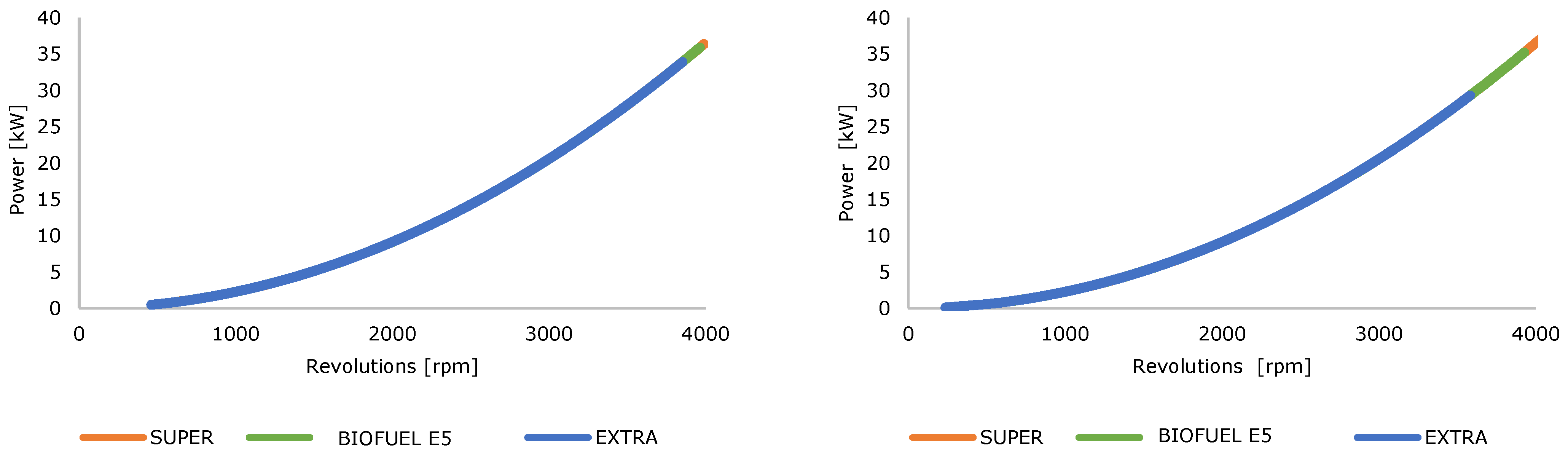
Figure 5 shows the power curve (kW vs. rpm) obtained with the E5–CCN51 blend during the first and second test under real driving conditions. In the first test, the E5–CCN51 blend exhibited a positive trend, with a steady increase in effective engine power as engine speed rose. The initial power was 0.87 kW at 616 rpm (idle), reaching a maximum of 35.22 kW at 3926 rpm. This performance outperformed Extra gasoline, which reached only 29.29 kW at 3580 rpm, and was comparable to Super gasoline, which attained 37.88 kW at 4071 rpm, with only a minimal difference.
In the first test, the E5–CCN51 blend exhibited a positive trend, with a steady increase in effective engine power as engine speed rose. The initial power was 0.87 kW at 616 rpm (idle), reaching a maximum of 35.22 kW at 3926 rpm. This performance outperformed Extra gasoline, which reached only 29.29 kW at 3580 rpm, and was comparable to Super gasoline, which attained 37.88 kW at 4071 rpm, with only a minimal difference.
In the second test, the E5–CCN51 blend maintained a similar behavior. The initial power was 0.63 kW at 564 rpm (idle), while the maximum power reached 35.88 kW at 3963 rpm, again outperforming Extra gasoline (33.90 kW at 3852 rpm) and showing performance very close to Super gasoline (36.37 kW at 3990 rpm). These results confirm that the cocoa mucilage-derived E5–CCN51 blend demonstrates competitive performance compared to conventional fuels in the Ecuadorian market, particularly when compared to Extra gasoline. These findings in Figure 5 are consistent with Najafi et al. [56], who evaluated ethanol–gasoline blends ranging from E5 to E15, increasing ethanol content in steps of 2.5%. Their study reported a slight increase in engine power across all speeds as the ethanol proportion rose, attributed to improvements in the indicated mean effective pressure and the higher latent heat of vaporization of ethanol, which enhances charge cooling, increases mixture density, and ultimately delivers higher output power. Although ethanol addition reduces the lower heating value of the blend, its oxygenated nature promotes more complete combustion, thereby offsetting this drawback. These results corroborate the present study, demonstrating that low-percentage ethanol blends (E5) can enhance engine performance compared to lower-quality base fuels such as 85 RON Extra gasoline.
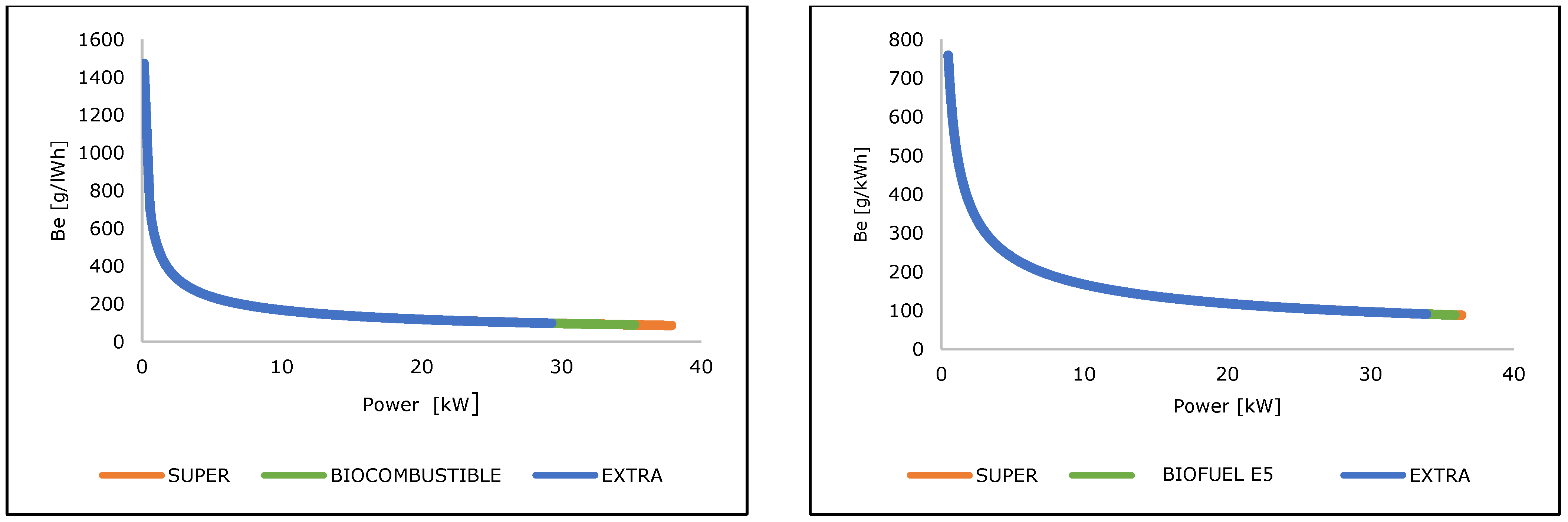
Figure 6 depicts the relationship between Specific fuel consumption (Symbol of Be/Unit g/lWh) and engine power output for Super gasoline, Extra gasoline, and the E5–CCN51 blend during both experimental stages. In the first test, the biofuel curve exhibits a descending trend as engine power increases, indicating improved efficiency under higher load conditions. This behavior is attributed to the mechanical inertia at high revolutions, which contributes to a periodic reduction in fuel consumption. At the lowest power point corresponding to engine idle, the consumption reached approximately 570 g/kWh, while Super and Extra gasoline recorded maximum values of 500.06 g/kWh and 710 g/kWh, respectively. The small difference between the biofuel and Super gasoline highlights a comparable energetic performance.
During the second experimental stage, the E5–CCN51 blend showed an initial consumption of 619.65 g/kWh at low power and revolutions, with noticeable variability mainly due to environmental conditions affecting air density and thus the air–fuel ratio. In comparison, Super gasoline presented a specific consumption of 567.38 g/kWh, whereas Extra gasoline reached 759.18 g/kWh, representing a substantial increase relative to the first test.
The E5–CCN51 blend exhibited higher fuel consumption than conventional gasoline, consistent with previous studies attributing this to the lower calorific value of ethanol compared to pure gasoline. According to Jhan S. et al. (2020) [57], in their analysis of fuel consumption and greenhouse gas emissions in vehicles powered by bioethanol, gasoline, and hydrogen, a direct relationship was found between the increased bioethanol content and higher fuel consumption. This behavior results from the lower energy release per unit mass of ethanol, requiring a larger fuel quantity to achieve equivalent power. The findings of the present study align with this trend, confirming that the E5–CCN51 blend demonstrates energy performance consistent with internationally reported results.
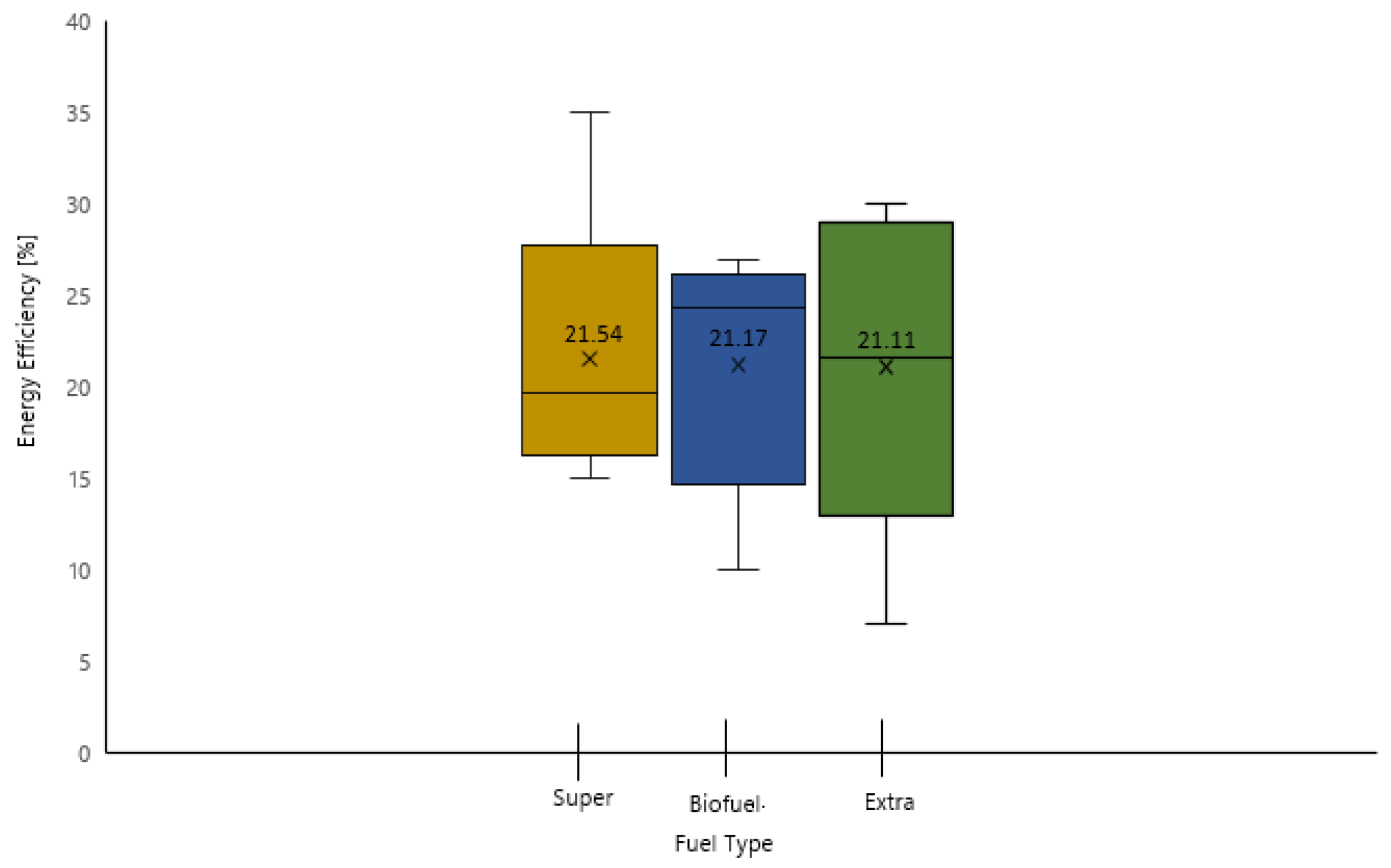
On the other hand, Figure 7 illustrates the energy efficiency obtained for each fuel type evaluated. A minimal yet statistically significant difference was observed among the three formulations. Super gasoline achieved the highest efficiency at 21.54%, followed by the E5–CCN51 blend at 21.17%, while Extra gasoline recorded 21.11%. Energy efficiency values reported correspond to brake thermal efficiency, calculated from the ratio between measured brake power and the fuel heat release rate, as defined in Equation (7).
Although the variations are small, it is noteworthy that the E5–CCN51 blend, derived from Extra gasoline with the addition of bioethanol, exhibited a relative improvement of 0.28% in overall efficiency. This enhancement indicates that the incorporation of low bioethanol concentrations can improve the energetic performance of base gasoline.
These findings are consistent with those reported by Rostami et al. [58], who found that higher bioethanol content enhances second-law efficiency and engine exergy due to greater oxygen availability, leading to more complete combustion and lower irreversibilities. Similarly, in this study, cocoa-mucilage bioethanol in the E5–CCN51 blend improved energy efficiency over the base fuel, indicating that even low ethanol concentrations (≤5%) can yield measurable efficiency gains without engine or injection adjustments.
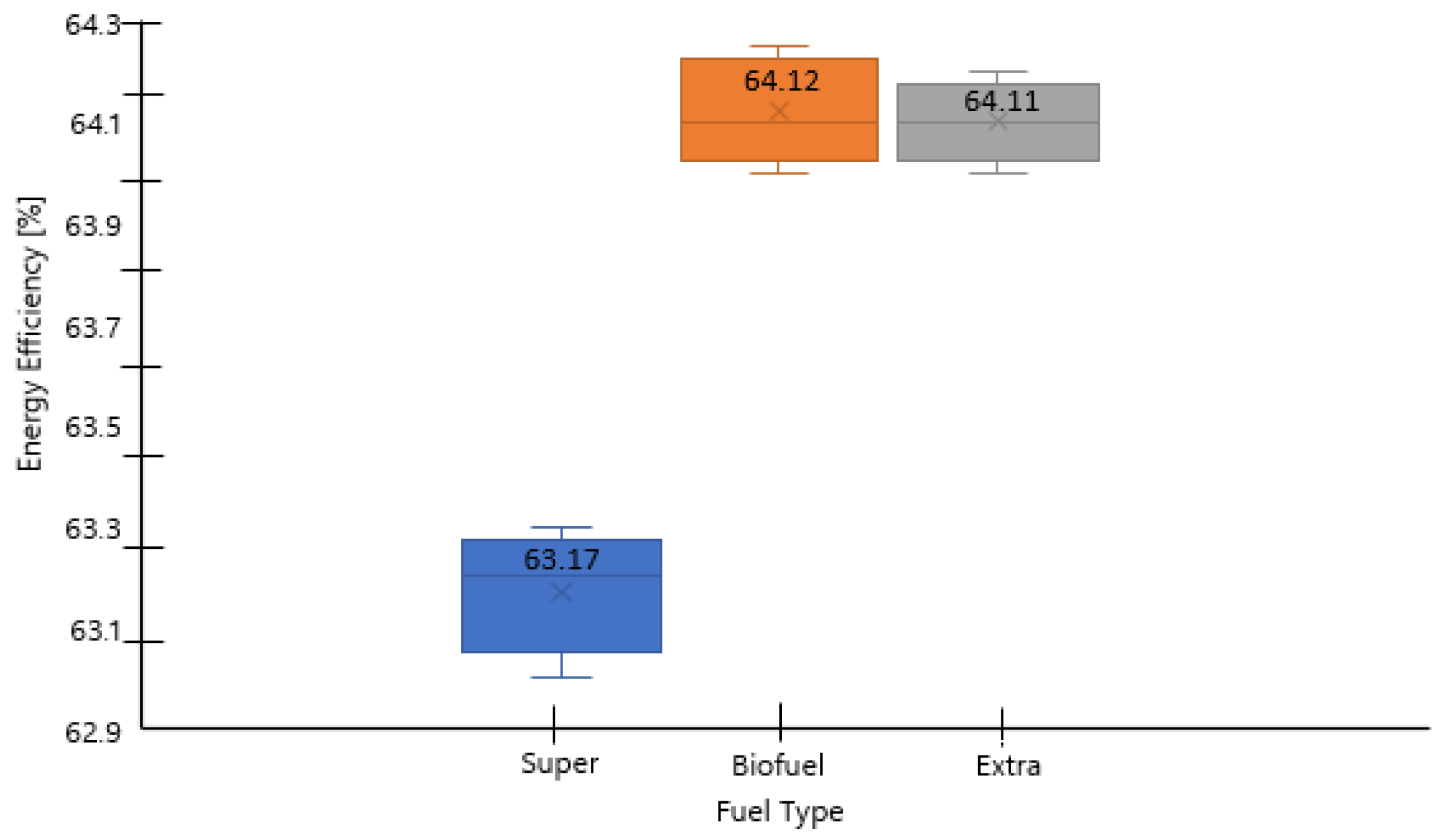
Figure 8 presents the experimental results of exergy efficiency for the three fuels evaluated. A significant difference was observed between the E5–CCN51 blend and Super gasoline, with the biofuel achieving the highest efficiency at 64.12%, outperforming the reference fuel. When compared with Extra gasoline (64.10%), the difference was not statistically significant. This behavior indicates that the controlled addition of bioethanol enhances the conversion of chemical energy into useful work.
From a thermodynamic perspective, the observed improvement in the biofuel’s exergy efficiency arises from reduced in-cylinder irreversibilities and an increased share of useful available energy. Due to its oxygenated nature, ethanol fosters a more homogeneous and complete combustion process, thereby enhancing the conversion of chemical energy into mechanical work while minimizing entropy generation losses.
The exergy efficiency shown in Figure 8 was calculated according to Equation (11), where the total exergy input corresponds to the chemical exergy of the fuel (Equation (8)), and the exergy outputs include the useful brake power together with the exergy remaining in the exhaust gases (Equation (9)), minus the exergy destroyed due to heat transfer and in-cylinder irreversibilities. The positive deviation observed for the E5–CCN51 blend arises from its oxygenated nature, which promotes more homogeneous combustion and reduces exergy destruction. Conversely, the slightly lower values observed for Extra and Super gasoline reflect higher exhaust-gas exergy losses and greater entropy generation, a pattern that is consistent with the energy distribution illustrated in the Sankey diagram (Figure 9).
The experimental data required to compute both energy and exergy efficiencies were obtained directly from the engine tests, including brake power, torque, fuel consumption, air–fuel ratio, and exhaust-gas temperature. These measurements were used as inputs in the thermodynamic model described in Section 2.3, where the fuel chemical exergy (Equation (8)), the physical exergy of the exhaust gases (Equation (9)), and the mass–flow relationships (Equation (10)) were integrated to obtain the exergy efficiency defined in Equation (11). This ensures that the efficiencies presented in Figure 8 are based strictly on measured operational parameters consistent across all fuels.
In Figure 8, the exergy efficiency was obtained using Equation (11), where the exergy input corresponds to the chemical exergy of the fuel (Equation (8)) and the exergy output considers the useful brake power together with the exergy remaining in the exhaust gases (Equation (9)). The difference between these terms represents the exergy destroyed through heat transfer and combustion irreversibilities. All variables required for this computation were taken directly from the experimental operating conditions described in Section 2.3, ensuring consistency in the comparison among fuels.
These results are consistent with the findings of Rufino et al. [59], who conducted an exergetic analysis of a spark-ignition engine fueled with gasohol and hydrous ethanol. Their work demonstrated that ethanol exhibits lower in-cylinder exergy destruction and higher first- and second-law efficiencies compared with gasoline, mainly due to its higher flame speed and oxygen content. They also identified that exhaust gases represent the main source of exergy losses, while exergy destruction due to friction and heat transfer is reduced when using oxygenated fuels.
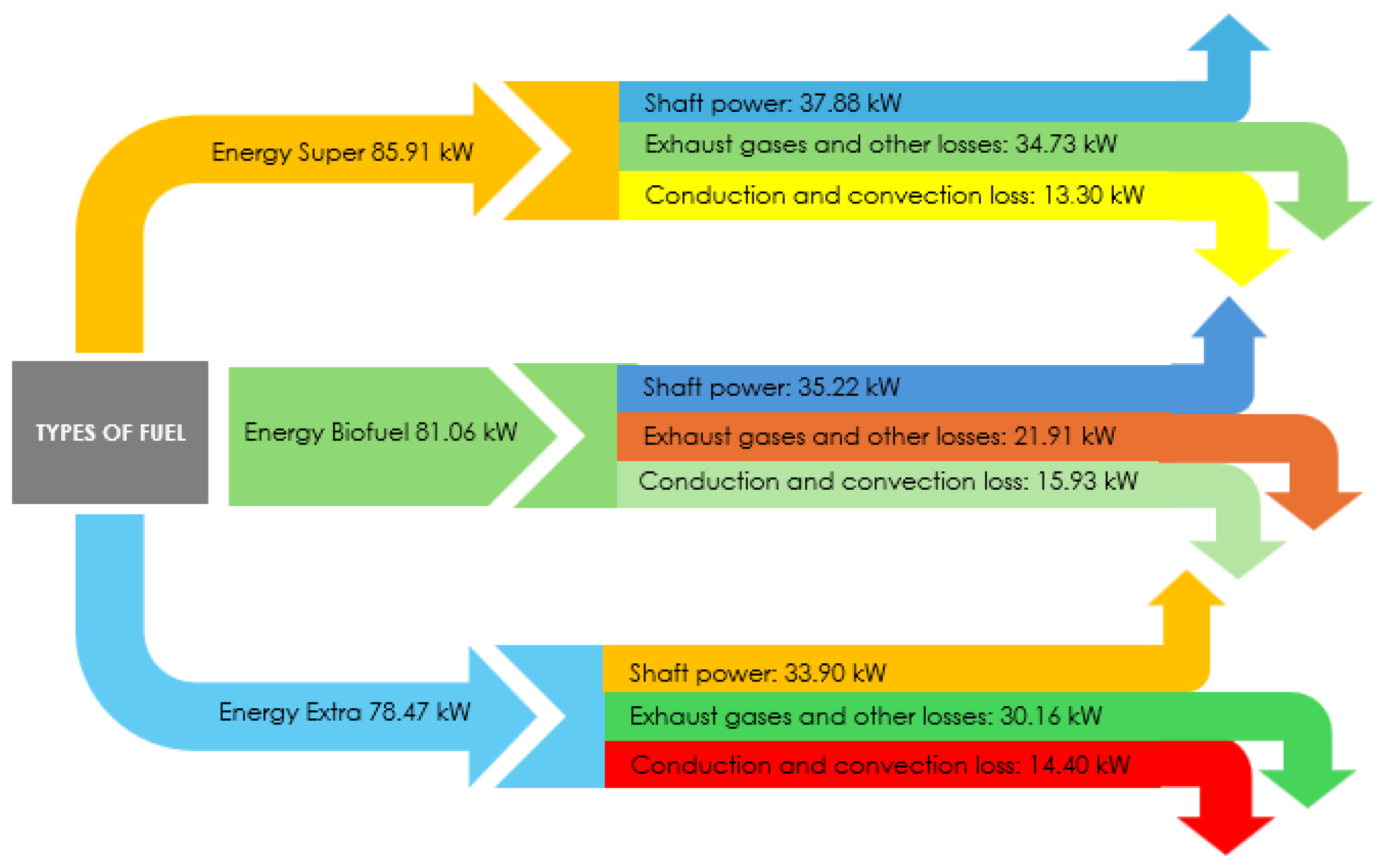
Nonetheless, Figure 9 presents the Sankey diagram of the engine energy balance for the three tested fuels: Super gasoline, E5–CCN51 blend, and Extra gasoline. This diagram illustrates the distribution and magnitude of energy flows, highlighting the fraction converted into shaft power and the corresponding thermal losses through exhaust gases, conduction, and convection.
For Super gasoline, the total supplied energy was 85.91 kW, of which 37.88 kW (44.09%) was converted into useful shaft power. Exhaust gas and other irreversibility losses accounted for 34.73 kW (40.40%), while conduction and convection heat losses represented 13.30 kW (15.49%). For the E5–CCN51 blend, with a total input of 81.06 kW, the shaft power reached 35.22 kW (43.44%), accompanied by 21.91 kW (27.03%) of exhaust gas losses and 15.93 kW (19.65%) of conduction–convection losses. Finally, Extra gasoline delivered 78.47 kW in total, producing 33.90 kW (43.19%) of shaft power, 30.16 kW (38.43%) of exhaust losses, and 14.40 kW (18.35%) of thermal transfer losses.
These results confirm that the E5–CCN51 blend exhibits a more balanced energy distribution, with lower exhaust gas losses compared to Extra gasoline and performance comparable to Super gasoline. The reduction in exhaust losses suggests a more complete and stable combustion, attributed to the oxygenated nature of bioethanol, which enhances hydrocarbon oxidation and minimizes unburned energy losses.
From an exergy perspective, the proportion of useful work and reduced irreversibility highlights a more efficient utilization of chemical energy potential. The studies by Hong et al. [60] and Örs et al. [61] confirm that oxygenated fuels, like ethanol, lower exergy destruction by improving mixture homogeneity and shortening combustion duration. Likewise, Qasemian et al. [62] report that biofuels generally exhibit reduced residual heat losses, increasing recoverable energy and system sustainability.
Overall, the Sankey analysis demonstrates that the E5–CCN51 blend achieves a better ratio between useful power and total losses, positioning it as a thermodynamically stable and energy-efficient alternative to conventional fossil fuels.

3.4. Evaluation of Environmental Parameters

Figure 10 presents the average carbon monoxide (CO) concentrations measured in the Hyundai i10 2021 under steady-state operation at 700 rpm and 2500 rpm, revealing distinct behaviors between idle and accelerated conditions.
At 700 rpm, combustion efficiency is mainly constrained by low exhaust temperatures and limited mixture turbulence, with minimal after-treatment system activity. Under these conditions, Extra gasoline produces the highest CO levels (0.6–0.9% vol.), reflecting a richer mixture and incomplete oxidation at low engine load. Super gasoline maintains near-zero concentrations throughout the test, indicating stable combustion. The E5–CCN51 blend from cocoa mucilage exhibits intermediate CO values that remain consistently below Extra gasoline, although with a gradual increase as thermal stabilization is reached, demonstrating the behavior of oxygenated fuel under low-temperature idle conditions. At 2500 rpm, higher engine speed and exhaust temperature enhance oxidation, stabilizing the emission profiles. The E5–CCN51 blend consistently yields the lowest CO emissions, followed by Super and Extra, in line with their oxygen content and octane rating.
The findings are consistent with those of Kothare et al. [63], who reported average CO emissions of approximately 2.5% vol. using an E5 blend in a spark-ignition engine with variable compression ratio and 96 RON Indian petrol. In contrast, the E5–CCN51 blend in the present study produced average CO emissions around 0.3–0.4% vol., an order of magnitude lower, mainly due to the differences in test methodology, ambient conditions, and the lower octane rating (85 RON) of Ecuadorian base gasoline. Despite these differences, Figure 10 confirms the superior environmental performance of the E5–CCN51 blend, achieving substantially lower CO emissions than conventional fossil fuels under comparable operating conditions.
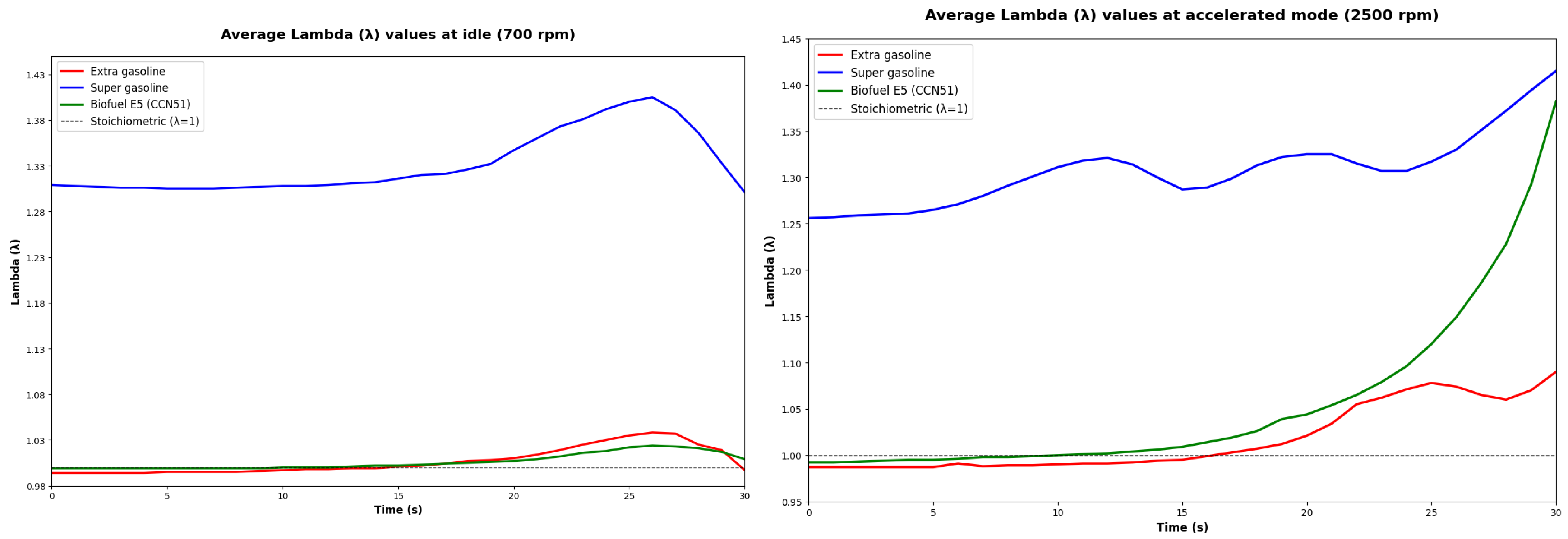
On the other hand, Figure 11 illustrates the comparative behavior of the Lambda (λ) stoichiometric ratio for Extra, Super, and the E5–CCN51 blend, revealing consistent patterns that reflect the influence of fuel composition on combustion quality and thermochemical efficiency under different engine operating speeds (700 rpm and 2500 rpm).
At 700 rpm, the measured λ values for all fuels remained close to unity, indicating near-stoichiometric combustion conditions. The E5–CCN51 blend exhibited a slightly higher average λ (~1.00–1.02) than Extra gasoline (~0.99), while Super gasoline maintained similar values (~1.01). This confirms that ethanol’s oxygen content contributes to maintaining an optimal air–fuel ratio even at idle operation.
At 2500 rpm, λ values increased moderately for all fuels, reflecting a leaner combustion regime as airflow and exhaust temperature rise. The E5–CCN51 blend presented the highest λ (up to ~1.05), followed by Super (~1.03) and Extra (~1.00), demonstrating the enhanced oxidation potential of oxygenated fuels.
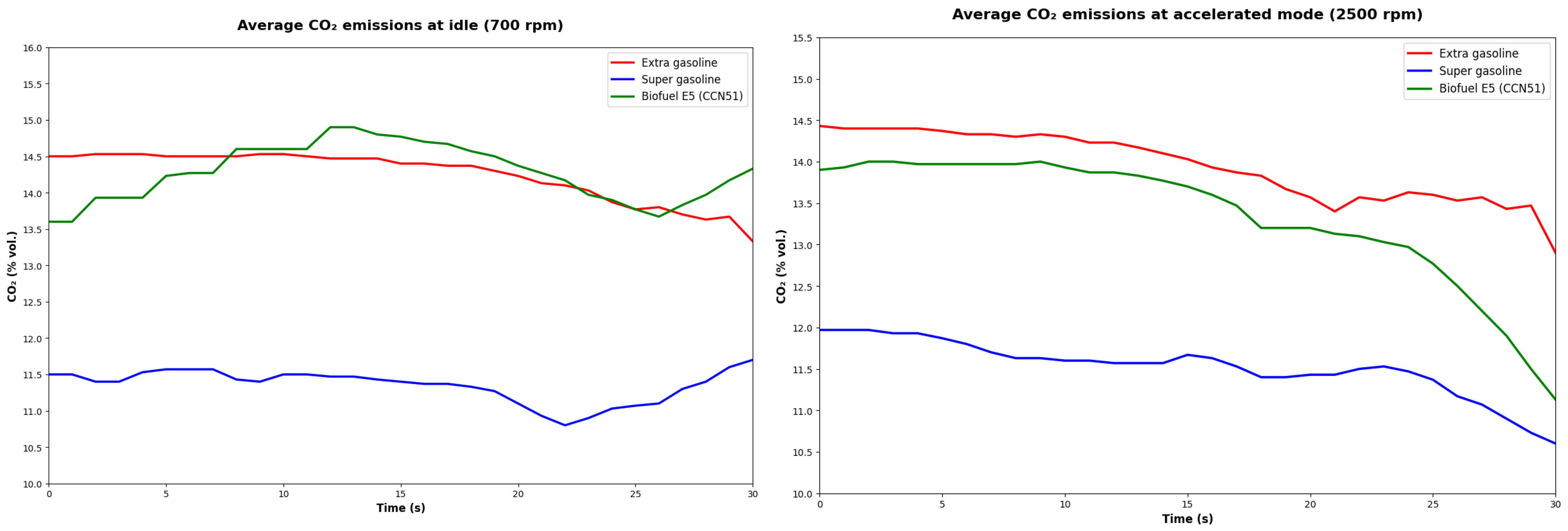
Thus, Figure 12 presents the comparative behavior of carbon dioxide (CO2) emissions for Extra, Super, and the E5–CCN51 blend, highlighting clear differences across the engine operating regimes (700 rpm and 2500 rpm) and among the fuels tested.
At 700 rpm, the CO2 concentrations recorded for the E5–CCN51 blend averaged around 14.3% vol., slightly higher than Extra gasoline (~14.0% vol.) and notably higher than Super gasoline (~11.5% vol.). These results indicate a more complete oxidation process in the E5–CCN51 blend due to its oxygenated nature.
At 2500 rpm, the differences between fuels became less pronounced, with CO2 levels ranging from 13.5 to 13.7% vol. for the E5–CCN51 blend and Extra, and approximately 11.5% vol. for Super. This stabilization reflects improved combustion efficiency at higher engine speeds and a consistent stoichiometric balance among the fuels.
These findings are consistent with Iodice et al. [64], who investigated gasoline–ethanol blends and their influence on fuel consumption and exhaust emissions in spark-ignition engines under cold-start conditions. Their results indicated a rise in CO2 emissions associated with ethanol addition, attributed to the complete oxidation of carbon in the fuel and the higher latent heat of vaporization of ethanol, which promotes a more homogeneous air–fuel mixture and efficient combustion.
The present results at 700 rpm corroborate this trend, confirming that ethanol-containing fuels tend to yield higher CO2 as a consequence of improved combustion completeness. The decreasing CO2 profile for Extra gasoline reflects a leaner idle correction by the E5–CCN51 blend once stabilization is achieved, consistent with its lower octane and reduced enrichment requirements compared with oxygenated fuels.
Similarly, Hoang et al. [65], in their study of performance and emission characteristics of a four-stroke motorcycle engine fueled with E5, E10, and 95 RON gasoline, observed that CO2 emissions increased with higher ethanol concentration, E10 > E5 > gasoline. This behavior, linked to the enhanced combustion quality provided by ethanol’s oxygen content, aligns closely with the findings of the present research, where the E5–CCN51 blend yields CO2 levels higher than Extra gasoline but below those of Super gasoline (92 RON).
Furthermore, the results correspond to those of Hsieh et al. [66], who reported that the addition of ethanol to gasoline in spark-ignition engines leads to a rise in CO2 emissions primarily due to improved combustion efficiency. Therefore, the results shown in Figure 13 confirm a general trend observed across multiple studies: oxygenated fuels, such as the E5–CCN51 blend, promote more complete combustion, lowering partial oxidation products while proportionally increasing CO2 emissions, an indicator of enhanced carbon oxidation and overall thermal efficiency within the combustion process.
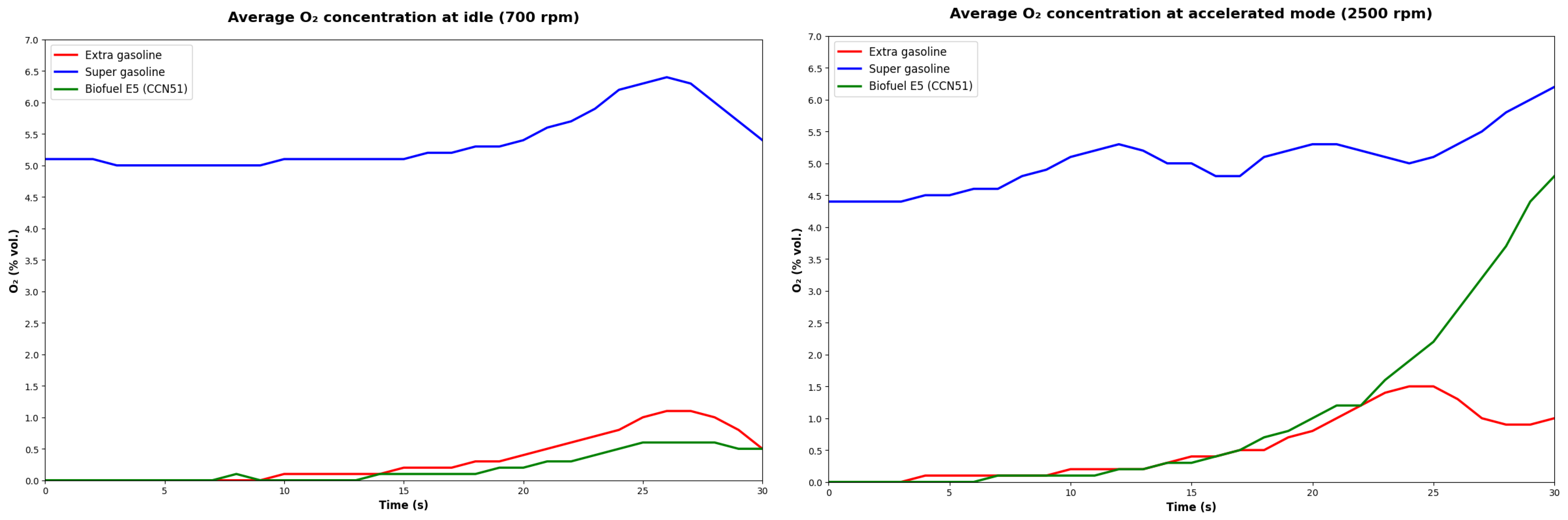
Figure 13 illustrates the comparative behavior of oxygen (O2) emissions for Extra, Super, and the E5–CCN51 blend, revealing a clear contrast between 700 rpm and 2500 rpm conditions and highlighting the influence of both fuel composition and engine speed on combustion efficiency.
At 700 rpm, the E5–CCN51 blend exhibited residual oxygen (O2) concentrations close to zero (~0.2–0.6% vol.), whereas Extra gasoline ranged between 0 and 1.0% vol., and Super gasoline maintained substantially higher levels around 5% vol. These results indicate a more complete combustion process for the E5–CCN51 blend, as nearly all available oxygen participated in oxidation reactions, leaving minimal unreacted O2 in the exhaust.
At 2500 rpm, the O2 values increased for all fuels due to the enhanced air intake and leaner mixture formation. However, the E5–CCN51 blend still showed significantly lower O2 emissions (1–4% vol.) compared with Super gasoline (5–6% vol.), confirming that ethanol’s oxygenated molecular structure promotes improved combustion completeness and oxygen utilization.
As Figure 13 shows, the E5–CCN51 blend consistently reduced CO and HC emissions while maintaining λ ≈ 1, evidencing complete combustion. The moderate increase in CO2 indicates improved oxidation, and residual O2 remained minimal, confirming efficient air–fuel utilization. These results collectively demonstrate that ethanol’s oxygen content enhances combustion stability, reduces partial oxidation products, and improves overall thermodynamic efficiency compared with conventional fuel.
The reduction in CO and HC emissions is primarily attributed to the intrinsic oxygen content of ethanol, which promotes homogeneous charge formation, enhances flame propagation, and mitigates incomplete combustion under both operating modes. Concurrently, the slight increase in CO2 emissions reflects the shift toward full oxidation of fuel carbon. The residual oxygen fraction trends (O2) further confirm the efficient use of available oxidizers within the combustion chamber, consistent with the findings of Mobin et al. [67].
Comparable outcomes have been reported by Wang et al., who demonstrated that ethanol–gasoline blends reduce CO and HC emissions while increasing CO2 output due to enhanced oxidation efficiency [68]. Larsson et al. highlighted that oxygenated biofuels improve thermal efficiency and decrease complete combustion products in spark-ignition engines [69]. Moreover, Wargula et al. [70] confirmed that the improved atomization and vaporization characteristics of low-ethanol blends (E5–E10) contribute to stable combustion and reduced pollutant formation.
In summary, the experimental evidence from the E5–CCN51 blend demonstrates that ethanol derived from Ecuadorian cocoa mucilage constitutes an effective oxygenated additive capable of reducing partial oxidation emissions and enhancing combustion efficiency. These results reinforce the viability of incorporating low-percentage bioethanol blends into the national fuel matrix as a practical pathway toward cleaner combustion and sustainable mobility in tropical developing regions.
All curves exhibit a consistent trend: while Extra gasoline maintains higher Lambda values indicative of a relatively lean and less stable mixture, the biofuel remains closer to the stoichiometric point, signifying greater combustion efficiency and thermodynamic stability. The proximity of the E5–CCN51 blend Lambda values to those of Super gasoline further confirms its enhanced combustion behavior, consistent with fuels of higher-octane ratings and superior volatility characteristics.
The results of the study are consistent with those reported by Elshenawy et al., who demonstrated through a quasi-dimensional two-zone combustion model that ethanol–gasoline mixtures such as E5 maintain near-stoichiometric operation (λ ≈ 1) due to improved vaporization and faster flame propagation, leading to more homogeneous air–fuel preparation and higher combustion efficiency. As shown in Figure 11, the E5–CCN51 blend achieved nearly stoichiometric λ values at both engine speeds, which explains its lower CO and HC emissions compared with commercial Ecuadorian fuels [71].
Overall, the integrated analysis of emissions confirms that the E5–CCN51 blend enhances combustion quality and environmental performance. The concurrent reduction in CO and HC emissions, the near-stoichiometric λ values, and the slight increase in CO2 indicate a more complete oxidation process with minimal unreacted oxygen. Together, these results demonstrate that ethanol’s intrinsic oxygen content facilitates more homogeneous combustion, reducing partial oxidation and improving thermodynamic stability. This consistent pattern across all the pollutants evidences that low-ethanol formulations such as E5 can deliver measurable environmental benefits while maintaining comparable energetic performance to premium fuels.

4. Conclusions

This study provides experimental evidence supporting the technical feasibility and environmental advantages of utilizing bioethanol derived from Cacao CCN51 mucilage as an oxygenated additive in low-level ethanol–gasoline blends (E5) for spark-ignition engines.
The CCN51 bioethanol was successfully blended with Ecuadorian commercial fuels and demonstrated physicochemical properties fully compliant with the NTE INEN 2102 standard, achieving a Research Octane Number (RON) of 85.8 and exhibiting lower sulfur and aromatic contents compared with conventional gasoline of Ecuador.
The thermodynamic and energy analyses conducted on a Hyundai i10 engine revealed that the E5–CCN51 blend improves energy utilization efficiency while maintaining operational stability. Specifically, energy and exergy efficiencies of 21.17% and 64.12%, respectively, were recorded, exceeding those of Extra gasoline and approaching the performance of Super gasoline. The corresponding Sankey diagram confirmed a more balanced energy distribution, characterized by reduced exhaust losses and enhanced conversion of chemical to useful mechanical energy.
From an emissions perspective, the E5–CCN51 biofuel achieved the lowest average concentrations of carbon monoxide (CO) and unburned hydrocarbons (HC), while maintaining nearly stoichiometric air–fuel ratios (λ ≈ 1), minimal residual oxygen (O2), and slightly higher carbon dioxide (CO2) fractions. This emission pattern reflects a more complete oxidation process and enhanced combustion kinetics typically observed in oxygenated ethanol–gasoline blends.
Considering Ecuador’s annual cocoa production exceeding 300,000 tons, the conversion of mucilage waste into bioethanol could supply more than 20 million liters per year, enabling nationwide E5 adoption without major infrastructure modifications. The CCN51-derived E5 blend, therefore, constitutes a practical alternative to partially substitute fossil gasoline, reduce transport-related emissions, and enhance the sustainability and resilience of Ecuador’s energy grid.

Author Contributions

Conceptualization, C.L.-A., J.F.G.G. and J.V.-B.; Methodology, C.L.-A. and J.F.G.G.; Validation, C.L.-A. and J.F.G.G.; Formal analysis, C.L.-A., B.L.C. and S.R.S.; Resources, S.R.S. and J.V.-B.; Data curation, S.R.S., D.P.-B. and S.N.-S.; Writing—original draft, B.L.C., S.R.S., D.P.-B., S.P.-B. and S.N.-S.; Writing—review and editing, B.L.C., D.P.-B., S.P.-B. and S.P.-B. Supervision, C.L.-A. and J.F.G.G. All authors have read and agreed to the published version of the manuscript.

Funding

This research received no external funding.

Data Availability Statement

The original contributions presented in this study are included in the article. Further inquiries can be directed to the corresponding author.

Acknowledgments

The authors thank CYTED (Programme for the Research Cooperation of Iberoamerican Countries), which, through the net RIMSGES (Red de Investigación en Modelos de Sistemas de Gestión de Energía Sostenibles), has allowed C.L.’s Ph.D. research to stay at the Universidad de Extremadura in 2022 and 2024.

Conflicts of Interest

The authors declare no conflicts of interest.

References

  1. Paulina, J.; Peter, N. Transport. In Climate Change 2022—Mitigation of Climate Change; Cambridge University Press: Cambridge, UK, 2023; pp. 1049–1160. [Google Scholar] [CrossRef]
  2. Friedlingstein, P.; O’SUllivan, M.; Jones, M.W.; Andrew, R.M.; Hauck, J.; Landschützer, P.; Le Quéré, C.; Li, H.; Luijkx, I.T.; Olsen, A.; et al. Global Carbon Budget 2024. Earth Syst Sci Data 2025, 17, 965–1039. [Google Scholar] [CrossRef]
  3. Guedes, A.; Valentim, B.; Prieto, A.C.; Noronha, F. Raman spectroscopy of coal macerals and fluidized bed char morphotypes. Fuel 2012, 97, 443–449. [Google Scholar] [CrossRef]
  4. Durbin, T.D.; Miller, J.W.; Younglove, T.; Huai, T.; Cocker, K. Effects of Fuel Ethanol Content and Volatility on Regulated and Unregulated Exhaust Emissions for the Latest Technology Gasoline Vehicles. Environ. Sci. Technol. 2007, 41, 4059–4064. [Google Scholar] [CrossRef]
  5. Dorr, E.; Goldstein, B.; Aubry, C.; Gabrielle, B.; Horvath, A. Best practices for consistent and reliable life cycle assessments of urban agriculture. J. Clean. Prod. 2023, 419, 138010. [Google Scholar] [CrossRef]
  6. Xu, H.; Ou, L.; Li, Y.; Hawkins, T.R.; Wang, M. Life Cycle Greenhouse Gas Emissions of Biodiesel and Renewable Diesel Production in the United States. Environ. Sci. Technol. 2022, 56, 7512–7521. [Google Scholar] [CrossRef]
  7. Canabarro, N.I.; Silva-Ortiz, P.; Nogueira, L.A.H.; Cantarella, H.; Maciel-Filho, R.; Souza, G.M. Sustainability assessment of ethanol and biodiesel production in Argentina, Brazil, Colombia, and Guatemala. Renew. Sustain. Energy Rev. 2023, 171, 113019. [Google Scholar] [CrossRef]
  8. Arcentales, D.; Silva, C.; Ramirez, A.D. Environmental analysis of road transport: Sugarcane ethanol gasoline blend flex-fuel vs. battery electric vehicles in Ecuador. Transp. Res. D Transp. Environ. 2023, 118, 103718. [Google Scholar] [CrossRef]
  9. Eriksson, M.; del Valle, A.; de la Fuente, A. Droughts worsen air quality and health by shifting power generation. Nat. Commun. 2025, 16, 4774. [Google Scholar] [CrossRef]
  10. Naranjo-Silva, S.; Punina-Guerrero, D.; Rivera-Gonzalez, L.; Escobar-Segovia, K.; Barros-Enriquez, J.D.; Almeida-Dominguez, J.A.; del Castillo, J.A. Hydropower Scenarios in the Face of Climate Change in Ecuador. Sustainability 2023, 15, 10160. [Google Scholar] [CrossRef]
  11. Lavrador, R.B.; Teles, B.A.d.S. Life cycle assessment of battery electric vehicles and internal combustion vehicles using sugarcane ethanol in Brazil: A critical review. Clean. Energy Syst. 2022, 2, 100008. [Google Scholar] [CrossRef]
  12. Grijalva, E.R.; Martínez, J.M.L.; Flores, M.N.; Del Pozo, V. Design and Simulation of a Powertrain System for a Fuel Cell Extended Range Electric Golf Car. Energies 2018, 11, 1766. [Google Scholar] [CrossRef]
  13. Grijalva, E.R.; Martínez, J.M.L. Analysis of the Reduction of CO2 Emissions in Urban Environments by Replacing Conventional City Buses by Electric Bus Fleets: Spain Case Study. Energies 2019, 12, 525. [Google Scholar] [CrossRef]
  14. Laverde-Albarracín, C.; González, J.F.; Ledesma, B.; Román-Suero, S. Comparative Study of Thermochemical Valorization of CCN51 Cocoa Shells: Combustion, Pyrolysis, and Gasification. Appl. Sci. 2025, 15, 2071. [Google Scholar] [CrossRef]
  15. Schaffitzel, F.; Jakob, M.; Soria, R.; Vogt-Schilb, A.; Ward, H. Can government transfers make energy subsidy reform socially acceptable? A case study on Ecuador. Energy Policy 2020, 137, 111120. [Google Scholar] [CrossRef]
  16. Zalakeviciute, R.; Diaz, V.; Rybarczyk, Y. Impact of City-Wide Diesel Generator Use on Air Quality in Quito, Ecuador, during a Nationwide Electricity Crisis. Atmosphere 2024, 15, 1192. [Google Scholar] [CrossRef]
  17. Ayala, H.; Kaiser, D.; Pavón, S.; Molina, E.; Siguenza, J.; Bertau, M.; Lapo, B. Valorization of cocoa’s mucilage waste to ethanol and subsequent direct catalytic conversion into ethylene. J. Chem. Technol. Biotechnol. 2022, 97, 2171–2178. [Google Scholar] [CrossRef]
  18. Soares, T.F.; Oliveira, M.B.P.P. Cocoa By-Products: Characterization of Bioactive Compounds and Beneficial Health Effects. Molecules 2022, 27, 1625. [Google Scholar] [CrossRef]
  19. Calvo, A.M.; Botina, B.L.; García, M.C.; Cardona, W.A.; Montenegro, A.C.; Criollo, J. Dynamics of cocoa fermentation and its effect on quality. Sci. Rep. 2021, 11, 16746. [Google Scholar] [CrossRef]
  20. Morales-Rodriguez, W.J.; Morante-Carriel, J.; Carranza-Patiño, M.; Ormaza-Vásquez, D.; Ayuso-Yuste, M.C.; Bernalte-García, M.J. Fermentation with Pectin Trans-Eliminase to Reduce Cadmium Levels in Nacional and CCN-51 Cocoa Bean Genotypes. Plants 2025, 14, 2553. [Google Scholar] [CrossRef] [PubMed]
  21. Llerena, W.; Samaniego, I.; Vallejo, C.; Arreaga, A.; Zhunio, B.; Coronel, Z.; Quiroz, J.; Angós, I.; Carrillo, W. Profile of Bioactive Components of Cocoa (Theobroma cacao L.) By-Products from Ecuador and Evaluation of Their Antioxidant Activity. Foods 2023, 12, 2583. [Google Scholar] [CrossRef]
  22. Delgado-Noboa, J.; Bernal, T.; Soler, J.; Peña, J.Á. Kinetic modeling of batch bioethanol production from CCN-51 Cocoa Mucilage. J. Taiwan Inst. Chem. Eng. 2021, 128, 169–175. [Google Scholar] [CrossRef]
  23. Rodríguez-Castro, R.; Guerrero, R.; Valero, A.; Franco-Rodriguez, J.; Posada-Izquierdo, G. Cocoa Mucilage as a Novel Ingredient in Innovative Kombucha Fermentation. Foods 2024, 13, 1636. [Google Scholar] [CrossRef]
  24. ASTM D1298-12b(2017)e1; Standard Test Method for Density, Relative Density, or API Gravity of Crude Petroleum and Liquid Petroleum Products by Hydrometer Method. ASTM International: West Conshohocken, PA, USA, 2017.
  25. ASTM D4814-22; Standard Specification for Automotive Spark-Ignition Engine Fuel. ASTM International: West Conshohocken, PA, USA, 2022.
  26. ASTM D7794-21; Standard Practice for Blending Mid-Level Ethanol Fuel Blends for Flexible-Fuel Vehicles with Automotive Spark-Ignition Engines. ASTM International: West Conshohocken, PA, USA, 2021.
  27. Chicaiza Intriago, J.G.; Zambrano Briones, G.E.; Delgado Villafuerte, C.R.; Ávila Martínez, M.F.; Pincay Cantos, M.F. Linear Correlation Analysis of Production Parameters of Biofuel from Cacao Theobroma cacao L.) Mucilage. J. Ecol. Eng. 2024, 25, 187–194. [Google Scholar] [CrossRef]
  28. Coyago-Cruz, E.; Salazar, I.; Guachamin, A.; Alomoto, M.; Cerna, M.; Mendez, G.; Heredia-Moya, J.; Vera, E. Bioactive Compounds, Antioxidant, and Antimicrobial Activity of Seeds and Mucilage of Non-Traditional Cocoas. Antioxidants 2025, 14, 299. [Google Scholar] [CrossRef]
  29. ASTM D4809-18; Standard Test Method for Heat of Combustion of Liquid Hydrocarbon Fuels by Bomb Calorimeter (Precision Method). American Society for Testing and Materials: West Conshohocken, PA, USA, 2018.
  30. ASTM D86; Standard Test Method for Distillation of Petroleum Products at Atmospheric Pressure. American Society for Testing and Materials ASTM: West Conshohocken, PA, USA, 2015.
  31. ASTM D323; Standard Test Method for Vapor Pressure of Petroleum Products (Reid Method). American Society for Testing and Materials ASTM: West Conshohocken, PA, USA, 2015.
  32. ASTM D4052; Standard Test Method for Density, Relative Density, and API Gravity of Liquids by Digital Density Meter. ASTM International: West Conshohocken, PA, USA, 2018.
  33. ASTM D445; Standard Test Method for Kinematic Viscosity of Transparent and Opaque Liquids (and Calculation of Dynamic Viscosity). ASTM International: West Conshohocken, PA, USA, 2021.
  34. ASTM D4294; Standard Test Method for Sulfur in Petroleum and Petroleum Products by Energy Dispersive X-ray Fluorescence Spectrometry. American Society for Testing and Materials ASTM: West Conshohocken, PA, USA, 2016.
  35. ASTM D381; Standard Test Method for Gum Content in Fuels by Jet Evaporation. ASTM International: West Conshohocken, PA, USA, 2020.
  36. ASTM D4815; Standard Test Method for Determination of MTBE, ETBE, TAME, DIPE, tertiary-Amyl Alcohol and C1 to C4 Alcohols in Gasoline by Gas Chromatography. ASTM International: West Conshohocken, PA, USA, 2022.
  37. NTE INEN 2102; Standard Test Method for Distillation of Petroleum Products at Atmospheric Pressure. ASTM International: West Conshohocken, PA, USA, 2015.
  38. NTE INEN 2102; Derivados del Petróleo. Gasolina. Determinación de las Características Antidetonantes. Método Research (RON). Servicio Ecuatoriano de Normalización (INEN): Quito, Ecuador, 1998.
  39. Chang, J.V.; Coronel, A.T.; Cortez, L.V.; Vasquez, K.A.; Flor, F.I. Extraction of Cocoa Powder for the Preparation of a Drink by Adding Mucilage and Guava. Sarhad J. Agric. 2024, 39, 10–18. [Google Scholar] [CrossRef]
  40. Guzmán-Armenteros, T.M.; Guerra, L.S.; Ruales, J.; Ramos-Guerrero, L. Ecuadorian Cacao Mucilage as a Novel Culture Medium Ingredient: Unveiling Its Potential for Microbial Growth and Biotechnological Applications. Foods 2025, 14, 261. [Google Scholar] [CrossRef]
  41. ISO 3930:2000 (E)/OIML R 99:2000 (E); Instruments for measuring vehicle exhaust emissions. ISO: Geneva, Switzerland, 2000.
  42. Pacura, W.; Szramowiat-Sala, K.; Gołaś, J. Emissions from Light-Duty Vehicles—From Statistics to Emission Regulations and Vehicle Testing in the European Union. Energies 2023, 17, 209. [Google Scholar] [CrossRef]
  43. Villarroel-Bastidas, J.; Párraga-Maquilón, J.S.; Zapata-Zambrano, C.E.; Córdoba, M.d.G.; Rodríguez, A.; Hernández, A.; Briones-Bitar, J. Cacao Mucilage Valorisation to Produce Craft Beers: A Case Study Towards the Sustainability of the Cocoa Industry in Los Ríos Province. Beverages 2025, 11, 57. [Google Scholar] [CrossRef]
  44. Tulu, E.D.; Duraisamy, R.; Kebede, B.H.; Tura, A.M. Anchote (Coccinia abyssinica) starch extraction, characterization and bioethanol generation from its pulp/waste. Heliyon 2023, 9, e14320. [Google Scholar] [CrossRef]
  45. Kiss, A.A.; Ignat, R.M.; Bildea, C.S. Optimal extractive distillation process for bioethanol dehydration. In Computer Aided Chemical Engineering; Elsevier B.V.: Amsterdam, The Netherlands, 2014; Volume 33, pp. 1333–1338. [Google Scholar] [CrossRef]
  46. Janković, T.; Straathof, A.J.J.; McGregor, I.R.; Kiss, A.A. Bioethanol separation by a new pass-through distillation process. Sep. Purif. Technol. 2024, 336, 126292. [Google Scholar] [CrossRef]
  47. Arenas-Grimaldo, C.; Avendaño-Guerrero, J.G.; Molina-Guerrero, C.E.; Segovia-Hernández, J.G. Design and control of a distillation sequence for the purification of bioethanol obtained from sotol bagasse (Dasylirium sp.). Chem. Eng. Res. Des. 2024, 203, 11–17. [Google Scholar] [CrossRef]
  48. Berlanga-Labari, C.; Albistur-Goñi, A.; Barado-Pardo, I.; Gutierrez-Peinado, M.; Fernández-Carrasquilla, J. Compatibility study of high density polyethylene with bioethanol–gasoline blends. Mater. Des. 2011, 32, 441–446. [Google Scholar] [CrossRef]
  49. ASTM D323-15a; Standard Test Method for Vapor Pressure of Petroleum Products (Reid Method). ASTM International: West Conshohocken, PA, USA, 2015.
  50. ASTM D130-12; Standard Test Method for Corrosiveness to Copper from Petroleum Products by Copper Strip Test. ASTM International: West Conshohocken, PA, USA, 2012.
  51. Abdellatief, T.M.M.; Ershov, M.A.; Kapustin, V.M.; Chernysheva, E.A.; Mustafa, A. Low carbon energy technologies envisaged in the context of sustainable energy for producing high-octane gasoline fuel. Sustain. Energy Technol. Assess. 2023, 56, 103103. [Google Scholar] [CrossRef]
  52. Ge, S.; Manigandan, S.; Mathimani, T.; Basha, S.; Xia, C.; Brindhadevi, K.; Unpaprom, Y.; Whangchai, K.; Pugazhendhi, A. An assessment of agricultural waste cellulosic biofuel for improved combustion and emission characteristics. Sci. Total Environ. Sci. Total. Environ. 2022, 813, 152418. [Google Scholar] [CrossRef] [PubMed]
  53. Schifter, I.; Diaz, L.; Rodriguez, R.; Gómez, J.P.; Gonzalez, U. Combustion and emissions behavior for ethanol–gasoline blends in a single cylinder engine. Fuel 2011, 90, 3586–3592. [Google Scholar] [CrossRef]
  54. EN 228:2012; Automotive fuels—Unleaded petrol—Requirements and test methods. European Committee for Standardization: Brussel, Belgium, 2012.
  55. ASTM D5798; Standard Specification for Fuel Ethanol (E100) for Automotive Engines. ASTM International: West Conshohocken, PA, USA, 2011.
  56. Najafi, G.; Ghobadian, B.; Yusaf, T.; Ardebili, S.M.S.; Mamat, R. Optimization of performance and exhaust emission parameters of a SI (spark ignition) engine with gasoline–ethanol blended fuels using response surface methodology. Energy 2015, 90, 1815–1829. [Google Scholar] [CrossRef]
  57. Jhang, S.-R.; Lin, Y.-C.; Chen, K.-S.; Lin, S.-L.; Batterman, S. Evaluation of fuel consumption, pollutant emissions and well-to-wheel GHGs assessment from a vehicle operation fueled with bioethanol, gasoline and hydrogen. Energy 2020, 209, 118436. [Google Scholar] [CrossRef]
  58. Rostami, S.; Kiani, M.K.D.; Eslami, M.; Ghobadian, B. The effect of throttle valve positions on thermodynamic second law efficiency and availability of SI engine using bioethanol-gasoline blends. Renew. Energy 2017, 103, 208–216. [Google Scholar] [CrossRef]
  59. Rufino, C.H.; de Lima, A.J.; Mattos, A.P.; Allah, F.U.; Bernal, J.L.; Ferreira, J.V.; Gallo, W.L. Exergetic analysis of a spark ignition engine fuelled with ethanol. Energy Convers. Manag. 2019, 192, 20–29. [Google Scholar] [CrossRef]
  60. Hong, B.; Lius, A.; Mahendar, S.K.; Mihaescu, M.; Cronhjort, A. Energy and exergy characteristics of an ethanol-fueled heavy-duty SI engine at high-load operation using lean-burn combustion. Appl. Therm. Eng. 2023, 224, 120063. [Google Scholar] [CrossRef]
  61. Örs, İ.; Yelbey, S.; Gülcan, H.E.; Kul, B.S.; Ciniviz, M. Evaluation of detailed combustion, energy and exergy analysis on ethanol-gasoline and methanol-gasoline blends of a spark ignition engine. Fuel 2023, 354, 129340. [Google Scholar] [CrossRef]
  62. Qasemian, A.; Haghparast, S.J.; Azarikhah, P.; Babaie, M. Effects of Compression Ratio of Bio-Fueled SI Engines on the Thermal Balance and Waste Heat Recovery Potential. Sustainability 2021, 13, 5921. [Google Scholar] [CrossRef]
  63. Kothare, C.B.; Kongre, S.; Malwe, P.; Sharma, K.; Qasem, N.A.; Ağbulut, Ü.; Eldin, S.M.; Panchal, H. Performance improvement and CO and HC emission reduction of variable compression ratio spark-ignition engine using n-pentanol as a fuel additive. Alex. Eng. J. 2023, 74, 107–119. [Google Scholar] [CrossRef]
  64. Iodice, P.; Langella, G.; Amoresano, A. Ethanol in gasoline fuel blends: Effect on fuel consumption and engine out emissions of SI engines in cold operating conditions. Appl. Therm. Eng. 2018, 130, 1081–1089. [Google Scholar] [CrossRef]
  65. Hoang, A.T.; Nižetić, S.; Ölçer, A.I. 5-Dimethylfuran (DMF) as a promising biofuel for the spark ignition engine application: A comparative analysis and review. Fuel 2021, 285, 119140. [Google Scholar] [CrossRef]
  66. Hsieh, W.-D.; Chen, R.-H.; Wu, T.-L.; Lin, T.-H. Engine performance and pollutant emission of an SI engine using ethanol–gasoline blended fuels. Atmos. Environ. 2002, 36, 403–410. [Google Scholar] [CrossRef]
  67. Mobin Siddique, M.B.; Khairuddin, N.; Ali, N.A.; Hassan, M.A.; Ahmed, J.; Kasem, S.; Tabassum, M.; Afrouzi, H.N. A comprehensive review on the application of bioethanol/biodiesel in direct injection engines and consequential environmental impact. Clean. Eng. Technol. 2021, 3, 100092. [Google Scholar] [CrossRef]
  68. Wang, L.; Huang, Z.; Ren, L.; Tao, B.; Pan, J. Experimental Investigation of Combustion and Emission Characteristics of Ethanol–Gasoline Blends across Varying Operating Parameters. ACS Omega 2025, 10, 16079–16089. [Google Scholar] [CrossRef] [PubMed]
  69. Larsson, T.; Mahendar, S.K.; Christiansen-Erlandsson, A.; Olofsson, U. The Effect of Pure Oxygenated Biofuels on Efficiency and Emissions in a Gasoline Optimised DISI Engine. Energies 2021, 14, 3908. [Google Scholar] [CrossRef]
  70. Warguła, Ł.; Wieczorek, B.; Gierz, Ł.; Karwat, B. Critical Concerns Regarding the Transition from E5 to E10 Gasoline in the European Union, Particularly in Poland in 2024—A Theoretical and Experimental Analysis of the Problem of Controlling the Air–Fuel Mixture Composition (AFR) and the λ Coefficient. Energies 2025, 18, 852. [Google Scholar] [CrossRef]
  71. Elshenawy, A.A.; Razik, S.M.A.; Gad, M.S. Modeling of combustion and emissions behavior on the effect of ethanol–gasoline blends in a four stroke SI engine. Adv. Mech. Eng. 2023, 15, 168781322311571. [Google Scholar] [CrossRef]
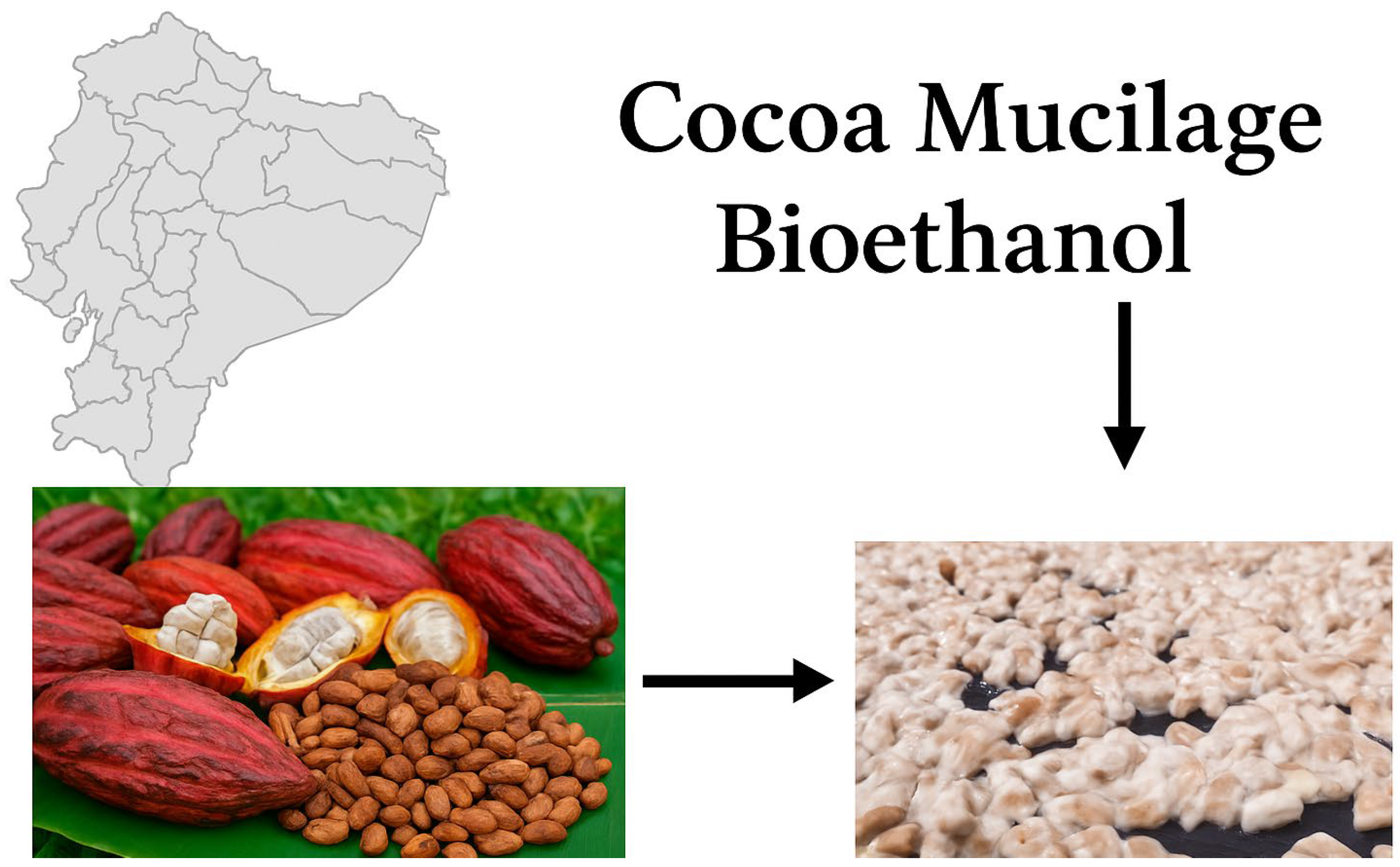
Figure 1. Initial fermentation of cocoa beans (CCN51 variety) in collection centers of Los Ríos province, Ecuador. Fresh mucilage is obtained prior to the final drying of the seeds.
Energies 18 06378 g001
Figure 2. Methodological process: Cocoa mucilage CCN51 collection and fermentation, distillation, E5–CCN51 blend formulation, physicochemical description, and internal combustion engine evaluation.
Energies 18 06378 g002
Figure 3. Selected test route in Quito (24.8 km), including urban and extra-urban sections with representative slopes and curves.
Energies 18 06378 g003
Figure 4. Fermentation curve of cocoa mucilage (CCN51 variety). Axis Y represents the 21 days of the test, and Axis X shows the °Brix evolution.
Energies 18 06378 g004
Figure 5. Power curves obtained with Super gasoline, Extra gasoline, and Biofuel E5 during the first and second tests under real driving conditions.
Energies 18 06378 g005
Figure 6. Specific fuel consumption (Symbol of Be/Unit g/lWh) as a function of power for Super gasoline, Extra gasoline, and E5–CCN51 blend during the first and second tests under real driving conditions.
Energies 18 06378 g006
Figure 7. Variation in energy efficiency (%) as a function of fuel type: Super gasoline, E5–CCN51 blend, and Extra gasoline.
Energies 18 06378 g007
Figure 8. Variation in exergy efficiency (%) as a function of fuel type: Super gasoline, E5–CCN51 blend, and Extra gasoline.
Energies 18 06378 g008
Figure 9. Sankey diagram of the engine energy balance for Super, Bioethanol E5, and Extra fuels.
Energies 18 06378 g009
Figure 10. Comparative profile of average CO emissions (% vol.) at idle (700 rpm) and accelerated mode (2500 rpm) for Extra, Super, and CCN51 bioethanol blends in the Hyundai i10 engine.
Energies 18 06378 g010
Figure 11. Comparative profile of average Lambda values (–) at idle (700 rpm) and accelerated mode (2500 rpm) for Extra, Super, and CCN51 bioethanol–gasoline blends in the Hyundai i10 engine.
Energies 18 06378 g011
Figure 12. Comparative profile of average CO2 emissions (% vol.) at idle (700 rpm) and accelerated mode (2500 rpm) for Extra, Super, and CCN51 bioethanol blends in the Hyundai i10 engine.
Energies 18 06378 g012
Figure 13. Comparative profile of average O2 concentration (% vol.) at idle (700 rpm) and accelerated mode (2500 rpm) for Extra, Super, and CCN51 bioethanol blends in the Hyundai i10 engine.
Energies 18 06378 g013
Table 1. Physicochemical properties of commercial Ecuadorian gasolines and the E5–CCN51 blend derived from cocoa mucilage.
TESTStandard/MethodE5–CCN51 BlendSuperExtraUnit
Lower heating valueASTM D4809-18 [29]45.21847.12445.882MJ/kg
Octane number (RON)NTE INEN 2102 [37]85.89285-
Distillation temperature (90%)ASTM D86-15 [30]164190189°C
Distillation temperature (50%)ASTM D86-15 [30]10790120°C
Distillation temperature (10%)ASTM D86-15 [30]54.15070°C
Reid vapor pressureASTM D323-15a [49]56.015860kPa
ResidueASTM D86-15 [30]1.011.12%
Gum contentASTM D381 [35]343mg/100 mL
Sulfur contentASTM D4294 [34]0.0590.0650.065%
Final boiling pointASTM D86-15 [30]210218220°C
Copper strip corrosionASTM D130-12 [50]1a1a1a-
Disclaimer/Publisher’s Note: The statements, opinions and data contained in all publications are solely those of the individual author(s) and contributor(s) and not of MDPI and/or the editor(s). MDPI and/or the editor(s) disclaim responsibility for any injury to people or property resulting from any ideas, methods, instructions or products referred to in the content.