Review

Emerging Issues of Corrosion in Nuclear Power Plants: The Case of Small Modular Reactors

by
Dagmara Chmielewska-Śmietanko
* and
Bożena Sartowska
*
Institute of Nuclear Chemistry and Technology, Dorodna 16, 03-195 Warsaw, Poland
*
Authors to whom correspondence should be addressed.
Energies 2025, 18(24), 6376; https://doi.org/10.3390/en18246376 (registering DOI)
Submission received: 5 June 2025 / Revised: 28 August 2025 / Accepted: 2 December 2025 / Published: 5 December 2025

Abstract

There has been increasing interest in deploying Small Modular Reactors (SMRs) due to their simplicity, enhanced safety features, and economic advantages, which may facilitate the transition from coal to nuclear energy. However, the revival of nuclear power today depends on reactors meeting long-term operational security requirements, which can lead to optimized costs for nuclear energy and greater public acceptance. Therefore, it is crucial to demonstrate best practices in the operation, reliability, and stability of the systems and materials used in construction to ensure that nuclear power plants can operate safely over extended periods. Corrosion remains a critical factor affecting the safe operation of these plants. While corrosion issues have been extensively studied in traditional nuclear reactors that use water as a coolant, advanced reactors employing non-water coolants—such as liquid metals or molten salts—present new corrosion challenges. This work aims to present the various sources of corrosion in different SMR cooling systems, along with the results of corrosion processes. It also discusses the challenges related to materials used in multiple SMR designs and highlights advancements in the development of new materials suitable for use in SMRs.

1. Introduction

Small Modular Reactors (SMRs), designed to generate electric power of up to 300 MWe, have gained significant interest in recent years. These projects offer numerous advantages, including simplicity that leads to shorter construction times and reduced costs, easier transport, improved quality due to standardized construction elements, enhanced safety, a smaller ecological footprint, and a lower environmental impact [1]. A small SMR system is characterized by its limited power capacity, size, and cost. Safety in SMRs is a priority, as they are designed to minimize the frequency of severe accidents and their radiological consequences. The area that needs to be controlled is confined to the boundary of the SMR building or a defined area around it. The modular construction approach allows SMRs to be manufactured in modules at a factory, reducing the scale of construction work required at the installation site [2]. The potential use of SMRs for converting coal plants to nuclear plants is an attractive option [3]. SMRs are anticipated to play a significant role in the future of nuclear energy. They have promising applications, such as providing off-grid heat and power to replace diesel generators in mining regions, serving as a fossil fuel alternative for district heating, and supplying high-temperature heat for heavy industries. Additional uses include the production of ammonia, potash, hydrogen, and clean steel, as well as generating heat, electricity, and facilitating desalination [4]. SMR technologies, utilizing various design concepts, are being developed globally. These reactors are driving innovation within the nuclear sector, leading to advancements in fundamental research, new concepts, and operational methods. Innovations encompass improvements in existing light water reactor technologies and the development of advanced Generation IV reactors. Various configurations and construction methods for SMRs are possible, incorporating new materials, different coolants, and alternative fuels [4]. Some advanced reactors, such as sodium-cooled fast reactors (SFRs), molten salt reactors (MSRs), and high-temperature gas reactors (HTGRs), provide outlet temperatures suitable for producing process heat in the chemical and petrochemical industries [4,5,6]. However, there are also emerging challenges associated with SMRs. Some issues that have been identified and addressed in conventional-size nuclear power reactors, which utilize standard water technologies, will also arise in SMRs that employ these methods. It is expected that SMRs utilizing proven LWR technology will be more easily accepted by regulators and, as a consequence of their licensing, will be less challenging [7]. But up to now, the lack of established licensing processes and frameworks, as well as gaps in legal and regulatory procedures, have been the actual problem [2]. Safety considerations are crucial when it comes to the operation of nuclear reactors and, consequently, nuclear power plants. There are many established methods and regulations related to this issue. Some of these include active and passive safety measures, physical security protocols, and various control procedures. Safety concerns are closely linked to waste management and environmental issues. The operation of nuclear reactors, including Small Modular Reactors (SMRs), results in the production of radioactive waste. The waste streams generated by SMRs may have distinct (radio)chemical properties compared to those from traditional nuclear reactors. Furthermore, it has been emphasized that the volume of waste produced by SMRs will be greater than that generated by conventional nuclear power plants [8].
The start-up and shut-down processes of a nuclear power plant are critical considerations. These involve various operational phases, including plant commissioning with hot functional testing, starting up the plant after an extended shutdown, and decommissioning the plant [6]. Site selection for nuclear reactors involves a thorough assessment of geological, ecological, and demographic factors. Choosing the right location is not just about finding a suitable spot; it also focuses on ensuring the plant’s longevity and sustainability [9]. Site selection is a crucial decision for integrating Small Modular Reactors (SMRs) into a regional energy system. Zhang and colleagues [9] identified several factors to consider during the siting process, including the following: (i) natural factors, which encompass geographical, geological, and meteorological elements; (ii) environmental factors, addressing both radiological and non-radiological issues; (iii) socio-economic factors; (iv) safety factors, which account for proximity to hazardous facilities and the safety of the surrounding area.
Furthermore, the introduction of advanced cooling designs, such as molten salts or helium gas, brings about entirely new chemistry in cooling systems, which is closely related to corrosion issues. While water chemistry and corrosion problems in nuclear reactors using water as a coolant have been well studied, our understanding of the corrosion processes and their prevention in new advanced reactors remains limited. This lack of knowledge is due to the scarcity of practical studies and the low maturity of these technologies.
Corrosion is the process that occurs when material components interact with their surrounding environment, leading to structural degradation and deterioration. Additionally, some corrosion products can become activated in neutron flux, forming radionuclides that pose potential hazards to both the staff at nuclear power plants (NPPs) and the environment if released.
Currently, enhancing the safety and reliability of nuclear power plant (NPP) operations is of utmost importance. A comprehensive set of guidelines on coolant chemistry and corrosion control has been developed and implemented, alongside continuous advancements in the construction materials used for NPPs. Additionally, there has been progress in monitoring, modeling, and controlling material corrosion. To mitigate corrosion of NPP structural materials and eliminate radioactive corrosion products, various solutions have been introduced. Given the current trend towards extending the lifespan of NPPs, it is crucial to address corrosion issues effectively.
Corrosion mechanisms in nuclear power plants (NNPs) are quite complex, with several factors contributing to the issue. Some aspects of corrosion can be linked—either directly or indirectly—to the radiation emitted from the reactor core, which affects both fuel and construction materials, as well as to water radiolysis. The harsh environment of a nuclear reactor, characterized by elevated temperatures, high pressures, and the aggressive chemistry of the coolant, creates favorable conditions for corrosion processes. These factors significantly impact the stability of fuel cladding and the resistance of construction materials used in the cooling circuit.
Furthermore, while the chemistry of water—which remains the most commonly used coolant in nuclear reactors—is well understood and has been extensively studied, new advanced reactor designs are beginning to incorporate different cooling agents. Although efforts are made to predict the potential corrosion problems associated with these new solutions, practical studies are still lacking due to various challenges in implementing these technologies.
The main strategy for reducing corrosion involves selecting appropriate construction materials, ensuring proper coolant chemistry, and implementing corrosion control measures. The use of various cooling agents in different nuclear reactor designs has led to differences in how this strategy is implemented, which are discussed in more detail in this work.

2. Corrosion Processes in Nuclear Reactors

Corrosion is a natural process that involves the deterioration of materials due to chemical or electrochemical reactions with their environment. This process can negatively impact a material’s useful properties, structure, and appearance. There are different types of corrosion based on the mechanism involved, including electrochemical, chemical, and biochemical corrosion (not covered in this text). One common method for measuring the effects of corrosion is the weight loss method.
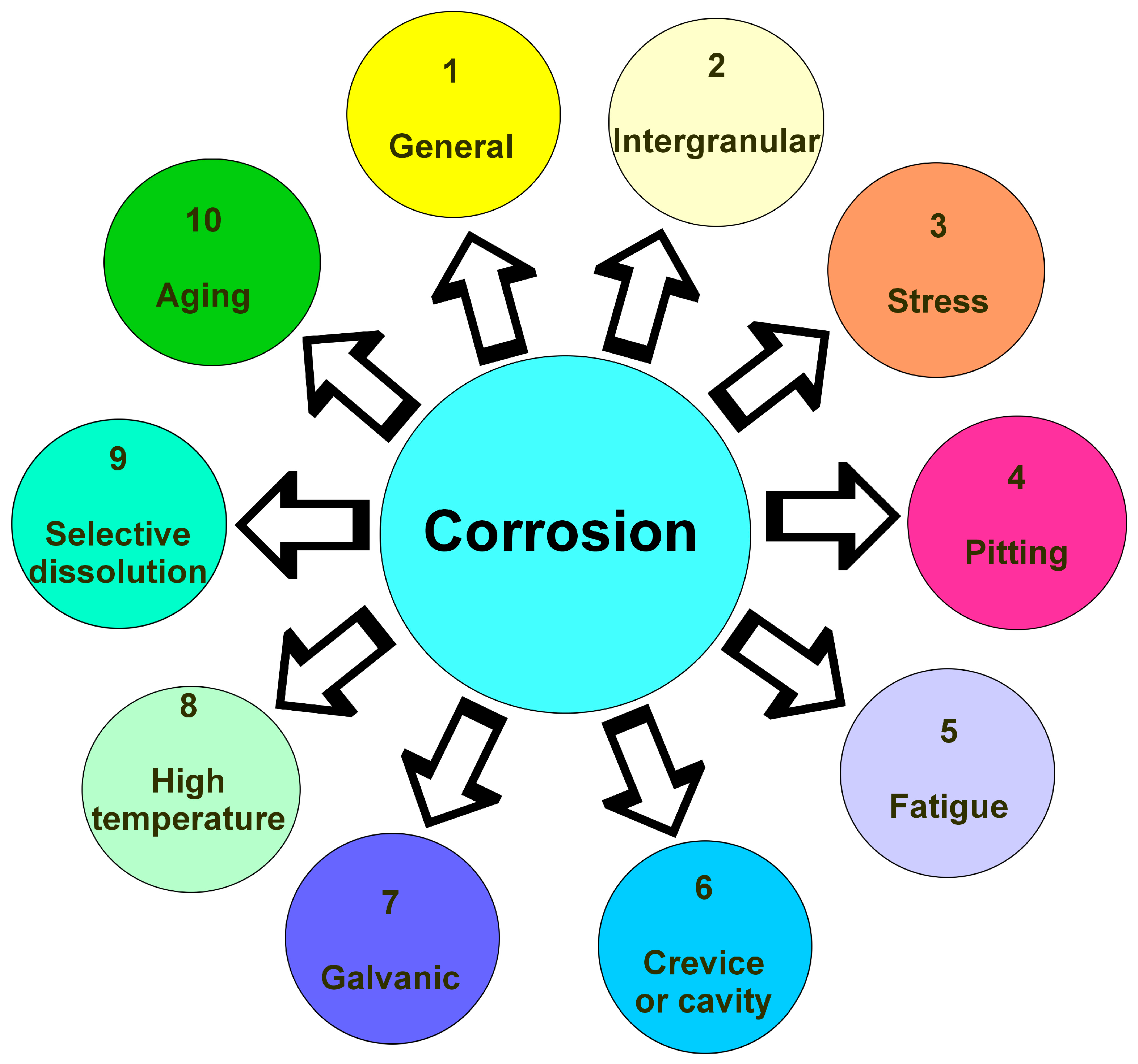
The defined types of corrosion are shown in Figure 1 and they vary in the origin and mechanism involved:
  • This involves a uniform loss of metal across the entire surface.
  • This occurs at the boundaries of material grains, leading to localized corrosion.
  • This happens when a material is exposed to both stress and a corrosive environment, which may lead to stress corrosion cracking (SCC).
  • This is characterized by localized dissolution of material, resulting in the rapid formation of holes.
  • This is a type of material failure that arises when a material is subjected to repeated stress while simultaneously being exposed to corrosion. This can lead to cracks and eventual structural failure.
  • This develops in areas where flow is restricted, often occurring in spaces with limited access to working fluids.
  • This results from the contact between two different metals that are in contact with the same corrosive medium. The less noble metal corrodes more quickly when in contact with the more noble metal (which is protected).
  • This refers to the chemical deterioration of a material due to elevated temperatures.
  • This occurs when a specific alloying element or alloy phase dissolves preferentially under certain conditions.
  • This refers to the changes (for better or worse) in the properties of a material, structure, or system over time or with use.
Some metals exhibit greater resistance to corrosion than others or have naturally slow reaction kinetics. Examples include zinc, magnesium, and cadmium. Graphite is another example; it releases a significant amount of energy in oxidizing conditions, though at a very slow rate. However, these materials still must be specifically designed for use in nuclear reactors. Passivation is the process by which a thin layer of corrosion products is created on the metal’s surface, effectively acting as a barrier to further oxidation [10,11].
Choosing the appropriate quality of materials for specific environments is crucial for the long-term performance of these materials. Several treatments can be applied to slow down corrosion processes on metallic objects exposed to harsh conditions, such as through weather, saltwater, or acids.
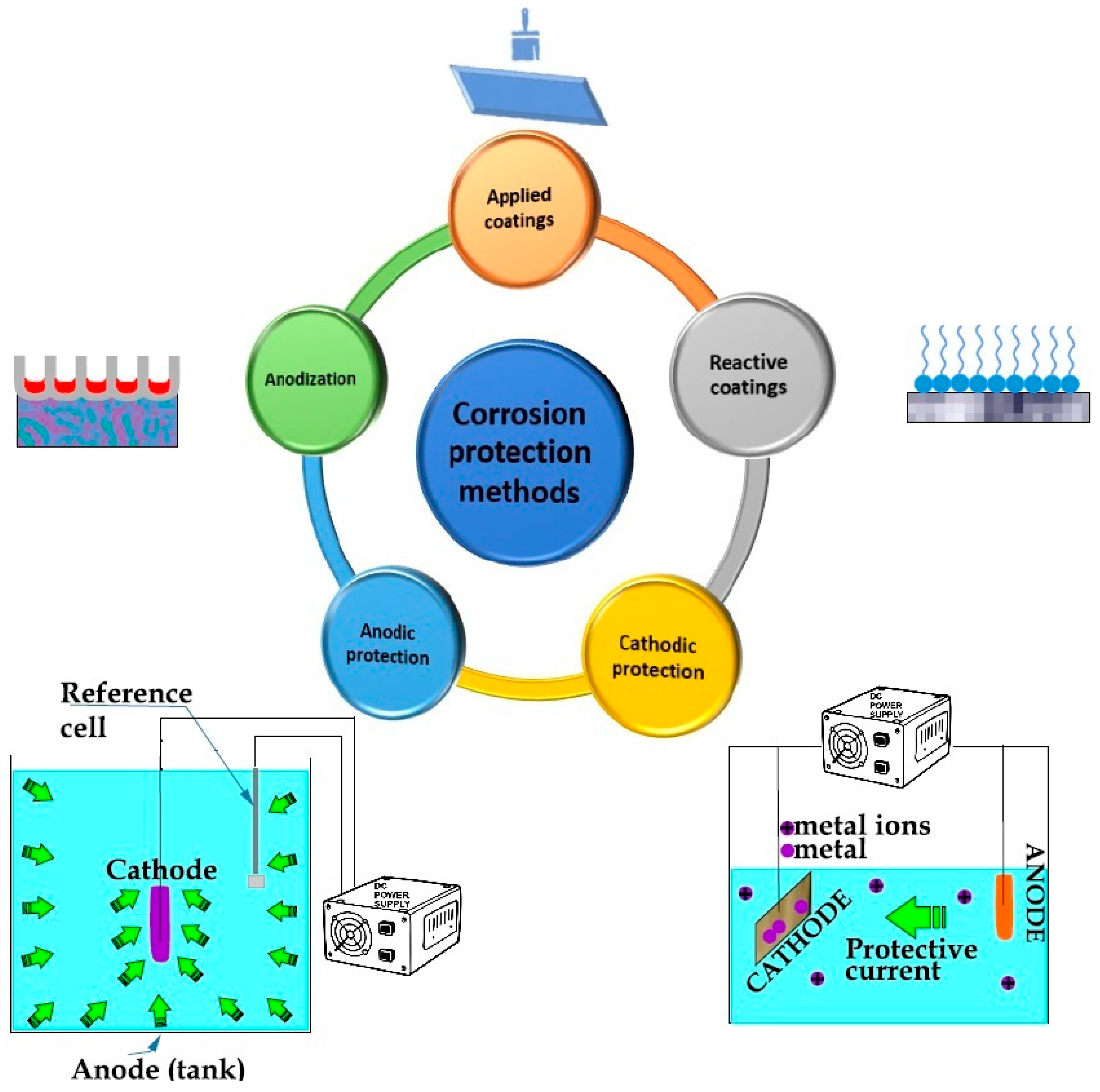
The following corrosion protection methods can be utilized (Figure 2):
  • Applied coatings techniques like plating, painting, and enamel application serve as barriers made of corrosion-resistant materials between the environment and the structural material.
  • Corrosion inhibitors can be added to create an electrically insulating reactive coating on metal surfaces.
  • In the anodizadion process uniform pores appear in the oxide film on metals under electrochemical conditions, making the oxide layer thicker than the passive layer.
  • In cathodic protection the metal surface acts as the cathode in an electrochemical cell. This approach is widely employed to safeguard steel pipelines, tanks, pier piles, ships, and offshore oil platforms.
  • In anodic protection the metal surface serves as the anode in an electrochemical cell.
It is important to note that some elements found in coatings or materials used in nuclear reactors, such as Fe, Co, Cu, and Ni, can be activated by neutron flux and produce radioactive isotopes.
Many systems, structures, and components in nuclear power plants are expected to endure harsh environments for extended periods. Therefore, understanding, controlling, and mitigating material degradation processes is crucial for the safe operation of nuclear power plants.
At high temperatures—specifically above 0.5–0.6 times the melting temperature (TM)—the annealing of lattice defects can recover from radiation damage. Helium can diffuse to grain boundaries, where it may form bubbles that reduce the strength of these boundaries and decrease elongation. This phenomenon, known as helium embrittlement, may limit the maximum operational temperature of materials [12].
Figure 2. Corrosion protection methods (adopted on the basis of [13,14,15]).
Energies 18 06376 g002
There are five key effects of irradiation degradation:
  • Low-temperature radiation hardening and embrittlement.
  • Radiation-induced segregation and phase stability.
  • Irradiation creep.
  • Void swelling.
  • High-temperature helium embrittlement.
Corrosion and stress corrosion cracking in water-cooled and advanced reactors are significant considerations for selecting structural materials. The radiation damage caused by nuclear energy reactions is quantified using displacements per atom (dpa) [12]. Neutrons are the main source of radiation damage to structural materials used in reactor core fuel cladding and assembly components. Typical level of displacement damage exposures in fuel cladding reaches about 15 dpa. Over a span of 40 years, the cumulative displacement damage in core internal structures may approach 80 dpa. This radiation damage can lead to microstructural changes, including the formation of dislocation loops, precipitates, voids, and radiation-induced segregation. These changes impact mechanical properties such as strength, hardness, ductility, fracture toughness, and embrittlement, as well as creep and fatigue. Neutron irradiation can cause hardening due to the formation of nanoscale defect clusters that impede the motion of dislocations. A reduction in elongation and fracture toughness is also observed, particularly in body-centered cubic materials like ferritic and martensitic steels. The primary effect of gamma ray irradiation is heating and alterations in water chemistry. Gamma rays cause the radiolysis of water and the creation of radicals, which can increase corrosion potential. Radiation-induced phases may develop in initially single-phase austenitic stainless steel due to localized radiation-induced segregation processes during neutron irradiation. Irradiation creep and irradiation growth can lead to dimensional changes, where irradiation growth is particularly significant in anisotropic crystallographic systems, resulting in expansion in one direction and shrinkage in another. Two categories of irradiation effects are identified: water chemistry (radiolysis) and microstructure changes (segregation, microstructural changes, swelling, and creep). Irradiation alters the composition near grain boundaries, often leading to chromium depletion and nickel and silicon enrichment, which are important factors in irradiation-assisted stress corrosion cracking (IASCC). Irradiation also modifies the microstructure. Radiation hardening induces highly localized deformation, and irradiation can relieve macrostresses while enhancing local dynamic deformation. Swelling and the formation of new phases may increase the risk of IASCC at high fluence levels. IASCC-resistant austenitic alloys are characterized by high contents of nickel and chromium, the presence of silicon, the absence of brittle inclusions, and grain boundaries with chromium carbides. Both austenitic stainless steel and tempered martensitic steel exhibit radiation-induced increases in yield and tensile strength. Moreover, a reduction in elongation and decrease in strain hardening are observed as well. Promising candidates for materials used in the nuclear industry are also ferritic or ferritic–martensitic alloys because their resistance to radiation effects and intergranular stress corrosion cracking (IGSCC) is higher [12].

3. Cooling Agents

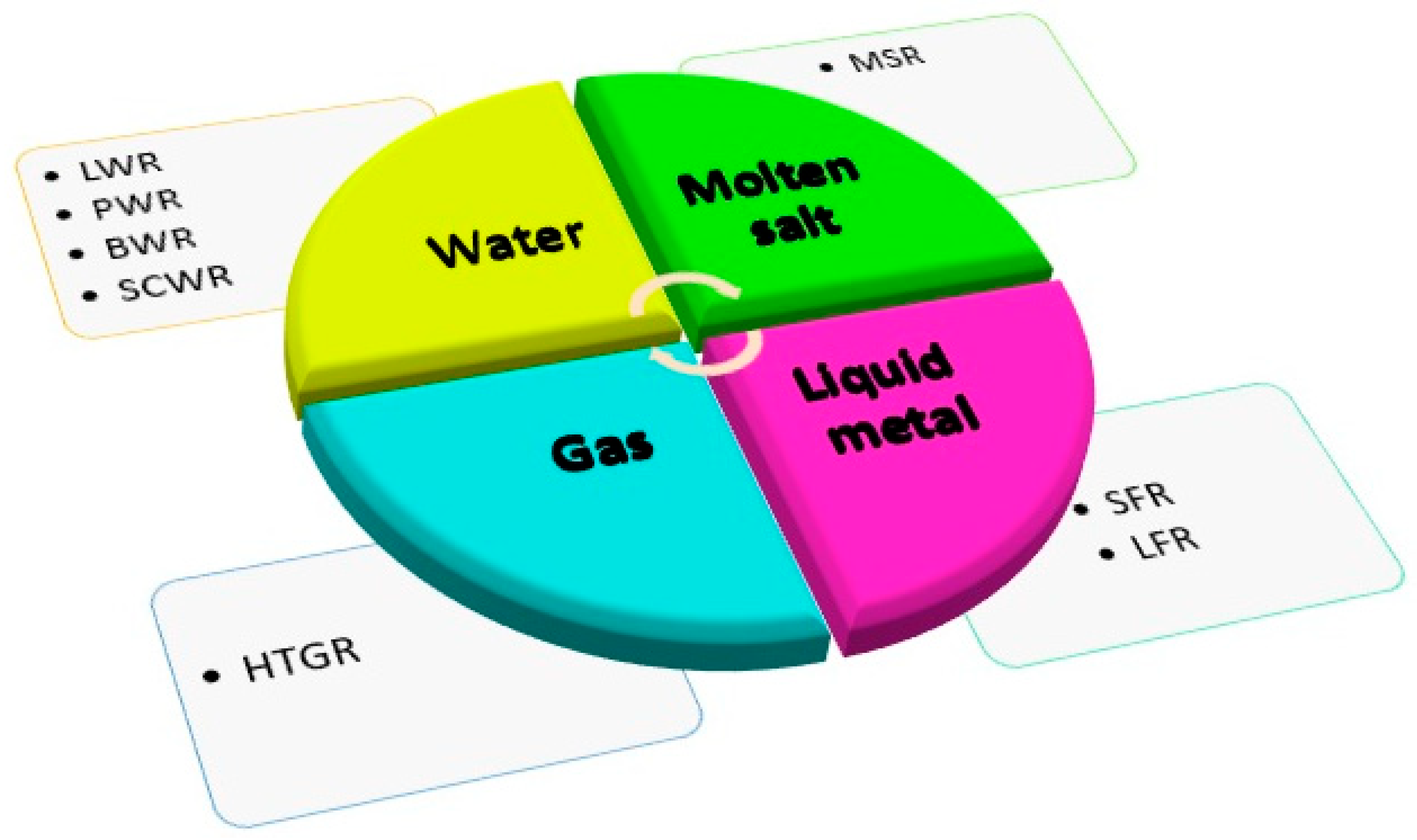
Generation III SMRs are built on the proven technology of large-scale nuclear reactors that are currently in operation around the world and cooled with water. In contrast, Generation IV SMRs feature designs that utilize cooling agents other than water, aiming to enhance their applications, safety, and cost-effectiveness. The different types of coolants used in various SMRs are illustrated in Figure 3.

3.1. Small Modular Reactors Cooled with Water

Some Small Modular Reactor (SMR) designs are developed by scaling down conventional technologies that use water as a coolant. In these designs, corrosion processes are well understood, and significant experience has been gained over the years, leading to valuable lessons being applied to their foundations. Currently, SMR designs based on conventional technologies are considered the most advanced. Effective water quality management is crucial for the safe operation of nuclear reactors. Therefore, several water parameters are continuously monitored during the operation of NPPs. The number of guidelines and strategies has been elaborated to monitor and control of water chemistry in the primary cooling circuit [16,17,18].
The most important parameters include the pH and conductivity of cooling water [19]. Regularly measuring conductivity is an effective method for detecting increase in the concentration of ionic species. It is also used to assess whether the water quality favors corrosion. Boric acid is added to the primary coolant to control neutron flux; however, this results in an acidic pH that favors the formation and transport of corrosion products which can be deposited in the form of the “crud” [20]. This crud can absorb neutrons, reducing the reactor’s power output. In contrast, lithium hydroxide (LiOH) is used to increase the pH of the primary cooling circuit, which helps limit crud formation [21]. However, higher concentrations of lithium can cause corrosion of zirconium alloy fuel cladding. To address these issues, several strategies have been proposed. One approach involves maintaining an elevated pH in the coolant to decrease the dose rate. Another concept suggests operating without soluble boron to minimize corrosion caused by boric acid [22]. Ammonia has been suggested as a substitute for boron. During ammonia radiolysis, hydrogen is produced, which can be used to remove dissolved oxygen from the coolant and to suppress water radiolysis [23]. The concentration of ammonia and the temperature of the water are key factors that influence pH. The replacement of LiOH with potassium hydroxide (KOH) has been considered in boron-free operations. This option was also proposed for Small Modular Reactors (SMRs) due to its economic advantages and the abundance of the material. Previous studies have validated this approach in VVER reactors, and recent research confirms that there is no observed negative impact on corrosion resulting from this substitution [24,25].
In some NPPs, seawater is used as a cooling agent. This water is characterized by its high conductivity, which results from various soluble cations and anions. Even pure water contains some impurities due to corrosion of materials within the system. To eliminate these contaminants and maintain the appropriate level of conductivity, various purification systems are employed [26].
Harsh operating conditions in water nuclear reactors, with temperatures ranging from 280 to 320 °C and pressures of 150 bars, significantly influence corrosion processes due to the interaction of structural materials with the high-temperature reactor coolant. As a result, oxide films form on the structural materials of NPPs, including stainless steels and nickel-based alloys. The outer layer of these films tends to bind to the ions present in the coolant. Cobalt-60 is the main contributor to the shutdown of a nuclear reactor due to the increased irradiation dose rate it causes, which poses a serious threat to the NPP staff. Cobalt-59 reacts with insoluble iron oxide particles, which form crud. Cobat-60 is produced by the activation of stable cobalt-59, which can be found in the alloys used for constructing pressurized water reactors (PWRs), either as an impurity (for example, in stainless steel and Inconel) or as a primary component in hard-facing alloys like Stellite [27].
One extensively studied method for preventing corrosion in PWR systems is the injection of zinc into the reactor coolant [28]. Zinc serves a dual purpose in corrosion prevention [29]. First, it alters the properties of the deposited crud on the oxide layers. Zinc is incorporated into oxide films and can replace elements like nickel, cobalt, and iron that are present in the absence of zinc. This substitution significantly changes the composition and structure of the crud, and studies have shown that the addition of zinc leads to a notable reduction in both the size and quantity of oxide particles. Additionally, zinc positively impacts the electrochemical corrosion of steel by shifting the corrosion potential of steel toward more positive values and decreasing its corrosion current density after prolonged exposure to high-temperature coolant solutions [30]. When the zinc concentration exceeds 10 parts per billion (ppb), it substantially lowers the concentration of radioactive corrosion products such as Co-60, thereby reducing radiation exposure for the staff at NPPs [31].
The advanced design among reactors cooled with water is the supercritical water-cooled reactor (SCWR) which belongs to Generation IV of nuclear reactors. The critical point of water occurs at 374.4 °C and 22.1 MPa. At temperatures above 374.4 °C and a pressure of 22.06 MPa, water enters a physical state known as a supercritical fluid. In this state, water lacks hydrogen bonds. Supercritical water can serve as a solvent medium and as a catalytic material for chemical reactions. Its high temperature facilitates the hydrolysis of compounds, and in the presence of oxidants, it becomes a powerful oxidizing medium. Under extreme pressures, oxygen is completely miscible with supercritical water, which enhances its capacity as an oxidant and increases its corrosiveness. Operating in supercritical water conditions necessitates specialized equipment [32,33].
The SCWR system operates at a pressure of 25 MPa and uses water as both the coolant and moderator. The mass flow rate to thermal power ratio in an SCWR is lower compared to PWR and BWR. The SCWR experiences a higher fuel temperature rise during a loss of flow accident (LOFA) and has a quicker depressurization process during a loss-of-coolant accident (LOCA).

3.2. Molten-Salt-Cooled Small Modular Reactors

Several Small Modular Reactor (SMR) designs based on salt-cooled high-temperature nuclear reactor technology are currently under development [34]. According to technological data, these reactors will be cooled by a stable mixture of lithium fluoride and beryllium fluoride salts or molten fluoride salts. This approach is expected to enhance the safety of nuclear reactors by eliminating the risk of core meltdown, which can be a significant issue with traditional water-cooled reactors. Molten salts operate at high boiling points, allowing nuclear reactors to function at lower pressures—near ambient pressure—while achieving higher temperatures compared to conventional water-cooled designs [34]. Additionally, the high volumetric heat capacity of molten salts can provide greater thermal efficiency. Another advantage is the high solubility of most fission products in these salts. Despite these attractive features, corrosion issues in molten salt reactors are more challenging than those in water-cooled ones. When using molten salt as a coolant, several factors influencing corrosion must be considered, such as temperature, impurities present in the salts, and the corrosion behavior of different alloys. Materials used in high-temperature processes tend to form protective surface oxide films, incorporating elements like Cr, Al, or Si into the alloy [35]. These elements react with moisture or air to create a protective layer that enhances the material’s resistance to corrosion. Unfortunately, oxides and fluorides can dissolve in molten fluoride salts, rendering these oxide films chemically unstable.
The redox potential of a material indicates its tendency to undergo oxidation or reduction, which can ultimately lead to corrosion. When evaluating redox control, it is crucial to consider both the direct effects of oxidation from activation reactions and the indirect effects of shifts in redox potential on corrosion rates. These rates can be particularly influenced by temperature gradients in a flow loop. Research into metal corrosion in fluoride salt-cooled high-temperature reactors (FHRs) should take into account the lithium isotopic composition of the salt, all activation reactions that contribute to changes in redox potential, and remaining sources of oxidants. Moreover, the total surface area of the metal, which is in contact with the salt, also plays important role [36].
Pure fluoride salts serve as reducing agents, which helps limit their corrosive effects on surrounding materials. However, impurities in the salt can elevate the redox potential, making the mixture more oxidizing. Dissolved cations such as Ni, Fe, and Cr in the molten salt can act as potential oxidants, although their redox potential varies with concentration. Temperature plays a significant role in the corrosion process since the solubility of fluoride corrosion products in molten salts is strongly dependent on temperature. The mass transport of these corrosion products is driven by temperature differences between the hot and cold sections of a system. In the hotter areas, alloy components are leached, eventually reaching saturation in the salt on the cooler side. This process leads to solid nucleation and diffusion into the structural material of the cooler section, resulting in the formation of a layer. Consequently, corrosion products dissolved in the higher temperature areas may partially deposit in the relatively cooler regions. This causes mass loss and corrosion of the structural material in the hot section of the cooling loop, while deposits accumulate in the cold section. For instance, when Ni impurities were present in molten salt, the formation of BeCr2O4 was observed on the surface of the alloy in the cold section but not in the hot section [37].
Moisture is one of the most common and harmful impurities found in molten salts, as it readily reacts with fluorine ions to produce oxide impurities and highly corrosive hydrofluoric acid [38,39]. Oxide impurities within molten salts can include O2, which is introduced through contamination by oxygen and water. While O2 does not oxidize metals, it can still impact structural materials due to the formation of oxide corrosion products [40].
Corrosion in such nuclear reactors can lead to the thinning of structural components, with corrosion products potentially depositing in cooler sections of the reactor system since their solubility is highly temperature-dependent [41]. Another critical issue in reactors cooled with molten salts is the generation of tritium, which is produced by the irradiation of lithium in molten salt containing lithium fluoride (LiF) [42,43]. Tritium is a radioactive form of hydrogen that can easily permeate structural materials, allowing it to escape the reactor system.

3.3. Liquid Metal-Cooled Fast Reactors

Several reactors of this type have been constructed worldwide, and numerous new designs involving sodium, lead, or lead–bismuth eutectic as the coolant are currently under development [44]. Generation IV reactors offer several advantages over conventional water-cooled reactors. For instance, the Sodium Fast Reactor (SFR) achieves a significantly higher outlet temperature of around 550 °C, which results in improved thermal efficiency for energy conversion. Additionally, the absence of a neutron moderator permits the use of fast neutrons for the nuclear fission reaction and enables the utilization of mixed oxide (MOX) fuel, which includes transuranic isotopes for power generation. Notably, this reactor can produce plutonium from U-238, allowing for more efficient use of uranium and reducing the amount of radioactive waste produced [44,45]. On the downside, a closed fuel cycle is recommended to meet nonproliferation requirements, ensuring that materials that could be used in nuclear weapons are not produced. However, it is important to note that in this process, plutonium is not separated from the uranium and minor actinides [46].
Sodium has been proposed as the cooling agent in this type of nuclear reactor for several reasons. Firstly, it has a small cross-section for collisions with neutrons, meaning that it does not hinder neutron movement as they pass through the coolant [46]. Additionally, sodium has high thermal conductivity and can function at low pressures, as its boiling point is higher than the temperatures used in the reactor. This characteristic allows for high power density with a low coolant volume fraction [47]. Sodium is found in many minerals, making it one of the most abundant elements in the Earth’s crust. However, it does have significant drawbacks. Its high reactivity when in contact with air can lead to ignition, producing toxic aerosols of sodium oxide. Furthermore, sodium reacts vigorously and exothermically with water, generating sodium hydroxide and hydrogen, which poses an explosion risk [48]. As a result, monitoring and controlling the composition of the coolant is critical not only for preventing corrosion but also for enhancing safety during reactor operations.
Two main mechanisms contribute to corrosion in sodium cooling loops. The first involves the dissolution of alloy elements into the sodium, while the second pertains to chemical reactions between impurities present in the sodium and the circuit materials [49]. When a temperature gradient exists in the system, the first type of corrosion is influenced by temperature, the temperature gradient itself, and the rates of dissolution and deposition of alloy constituents in the sodium loop. Consequently, a phenomenon similar to that seen in MSRs is also observed in SFRs. In the high-temperature sections, there is a reduction in component mass due to corrosion, while in the low-temperature areas, an increase in mass occurs as dissolved elements such as carbon, chromium, manganese, nickel, and silicon precipitate [50].
It was confirmed that the presence of nonmetallic impurities in sodium environments negatively affects both the short-term and long-term operation of SFR systems [51]. Sodium is a strong reducing agent and thus reacts easily with oxygen, forming various types of sodium oxides. Additionally, nitrogen, hydrogen, and moisture may be present in liquid sodium and can cross-react, leading to the formation of larger oxide particles. As a result, higher concentrations of suspended sodium monoxide particles can cause permanent blockages in restricted flow regions of a sodium loop [52]. Furthermore, research indicates that the oxygen concentration in the cooling system affects the corrosion behavior of certain alloys [53]. Many factors influence sodium-driven corrosion, including the sodium flow rate, temperature, exposure time, and alloy composition. The corrosion rate is strongly dependent on temperature and follows an Arrhenius-like function [49]. The influence of exposure time on the corrosion rate is similar to that reported for SFRs. After an initial phase, where the corrosion process accelerates, the rate gradually decreases to a steady-state level. The corrosion is observed to be more pronounced at higher sodium flow rates. However, once the flow rate reaches a certain threshold, no further increase in the corrosion rate is observed; this threshold varies based on the oxygen level in the cooling agent [54].
LFRs utilize lead or lead–bismuth alloy as coolant and operate with a fast neutron spectrum, offering fuel flexibility that supports closed fuel cycle options. One significant advantage of using lead coolant over sodium is its much higher boiling point. This allows LFRs to operate at elevated temperatures while providing greater safety margins. Additionally, unlike sodium, lead and lead–bismuth eutectic (LBE) do not react exothermically with water or air, which eliminates the risk of explosions. However, lead alloys are more corrosive to structural materials compared to sodium. Their high density and low thermal conductivity, coupled with the erosion of protective oxide layers, restrict possible flow rates of lead. This limitation impacts the total allowed power density and the time required to breed plutonium. Moreover, the high melting temperature of lead necessitates special measures to prevent it from freezing in the primary circuit [55]. Common steel alloying elements, such as nickel, iron, chromium, and silicon, have high solubility in lead and LBE at elevated temperatures, which constrains their use in LFRs [56,57].

3.4. Gas-Cooled Nuclear Small Modular Reactors

Gas-cooled nuclear reactors offer a number of advantages. Operating SMRs and those under development use helium as the cooling agent; therefore temperature at the outlet can reach 800 °C. This enables a higher-efficiency conversion of the core heat to electricity; thus these types of reactors can be utilized in many branches of industry, supplying heat. Nevertheless gas has a much lower heat capacity than liquids; therefore, it must be pumped at high velocity to effectively remove the heat from the reactor core. In consequence, the temperature gradient across the core is very high, typically 500 °C, and this creates challenges in the development of suitable resistant materials [58]. Moreover, this type of reactor is characterized by lower risk of coolant leaks due to low operating pressure and safe fuel designs such as pebble-bed or prismatic core designs that incorporate tristructural isotropic (TRISO) coated particle fuel. TRISO-coated particle fuel consists of particles encased in three layers of carbon and ceramic-based materials, which help prevent the release of radioactive fission products. High-temperature gas-cooled reactors (HTGRs) generate less high-level waste (HLW) per unit of energy and contain lower amounts of plutonium, while also providing cogeneration of energy. It should be noted that this kind of nuclear reactor is already in operation in China and in Japan; therefore corrosion issues can be monitored in real conditions. Helium, used as a coolant, is an inert gas that does not chemically react with other materials. Additionally, when exposed to neutron radiation, helium does not become radioactive, unlike many other potential coolants.
Therefore, the corrosion issues in high-temperature reactors (HTRs) are probably less critical compared to such issues in other nuclear reactors. Nevertheless it is important to take them into account adequately. Taking into account the high temperatures which are required in HTGR operation, the main technical challenges involve ensuring the durability of the fuel, cladding, and reactor structure at those elevated temperatures [58].
Also in this case, the problem of impurities present in cooling agents can be reflected in corrosion issues. The main impurities detected in helium include H2, CO, CH4, H2O, and CO2 [58]. They can originate from different sources. Some amounts of O2 and H2O are present in helium entering the core. In consequence oxygen reacts with hot graphite to form CO, while not all H2O can react with graphite to create H2 and CO due to slower kinetics of this reaction. Therefore trace amounts of H2O are still present in the helium. The CO2 resulting from degassing of the graphite reflectors is largely converted to CO through reaction with the hot core. Some part of hydrogen in the primary circuit is transported via diffusion reaction from the steam circuit. A part of hydrogen can react with the cooler parts of the core via a radiolytic reaction, resulting in the production of methane [59,60]. High-temperature hydrogen attack is caused by atomic hydrogen that diffuses into steel. It can react with dissolved carbon or metal carbides in defects of steel, producing methane. This leads to pressure build-up in the steel and formation of cracks. This decarburization process results in decrease in carbon present in steel and tensile strength loss [61]. The interaction with carbon species that are present as impurities in helium leads to the formation of unwanted carbon on the surface. At high temperatures, the carbon could separate from the surface and diffuse further into the metal [62]. In some materials containing chromium, such as stainless steel, this phenomenon can lead to reduced resistance. Another important issue that plays role in corrosion processes, especially in accident conditions, is oxidation of graphite which serves as the moderator in HTGRs [63]. It was confirmed that graphite oxidation under normal operating conditions does not affect graphite structural integrity [64]. Nevertheless, the amount of oxidizing gas entering the reactor core increases highly in accident conditions; the chemical reaction leading to the graphite corrosion is more pronounced and starts to be critical to graphite stability [65].
Moreover, the special design of reactor fuel particles called tristructural-isotropic (TRISO) particles was developed to be utilized in this kind of nuclear reactor and provide passive safety [66]. This type of fuel features a structural SiC layer which is resistant to combinatory effects of high temperature, irradiation, and oxidation [67]. The SiC layer withstands strong oxidation conditions in temperatures exceeding 1000 °C [68,69]. On the other hand, the circulation of spherical fuel elements in a pebble bed reactor leads to numerous interactions between the fuel elements and other graphite components, resulting in the production of graphite dust. These micron-sized graphite particles mix with the helium gas and can settle on various surfaces within the primary loop. This accumulation complicates maintenance and repair of the equipment and negatively impacts heat transfer [70].

4. Mitigation Measures in Cooling Systems to Prevent Corrosion

The mitigation of corrosion issues in various types of nuclear reactors typically follows a consistent approach. This involves managing and maintaining the appropriate chemistry of cooling agents and application of optimal operating conditions as well as developing and utilizing specially designed corrosion-resistant structural materials. The first reason for corrosion in water-cooled reactors relates to the radiolysis of water, which produces a variety of radioactive species. Some of these species exhibit reducing properties, while others have oxidizing characteristics that can contribute to radiolytic corrosion processes [70]. In the reactor coolant system, oxygen and hydrogen peroxide play a significant role in corrosion by shifting the electrochemical corrosion potential in a positive direction. Additionally, these two species are interdependent; if their concentrations become too high, the chain reaction that leads to the removal of oxidizing species can be disrupted [71]. To maintain the balance, excess molecular hydrogen, which supports the chain reaction, is dissolved in the primary coolant system of pressurized water reactors (PWRs). Researchers have studied various factors, including pH, temperature, and the concentrations of LiOH, Fe(NO3)3, Zn(NO3)2, hydrogen, and boric acid, to understand their influence on the water radiolysis process. They have found that the concentration of boric acid is a crucial parameter; higher concentrations of H3BO3 lead to increased formation of 10B(n,α)7Li, which negatively impacts the mechanism of water recombination with hydrogen [72].
The first stage of the corrosion process in MSRs is driven by the presence of impurities. However, when the impurities are consumed, corrosion slows down, but linear progress can still be observed in time, but further the corrosion is driven by the thermal gradient and other effects. Sources of impurities are different; some of them such as NiF2 and H2O are introduced in the processing and the transfer of molten salt, while others such as O2 come from leakage through some flanges. Moreover, CrF2, CrF3, FeF2, FeF3, NiF2, and MoF5, which are formed through the corrosion simultaneously, act as impurities [73,74]. Impurities originating from the processing and the transfer of molten salt can be consumed during reactor operation. However, leakage through flanges remains a continuous source of oxygen-containing impurities in molten salts [65]. A large number of different impurities can be present in molten salts, making these systems very complex [75,76]. Nevertheless, the quantification and identification of impurities present in clean FLiBe salt was performed and quantitative limits for salt purity were proposed on the basis of the outcomes [68]. Thus, monitoring and controlling the composition of molten salts is essential, as impurities in the cooling agent significantly contribute to the corrosion process. Therefore a purification step should be applied prior to use to ensure the highest purity and quality of these cooling agents. Different purification methods have been developed to meet these requirements. The most effective method reported for the purification of fluoride molten salts is the hydrofluorination process [77,78,79]. An alternative purification step is based on the electrochemical method [80,81].
The release of tritium from molten-salt-cooled reactors poses a significant risk to humans and the environment. Therefore, implementing mitigation measures is essential to address this issue. One potential solution is to use graphite pebbles with embedded coated particle fuel, similar to those used in high-temperature gas-cooled reactors (HTGRs), in fluoride salt-cooled FHRs with solid fuel and liquid salt coolants. The carbon in the graphite can absorb tritium. Additionally, using isotopically separated lithium-7, which has a very small neutron cross-section, can limit neutron absorption and tritium production. While the residual lithium-6 will partially burn out, it may never be completely eliminated if the salt also contains beryllium. In such cases, neutron reactions with beryllium can generate lithium-6, which is then converted into tritium. In this case neutron reactions with beryllium will generate liuthium-6 that is converted into tritium. The maximum acceptable tritium gas pressure in the primary system with metallic heat exchangers should not exceed 0.05 Pa. If it does, tritium concentration gradients through hot heat exchangers may facilitate the escape of tritium during operational conditions that exceed typical releases from nuclear reactors [82]. It has also been confirmed that graphite used in FHRs and thermal-spectrum molten salt reactors (MSRs) as a neutron moderator can absorb tritium. However, it is important to be cautious of potential issues in MSRs, where salt penetration into graphite can create hot spots, potentially accelerating damage in those areas [83].
Various systems are utilized to purify sodium in SFRs to mitigate corrosion processes and their detrimental effects on structural materials:
  • Cold traps are designed to reduce the solubility of impurities such as sodium oxide and sodium hydride by lowering the temperature to a point where these impurities precipitate and are captured in wire mesh located inside the trap [84,85].
  • Hot traps are crafted from strongly reducing metallic materials that form more stable oxides with the oxygen present in sodium, compared to sodium oxide [86]. Materials like zirconium foil or a suspended layer of granules can be employed in this process [87].
While these traps effectively remove tritium, iodine, and tellurium, other radioactive impurities require different elimination methods. Various sorbents, particularly those based on graphite or vitreous carbon, have been proposed to extract cesium radioisotopes [87,88].
Control of the impurities level in HTGRs is a tricky and complicated issue [89]. Even though cooling gas impurities are the main source of corrosion, it is recommended to control the impurity chemistry instead of purification of the coolant, while a low level of impurities is not always favorable to all alloys in the high-temperature environment. It was confirmed that the oxide scale, which is formed on the surface, helps protect alloys from internal corrosion under impure helium at elevated temperatures [90]. However, when the temperature increases the corrosion resistance of the oxide scale decreases [90,91,92]. It was confirmed that this process occurs in the atmosphere without CO; therefore it is critical to control the impurity ratio to form a protective oxide layer [89,90].

5. Materials

Corrosion issues in nuclear reactors have been extensively studied. Structural materials used in nuclear energy systems must resist both radiation damage and chemical effects. The design criteria for these materials are based on essential properties required in nuclear systems, such as tensile strength, creep resistance, and fatigue strength [4,8,12,15].
The severe accident at the Fukushima Daiichi nuclear power plant in Japan happened in 2011 when the cooling system failed due to a loss of power supply. This loss of cooling led to overheating, causing the cladding to react with water and produce a significant amount of hydrogen. The climax of this incident involved explosions and the melting of fuel. In the aftermath, scientists began to investigate alternative fuel types and cladding materials. There was a clear need for new materials that could withstand severe accident conditions. Improvements were necessary in the nuclear fuel composition, cladding integrity, and the interactions between fuel and cladding, all of which are critical for enhancing nuclear reactor safety.
Concepts for accident-tolerant fuel (ATF) and accident-tolerant materials (ATMs) were proposed, focusing on several key areas described in [93,94,95,96]:
  • Decreasing core enthalpy input;
  • Reducing hydrogen generation;
  • Improving cladding materials;
  • Enhancing containment control.
Research concentrated on the following subjects:
  • Developing non-zirconium cladding with high oxidation resistance and strength;
  • Enhancing the high-temperature oxidation resistance and strength of zirconium alloy cladding;
  • Exploring alternative fuel forms that offer improved performance and fission product retention.
One approach involves developing new materials for cladding. Important considerations for these materials include thermal neutron absorption cross-sections, radiation hardening and embrittlement, fuel–cladding interaction behavior, and oxidation behavior in steam at high temperatures. Examples of potential materials include stainless steel, FeCrAl alloys, refractory alloys (based on molybdenum, niobium, tantalum, and tungsten), and silicon carbide (SiC)/SiC matrix ceramic composites [94].
Another approach is to create protective coatings on zirconium alloys. When considering these coatings, factors such as the coefficients of thermal expansion of the coating and base material, as well as the regeneration of the coating, need to be addressed. Possible materials for coatings include silicon, chromium, FeCrAl, MAX phases, ceramics, and carbides [95,96,97,98,99].
Currently, there are no construction materials suitable for fuel cladding in a supercritical water reactor (SCWR). Various materials have been proposed, including ferritic/martensitic (F/M) steels, austenitic stainless steels, and nickel-based alloys. Research by Shen and others indicates that F/M-ODS (ferritic/martensitic–oxide-dispersion-strengthened) steels with low chromium (Cr) concentrations exhibit poor corrosion resistance, while those with high Cr concentrations demonstrate low ductility in supercritical water (SCW) environments [100]. Alloys with a face-centered cubic (FCC) crystalline structure, such as austenitic stainless steels and nickel-based alloys, show significantly lower corrosion rates compared to those with a body-centered cubic (BCC) structure, like F/M steels. The corrosion resistance of iron-based alloys is tied to the formation of a transport barrier for oxygen and metal created by iron and chromium oxides at the surface. Studies have shown that increasing chromium content in the alloy enhances corrosion resistance under nuclear SCW conditions [12]. The austenitic steel AISI 310 (composed of a maximum of 0.25% carbon, 24–26% chromium, 19–22% nickel, and 2.0% manganese) was developed for high-temperature corrosion-resistant applications, maintaining oxidation resistance up to 1100 °C. The stainless steel AISI 310S (with a maximum of 0.08% carbon) and alloy 800H (containing 30–35% nickel, 19–23% chromium, and 1.5% manganese) have been identified as promising cladding materials for SCW-SMRs. For materials intended for high-temperature nuclear environments, the oxide-dispersion-strengthened (ODS) method can be employed to improve mechanical strength and resistance to irradiation damage [101]. The Fe-Ni-Cr alloy 800, due to its resistance to oxidation, carburization, and other forms of high-temperature corrosion, can be widely applied at elevated temperatures. The alloy 800H, with a carbon range of 0.05–0.10 wt.%, and containing aluminum and titanium (0.30–1.20 wt.%), is certified for use in nuclear systems at temperatures up to 760 °C. Its microstructure typically includes TiN, TiC, and chromium carbides. However, both the 800H and 800HT alloys, like other austenitic alloys, may not resist intergranular corrosion at temperatures between 540 °C and 760 °C in aggressive environments [100]. Nickel-based alloys and austenitic stainless steels generally exhibit good corrosion resistance in SCW conditions but are prone to stress corrosion cracking (SCC). Intergranular stress corrosion cracking can occur in deaerated SCW at temperatures of 400 °C and above in both types of alloys. In contrast, ferritic–martensitic alloys demonstrate resistance to SCC at temperatures ranging from 400 °C to 600 °C [12]. Another candidate for cladding material is aluminum-forming austenitic (AFA) stainless steels. AFA steels offer excellent corrosion resistance at high temperatures due to the formation of an Al2O3 protective scale, as well as high strength via precipitation hardening [100]. They also exhibit promising properties concerning oxidation and creep resistance, along with good tensile strength and weldability. Studies involving irradiated AISI 316L stainless steel and nickel-based alloy 690 indicate a rise in intergranular cracking compared to their unirradiated counterparts. Under similar irradiation conditions, however, ferritic–martensitic alloys remain resistant to cracking [12].
Candidate cladding materials for reactors cooled by liquid metals include austenitic steels, ferritic/martensitic (F/M) steels, and oxide-dispersion-strengthened (ODS) steels [101,102]. Studies on the corrosion behaviors of certified materials, following American Society of Mechanical Engineers (ASME) guidelines, were conducted. Both F/M steels, HT9 (8.5% Cr) and T91 (11.5% Cr), demonstrated greater resistance to irradiation at 200 dpa compared to austenitic stainless steels. Silicon-added ASTM (8–10% Cr) steels, tested at 450–550 °C, showed improved corrosion resistance at low temperatures. For T91 (8–9.5% Cr) and HT9 (12.0% Cr, 1.0% Mo), an internal chromium-rich protective layer formed; however, liquid bismuth–lead (LBE) could penetrate into the chromium-depleted zone. In the case of the AISI 316L stainless steel (17–19% Cr, 13.5% Ni, 2.25–3.0% Mo, 2.0% Mn), dissolution occurred as LBE penetrated the metal substrate to a depth of approximately 300 µm [103].
Li and others developed ODS-FeCrAl ferritic steels with additions of silicon and alumina. The tested silicon-containing F/M steels and ferritic steels with aluminum exhibited radiation embrittlement due to the segregation of silicon and aluminum at grain boundaries, along with the formation of a chromium-rich phase. A hybrid fuel cladding tube has been suggested for both classes of alloys [104].
Refractory NbMoVCr multi-principal element alloy (MPEA) coatings on F/M steels were fabricated and tested by Yang and colleagues. They reported that NbMoVCr coatings with a body-centered cubic (BCC) structure demonstrated good structural stability up to 650 °C, and LBE corrosion resistance was noted due to the formation of a protective (CrV)2O3 layer. Vanadium, with its high oxygen activity, exhibited selective oxidation phenomena [105]. The formation of a passive oxide layer on corrosion-resistant alloys in reactors cooled with molten slats is thermodynamically impossible. The aggressive nature of alkali metal halide melts necessitates the use of materials with high corrosion resistance, such as functional materials suitable for molten salts. From a corrosion perspective, it is crucial for salt with redox potential to be far from areas that could lead to undesirable reactions. Hartman and colleagues analyzed chloride salt systems and structural materials, including nickel-based alloys from the Mo-Cr Hastelloy N family, ferritic–martensitic stainless steel, and the austenitic stainless steels AISI 304 and AISI 316 [106]. The authors highlighted the relationships between corrosion and the formation of CrCl2/CrCl3 for various alloys. They considered the stoichiometry and corrosion data of Hastelloy N, Inconel alloys, Incoloy, and stainless steel in the LiF-BeF2-ZrFe-UF4 salt. In austenitic steel, radiation-induced precipitation can reduce the levels of alloying elements such as Mn, Si, P, Cr, and Ni. Conversely, in ferritic–martensitic steel, irradiation leads to the formation of precipitates, such as carbides, that contain high concentrations of Cr, Mo, Si, W, and V. The decrease in the amount of alloying elements in the steel matrix can consequently diminish corrosion resistance [106]. The corrosion behavior of 12Cr18Ni10Ti steel, Hastelloy C2000 (60% Ni, 20% Cr, 15% Mo), and Monel 404 (50% Ni, 50% Cu) was investigated by Karfidov and others using a FLiNaK eutectic mixture. The corrosion resistance of the studied materials, when exposed to a eutectic FLiNaK melt containing cerium fluoride (acting as a surrogate for plutonium trifluoride) or neodymium fluoride (acting as a surrogate for uranium fluoride), was found to decrease in the following order: Monel 404 > Hastelloy C2000 > 12Cr18Ni10Ti. The addition of f-element fluorides increased local corrosion in the materials. Specifically, incorporating cerium fluoride into the melt led to additional etching of the 12Cr18Ni10Ti steel surface and a depletion of chromium at the surface. The addition of neodymium fluoride contributed to point and intercrystalline corrosion damage. Microanalyses of the Hastelloy C2000 samples revealed localized corrosion at the surface [107]. Corrosion in chloride salt systems is more complex compared to that in fluoride salt systems. Stable alloying metal chlorides of Cr, Mn, Fe, Co, Ni, and Mo can form, with the concentration of these metal chloride species depending on the redox conditions of the fuel, the microstructure of the containment alloy, the salt temperature, and time. Diffusion in structural alloys under molten salt reactor (MSR) operation temperatures (550–700 °C) occurs primarily along selected paths, with grain boundary diffusion being the dominant mechanism. In austenitic steel, radiation-induced precipitation decreases the concentration of alloying elements in the steel matrix, increasing susceptibility to corrosion. In ferritic–martensitic steel, irradiation fosters the formation of precipitates rich in Cr, Mo, Si, W, and V, which decreases the concentration of alloying metals in the ferritic steel matrix and reduces corrosion resistance [106]. Banerje and colleagues demonstrated that fluorapatite exhibits good structural stability against electron beam irradiation at doses of up to 20 MGy [108].
At the extreme operating temperatures found in gas-cooled reactors, graphite and ceramic composites are suitable candidates for structural materials. For components exposed to high levels of displacement damage or significant engineering stresses, ceramic composites should be preferred over graphite. Metals are still widely used for heat transfer components, where the high temperatures necessitate the use of nickel-based alloys that are rich in chromium (approximately 22 wt.%) and strengthened by additions of molybdenum, cobalt, and tungsten. Examples of such alloys include Inconel 617 (with compositions of about 44.5% nickel, 20–24% chromium, and 10–15% cobalt) and Haynes 230 (comprising 62% nickel, 22% chromium, 14% tungsten, and 2% molybdenum) [12].
For fuel, coated TRISO particles (which consist of tri-layer coatings made of buffer carbon, silicon carbide, and isotropic pyrocarbon) are utilized. A significant challenge for in-core nuclear graphite is high neutron irradiation damage, which can alter its mechanical and physical properties. In nuclear-grade graphite, radiation-induced creep results in a shrink-and-swell phenomenon along crystallographic orientations.
Ceramic composite materials, such as silicon carbide (SiC) and carbon-based ceramics, can be employed within the high-temperature gas-cooled reactor (HTGR) core because they can maintain their structural integrity even at temperatures exceeding 900 °C, as well as withstanding high neutron fluences and levels of damage. Composite ceramics, including carbon–carbon (C/C), silicon carbide–carbon (SiC/C), and silicon carbide–silicon carbide (SiC/SiC), are suitable for use in in-core structural components. In these composites, the matrix material (M) is infused into a woven fiber structure (F) to form the fiber/matrix (F/M) composite [90].
Examples of various structural materials designed for various types of nuclear reactors and radiation-induced effects observed on them are presented in Table 1.

6. Conclusions

Despite the operational status of Generation III+ nuclear reactors, which utilize well-established technology enhanced with passive safety systems, the energy and industrial sectors are still awaiting the implementation of the first SMR based on this technology. Although legal and regulatory processes can be lengthy to deploy SMRs, these technologies have already been applied in conventional nuclear power plants. Over the years, valuable experience concerning corrosion issues in water-cooled nuclear reactors has been accumulated, resulting in numerous guidelines and standards from national and international organizations. These resources advise on how to mitigate various problems arising from the interactions between cooling agents and environments, which can lead to corrosion. Specifically, corrosion concerns have been identified in multiple types of nuclear reactors using water as a cooling medium. This issue not only has been studied in laboratory settings but also has informed solutions that can be implemented in operational reactors. Thus, aside from accumulated experience, testing the most promising technological solutions and materials plays a critical role in effectively mitigating corrosion. On the other hand, advanced Generation IV nuclear reactors offer numerous advantages in terms of safety, costs, and applications, but many of these projects are still in the conceptual or design phases. This situation significantly limits the practical testing of solutions intended to prevent corrosion and the use of newly developed advanced materials designed to resist such issues. Nevertheless, potential corrosion problems associated with alternative cooling agents, such as liquid metals, molten salts, and gases, have been highlighted in the literature. Some proposals for overcoming or mitigating these challenges have been tested at the laboratory level, raising awareness of the corrosion issues that may arise in nuclear reactors using cooling agents other than water. New materials specifically designed for advanced reactors are currently being developed, meaning that technologies and materials will be available when Generation IV nuclear reactor technology matures for implementation. However, it is essential to understand that the corrosion problems encountered in reactors cooled by different agents are partially similar. Still, the unique interactions between each cooling medium and the surrounding environment, as well as structural materials, are also critical. This understanding should lead to tailored approaches and mitigation measures to ensure the effective and long-term operation of nuclear reactors including SMRs.

Author Contributions

Conceptualization, D.C.-Ś.; methodology, B.S. and D.C.-Ś.; formal analysis, D.C.-Ś.; resources, B.S. and D.C.-Ś.; data curation, B.S. and D.C.-Ś.; writing—original draft preparation, D.C.-Ś. and B.S.; writing—review and editing, D.C.-Ś. and B.S.; supervision, D.C.-Ś. and B.S.; project administration, D.C.-Ś. and B.S. All authors have read and agreed to the published version of the manuscript.

Funding

This research was funded by the National Center for Research and Development under the program “Social and economic development of Poland in conditions of globalizing markets” (GOSPOSTRATEG; Contract No.: Gospostrateg VI/0032/2021-00; dated 15 March 2022)—“Plan of decarbonization of the domestic power industry through modernization with the use of nuclear reactors”. This research was partially funded by the International Atomic Energy Agency (IAEA) in the framework of the project Testing and Simulation for Advanced Technology and Accident Tolerant Fuels (ATF-TS) (Research Contract No. 24053) (6 August 2020).

Institutional Review Board Statement

No new data were created or analyzed in this study.

Data Availability Statement

Data are contained within the article.

Conflicts of Interest

The authors declare no conflicts of interest. The funders had no role in the design of the study; in the collection, analyses, or interpretation of data; in the writing of the manuscript; or in the decision to publish the results.

References

  1. Lloyd, C.A.; Roulstone, T.; Lyons, R.E. Transport, constructability, and economic advantages of SMR modularization. Prog. Nucl. Energy 2021, 134, 103672. [Google Scholar] [CrossRef]
  2. Lee, J.I. Review of Small Modular Reactors: Challenges in Safety and Economy to Success. Korean J. Chem. Eng. 2024, 41, 2761–2780. [Google Scholar] [CrossRef]
  3. Chmielewska-Śmietanko, D.K.; Miśkiewicz, A.; Smoliński, T.; Zakrzewska-Kołtuniewicz, G.; Chmielewski, A. Selected Legal and Safety Aspects of the “Coal-To-Nuclear” Strategy in Poland. Energies 2024, 17, 128. [Google Scholar] [CrossRef]
  4. Vanatta, M.; Patel, D.; Allan, T.; Cooper, D.; Craig, M.T. Technoeconomic analysis of small modular reactors decarbonizing industrial process heat. Joule 2023, 7, 713–737. [Google Scholar] [CrossRef]
  5. Trevisan, S.; Buchbjerg, B.; Guedez, R. Power-to-heat for the industrial sector: Techno-economic assessment of a molten salt-based solution. Energy Convers. Manag. 2022, 272, 116362. [Google Scholar] [CrossRef]
  6. de Dios Sánchez, J. Key Emerging Issues and Recent Progress Related to Plant Chemistry/Corrosion (PWR, CANDU, and BWR Nuclear Power Plants). Available online: https://antinternational.com/docs/samples/LCC/SAMPLE%20-%20LCC19-Key%20Emerging%20Issues%20NPC-2023-%20Sample.pdf (accessed on 3 November 2025).
  7. Vujic, J.; Bergman, R.M.; Skoda, R.; Miletic, M. Small modular reactors: Simpler, safer, cheaper? Energy 2012, 45, 288–295. [Google Scholar] [CrossRef]
  8. Krall, L.M.; Macfarlane, A.M.; Ewing, R.C. Nuclear waste from small modular reactors. Proc. Natl. Acad. Sci. USA 2022, 119, e2111833119. [Google Scholar] [CrossRef] [PubMed]
  9. Zhang, X.Y.; Huang, G.H.; Liu, R.L.; Chen, J.P.; Luo, B.; Fu, Y.P.; Zheng, X.G.; Han, D.C.; Liu, Y.Y. Perspective on Site Selection of Small Modular Reactors. JEIL 2020, 3, 39–48. [Google Scholar] [CrossRef]
  10. Cattant, F.O. Materials Ageing in Light-Water Reactors: Handbook of Destructive Assays, 2nd ed.; Springer: Cham, Switzerland, 2022; ISBN 978-3-030-85600-7. [Google Scholar]
  11. Vachtsevanos, G.; Natarajan, K.A.; Rajamani, R.; Sandborn, P. Corrosion Processes Sensing, Monitoring, Data Analytics, Prevention/Protection, Diagnosis/Prognosis and Maintenance Strategies (Structural Integrity), 1st ed.; Springer: Berlin/Heidelberg, Germany, 2020; Volume 2, ISBN 978-3030328337. [Google Scholar]
  12. Zinkle, S.J.; Was, G.S. Materials challenges in nuclear energy. Acta Mater. 2013, 61, 735–758. [Google Scholar] [CrossRef]
  13. Manu, K.C.; Madhushree, C.; Chandini, M.S.; Shree, N.; Hemanth, S.; Jeevanl, T.P. Corrosion in Steel Structures: A Review. J. Mines Met. Fuels 2025, 73, 189–198. [Google Scholar] [CrossRef]
  14. Paz Martínez-Viademonte, M.; Abrahami, S.T.; Hack, T.; Burchardt, M.; Terryn, H. A Review on Anodizing of Aerospace Aluminum Alloys for Corrosion Protection. Coat 2020, 10, 1106. [Google Scholar] [CrossRef]
  15. Narasimha, R. Latest Exploration on Natural Corrosion Inhibitors for Industrial Important Metals in Hostile Fluid Environments: A Comprehensive Overview. J. Bio Tribo Corros. 2019, 5, 54. [Google Scholar] [CrossRef]
  16. Gressier, F.; Mascarenhas, D.; Taunier, S.; Le-Calvar, M.; Bretelle, J.-L.; Ranchoux, G. EDF PWRs primary coolant purification strategies. In Proceedings of the Nuclear Plant Chemistry Conference, International Conference on Water Chemistry of Nuclear Reactor Systems (NPC 2012), Paris, France, 23–27 September 2012. [Google Scholar]
  17. International Atomic Energy Agency. Good Practices for Water Quality Management in Research Reactors and Spent Fuel Storage Facilities, IAEA Nuclear Energy Series No. NP-T-5.2; International Atomic Energy Agency: Vienna, Austria, 2011. [Google Scholar]
  18. Lister, D.; Uchida, S. Determining water chemistry conditions in nuclear reactor coolants. J. Nucl. Sci. 2015, 52, 451–466. [Google Scholar] [CrossRef]
  19. International Atomic Energy Agency. High-Temperature On-Line Monitoring of Water Chemistry and Corrosion Control in Water Cooled Power Reactors, IAEA-TECDOC-1303; International Atomic Energy Agency: Vienna, Austria, 2002. [Google Scholar]
  20. Sindelar, R.L.; Chandler, G.T.; Micalonis, J.L. Water quality and corrosion: Considerations for nuclear reactor systems. J. SCAS 2011, 9, 13. [Google Scholar]
  21. Cheon, Y.H.; Lee, N.Y.; Park, B.H.; Park, S.C.; Kim, E.K. Primary Coolant pH Control for Soluble Boron-Free PWRs. In Proceedings of the Transactions of the Korean Nuclear Society Autumn Meeting, Gyeongju, Republic of Korea, 9–30 October 2015. [Google Scholar]
  22. Rizk, J.T.; McMurray, J.W.; Wirth, B.D. Boron and lithium aqueous thermochemistry to model crud deposition in pressurized water reactors. J. Chem. Thermodyn. 2024, 195, 107289. [Google Scholar] [CrossRef]
  23. Alzaben, Y.; Sanchez-Espinoza, V.H.; Stieglitz, R. Core neutronics and safety characteristics of a boron-free core for Small Modular Reactors. Ann. Nucl. Energy 2019, 132, 70–81. [Google Scholar] [CrossRef]
  24. Choi, B.S.; Kim, A.-Y.; Kim, S.-H.; Yoon, J.; Zee, S.-Q. Design criteria of primary coolant chemistry in SMART-P. In Proceedings of the Korean Nuclear Society Conference, Busan, Republic of Korea, 27–28 October 2005. [Google Scholar]
  25. Chen, K.; Ickes, M.R.; Burke, M.A.; Was, G.S. The effect of potassium hydroxide primary water chemistry on the IASCC behavior of 304 stainless steel. J. Nucl. Mater 2022, 558, 153323. [Google Scholar] [CrossRef]
  26. Chou, P.; Smith, J.; Demma, A.; Burke, M.; Fruzzetti, K. Potassium Hydroxide for PWR Primary Coolant pH Control: Materials Qualification Testing. In Proceedings of the 21st International Conference on Water Chemistry in Nuclear Reactor Systems, NPC 2018, San Francisco, CA, USA, 9–14 September 2018. [Google Scholar]
  27. Wang, J.; Zhu, T.; Bao, Y.; Liu, X.; Shi, X.; Guo, X.; Han, Z.; Andresen, P.L.; Zhang, L.; Chen, K. Insights into the stress corrosion cracking propagation behavior of Alloy 690 and 316 L stainless steel in KOH versus LiOH oxygenated water. Corros. Sci. 2023, 224, 111556. [Google Scholar] [CrossRef]
  28. Liu, D.; Liu, J.; Wang, J.; Chen, B.; Weng, M. Chemical Flocculation for Treatment of Simulated Liquid Radwaste From Nuclear Power Plant. At. Energy Sci. Technol. 2014, 48, 781–785. [Google Scholar] [CrossRef]
  29. Arjmand, F.; Wang, J.; Zhang, L. Zinc addition and its effect on the corrosion behavior of a 30% cold forged Alloy 690 in simulated primary coolant of pressurized water reactors. J. Alloys Compd. 2019, 791, 1176–1192. [Google Scholar] [CrossRef]
  30. Jeon, S.-H.; Lim, D.-S.; Choi, J.; Song, K.-M.; Lee, J.-H.; Hur, D.-H. Effects of Zinc Addition on the Corrosion Behavior of Pre-Filmed Alloy 690 in Borated and Lithiated Water at 330 °C. Materials 2021, 14, 4105. [Google Scholar] [CrossRef] [PubMed]
  31. Arjmand, F.; Zhang, L.; Zhang, Y.; Guan, K. Effect of zinc injection on the electrochemical behavior and crack growth rate of a 316 L stainless steel in simulated primary coolant of pressurized water reactors. Mater. Charact. 2021, 177, 111177. [Google Scholar] [CrossRef]
  32. Choi, J.-S.; Park, S.-C.; Park, K.-R.; Yang, H.; Yang, O. Effect of zinc injection on the corrosion products in nuclear fuel assembly. Nat. Sci. 2013, 5, 173–181. [Google Scholar] [CrossRef]
  33. International Atomic Energy Agency. Status of Research and Technology Development for Supercritical Water Cooled Reactors; IAEA-TECDOC-1869; International Atomic Energy Agency: Vienna, Austria, 2019. [Google Scholar]
  34. Roper, R.; Harkema, M.; Sabharwall, P.; Riddle, C.; Chisholm, B.; Day, B.; Marotta, P. Molten salt for advanced energy applications: A review. Ann. Nucl. Energy 2022, 169, 108924. [Google Scholar] [CrossRef]
  35. Kim, T.; Shin, D.; Yoon, D.; Choi, E.-Y.; Lee, C.H. Corrosion Behavior of Candidate Structural Materials for Molten Salt Reactors in Flowing NaCl-MgCl2. Int. J. Energy Res. 2024, 1, 2883918. [Google Scholar] [CrossRef]
  36. Olson, L.C.; Ambrosek, J.W.; Sridharan, K.; Anderson, M.H.; Allen, T.R. Materials corrosion in molten LiF–NaF–KF salt. J. Fluorine Chem. 2009, 130, 67–73. [Google Scholar] [CrossRef]
  37. Vergari, L.; Scarlat, R.O.; Hayes, R.D.; Fratoni, M. The corrosion effects of neutron activation of 2LiF-BeF2 (FLiBe). Nucl. Mater. Energy 2023, 34, 101289. [Google Scholar] [CrossRef]
  38. Yang, X.; Liu, H.; Chen, B.; Ge, M.; Qian, Y.; Wang, Q. Corrosion behavior of GH3535 alloy in molten LiF–BeF2 salt. Corros. Sci. 2022, 199, 110168. [Google Scholar] [CrossRef]
  39. Sulejmanovic, D.; Kurley, J.M.; Robb, K.; Raima, S. Validating modern methods for impurity analysis in fluoride salts. J. Nucl. Mater. 2021, 553, 152972. [Google Scholar] [CrossRef]
  40. Ma, L.; Zhang, C.; Wu, Y.; Yuanwei, L. Comparative review of different influence factors on molten salt corrosion characteristics for thermal energy storage. Sol. Energy Mater. Sol. Cells 2022, 235, 111485. [Google Scholar] [CrossRef]
  41. Guo, S.; Zhang, J.; Wu, W.; Zhou, W. Corrosion in the molten fluoride and chloride salts and materials development for nuclear applications. Prog. Mater. Sci. 2018, 97, 448–487. [Google Scholar] [CrossRef]
  42. Zheng, G.; Sridharan, K. Corrosion of Structural Alloys in High-Temperature Molten Fluoride Salts for Applications in Molten Salt Reactors. JOM 2018, 70, 1535–1541. [Google Scholar] [CrossRef]
  43. Zhang, J.; Forsberg, C.W.; Simpson, M.F.; Guo, S.; Lam, S.T.; Scarlat, R.O.; Carotti, F.; Chan, K.J.; Singh, P.M.; Donigeret, W.; et al. Redox potential control in molten salt systems for corrosion mitigation. Corros. Sci. 2018, 144, 44–53. [Google Scholar] [CrossRef]
  44. Paydar, A.Z.; Balgehshiri, S.K.M.; Zohuri, B. Chapter 1—Next generation nuclear plant (NGNP). In Advanced Reactor Concepts (ARC), 1st ed.; Paydar, A.Z., Balgehshiri, S.K.M., Zohuri, B., Eds.; Elsevier: Amsterdam, The Netherlands, 2023; pp. 1–102. ISBN 9780443189890. [Google Scholar]
  45. Won, J.H.; Cho, N.Z.; Park, H.M.; Jeong, Y.H. Sodium-cooled fast reactor (SFR) fuel assembly design with graphite-moderating rods to reduce the sodium void reactivity coefficient. Nucl. Eng. Des. 2014, 280, 223–232. [Google Scholar] [CrossRef]
  46. Joyce, M. Advanced Reactors and Future Concepts. In Nuclear Engineering; Butterworth-Heinemann: Oxford, UK, 2018; pp. 263–295. ISBN 978-0-08-100962-8. [Google Scholar]
  47. Suppes, G.J.; Storvick, T. Chapter 12—Nuclear Power Plant Design. In Sustainable Nuclear Power; Elsevier: Amsterdam, The Netherlands, 2007; pp. 319–351. ISBN 978-0-12-370602-7. [Google Scholar]
  48. Judd, A.M. An Introduction to the Engineering of Fast Nuclear Reactors; Cambridge University Press: Cambridge, UK, 2014; pp. 192–238. [Google Scholar]
  49. Canadian Nuclear Safety Commission. Overview of Liquid Sodium Fires: A Case of Sodium-Cooled Fast Reactors; Canadian Nuclear Safety Commission: Ottawa, ON, USA, 2019. [Google Scholar]
  50. Furukawa, T.; Kato, S.; Yoshida, E. Compatibility of FBR materials with sodium. J. Nucl. Mater. 2009, 392, 249–254. [Google Scholar] [CrossRef]
  51. Yoshida, E.; Kato, S.; Wada, E. Post-corrosion and metallurgical analyses of sodium piping materials operated for 100,000 h. In Liquid Metal Systems; Borgstedt, H.U., Frees, G., Eds.; Springer: Boston, MA, USA, 1995; pp. 55–66. ISBN 978-1-4615-1977-5. [Google Scholar]
  52. Mangus, D.; Napora, A.; Briggs, S.; Anderson, M.; Nollet, W. Design and demonstration of a laboratory-scale oxygen-controlled liquid sodium facility. Nucl. Eng. Des. 2021, 378, 111093. [Google Scholar] [CrossRef]
  53. Foust, O. Sodium-NaK Engineering Handbook; Gordon and Breach, Science Publishers, Inc.: New York, NY, USA, 1976; ISBN 0-677-03030-4. [Google Scholar]
  54. Rivollier, M.; Courouau, J.-L.; Tabarant, M.; Blanc, C.; Jomard, F.; Giorgi, M.-L. Further insights into the mechanisms involved in the corrosion of 316L(N) austenitic steel in oxygenated liquid sodium at 550 °C. Corros. Sci. 2020, 165, 108399. [Google Scholar] [CrossRef]
  55. Allen, T.; Crawford, D. Lead-Cooled Fast Reactor Systems and the Fuels and Materials Challenges. STNI 2007, 2007, 097486. [Google Scholar] [CrossRef]
  56. Caro, M.; Woloshun, K.; Rubio, F.; Maloy, S.A.; Hosemann, P. Heavy Liquid Metal Corrosion of Structural Materials in Advanced Nuclear Systems. JOM 2013, 65, 1057–1066. [Google Scholar] [CrossRef]
  57. Thorley, A.; Tyzack, C. Corrosion and mass transport of steel and nickel alloys in sodium systems. In Liquid Alkali Metals; Emerald Publishing Limited: Leeds, UK, 1973; ISBN 978-0-7277-5126-3. [Google Scholar]
  58. Ingersoll, D.T. 2–Small modular reactors (SMRs) for producing nuclear energy: International developments. In Handbook of Small Modular Nuclear Reactors, 2nd ed.; Ingersoll, D.T., Carelli, M.D., Eds.; Woodhead Publishing: Cambridge, UK, 2014; pp. 29–50. ISBN 9780128239162. [Google Scholar]
  59. Sakaba, N.; Ohashi, H.; Takeda, T. Hydrogen permeation through heat transfer pipes made of Hastelloy XR during the initial 950 °C operation of the HTTR. J. Nucl. Mater. 2006, 353, 42–51. [Google Scholar] [CrossRef]
  60. Natesan, K.; Purohit, A.; Tam, S.W. Materials Behavior in HTGR Environments; Division of Engineering Technology, Office of Nuclear Regulatory Research, U.S. Nuclear Regulatory Commission: Washington, DC, USA, 2003.
  61. Graham, L.W. Corrosion of metallic materials in HTR-helium environments. J. Nucl. Mater. 1990, 171, 76–83. [Google Scholar] [CrossRef]
  62. Li, H.; Yan, D.; Li, G.; Tian, C.; An, J.; Tan, J.; Zheng, W.; Du, B.; Yin, H. Corrosion mechanisms and differences of Inconel 617 and Incoloy 800H under high-temperature air ingress accident. Prog. Nucl. Energy 2025, 184, 105725. [Google Scholar] [CrossRef]
  63. Khoshnaw, F.; Gubner, R. Part II: Corrosion Topics. In Corrosion Atlas Case Studies, 1st ed.; Elsevier: Amsterdam, The Netherlands, 2020; ISBN 9780443132278. [Google Scholar]
  64. Chen, D. Behavior Comparison and Kinetics Simulation of Nuclear Graphite Corroded by Oxygen and Vapor. Master’s Thesis, Tsinghua University, Beijing, China, 2012. [Google Scholar]
  65. Contescu, C.I. Validation of Wichner Predictive Model for Chronic Oxidation by Moisture of Nuclear Graphite; Oak Ridge National Laboratory (ORNL): Oak Ridge, TN, USA, 2019. Available online: https://info.ornl.gov/sites/publications/Files/Pub131755.pdf (accessed on 3 November 2025).
  66. Zhang, X.; Sun, F.; Xiong, G.; Wei, X.; Ding, M. A review of research progress of graphite oxidation in high temperature gas-cooled reactors. Nucl. Eng. Des. 2024, 428, 113486. [Google Scholar] [CrossRef]
  67. Forsberg, C.; Kadak, A. Safeguards and Security for High-Burnup TRISO Pebble Bed Spent Fuel and Reactors. Nucl. Technol. 2024, 210, 1354–1365. [Google Scholar] [CrossRef]
  68. Cabet, C. Review: Oxidation of SiC/SiC Composites in Low Oxidising and High Temperature Environment. In Materials Issues for Generation IV Systems; Springer: Dordrecht, The Netherlands, 2008. [Google Scholar]
  69. Jalan, V.; Bratten, A.; Shi, M.; Gerczak, T.; Zhao, H.; Poplawsky, J.D.; He, X.; Helmreich, G.; Wen, H. Influence of temperature, oxygen partial pressure, and microstructure on the high-temperature oxidation behavior of the SiC Layer of TRISO particles. J. Eur. Ceram. Soc. 2025, 45, 116913. [Google Scholar] [CrossRef]
  70. Guo, C.; Wei, L.; Li, H.; Cao, J.; Fang, S. Radiation Protection Practices during the Helium Circulator Maintenance of the 10 MW High Temperature Gas-Cooled Reactor-Test Module (HTR-10). Sci. Technol. Nucl. Install. 2016, 2016, 5967831. [Google Scholar] [CrossRef]
  71. Stanbury, D.M. Reduction potentials involving inorganic free radicals in aqueous solution. In Advances in Inorganic Chemistry; Elsevier: Amsterdam, The Netherlands, 1989; pp. 69–138. [Google Scholar]
  72. Pastina, B.; Isabey, J.; Hickel, B. The influence of water chemistry on the radiolysis of the primary coolant water in pressurized water reactors. J. Nucl. Mater. 1999, 264, 309–318. [Google Scholar] [CrossRef]
  73. Doniger, W.H.; Falconer, C.; Elbakhshwan, M.; Britsch, K.; Couet, A.; Sridharan, K. Investigation of impurity driven corrosion behavior in molten 2LiF-BeF2 salt. Corros. Sci. 2020, 174, 108823. [Google Scholar] [CrossRef]
  74. Sridharan, K.; Allen, T.R. 12–Corrosion in Molten Salts. In Molten Salts Chemistry; Lantelme, F., Groult, H., Eds.; Elsevier: Oxford, UK, 2013; pp. 241–267. [Google Scholar]
  75. Seifried, J.E.; Scarlat, R.O.; Peterson, P.F.; Greenspan, E. A general approach for determination of acceptable FLiBe impurity concentrations in Fluoride-Salt Cooled High Temperature Reactors (FHRs). Nucl. Eng. Des. 2019, 343, 85–95. [Google Scholar] [CrossRef]
  76. Ames, M.; Hu, L. Trace Elemental Analysis of Flibe by Neutron Activation Analysis in support of FHR Research. In Proceedings of the ANS Proceedings 2013, Atlanta, GA, USA, 16–20 June 2013. [Google Scholar]
  77. Shaffer, J.H. Preparation and Handling of Salt Mixtures for the Molten Salt Reactor Experiment; Oak Ridge National Lab. (ORNL): Oak Ridge, TN, USA, 1971.
  78. Zong, G.; Zhang, Z.-B.; Sun, J.-H.; Xiao, J.-C. Preparation of high-purity molten FLiNaK salt by the hydrofluorination process. J. Fluor. Chem. 2017, 197, 134–141. [Google Scholar] [CrossRef]
  79. Grimes, W. Chemical Research and Development for Molten-Salt Breeder Reactors; Oak Ridge National Lab.(ORNL): Oak Ridge, TN, USA, 1967.
  80. Wang, H.; Liu, S.; Li, B.; Zhao, Z. Characterization and removal of oxygen ions in LiF-NaF-KF melt by electrochemical methods. J. Fluor. Chem. 2015, 175, 28–31. [Google Scholar] [CrossRef]
  81. Zuo, Y.; Song, Y.-L.; Tang, R.; Qian, Y. A novel purification method for fluoride or chloride molten salts based on the redox of hydrogen on a nickel electrode. RSC Adv. 2021, 11, 35069–35076. [Google Scholar] [CrossRef]
  82. Forsberg, C.W.; Lam, S.; Carpenter, D.M.; Whyte, D.G.; Scarlat, R.; Contescu, C.; Wei, L.; Stempien, J.; Blandford, E. Tritium Control and Capture in Salt-Cooled Fission and Fusion Reactors: Status, Challenges, and Path Forward. Nucl. Technol. 2017, 197, 119–139. [Google Scholar] [CrossRef]
  83. Burchell, T.D. 4.10–Radiation Effects in Graphite. In Comprehensive Nuclear Materials; Konings, R.J.M., Ed.; Elsevier: Oxford, UK, 2012; pp. 299–324. [Google Scholar]
  84. Hemanath, M.; Meikandamurthy, C.; Kumar, A.A.; Chandramouli, S.; Rajan, K.; Rajan, M.; Vaidyanathan, G.; Padmakumar, G.; Kalyanasundaram, P.; Raj, B. Theoretical and experimental performance analysis for cold trap design. Nucl. Eng. Des. 2010, 240, 2737–2744. [Google Scholar] [CrossRef]
  85. Appiah, R.; Heifetz, A.; Kultgen, D.; Tsoukalas, L.H.; Vilim, R.B. Dynamic Control of Sodium Cold Trap Purification Temperature Using LSTM System Identification. Energies 2024, 17, 6257. [Google Scholar] [CrossRef]
  86. Latgé, C.; Sellier, S. Oxidation of Zirconium-Titanium Alloys in Liquid Sodium: Validation of a Hot Trap, Determination of the Kinetics. In Liquid Metal Systems: Material Behavior and Physical Chemistry in Liquid Metal Systems 2; Borgstedt, H.U., Frees, G., Eds.; Springer US: Boston, MA, USA, 1995; pp. 225–231. [Google Scholar]
  87. Kozlov, F.A.; Konovalov, M.A.; Sorokin, A.P. Purification of liquid metal systems with sodium coolant from oxygen using getters. Therm. Eng. 2016, 63, 367–373. [Google Scholar] [CrossRef]
  88. Vaizer, V.P.; Efimov, I.A.; Lastov, A.I.; Shereshkov, V.S.; Konovalov, É.E. Purification of the BR-10 sodium coolant from cesium radionuclides. Sov. At. Energy 1983, 54, 238–241. [Google Scholar] [CrossRef]
  89. Zheng, W.; Li, H.; Du, B.; Yin, H.; He, X.; Ma, T. High-temperature reaction kinetics of Inconel 617 in impure helium. Nucl. Mater. Energy 2023, 34, 101409. [Google Scholar] [CrossRef]
  90. Quadakkers, W.J.; Schuster, H. Thermodynamic and kinetic aspects of the corrosion of high-temperature alloys in high-temperature gas-cooled reactor helium. Nucl. Technol. 1984, 66, 383–391. [Google Scholar] [CrossRef]
  91. Rouillard, F.; Cabet, C.; Wolski, K.; Terlain, A.; Tabarant, M.; Pijolat, M.; Valdivieso, F. High temperature corrosion of a nickel base alloy by helium impurities. J. Nucl. Mater. 2007, 362, 248–252. [Google Scholar] [CrossRef]
  92. Cabet, C.; Chapovaloff, J.; Rouillard, F.; Girardin, G.; Kaczorowski, D.; Wolski, K.; Pijolat, M. High temperature reactivity of two chromium-containing alloys in impure helium. J. Nucl. Mater. 2008, 375, 173–184. [Google Scholar] [CrossRef]
  93. Sawabe, T.; Sonoda, T.; Furuya, M.; Kitajima, S.; Kinoshita, M.; Tokiwai, M. Microstructure of oxide layers formed on zirconium alloy by air oxidation, uniform corrosion and fresh-green surface modification. J. Nucl. Mater. 2011, 419, 310–319. [Google Scholar] [CrossRef]
  94. Sartowska, B.; Starosta, W.; Sokołowski, P.; Wawszczak, D.; Smolik, J. Protective layers of zirconium alloys used for claddings to improve the corrosion resistance. Nukleonika 2024, 69, 125–128. [Google Scholar] [CrossRef]
  95. Terrani, K.; Zinkle, S.J.; Snead, L.L. Advanced Oxidation-Resistant Iron-Based Alloys for LWR Fuel Cladding. J. Nucl. Mater. 2014, 448, 420–435. [Google Scholar] [CrossRef]
  96. Tang, C.; Stueber, M.; Seifert, H.J.; Steinbrueck, M. Protective coatings on zirconium-based alloys as accident-tolerant fuel (ATF) claddings. Corros. Rev. 2017, 35, 141–165. [Google Scholar] [CrossRef]
  97. International Atomic Energy Agency. Analysis of Options and Experimental Examination of Fuels for Water Cooled Reactors with Increased Accident Tolerance (ACTOF); International Atomic Energy Agency: Vienna, Austria, 2020. [Google Scholar]
  98. Kashkarov, E.; Afornu, B.; Sidelev, D.; Krinitcyn, M.; Gouws, V.; Lider, A. Recent Advances in Protective Coatings for Accident Tolerant Zr-Based Fuel Claddings. Coatings 2021, 11, 557. [Google Scholar] [CrossRef]
  99. Sartowska, B.; Starosta, W.; Waliś, L.; Smolik, J.; Pańczyk, E. Multi-Elemental Coatings on Zirconium Alloy for Corrosion Resistance Improvement. Coatings 2022, 12, 1112. [Google Scholar] [CrossRef]
  100. Terrani, K.A.; Parish, C.M.; Shin, D.; Pint, B.A. Protection of zirconium by alumina- and chromia-forming iron alloys under high-temperature steam exposure. J. Nucl. Mater. 2013, 438, 64–71. [Google Scholar] [CrossRef]
  101. Shen, Z.; Chen, K.; Guo, X.; Zhang, L. A study on the corrosion and stress corrosion cracking susceptibility of 310-ODS steel in supercritical water. J. Nucl. Mater. 2019, 514, 56–65. [Google Scholar] [CrossRef]
  102. Cheon, J.S.; Lee, C.B.; Lee, B.O.; Raison, J.; Mizuno, T.; Delage, F.; Carmack, J. Sodium fast reactor evaluation: Core materials. J. Nucl. Mater. 2009, 392, 324–330. [Google Scholar] [CrossRef]
  103. Lee, S.G.; Shin, Y.-H.; Park, J.; Hwang, I.S. High-Temperature Corrosion Behaviors of Structural Materials for Lead-Alloy-Cooled Fast Reactor Application. Appl. Sci. 2021, 11, 2349. [Google Scholar] [CrossRef]
  104. Li, J.-S.; Wang, Y.-F.; Chai, J.; Gong, W.; Wang, X.-Z. Additive manufactured ODS-FeCrAl steel achieves high corrosion resistance in lead-bismuth eutectic (LBE). J. Nucl. Mater. 2025, 604, 155516. [Google Scholar] [CrossRef]
  105. Yang, J.; Long, B.; Li, L.; Lu, S.; Yang, J. Lead-bismuth eutectic corrosion behavior of NbMoVCr refractory multi-principal element alloys coating synthesized by magnetron sputtering. J. Nucl. Mater. 2024, 599, 155230. [Google Scholar] [CrossRef]
  106. Hartman, T.; Paviet, P. Corrosion of Containment Alloys in Molten Salt Reactors and the Prospect of Online Monitoring. J. Nucl. Fuel Cycle Waste Technol. 2022, 20, 43–63. [Google Scholar] [CrossRef]
  107. Karfidov, E.; Nikitina, E.; Erzhenkov, M.; Seliverstov, K.; Chernenky, P.; Mullabaev, A.; Tsvetov, V.; Mushnikov, P.; Karimov, K.; Molchanova, N.; et al. Corrosion Behavior of Candidate Functional Materials for Molten Salts Reactors in LiF–NaF–KF Containing Actinide Fluoride Imitators. Materials 2022, 15, 761. [Google Scholar] [CrossRef] [PubMed]
  108. Banerjee, R.H.; Alexander, R.; Chaudhary, N.; Sanyal, S.; Sengupta, P. Spectroscopic studies on natural fluorapatites irradiated with 10 MeV electrons. J. Nucl. Mater. 2024, 599, 155199. [Google Scholar] [CrossRef]
  109. Herschitz, R.; Seidman, D.N. An atomic resolution study of homogeneous radiation-induced precipitation in a neutron irradiated W-10at.% Re alloy. Acta Metall. 1984, 32, 1141–1154. [Google Scholar] [CrossRef]
  110. Marquis, E.A.; Hyde, J.M.; Saxey, D.W.; Lozano-Perez, S.; de Castro, V.; Hudson, D.; Williams, C.A.; Humphry-Baker, S.; Smith, G.D. Nuclear reactor materials at the atomic scale. Mater. Today 2009, 12, 30–37. [Google Scholar] [CrossRef]
  111. Edwards, D.; Simonen, E.; Bruemmer, S.; Efsing, P. Microstructural Evolution in Neutron-Irradiated Stainless Steels: Comparison of LWR and Fast-Reactor Irradiations. In Proceedings of the 12th International Conference on Environmental Degradation of Materials in Nuclear Power System-Water Reactos, Salt Lake City, UT, USA, 14–18 August 2005. [Google Scholar]
  112. Porollo, S.I.; Vorobjev, A.N.; Konobeev, Y.V.; Dvoriashin, A.M.; Krigan, V.M.; Budylkin, N.I.; Mironova, E.G.; Garner, F.A. Swelling and void-induced embrittlement of austenitic stainless steel irradiated to 73–82 dpa at 335–365 °C. J. Nucl. Mater. 1998, 258–263, 1613–1617. [Google Scholar] [CrossRef]
  113. Okita, T.; Sato, T.; Sekimura, N.; Garner, F.A.; Greenwood, L.R.; Wolfer, W.G.; Isobe, Y. Neutron-Induced Microstructural Evolution of Fe-15Cr-16Ni Alloys at ~400 C During Neutron Irradiation in the FFTF Fast Reactor; US Department of Energy, Office of Fusion Energy Sciences: Washington, DC, USA; Pacific Northwest National Lab. (PNNL): Richland, WA, USA, 2001.
  114. Bond, G.M.; Sencer, B.H.; Garner, F.A.; Hamilton, M.L.; Allen, T.R.; Porter, D.L. Void Swelling of Annealed 304 Stainless Steel at ∼370–385 °C and PWR-Relevant Displacement Rates. In Ninth International Symposium on Environmental Degradation of Materials in Nuclear Power Systems—Water Reactors; Minerals, Metals and Materials Society: Pittsburgh, PA, USA, 1999; pp. 1045–1050. [Google Scholar]
  115. Byun, T.; Garrison, B.; McAlister, M.; Chen, X.; Gussev, M.; Lach, T.; Le Coq, A.; Linton, K.; Joslin, C.; Carver, J.; et al. Mechanical behavior of additively manufactured and wrought 316L stainless steels before and after neutron irradiation. J. Nucl. Mater. 2021, 548, 152849. [Google Scholar] [CrossRef]
  116. Tunes, M.A.; Harrison, R.W.; Donnelly, S.E.; Edmondson, P.D. A Transmission Electron Microscopy study of the neutron-irradiation response of Ti-based MAX phases at high temperatures. Acta Mater. 2019, 169, 237–247. [Google Scholar] [CrossRef]
  117. Sumita, J.; Shibata, T.; Nakagawa, S.; Iyoku, T.; Sawa, K. Development of an Evaluation Model for the Thermal Annealing Effect on Thermal Conductivity of IG-110 Graphite for High-Temperature Gas-Cooled Reactors. J. Nucl. Sci. Technol. 2009, 46, 690–698. [Google Scholar] [CrossRef]
  118. Gallego, N.C.; Burchell, T.D. A Review of Stored Energy Release of Irradiated Graphite; Oak Ridge National Lab. (ORNL): Oak Ridge, TN, USA, 2011.
  119. Burchell, T.D.; Eatherly, W.P. The effects of radiation damage on the properties of GraphNOL N3M. J. Nucl. Mater. 1991, 179–181, 205–208. [Google Scholar] [CrossRef]
  120. Clement, C.; Panuganti, S.; Warren, P.H.; Zhao, Y.; Lu, Y.; Wheeler, K.; Frazer, D.; Guillen, D.P.; Gandy, D.W.; Wharry, J.P. Comparing structure-property evolution for PM-HIP and forged alloy 625 irradiated with neutrons to 1 dpa. Mater. Sci. Eng. A 2022, 857, 144058. [Google Scholar] [CrossRef]
  121. Field, K.G.; Briggs, S.A.; Sridharan, K.; Yamamoto, Y.; Howard, R.H. Dislocation loop formation in model FeCrAl alloys after neutron irradiation below 1 dpa. J. Nucl. Mater. 2017, 495, 20–26. [Google Scholar] [CrossRef]
  122. Senor, D.; Youngblood, G.; Greenwood, L.; Archer, D.; Alexander, D.; Chen, M.; Newsome, G. Defect structure and evolution in silicon carbide irradiated to 1 dpa-SiC at 1100 °C. J. Nucl. Mater. 2003, 317, 145–159. [Google Scholar] [CrossRef]
  123. Gelles, D.S. Void swelling in binary FeCr alloys at 200 dpa. J. Nucl. Mater. 1995, 225, 163–174. [Google Scholar] [CrossRef]
  124. Liu, T.; Reese, E.R.; Ghamarian, I.; Marquis, E.A. Atom probe tomography characterization of ion and neutron irradiated Alloy 800H. J. Nucl. Mater. 2020, 543, 152598. [Google Scholar] [CrossRef]
  125. Tan, L.; Kim, B.; Yang, Y.; Field, K.; Gray, S.; Li, M. Microstructural evolution of neutron-irradiated T91 and NF616 to ∼4.3 dpa at 469 °C. J. Nucl. Mater. 2017, 493, 12–20. [Google Scholar] [CrossRef]
  126. Li, J.; Yan, L.; Huang, H.; Huang, Q.; Ren, C.; Lei, G.; Lin, J.; Fu, C.; Bai, J. Corrosion behavior of ion-irradiated SiC in FLiNaK molten salt. Corros. Sci. 2020, 163, 108229. [Google Scholar] [CrossRef]
  127. Wang, P.; Bowman, J.; Bachhav, M.; Kammenzind, B.; Smith, R.; Carter, J.; Motta, A.; Lacroix, E.; Was, G. Emulation of neutron damage with proton irradiation and its effects on microstructure and microchemistry of Zircaloy-4. J. Nucl. Mater. 2021, 557, 153281. [Google Scholar] [CrossRef]
  128. Stasiak, T.; Jasiński, J.; Rzempołuch, J.; Woy, U.; Wilczopolska, M.; Mulewska, K.; Kowal, M.; Ciporska, K.; Kurpaska, Ł.; Jagielski, J. Effects of Fe2+ ion-irradiation on additively manufactured Inconel 617 alloy. J. Nucl. Mater. 2025, 615, 155978. [Google Scholar] [CrossRef]
  129. Yang, J.; Zhong, Y.; Long, B.; Li, L.; Qu, G.; Lu, S.; Yang, J. Corrosion of irradiated NbMoVCr coatings in lead-bismuth eutectic. Corros. Sci. 2024, 237, 112331. [Google Scholar] [CrossRef]
  130. de los Reyes, M.; Edwards, L.; Kirk, M.A.; Bhattacharyya, D.; Lu, K.T.; Lumpkin, G.R. Microstructural Evolution of an Ion Irradiated Ni-Mo-Cr-Fe Alloy at Elevated Temperatures. Mater. Trans. 2014, 55, 428–433. [Google Scholar] [CrossRef]
  131. Liu, M.; Liu, W.; He, X.; Gao, Y.; Liu, R.; Zhou, X. Defects evolution and element segregation of Ni-Mo-Cr alloy irradiated by 30 keV Ar ions. Nucl. Eng. Technol. 2020, 52, 1749–1755. [Google Scholar] [CrossRef]
  132. Gusev, M.; Maksimkin, O.; Osipov, I.; Garner, F. Anomalously large deformation of 12Cr18Ni10Ti austenitic steel irradiated to 55 dpa at 310 °C in the BN-350 reactor. J. Nucl. Mater. 2009, 386–388, 273–276. [Google Scholar] [CrossRef]
  133. Porollo, S.I.; Shulepi, S.V.; Konobeev, Y.V.; Garner, F.A. Influence of silicon on swelling and microstructure in Russian stainless steel EI-847 irradiated to high neutron doses. J. Nucl. Mater. 2008, 378, 17–24. [Google Scholar] [CrossRef]
  134. Habiyaremye, F.; Rouland, S.; Radiguet, B.; Cuvilly, F.; Klaes, B.; Tanguy, B.; Malaplate, J.; Domain, C.; Goncalves, D.; Abramova, M.M. Microstructural evolution of neutron irradiated ultrafine-grained austenitic stainless steel. J. Nucl. Mater. 2008, 607, 155710. [Google Scholar] [CrossRef]
Figure 1. Different types of corrosion.
Energies 18 06376 g001
Figure 3. Different types of coolants used in various SMRs.
Energies 18 06376 g003
Table 1. Radiation-related effects observed on different structural materials designed for various types of nuclear reactors.
No. MaterialType of Reactor for Which Material Is Specifically EngineeredRadiation Damage to Material
(dpa)
Changes Observed in Material after IrradiationIrradiation TemperatureReference
1.W-10 at.% Re alloySFR8.6Coherent, semicoherent, and possibly incoherent precipitates of the σ phase.575–675 °C[109]
2.W-25 at.% Re alloySFR2.8Coherent, semicoherent, and possibly incoherent precipitates of the σ phase.500 °C[110]
3.UHP 304 SSSFR20No evidence of He bubbles, voids, or
precipitates. Fine-scale defects observed.
320 °C[111]
4.316 SSSFR20No precipitates, cavities, or voids.320 °C[111]
5.316 SSPWR33No precipitates or voids. Presence of nanocavities.290 °C[111]
6.316 SSPWR70A low density of precipitation. Presence of nanocavities.315 °C[111]
7.EI-847SFR73–83Large levels of void swelling.
Pronounced embrittlement.
335–365 °C[112]
8.Austenitic alloys (Fe-15Cr-16Ni and Fe-15Cr-16Ni-0.25Ti)SFR<1 to ~60 Pronounced reduction in the transient regime of void swelling.400 °C[113]
9.AISI 304 SSSFR14–17Swelling.370–385 °C[114]
10.AM 316L SSLWR2Unstable plastic deformation (i.e., necking).
No embrittlement.
300 °C[115]
11.Ti-based MAX phasesLWR2, 10Dislocation lines and loops, cavities, and stacking faults. Phase decomposition and segregation.1000 °C[116]
12.IG-110 graphiteHTGRup to 1.5Reduction in thermal conductivity.550–1150
°C
[117]
13.PCEA graphiteHTGRUp to 12Dimensional changes (crystallite shrinkage in the a-direction).1300–1500 °C[118]
14.GraphNOL N3M graphiteHTGR28.4Reduction in thermal conductivity.600 °C[119]
15.Alloy 625LWR1Greater ductility.400 °C[120]
16.FeCrAl alloysLWR0.3, 0.8Dislocation loop formation.335–360 °C[121]
17.SiCLWR1No void swelling. Formation of point defects.1100 °C[122]
18.Hexoloy SALWR1Formation of helium bubbles on the grain boundaries.1100 °C[122]
19.Fe-Cr alloysSFR200Swelling. Precipitation.425 °C[123]
20.Alloy 800HBWR
PWR
MSR
17Formation of Al and Ti co-clusters, a high density of dislocation loops, and formation of carbides. 385 °C[124]
21.NF616LWR4.28Development of dislocation loops.469 °C[125]
22.T91LWR4.36Development of dislocation loops. Formation of small cavities.469 °C[125]
23.SiCMSR3Amorphization.RT[126]
24.Zircaloy-4PWR17Formation of precipitates. Localized Fe redistribution.270 °C[127]
25.Inconel 617HTGR
MSR
SFR
LFR
1Presence of defect clusters.RT[128]
26.NbMoVCr coatingsLFR80Formation of dislocation loops. No voids. Desegregation of Cr and V. Facilitation of intergranular corrosion.550 °C[129]
27.Ni-Mo-Cr-Fe alloyMSR5Formation and annihilation of point defect clusters.700 °C[130]
28.Ni-Mo-Cr alloyMSR1.38 and 2.76 Formation of black dots that grow with increasing dose.RT[131]
29.Ni-Mo-Cr alloyMSR13.8 and 27.6Pea-shaped dislocation loops, polygon dislocation networks, and large loops. Significant Mo depletions at dislocation lines and grain boundaries.RT[131]
30.12Cr18Ni10Ti SSSFR55A moving wave of plastic deformation at 20 °C results in very high values of engineering ductility.310 °C[132]
31.EI-847SFRup to 49Void swelling, reduced with silicon concentration.485–550 °C[133]
32.316 SSLWRup to 3.9Frank loops, cavities, Mo-Cr carbides, radiation-induced element segregation, and increase in grain size.~365 °C[134]
Disclaimer/Publisher’s Note: The statements, opinions and data contained in all publications are solely those of the individual author(s) and contributor(s) and not of MDPI and/or the editor(s). MDPI and/or the editor(s) disclaim responsibility for any injury to people or property resulting from any ideas, methods, instructions or products referred to in the content.