Article

Active Battery Balancing System for High Capacity Li-Ion Cells
1
School of Intelligent Manufacturing, Yangzhou Polytechnic Institute, Yangzhou 225127, China
2
Department of Electronics and Informatics, Gunma University, Kiryu 376-8515, Gunma, Japan
*
Author to whom correspondence should be addressed.
Energies 2025, 18(23), 6371; https://doi.org/10.3390/en18236371 (registering DOI)
Submission received: 18 November 2025 / Revised: 1 December 2025 / Accepted: 3 December 2025 / Published: 4 December 2025
(This article belongs to the Section D: Energy Storage and Application)

Abstract

Battery energy storage systems can mitigate power fluctuations and enhance system reliability; however, cell-to-cell inconsistencies and aging in large-capacity battery packs can lead to imbalance. To address the limitations of passive balancing, which suffers from high energy loss and low efficiency, this work proposes a high-current active balancing system based on a single-input multiple-output (SIMO) topology. The system enables energy transfer through a full-bridge converter and transformer, supporting series discharge and selective charging of lithium iron phosphate (LFP) cells. To optimize system performance, a small-signal model was established, and corresponding control strategies were designed: the primary-side inverter employs quasi-open-loop control, while the secondary-side charging modules use a voltage–current dual-loop control. The effectiveness of the model and control strategies was validated via QSPICE simulations. Furthermore, a hybrid active–passive balancing strategy based on a voltage-difference threshold was proposed, allowing for real-time dynamic adjustment of the operating mode according to individual cell voltages. Experimental results on a large-capacity LFP battery demonstrate that the system achieves fast balancing with high accuracy, maintaining cell voltage differences within 30 mV. This provides a practical and effective solution for maintaining cell consistency in electric vehicles and grid-scale energy storage systems.

1. Introduction

Driven by economic growth and population expansion, global energy demand continues to rise, while the risks of depletion and environmental issues associated with fossil fuels have become increasingly severe, prompting a global consensus toward an energy transition. By the end of 2024, China’s installed capacities of wind and photovoltaic power had reached 520 GW and 890 GW, respectively, ranking first worldwide. Meanwhile, the rapid development of the new energy vehicle and energy storage industries has effectively facilitated the decarbonization of the energy structure. Among them, energy storage systems play a key role in developing the new power system by mitigating fluctuations in renewable energy and enhancing grid flexibility [1].
Battery energy storage serves as the core of renewable energy utilization, and its performance and lifespan are largely determined by the internal consistency of battery packs. To meet high-voltage and large-capacity requirements, battery packs are typically configured in series–parallel connections [2]. However, due to manufacturing variations, environmental conditions, and cyclic aging, inconsistencies in cell voltage, capacity, and internal resistance inevitably occur, leading to issues such as overcharge, over-discharge, and thermal runaway, which consequently reduce system reliability [3,4].
Approaches to improving consistency include manufacturing optimization, cell sorting, and balancing control. Among these, battery balancing technology integrated into the BMS is an effective approach to mitigating in-service degradation [5,6,7]. Passive balancing technology features a simple structure and low cost but suffers from high energy loss and low balancing current, making it unsuitable for large-capacity systems [8]. Active balancing technology, on the other hand, employs inductors, transformers, or capacitors to transfer charge between cells, significantly improving efficiency and balancing speed, though at the expense of increased circuit complexity, cost, and limited adaptability [9,10].
To address these challenges, this paper proposes a high-efficiency active balancing system for large-capacity battery modules, as illustrated in Figure 1. The system adopts a SIMO topology to achieve bidirectional energy transfer between high- and low-SOC cells. A small-signal model of the balancing circuit is established and a quasi-open-loop control for the primary-side full-bridge inverter, along with a dual closed-loop control strategy for the battery side, is designed. Digital control simulations are conducted on the QSPICE platform. Furthermore, a hybrid active–passive balancing method based on voltage-difference threshold is proposed, which adaptively switches between modes according to the real-time SOC, thereby achieving a trade-off between balancing speed and energy efficiency.
In summary, the main contributions of this work are as follows:
(1)
A high-current active balancing topology suitable for large-capacity battery packs is proposed, enabling efficient energy redistribution among multiple cells.
(2)
A control-oriented model and dual closed-loop control strategy for the balancing circuit are established to enhance system dynamic response and control accuracy.
(3)
A hybrid balancing mechanism is introduced to improve system safety and versatility while maintaining high energy efficiency.
This research provides a practical and effective solution for maintaining cell consistency in battery systems applied to electric vehicles and grid-scale energy storage.

2. Design of Lithium Battery Balancing Circuit Topology

In the battery management system, the appropriate selection of balancing circuit topology plays a crucial role in enhancing the performance and extending the lifespan of battery packs. Different topologies exhibit significant variations in energy transfer paths, structural complexity, and efficiency. Therefore, their design must comprehensively consider factors such as cell capacity difference, charge–discharge characteristics, energy efficiency, and cost [11,12,13].
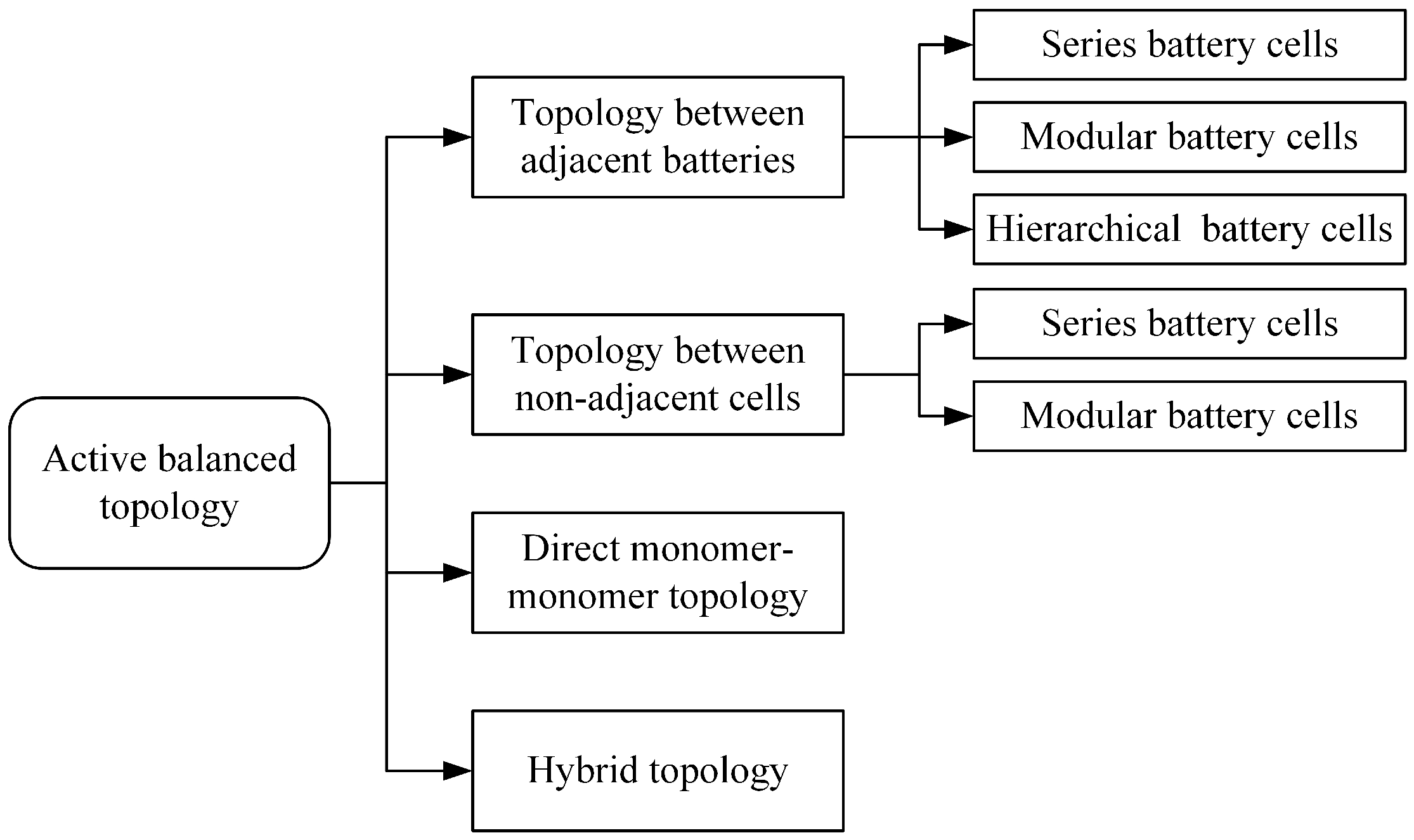
This study focuses on active balancing topologies, which achieve SOC equalization among cells by transferring excess energy from high-energy cells to low-energy ones. As illustrated in Figure 2, active balancing topologies can be categorized according to their energy transfer paths into adjacent-cell transfer, non-adjacent transfer, direct cell-to-cell transfer, and hybrid types. Each topology presents distinct trade-offs in terms of balancing speed, energy utilization, and control complexity [14].
The comparison of balancing topologies shows that circuit structure fundamentally determines energy transfer paths and efficiency, making it central to balancing performance. Passive balancing relies on resistive dissipation and, despite its simplicity, is inefficient and unsuitable for large-capacity systems. Active balancing enables efficient energy transfer through magnetic or capacitive elements and is widely adopted in high-performance BMSs. Among active methods, adjacent structures are simple but limited by long transfer paths, while non-adjacent structures achieve higher efficiency and faster response through centralized converters. Cell-to-cell and hybrid approaches offer greater flexibility, but at the cost of higher structural and control complexity.
In this work, a 3.2 V, 100 Ah LiFePO4 battery pack is used. Due to the need for rapid balancing and large capacity, a modular non-adjacent topology is adopted, as illustrated in Figure 3.
To strengthen the comparison between the proposed system and existing balancing approaches, Table 1 summarizes representative active balancing architectures reported in the literature. The comparison focuses on key metrics, including balancing current capability, topology complexity, scalability for large-capacity lithium iron phosphate (LFP) systems, and reported balancing efficiency. As shown in the table, conventional capacitor-based or adjacent inductive approaches typically provide balancing currents below 2 A and are not optimized for large-format battery modules. In contrast, transformer-based SIMO architectures—such as the system proposed in this work—support higher balancing currents (≥10 A), maintain high efficiency through synchronous rectification, and demonstrate better suitability for high-capacity pack-level energy storage applications.

3. Modeling and Control Strategies of Balancing Circuits

3.1. SIMO Active Balancing Topology

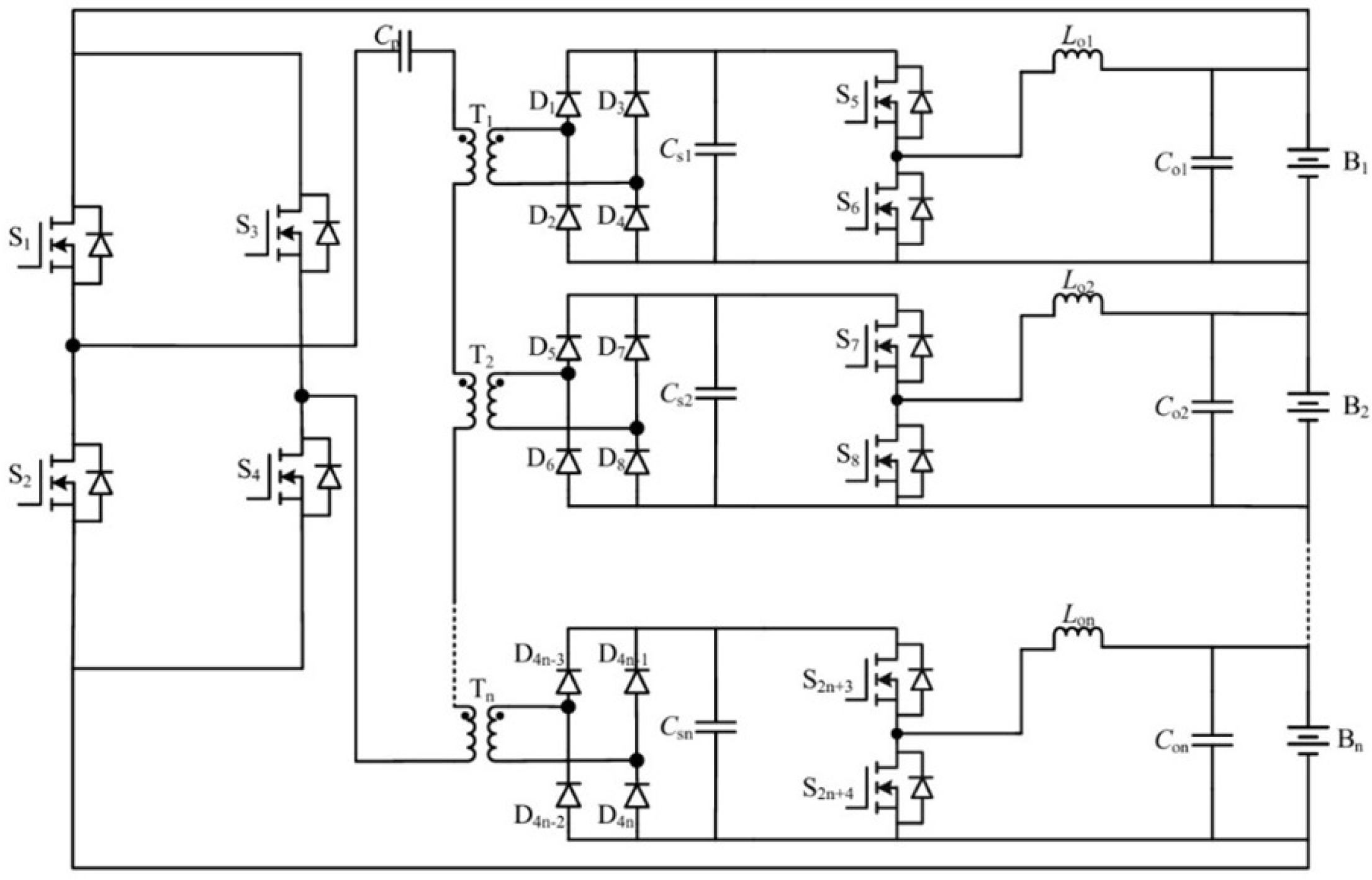
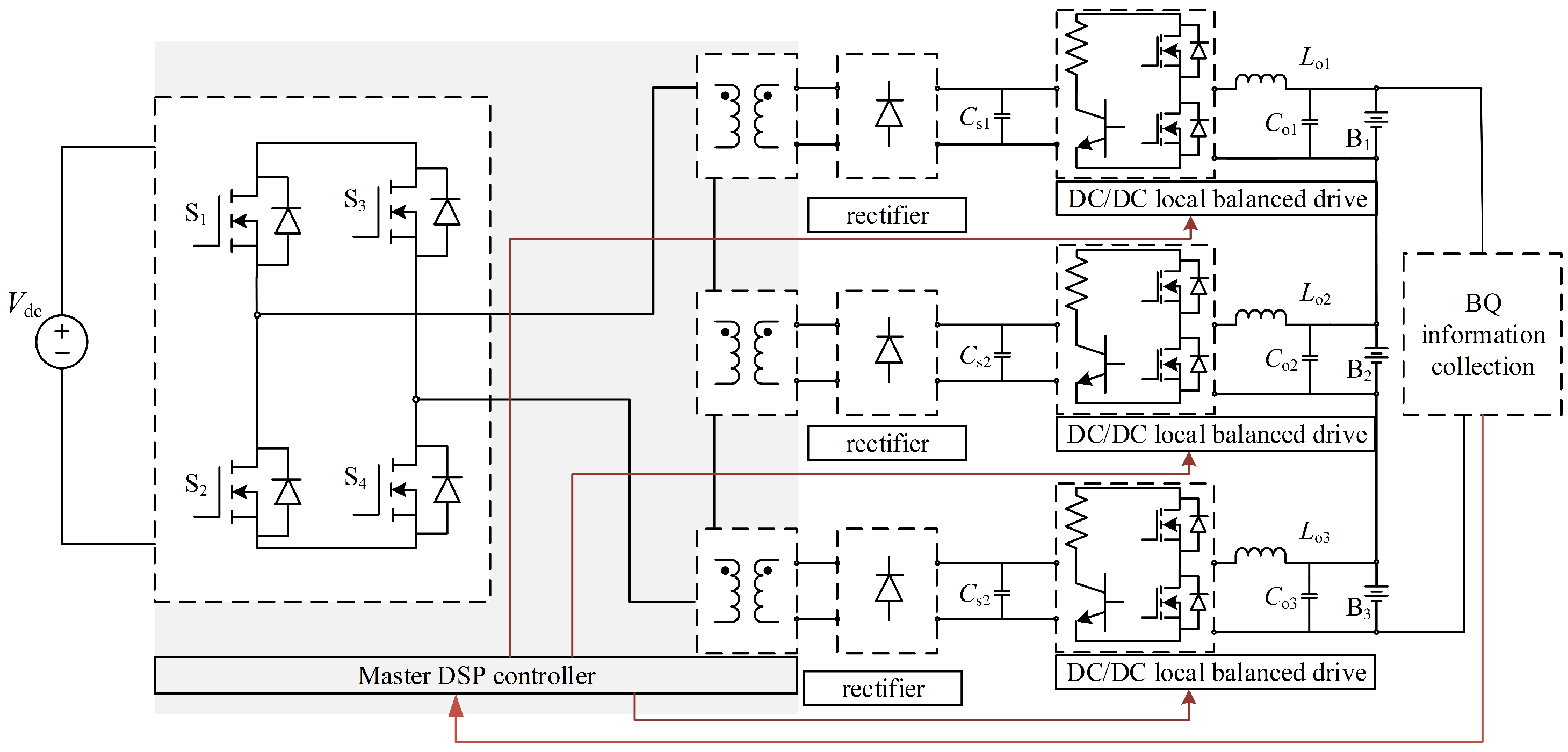
Based on Section 2, a non-adjacent active balancing topology is adopted, as illustrated in Figure 4. Energy transfer occurs via a central coupling node rather than between adjacent cells, with high-frequency DC/DC converters enabling direct transfer from higher- to lower-voltage cells, thus improving efficiency.
Conventional centralized systems with a single DC/DC converter require large currents, increasing size, cost, and reducing efficiency. To address this, each cell is equipped with an independent DC/DC module under a distributed control scheme. This preserves centralized efficiency while offering modularity and scalability, suitable for large-series packs, and avoids sequential energy losses.
During charging, the pack voltage V in is converted to AC via an inverter and coupling capacitor C p , transmitted through isolation transformers T 1 T n to modules B 1 B n . Secondary-side rectification provides a stable DC balancing current. Real-time cell voltage feedback selectively controls each module, achieving uniform cell voltages and overall pack balance. This topology ensures high efficiency, fast balancing, and scalability.
As shown in Figure 4, the primary-side full-bridge switches convert DC to high-frequency AC and distribute the voltage, while the secondary-side rectification and filtering provide DC to meet the requirements of downstream charging modules. The operation of this stage is not analyzed in detail here; the focus is on the working mode of the secondary-side charging modules of the transformers.
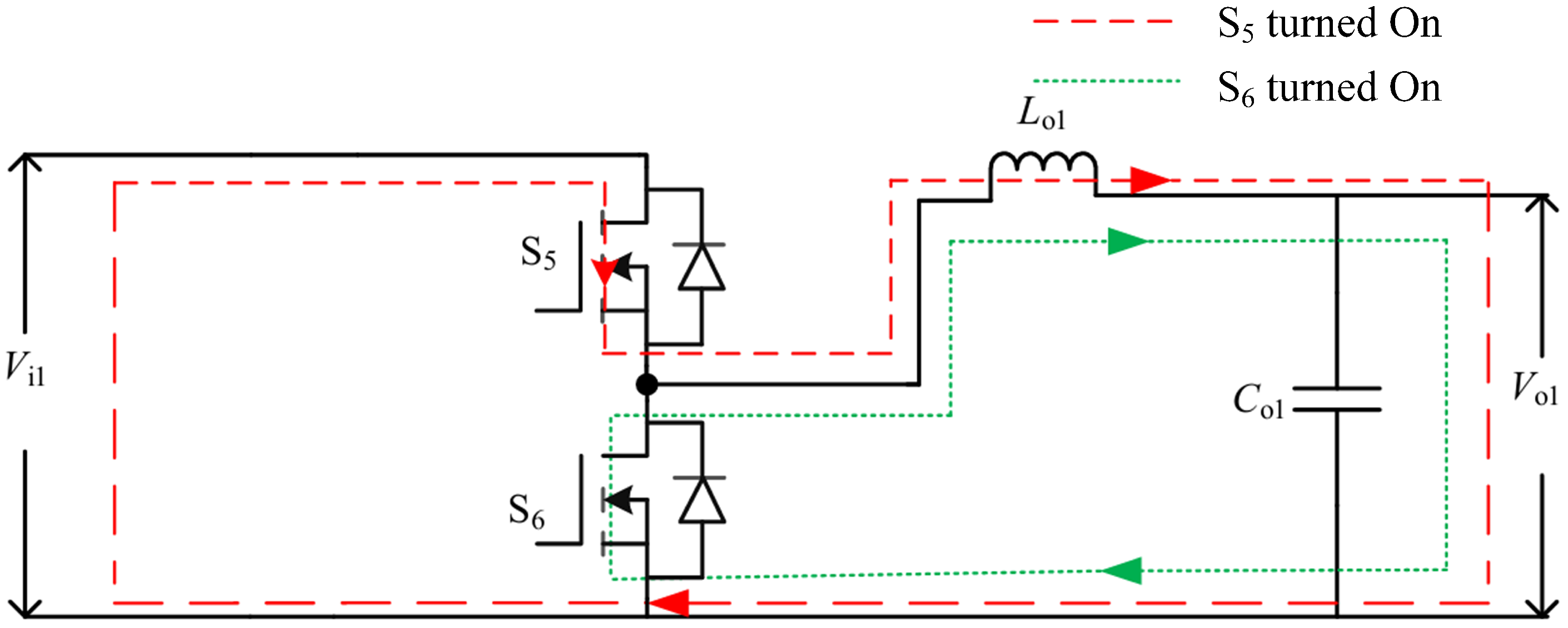
After each secondary output undergoes full-bridge diode rectification and filtering, the high-frequency AC voltage on the secondary side is converted into a DC voltage, which is then supplied to the individual DC/DC charging module. As a power regulation unit, the DC/DC charging module adjusts its output voltage and current under the control of switches S5, S6 to S 2 n + 3 , S 2 n + 4 . Taking switches S5 and S6 as an example, S6 replaces diodes to provide a low-loss channel for charge discharge. This design ensures continuous inductor current, prevents high-voltage spikes, and constitutes a synchronous rectification buck circuit, as shown in Figure 5.
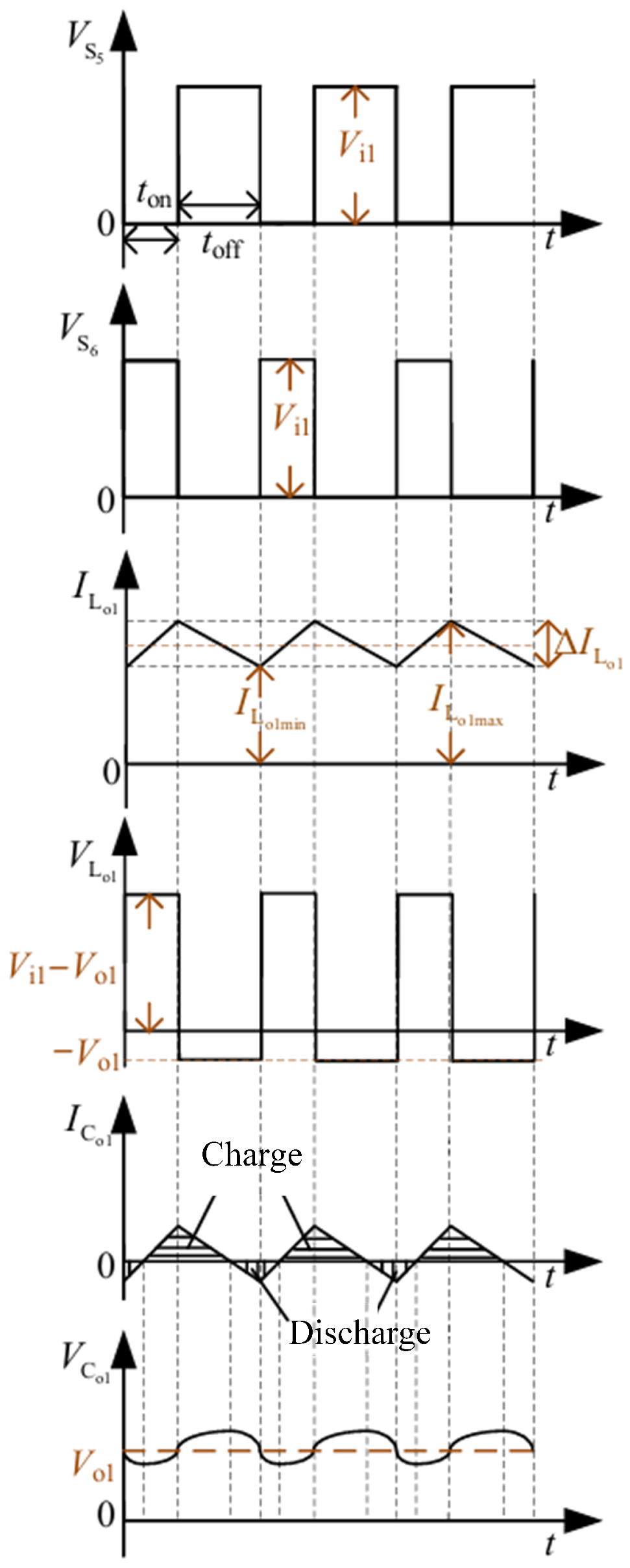
The waveforms of the circuit in continuous conduction mode are shown in Figure 6. When S 5 is turned on and S 6 is off ( t = t on ), starting from t = 0 , the inductor current rises rapidly from 0 and increases linearly with a constant slope to its maximum. At this moment, the voltage across the inductor is V L = V i 1 V o 1 , and the change in inductor current can be expressed as:
Δ I L el - on = V il V ol L ol D i T
When S 6 is turned on and S 5 is off ( t = t off ), the inductor releases its stored energy, and the current decreases linearly from its peak to the minimum with a constant slope. At this moment, the voltage across the inductor is V L = V o 1 , and the corresponding change in inductor current can be expressed as:
Δ I L el - off = V ol L ol D 2 T
Based on the volt-second balance, we obtain:
V il V ol L ol D i T V ol L ol D 2 T = 0
In continuous conduction mode, D 1 + D 2 = 1 . Substituting this into the above equation, we obtain:
V ol V il = D 1
In the above equation, Δ I L ol - on is the variation of current I L ol when t = t on ; Δ I L ol - off is the variation of current I L ol when t = t off ; D 1 is the conduction duty cycle of S 5 , where D 1 = t on / T ; D 2 is the conduction duty cycle of S 6 , where D 2 = t off / T = 1 D 1 .
It can be seen from Equations (2) and (3) that the output current ripple is determined by the inductance value. To make the circuit operate in continuous conduction mode:
L ol V ol · ( V il V ol ) · T Δ I L ol · V il
The voltage ripple can be expressed as:
Δ U ol = Δ I L ol · T 8 · C = V ol 8 · C · L ol ( 1 D 1 ) T 2
The Buck converter can achieve both constant-current (CC) and constant-voltage (CV) charging characteristics through appropriate control strategies. In the CC mode, at the initial stage of Li-ion battery charging, the cell voltage is relatively low and the charging current is maintained at a constant value I ref , resulting in relatively high charging power. By adjusting the duty cycles of S 5 and S 6 , the inductor current is regulated to keep the output current constant at I ref .
I L ol ( t ) = 1 L ol v il ( t ) v ol ( t ) d t
Through closed-loop control of D 1 , the output current is regulated. The duty cycle D 1 affects the secondary-side rectified voltage, which in turn determines the inductor charging current.
In the constant-voltage (CV) mode, during the later stage of charging, as the battery voltage gradually approaches the target value V ref , the charging mode switches from constant-current (CC) to CV. The duty cycle D 1 of S 5 is controlled in a closed loop to maintain the output voltage at V ref .
v ol ( t ) = 1 C ol ( i L ol ( t ) i o 1 ( t ) ) d t
Through closed-loop regulation, the output voltage is maintained at V o 1 = V ref . The duty cycles of S 5 and S 6 gradually decrease, allowing the output voltage to stabilize. Meanwhile, the output current gradually diminishes, eventually approaching zero.
Each branch independently achieves CC and CV control through closed-loop regulation, without affecting the loads of other branches. The primary windings are connected in series and each secondary winding has the same number of turns, ensuring uniform secondary-side input voltages across all branches.

3.2. Small-Signal Modeling of Active Balancing Circuits

The active balancing circuit can be divided into two main parts. On the primary side, the transformer voltage is controlled by adjusting the duty cycle of the switches, thereby coupling energy to the secondary side. The secondary side, in turn, governs the energy output and the dynamic behavior of the system.
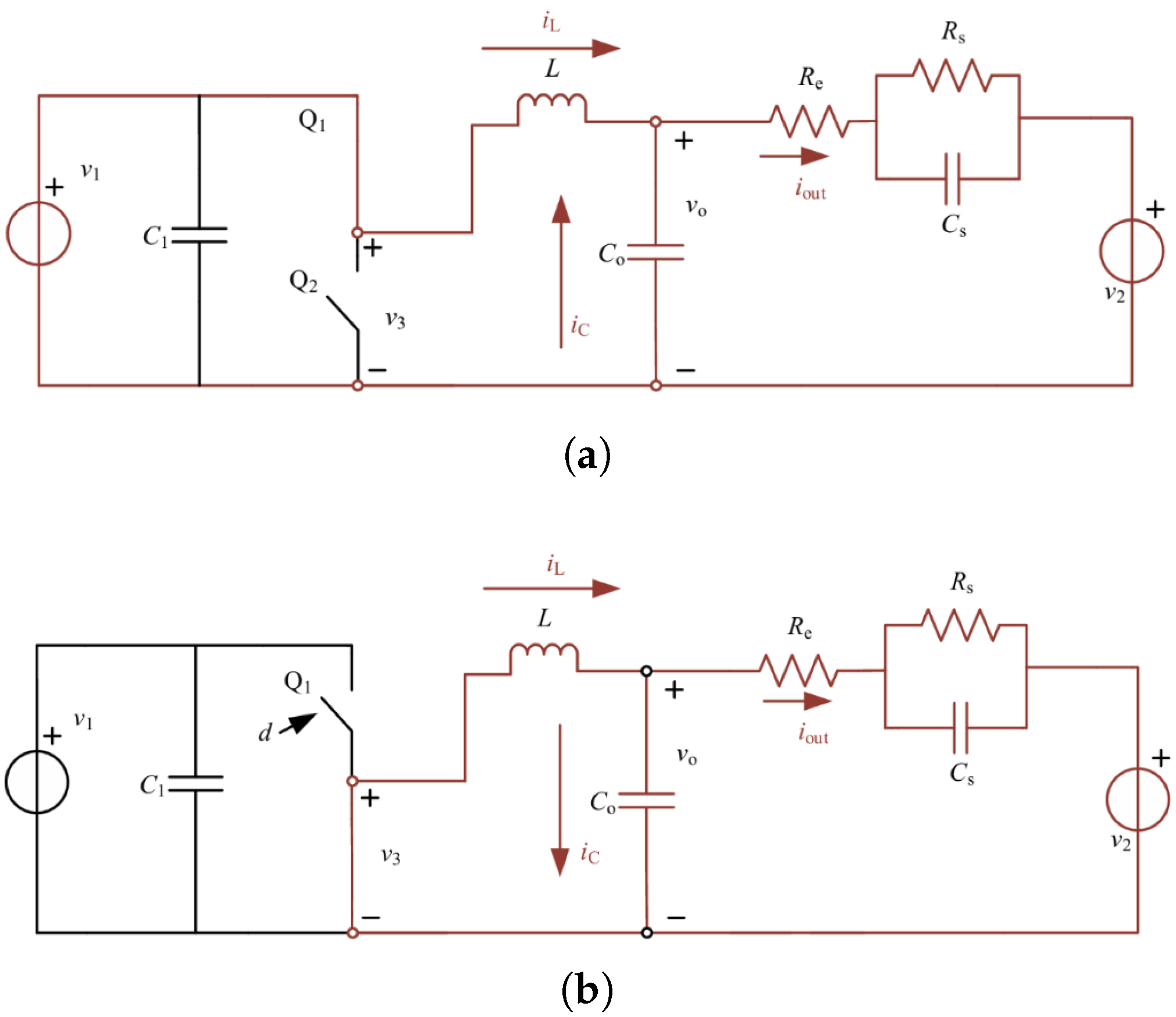
Each secondary branch converts the coupled energy into DC voltage through a rectifier bridge and a filter. This DC voltage is then fed into a Buck converter. The small-signal model of each secondary side is illustrated in Figure 7. In this model, v 1 represents the voltage after rectification and filtering, v 2 denotes the open-circuit voltage of the lithium battery Thevenin equivalent circuit, and d is the duty cycle of the main switch Q 1 .
From the small-signal model, the dynamic equation of the inductor current i ˜ L ( t ) is given by:
L d i L ( t ) d t = v 3 ( t ) v o ( t )
v 3 ( t ) = V 1 · d ( t )
Expressing v 3 ( t ) , i L ( t ) , and v o ( t ) as the sum of their steady-state values and small-signal perturbations, the system equations are linearized to obtain:
L d i ˜ L ( t ) d t = V 1 · d ˜ ( t ) + D · v ˜ 1 ( t ) v ˜ o ( t )
By transforming into the frequency domain, the small-signal response of the inductor current can be obtained as:
i ˜ L ( s ) = 1 s L V 1 · d ˜ ( s ) + D · v ˜ 1 ( s ) v ˜ o ( s )
Therefore, from the dynamic equation of the capacitor voltage v o ( t ) , we can observe that:
C o d v o ( t ) d t = i L ( t ) i o u t ( t )
Expressing i L ( t ) and i o u t ( t ) as the sum of their steady-state values and small-signal perturbations, the system equations are linearized to obtain:
C o d v ˜ o ( t ) d t = i ˜ L ( t ) i ˜ out ( t )
By transforming into the frequency domain, the small-signal response of the voltage can be obtained as:
v ˜ o ( s ) = 1 s C o i ˜ L ( s ) i ˜ out ( s )
The equivalent dynamic impedance of the lithium battery is given by:
Z b ( s ) = R e + R s s C s R s + 1
Therefore, the relationship between the output current and the output voltage is:
i ˜ out ( s ) = v ˜ o ( s ) v ˜ 2 ( s ) Z b ( s ) = v ˜ o ( s ) v ˜ 2 ( s ) R e + R s s C s R s + 1
By combining the dynamic equations of the inductor current and the capacitor voltage, and eliminating the inductor current, the transfer function from the duty cycle perturbation to the output voltage can be obtained. Substituting the inductor current equation into the capacitor voltage equation yields:
v ˜ o ( s ) s C o + 1 s L + 1 R e + R s s C s R s + 1 = V 1 s L · d ˜ ( s ) + D s L · v ˜ 1 ( s ) + 1 R e + R s s C s R s + 1 · v ˜ 2 ( s )
Finally, the small-signal transfer functions from the duty cycle to the output voltage and to the inductor current are obtained as:
v ˜ o ( s ) d ˜ ( s ) = V 1 s L s C o + 1 s L + 1 R e + R s s C s R s + 1
i ˜ L ( s ) d ˜ ( s ) = V 1 s L + 1 s C o + 1 R e + R s s C s R s + 1
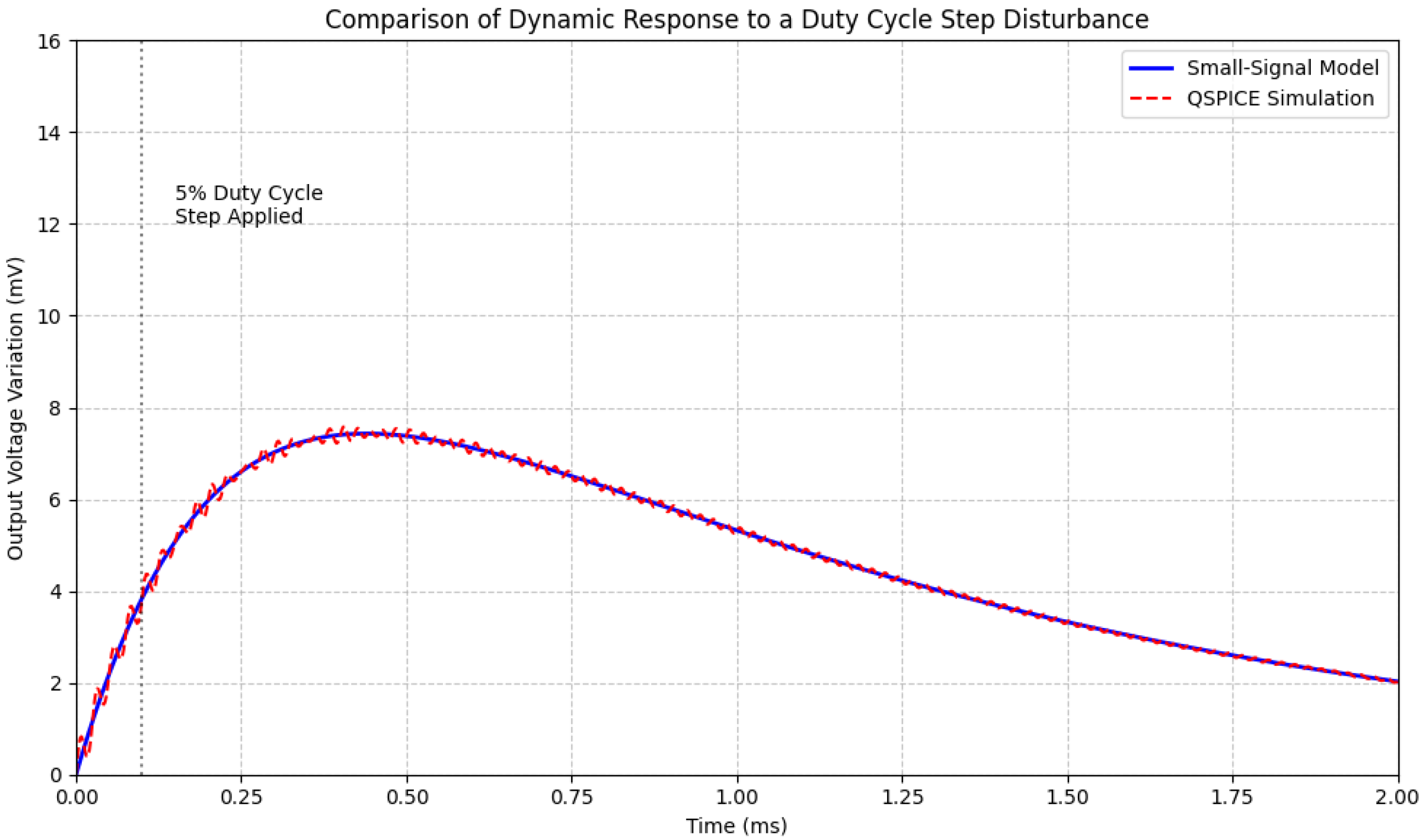
To verify the accuracy of the derived small-signal model, its dynamic response was compared against the transient response of the detailed switching model implemented in QSPICE. A step change in the duty cycle d ^ ( s ) of 5% was applied at t = 0.1 ms , and the resulting output voltage transient v ˜ o ( s ) was observed. The comparison is shown in Figure 8. The output voltage from the QSPICE simulation exhibits high-frequency switching ripple, which is naturally absent in the continuous-domain small-signal model. However, the overarching dynamic characteristics—namely, the rise time, settling time, and the general shape of the transient response—are in excellent agreement. The small-signal model accurately predicts the system’s bandwidth and damping characteristics. This close correlation validates the fidelity of the small-signal model and confirms its suitability for use in control loop design and stability analysis.

3.3. Control Design of Active Balancing System

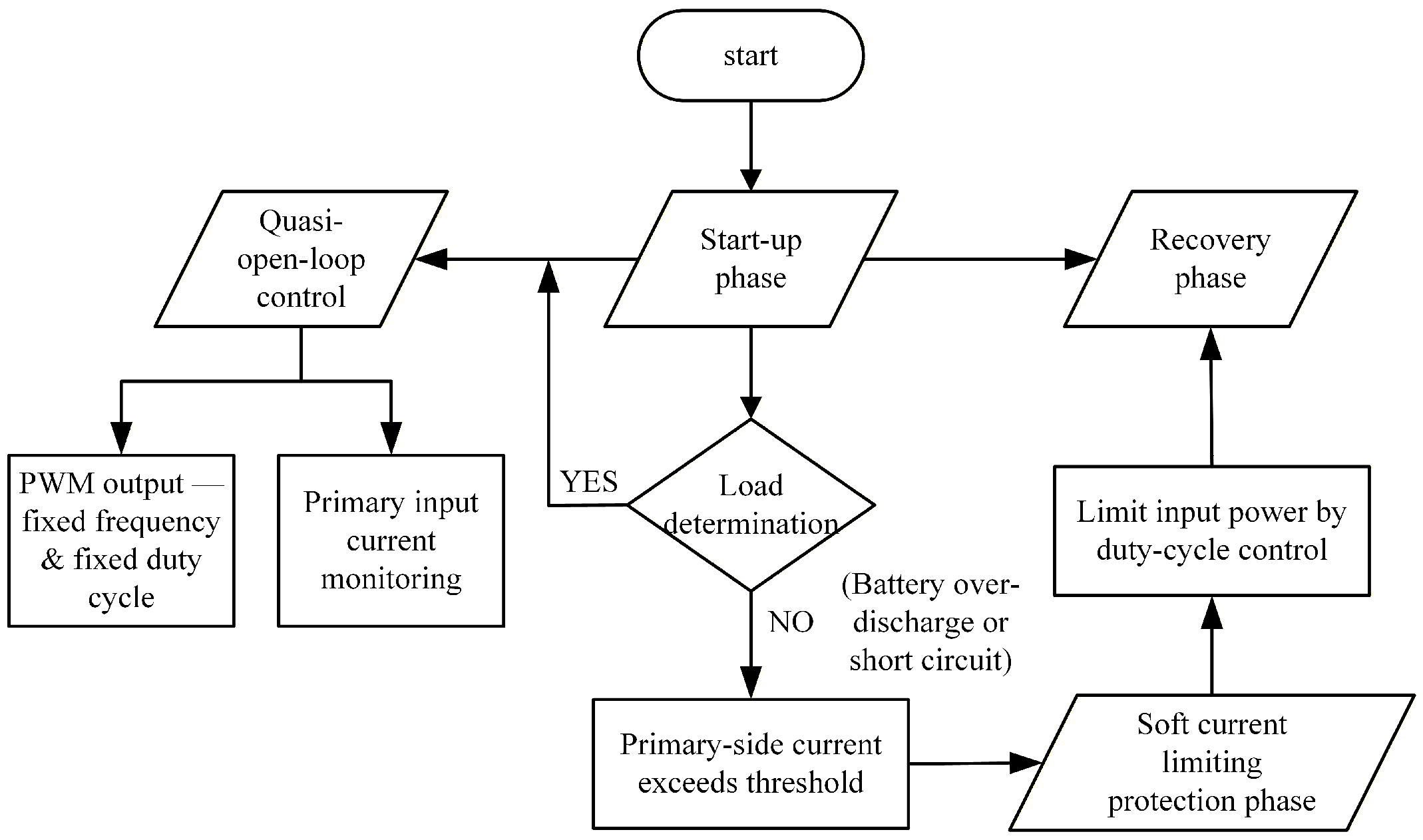
The primary-side full-bridge inverter in this system employs a hybrid control strategy that combines quasi–open-loop and current-limiting mechanisms to achieve efficient power transfer and system protection. Under normal operating conditions, a high-frequency voltage with fixed frequency and duty cycle is generated to deliver energy to the secondary side through the transformer. When the primary-side current exceeds the preset threshold, the current-limiting mechanism adjusts the duty cycle to restrict input power, thereby preventing overcurrent and ensuring overall system stability. The corresponding control logic diagram is shown in Figure 9.
The secondary side of the proposed active balancing system adopts a voltage–current dual-loop control structure, in which the outer loop regulates voltage while the inner loop controls current. This configuration enables dynamic coordination between voltage and current during different charging stages, thereby ensuring both high charging efficiency and operational safety. The dual-loop controller adjusts the PWM duty cycle in real-time based on feedback from the battery terminal voltage and current, ensuring precise control of the charging process.
In the constant-current (CC) mode, the inner loop maintains a fixed charging current by adaptively modulating the PWM duty ratio, enabling fast and safe charging. When the terminal voltage reaches the reference value V ref , the system automatically switches to the constant-voltage (CV) mode. In the CV mode, the outer loop maintains a stable output voltage while gradually reducing the charging current according to the battery’s state of charge. This precise voltage regulation prevents overcharging and suppresses efficiency degradation caused by voltage fluctuations.
To ensure a smooth transition between the two modes, a hysteresis zone ( x hysteresis ) is introduced to prevent frequent mode switching due to small voltage perturbations [21,22]. For example, when the terminal voltage approaches V ref , minor fluctuations caused by transient load disturbances may otherwise trigger repeated switching between CC and CV modes. The hysteresis mechanism effectively eliminates such oscillations, ensuring a stable and continuous charging process.
Furthermore, to prevent integrator windup and abrupt control variations during mode transitions, the integral terms of both inner and outer PI controllers are reset at each mode change. This approach mitigates sudden PWM duty changes, suppresses transient voltage and current spikes, and enhances overall system stability and battery longevity.
The switching logic is expressed as Equation (21):
V o < V ref x hysteresis , maintain constant current mode V o > V ref + x hysteresis , switch to constant voltage mode
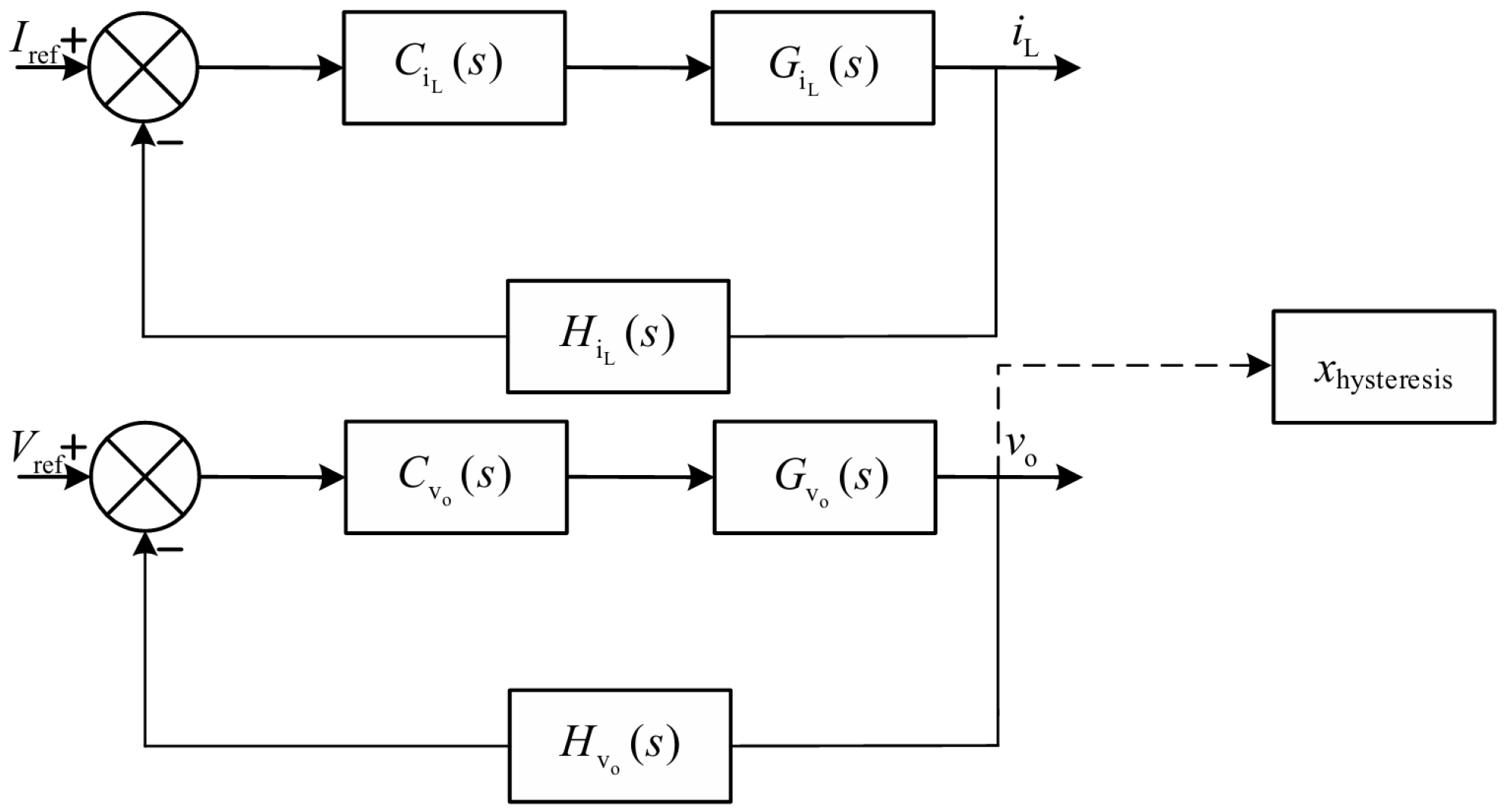
During mode transitions, the controller gradually minimizes the error term to ensure a smooth transition of system states. The overall block diagram of the proposed control strategy is shown in Figure 10, where G c V ( s ) and G c I ( s ) denote the PI controllers of the voltage and current loops, respectively, while G p V ( s ) and G p I ( s ) represent the corresponding plant transfer functions. H V ( s ) and H I ( s ) denote the respective feedback paths. This dual-loop control framework enables efficient regulation and stable control throughout the charging process, providing a robust guarantee for the safe and reliable operation of the lithium-ion battery balancing system.
To prevent excessive or insufficient integration that may cause sluggish or abrupt controller responses during mode switching, the integral terms of both inner and outer PI controllers are reset upon each transition. This integral reset strategy effectively suppresses sudden variations in charging current or voltage, thereby mitigating electrical stress on the battery and improving system stability.
Compensator designs are carried out for both the current and voltage loops, corresponding to G i L ( s ) and G v o ( s ) , respectively. A Type-II PI compensator with a double-pole and single-zero configuration is adopted in this design. The controller structure is expressed in (22).
C ( s ) = k · s ω z + 1 s ω p + 1
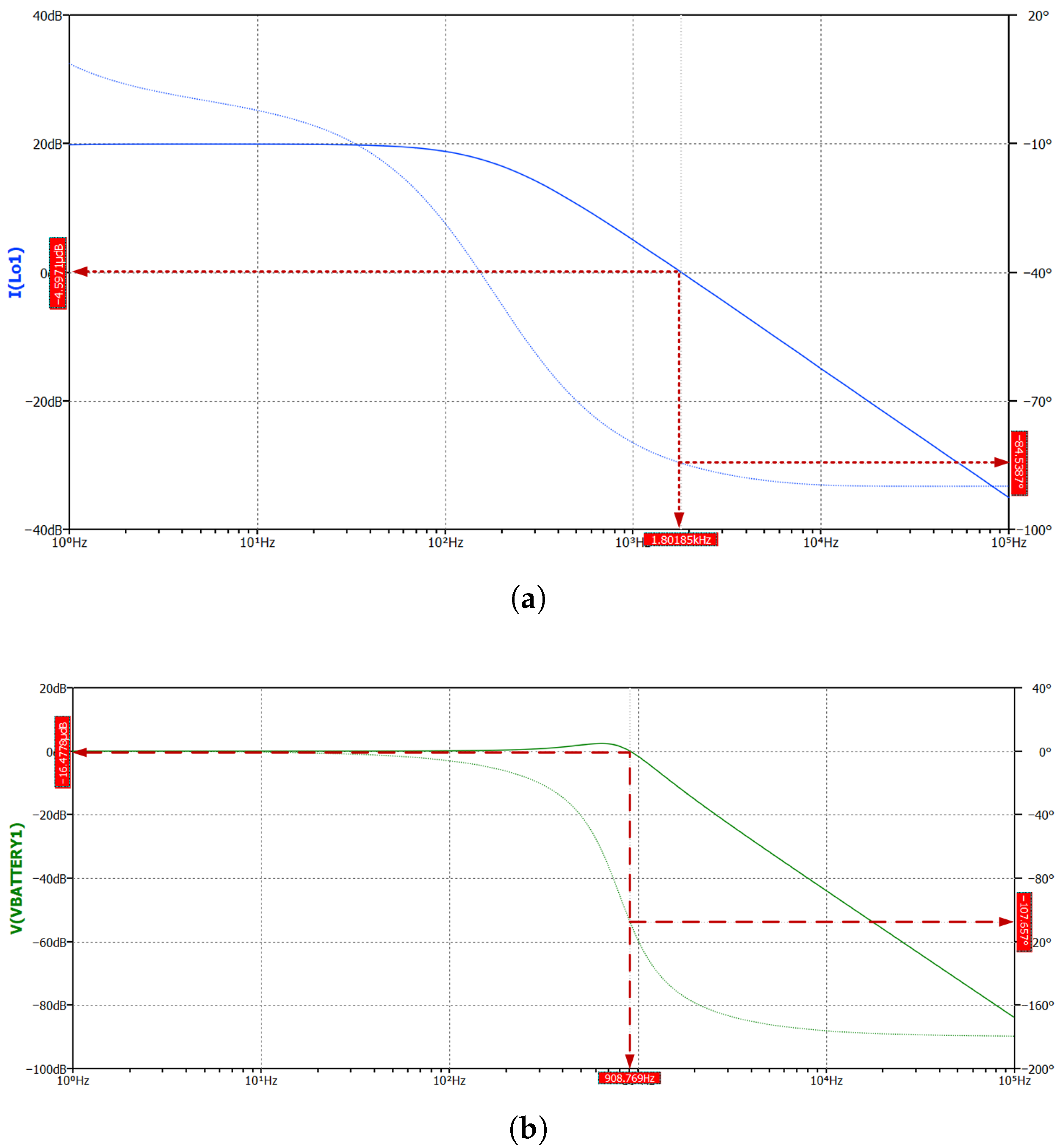
In QSPICE, the cascaded systems of the current loop, G i L ( s ) and H i L ( s ) , and the voltage loop, G v o ( s ) and H v o ( s ) , were established. The frequency responses of the open-loop transfer functions with the designed controllers were obtained, as shown in Figure 11. The current loop exhibits a gain crossover frequency of 1.8   k Hz with a phase margin of 95.5°, indicating excellent stability. Under these conditions, the charging current remains constant, enabling the system to respond rapidly to external disturbances or load variations, thereby ensuring stable and consistent battery charging. The voltage loop has a gain crossover frequency of 908 Hz with a phase margin of 72.3°, providing sufficient stability to maintain smooth battery voltage. Overall, the PI closed-loop control effectively suppresses disturbances while enhancing system robustness and dynamic performance.

4. System Simulation Verification and Analysis

4.1. Simulation Model Development and System Design

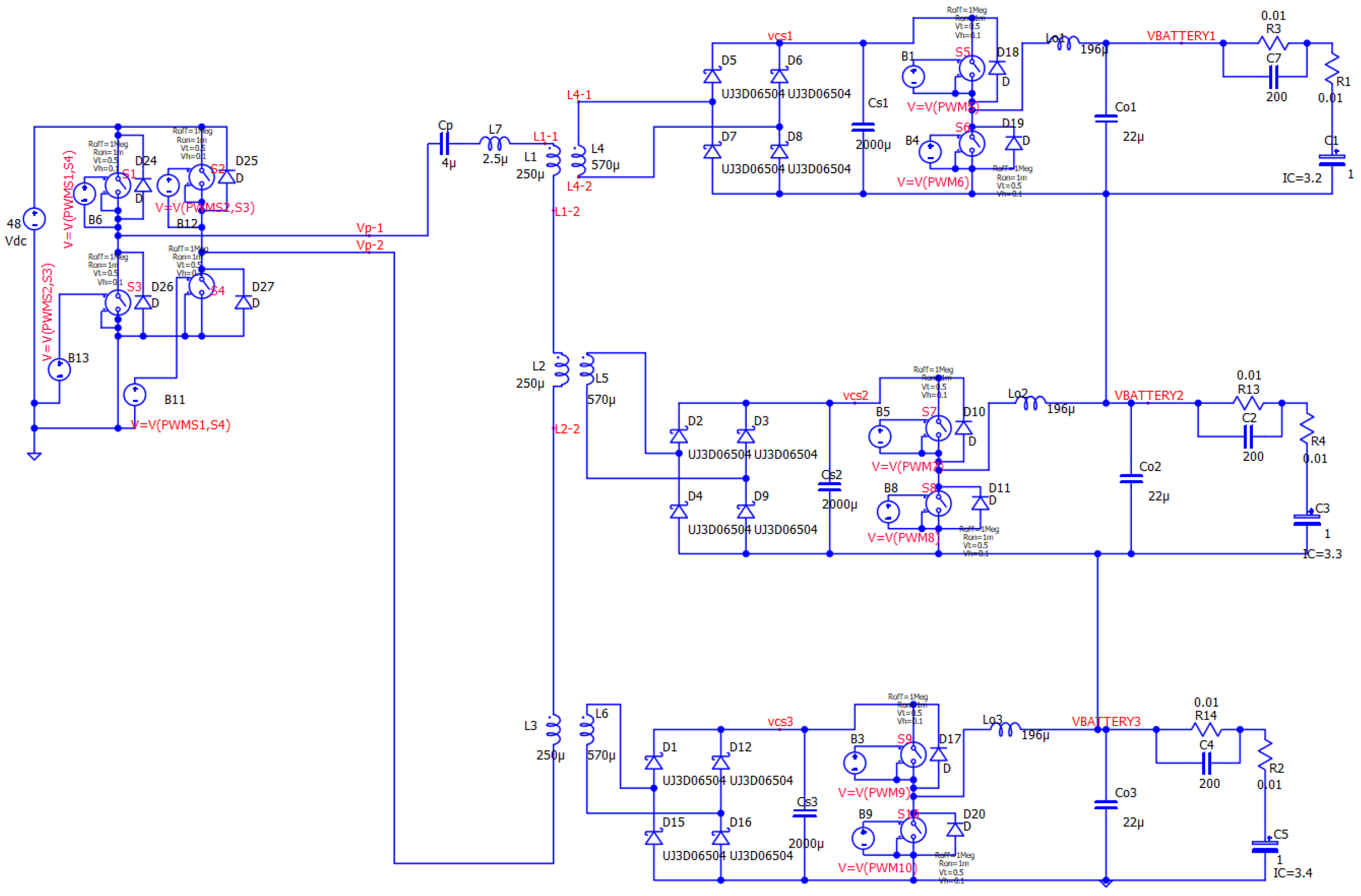
Circuit-level simulations were conducted in QSPICE to validate the proposed active balancing strategy. As shown in Figure 12, the model was built using the parameters listed in Table 2 and the topology shown in Figure 8. Different initial voltages were assigned to capacitors C 1 , C 3 , and C 5 to emulate typical imbalance conditions.
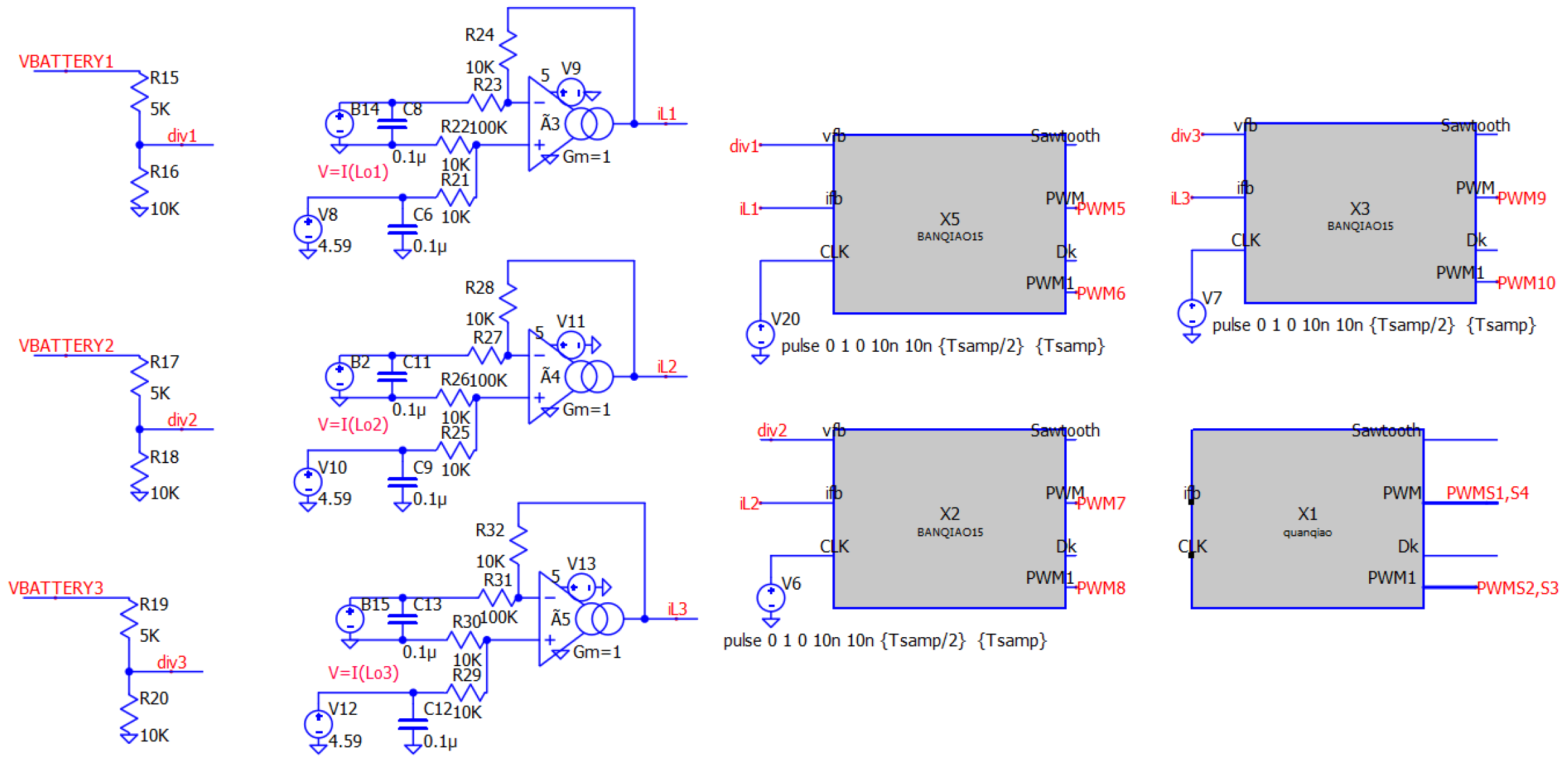
The signal acquisition and modulation process is illustrated in Figure 13. The C-Block generates PWM signals and performs CC–CV dual-loop control based on sampled voltages and currents. When any cell voltage drops below 3.65 V, the balancing function is enabled to adjust branch charging currents and maintain pack consistency.

4.2. Analysis of Battery Balanced Charging Process and Control System

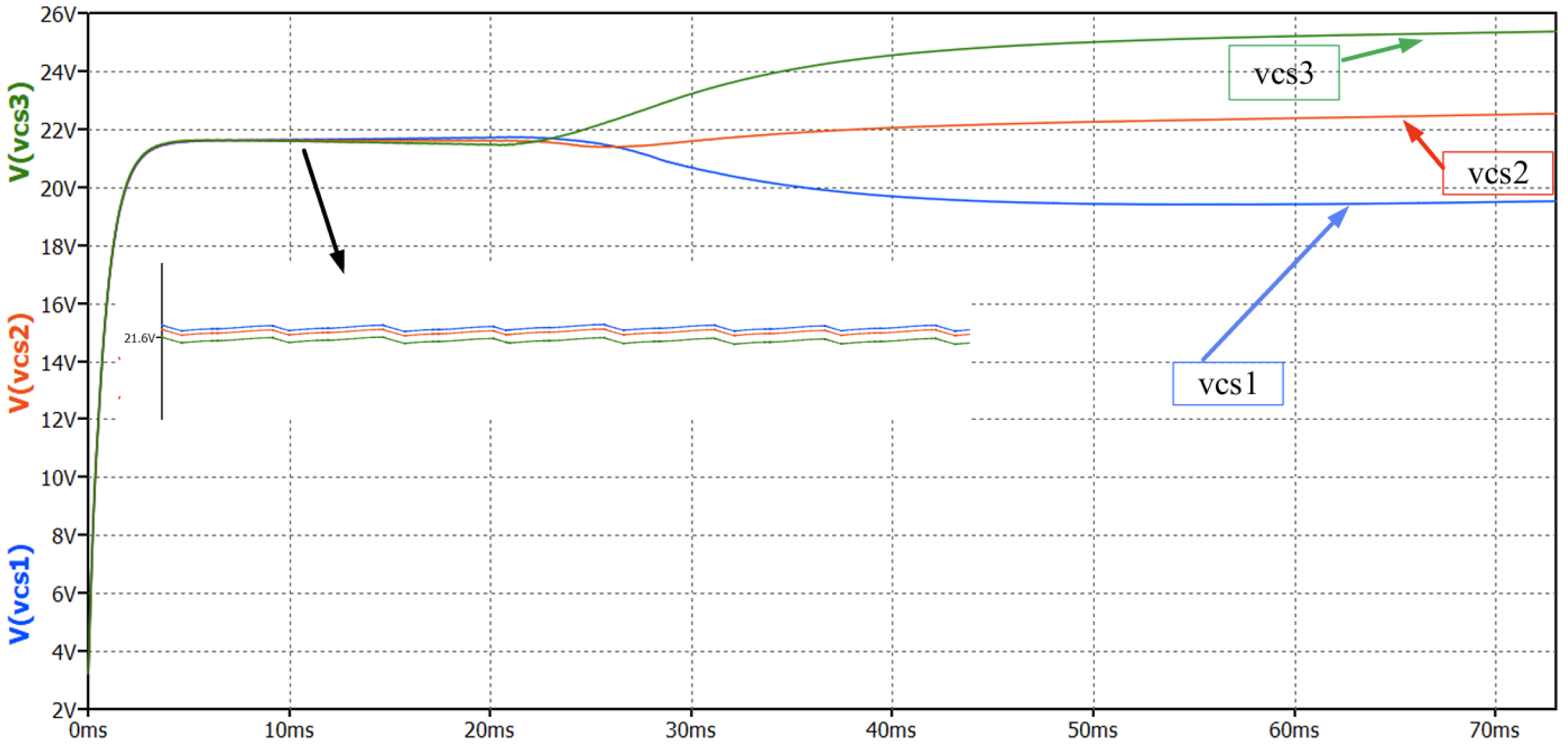
The system employs a PI-controlled closed-loop strategy for charging, initially operating in CC mode and gradually transitioning to CV mode. During the stable CC stage, the full-bridge rectified voltages ( v c s 1 , v c s 2 , v c s 3 ) are maintained at 21.6   V , corresponding to the input voltage of each secondary-side Buck module. Due to initial voltage differences among the cells, the system dynamically adjusts the charging process based on individual cell requirements. Specifically, C5, with a higher initial voltage, enters CV mode first, reducing its charging demand and the corresponding load, which raises v c s 3 . Conversely, C1, with a lower initial voltage, enters CV mode only in the late charging stage, causing v c s 1 to gradually decrease.
As shown in Figure 14, by the end of the charging process, the system voltages converge, stabilizing at v c s 1 = 25.2 V , v c s 2 = 22.2 V , and v c s 3 = 19.4 V . This indicates that individual cell voltages become consistent during charging, while each cell’s charging process remains relatively independent, with negligible mutual interference, ensuring balanced and safe charging.
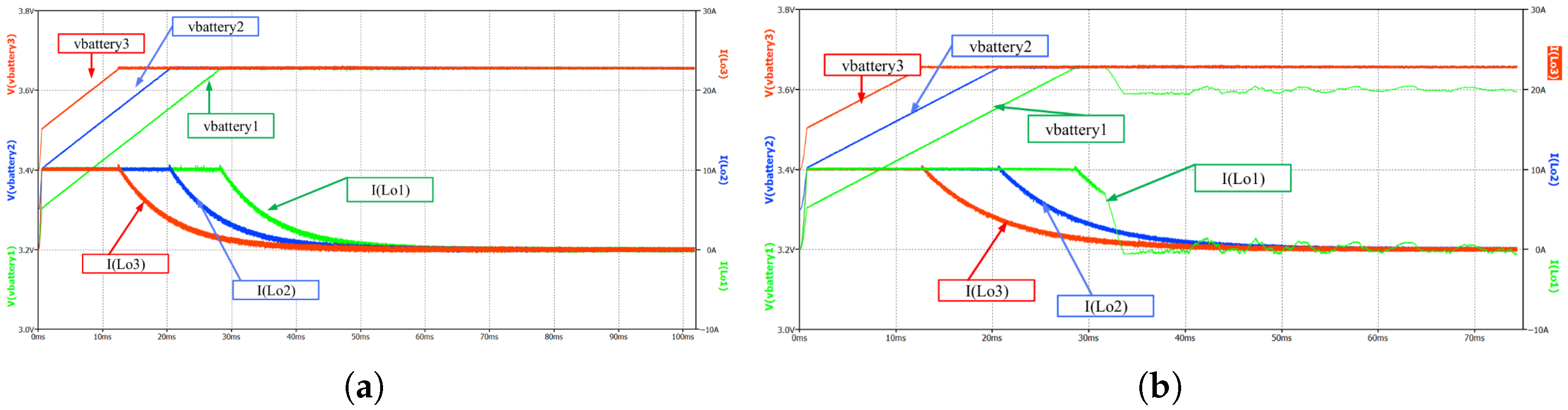
As illustrated in Figure 15a, when the transformer turns ratio is set to 1:1.5, with primary and secondary inductances of 250 µH and 570 µH, respectively, the charging process of all battery cells remains stable. Under PI control, the balancing current is maintained at approximately 10 A. During the transition from constant-current (CC) to constant-voltage (CV) mode, the charging current gradually decreases to nearly zero. At the same time, the cell voltages rise from their initial values and eventually stabilize at the preset threshold of 3.65 V. These results demonstrate that all cells within the battery pack have completed the charging process and that their voltages progressively converge toward equilibrium during operation.
As shown in Figure 15b, the transformer turns ratio is set to 1:1, and both the primary and secondary inductances are 250 µH. The cell with the lowest initial voltage exhibits a significantly higher power demand. Consequently, it fails to reach the target charging voltage, leading to a sharp drop in charging current and unstable voltage behavior. Under these conditions, the balancing system struggles to effectively regulate power distribution. The high charging demand of the low-voltage cell reduces the overall system efficiency and increases conversion losses, thereby deteriorating the charging performance of the entire system.
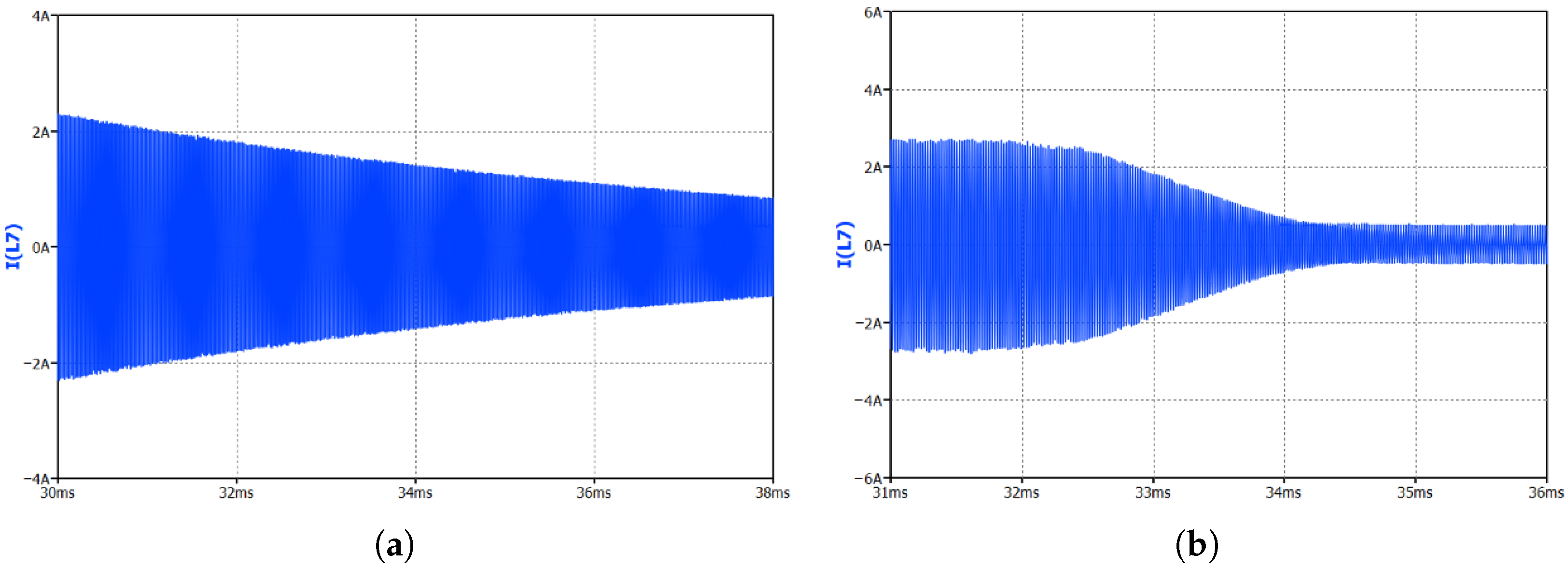
As illustrated in Figure 16, the current waveforms of the primary leakage inductance L 7 are compared under two transformer turns-ratio configurations. In the 1:1 configuration, a sharp current fluctuation occurs, leading to system instability and increased power losses. In contrast, when the turns ratio is set to 1:1.5, the current decreases gradually, enabling more effective power distribution and regulation on the secondary side, thereby ensuring stable system operation.
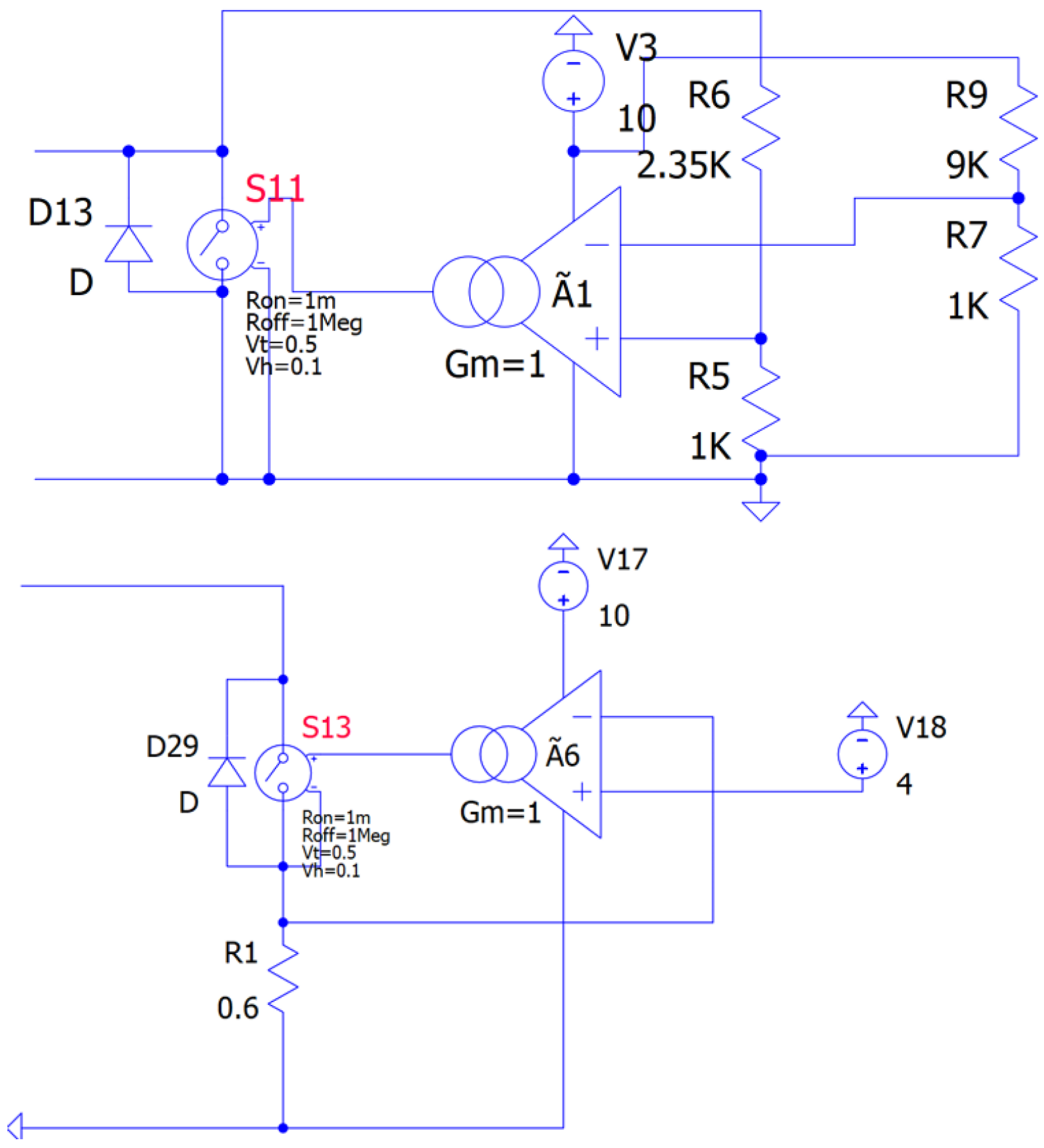
To verify the stability and effectiveness of the proposed circuit during the balancing charging process, each output is connected to either a CC source or a CV source. By adjusting the parameters of the constant-current and constant-voltage sources, the circuit performance under different charging modes can be evaluated. As shown in Figure 17, the output voltage of the constant-voltage source can be regulated by adjusting the ratio of resistors R 6 and R 5 ; when the voltage drops below 3.65 V, the circuit is tested to determine whether it can stably deliver 10 A. Similarly, the output current of the constant-current source can be adjusted by changing the ratio of V 18 and R 1 , allowing verification of whether the circuit can maintain a constant current of 3.65 V. After connecting the three battery channels to different modes, the current and voltage waveforms are observed to evaluate the balancing charging performance and system response characteristics.
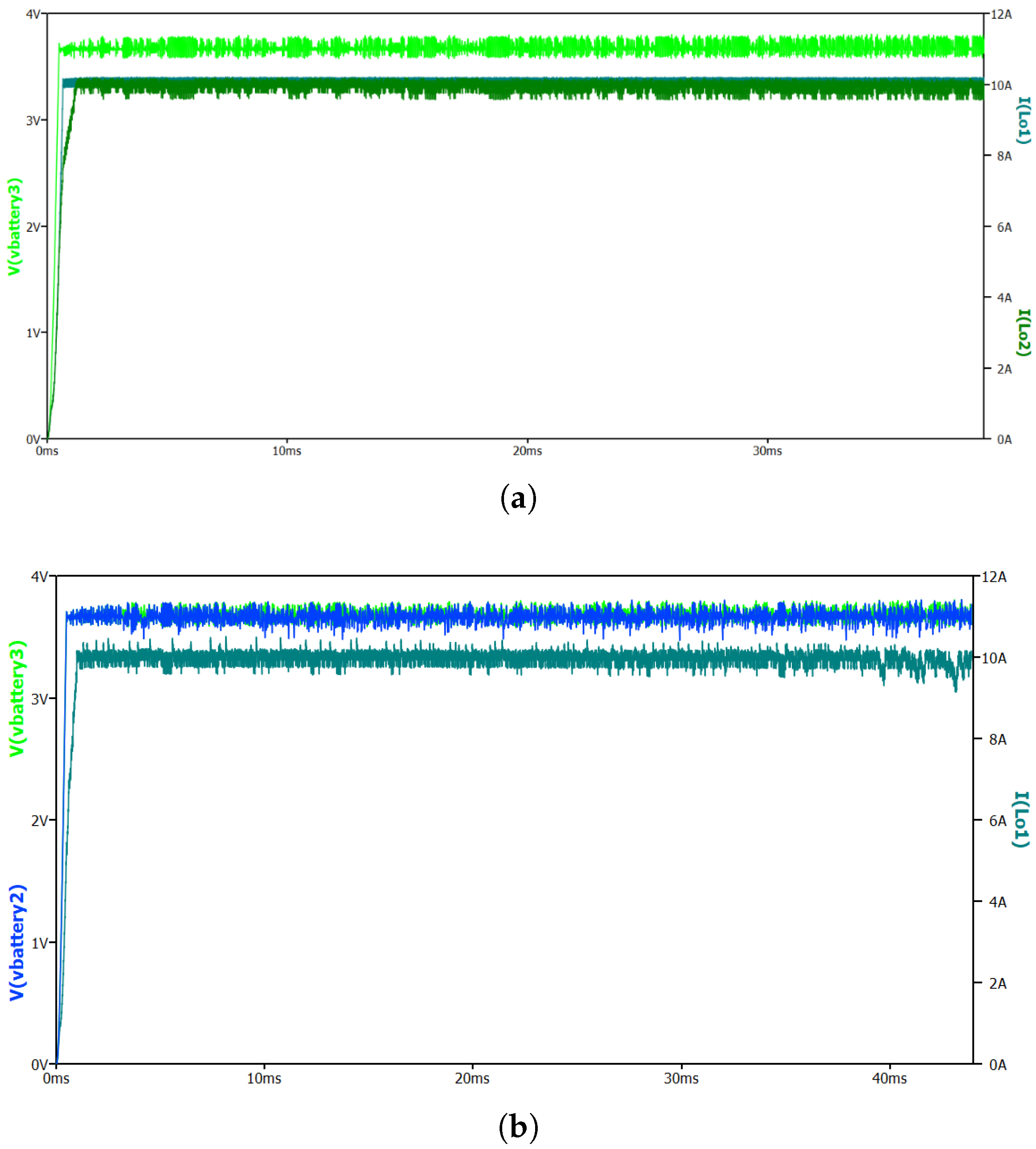
As shown in Figure 18a, when two outputs are connected to constant-voltage sources with voltages below 3.65 V, the output current remains stably at 10 A. In contrast, the third output is connected to a constant-current source, maintaining a stable voltage of 3.65 V. Figure 18b shows that when two outputs are connected to constant-current sources with voltages maintained at 3.65 V, the third output is connected to a constant-voltage source, with its output current stably maintained at 10 A.
To complement the experimental results, a brief performance estimation based on measured operating conditions and loss analysis was carried out. Under a 2.5 A balancing current, conduction loss from the MOSFETs and inductor winding accounts for the majority of energy dissipation, while switching loss remains relatively low. Based on this analysis, the balancing efficiency is estimated to exceed 90%. During continuous operation, no noticeable thermal stress or derating behavior was observed, and all components remained within normal operating temperature, even without forced cooling. These estimations help illustrate the practical operation condition of the proposed design.

5. System Experimental Verification and Analysis

As shown in Figure 19, the experimental platform consists of a main power circuit and a control module. The main circuit includes a full-bridge converter, coupling capacitor, single-input multi-output transformer, and three equalization modules integrating DC/DC converters, voltage–current sensors, and local controllers. The control module comprises an AFE board, an opto-isolated interface, a core controller, a CH340 protocol converter, and auxiliary power for data acquisition and monitoring.
A series battery pack composed of three 3.2 V/100 Ah Li-ion cells is employed, with parameters as listed in Table 3. The AFE board adopts a BQ40Z50 battery management IC (Texas Instruments, Dallas, TX, USA) to measure cell voltage, current, and temperature through divider sampling, a 1 m Ω shunt resistor, and an NTC thermistor, respectively. It provides multiple protections and enhances cell balance and energy utilization via SMBus (I2C) communication.

5.1. Lithium Battery Management System Performance Test

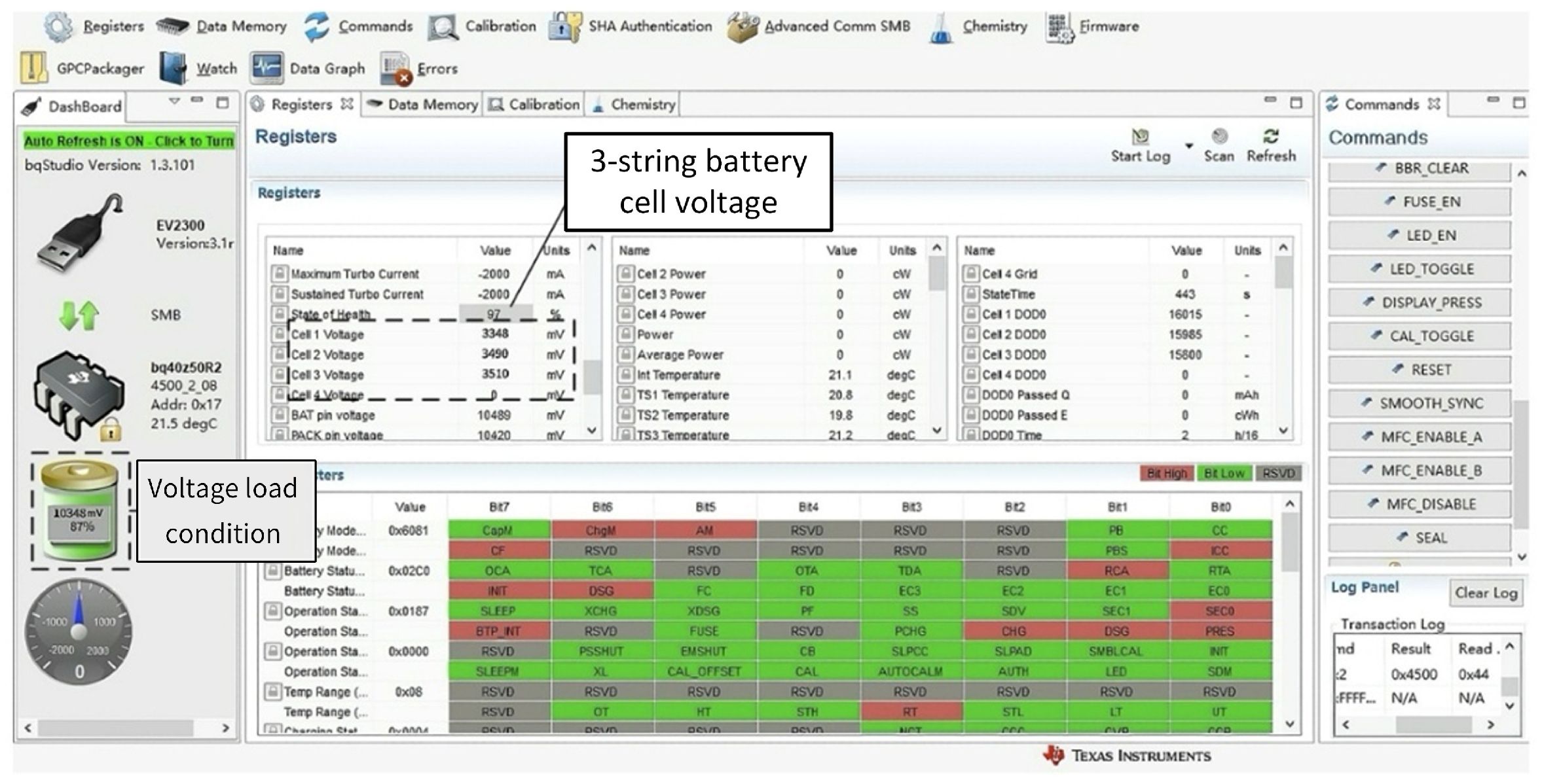
The BQ40Z50 chip is initialized and calibrated using the bqStudio software (version 1.3.101.0, Texas Instruments, Dallas, TX, USA). by configuring register parameters for three 100 Ah LiFePO4 cells. Since the battery capacity and current exceed the chip’s direct measurement range, a 1/5 linear scaling is applied to adjust the related parameters. After parameter configuration, the measured data are matched with ChemID 0435 and programmed into the chip, enabling accurate monitoring and management of the battery pack by the AFE.
As shown in Figure 20, the bqStudio interface establishes normal communication with the host software. Upon completion of debugging, the BQ40Z50 chip is configured as a slave device to communicate with the ATmega328P microcontroller (Microchip Technology Inc., Chandler, AZ, USA). for internal data acquisition.
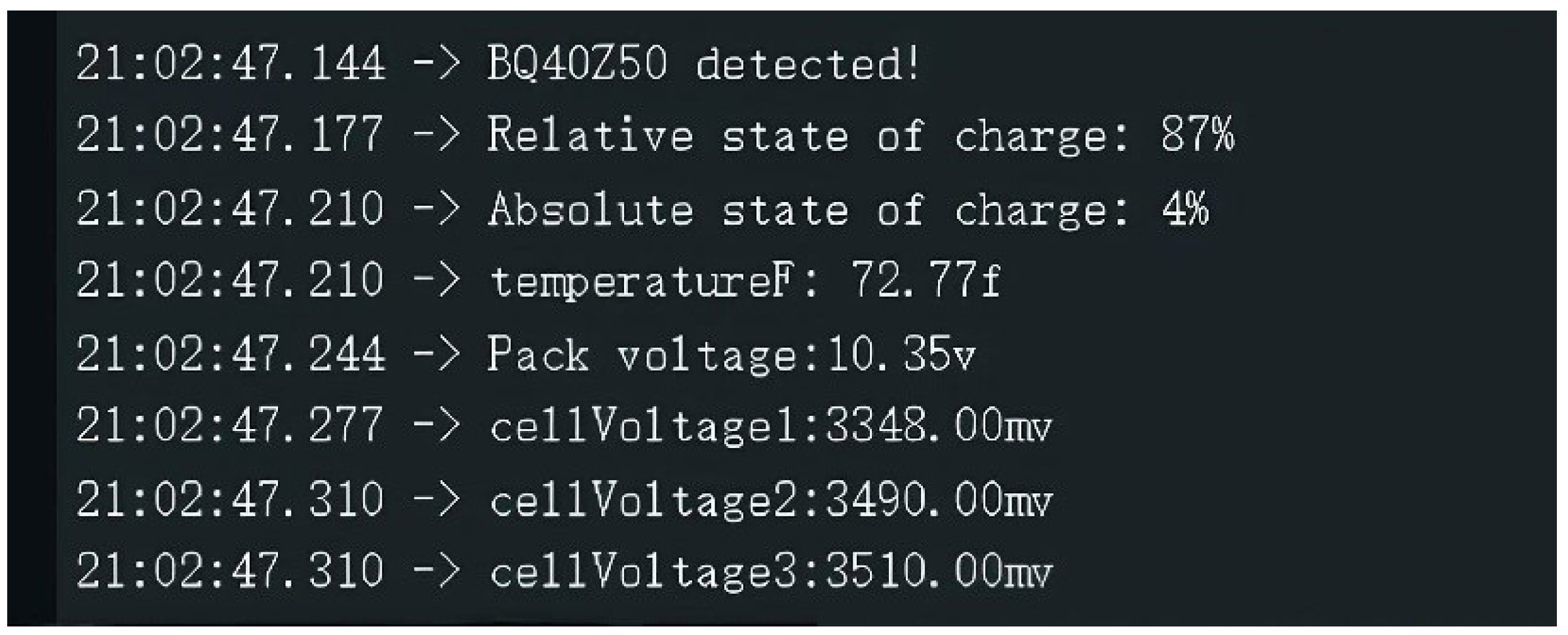
The equalization strategy is designed based on cell terminal voltages, requiring real-time monitoring for undervoltage and overvoltage protection. To ensure accurate fault detection and safe operation, the voltage measurement precision must be verified. During the equalization test, voltage data collected by the BQ40Z50 chip are transmitted to the host computer via the ATmega328P and displayed on the Arduino IDE serial monitor, as shown in Figure 21. The measured voltages are compared with those obtained using a Fluke 17B MAX digital multimeter (Fluke Corporation, Everett, WA, USA). as listed in Table 4. The results indicate that the deviation between the two measurements remains within ±3 mV, satisfying the accuracy requirements for voltage acquisition and ensuring reliable battery monitoring.
In this work, the State of Charge (SOC) is estimated using the BQ40Z50 analog front-end circuit. The SOC calculation is based on a hybrid algorithm that combines coulomb counting with an adaptive open-circuit voltage (OCV) lookup table linked to ChemID 0435. Coulomb counting provides fast tracking during dynamic charge and discharge events, while OCV correction compensates long-term drift to improve accuracy. Although SOC information is available, voltage remains the primary balancing trigger because for LiFePO4 cells the terminal voltage has a strong monotonic correlation with SOC in the upper region near the balancing threshold (3.45–3.65 V). Therefore, SOC serves as a supervisory indicator, while voltage-based balancing ensures more responsive and reliable equalization under practical operating conditions.

5.2. Experimental Analysis of CV and CC Function

To evaluate the stability of the DC/DC equalization module under CC and CV modes, an IT8512 programmable electronic load (120 V/30 A/300 W) was connected to the circuit output. The electronic load was configured in either CV or CC mode to test the module’s performance.
(1)
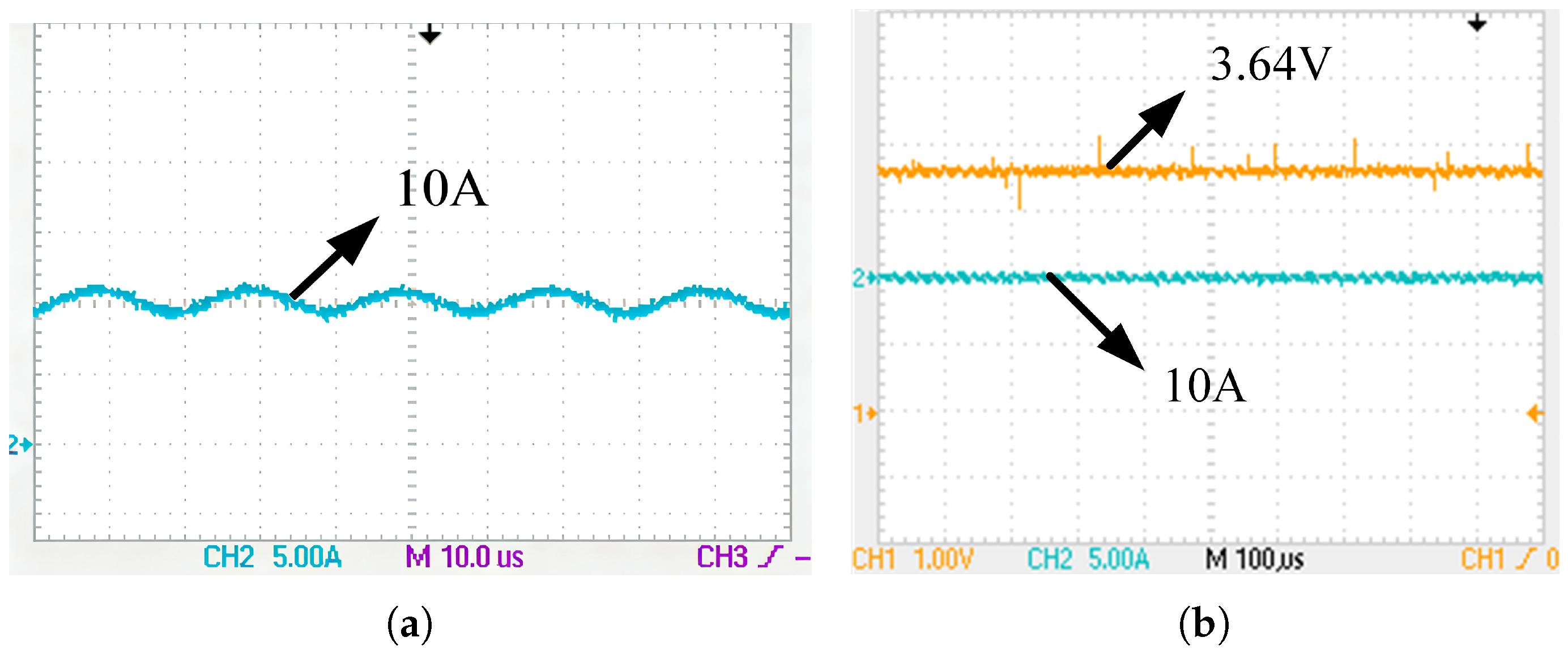
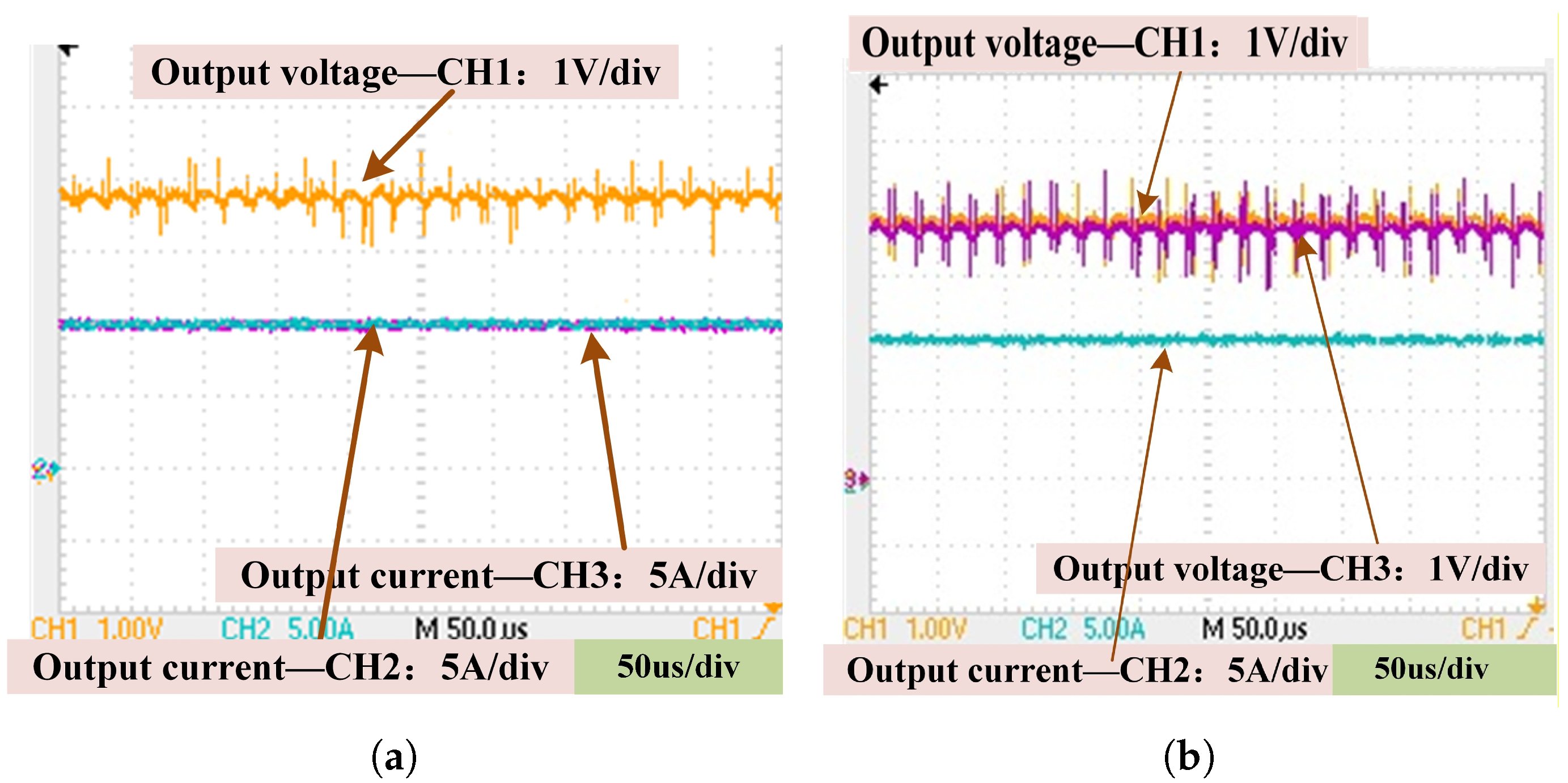
In CV mode, the load voltage was gradually varied from 3.0 to 3.65 V to emulate a battery CC charging process. As shown in Figure 22a, the module output current remained stable at approximately 10 A, meeting the design specifications.
(2)
In CC mode, the load current was adjusted from 0 to 10 A to simulate a battery CV charging process. As depicted in Figure 22b, the module output voltage stayed around 3.64 V, satisfying the design requirements.
Further tests were conducted by configuring the three electronic loads in different modes, as illustrated in Figure 23. The results indicate that the module maintained stable voltage and current under both CC and CV modes, with no significant fluctuations, overshoot, or oscillation. These experiments validate the system’s reliability and steady-state control performance across different operating conditions, demonstrating its capability to handle multi-condition loads.
The overall power conversion efficiency of the balancing module was evaluated by measuring input and output power during active equalization. Under a balancing current of 10 A, the measured conversion efficiency is greater than 90%, depending on the charging stage and switching mode. The high efficiency is attributed to the use of synchronous rectification and a resonant primary-side converter, which reduces switching losses and improves energy utilization during high-current operation.

5.3. Experimental Analysis of Battery Balancing System

Three series-connected LiFePO4 cells were integrated into the equalization system with a 48 V DC regulated power supply. Each cell was connected to the output of its respective equalization module. The ATmega328P microcontroller acquired cell voltages from the BQ40Z50 chip via the host computer, updating the display every 5 s. When the voltage spread exceeded 30 mV, the system initiated equalization according to the mode: in passive mode, the highest-voltage cell was discharged; in active mode, cells below 3.65 V received equalization charging.
The equalization current was calculated by the local controller and regulated via duty cycle to maintain 10 A. Cells reaching 3.65 V switched to CV charging with gradually decreasing current, while others continued CC charging.
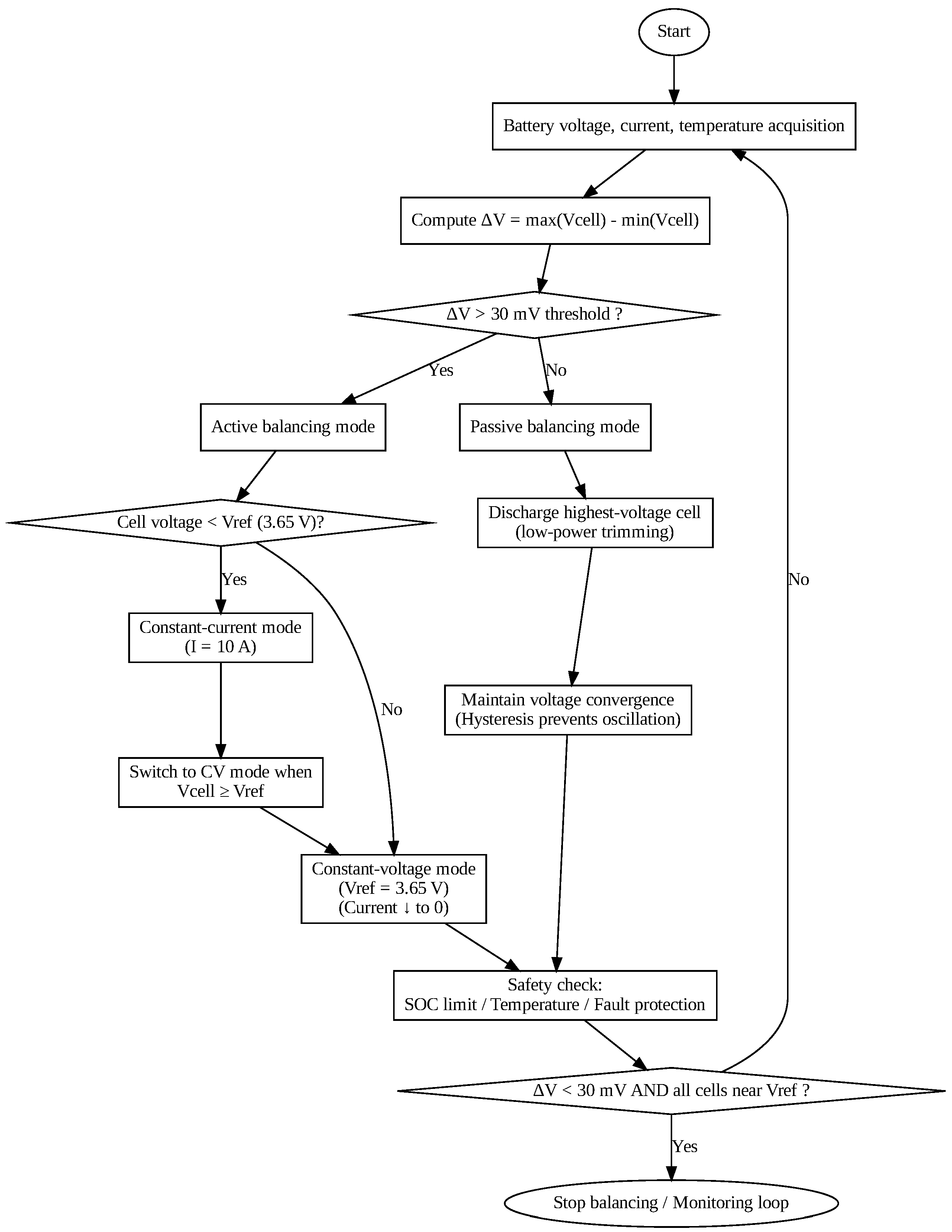
The decision-making logic for switching between active and passive balancing is shown in Figure 24. When the voltage deviation exceeds the preset threshold (30 mV), the system activates energy redistribution to lower-SOC cells. Once the deviation is small and the cell voltage approaches 3.65 V, passive trimming is applied to finalize convergence and prevent excessive charging. A small hysteresis margin prevents repeated switching.
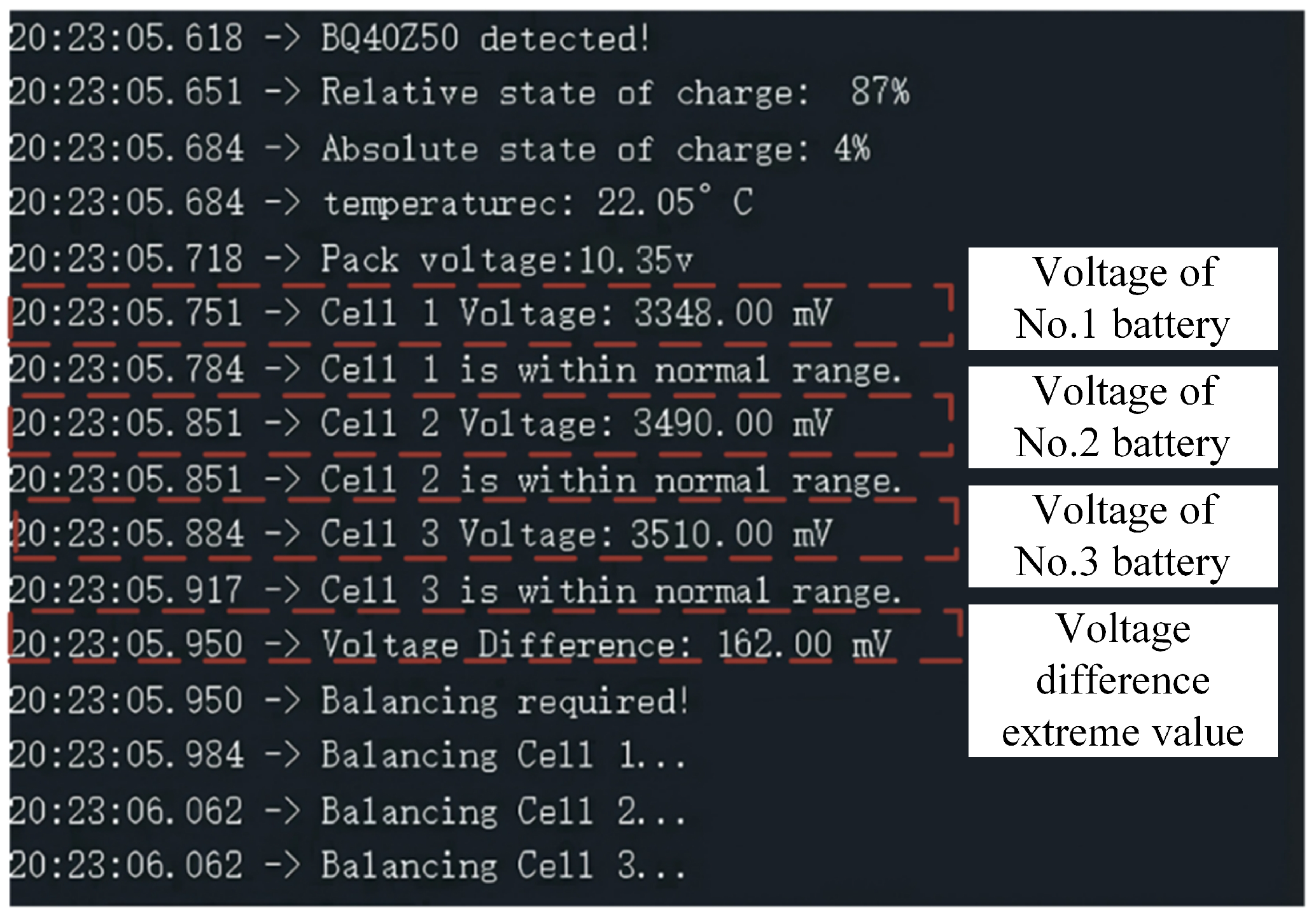
At the start of the experiment, the pack SOC was 87%, total voltage 10.35 V, and individual cell voltages were 3348, 3490, and 3510 mV (spread 162 mV). As shown in Figure 25, the system initiated equalization, progressively aligning the cell voltages.
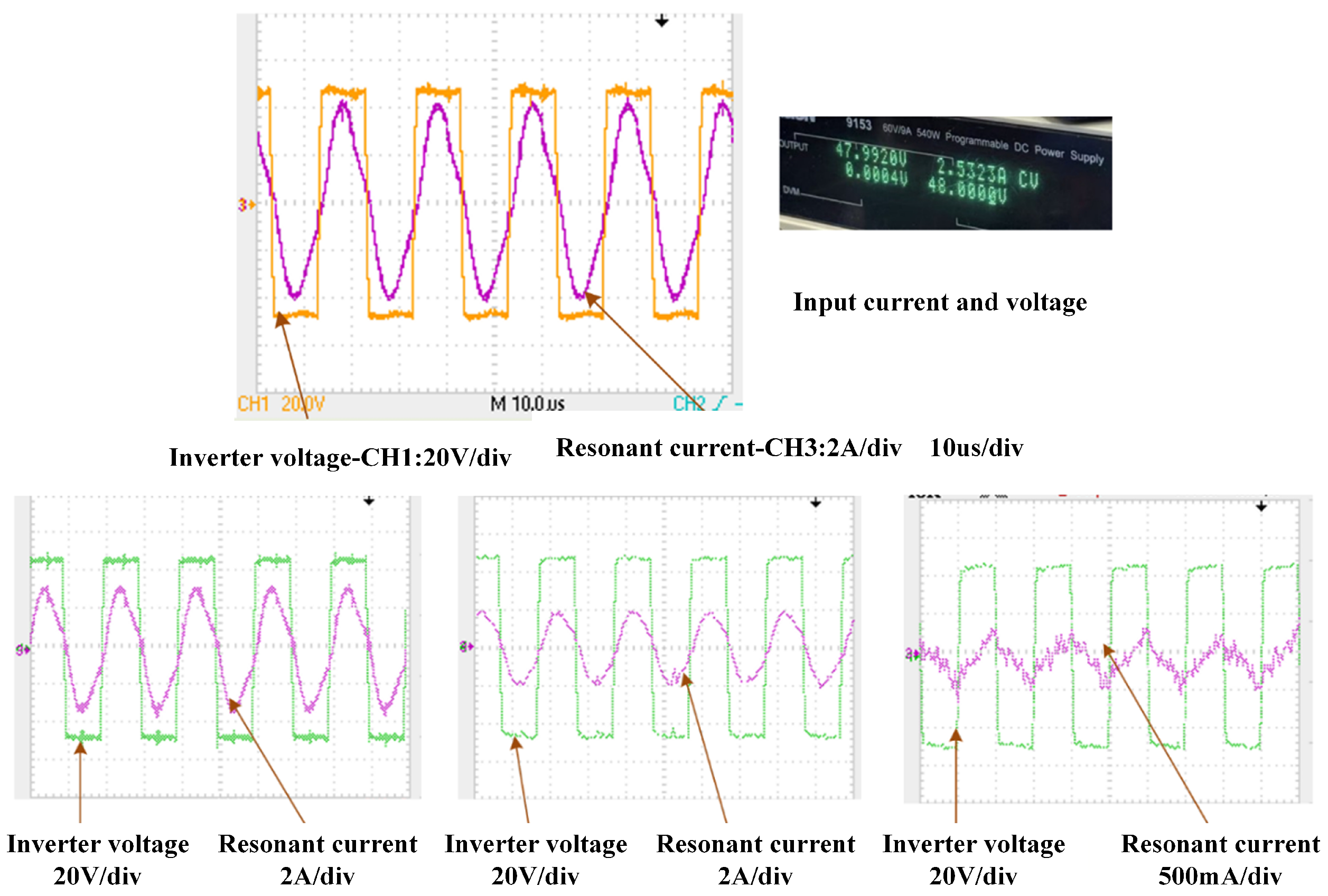
During constant-current equalization of three series-connected cells, the full-bridge converter operates in resonant mode, with inverter voltage and primary current in phase. The switching frequency is 50 kHz, voltage amplitude approximately ±48 V, and current peak around 4 A, exhibiting a near-sinusoidal waveform with no DC offset. The switching on/off current is 0 A, consistent with simulation results, effectively reducing switching losses.
During the charging process, the initial voltage differences among the cells cause an asynchronous transition from constant-current (CC) to constant-voltage (CV) mode for each cell. Consequently, the equalization current gradually decreases, the voltage spread narrows, and the primary current declines smoothly, as shown in Figure 26. These results demonstrate that the proposed single-input multi-output (SIMO) active equalization topology can achieve stable equalization charging in response to voltage differences. According to these experimental results, during the balancing process, the balancing efficiency of the three batteries obtaining energy from the power supply side at a constant current is:
η = P out P in = 3 · V out · I out V dc · I in = 3 × 3.65 × 10 47.992 × 2.5323 = 90.11 %
Taking Battery 2 as an example, the dynamic transition of active equalization was assessed. During the CC phase, the charging current remained stable at 10 A, and the voltage gradually increased to the threshold. Upon switching to the CV phase, the voltage was maintained while the current smoothly decreased to 0 A, with no abrupt changes, indicating a seamless transition.
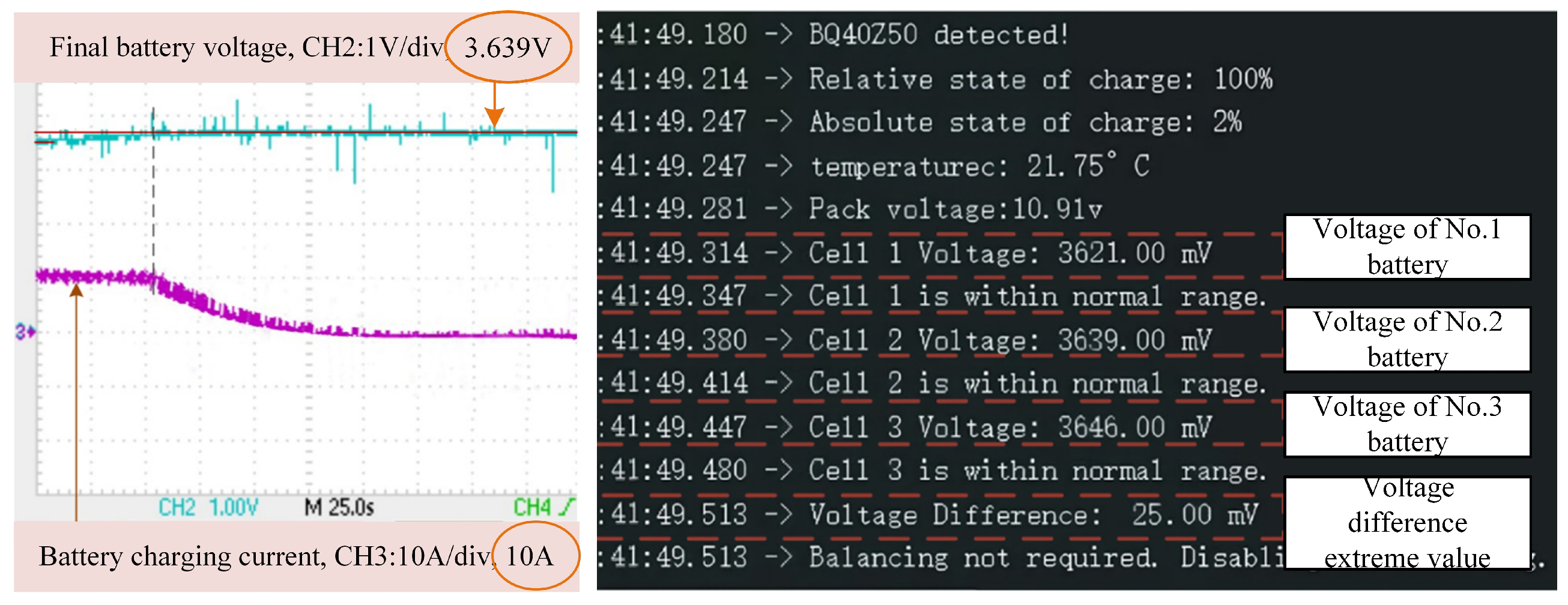
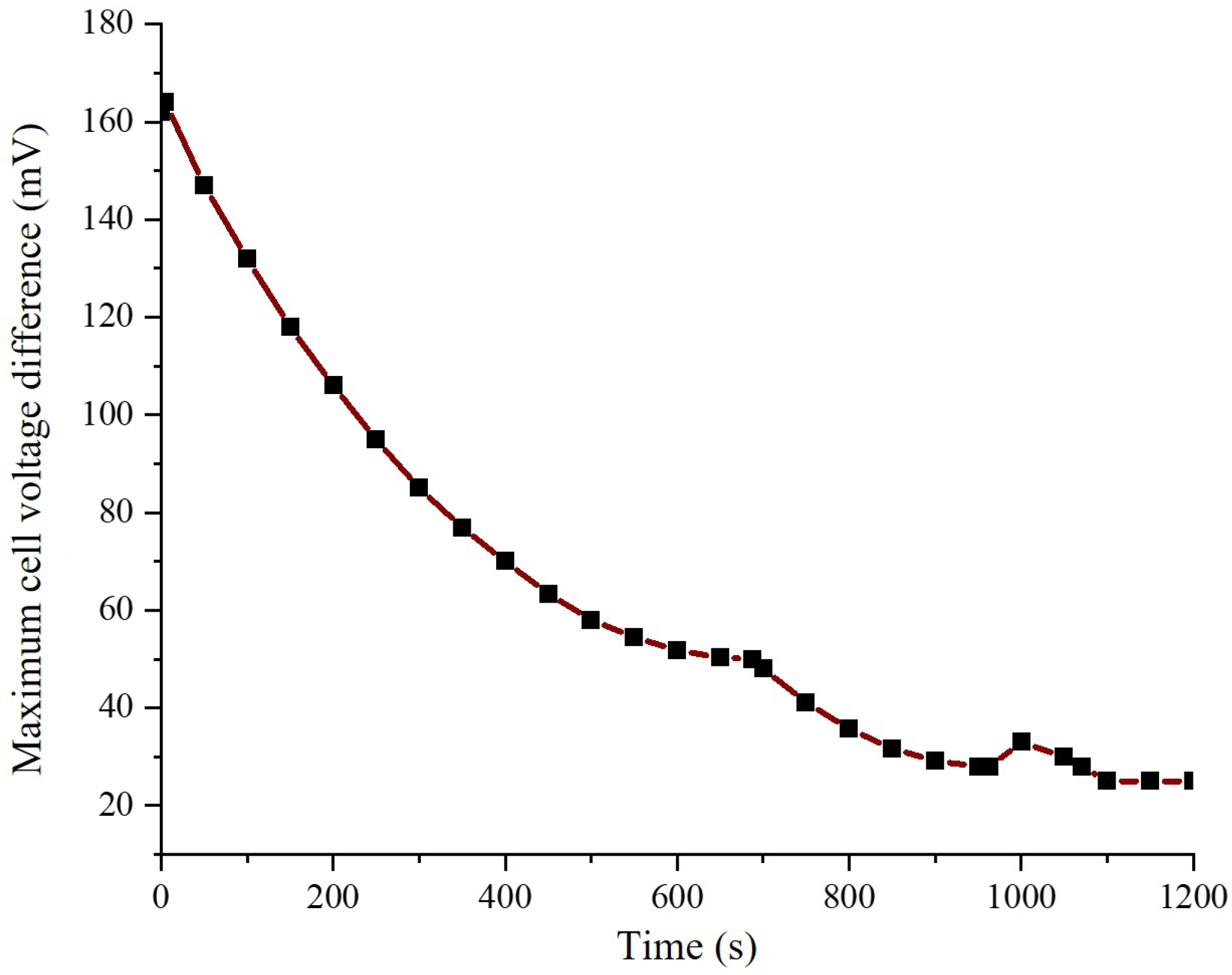
At the end of the equalization experiment, as shown in Figure 27, the pack SOC reached 100%, with a total voltage of 10.91 V. Individual cell voltages were 3621, 3639, and 3646 mV, yielding a maximum voltage difference of 25 mV, below the 30 mV threshold. The equalization system was then deactivated, confirming the stability and effectiveness of the active equalization strategy. During the equalization charging of three Li-ion cells, the voltage spread gradually decreased from an initial 162 mV to below 30 mV after 1200 s. The experiment demonstrates that the single-input multi-output equalization system can dynamically distribute energy, effectively improving the consistency of series-connected cells. With an equalization current of 10 A, the voltage spread converged to the design target, validating the system’s equalization performance.
As shown in Figure 28, the voltage difference among the three lithium-ion cells gradually decreases during the equalization charging process. The initial maximum cell voltage difference of 162 mV is reduced and stabilized below 30 mV after 1200 s of adjustment. The experimental results demonstrate that the proposed single-input multi-output equalization system can dynamically allocate energy among cells, thereby improving the uniformity of the series-connected battery pack. Under an equalization current of 10 A, the cell voltage difference converges rapidly to the target, verifying the system’s effectiveness and performance.
Although long-term aging testing was not conducted in this work, maintaining a small cell voltage deviation (≥30 mV) during charging helps to prevent repeated overcharge/undercharge stress, reduces thermal imbalance, and minimizes uneven resistance growth among cells. Therefore, the proposed hybrid balancing strategy is expected to contribute positively to long-term consistency and battery pack lifetime.

6. Conclusions

This work presented a SIMO active balancing system for large LiFePO4 modules, integrating a transformer-based shared interface with distributed synchronous-rectified buck modules. Quasi-open-loop primary control and dual-loop CC–CV secondary control enabled stable high-current balancing, effectively reducing initial cell voltage deviations. Compared with existing methods, the system demonstrates enhanced suitability for large-format cells and high-current scenarios. Future work will focus on SOC/SOH-aware control, multi-module coordination, and long-term testing to evaluate practical deployment potential.

Author Contributions

Conceptualization, W.J. and F.Z.; methodology, W.J. and F.Z.; software, W.J. and F.Z.; validation, W.J. and F.Z.; formal analysis, W.J. and F.Z.; investigation, W.J. and F.Z.; resources, W.J. and F.Z.; data curation, F.Z.; writing—original draft preparation, W.J.; writing—review and editing, F.Z.; visualization, F.Z.; supervision, F.Z.; project administration, F.Z. All authors have read and agreed to the published version of the manuscript.

Funding

This research was funded by the Yangzhou City Zero-Carbon Smart Manufacturing Engineering Technology Research Center and the Industrial Microgrid Intelligent Gateway Research and Development Project under grant number YZ202428.

Data Availability Statement

The original contributions presented in this study are included in the article. Further inquiries can be directed to the corresponding author.

Conflicts of Interest

The authors declare no conflicts of interest. The funders played an active role in the design of the study, data collection, analysis, interpretation of results, manuscript writing, and the decision to publish the findings.

References

  1. Devi, B.; Kumar, V.S.; Leelavathi, M. Innovations in Battery Technologies of Electric Vehicle: A Review. In Proceedings of the 2023 International Conference on Energy, Materials and Communication Engineering (ICEMCE), Madurai, India, 14–15 December 2023; pp. 1–5. [Google Scholar] [CrossRef]
  2. Chen, J.; Zhou, Z.; Wang, X.; Liaw, B. Impact of Battery Cell Imbalance on Electric Vehicle Range. Green Energy Intell. Transp. 2022, 1, 100025. [Google Scholar] [CrossRef]
  3. Hoekstra, F.S.J.; Bergveld, H.J.; Donkers, M.C.F. Range Maximisation of Electric Vehicles through Active Cell Balancing Using Reachability Analysis. In Proceedings of the 2019 American Control Conference (ACC), Philadelphia, PA, USA, 10–12 July 2019; pp. 1567–1572. [Google Scholar]
  4. Kumar, R.; Bharatiraja, C.; Udhayakumar, K.; Devakirubakaran, S.; Sekar, K.S.; Mihet-Popa, L. Advances in Batteries, Battery Modeling, Battery Management System, Battery Thermal Management, SOC, SOH, and Charge/Discharge Characteristics in EV Applications. IEEE Access 2023, 11, 105761–105809. [Google Scholar] [CrossRef]
  5. Lacap, J.; Park, J.W.; Beslow, L. Development and Demonstration of Microgrid System Utilizing Second-Life Electric Vehicle Batteries. Energy Storage 2021, 41, 102837. [Google Scholar] [CrossRef]
  6. Ouyang, T.; Liu, B.; Wang, C.J.; Ye, J.L.; Liu, S. Novel Hybrid Thermal Management System for Preventing Li-Ion Battery Thermal Runaway Using Nanofluids Cooling. Int. J. Heat Mass Transf. 2023, 201, 123652. [Google Scholar] [CrossRef]
  7. Guo, Z.; Xu, Q.; Wang, Y.; Zhao, T.; Ni, M. Battery Thermal Management System with Heat Pipe Considering Battery Aging Effect. Energy 2023, 263, 126116. [Google Scholar] [CrossRef]
  8. Jeong, D.; Bae, S. Estimating Battery State-of-Charge with a Few Target Training Data by Meta-Learning. J. Power Sources 2023, 553, 2323–4424. [Google Scholar] [CrossRef]
  9. Xu, J.; Mei, X.; Wang, X.; Fu, Y.; Zhao, Y.; Wang, J. A Relative State of Health Estimation Method Based on Wavelet Analysis for Lithium-Ion Battery Cells. IEEE Trans. Ind. Electron. 2021, 68, 6973–6981. [Google Scholar] [CrossRef]
  10. Frost, D.F.; Howey, D.A. Completely Decentralized Active Balancing Battery Management System. IEEE Trans. Power Electron. 2018, 33, 729–738. [Google Scholar] [CrossRef]
  11. Zhang, Q.; Liu, T.; Wang, Q. Experimental Study on the Influence of Different Heating Methods on Thermal Runaway of Lithium-Ion Battery. J. Energy Storage 2021, 42, 103063. [Google Scholar] [CrossRef]
  12. Ghaeminezhad, N.; Ouyang, Q.; Hu, X.; Xu, G.; Wang, Z. Active Cell Equalization Topologies Analysis for Battery Packs: A Systematic Review. IEEE Trans. Power Electron. 2021, 36, 9119–9135. [Google Scholar] [CrossRef]
  13. Al-Smadi, M.K.; Abu Qahouq, J.A. Evaluation of Current-Mode Controller for Active Battery Cells Balancing with Peak Efficiency Operation. IEEE Trans. Power Electron. 2023, 38, 1610–1621. [Google Scholar] [CrossRef]
  14. Raeber, M.; Heinzelmann, A.; Abdeslam, D.O. Analysis of an Active Charge Balancing Method Based on a Single Nonisolated DC/DC Converter. IEEE Trans. Ind. Electron. 2021, 68, 2257–2265. [Google Scholar] [CrossRef]
  15. Wang, S.; Yang, S.; Yang, W.; Wang, Y. A New Kind of Balancing Circuit With Multiple Equalization Modes for Serially Connected Battery Pack. IEEE Trans. Ind. Electron. 2021, 68, 2142–2150. [Google Scholar] [CrossRef]
  16. Lu, J.; Wang, Y.; Li, X. Isolated Bidirectional DC–DC Converter With Quasi-Resonant Zero-Voltage Switching for Battery Charge Equalization. IEEE Trans. Power Electron. 2019, 34, 4388–4406. [Google Scholar] [CrossRef]
  17. Hannan, M.A.; Hoque, M.M.; Peng, S.E. Lithium-Ion Battery Charge Equalization Algorithm for Electric Vehicle Applications. IEEE Trans. Ind. Appl. 2017, 53, 2541–2549. [Google Scholar] [CrossRef]
  18. Wei, Z.; Peng, F.; Wang, H. An LCC-Based String-to-Cell Battery Equalizer With Simplified Constant Current Control. IEEE Trans. Power Electron. 2022, 37, 1816–1827. [Google Scholar] [CrossRef]
  19. La, P.H.; Choi, S.J. Direct Cell-to-Cell Equalizer for Series Battery String Using Switch-Matrix Single-Capacitor Equalizer and Optimal Pairing Algorithm. IEEE Trans. Power Electron. 2022, 37, 8625–8639. [Google Scholar] [CrossRef]
  20. Zhang, Z.; Gui, H.; Gu, D.J.; Yang, Y.; Ren, X. A Hierarchical Active Balancing Architecture for Lithium-Ion Batteries. IEEE Trans. Power Electron. 2017, 32, 2757–2768. [Google Scholar] [CrossRef]
  21. Schmitt, A.; Horstkötter, I.; Bäker, B. A Novel Approach for Modelling Voltage Hysteresis in Lithium-Ion Batteries Demonstrated for Silicon Graphite Anodes: Comparative Evaluation Against Established Preisach and Plett Model. J. Power Sources Adv. 2024, 26, 100139. [Google Scholar] [CrossRef]
  22. Ilyushin, Y.V.; Novozhilov, I.M. Methodology of Inspection of Absolute Stability of Pulse Distributed Control System. In Proceedings of the 2019 XXII International Conference on Soft Computing and Measurements (SCM), St. Petersburg, Russia, 23–25 May 2019; pp. 1–5. [Google Scholar] [CrossRef]
Figure 1. Block diagram of active balancing system for battery modules.
Energies 18 06371 g001
Figure 2. Classification of active balancing circuit topologies [15,16,17,18,19,20].
Energies 18 06371 g002
Figure 3. Modular non-adjacent cell topology.
Energies 18 06371 g003
Figure 4. SIMO active balancing circuit topology.
Energies 18 06371 g004
Figure 5. Model of the Synchronous Rectification Buck Circuit.
Energies 18 06371 g005
Figure 6. Voltage and current waveforms in continuous conduction mode.
Energies 18 06371 g006
Figure 7. Secondary side based on small signal modeling: (a) 0 < t < d T ; (b) d T < t < T .
Energies 18 06371 g007
Figure 8. Comparison of the dynamic response to a duty cycle step disturbance between the derived small-signal model and the detailed QSPICE circuit simulation.
Energies 18 06371 g008
Figure 9. Quasi-open-loop control logic diagram.
Energies 18 06371 g009
Figure 10. CC/CV control block diagram.
Energies 18 06371 g010
Figure 11. Frequency characteristics of the open-loop transfer function for CC and CV: (a) CC control; (b) CV control.
Energies 18 06371 g011
Figure 12. Main circuit simulation diagram.
Energies 18 06371 g012
Figure 13. Signal acquisition simulation diagram.
Energies 18 06371 g013
Figure 14. Three-way full-bridge filtered rectifier voltage waveform.
Energies 18 06371 g014
Figure 15. Battery balancing charging voltage and current waveform: (a) the transformation ratio is 1:1.5; (b) the transformation ratio is 1.
Energies 18 06371 g015
Figure 16. Transformer leakage current: (a) the transformation ratio is 1:1; (b) the transformation ratio is 1.5.
Energies 18 06371 g016
Figure 17. Simulation model of CC source and CV source.
Energies 18 06371 g017
Figure 18. Voltage and current waveforms in different modes: (a) two CV sources and one CC source; (b) two CC sources and one CV source.
Energies 18 06371 g018
Figure 19. System experimental platform.
Energies 18 06371 g019
Figure 20. BQ40Z50 normal communication screen.
Energies 18 06371 g020
Figure 21. Serial port monitoring diagram under Arduino IDE environment.
Energies 18 06371 g021
Figure 22. Balancing module CV and CC mode output: (a) CC mode; (b) CV mode.
Energies 18 06371 g022
Figure 23. Output of the balancing module in different working modes: (a) two CC modes, one CV mode; (b) two CV modes, one CC mode.
Energies 18 06371 g023
Figure 24. Decision flow of the proposed hybrid balancing control strategy.
Energies 18 06371 g024
Figure 25. Experimental communication initial state.
Energies 18 06371 g025
Figure 26. Voltage and current waveforms of three series-connected cells during CC-to-CV equalization charging.
Energies 18 06371 g026
Figure 27. Output voltage and current diagram of No. 2 battery equalization charging.
Energies 18 06371 g027
Figure 28. Variation of maximum cell voltage difference during equalization charging of the battery pack.
Energies 18 06371 g028
Table 1. Comparison of representative active balancing architectures.
Ref.TopologyCurrentEfficiencyScalabilityFor ≥100 Ah
[11]Capacitor switched0.5–1.2 A68–78%MediumLimited
[20]MOSFET matrix C2C1–2 A75–82%LowModerate
[19]Resonant inductor3–5 A85–90%MediumGood
This WorkSIMO + SR buck10 A90–94%HighExcellent
Table 2. System simulation parameters.
Design ParametersParameter Values
Input Voltage48 V
Switching Tube Operating Frequency50 kHz
Coupling Capacitor C p 4 µF
Transformer Primary Inductances L1, L2, L3250 µH
Transformer Secondary Inductances L4, L5, L6570 µH
Transformer Leakage Inductance L72.5 µH
Filter Capacitors Cs1, Cs2, Cs32000 µF
Output Inductances Lo1, Lo2, Lo3196 µH
Output Capacitors Co1, Co2, Co322 µF
Table 3. Basic parameters of single energy storage lithium battery.
Parameter NameParameter Value
Nominal Capacity100 Ah
Nominal Voltage3.2 V
Battery Internal Resistance (1 kHz)0.5 m Ω
Charge Cut-off Voltage3.65 V
Discharge Cut-off Voltage2.5 V
Maximum Charge C-rate1 C
Maximum Discharge Current1 C
Operating Temperature0–55 °C
Table 4. Battery Terminal Voltage Collection Comparison (mV).
Sampling
No.
Battery 1Battery 2Battery 3
AFEFlukeErrorAFEFlukeErrorAFEFlukeError
1334833491349034900351035111
2342234253353035311354735470
3352535250360536061361736181
4357235720362536283363836362
5362136210363936401364636460
Disclaimer/Publisher’s Note: The statements, opinions and data contained in all publications are solely those of the individual author(s) and contributor(s) and not of MDPI and/or the editor(s). MDPI and/or the editor(s) disclaim responsibility for any injury to people or property resulting from any ideas, methods, instructions or products referred to in the content.