You are currently viewing a new version of our website. To view the old version click .
Energies
  • Article
  • Open Access

27 November 2025

TESE-Informed Evolution Pathways for Photovoltaic Systems: Bridging Technology Trajectories and Market Needs


,
and
1
Institute of Economics and Finance, Faculty of Law and Economics, University of Zielona Góra, ul. Licealna 9, 65-417 Zielona Góra, Poland
2
Institute of Management and Quality Science, Faculty of Law and Economics, University of Zielona Góra, ul. Licealna 9, 65-417 Zielona Góra, Poland
3
Arsnovo, 02-496 Warsaw, Poland
*
Authors to whom correspondence should be addressed.
This article belongs to the Special Issue Current Dynamics in Energy, Climate and Environmental Sustainability: Challenges, Prospects and Analysis

Abstract

Challenges related to energy security require support for investments in renewable energy sources. One of the most dynamically developing technologies in this area is photovoltaics. The literature provides numerous publications indicating PV development directions; however, strategic development planning remains fragmented between purely technological solutions and market-economic analyses. Systematic integration of both perspectives with customer needs is lacking. This study fills this gap: applying the Trends of Engineering System Evolution (TESE) methodology enables identification of PV system development trends with particular attention to PV user needs and consideration of market-economic and technological conditions. The TESE framework was used to identify the Main Parameter of Value (MPV), which indicates which technology features are important to consumers. Two key MPVs were identified: “profitability” and “independence.” These reflect the fundamental decision criteria of customers in residential and commercial segments. The analysis revealed that profitability is between stages 2 and 3 of the technology S-curve, while independence is at stage 2. As areas worth developing in terms of the indicated MPVs, the authors proposed: increasing panel efficiency, building integrated platforms containing PV, batteries, and an efficient management system (PV + ESS + EMS), and creating PV microgrids with energy storage. The integration of photovoltaic systems with energy storage solutions proved to be the most important strategic direction, simultaneously addressing both MPVs and enabling advanced energy management capabilities. The study provides manufacturers and technology developers with evidence-based recommendations concerning resource allocation in photovoltaic innovation. It combines the technology development approach and market demand through systematically verified evolutionary patterns. This methodology offers a repeatable framework for strategic technology planning in renewable energy sectors.

1. Introduction

The rapid growth of industrial activity, which has led to severe environmental degradation, has spurred global debate on how to mitigate the negative effects of economic development on the natural environment. The cornerstone of international climate action is the Paris Agreement, which calls for limiting the rate of global warming to well below 2 °C and pursuing efforts to restrict it to 1.5 °C above pre-industrial levels []. The document was adopted by 195 countries and the European Union. To fulfil the commitments of the Paris Agreement, the European Union introduced the European Green Deal in December 2019 [], followed by a more detailed framework established in 2021 through the European Climate Law []. These initiatives set legally binding targets of achieving climate neutrality by 2050 and reducing net greenhouse gas emissions by at least 55% by 2030, compared to 1990 levels. Russia’s invasion of Ukraine and the ensuing instability in energy security further accelerated the revision of climate and energy policies. In May 2022, the EU launched the REPowerEU plan [], which couples climate objectives with measures to strengthen energy independence, promoting the transition towards renewable energy sources as a strategy to phase out Russian fossil fuels. A central focus of this plan is photovoltaic technology, recognised as the most rapidly deployable renewable energy source. According to the document’s targets, the EU aims to install more than 320 GW of new solar capacity by the end of 2025, and nearly 600 GW by 2030 [].
Recommendations concerning the use of photovoltaics stem from the fact that solar energy is an easily accessible and inexhaustible resource, and the technology itself is already well developed. The installed capacity of photovoltaic systems worldwide has been growing exponentially. In 2024, 597 GW of new solar power capacity was installed (a 33% increase compared to 2023), bringing the total global capacity to 2.2 TW by the end of that year. More than 80% of all newly added renewable energy generation came from photovoltaic sources []. In the same period, Europe saw the installation of 65.2 GW of new solar systems, reaching a cumulative capacity of 368 GW []. These figures confirm that the objectives of the REPowerEU plan have been met. The most dynamic growth in solar installations occurred in China and India, while the largest solar power fleets are currently located in China, the United States, India, Germany, Japan, and Brazil []. Meanwhile, the costs associated with photovoltaic installations continue to decline steadily.
In light of the above, it can be concluded that generating energy from photovoltaic systems holds strategic significance. This applies not only to Europe’s energy security in the context of Russia’s aggression against Ukraine and its geopolitical consequences, but also to the opportunities it provides for economic growth in developing countries. For these reasons, it is worth considering how the further development of this technology should be shaped.
The literature contains a vast number of publications addressing this issue. Broadly, they can be divided into two main groups. The first focuses on solving technological problems, such as efficiency, resistance to weather conditions, and panel durability (e.g., [,,,,,]. The second group examines the development of photovoltaic panels in the context of market, political, and legal changes such as support programmes, legislation, and regulations and links them to the specific conditions of countries that are dynamically implementing PV-based power systems (e.g., [,,,,]). Some studies partially combine these two perspectives (e.g., [,]). Although all these analyses provide valuable insights, they generally lack a systematised approach to assessing technological change and a broader interpretation that connects these changes with market and economic challenges. Such integration would enable the formulation of development strategies fostering both incremental and disruptive innovations. In this context, the voice of the customer who may potentially purchase PV-based solutions must be taken into account. This is a critical issue for entities that manufacture and implement photovoltaic systems. With the abundance of studies focused on solving technological issues, it is often difficult to identify those with actual implementation potential, while considering only legal or economic factors does not suffice for constructing a comprehensive strategic plan. Therefore, there is a need to define assumptions and recommendations that will help enterprises identify strategic areas for the development of their products, while encompassing the aforementioned dimensions. A tool that provides such analytical capability is Trends of Engineering System Evolution (TESE).
TESE forms the foundation of the Theory of Inventive Problem Solving, which was developed by Genrich Altshuller. Based on the analysis of patents, Altshuller identified how technical systems evolve—determining which technical solutions survived in the market and which disappeared from it. Trends of Engineering System Evolution reflect the principles underlying the development of technical systems that have proven successful in the marketplace. Since these principles were derived from the analysis of a large statistical database, they possess a universal character applicable to various types of engineering systems. The trends have enormous heuristic value because they can be consciously applied to develop and improve engineering systems, thereby ensuring their success in competition with other systems []. They represent a statistically proven direction of engineering system development that describes the natural transitions of engineering systems from one state to another []. Through the use of TESE, the market pull and technology push approaches are integrated. This integration is embodied in the Main Parameter of Value (MPV), the primary driving force behind the development of technical systems that determines their market success. MPV is the critical attribute on which customers base their purchasing decisions for a technical system. Its identification makes it possible to pinpoint those areas of the technical system whose development is most attractive to the customer. MPV is one of the key mechanisms of TESE, and through this framework, TESE becomes a tool for precise, critical, and creative forecasting of technological development [,]. Considering the broad context of customer needs, rather than only technological or economic changes, allows for the identification of solutions that address not just the requirements of the technology, but also those of the market. This approach allows TESE to support the management of new and existing product development [,], particularly during the idea generation phase [].
Accordingly, the aim of this article is to identify trends in the development of PV systems, with particular emphasis on the needs of PV users and the inclusion of market-economic and technological conditions. In this context, the authors pose the main research question: What development priorities should be set for PV technology? This issue is addressed through three specific research questions:
  • What stage of development has PV technology reached?
  • What market conditions (economic, legal, and political) determine the growth of the photovoltaic panel market?
  • Which trends in the development of technical systems will prove most effective for the current stage of PV development?
To the best of the authors’ knowledge, this study represents the first comprehensive investigation of PV system development that systematically addresses the identification of evolutionary trends, thereby significantly contributing to the existing body of knowledge. The application of TESE extends beyond previous research in three fundamental ways.
First, existing forecasting approaches in photovoltaics predominantly focus on technological aspects, with some studies incorporating market and economic dimensions. However, the integration of customer needs embodied in the Main Product Value (MPV) fundamentally shifts the direction of forecasting and innovation development by entrepreneurs, as it establishes a different starting point for predictions. Rather than developing products in directions that appear subjectively appropriate, entrepreneurs can orient their development toward directions that customers actually need. While these development trajectories may converge, only precise MPV identification reveals whether this convergence actually occurs. Beginning the analysis with MPV determination thus extends beyond standard cost-benefit analysis, as it indicates in which areas these costs and benefits should be considered.
Second, TESE distinguishes itself from conventional forecasting methods in that linear projections and econometric models rely on historical data and assume continuation of observed patterns. These quantitative methods can predict, for example, how much installed PV capacity will increase or how costs will change, but they fail to determine the direction of qualitative technological evolution, particularly in the face of potential technological breakthroughs that have no precedent in historical data. TESE overcomes this limitation by enabling forecasting based on universal laws of technical systems evolution. These laws explain the causal mechanisms driving changes in technical systems, thereby enabling prediction of development directions (“how” and “why” technology will change) rather than merely quantitative parameters (“by how much” PV capacity will increase). This characteristic makes TESE particularly valuable for forecasting disruptive innovations that traditional extrapolation models cannot predict by definition, as they lack precedent in historical data.
Third, TESE integrates market-economic and technological approaches. The market-technological dimension is emphasized by initiating the analysis with MPV determination and subsequently establishing its position on the technology S-curve, while the technological dimension is reflected in subsequent analytical steps, where development directions are identified based on evolutionary trends.
This paper is structured as follows. Section 2 presents the approaches adopted in the literature for analyzing development trends related to photovoltaics. Section 3 explains the research methodology in detail, describing how to identify the Main Parameter of Value (MPV) and the operational principles of Trends of Engineering System Evolution (TESE), as well as their advantages and potential applications. Section 4 contains the results of the conducted analyses, including the identification of the MPV and its technological aspects, the determination of key market conditions, and the application of trends in forecasting technological development. Section 5 situates the findings within the context of existing scientific literature. Finally, the study concludes with a summary, outlining its limitations and suggesting directions for further research.

3. Materials and Methods

3.1. MPV and Its Position on the S-Curve

Technical systems develop in accordance with the S-curve, meaning that the evolution of key parameters of a technical system follows a trajectory whose shape resembles the letter “S” (Figure 1). These parameters are referred to as Main Parameters of Value (MPV). According to Lyubomirskiy et al. [], they pass through five stages:
Figure 1. Stages of the S-curve. Source: [].
  • 1st stage: infancy—the system is not yet present on the market;
  • Transitional stage—the system enters the market;
  • 2nd stage: rapid growth—the system is present on the market, and its production grows rapidly;
  • 3rd stage: maturity—the system remains on the market, but its development is already limited;
  • 4th stage: decline—the system loses its position in the market.
MPV is a key factor influencing customer purchasing decisions [,]. It reflects the functionality of the technical system from the end-user perspective rather than from the producer or engineer perspective. However, identifying MPV is not straightforward. When customers are asked about important product features, they will indicate a large number of them, but the actual trigger for making a purchase will be only one or a few []. In practice, this means that it conveys the essential product features the customer would like to acquire []. MPV is traditionally defined in terms of performance, safety, style, user experience and cost, as well as product functionality related, for example, to its physical or chemical properties []. MPV is not a universal parameter—each company, even if it offers products from the same category, may have both similar and different MPVs. This stems from the fact that companies within the same industry may serve different market segments with distinct needs and priorities.
MPVs have an impact on customer base retention, adjacent markets, market share, positioning, and acquisitions, because they fulfill market needs that drive all revenue sources []. MPVs can be used to create new products, identify adjacent markets for existing products and technologies, and for technology scouting []. The use of MPVs differs fundamentally from conventional development planning methods that rely on constructing futuristic scenarios for an entire product. In MPV-based forecasting, each parameter is analysed separately, which ensures greater precision. As a result, several potential development scenarios can be generated, allowing the optimal direction to be selected after comparative analysis.
A range of indicators determine the stage of the S-curve at which a given Main Parameter of Value (MPV) is located. These indicators are presented in Table 2. The starting point for identifying the S-curve stage is the assessment of the presence of the technical system on the market and the trajectory of the given MPV. The remaining indicators provide additional detail about its position. In this context, it is important to note that a technical system does not necessarily meet all indicators associated with a particular stage and may simultaneously exhibit features of two or more stages. This requires the analysis of the technical system within a broader context and the consideration of possible divergence in the application of the TESE methodology.
Table 2. Indicators of S-Curve Stages.

3.2. Trends of Engineering Systems Evolution as a Development Prediction Framework

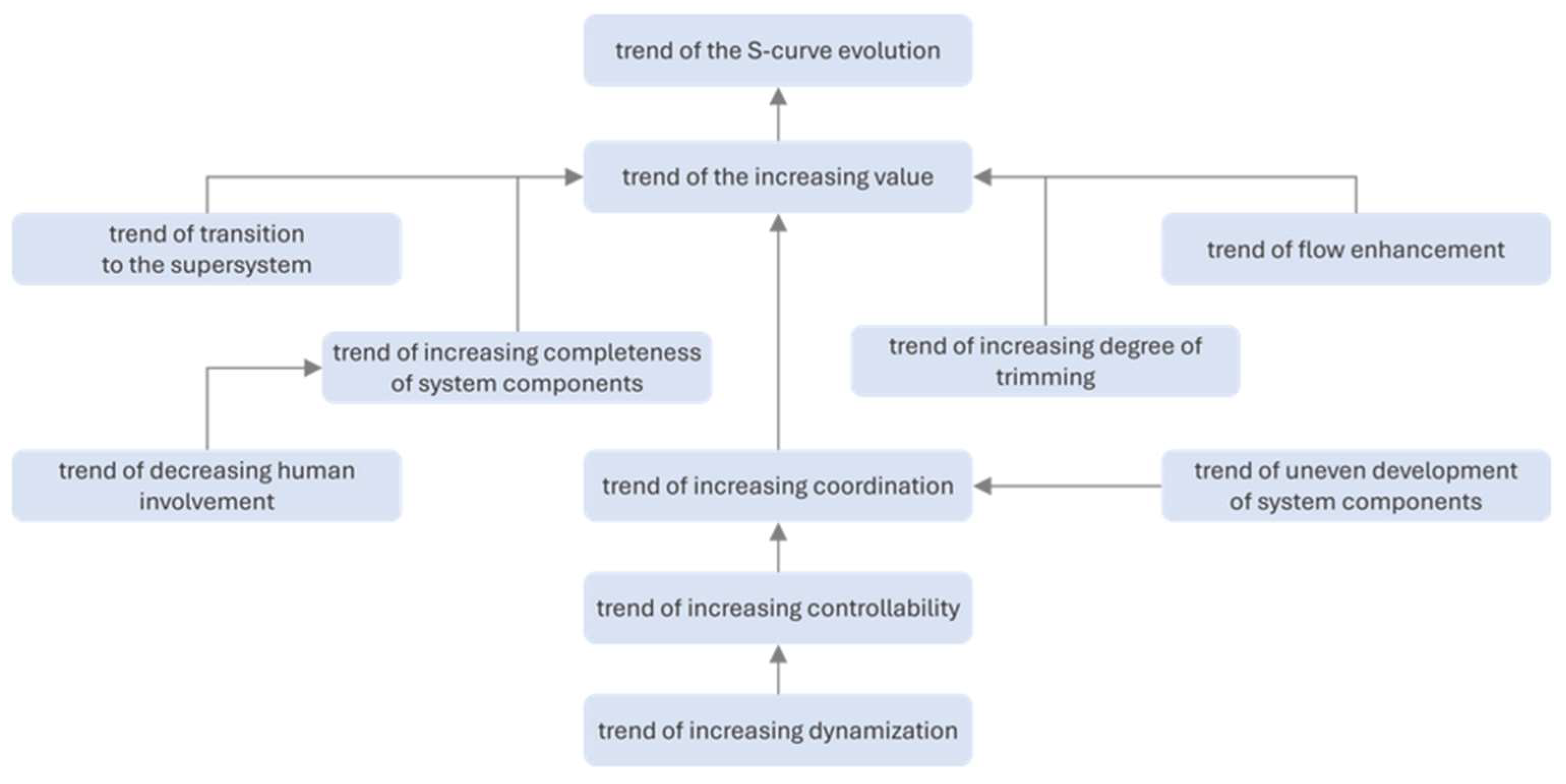
The concept of Trends of Engineering Systems Evolution (TESE) was initiated by Genrich S. Altshuller in the 1970s. He developed it further while formulating the Theory of Inventive Problem Solving (TRIZ). Altshuller discovered these principles through the analysis of patents. He identified certain recurring patterns in their evolution and called them patterns of invention. The combined and generalized synthesis of these patterns, independent of specific contexts, led to the formulation of evolutionary trends []. However, these early trends did not provide practical guidance on how to use them for predicting the development of products and technologies. Consequently, over the years, researchers associated with TRIZ have advanced this concept (e.g., [,,]). These experts belong to the distinguished group of TRIZ Masters affiliated with the International TRIZ Association (MATRIZ) and GEN TRIZ (formerly GEN3 Partners). Thanks to their work, TESE today encompasses 11 trends, which can be defined as “statistically proven directions of engineering system development that describe the natural transitions of engineering systems from one state to another” []. TESE has a hierarchical structure reflecting the relationships among the trends (Figure 2). A subordinate trend functions as the mechanism of the trend positioned above it in the hierarchy. In addition, each trend has its own internal mechanisms. Therefore, for a given trend to evolve in line with a higher-level one, both its internal mechanisms and those of its subordinate trends must be realized.
Figure 2. Hierarchical structure of the Trends of Engineering Systems Evolution (TESE). Source: [].
Technology forecasting using the Trends of Engineering Systems Evolution (TESE) is based on a product’s Main Parameter of Value (MPV). This provides a significant advantage over other forecasting methods, as it not only incorporates the voice of the customer but also automatically identifies competing technologies that meet the minimum acceptable performance level for a given MPV, thus enabling knowledge transfer across different domains. For example, if the MPV concerns the long driving range of electric vehicles, the analysis includes all competing technologies that meet this MPV within the context of range performance for comparative evaluation. In other words, both state-of-the-art and emerging technologies are inherently embedded in this approach. Furthermore, combining S-curve analysis with TESE provides valuable insights into innovation activities aimed at improving the MPV [].
Within the entire hierarchy, the Trend of S-Curve Evolution is the superior trend, while the remaining trends serve as mechanisms for its implementation. Its application is based on pragmatic S-curve analysis, which identifies the stage of development of one or several Main Parameters of Value (MPV) within a given technical system and, on this basis, determines the actions necessary to improve that system []. The purpose of this process is to uncover hidden customer needs and provide direct input for new product portfolio development. It is important not to treat the technical system as a single unit but to analyse its individual MPVs, since different MPVs of the same technical system may be located at different stages of the S-curve. For example, in the case of automobiles, parameters such as fuel efficiency and maximum speed may correspond to stage 3, while driving comfort and emission reduction may still be at stage 2 [].
The mechanism underlying the trend of S-curve evolution is the trend of increasing value. This trend indicates that, as a technical system evolves, its overall value increases. The rise in value occurs either through the implementation of the trend’s internal mechanisms (Figure 3) or by employing subordinate trends positioned lower in the hierarchy (Figure 2). The value of a technical system is directly proportional to its functionality and inversely proportional to its costs. It can thus be expressed as follows:
V = F C
where:
V —value of the technical system;
F —total functionality of the technical system;
C —total costs or expenditures related to the technical system.
Figure 3. Recommendations to increase value depending on S-curve stage. Source: []. Energies 18 06216 i001 functionality increases while costs decrease; Energies 18 06216 i002 functionality grows faster than costs; Energies 18 06216 i003 functionality increases while costs remain stable; Energies 18 06216 i004 functionality remains at the same level, while costs decrease; Energies 18 06216 i005 functionality declines more slowly than costs.
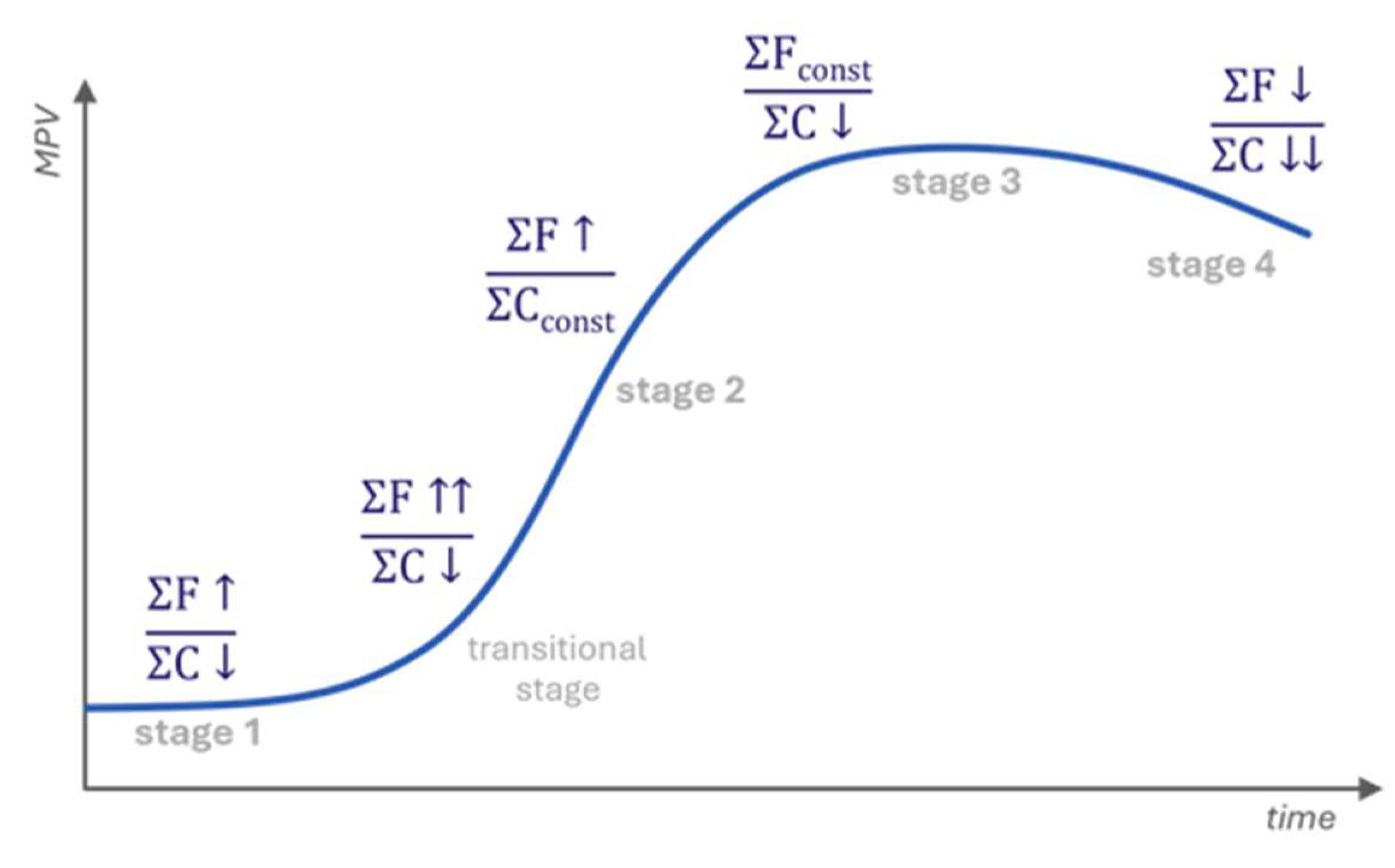
Considering the profitability of a given product, it is essential to ensure that the total costs of its production remain lower than the sum of its functionalities. Depending on the stage of the S-curve at which a given Main Parameter of Value (MPV) is located, this balance can be achieved in different ways []:
  • 1st stage: infancy—functionality should be improved while simultaneously reducing costs.
  • Transitional stage—at this stage, MPV increases significantly, which drives cost growth; efforts should be made to ensure that the growth rate of costs remains slower than that of functionality.
  • 2nd stage: rapid growth—MPV continues to increase; measures should be taken to keep cost growth below the rate of increased functionality or to maintain costs at a stable level.
  • 3rd stage: maturity—MPV has limited potential for further development; the focus should shift primarily to cost reduction.
  • 4th stage: decline—both functionality and costs should be reduced, but the decrease in costs must exceed the decline in functionality; for instance, producing simpler, lower-cost products that still meet customer needs.
These recommendations are illustrated in Figure 3.
Understanding the position of a given Main Parameter of Value (MPV) on the S-curve is crucial, particularly for managers responsible for product development. For instance, initiating projects aimed at enhancing functionality under a specific MPV during stage 3 constitutes a misallocation of resources, since at this stage, the focus should instead be on cost reduction []. All other trends presented in Figure 2 function as mechanisms of the Trend of Increasing Value. A detailed description of the trends is provided in the table in the Supplementary Materials (Table S1). In general, they can be defined as follows [,]:
  • Trend of increasing degree of trimming—as the engineering system evolves, certain elements of the system (components or operations) are eliminated without diminishing its functionality; in many cases, this process even enhances overall system performance.
  • Trend of flow enhancement—as the engineering system develops, the intensity of flows of substances, energy, or information through the system increases and/or these flows become more efficiently utilized.
  • Trend of increasing system completeness—as an engineering system evolves, it progressively acquires the following typical function blocks: the operating agent (which carries out the main function (the function for which the technical system was created) of the system), transmission (which channels energy supplied to the system to the operating agent), energy source (required for system operation), and control block (which manages the system’s activity).
    • Trend of decreasing human involvement—with the evolution of the engineering system, the number of functions performed by humans decreases.
  • Trend of transition to the supersystem—as the technical system evolves, it becomes increasingly integrated with elements of the supersystem. (the system that contains the analyzed technical system within itself.)
  • Trend of increasing coordination—as the engineering system evolves, the characteristics of its components become more coordinated with each other and with the supersystem.
    • Trend of uneven development of system components—the evolution of the engineering system initially focuses on the operating agent, with other components developed later.
    • Trend of increasing controllability—as the engineering system evolves, more means of controlling the system are developed.
      Trend of increasing dynamization—the engineering system and its components progress towards greater flexibility, dynamism, and adaptability, acquiring more degrees of freedom.
The described trends exhibit different mechanisms of action. Although they serve as essential tools for anticipating system evolution, their effectiveness varies depending on the stage of the S-curve. The applicability of these trends relative to the developmental stage of the analyzed Main Parameter of Value (MPV) is presented in Table 3.
Table 3. Recommendations for the use of TESE at different stages of MPV development in the technical system.
The use of trends offers a range of advantages. Understanding and applying them provides guidance on how to develop solutions that align with the natural, evolutionary progression of a system []. TESE enables convenient retrospective analysis of multiple system generations, tracing their development from inception to the present day. Individual trends facilitate an efficient assessment of the development potential of technical systems according to selected criteria, such as energy conductance, functional dynamics, or coordination of actions []. TESE serves as a set of heuristics that helps to identify weaknesses in existing products [] and supports new product development []. Integrating TESE into the design process strengthens strategic planning and technology development, enabling shorter project durations, increased productivity, and improved quality and innovativeness of resulting solutions [,]. As a result, trends combine both market pull and technology push principles. TESE facilitates meeting market demand (via S-curve trend analysis) and drives technological advancement (via analysis of trends and subtrends as underlying mechanisms) [,].
The numerous advantages associated with TESE ensure its potential is increasingly recognized, leading to a growing volume of literature leveraging its methodologies. For instance, Baur et al. [] demonstrated that utilizing select TESE trends with manufacturer data can support the design of improvements for household appliances. Mansoor et al. [] illustrated how applying the trend of dynamization in green roof development can help identify areas where current solutions have “stalled,” enabling radical innovation. Abramov et al. [] highlighted the application of TESE for technology scouting in solid waste treatment. Nikulin et al. [] examined TESE’s role in advancing strategic development in the Chilean mining industry, and Berdonosov et al. [] applied them to forecasting the technological development of black oil coking installations. The trend of decreasing human involvement has also indicated pathways for solutions in TRIZ, particularly through its integration with artificial intelligence [].
Over time, analyses using TESE have grown more sophisticated, with an increasingly pragmatic focus. The application of artificial intelligence to extract information from social media about household appliances has demonstrated the usefulness of product development forecasting through the S-curve trend []. Analyzing the evolution of domestic robots based on patent data has proven that TESE is especially valuable in sectors where rapid technological evolution and patent competitiveness are crucial for market advantage [].

3.3. Justification for Selecting TESE as a Technological Forecasting Framework

Numerous methods for forecasting technological development exist in the literature. These are fundamentally divided into quantitative and qualitative methods, with hybrid approaches that combine both forecasting perspectives also evident. While each of these methods is valuable, they also have limitations that must be considered when designing scientific research.
Among quantitative methods, trend extrapolation and statistical modeling warrant particular attention. These methods rely on historical data and assume continuation of observed patterns. They are highly accurate and objective; however, they cannot predict disruptive innovations []. Furthermore, accurate forecasting requires large datasets—when data are sparse, rapidly changing, or unavailable, statistical models may be unable to generate precise predictions []. Patent analysis and bibliometrics also provide objective forecasts. However, it should be noted that while a very large number of patents are registered, only a portion possess commercial potential []. These methods also rely on keyword occurrence, which can be broadly interpreted and may complicate analyses []. Moreover, these methods are characterized by delayed inference due to the time elapsed between patent publication or other source data release and the initiation of analysis and interpretation. Quantitative methods also require specialized skills and can therefore be expensive [].
To capture the potential associated with disruptive innovations, it is preferable to apply qualitative methods. In this domain, the Delphi method, which relies on expert opinions within a given field, warrants particular attention. It is iterative in nature—the study is repeated until consensus among experts becomes apparent. The method’s advantage lies in its applicability with limited data availability, while its disadvantage includes difficulties in properly determining the methodological procedure [,]. Due to its iterative nature, it requires significant time investment, and employing experts, particularly renowned specialists, can prove expensive []. Scenario-based methods, which construct multiple images of the future, also rely on expert knowledge [] Scenario planning is likewise subjective and difficult to validate.
A hybrid method that integrates quantitative and qualitative approaches is technology roadmapping. Similar to TESE, it integrates market, product, and technological aspects and is widely used for strategic planning [,]. However, forecasting using roadmaps is resource-intensive—it requires substantial time, human resources, and financial commitment []. Simultaneously, challenges arise in updating roadmaps within dynamic environments. This means they become rigid strategic documents [].
Comparative studies of different forecasting methods demonstrate that both quantitative and qualitative approaches have difficulty fully capturing technological progress []. Furthermore, no single method proves universally superior; the appropriateness of their application depends on multiple factors []. Considering the objectives of the present study, the authors contend that TESE methodology represents the optimal choice. Compared to quantitative methods, it eliminates the problem of predicting qualitative technological changes and disruptive innovations. While quantitative methods might indicate, for example, by how much panel efficiency will increase, TESE reveals how and in which direction this technology may evolve qualitatively. Regarding qualitative methods, the primary advantage of TESE is its systematic approach. In contrast to the Delphi method, which aggregates subjective expert opinions, TESE is grounded in universal laws of technical systems. The same applies to scenario-based methods, which are subjective and dependent on the creators’ creativity. Compared to other qualitative methods, TESE—through its systematic research procedure and reliance on universal development trends—mitigates the risk of overlooking important aspects in technology forecasting.
At the same time, it is important to acknowledge the limitations of TESE. Scenario-based methods and the Delphi method surpass TESE in terms of flexibility when addressing market uncertainty—they can more extensively account for various energy policy scenarios, climate change impacts, and geopolitical factors. These methods therefore perform better under conditions of high uncertainty. While TESE also considers these factors, it does so to a lesser extent. Quantitative methods surpass TESE in numerical precision—based on historical data observations, they can predict specific parameter values (costs, capacity, efficiency). They are also more objective. This means that TESE will indicate, for example, the direction of development regarding photovoltaic panel capacity improvement, but will not show by how much this capacity will increase or whether it will be satisfactory for the entrepreneur.
Despite these methodological limitations, the authors believe that applying TESE methodology is most appropriate for achieving the research objectives. TESE integrates the technology push and market pull approaches by beginning the analysis with MPV determination, thereby incorporating customer needs. None of the identified methods accomplishes this to such an extent. Quantitative methods ignore the end-user perspective—they assume that a given technology will be adopted in the market (technology push). Furthermore, TESE forecasts development based on evolutionary laws rather than historical data, which eliminates problems with predicting disruptive changes. Other qualitative methods consider market context, but lack a systematic mechanism for linking customer needs with technological capabilities. TESE integrates customer needs, market conditions, and technology development forecasting through a single, coherent methodology.

3.4. Research Methodology

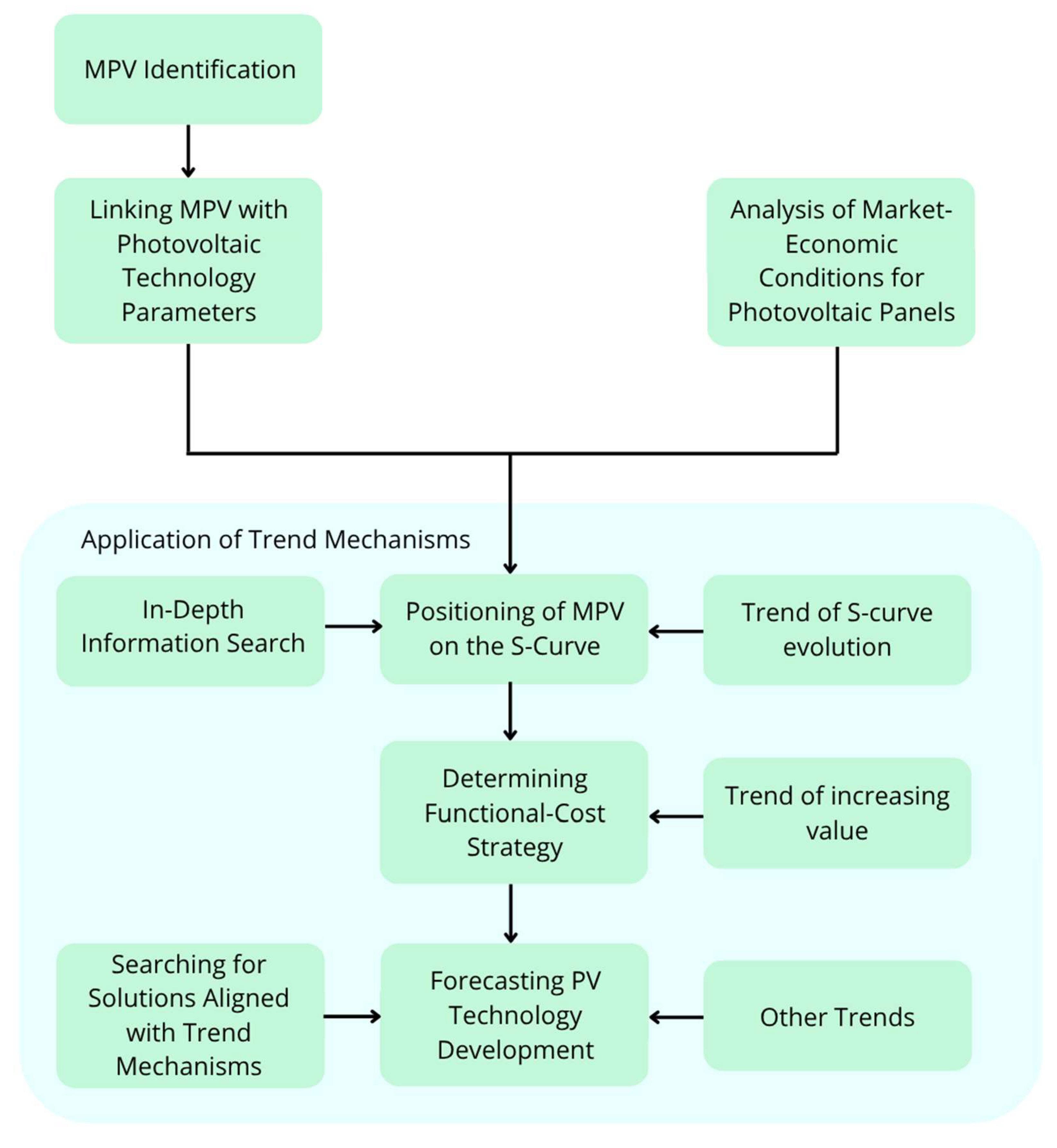
The research procedure is presented in Figure 4.
Figure 4. Research procedure for forecasting photovoltaic panel technology development using TESE. Source: Authors’ own study.
To properly apply TESE, the authors will first identify the MPVs for which analyses will be conducted. These constitute the starting point for further research work. Subsequently, parameters of the analyzed technology will be linked with the identified MPVs. In parallel, work will be conducted to assess the market-economic conditions of photovoltaic panels. In the next step, the MPV position on the S-curve will be determined. This will occur based on indicators consistent with TESE methodology (Table 3), utilizing information from earlier analysis stages (technological and market data). In cases where data or information are lacking, they will be supplemented. At this stage, market and technological data integration occurs, and this stage reflects the application of the trend of S-curve evolution. Next, based on the previously determined MPV position on the S-curve, an innovation introduction strategy related to implementing the trend of increasing value will be selected. The final step will consist of forecasting PV technology development in accordance with the remaining trends and issuing recommendations for entrepreneurs.
Conducting this study requires extensive desk research. To maintain the article’s readability, detailed elaboration of these analyses is provided in the Supplementary Materials, while the Results section presents the conclusions from each stage. This approach preserves the article’s coherence while simultaneously enabling readers to reproduce the conducted analyses.

4. Results

4.1. Characteristics of the Main Parameter of Value (MPV) for Photovoltaic Panels

4.1.1. Identification of MPV for Photovoltaic Panels

As mentioned earlier, the MPV is the key attribute or product/service property important to the user, which significantly influences purchasing decisions. Therefore, to identify the MPV for photovoltaic panels, attention was directed to customer purchasing decisions. To ensure maximum universality of the conducted analyses and their appropriate quality, the process of determining this indicator was based on analysis of scientific articles from the Web of Science and Scopus databases. Searching with the phrases: (photovoltaic OR PV OR solar) AND (decision making) AND (customer*) yielded 195 items in the Web of Science database and 244 in the Scopus database. In the first stage of analysis, articles constituting literature reviews (7—Web of Science; 12—Scopus) and peer-reviewed articles with accessible content in English (73—Web of Science; 64—Scopus) were considered. Articles were included if they directly addressed customer decision-making factors related to photovoltaic panel adoption and were excluded if they focused solely on technical specifications without consumer perspectives. Ultimately, 13 publications from the WoS database (including 6 review articles) and 9 from the Scopus database (including 2 review articles) were included in the final analysis. Duplicate articles were eliminated, subjecting 16 publications that thematically corresponded to the MPV issues as defined by the authors to final analysis.
It should be noted that among the factors influencing photovoltaic panel purchase decisions, two groups can be distinguished. The first includes motivations for purchasing photovoltaic panels and the second focuses on the objectives behind their implementation [,,,,,,,]. Motivations often serve as short-term drivers, while objectives are more deliberate, associated with long-term planning and representing desirable, measurable outcomes. This distinction is crucial for MPV identification because, in the authors’ view, motivations spark initial interest in PV systems, whereas objectives ultimately form the basis for the final decision to purchase. This means that the objectives have a direct impact on defining the MPV. In this context, it is also important to consider customer types and the possible differences between them regarding their motivations and objectives [,,,,,].
For individual customers, the main predictors (motives) of interest in PV systems include high electricity bills and concerns about rising energy prices, the availability of subsidies and support programs, increased environmental awareness or social pressure in this regard, and the prestige associated with adopting modern technology solutions [,,,,,,,,,]. It should be emphasized that economic benefits play a dominant role, while environmental aspects become more important, particularly among innovators and individuals with high environmental awareness [,,]. The most frequently cited objectives for PV adoption include reducing energy costs (long-term saving); increasing energy independence, which enhances security, comfort, and peace of mind; raising property value and participating in environmental protection through technology [,,,,,,,,].
Motivations and objectives differ for enterprises compared to individual customers. For businesses, financial gain is the primary goal, with environmental preferences playing a minor role [,,,,]. Motivations for interest in photovoltaic panels include uncertainty about increasing energy and operating costs and the desire to reduce them, energy price volatility, instability of energy policy, as well as evolving regulations and legal requirements. Companies are also motivated by pressure from contractors and investors (with reference to CSR), aiming to enhance corporate image. Other motivating factors include the availability of subsidies and tax breaks and broader technological progress [,,]. The implementation objectives are closely tied to financial considerations, such as operational cost savings (minimizing energy expenses in the company’s economic calculation), financial stability and predictability (long-term financial planning), maintaining business continuity (safeguarding operational processes), and enhancing company image [,,,,]. Reducing the carbon footprint, meeting environmental and corporate requirements, and gaining competitive advantage [,,,,,].
The hierarchy of PV adoption motives and objectives shows that individual buyers are mostly driven by financial and psychological benefits, while businesses focus on strategic, operational, and long-term gains. For individual consumers, the most important factors are noticeable reductions in electricity bills, rapid return on investment, and the ability to use energy independently of the market and grid. Savings can reach up to 65% of annual energy costs over the installation’s lifetime, with investment payback periods typically ranging from 5 to 10 years. Additional benefits include increased property value and protection against rising energy prices. In contrast, companies place strong emphasis on economic aspects, such as stabilizing energy costs, investment profitability (predictable costs and a positive economic account: return of investment (ROI), levelized cost of electricity (LCOE), risk reduction), and energy security for operational continuity. For firms, the overall economic calculation, strategic energy security, and fulfillment of sustainability policies (reputation, CSR, legal compliance) are paramount [,,,,,,].
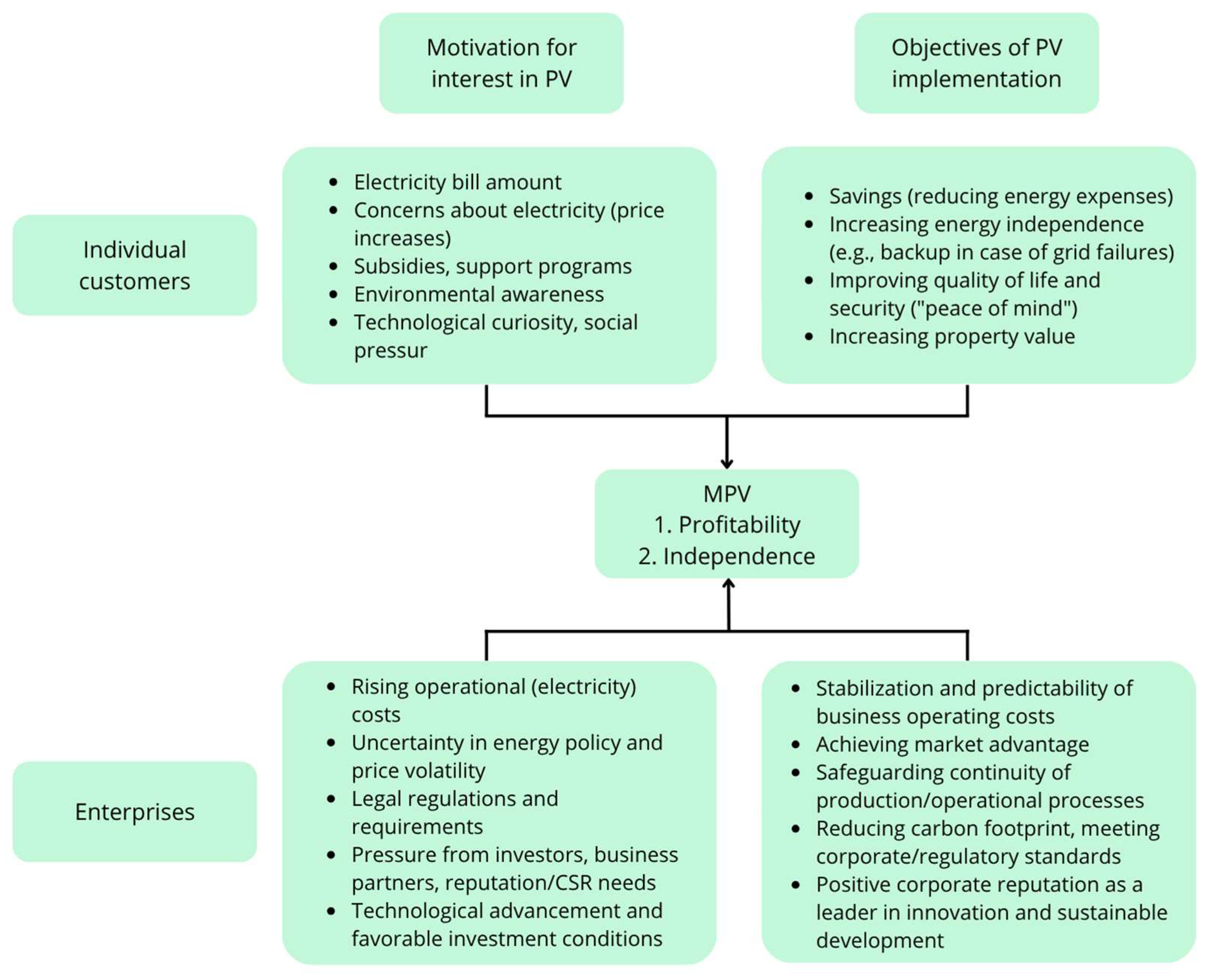
It should be emphasized that the described motivations and goals for PV implementation (Figure 5) represent key factors—essentially typical ones (most frequently cited or most important, particularly in review articles). It must be noted that these are influenced by factors such as [,,]: regional differences, public policy and support instruments, customer demographic and socio-economic characteristics, local cultural conditions, and technological context. For example, in countries such as South Korea and the USA, differences in solar irradiation, tariffs, taxation models, and building structure (single-family vs. multi-family homes) strongly influence financial benefits and optimization of leasing models for PV []. In East Africa (Kenya, Tanzania), rapid PV diffusion results from the integration of PV with mobile payment systems and the significant share of pay-as-you-go models and mini-grids, whereas in West Africa, adoption is slower due to low mobile payment penetration and less advanced financing models [].
Figure 5. Links between motivations for interest in PV and implementation objectives. Source: Authors’ own study.
For both individual and business customers, MPV can be defined as profitability and independence (Figure 5). The interpretation of these attributes varies according to customer type. For individuals, profitability is tied to costs and benefits (e.g., initial investment, payback period, the amount of achievable savings), while independence is understood as energy autonomy, meaning greater freedom from reliance on the external power grid. For enterprises, profitability is understood as measurable financial gain, reflected by factors such as lower electricity costs, return on investment, and overall project profitability, while independence is viewed in terms of operational activities.
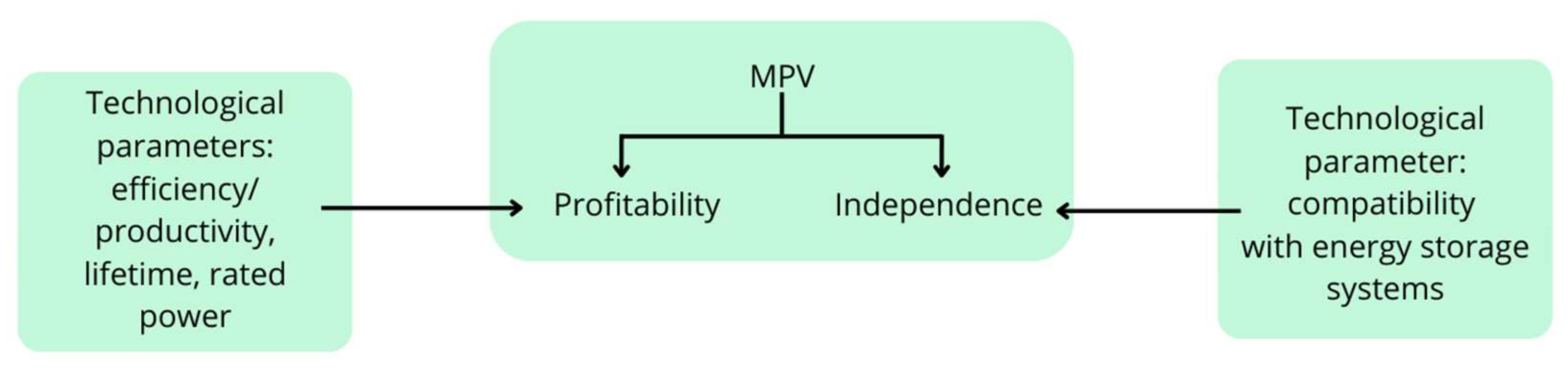
MPV is shaped by both technological parameters of the panels and market conditions (Figure 6). From a technological perspective, efficiency and productivity, rated power, and panel lifetime are the most important factors for profitability. Independence, meanwhile, requires compatibility of the panels with energy storage systems, signifying seamless cooperation of three components: storage, inverter, and photovoltaic installation.
Figure 6. Relationships between MPV and Technology Parameters. Source: Authors’ own study.
The economic viability of PV installations results from the synergy of efficiency, lifetime, and appropriately selected panel capacity. Interdependencies exist among these parameters that determine PV installation performance. Higher panel efficiency can result in faster return on investment, particularly where available space for PV installation is limited. However, highly efficient panels are typically more expensive, which may extend the payback period—thus, economic viability depends on local conditions, energy prices, and available subsidies. Similarly, higher rated panel capacity enables faster achievement of economic viability. Oversizing the installation often generates losses or extends the payback period. Shorter lifetime or rapid degradation reduces investment profitability, as reinvestment or maintenance requirements shorten the profit-generating period [].
Independence is closely linked to energy storage systems (e.g., batteries), which enable increased self-consumption of produced energy. This reduces dependence on the external grid and limits transmission/distribution costs [].
It must be remembered that the MPV derivation was based on specific motivations and goals. Although their arrangement, ranking, and significance can be considered typical, they cannot be assumed to be universal. Consequently, it should be noted that MPV is not a constant value but is subject to change under the influence of regulatory, social, technological, and market factors. It will also evolve over time and space.

4.1.2. Linking MPV with Technological Parameters of Photovoltaic Panels and Their Development Level

To complete the MPV-related analysis, it is necessary to link the identified MPVs with their technological parameters and assess their current development level. In this context, the previously indicated efficiency and productivity, rated capacity, panel lifetime, and panel compatibility with energy storage systems will be considered.
Efficiency is a technical parameter indicating the proportion of solar radiation striking the module surface that is converted into electricity []. It is determined under standard test conditions (STC) enabling direct comparisons between panels from different manufacturers and technologies in a uniform test environment.
The first photovoltaic panels, developed in the 1950s, converted only 6% of sunlight into electricity. Subsequent research and development efforts raised efficiency to 13–15% by the 1990s []. Currently, the efficiency of commercially available photovoltaic panels ranges from 15% to 24%. Polycrystalline panels yield lower values, while monocrystalline panels achieve higher ones. It is anticipated that cells entering mass production around 2027 will offer efficiency near 27% []. However, laboratory analyses demonstrate further efficiency improvements are possible by advancing essential components, including the type and quality of photovoltaic cells, panel materials and architecture, module structure, protective coatings, and overall enclosure quality.
Oni et al. [] demonstrated significant potential for efficiency improvements in solar cell technologies:
  • The efficiency of silicon-based (Si) solar cells has reached nearly its maximal value, about 25%. In contrast, III-V compound semiconductor solar cells continue to show annual performance gains of approximately 1%. These cells have recently achieved a remarkable efficiency of 47.1%.
  • Thin-film photovoltaic cells are advantageous due to minimal material consumption and steadily increasing performance. Cadmium telluride (CdTe), copper indium gallium selenide (CIGS), and amorphous silicon (α-Si) are three major materials utilized in thin-film photovoltaic cells. CIGS and CdTe PV technologies rival crystalline cells, with current record efficiencies at 23.6% for CIGS and 22.3% for CdTe. Meanwhile, perovskite photovoltaic cells exhibit extraordinary efficiency, reaching 26% for single-junction cells and 33.7% for perovskite–silicon tandem cells.
  • For single-junction solar cells, sub-bandgap loss accounts for around 25%, while thermalization loss is approximately 29.8% for material with a bandgap of 1.31 eV.
  • Integrating plasmonic nanoparticles on the cell surface offers promising opportunities for enhanced light trapping, while multijunction solar cells deliver exceptional spectral utilization.
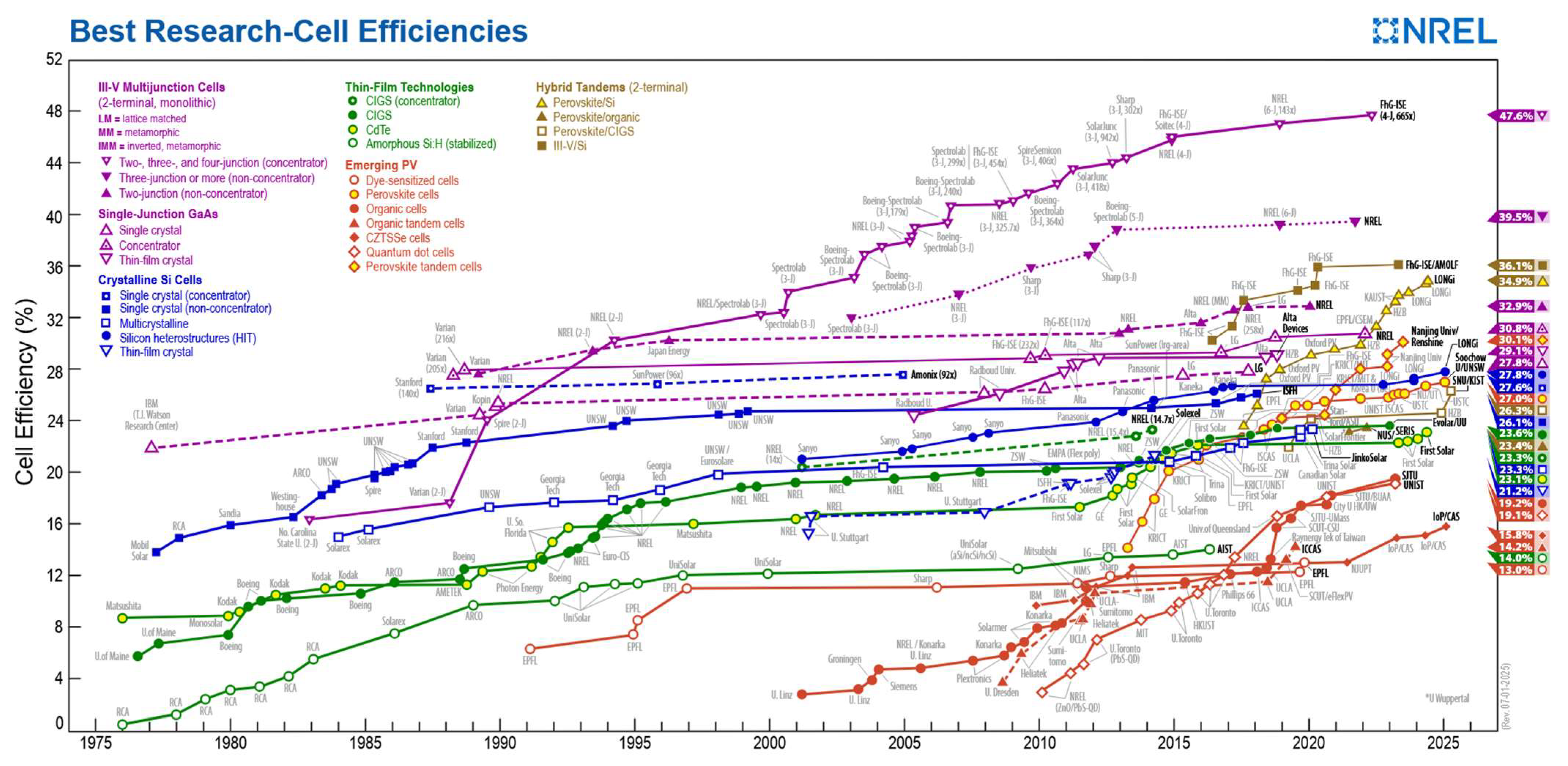
A similar outcome, namely an increase in PV efficiency (exceeding 47%) for various technologies, is confirmed by the monitoring of PV performance conducted by the National Renewable Energy Laboratory (NREL). Detailed changes in this area are presented in Figure 7. The most recent world record for each technology is highlighted on the right, in a flag containing the efficiency value and the technology symbol. The company or group responsible for producing the device holding the latest record is shown in bold on the chart. Other entities are marked in grey.
Figure 7. Laboratory efficiency of different PV technologies. Source: [].
Photovoltaic panel productivity refers to the actual amount of electrical energy generated by a module under specific operating conditions (such as on a building rooftop, PV farm, warehouse, etc.) over a defined period, for example, within a year [].
While efficiency is a constant value for a panel (a technological characteristic), productivity depends on numerous environmental factors, including the level of solar irradiance at a given location, panel orientation and tilt angle, weather conditions, ambient temperature, module cleanliness, and shading effects [].
Sarmah et al. [] explain these mechanisms as follows:
Temperature: An increase of 1 °C results in a decrease in productivity by 0.0316 percentage points.
Humidity: An increase in humidity by 1% leads to a decrease in productivity by 0.021 percentage points.
Irradiance: An increase of irradiance by 1 W/m2 raises productivity by 0.0027 percentage points.
Wind speed: Higher wind speeds enhance cooling and reduce panel overheating, maintaining a lower operating temperature and positively correlating with productivity.
Dew point: A high dew point adversely affects productivity, because it increases the propensity for moisture deposition on panels, forming a layer that impedes solar radiation flow and thus reduces energy output.
Precipitation: Rain and snow temporarily limit energy production (due to the obstruction of light by water or snow layers) but can also clean the panel surface, which, in the long run, benefits overall productivity.
As highlighted by Bamisile et al. [], the geographic and temporal variability of solar irradiance is the most significant factor determining cell productivity—it affects both the instantaneous power output and the total energy generation at a given location. The author also discusses atmospheric conditions. Dust, dirt, clouds, aerosols, and air pollution can cause energy yield losses of up to 60%, particularly in desert regions. Similarly, wildfires, hailstorms, and even solar eclipses may result in substantial, albeit short-term, reductions in energy yield or permanent damage to modules. Accumulated snow can decrease production by up to 100% if the modules are completely covered. Conversely, light reflected from clean snow (albedo effect) can increase the amount of incident radiation.
Batić [], comparing the performance of panels of various types (monocrystalline, polycrystalline, amorphous, CdTe), indicates that monocrystalline modules achieve higher productivity at elevated temperatures. The author also emphasizes the qualitative advantages of modern versions such as PERC and HJT, which exhibit greater efficiency, lower temperature coefficients, and improved stability under diverse atmospheric conditions.
It should be noted that two identical panels installed in different locations or operated under distinct conditions may exhibit significantly different productivity, most commonly measured in kWh of energy generated per year or day [,].
In summary, while higher panel efficiency allows for a smaller surface area to achieve a given energy yield, productivity will always be lower, as it is particularly susceptible to environmental variables [,]. It appears that although efficiency defines the upper energy potential of a panel, productivity ultimately determines the economic viability of a specific PV installation [].
The rated power of a PV panel is defined as the sum of the maximum electrical output of all photovoltaic modules, determined under standard test conditions (STC) [,]. This value serves as the fundamental design parameter for PV systems and clearly establishes the upper production potential of a given configuration.
Rated power determines not only the technical capacity for energy generation but also fundamentally influences investment profitability and the payback period for installation costs. It is emphasized that, under fluctuating energy prices and a net billing arrangement, increasing self-consumption (on-site use of produced energy) is crucial to avoid low revenues from surplus energy sold to the grid [].
As noted by Kula [], proper alignment of the rated power of a PV installation with the actual energy consumption profile, considering building characteristics, seasonality, and local weather conditions, optimizes both the investment’s profitability and the energy security of the end user. Oversized installations generate surplus energy that must be sold below the retail price, thereby extending the payback period. Conversely, undersized systems fail to meet total demand, requiring supplemental electricity purchases from the grid at prevailing market rates. For example, in office buildings, selecting the appropriate power output (e.g., 150 kWp versus 250 kWp) in relation to consumption patterns and available storage capacity can lower operating costs and reduce the payback period to under four years with the benefit of subsidies.
The rated power of a photovoltaic module currently ranges from 350 W to 600 W, and even up to 740 W for bifacial modules (as of 2023). While a straightforward way to increase PV module power is to enlarge their physical size, there are limitations related to their weight. Consequently, typical powers for residential systems in 2023 ranged from 350 W to 435 W, whereas larger modules above 540 W were reserved for ground-mounted, utility-scale systems []. Nonetheless, there remains potential to enhance panel power without increasing their physical dimensions, achieved through technologies such as Half-Cut, PERC [], and its successor, TOPCon [].
The lifetime of a photovoltaic panel is defined as the period of operation during which the panel maintains the capability to generate energy, retaining at least 80% of its original power output. It is typically specified as 25–30 years, although recent studies suggest that the actual lifespan may be shorter (12–25 years), depending on operating conditions and the technology applied [].
Typical power degradation rates observed in scientific studies range from 0.5% to 1.5% per year, with monocrystalline panels exhibiting a reduction in maximum power of up to 20% after 25 years. The rate of decline depends on factors such as material quality, atmospheric conditions (humidity, UV exposure, extreme temperatures), and the installation and operational practices. Power loss is induced by physicochemical processes, including encapsulant degradation (e.g., EVA yellowing), interconnection corrosion, cell microcracking, or mechanical damage [].
The longer the lifetime of PV panels, the lower the cost of energy per full lifecycle of the installation. Shortening the actual lifetime from the declared 25–30 years to, for example, 12–20 years leads to increased economic and environmental costs, reduces investment profitability, and lengthens the payback period []. Extended panel lifetime yields greater savings and helps reduce the amount of waste and greenhouse gas emissions on a global scale. Scientific LCA analyses indicate that each additional year of panel lifetime substantially improves both environmental and economic metrics for the entire PV system [].
Despite these challenges, Deline et al. [] report a strong trend towards improved PV lifetime, with annual degradation rates decreasing from 0.55% per year for older technologies to 0.15–0.25% per year for the latest modules, indicating a potential lifetime exceeding 35–40 years. Particularly promising in this regard is the N-type silicon heterojunction technology, which is resistant to B-O light-induced degradation.
Compatibility of photovoltaic systems with energy storage systems (ESS) refers to the technical and operational ability to connect a PV installation with an energy storage unit, such as lithium-ion batteries or other technologies []. According to Horzela-Miś and Semrau [], this includes the optimization of inverter parameters (hybrid inverters), management of energy flows based on production and consumption profiles, and flexible adjustment of storage capacity to the size and characteristics of the PV system.
Integration of energy storage increases the efficiency of utilizing generated energy, improves energy independence, shortens the payback period, and enhances the value of the PV system, especially under volatile electricity prices and increasing demands for self-consumption []. The key benefits include:
Optimization of self-consumption []: Storing surplus production allows its use during non-sunny hours, reducing grid electricity purchases and raising the level of energy self-sufficiency.
Shortening of the payback period []: Economic studies indicate that combining PV with storage accelerates investment payback (down to 9 years under industrial conditions).
Protection against tariff changes, blackouts, and energy price fluctuations [,]: A PV + ESS system enables better management of operational costs and minimizes risks related to power outages or rising grid electricity charges.
Increase in system value [,]: Integrated PV + ESS solutions are more attractive in the real estate and industrial sectors; in 2024, over 28% of newly installed PV systems were equipped with energy storage.
Compatibility of photovoltaic panels with storage systems has been enabled by the rapid advancement of lithium-ion battery technology. The cost of these batteries has fallen from 1400 USD per kilowatt-hour in 2010 to less than 140 USD per kilowatt-hour in 2023, representing one of the fastest cost declines among all energy technologies in history. To triple global renewable energy capacity by 2030 while maintaining electricity security, energy storage must increase sixfold. Battery storage will account for 90% of this expansion, rising fourteenfold to reach 1200 GW by 2030, supplemented by pumped hydro, compressed air storage, and flywheel solutions []. Growing demand for energy storage and ongoing technological improvement indicate substantial development potential in this area.

4.2. Market Assessment of Photovoltaic Panels—Current Status and Forecasts

The photovoltaic panel market is one of the most rapidly expanding markets worldwide. Presently, the fastest-growing market is in Asia (Figure 8). This acceleration is driven by some of the world’s most dynamic markets, namely China and India. By 2024, installed PV capacity in China reached 887.10 GW, while in India it amounted to 97.58 GW [,].
Figure 8. Installed solar energy capacity by continent. Source: Our World in Data based [].
Rapid PV market growth is also evident in Europe, North America, and South America. In Europe, the leading countries are Germany (90 GW), Spain (36.3 GW), Italy (36 GW), the Netherlands (24 GW), France (21.5 GW), Poland (20.2 GW), and the United Kingdom (17.6 GW). In North America, the largest installed PV capacity is in the USA (176 GW), while in South America, Brazil (53.1 GW) and Chile (10.9 GW) are the dominant markets []. Notably, Brazil is among the countries with the fastest growth rates in installed PV capacity.
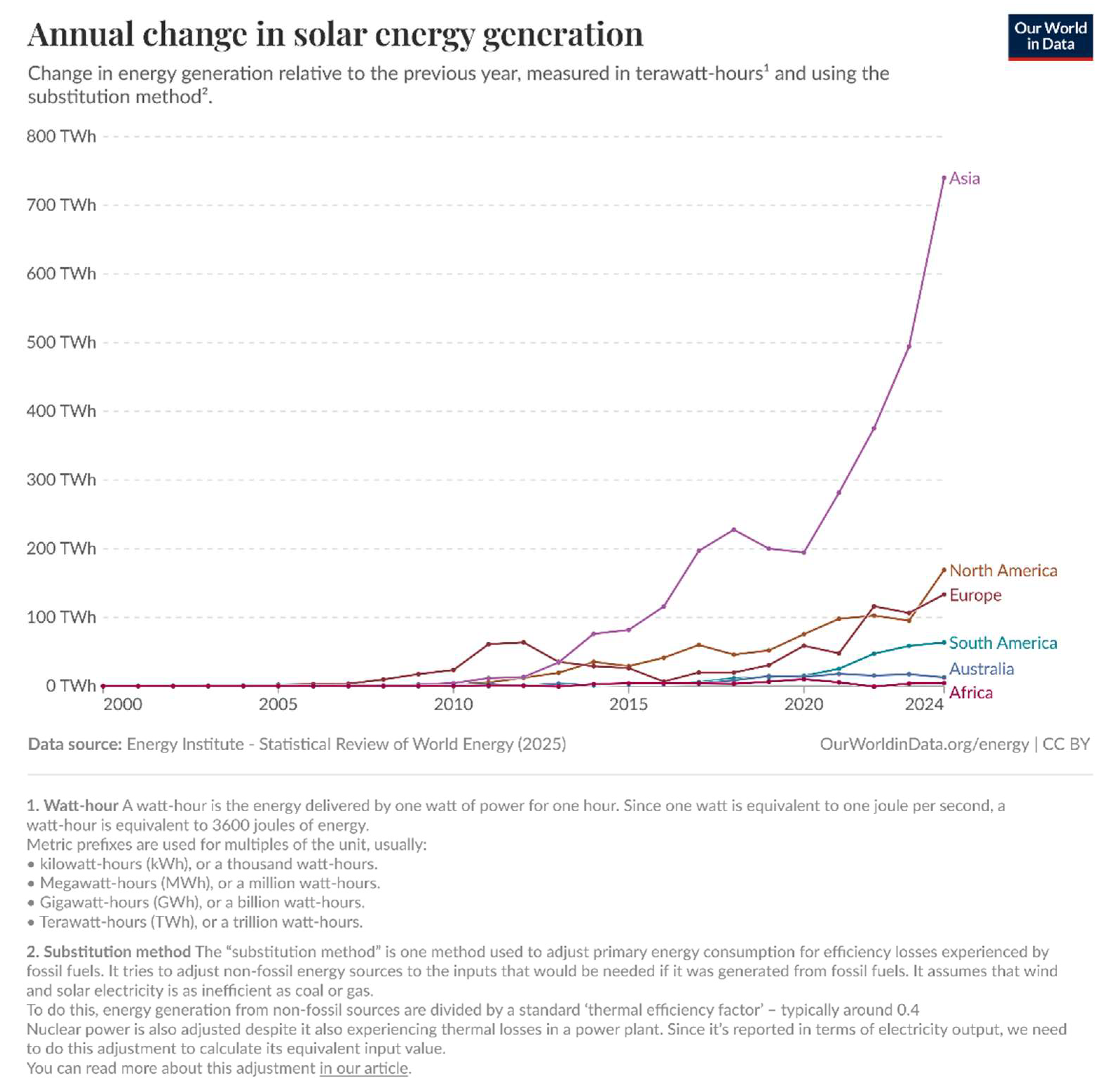
Each year, electricity production from photovoltaic installations continues to increase (Figure 9). Unsurprisingly, Asia leads in this respect. However, it should be emphasized that although installed PV capacity in Europe exceeds that of North America, recent annual increases have been higher on the American continent.
Figure 9. Annual change in solar energy generation. Source: Our World in Data [].
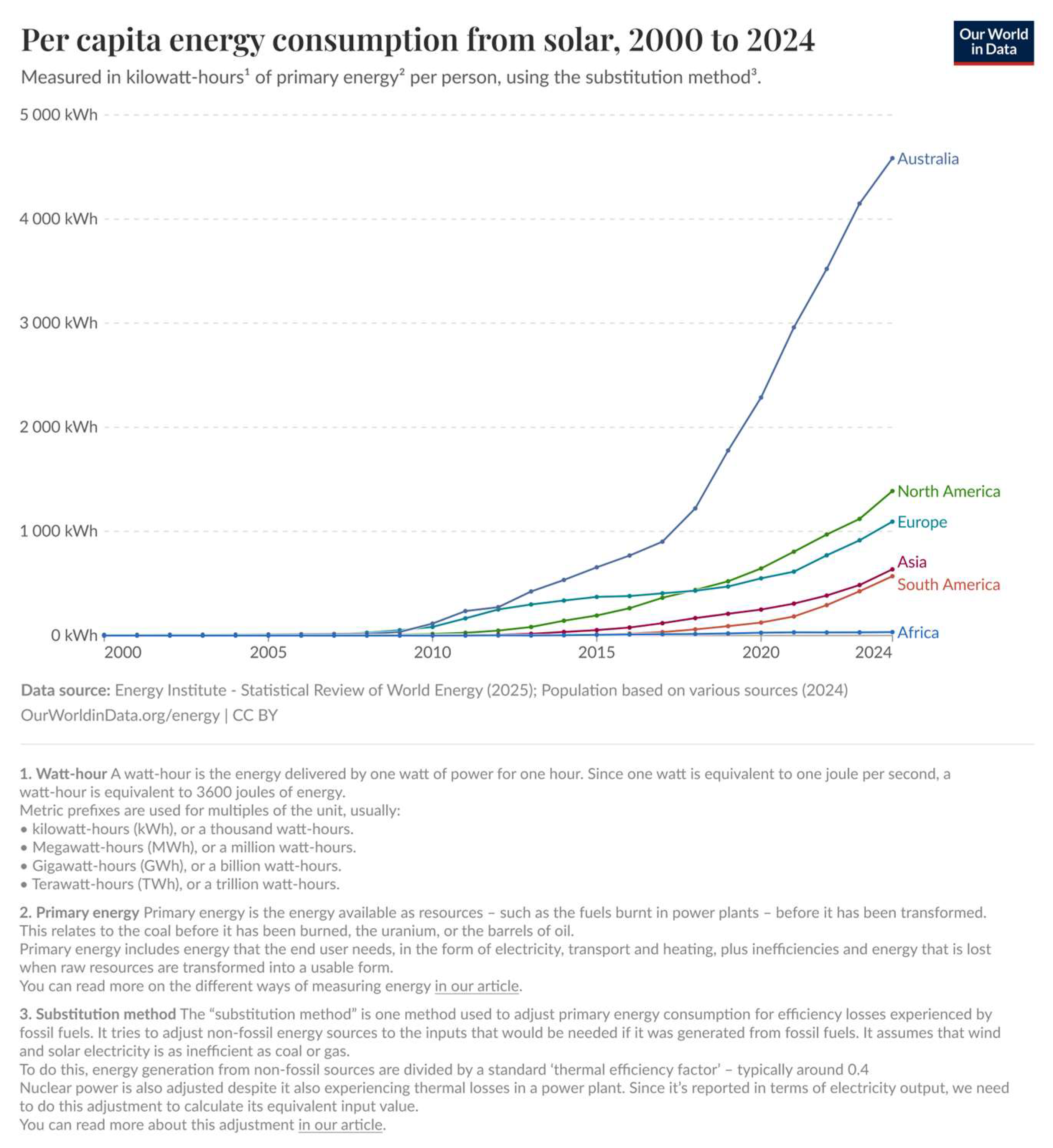
In analyses of the growth rate of PV installations, it is also important to consider per capita electricity consumption from PV sources (Figure 10). This metric highlights additional potential for PV development. Australia is the leading continent in this respect. Since 2016, North America has surpassed Europe, while Asia, despite its exceptionally rapid market expansion, ranks fourth [].
Figure 10. Per capita energy consumption from solar. Source: Our World in Data [].
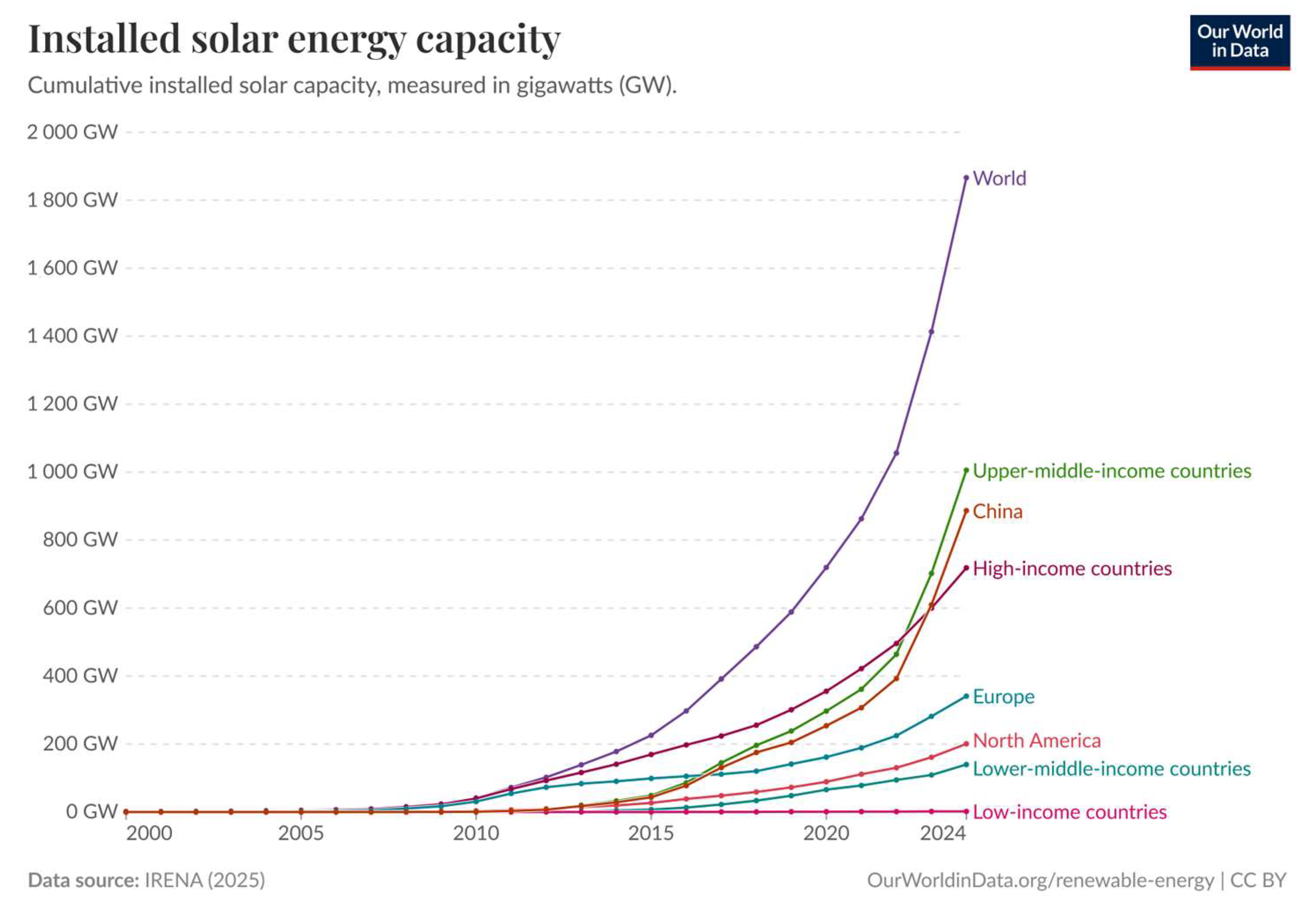
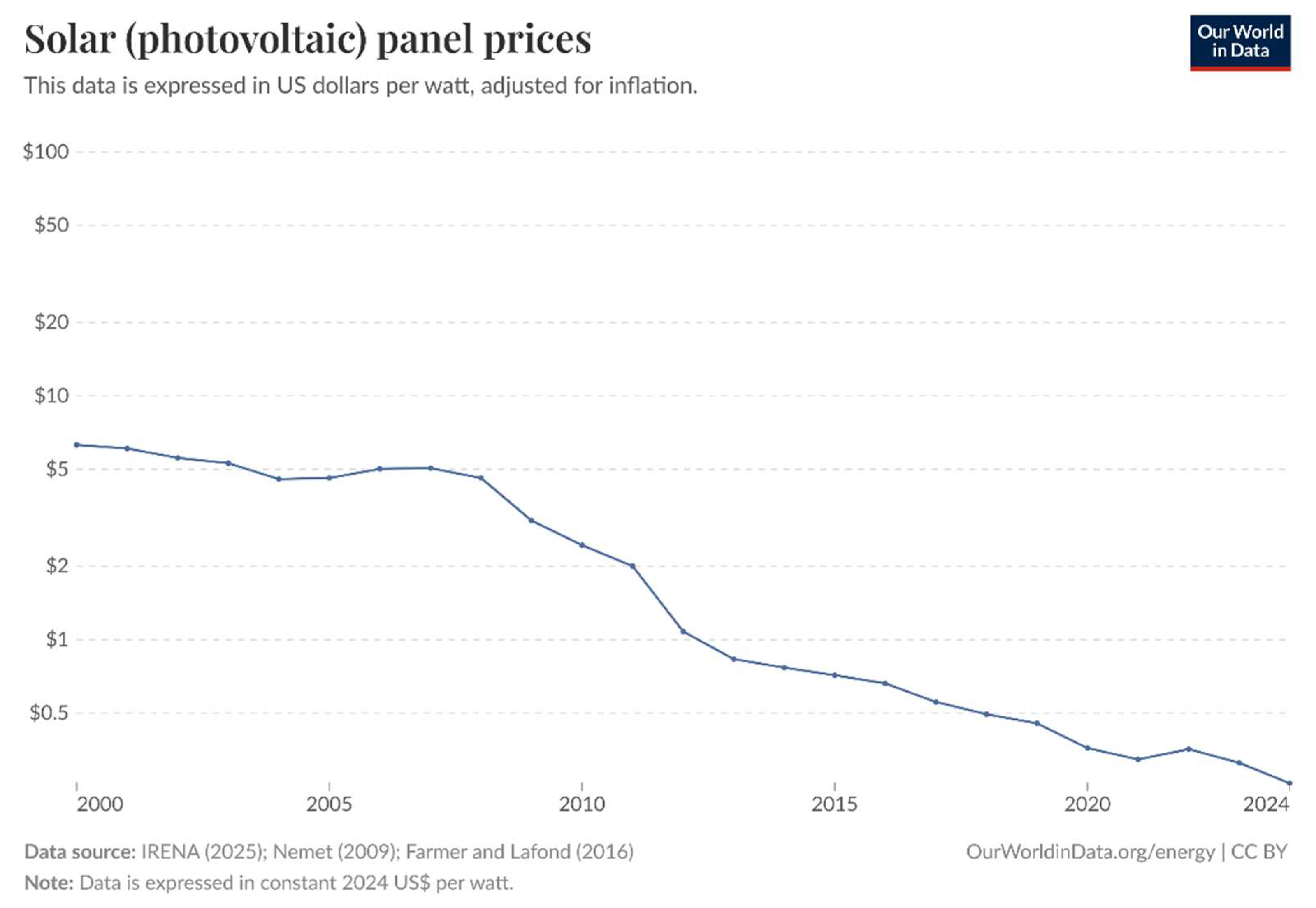
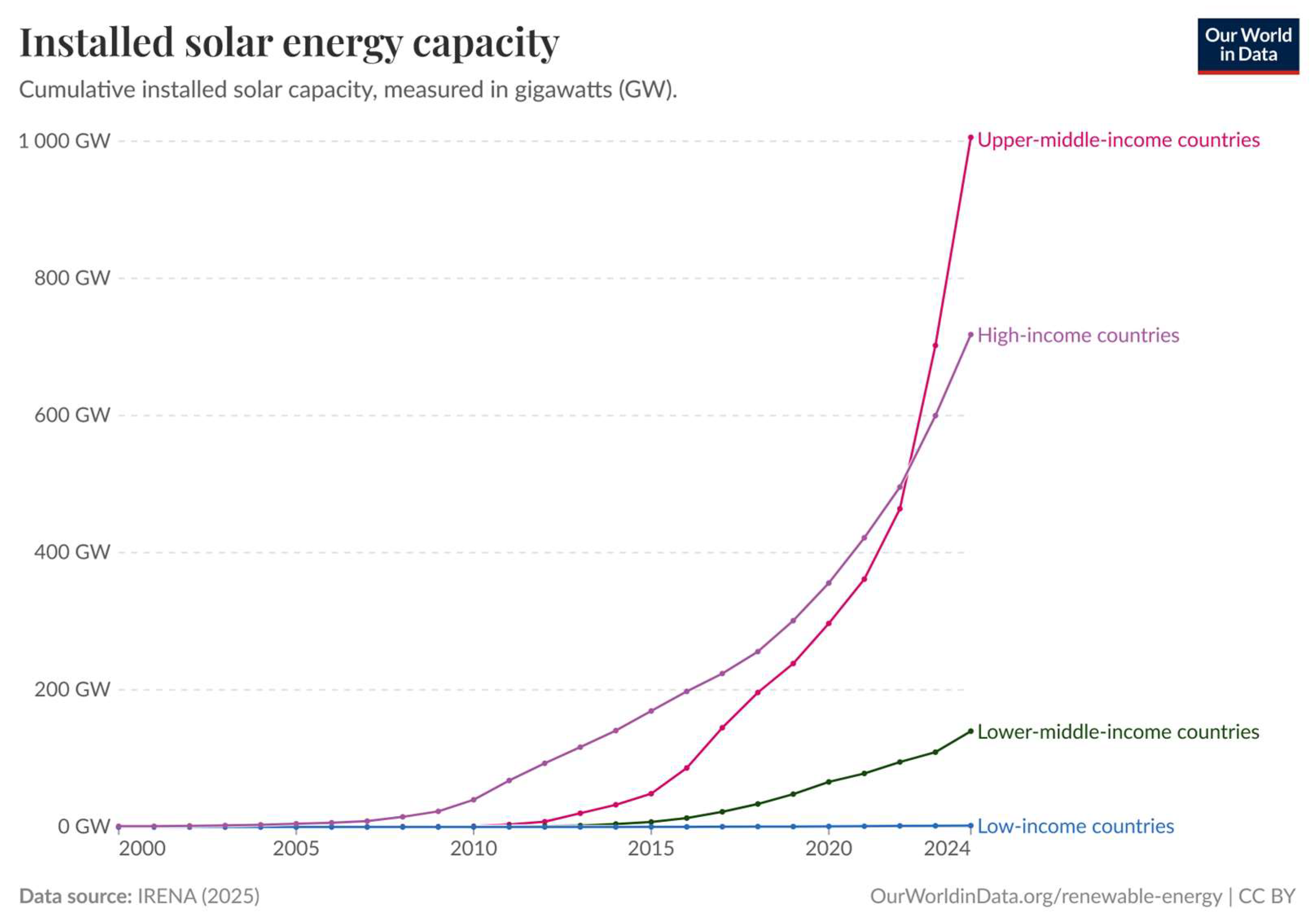
An important market indicator is the cost of technology. The price of photovoltaic panels continues to decrease [], which enhances their market availability (Figure 11). However, considering other market data (Figure 8, Figure 9 and Figure 10) and the installed solar energy capacity by income level (Figure 12), it should be noted that the current price levels enable development in upper-middle-income countries, high-income countries, and, to some extent, lower-middle-income countries. In contrast, low-income countries face challenges in accessing electricity and lack the necessary infrastructure and resources to effectively exploit the potential of PV technology.
Figure 11. Photovoltaic panel prices (per watt). Source: Our World in Data [].
Figure 12. Installed solar power capacity by country income level. Source: Our World in Data [].
As indicated by the data above, the PV market is developing dynamically. Globally, it will continue to grow, but at a slower pace than before. Its growth will be increasingly driven by the utility-scale segment rather than residential rooftop installations. In 2024, the utility-scale market clearly dominated, accounting for more than two-thirds of newly installed capacity [].
Following a record increase in installed PV capacity of 83% in 2023 and 33% in 2024, it is estimated that through 2029, installed PV capacity will grow by approximately 10–14% per year (medium scenario). However, this development will be uneven (Table 4). China, though experiencing a slight slowdown, will remain the global leader in PV market expansion. The projected decline is attributed to the country’s transition to a market-based mechanism instead of feed-in tariffs. Growth in the APAC region excluding China is fueled by spectacular expansion in India and by rising markets in the Philippines, Australia, and Uzbekistan. Europe is experiencing a deceleration due to infrastructure and political challenges, similar to trends in the Americas. Development in Africa and the Middle East is linked to projects in Saudi Arabia and South Africa. This highlights that large-scale PV installation creates significant infrastructure challenges, such as grid integration issues [].
Table 4. Characteristics of installed PV capacity in 2024 and projections for 2029 in major global regions.
The slowdown in large-scale PV panel installations indicates that the industry is facing significant challenges. These are mainly related to grid congestion []. This issue affects both developed countries (USA, Europe) and emerging markets (China, Brazil) []. Additionally, the occurrence of negative price markets during periods of high PV energy production necessitates the development of battery energy storage markets []. This phenomenon is particularly pronounced in Brazil, where no compensation was provided for shutdowns of power plants during periods of overproduction [].
There are also observable shifts in policy approaches regarding PV installations. In Europe, there is a gradual phase-out of subsidy programs for residential photovoltaics, while in the United States, uncertainty is emerging due to changes in climate policy introduced by President Trump’s administration. Potential restrictions on federal incentives for PV deployment and the possibility of import tariffs are discouraging investors [].
Despite these challenges, the PV sector will continue to grow. Currently, there is an oversupply in the manufacturing industry for photovoltaic panels and components, particularly in China []. At the same time, there remains strong political support for reducing CO2 emissions and transitioning to renewable energy sources. This is evident in the implementation of the Paris Agreements, for example, Saudi Arabia aims to achieve climate neutrality by 2060 and India by 2070 []. The European Union additionally emphasizes energy independence in the context of the war waged by Russia against Ukraine, as reflected in the REPowerEU document [].
Political support for PV initiatives is a significant driver of their development []. In developed countries, residential PV deployment has been strongly supported by guaranteed feed-in tariffs for consumers, while in China and India, support has focused on building utility-scale farms. Particularly effective in this regard is long-term, stable government support for the PV market [].
The area of PV compatibility with energy storage systems is also changing dynamically; however, access to historical, continuous market data related to storage is more limited than for photovoltaic technologies themselves []. Nevertheless, systematic growth in installed battery capacity is evident. Globally, installed capacity additions increased from 0.1 GWh in 2010 to 95.9 GWh in 2023. In 2023, China was the market leader, installing 46.5 GWh—3.25 times more than in 2022, accounting for nearly half of the total global additions. The United States was the second-largest market, adding 22 GWh, which represented almost one-quarter of total new capacity []. By 2030, a tenfold increase in installed battery capacity is projected, reaching over 800 GW [].
Europe has also experienced dynamic growth in energy storage system installations over the past decade. It is estimated that by the end of 2024, the total capacity of installed European batteries will reach 61.1 GWh, of which 49.1 GWh will be in the European Union. The largest increases were recorded in 2021–2023, at 86%, 145%, and 84% year-on-year, respectively. These increases were primarily driven by households utilizing various support programs. In 2024, the large-scale segment took the lead in battery installations []. Germany accounts for the largest growth in Europe, where in 2019, 46% of residential rooftop PV installations were connected to energy storage systems, and by 2023, this percentage increased to 77%. Currently, the total installed battery capacity stands at 12.6 GWh, with the majority (over 80%) consisting of residential batteries, 6% in commercial applications, and 12% in large-scale systems [].
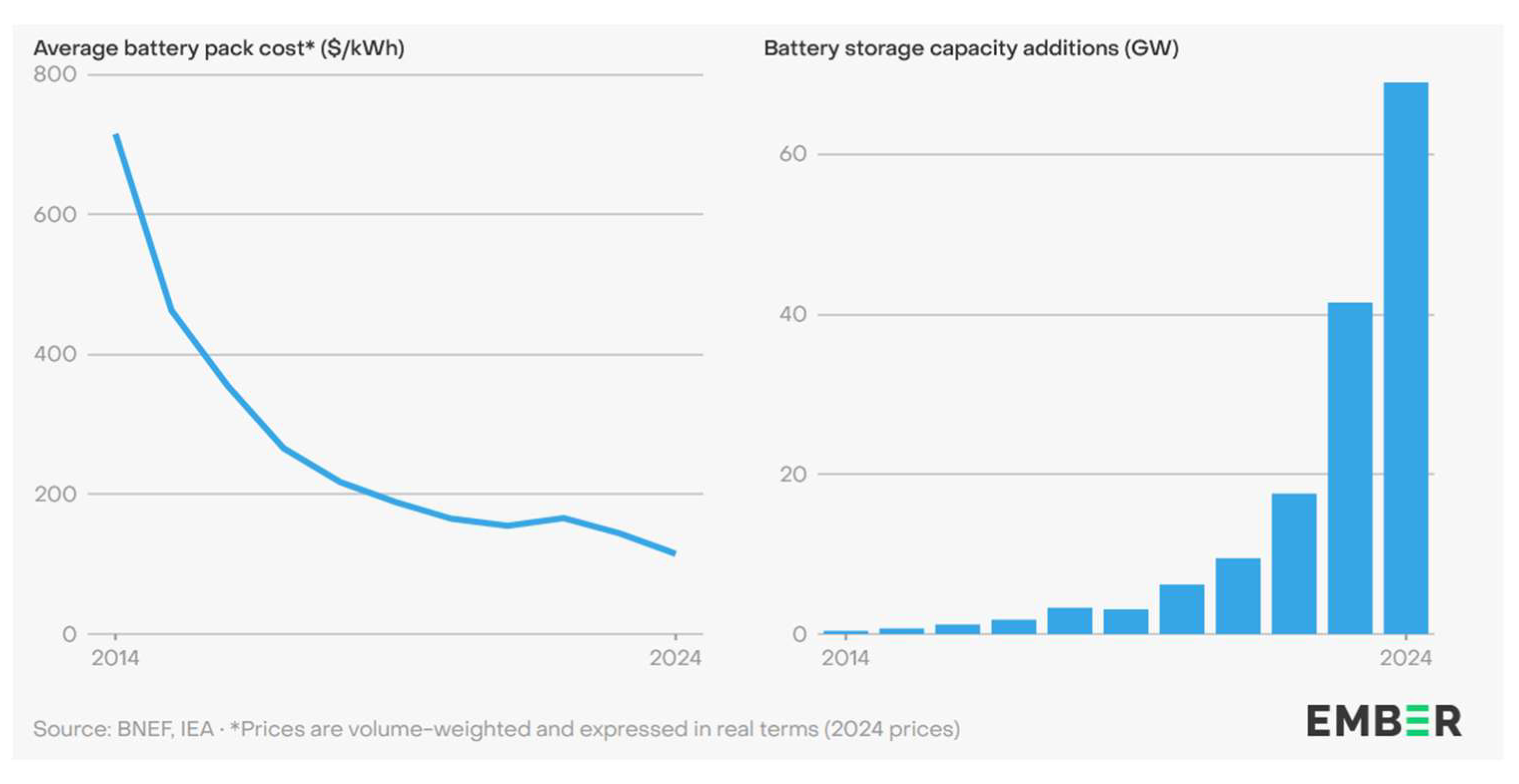
The increase in installed battery capacity is linked to declining prices (Figure 13). The average price of lithium-ion battery packs fell to 115 USD/kWh in 2024, representing a 20% cost reduction compared to the previous year and an 84% reduction compared to the average cost from a decade ago []. This price decline is attributable to the adoption of LFP (lithium iron phosphate) battery-based storage systems, which currently account for 85% of the market share []. The transition to this technology is associated with lower costs, longer lifespan, and greater safety compared to nickel-based lithium-ion batteries, as well as the substantial production capacity of battery manufacturing facilities in China [].
Figure 13. Average battery pack cost ($/kWh) and battery storage capacity additions (GW). Source: [].
The battery energy storage market is developing dynamically in countries with high energy prices and excellent solar resources, such as Australia. Other countries (e.g., in Europe) require an appropriate regulatory framework in this area to maintain growth potential []. This is also evident in the United States, where it has been indicated that the phase-out of the Inflation Reduction Act could cause a sharp decline in energy storage installations []. Investments in supporting storage systems are important to ensure energy system flexibility and enable shifting of daytime production surplus to periods of evening peak demand [].

4.3. Positioning of MPV on the S-Curve

The MPV attribute “profitability” is closely linked to efficiency and productivity, rated power, and panel lifetime, whereas the MPV attribute “independence” relates to compatibility with energy storage systems. In this context, the S-curve indicators presented in Table 2 will be analyzed. Their detailed identification along with verification justifications is provided in the Supplementary Materials (Tables S2–S5), while abbreviated tables containing the determination of each indicator’s presence and their summary are presented below. Verification of the fulfillment of individual indicators was conducted based on quantitative and qualitative data indicated in Section 4.1 and Section 4.2. In cases where information was lacking, the authors conducted further searches.
Since photovoltaic panels have been present on the market for several decades, the analysis omits Stage 1 and the Transitional Stage, which are characterized by either a lack of market presence or a short period after market entry. Stage 4 is also excluded, as it corresponds to declining MPV and the disappearance of the technical system from the market.

4.3.1. Profitability

Taking S-curve stage indicators into account, the MPV “profitability” parameter remains in its growth phase, though already exhibiting pronounced signs of Stage 3 characteristics (Table 5).
Table 5. Alignment of MPV “Profitability” with Stage 2 and 3 of the S-Curve.
The position of photovoltaic panels is well established in the market. As shown in Section 4.1.2, their market share is steadily increasing and is expected to continue to do so. The price of photovoltaic panels is also consistently declining []. Improvements in efficiency, rated power, and panel lifetime are evident; however, it should be noted that these advancements progress more rapidly under laboratory conditions than in commercial environments []. Consequently, it can be concluded that the MPV indicator “profitability” is increasing, consistent with Stage 2 of the S-curve. Nevertheless, in the context of S-curve stage metrics, the issue of PV panel overproduction in China poses a challenge []. This demonstrates that the indicator related to mass manufacturing is only partially met—overproduction creates market disruptions characteristic of the transition to Stage 3.
PV panels are available in numerous variants. In addition to conventional monocrystalline panels, there are thin-film, HJT, bifacial, glass-glass modules, various sizes, trackers, microinverters, and the initial BIPV products []. Additionally, there is growing diversity in construction solutions, materials, and mounting methods []. The range of PV applications continues to expand—integrating photovoltaics into building façades (BIPV), mobile devices (MIPV), agrivoltaic systems, EV charging systems, as well as new applications in urban infrastructure and precision agriculture. Nevertheless, it should be emphasized that the rate of new solution development is declining, and the market is focusing on perfection of existing designs []. Competition for market share leads to pressure and product differentiation through adding non-standard functionalities such as cloud monitoring, voice control, or off-grid backup []. Transition to Stage 3 is also reflected in the decreasing number of system designs and variants—companies such as Longi, JA Solar, and Jinko Solar have announced module size unification at 182 mm and the standardization of mounting hole spacing, setting a new industry standard for dimensions and installation systems. In 2024, agreement was reached on the standardization of rectangular silicon module dimensions.
Unfortunately, there is only partial adaptation between the technical system and the supersystem. Despite record investments in transmission lines and energy storage, many grids are unable to keep pace with the integration of rapidly expanding PV capacity. Issues such as connection delays, modernization challenges, and integration setbacks are emerging []. Consequently, the development of smart grids, energy storage technologies, dynamic tariffs, and digital demand management solutions is accelerating in many countries, constituting a key trend that enhances PV adaptation []. Simultaneously, numerous specialized companies have emerged, focusing on the installation, servicing, logistics, and recycling of photovoltaic systems, responding to the exponential growth of the PV market and evolving technological requirements. However, this market’s growth is not uniform; the most advanced markets are found in Western Europe and Asia, while in developing countries, the sector is only beginning to gain momentum [,]. This demonstrates that the resource consumption indicator, that is, resources specifically created for the system, is only partially met and exhibits characteristics of the system’s transition into Stage 3 of the S-curve.
The presence of PV panels on the market, due to overproduction, is beginning to exhibit characteristics of Stage 3 on the S-curve. However, the MPV indicator for profitability is not stagnant. The values of key parameters, such as efficiency, productivity, and panel functionality, continue to increase—no stagnation is observed. Technological innovations, including perovskite cells, bifacial panels, and tracker systems, are continually being introduced, and together with falling costs, they raise the MPV index (efficiency and productivity indicators). Dynamic breakthroughs are still occurring in laboratories, especially in the fields of perovskites, tandem cells, and innovative architectures, where the rate of parameter improvement is high. In contrast, the pace of change in mainstream commercial PV technologies (such as monocrystalline panels) is slowing; progress is less dramatic, reflecting the maturity of the technology and approaching physical limits of efficiency. In this context, barriers to technical system development largely concern systemic constraints (difficulties in adapting energy infrastructure, grid capacity, inadequate storage facilities, and connection regulations) rather than technological limits to efficiency or productivity of the panels themselves [].
Photovoltaics are beginning to extend beyond traditional rooftop and utility-scale installations, developing a broad array of niche applications characteristic of the technological maturity phase. Systems are increasingly being integrated into buildings (BIPV) through installations in windows, façades, and parking canopies. Floating PV installations and agrivoltaic systems are also advancing []. The development of innovative PV solutions remains profitable. Currently, the greater portion of investment is directed not so much toward the manufacturing of new cells as toward improvements in operation: software, algorithms, cybersecurity, management, and grid integration. New solutions (such as TOPCon modules, bifacial panels, hybrid PV + storage systems, and perovskites) do indeed enter the market at higher prices, but rapid competition and technological progress lead to sharp cost declines after the initial deployment phase. High innovation costs are temporary, as technologies quickly become widespread due to global oversupply and production scale [,].
The final four indicators of Stage 3 on the S-curve are also not fully satisfied. As shown in Stage 2, the system has begun consuming specialized resources pertaining to dedicated services; however, their deployment remains uneven on a global scale. Infrastructure is being rapidly adapted to PV, yet transmission networks continue to pose significant challenges. New PV variants relate not only to panel construction, but functionality is also being enhanced. The market has also introduced solutions not exclusively linked to the core function of PV. Solar roof tiles, designer façades, glass balustrades, and similar BIPV innovations incorporate additional features beyond electricity generation, such as improved insulation, aesthetic design, integration with security systems, or localized microclimate management in buildings [,].

4.3.2. Independence

The determination of the S-curve stage for the MPV attribute “independence” is more straightforward than for profitability, as expressing independence through compatibility with energy storage systems represents a relatively narrow area associated with PV panels. The presence of storage systems on the market has a shorter history than that of PV panels themselves. These systems are installed in two main configurations: grid-connected utility-scale systems and behind-the-meter systems located near consumers []. Based on the verification of indicators for individual S-curve stages, the compatibility of energy storage systems with PV is at Stage 2 of the S-curve (“rapid growth”) rather than Stage 3 (“maturity”) (Table 6).
Table 6. Alignment of MPV “Independence” with Stage 2 and 3 of the S-Curve.
With regard to Stage 2 S-curve indicators, MPV is increasing rapidly, and the technical system is being mass-produced. This is evidenced by the dynamic development of the energy storage market. Growth in the market share of battery energy storage systems (BESS) far exceeds the projected expansion of PV installations themselves. By 2029, the annual European BESS market is expected to be five times larger than in 2024. The medium scenario forecasts a sharp increase, with annual deployments growing by 41.9 GWh (+41%) in 2026 and 68 GWh (+62%) in 2027. By the end of the decade, growth rates will taper but nominal deployments will remain very high—90.8 GWh in 2028 (+34%) and 118 GWh in 2029 (+29%) []. A significant cost reduction of BESS has been observed. Between 2023 and 2024, BESS costs dropped by 38% for two-hour systems and 32% for four-hour systems, dramatically improving the economic feasibility of energy independence. Long-term, BESS costs decreased by 93% between 2010 and 2024 (from 2571 USD/kWh to 192 USD/kWh) []. A similar situation is seen in the USA, which installed approximately 31.1 GWh of grid-connected energy storage in 2024, increasing total capacity to 96.0 GWh []. Additionally, China’s policy mandating the integration of energy storage with solar systems has resulted in record global volumes [].
PV compatibility with storage systems exists in various configurations. The market hosts numerous battery types, capacities, hybrid solutions, and integration variants [,]. The US Department of Energy (2024) confirms the diversity of inverter solutions: three-phase inverters for large BESS, microinverters for hybrid systems, and dedicated topologies for residential, commercial & industrial, and utility-scale segments []. Batteries may be configured with PV either before the inverter (DC-coupled) or after it (AC-coupled). Furthermore, different BESS configurations require distinct power and energy specifications depending on the application: systems with 2 h, 4 h, 6 h, 8 h, and 10 h durations align with various usage profiles, from frequency regulation (2 h) to extended energy shifting (8–10 h) []. This demonstrates the availability of numerous product variants with the same core function. Moreover, new applications and expanded functionalities are emerging for storage systems. BESS can be used for energy arbitrage, in which the system procures electricity when prices are low and sells it during peak hours when prices are higher []. Prakash et al. [] describe the use of BESS for multiple purposes: primary frequency control, self-consumption optimisation, peak shaving, power loss reduction, and investment cost minimisation. Their study shows that BESS used for multiple applications increases revenues by 25% compared to a single application (frequency regulation only). Advanced Energy Management Systems (EMS) with predictive control are also being developed, enhancing grid stability, power quality, and the integration of renewable energy []. At present, the number of PV energy storage system variants and designs continues to evolve, and is not static. This indicates that storage systems have not yet reached the end of Stage 2 on the S-curve in this respect.
Partial links between energy storage and the supersystem are also evident. This is manifested through political support for battery installation, especially in countries facing grid congestion, high penetration rates, or elevated energy costs, such as China, Austria, Australia, Germany, Italy, and Japan [,]. The market has seen the emergence of dedicated storage inverters []. Additionally, energy storage systems increasingly rely on lithium iron phosphate (LFP) batteries, which are specifically designed for stationary storage applications in PV and other renewable energy systems. Lithium-iron-phosphate (LFP) batteries currently account for 85% of the market [].
For Stage 3 of the S-curve, only some indicators are partially fulfilled. The established market position of energy storage systems is only partially assured in terms of the S-curve framework. This market is not self-sustaining and continues to require support (a characteristic of Stage 2). In 2022, the USA included battery storage in the Inflation Reduction Act []. Additionally, some developed countries (Austria, Japan) offer financial incentives for battery storage, while others (Italy, Hungary, Canada) are still planning such measures. In China, mandatory integration of storage with new utility-scale solar installations has been implemented []. Moreover, as shown for Stage 2, MPV features dynamic growth rather than stagnation. The technology underpinning battery storage is also evolving rapidly. The shift from nickel-manganese-cobalt (NMC) batteries to lithium-iron-phosphate (LFP) ones [] can be considered a breakthrough innovation rather than an incremental change typical of Stage 3 on the S-curve. Furthermore, continual emergence of new technologies in the field of energy storage is being observed [].
New niches are emerging in the BESS market. For example, the use of merchant solar with merchant storage enables electricity trading. PV systems are being combined within Virtual Power Plants, where groups of small residential storage systems are aggregated and operate as a single virtual power station. Such solutions have been introduced by Tesla using the Autobidder application []. Nevertheless, the Stage 3 criterion is only partially fulfilled, as these niches are largely a result of the natural expansion of new technology rather than deliberate efforts to find new applications due to saturation in the main market. The criterion requiring disproportionately high investments in systems is not met. Rather, the costs associated with systems are increasing rapidly, as noted for Stage 2.
In the market for PV and storage system integration, partial links to the supersystem are evident. Resources used by storage systems for PV are shared with other technologies. LFP technology is considered preferable for stationary storage but is also used in the electric vehicle (EV) market. Lithium, the fundamental resource for batteries, is utilized across battery technologies in general, not only those related to PV [].
As demonstrated in Stage 2, PV systems integrated with energy storage exhibit multiple functionalities, with their number continuing to grow and new features being discovered that extend capabilities. Not all of these are directly related to energy independence. For example, the energy stored in batteries may be later sold to the grid rather than used for self-consumption, reflecting economic functionalities. However, these functionalities are not entirely novel or peripheral; they are closely linked to independence. Therefore, the criterion concerning the emergence of new functionalities can only be considered partially fulfilled.

4.4. PV Market Development for “Profitability” and “Independence” According to Trends of Technical System Evolution

4.4.1. Trend Operation in the Context of MPV “Profitability” and “Independence”

Contemporary photovoltaic development is occurring rapidly and dynamically. TESE enables the identification of PV system development pathways that are non-random and consistent with universal laws of innovation evolution. In practice, this means that breakthrough changes in PV economic efficiency (MPV “profitability”) and compatibility with energy storage systems (MPV “independence”) do not result solely from improvements in individual component parameters, but from comprehensive transformations in PV system architecture, functionality, and organization. The trends define directions in which photovoltaics can enhance its economic competitiveness, as PV investment profitability is closely linked to operational flexibility under real-world conditions (productivity) and becomes a function not only of module prices, but also their degree of integration with the power grid and batteries, as well as control efficiency. The situation is similar for independence, as trends indicate how users’ actual autonomy can increase. This autonomy becomes the result not only of improved technical parameters of modules, but also the degree of integration with storage systems, intelligent automation, and the system’s capability to operate flexibly under dynamic grid conditions. Tables S6 and S7 in the Supplementary Materials provide examples of various technological solutions that correspond to the implementation of individual trends. Below, the concept of their implementation will be presented with an indication of specific trends.
Decision-making regarding the development of new solutions for MPV “profitability” and “independence” is closely linked to their positioning on the S-curve (trend of S-curve evolution) and the implementation of the trend of increasing value and its sub-trends. MPV “profitability” is at the end of the growth phase, but already exhibiting fairly intensive characteristics of Stage 3 of the S-curve, whereas “independence” is in the intensive growth phase (Stage 2). Consequently, according to the trend of increasing value, strategies can be applied for both MPVs that improve system functionality at constant costs. However, given that “profitability” already displays characteristics of the third stage of the S-curve, it is advisable to introduce solutions that maintain functionality at a constant level while reducing the cost of providing it. These recommendations should be reflected in the implementation of the trends described below.
The trend of increasing degree of trimming is responsible for simplifying the technical system. The essence of this trend is the elimination of redundant elements from the technical system without loss of functionality. In the case of photovoltaic cells, this trend will be implemented through the design of modules, and subsequently systems, that achieve maximum efficiency with a minimal number of components or simplified processes. For example, in the field of PV panels themselves, the application of simplified contact structures in HJT and TOPCon cells improves panel efficiency [,]. These solutions are utilized in the market. At the laboratory stage, further innovations in this area are being developed, including interdigitated back-contact (IBC) [] and flexible perovskite cells []. In the area of PV compatibility with storage systems, innovations are also emerging. In Sungrow modular inverters, redundant cooling systems and oversizing have been eliminated, while under laboratory conditions, a transformerless microinverter topology has been developed []. Generally, the application of trimming significantly improves the enterprise cost structure. Simplification of contact structures in cells or elimination of redundant layers translates into both reduced raw material consumption and simplified production processes. Simultaneously, simplified module construction translates into lower transportation and storage costs. These factors affect the final price of cells and the amount of energy produced from them, which influences purchasing decisions. At the same time, in the case of independence, redundant elements are eliminated, which means maximum self-sufficiency with minimal service infrastructure—that is, a simple, robust, maintenance-free energy system.
The trend of flow enhancement indicates improvement of substance, energy, or information flows when they are useful, or reduction of these flows when they are harmful. In the context of photovoltaic systems, its implementation may refer to improving charge carrier flow within the cell structure and optimizing energy and information flows between elements of the entire system—from cells, through inverters, to storage. Commercial technologies such as TOPCon, HJT, and PERC utilize advanced passivation layers and charge transport structures, significantly reducing recombination and resistance—this improves the useful “flow” of charge carriers, increasing efficiency and profitability []. Laboratory research leads to further improvement of charge flow []. In the area of PV system compatibility with energy storage, the trend is implemented through the transition from systems with numerous flow barriers (resistance, losses) to systems in which flows are continuous, self-regulating, and optimized. Reducing the number of energy conversion stages improves efficiency, greater fluidity enables a more stable power supply, and achieving self-regulation results in greater operational autonomy. For example, in the commercial market, Huawei’s “Grid-Forming ESS” technology enables flexible energy flow between PV, storage, and the grid. At the laboratory stage, advanced solutions are also being developed in this area, such as Optimizing Urban Energy Flows, which controls energy flow among PV, buildings, and storage, thereby reducing power peaks by up to 25% []. The trend of flow enhancement is one of the key trends for improving “profitability” and “independence”. In the case of the first MPV, solutions related to flow improvement enable higher efficiency in converting sunlight into electrical current, while for the second, smooth, dynamic, and controllable communication between PV and energy storage provides the capability for efficient energy accumulation and utilization.
The trend of increasing system completeness signifies the technical system’s pursuit of functional self-sufficiency, meaning it contains all elements necessary for complete function execution without external support. In the case of PV panels, their implementation involves improvement through the addition of a control system, and subsequently the integration of energy storage batteries. This demonstrates that MPV “profitability” and “independence” are interconnected, and their pathways will converge in the future. This results from the fact that the technical system naturally integrates into a single structure functions that were previously distributed among different subsystems. This increases the system’s degree of profitability and self-sufficiency. In practice, integrated PV + storage + EMS systems are being developed, while laboratories are developing integrated autonomous microgrids (off-grid/backup) []. Consequently, systems are being created in which all key functions and components are present and cooperatively interact: PV generation, storage (ESS/BESS), intelligent control (EMS), inverters, protection systems, and connectivity with the environment (e.g., smart grid, monitoring). This enables consumers to meet their own energy needs to a greater extent through the “self-consumption” model, which reduces dependence on energy price increases and grid fees.
The trend of decreasing human involvement is a sub-trend of the previously discussed trend and signifies the transition from manual operation of the technical system to full automation and autonomy. In the case of PV panels, an increasing number of functions are being taken over by self-regulating, self-diagnostic, and self-maintaining systems. Platforms conducting automatic performance monitoring are available on the market, such as the SolarEdge Monitoring platform and PV cleaning robots, such as Ecoppia. Under laboratory conditions, AI-based solutions are being developed that learn to detect anomalies in PV operation in real time []. Solutions in this area enable lower annual installation maintenance costs because they reduce manual inspections and unplanned service interventions. Earlier fault detection allows for higher and more stable energy production. Human involvement is also being eliminated in solutions related to independence. Huawei introduced the Huawei FusionSolar Smart PV platform, which integrates automatic control, predictive monitoring, and inverter self-configuration. Solutions utilizing AI in this process are at the testing stage []. The completeness of the PV + ESS system determines its capability to ensure genuine energy independence without the need to install additional devices and configure them. The more autonomous this system becomes, the greater the sense of independence it will provide to users.
Photovoltaic systems are increasingly being integrated with the supersystem. The trend of transition to the supersystem signifies the moment when a technical system reaches its maximum level of perfection in its autonomous form and begins to be integrated with its environment (supersystem). In the context of photovoltaics, this means incorporating PV systems into integrated, multifunctional energy infrastructures—such as microgrids, buildings, agricultural systems, or global transmission networks. Examples of such applications include agrivoltaics [] and the integration of PV in hybrid systems with heat pumps or energy storage systems []. Under laboratory conditions, various types of simulations and prototypes for PV integration with smart grids are being developed [,]. Integrating PV with the supersystem enables achievement of a new dimension of profitability through better resource utilization. From the same space (e.g., land, buildings), additional benefits are obtained, such as electricity from land where food is grown or heat from buildings. As a result, investments in PV systems within supersystems become significantly more profitable, resilient to market changes, and stable throughout their life cycle. In the case of this trend, “profitability” becomes strongly linked to “independence,” as the integration of PV with energy storage systems constitutes one dimension of profitability. However, the ongoing transition can be very robust. Residential PV installations with batteries can not only function in isolation but go one step further—become part of a larger system of autonomy and energy sharing. A consumer can be part of a prosumer network, meaning they can use energy from their own PV, sell surplus energy, utilize neighbors’ backup, power electric vehicles, etc. []. This enables achievement of independence not only from the energy grid but also expansion of its scope beyond one’s own energy storage.
The trend of increasing coordination and its sub-trends constitute a process of enhancing the coherence and cooperation of system elements that may have previously operated independently or chaotically. This does not involve new technical elements but rather a new level of connections and management of solutions functioning in the market. One of its mechanisms is the trend of uneven development of system components, which indicates that individual subsystems or components of a technical system develop at different rates. The reason is that certain parts of the system more rapidly reach the limits of their technical capabilities, while others lag behind, causing an imbalance in the operation of the entire system. In the PV context, new cells develop most rapidly (new n-type technologies, TOPCon, HJT), while infrastructural components such as mounting systems, transmission networks, or regulatory standards adapt more slowly. This means that PV cells provide the greatest leap in profitability; however, other components may constitute a “bottleneck” that prevents full benefits from being realized from their high quality. In this case, a close link between “profitability” and “independence” is evident, exemplified by the slower dissemination of energy storage systems compared to PV installations, which in some regions limits profitability during periods of low prices/excessive energy production []. In the case of laboratory solutions, rapid development of high-efficiency perovskite or tandem cells is observed; however, slower development of sealing technologies, protective films, and interconnectors means that their commercial implementation is not yet profitable []. These imbalances trigger mechanisms that stimulate coordination of the technical system and, consequently, its greater controllability and dynamization.
The trend of increasing coordination signifies the integration and mutual adjustment of not only PV components, such as modules or inverters, but also their “coordination” with energy storage systems, power grids, and energy management systems (EMS, VPP, DERMS) []. In the context of independence, Huawei introduced SmartCluster 2025 (for the C&I segment), a system enabling the coordination of multiple PV-ESS installations within one region through a common AI-based data platform. Each micro-installation has local autonomy, but a superior EMS harmonizes flows at the cluster level, resulting in prevention of overloads and local phase differences. At the laboratory stage, solutions are being developed that coordinate energy flow among different renewable energy sources (PV, BESS, CSP), minimizing voltage deviations and costs [].
The trend of increasing controllability signifies the growth of precision and accuracy in controlling the technical system. It encompasses the system’s capability for self-regulation, dynamic response to external conditions, and minimization of losses resulting from control inaccuracies or delays. In the case of photovoltaic cells, it has growing significance through power control (for grid stability), PV-storage flow management (reconnecting profitability and independence), module operation optimization, and temperature and efficiency regulation. For example, in the market, cloud-based solutions enable monitoring, data collection, and remote control of hundreds of PV installations, while at the laboratory stage, AI platforms that dynamically manage hundreds of thousands of distributed micro-installations are under development []. In the context of “profitability,” the more precise and automated the PV system control, the lower the energy losses, operating costs, and risk of downtime, while in the context of “independence,” system control becomes more stable and maintains balance under variable conditions. It enables optimization of PV cells, inverters, and storage systems. For example, Huawei Smart String ESS is a platform that analyzes data on production, storage, and loads in real time and controls the energy storage system and inverter accordingly, increasing system control.
The final trend, trend of increasing dynamization, signifies that static objects can transform into dynamic ones. This refers to their parameters, position, or structure in real time in response to variable external conditions. In the photovoltaic context, this trend encompasses both dynamic sun tracking (movable tracker mounts), management of module tilt angles, and intelligent control of energy flows or panel cooling [,]. In the area of PV and storage system compatibility, Huawei created Smart String ESS with dynamic “grid-forming response.” This is a solution that dynamically changes its operational strategy depending on grid stability and local power flows, creating flexible microgrids.
Solutions in the areas of “profitability” and “independence” interpenetrate one another, whereby the scope of possibilities for introducing improvements in the context of profitability is broader than in the case of independence, because independence is a narrower issue. Simultaneously, solutions for both MPVs can interpenetrate and correspond to multiple trends. This is entirely appropriate, as the same technology, described across different trends, presents its morphological development—from structural completeness (trend of increasing degree of trimming, trend of increasing system completeness, and trend of decreasing human involvement) through control and autonomy (trend of flow enhancement, trend of transition to the supersystem) to self-regulation and dynamics (trend of increasing coordination, controllability and dynamization, and trend of uneven development of system components).

4.4.2. Recommendations

In the conducted analyses, “profitability” and “independence” were exemplary MPVs that were determined based on a literature review. However, when seeking to apply TESE to implement innovative processes in practice, each enterprise must determine its own MPVs. The process may be based on scientific data and industry reports; however, the most reliable information comes from users of products offered by the enterprise or, in the case of market expansion, from potential users. These will then be closely linked to the enterprise’s products and the needs of their users.
TESE is a tool that enables the determination of development directions. Implementation of improvements and creation of new solutions, however, is based on detailed analysis of the enterprise’s products and processes. This utilizes tools that were developed based on TESE. This process incorporates recommendations from two primary trends. According to the trend of S-curve evolution, the development stage at which a given MPV is located is determined, and then, considering the trend of increasing value, a strategy for increasing the technical system’s value is adopted. Fundamentally, in the case of intensive growth, solutions should be created in which system functionality grows faster than costs, while in the case of maturity, solutions in which functionality is enhanced but without increasing system costs.
Based on the material prepared by the authors of this study, specifically by examining the examples contained in Tables S6 and S7 (Supplementary Materials) and the trend operation schemes, in the area of MPV “profitability,” one can focus on developing improvements in panel efficiency. For example, these changes may be inspired by the trend of flow enhancement, which identifies bottlenecks in energy flows (e.g., development of tandem panels), or the trend of increasing coordination to develop the system toward better cooperation among its components. In the case of satisfactory efficiency, production cost reduction can be achieved through removal of redundant components (transfer of useful functions to other components inspired by the trend of increasing degree of trimming). These recommendations should be particularly effective for developing MPVs located at the third stage of the S-curve (cf. Table 3). Due to the fact that photovoltaic installations already operate worldwide (cf. Section 4.1.2), there exists a large potential sales market for such solutions.
From the perspective of building innovative product development strategies, it is desirable to create solutions that combine the implementation of both MPVs. In this way, the trend of increasing system completeness will stimulate enterprises to create integrated platforms containing PV, batteries, and an efficient management system (PV + ESS + EMS). Such solutions may also incorporate approaches inspired by the trend of flow enhancement and the trend of increasing coordination and controllability. Given that profitability here is linked to the effective operation of panel compatibility with energy storage, and this solution is at the second stage of the S-curve, particular attention should be paid to solutions in which system functionality grows faster than its development cost. In the context of sales markets, attention should be paid to the optimal combination of costs and functionality. In developed countries, functionality and optimal operation of such storage systems in on-grid systems will play a significant role, whereas in low-income countries, price will also be important, and in areas without access to the power grid, off-grid operation capability will also be crucial.
In the case of “independence”, integration can go even further—the trend of transition to the supersystem can inspire the construction of PV systems with storage that become part of microgrids, clusters, or virtual power plants. For example, through intelligent, dynamic control of such a system (inspired by, e.g., the trend of increasing dynamization), consumers during energy shortages can utilize energy stored by other network users, and during surplus situations, contribute their own energy to the network. However, market context must be considered in this solution. Due to the high costs of building such networks, this is a solution feasible for implementation in developed countries.
The recommendations provided constitute an example developed based on the collected material and demonstrate the potential that utilizing TESE brings to the design of innovative solutions. They can be translated into strategic and operational objectives of enterprises. For example, from a 5-year perspective, an entity may set a goal of introducing cells with improved efficiency; in a 10-year perspective, improving their operation with ESS/BESS systems; and in a 15-year perspective, creating a microgrid system. Each enterprise can determine such development directions by relating them to the MPVs it has identified and in the context of the products it offers. In this context, it is worth considering the specifics of the local market, such as its maturity. In countries with developed prosumer support systems, the priority should be innovation in PV integration with energy storage, while in developing countries without access to stable electricity grids, off-grid solutions with an emphasis on cost reduction are crucial.
From the perspective of policy support for the photovoltaic sector, TESE-based analyses suggest that policymakers should differentiate support instruments depending on the position of identified MPVs on the S-curve. For the “profitability” MPV, which is positioned between Stages 2 and 3 of the S-curve, mechanisms that reduce cost barriers and simplify procedures (e.g., tax incentives, preferential loans, simplified grid connection procedures) will be more effective in accelerating mass adoption of mature technology. In contrast, for the “independence” MPV, which is in the growth phase, programs supporting innovation in PV integration with energy storage are appropriate (e.g., subsidies for PV + ESS systems). As MPVs progress further along the S-curve, support should evolve toward eliminating remaining non-financial barriers—such as lengthy administrative procedures or connection capacity limitations.

5. Discussion

In the field of photovoltaic panels, numerous technological solutions exist. However, the best technical solutions are not always the best solutions from an economic perspective []. Many industry reports (prepared, for example, by the International Energy Agency or International Renewable Energy Agency), which are easily accessible and understandable for enterprises in the PV sector, do not incorporate the end-user perspective. Technical analyses assume that if a technology is available and financially justified, it will be adopted. This is a classic technology-push assumption that ignores the adoption gap associated with market-pull. However, the market-pull approach is very important in building PV product development strategies []. Schulte et al. [], in a meta-analysis encompassing thousands of respondents, demonstrated that perceived benefits are the strongest predictor of PV system adoption intention, while sociodemographic factors, which are included in technical reports, show no correlation with purchase intention. Incorporating the customer perspective enables identification of PV adoption barriers that remain undervalued in technical analyses. Mathew and Nagaraja Pandian [] demonstrated that financial and informational barriers dominate PV purchase decisions; therefore, key challenges for PV adoption do not lie in the sphere of technical parameters but in the area of economic accessibility and market education. Consideration of these aspects is reflected in the selection of MPVs’ “profitability” and “independence” as a starting point for defining the choice of areas that can be strategically developed by enterprises and can initiate the creation of incremental and disruptive innovations.
The analyses conducted in this article expand the existing forecasting process for PV development. Reports from various institutions that entrepreneurs can utilize indicate general development trends present in the market (e.g., [,,,,,]). However, they do not provide direct guidance on which of the proposed solutions to select, develop, or implement. TESE provides such guidance. Selecting an MPV and determining its position on the S-curve (trend of S-curve evolution) constitutes the foundation for defining a strategy that considers both functionality and costs (trend of increasing value). Meanwhile, the remaining trends provide guidance on what technological solutions to seek in a given area. At this stage, industry reports and scientific publications can be inspiring.
However, it must be remembered that each company, when selecting solutions suggested by TESE, must consider the actual market possibilities and limitations associated with them. The guidance provided by TESE should be examined within the broader context of market conditions. In the context of the solutions proposed in this article, improving photovoltaic panel efficiency is the least complicated. This is because improvements in this area largely depend on companies’ technological capabilities. Currently, the most promising are perovskite solar cells; however, the challenges associated with their implementation relate to ensuring stability, scalability of the production process (large-area processing), and the necessity of meeting stringent regulatory requirements due to the toxicity of materials used in them [].
All proposed solutions face challenges related to investment payback periods. It is lower for consumers living in areas with stronger solar irradiation and in the case of PV installation without batteries. Research conducted in Vietnam demonstrated that the payback period for a grid-connected solar system with energy storage is 6.2 years longer, and the total profit is nearly 1.9 times lower than for a solar system without battery energy storage due to the difference in inverter and battery prices. In contrast, a grid-connected solar system without battery energy storage exhibits better financial efficiency but is heavily dependent on grid operation [].
In integrated platforms containing PV, batteries, and efficient management systems (PV + ESS + EMS), and in the case of building PV systems with storage that become part of microgrids, clusters, or virtual power plants, interoperability problems emerge. Implementing this concept requires harmonization of technical standards and communication protocols between components, which is not straightforward. El Hariri et al. [] demonstrated that devices from different manufacturers, despite declared compliance with the IEC 61850 standard, may behave differently under identical conditions, hindering the achievement of true interoperability. In the case of building systems as part of external microgrids, limitations related to power grid capacity become very apparent. Connecting thousands of small distributed generation systems to aging grid infrastructure designed for unidirectional power flows requires massive infrastructural investments. Research shows that integration of small-scale and large-scale PV systems with the grid encounters problems with voltage and frequency stability, transmission line overloading, and limited capacity at connection points []. Considering the indicated limitations, the feasibility of their implementation should begin with developed countries, which have the greatest potential to eliminate them [].

6. Conclusions

The conducted research is unique because it demonstrates how enterprises’ technological capabilities are linked with their customers’ needs in the context of creating innovative solutions for PV development. Until now, in the subject literature, the “market-pull” aspect, which incorporated the “voice of the customer,” has been overlooked. This is a very important dimension for entrepreneurs because it helps them identify those development directions that have the greatest chances of market success. Trends also enable objectification of expert decisions by indicating a range of technology development possibilities based on objective criteria related to the natural evolution of technical systems. Only on this basis do experts select solutions that will be created within the enterprise. In the case of the conducted analyses, several themes related to PV development were indicated; however, the need for integration of PV systems with ESS/BESS was clearly emphasized. These were linked to both the MPV “independence” and “profitability.” Consequently, experts within a given enterprise may indicate that precisely this direction will be strategically developed. Such an approach is methodologically unique. It mitigates the shortcomings of pure expert opinions and statistical extrapolation and enables the creation of systematic, repeatable, and theoretically justified foresighting based on actual user values and universal laws of technical system evolution. This is all the more valuable because the Theory of Inventive Problem Solving, for which TESE provides the framework, possesses tools that support the resolution of specific problems in product and process innovations.
The conducted research has certain limitations. First, the application of trends indicates which development directions are consistent with the natural process of technical system evolution, but they do not provide a toolset that would lead step-by-step toward implementing the proposed solutions. In this context, other tools of the Theory of Inventive Problem Solving can be employed (e.g., functional analysis, cause-effect chain analysis, trimming, or solving physical and technical contradictions). Consequently, TESE itself is not directly linked to the process of rapid technological iteration, but it can serve as a prelude to it, setting development priorities in its definition, thereby improving its effectiveness.
Second, the indicated recommendations are related to the positioning of MPVs on the S-curve. For “economic viability,” this was at the transition between Stages 2 and 3, while for “independence,” it was at Stage 2 of the S-curve. The trend of increasing value clearly indicates that at these stages, system value is enhanced through improving system functionality at constant costs. Complete transition of these MPVs to Stage 3 would mean that implemented solutions should be more focused on cost reduction. Moreover, the MPVs were defined based on the subject literature and industry reports, rather than for a specific enterprise and its customers. The trend mechanisms were explained across a very broad spectrum of technologies. In the case of a specific enterprise, MPVs would be tailored to the needs of its customers, and the analyzed technologies would relate to the specificity of its products and possibilities for their expansion. The forecasting objective would be more specific.
Third, the conducted research is a qualitative study rather than a precise quantitative forecast. This approach was deliberate, as it enabled identification of fundamental development pathways based on objective engineering trends; however, it limited the precision of forecasts regarding specific technical parameters, cost reductions, or market penetration indicators. Future research would benefit from complementing this qualitative analysis with quantitative modeling to provide more practical forecasts for strategic planning and investment decisions.
Technological changes occurring in the photovoltaic panel market mean that MPVs will evolve over time, giving rise to new research directions in this area. For example, the “profitability” MPV, which was considered in the analyses in terms of savings, may evolve into the category of income generation, which would transform PV installation owners from energy consumers into active, revenue-generating participants in the energy market. This could occur, for instance, through the use of vehicles as energy storage (Vehicle-to-Grid (V2G) technology). This same concept also affects the “independence” MPV, which could then evolve toward “energy flexibility,” where obtaining energy from multiple sources would be important to consumers. Over time, entirely new MPVs may also emerge. For example, in the case of strong policy support for pro-environmental attitudes regarding panel and storage system installations, an “environmental sustainability” MPV may appear as a manifestation of obtaining energy from renewable sources or using solutions that do not pollute the natural environment at the end of the product life cycle. The aspect related to PV recycling is already becoming visible in the literature, as many consumers are concerned about issues related to the disposal of used PV panels, which may discourage investment in this area. In such cases, TESE should be employed to search for development directions that would be consistent with such an approach.

Supplementary Materials

The following supporting information can be downloaded at: https://www.mdpi.com/article/10.3390/en18236216/s1, Table S1: Mechanisms of trend of increasing value and their subtrends; Table S2: Alignment of MPV “Profitability” with Stage 2 of the S-Curve; Table S3: Alignment of MPV “Profitability” with Stage 3 of the S-Curve; Table S4: Alignment of MPV “Independence” with Stage 2 of the S-Curve; Table S5: Alignment of MPV “Independence” with Stage 3 of the S-Curve; Table S6: Examples of trend implementation in photovoltaics for MPV “productivity” in commercial and laboratory solutions and associated challenges; Table S7: Examples of trend implementation in photovoltaics for MPV “independence” in commercial and laboratory solutions and associated challenges.

Author Contributions

Conceptualization, J.G. and M.M.; methodology, J.G., M.M. and S.Y.; investigation, J.G. and M.M.; resources, J.G. and M.M.; writing—original draft preparation, J.G. and M.M.; writing—review and editing, J.G., M.M. and S.Y.; visualization, J.G., M.M. and S.Y. All authors have read and agreed to the published version of the manuscript.

Funding

This research was funded by the statutory activity funds of the University of Zielona Góra.

Data Availability Statement

All data used in the article is included in its content or Supplementary Materials.

Acknowledgments

During the preparation of this manuscript/study, the authors used Perplexity.ai Pro to deepen their search for source materials related to photovoltaic technology and to proofread the text of the article. Perplexity was used as a tool supporting the work, not performing the work on behalf of the researcher. The authors have reviewed and edited the output and take full responsibility for the content of this publication.

Conflicts of Interest

Author Sergey Yatsunenko is employed by the company Arsnovo. The remaining authors declare that the research was conducted in the absence of any commercial or financial relationships that could be construed as a potential conflict of interest.

Abbreviations

The following abbreviations are used in this manuscript:
ACAlternating current
AIArtificial Intelligence
APACAsia–Pacific countries
ASMCAdaptive Sliding Mode Control
BESSBattery Energy Storage System
BIPVBuilding-Integrated Photovoltaics
BMSBattery Management System
BoSBalance of System
CAGRCompound Annual Growth Rate
CAPEXCapital Expenditure
C&ICommercial and Industrial
CdTeCadmium telluride
CIGScopper indium gallium selenide
CPVTConcentrated Photovoltaic Thermal Hybrid
CSPConcentrated Solar Power
CSRCorporate Social Responsibility
DCDirect current
DERMSDistributed Energy Resource Management System
DSODistribution System Operator
EMSEnergy Management Systems
EPBDEnergy Performance of Buildings Directive
EPCsEnergy Performance Certificates
ESSEnergy Storage System
EVElectric Vehicle
FACTSFlexible AC Transmission Systems
GFMGrid-forming inverters
HEMSHome Energy Management System
HJTHeterojunction Technology
IECInternational Electrotechnical Commission
IM-TLBOImproved Teaching-Learning-Based Optimization
IoTInternet of Things
ISOInternational Organization for Standardization
ITInformation Technology
LCOELevelized Cost of Electricity
LFPLithium-iron-phosphate
MATRIZInternational TRIZ Association
MIPVMobile Integrated Photovoltaics
MLPEModule Level Power Electronics
MPPTMaximum Power Point Tracking
MPVMain Parameter of Value
NMCNickel-manganese-cobalt
O&MOperations and Maintenance
OPVOrganic Photovoltaics
PCMsPhase Change Materials
PERCPassivated Emitter and Rear Cell
PSHPumped Storage Hydropower
PVPhotovoltaic
PVCSPhotovoltaic Charging Stations
PVTPhotovoltaic Thermal Hybrid
R&DResearch & Development
RESRenewable Energy Sources
ROIReturn on Investment
STCStandard test conditions
T&DTransmission and distribution
TESETrend of Engineering System Evolution
TOPConTunnel Oxide Passivated Contact
TRIZTheory of inventive problem solving
TSOTransmission System Operator
UVUltraviolet
VPPVirtual Power Plant
WEEEWaste Electrical and Electronic Equipment
WoSWeb of Science
α-SiAmorphous silicon

References

  1. United Nations. The Paris Agreement. Framework Convention on Climate Change. Available online: https://unfccc.int/sites/default/files/resource/parisagreement_publication.pdf (accessed on 30 September 2025).
  2. Communication from the Commission to the European Parliament, the European Council, the Council, the European Eco-nomic and Social Committee and the Committee of the Regions, Brussels, Belgium. Available online: https://eur-lex.europa.eu/resource.html?uri=cellar:b828d165-1c22-11ea-8c1f-01aa75ed71a1.0002.02/DOC_1&format=PDF (accessed on 28 November 2020).
  3. European Parliament. Regulation (EU) 2021/1119 of the European Parliament and of the Council of 30 June 2021 Establishing the Framework for Achieving Climate Neutrality and Amending Regulations (EC) No 401/2009 and (EU) 2018/1999 (‘European Climate Law’). Available online: https://eur-lex.europa.eu/legal-content/EN/TXT/PDF/?uri=CELEX%3A32021R1119&from=EN (accessed on 30 September 2025).
  4. European Commission. REPowerEU Plan. Available online: https://eur-lex.europa.eu/resource.html?uri=cellar:fc930f14-d7ae-11ec-a95f-01aa75ed71a1.0001.02/DOC_1&format=PDF (accessed on 25 September 2025).
  5. SolarPower Europe. Global Market Outlook for Solar Power 2025–2029. Available online: https://www.solarpowereurope.org/insights/outlooks/global-market-outlook-for-solar-power-2025-2029/detail (accessed on 25 September 2025).
  6. SolarPower Europe. EU Market Outlook for Solar Power, 2025 Mid-Year Analysis. Available online: https://www.solarpowereurope.org/insights/outlooks/eu-market-outlook-for-solar-power-2025-mid-year-analysis/detail (accessed on 30 September 2025).
  7. Padture, N.P.; Berry, J.J.; Unger, E. Halide perovskite solar photovoltaics. MRS Bull. 2024, 49, 1235–1239. [Google Scholar] [CrossRef]
  8. Samsudin, M.F.R. Photovoltaic-Assisted Photo(electro)catalytic Hydrogen Production: A Review. Energies 2023, 16, 5743. [Google Scholar] [CrossRef]
  9. Xiao, D.; Liu, T. Optimized photovoltaic system for improved electricity conversion. Int. J. Low Carbon Technol. 2022, 17, 456–461. [Google Scholar] [CrossRef]
  10. Mariam, E.; Ramasubramanian, B.; Reddy, V.S.; Dalapati, G.K.; Ghosh, S.; Pa, T.S.; Chakrabortty, S.; Motapothula, M.R.; Kumar, A.; Ramakrishna, S.; et al. Emerging trends in cooling technologies for photovoltaic systems. Renew. Sustain. Energy Rev. 2023, 192, 114203. [Google Scholar] [CrossRef]
  11. Thakfan, A.; Bin Salamah, Y. Development and Performance Evaluation of a Hybrid AI-Based Method for Defects Detection in Photovoltaic Systems. Energies 2025, 18, 812. [Google Scholar] [CrossRef]
  12. Li, Z. Prospects of Photovoltaic Technology. Engineering 2022, 21, 28–31. [Google Scholar] [CrossRef]
  13. Bai, B.; Wang, Z.; Chen, J. Shaping the solar future: An analysis of policy evolution, prospects and implications in China’s photovoltaic industry. Energy Strategy Rev. 2024, 54, 101474. [Google Scholar] [CrossRef]
  14. Al-Hanoot, A.K.; Mokhlis, H.; Mekhilef, S.; Alghoul, M.; Shareef, H.; Samatar, A.M. Distributed PV systems in Saudi Arabia: Current status, challenges, and prospects. Energy Strategy Rev. 2024, 55, 101535. [Google Scholar] [CrossRef]
  15. Rauf, A.; Nureen, N.; Irfan, M.; Ali, M. The current developments and future prospects of solar photovoltaic industry in an emerging economy of India. Environ. Sci. Pollut. Res. 2023, 30, 46270–46281. [Google Scholar] [CrossRef]
  16. Endiz, M.S.; Coşgun, A.E. Assessing the potential of solar power generation in Turkey: A PESTLE analysis and comparative study of promising regions using PVsyst software. Sol. Energy 2023, 266, 112153. [Google Scholar] [CrossRef]
  17. Zurita, A.; Castillejo-Cuberos, A.; García, M.; Mata-Torres, C.; Simsek, Y.; García, R.; Antonanzas-Torres, F.; Escobar, R.A. State of the art and future prospects for solar PV development in Chile. Renew. Sustain. Energy Rev. 2018, 92, 701–727. [Google Scholar] [CrossRef]
  18. Al-Ali, S.; Olabi, A.G.; Mahmoud, M. A review of solar photovoltaic technologies: Developments, challenges, and future perspectives. Energy Convers. Manag. X 2025, 27, 101057. [Google Scholar] [CrossRef]
  19. Khan, F.; Rezgui, B.D.; Khan, M.T.; Al-Sulaiman, F. Perovskite-based tandem solar cells: Device architecture, stability, and economic perspectives. Renew. Sustain. Energy Rev. 2022, 165, 112553. [Google Scholar] [CrossRef]
  20. Ikovenko, S. Knowledge-Base Innovation—A Technology of the Future. In From Knowledge Intensive CAD to Knowledge Intensive Engineering; IFIP TC5 WG5.2. Fourth Workshop on Knowledge Intensive CAD 22–24 May 2000, Parma, Italy; Cugini, U., Wozny, M., Eds.; Springer: Boston, MA, USA, 2002; pp. 3–10. [Google Scholar] [CrossRef]
  21. Ikovenko, S. Training Materials for MA TRIZ Level; GEN3 Partners: Boston, MA, USA, 2009. [Google Scholar]
  22. Ghane, M.; Ang, M.C.; Kadir, R.A.; Ng, K.W. Technology Forecasting Model Based on Trends of Engineering System Evolution (TESE) and Big Data for 4IR. In Proceedings of the 2020 IEEE Student Conference on Research and Development (SCOReD), Batu Pahat, Malaysia, 27–29 September 2020; pp. 237–242. [Google Scholar]
  23. Schollmeyer, J.; Tamuzs, V. Deducing Altshuller’s Laws of Evolution of Technical Systems. In New Opportunities for Innovation Breakthroughs for Developing Countries and Emerging Economies; Benmoussa, R., De Guio, R., Dubois, S., Koziołek, S., Eds.; Springer International Publishing: Cham, Switzerland, 2019; pp. 55–69. [Google Scholar] [CrossRef]
  24. Phadnis, N.S. Innovation Portfolio Management: How Can TRIZ Help? In Systematic Innovation Partnerships with Artificial Intelligence and Information Technology; Nowak, R., Chrząszcz, J., Brad, S., Eds.; Springer International Publishing: Cham, Switzerland, 2022; pp. 352–366. [Google Scholar] [CrossRef]
  25. Lok, A. Combining hidden customer need tools and MPV to generate product concept. In Proceedings of the TRIZfest International Conference, Beijing, China, 28–30 July 2016; Souchkov, V., Ed.; International TRIZ Association—MATRIZ: Warsaw, Poland, 2016; pp. 93–107. [Google Scholar]
  26. Teplov, R.; Chechurin, L.; Podmetina, D. TRIZ as innovation management tool: Insights from academic literature. Int. J. Technol. Mark. 2017, 12, 207. [Google Scholar] [CrossRef]
  27. Ashraf, M.; Ayaz, M.; Khan, M.; Adil, S.F.; Farooq, W.; Ullah, N.; Tahir, M.N. Recent Trends in Sustainable Solar Energy Conversion Technologies: Mechanisms, Prospects, and Challenges. Energy Fuels 2023, 37, 6283–6301. [Google Scholar] [CrossRef]
  28. Guesnay, Q.; Sahli, F.; Artuk, K.; Turkay, D.; Kuba, A.G.; Mrkyvkova, N.; Vegso, K.; Siffalovic, P.; Schreiber, F.; Lai, H.; et al. Pizza Oven Processing of Organohalide Perovskites (POPOP): A Simple, Versatile and Efficient Vapor Deposition Method. Adv. Energy Mater. 2024, 14, 2303423. [Google Scholar] [CrossRef]
  29. Huang, X.; Wu, B.; Zheng, N. Optimizing Solvent Chemistry for High-Quality Halide Perovskite Films. Accounts Mater. Res. 2024, 6, 40–51. [Google Scholar] [CrossRef]
  30. Jiao, J.; Yang, C.; Wang, Z.; Yan, C.; Fang, C. Solvent engineering for the formation of high-quality perovskite films: A review. Results Eng. 2023, 18, 101158. [Google Scholar] [CrossRef]
  31. Khan, M.; Rahaman, Z.; Ali, L. Pressure-Induced Band Gap Engineering of Nontoxic Lead-Free Halide Perovskite CsMgI3 for Optoelectronic Applications. ACS Omega 2023, 8, 24942–24951. [Google Scholar] [CrossRef] [PubMed]
  32. Kurokawa, K. PV systems in urban environment. Sol. Energy Mater. Sol. Cells 2001, 67, 469–479. [Google Scholar] [CrossRef]
  33. Matei, A.T.; Visan, A.I.; Negut, I. Laser-Fabricated Micro/Nanostructures: Mechanisms, Fabrication Techniques, and Applications. Micromachines 2025, 16, 573. [Google Scholar] [CrossRef]
  34. Teo, S.H.; Ng, C.H.; Ng, Y.H.; Islam, A.; Hayase, S.; Taufiq-Yap, Y.H. Resolve deep-rooted challenges of halide perovskite for sustainable energy development and environmental remediation. Nano Energy 2022, 99, 107401. [Google Scholar] [CrossRef]
  35. Teomete, E. Roughness damage evolution due to wire saw process. Int. J. Precis. Eng. Manuf. 2011, 12, 941–947. [Google Scholar] [CrossRef]
  36. Wang, X.; Han, J.; Huang, D.; Wang, J.; Xie, Y.; Liu, Z.; Li, Y.; Yang, C.; Zhang, Y.; He, Z.; et al. Optimized Molecular Packing and Nonradiative Energy Loss Based on Terpolymer Methodology Combining Two Asymmetric Segments for High-Performance Polymer Solar Cells. ACS Appl. Mater. Interfaces 2020, 12, 20393–20403. [Google Scholar] [CrossRef] [PubMed]
  37. Suchan, K.; Jacobsson, T.J.; Rehermann, C.; Unger, E.L.; Kirchartz, T.; Wolff, C.M. Rationalizing Performance Losses of Wide Bandgap Perovskite Solar Cells Evident in Data from the Perovskite Database. Adv. Energy Mater. 2023, 14, 2303420. [Google Scholar] [CrossRef]
  38. Odabaşı, Ç.; Yıldırım, R. Performance analysis of perovskite solar cells in 2013–2018 using machine-learning tools. Nano Energy 2019, 56, 770–791. [Google Scholar] [CrossRef]
  39. Singareddy, A.; Sadula, U.K.R.; Nair, P.R. Phase segregation induced efficiency degradation and variability in mixed halide perovskite solar cells. J. Appl. Phys. 2021, 130, 225501. [Google Scholar] [CrossRef]
  40. Pagliai, G.; Brambilla, M. Photovoltaics and TLC. In Proceedings of the 10th International Telecommunications Energy Conference, San Diego, CA, USA, 30 October–2 November 1988. [Google Scholar]
  41. Radisavljevic-Gajic, V.; Karagiannis, D.; Gajic, Z. The Modeling and Control of (Renewable) Energy Systems by Partial Differential Equations—An Overview. Energies 2023, 16, 8042. [Google Scholar] [CrossRef]
  42. Liu, H.; Qu, S.; Zhao, L.; Wang, W. Optimization of heterojunction back-contact (HBC) crystalline silicon solar cell based on Quokka simulation. Mater. Today Commun. 2023, 36, 106816. [Google Scholar] [CrossRef]
  43. Yokoyama, A. Toward Deregulated, Smart and Resilient Power Systems with Massive Integration of Renewable Energy in Japan. IEEJ Trans. Electr. Electron. Eng. 2022, 17, 1242–1254. [Google Scholar] [CrossRef]
  44. Ponrekha, A.S.; Subathra, M.S.P.; Bharatiraja, C.; Kumar, N.M.; Alhelou, H.H. A topology review and comparative analysis on transformerless grid-connected photovoltaic inverters and leakage current reduction techniques. IET Renew. Power Gener. 2022, 19, e12655. [Google Scholar] [CrossRef]
  45. Novo, R.; Minuto, F.D.; Bracco, G.; Mattiazzo, G.; Borchiellini, R.; Lanzini, A. Supporting Decarbonization Strategies of Local Energy Systems by De-Risking Investments in Renewables: A Case Study on Pantelleria Island. Energies 2022, 15, 1103. [Google Scholar] [CrossRef]
  46. Romero, R.L.; Stershic, J.; Ryan, T.; Young, M. The Future of Building Science Education with the U.S. Department of Energy Solar Decathlon. In Proceedings of the 2022 ASEE Annual Conference & Exposition, Minneapolis, MN, USA, 26–29 June 2022; pp. 1–12. [Google Scholar]
  47. Kerekes, T. Analysis and Modeling of Transformerless Photovoltaic Inverter Systems. Ph.D. Thesis, Aalborg Universitet, Aalborg, Denmark. Available online: https://vbn.aau.dk/en/publications/analysis-and-modeling-of-transformerless-photovoltaic-inverter-sy (accessed on 8 October 2025).
  48. Esram, T.; Chapman, P.L. Comparison of Photovoltaic Array Maximum Power Point Tracking Techniques. IEEE Trans. Energy Convers. 2007, 22, 439–449. [Google Scholar] [CrossRef]
  49. Villalva, M.G.; Gazoli, J.R.; Filho, E.R. Comprehensive Approach to Modeling and Simulation of Photovoltaic Arrays. IEEE Trans. Power Electron. 2009, 24, 1198–1208. [Google Scholar] [CrossRef]
  50. Yang, D.; Ye, Z.; Lim, L.H.I.; Dong, Z. Very short term irradiance forecasting using the lasso. Sol. Energy 2015, 114, 314–326. [Google Scholar] [CrossRef]
  51. Li, P.; Vu, Q.D. Identification of parameter correlations for parameter estimation in dynamic biological models. BMC Syst. Biol. 2013, 7, 91. [Google Scholar] [CrossRef]
  52. Buratti, Y.; Javier, G.M.; Abdullah-Vetter, Z.; Dwivedi, P.; Hameiri, Z. Machine learning for advanced characterisation of silicon photovoltaics: A comprehensive review of techniques and applications. Renew. Sustain. Energy Rev. 2024, 202, 114617. [Google Scholar] [CrossRef]
  53. Liu, R.-T.; Xu, Z.-L.; Li, F.-M.; Chen, F.-Y.; Yu, J.-Y.; Yan, Y.; Chen, Y.; Xia, B.Y. Recent advances in proton exchange membrane water electrolysis. Chem. Soc. Rev. 2023, 52, 5652–5683. [Google Scholar] [CrossRef]
  54. Rogdakis, K.; Karakostas, N.; Kymakis, E. Up-scalable emerging energy conversion technologies enabled by 2D materials: From miniature power harvesters towards grid-connected energy systems. Energy Environ. Sci. 2021, 14, 3352–3392. [Google Scholar] [CrossRef]
  55. Lyubomirskiy, A.; Litvin, S.; Ikovenko, S.; Thurnes, C.M.; Adunka, R. Trends of Engineering Systems Evolution (TESE): TRIZ Paths to Innovation; TRIZ Consulting Group GmbH: Sulzbach-Rosenberg, Germany, 2018. [Google Scholar]
  56. MATRIZ. Trend of the S-Curve Evolution. International TRIZ Association. Available online: https://wiki.matriz.org/knowledge-base/triz/trends-of-engineering-systems-evolution-tese-5919/trend-of-s-curve-evolution/ (accessed on 4 November 2025).
  57. Ikovenko, S. Directions for Future TRIZ Development and Applications. Available online: https://www.osaka-gu.ac.jp/php/nakagawa/TRIZ/eTRIZ/elinksref/eJapanTRIZ-CB/e4thTRIZSymp08/eTRIZSymp08Presentations/I01eS-Ikovenko.pdf (accessed on 30 September 2025).
  58. Phadnis, N.; Torkkeli, M. Impact of Theory of Inventive Problem Solving (TRIZ) on Innovation Portfolio Development. In Towards AI-Aided Invention and Innovation; Cavallucci, D., Livotov, P., Brad, S., Eds.; Springer Nature: Cham, Switzerland, 2023; pp. 342–359. [Google Scholar] [CrossRef]
  59. Abramov, O.; Medvedev, A.; Tomashevskaya, N. Main Parameters of Value (MPV) Analysis: Where MPV Candidates Come From. In Creative Solutions for a Sustainable Development; Borgianni, Y., Brad, S., Cavallucci, D., Livotov, P., Eds.; Springer International Publishing: Cham, Switzerland, 2021; pp. 391–400. [Google Scholar] [CrossRef]
  60. Filippi, S.; Barattin, D. Definition and exploitation of trends of evolution about interaction. Technol. Forecast. Soc. Change 2014, 86, 216–236. [Google Scholar] [CrossRef]
  61. Zlotin, B.; Zusman, A.; Hallfell, F. TRIZ to invent your future utilizing directed evolution methodology. Procedia Eng. 2011, 9, 126–134. [Google Scholar] [CrossRef]
  62. Lyubomirskiy, A.; Litvin, S. Trends of Engineering System Evolution; GEN3 Partners: Boston, MA, USA, 2003; Volume 9. [Google Scholar]
  63. MATRIZ. Trends of Engineering Systems Evolution (TESE). International TRIZ Association. Available online: https://wiki.matriz.org/knowledge-base/triz/trends-of-engineering-systems-evolution-tese-5919/ (accessed on 4 November 2025).
  64. MATRIZ. Trend of Increasing Value. International TRIZ Association. Available online: https://wiki.matriz.org/knowledge-base/triz/trends-of-engineering-systems-evolution-tese-5919/trend-of-increasing-value/ (accessed on 10 October 2025).
  65. Ghane, M.; Cavallucci, D. An Analytical Model for Sustainable Product Ideation Based on Main Parameter Values and Social Network Data. In World Conference of AI-Powered Innovation and Inventive Design; Cavallucci, D., Brad, S., Livotov, P., Eds.; Springer Nature: Cham, Switzerland, 2025; pp. 117–132. [Google Scholar] [CrossRef]
  66. MATRIZ. TRIZ Knowledge Base. International TRIZ Association. Available online: https://wiki.matriz.org/ (accessed on 10 October 2025).
  67. Krupińska, M.; Yatsunenko, S.; Ikovenko, S. Głos produktu zestrojony z głosem klienta [The Voice of the Product Aligned with the Voice of the Customer]. Prod. Manag. 2024, 4, 64–70. Available online: https://production-manager.pl/czasopismo/production-manager-4-2024 (accessed on 31 October 2025).
  68. Ikovenko, S. TRIZ and Computer Aided Inventing. In Building the Information Society; Jacquart, R., Ed.; Springer: Boston, MA, USA, 2004; pp. 475–485. [Google Scholar] [CrossRef]
  69. Chybowska, D.; Chybowski, L. A Review of TRIZ Tools for Forecasting the Evolution of Technical Systems. Manag. Syst. Prod. Eng. 2019, 27, 174–182. [Google Scholar] [CrossRef]
  70. Cascini, G.; Zini, M.; Russo, D. Functional TRIZ analysis. In Proceedings of the ICED’09: The 17th International Conference on Engineering Design, Palo Alto, CA, USA, 24–27 August 2009; pp. 371–384. [Google Scholar]
  71. Ghane, M.; Ang, M.C.; Cavallucci, D.; Kadir, R.A.; Ng, K.W.; Sorooshian, S. TRIZ trend of engineering system evolution: A review on applications, benefits, challenges and enhancement with computer-aided aspects. Comput. Ind. Eng. 2022, 174, 108833. [Google Scholar] [CrossRef]
  72. Baur, C.; Muenzberg, C.; Lindemann, U. Designing new concepts for household appliance with the help of TRIZ. In Proceedings of the 21st International Conference on Engineering Design (ICED17), Vancouver, BC, Canada, 21–25 August 2017; Volume 4, pp. 179–188. [Google Scholar]
  73. Mansoor, M.; Mariun, N.; AbdulWahab, N.I. Innovating problem solving for sustainable green roofs: Potential usage of TRIZ—Theory of inventive problem solving. Ecol. Eng. 2017, 99, 209–221. [Google Scholar] [CrossRef]
  74. Abramov, O.; Smirnova, E.; Fimin, P. Identifying the best technology for solid waste management using TRIZ-based technology scouting. In Proceedings of the MATRIZ International Conference TRIZfest-2022, Warsaw, Poland, 31 August–3 September 2022; pp. 101–112. Available online: https://matriz.org/wp-content/uploads/2022/09/TRIZfest-2022-Proceedings.pdf (accessed on 31 October 2025).
  75. Nikulin, C.; Graziosi, S.; Cascini, G.; Stegmaier, R. Integrated Model for Technology Assessment and Expected Evolution: A Case Study in the Chilean Mining Industry. J. Integr. Des. Process Sci. 2013, 17, 53–80. [Google Scholar] [CrossRef]
  76. Berdonosov, V.; Kozlita, A.; Zhivotova, A. TRIZ evolution of black oil coker units. Chem. Eng. Res. Des. 2015, 103, 61–73. [Google Scholar] [CrossRef]
  77. Abramov, O. Use of AI in the TRIZ Innovation Process: A TESE-Based Forecast. In World Conference of AI-Powered Innovation and Inventive Design; Cavallucci, D., Brad, S., Livotov, P., Eds.; Springer Nature: Cham, Switzerland, 2025; pp. 165–174. [Google Scholar] [CrossRef]
  78. Rahim, Z.A.; Iqbal, M.S. The Review of Patent Literature and Analytics of Robo-Physic System Evolution Using Theory of Inventive Problem Solving (TRIZ). In Advances in Intelligent Computing Techniques and Applications; Saeed, F., Mohammed, F., Fazea, Y., Eds.; Springer Nature: Cham, Switzerland, 2024; pp. 304–316. [Google Scholar] [CrossRef]
  79. Feng, L.; Wang, Q.; Wang, J.; Lin, K.-Y. A Review of Technological Forecasting from the Perspective of Complex Systems. Entropy 2022, 24, 787. [Google Scholar] [CrossRef] [PubMed]
  80. McAndrew, T.; Wattanachit, N.; Gibson, G.C.; Reich, N.G. Aggregating predictions from experts: A review of statistical methods, experiments, and applications. WIREs Comput. Stat. 2020, 13, e1514. [Google Scholar] [CrossRef]
  81. Choi, J.; Jang, D.; Jun, S.; Park, S. A Predictive Model of Technology Transfer Using Patent Analysis. Sustainability 2015, 7, 16175–16195. [Google Scholar] [CrossRef]
  82. Uhm, D.; Ryu, J.-B.; Jun, S. An Interval Estimation Method of Patent Keyword Data for Sustainable Technology Forecasting. Sustainability 2017, 9, 2025. [Google Scholar] [CrossRef]
  83. Doos, L.; Packer, C.; Ward, D.; Simpson, S.; Stevens, A. Past speculations of the future: A review of the methods used for forecasting emerging health technologies. BMJ Open 2016, 6, e010479. [Google Scholar] [CrossRef]
  84. Shang, Z.M. Use of Delphi in health sciences research: A narrative review. Medicine 2023, 102, e32829. [Google Scholar] [CrossRef]
  85. Niederberger, M.; Spranger, J. Delphi Technique in Health Sciences: A Map. Front. Public Health 2020, 8, 457. [Google Scholar] [CrossRef]
  86. Hussain, M.; Tapinos, E.; Knight, L. Scenario-driven roadmapping for technology foresight. Technol. Forecast. Soc. Change 2017, 124, 160–177. [Google Scholar] [CrossRef]
  87. Rocha, G.V.; Mello, C.H.P. How to develop technology roadmaps? The case of a Hospital Automation Company. Production 2015, 26, 345–358. [Google Scholar] [CrossRef]
  88. González, C.J.I.; Ogliari, A.; de Abreu, A.F. A Contribution to Guide the Use of Support Tools for Technology Roadmapping: A Case Study in the Clothing industry. J. Technol. Manag. Innov. 2013, 8, 153–169. [Google Scholar] [CrossRef]
  89. Carlos, R.; Amaral, D.C.; Caetano, M. Framework for continuous agile technology roadmap updating. Innov. Manag. Rev. 2018, 15, 321–336. [Google Scholar] [CrossRef]
  90. Meng, J.; Way, R.; Verdolini, E.; Anadon, L.D. Comparing expert elicitation and model-based probabilistic technology cost forecasts for the energy transition. Proc. Natl. Acad. Sci. USA 2021, 118, e1917165118. [Google Scholar] [CrossRef]
  91. Zellner, M.; Abbas, A.E.; Budescu, D.V.; Galstyan, A. A survey of human judgement and quantitative forecasting methods. R. Soc. Open Sci. 2021, 8, rsos.201187. [Google Scholar] [CrossRef] [PubMed]
  92. Regenfelder, M.; Slowak, A.P.; Werner, A.; Weiblen, M.; Goldmann, J.; Senger, S. The German Case of Clean Energy Transition. Teh. Glas. J. 2025, 19, 662–668. [Google Scholar] [CrossRef]
  93. Mukoro, V.; Sharmina, M.; Gallego-Schmid, A. A review of business models for access to affordable and clean energy in Africa: Do they deliver social, economic, and environmental value? Energy Res. Soc. Sci. 2022, 88, 102530. [Google Scholar] [CrossRef]
  94. Ridha, H.M.; Gomes, C.; Hizam, H.; Ahmadipour, M.; Heidari, A.A.; Chen, H. Multi-objective optimization and multi-criteria decision-making methods for optimal design of standalone photovoltaic system: A comprehensive review. Renew. Sustain. Energy Rev. 2021, 135, 110202. [Google Scholar] [CrossRef]
  95. Siwiec, D.; Pacana, A. Model of Choice Photovoltaic Panels Considering Customers’ Expectations. Energies 2021, 14, 5977. [Google Scholar] [CrossRef]
  96. Fargnoli, M.; Salvatori, E.; Tronci, M. A Green Marketing and Operations Management Decision-Making Approach Based on QFDE for Photovoltaic Systems. Sustainability 2024, 16, 5941. [Google Scholar] [CrossRef]
  97. Horne, C.; Kennedy, E.H.; Familia, T. Rooftop solar in the United States: Exploring trust, utility perceptions, and adoption among California homeowners. Energy Res. Soc. Sci. 2021, 82, 102308. [Google Scholar] [CrossRef]
  98. Abuzaid, H.; AbuMoeilak, L.; Alzaatreh, A. A structural equation modeling of customer attitudes towards residential solar initiatives in Jordan. Soc. Sci. Humanit. Open 2024, 10, 101038. [Google Scholar] [CrossRef]
  99. Hong, T.; Yoo, H.; Kim, J.; Koo, C.; Jeong, K.; Lee, M.; Ji, C.; Jeong, J. A model for determining the optimal lease payment in the solar lease business for residences and third-party companies—With focus on the region and on multi-family housing complexes. Renew. Sustain. Energy Rev. 2018, 82, 824–836. [Google Scholar] [CrossRef]
  100. Zehir, M.A.; Batman, A.; Bagriyanik, M. Review and comparison of demand response options for more effective use of renewable energy at consumer level. Renew. Sustain. Energy Rev. 2016, 56, 631–642. [Google Scholar] [CrossRef]
  101. Kerby, J.; Tarekegne, B. A guide to residential energy storage and rooftop solar: State net metering policies and utility rate tariff structures. Renew. Energy Focus 2024, 49, 100566. [Google Scholar] [CrossRef]
  102. Barwińska-Małajowicz, A.; Banaś, M.; Piecuch, T.; Pyrek, R.; Szczotka, K.; Szymiczek, J. Energy and Ecological Concept of a Zero-Emission Building Using Renewable Energy Sources—Case Study in Poland. Energies 2024, 17, 5817. [Google Scholar] [CrossRef]
  103. Siwiec, D.; Pacana, A. Eco-Innovation Method for Sustainable Development of Energy-Producing Products Considering Quality and Life Cycle Assessment (QLCA). Energies 2024, 17, 3841. [Google Scholar] [CrossRef]
  104. Fatima, N.; Qasuria, T.A.; Ibrahim, M.A. A Brief Review on Smart Grid Residential Network Schemes. Sains Malays. 2020, 49, 2989–2996. [Google Scholar] [CrossRef]
  105. Petrichenko, L.; Mutule, A.; Zalitis, I.; Lazdins, R.; Kozadajevs, J.; Mihaila, D. Assessing the Role of Electricity Sharing in Meeting the Prerequisites for Receiving Renewable Support in Latvia. Sustainability 2024, 16, 10495. [Google Scholar] [CrossRef]
  106. Libra, M.; Mrázek, D.; Tyukhov, I.; Severová, L.; Poulek, V.; Mach, J.; Šubrt, T.; Beránek, V.; Svoboda, R.; Sedláček, J. Reduced real lifetime of PV panels–Economic consequences. Sol. Energy 2023, 259, 229–234. [Google Scholar] [CrossRef]
  107. Baumgarte, F.; Glenk, G.; Rieger, A. Business Models and Profitability of Energy Storage. iScience 2020, 23, 101554. [Google Scholar] [CrossRef] [PubMed]
  108. Basem, A.; Opakhai, S.; Elbarbary, Z.M.S.; Atamurotov, F.; Benti, N.E. A comprehensive analysis of advanced solar panel productivity and efficiency through numerical models and emotional neural networks. Sci. Rep. 2025, 15, 259. [Google Scholar] [CrossRef]
  109. IRENA. Future of Solar Photovoltaic: Deployment, Investment, Technology, Grid Integration and Socio-Economic Aspects (A Global Energy Transformation: Paper). Available online: https://www.irena.org/-/media/Files/IRENA/Agency/Publication/2019/Nov/IRENA_Future_of_Solar_PV_2019.pdf (accessed on 4 March 2022).
  110. VDMA. International Technology Roadmap for Photovoltaics (ITRPV) 2023. 15th Ed. Verband Deutscher Maschinen-und Anlagenbau, 2024. Available online: https://www.qualenergia.it/wp-content/uploads/2024/06/ITRPV-15th-Edition-2024-2.pdf (accessed on 31 October 2022).
  111. Oni, A.M.; Mohsin, A.S.; Rahman, M.; Bhuian, M.B.H. A comprehensive evaluation of solar cell technologies, associated loss mechanisms, and efficiency enhancement strategies for photovoltaic cells. Energy Rep. 2024, 11, 3345–3366. [Google Scholar] [CrossRef]
  112. NREL. Best Research-Cell Efficiencies. National Renewable Energy Laboratory. Available online: https://www.nrel.gov/docs/libraries/pv/cell-pv-eff.pdf?sfvrsn=26e2254e_14 (accessed on 4 November 2022).
  113. IEA PVPS. Floating Photovoltaic Power Plants: A Review of Energy Yield, Reliability, and Maintenance. 2025, Photovoltaic Power Systems Technology Collaboration Programme, International Energy Agency. Available online: https://iea-pvps.org/wp-content/uploads/2025/04/IEA-PVPS-T13-31-2025-REPORT-Floating-PV-Plants.pdf (accessed on 2 October 2022).
  114. Elibol, E.; Özmen, Ö.T.; Tutkun, N.; Köysal, O. Outdoor performance analysis of different PV panel types. Renew. Sustain. Energy Rev. 2017, 67, 651–661. [Google Scholar] [CrossRef]
  115. Sarmah, P.; Das, D.; Saikia, M.; Kumar, V.; Yadav, S.K.; Paramasivam, P.; Dhanasekaran, S. Comprehensive Analysis of Solar Panel Performance and Correlations with Meteorological Parameters. ACS Omega 2023, 8, 47897–47904. [Google Scholar] [CrossRef]
  116. Bamisile, O.; Acen, C.; Cai, D.; Huang, Q.; Staffell, I. The environmental factors affecting solar photovoltaic output. Renew. Sustain. Energy Rev. 2024, 208, 115073. [Google Scholar] [CrossRef]
  117. Batić, I. Impacts of different photovoltaic panel technologies on electrical energy production and CO2 emission reduction. Front. Energy Res. 2025, 13, 1519131. [Google Scholar] [CrossRef]
  118. Meng, B.; Loonen, R.; Hensen, J. Performance variability and implications for yield prediction of rooftop PV systems—Analysis of 246 identical systems. Appl. Energy 2022, 322, 119550. [Google Scholar] [CrossRef]
  119. Kazanecka, E.; Olczak, P. A specific yield comparison of 2 photovoltaic installations—Polish case study. Polityka Energetyczna—Energy Policy J. 2023, 26, 129–148. [Google Scholar] [CrossRef]
  120. Gaglia, A.G.; Lykoudis, S.; Argiriou, A.A.; Balaras, C.A.; Dialynas, E. Energy efficiency of PV panels under real outdoor conditions–An experimental assessment in Athens, Greece. Renew. Energy 2017, 101, 236–243. [Google Scholar] [CrossRef]
  121. Harazin, J.; Wróbel, A. Analysis and study of the potential increase in energy output generated by prototype solar tracking, roof mounted solar panels. F1000Research 2022, 9, 1381. [Google Scholar] [CrossRef]
  122. Alsema, E.; Nieuwlaar, E. Energy viability of photovoltaic systems. Energy Policy 2000, 28, 999–1010. [Google Scholar] [CrossRef]
  123. IEA PVPS. Climatic Rating of Photovoltaic Modules: Different Technologies for Various Operating Conditions. 2020. Photovoltaic Power Systems Technology Collaboration Programme, International Energy Agency. Available online: https://iea-pvps.org/wp-content/uploads/2021/02/Report-IEA-PVPS-T13-20_2020-Climatic-Rating-of-PV-Modules.pdf (accessed on 2 October 2022).
  124. Green, M.A.; Dunlop, E.D.; Yoshita, M.; Kopidakis, N.; Bothe, K.; Siefer, G.; Hinken, D.; Rauer, M.; Hohl-Ebinger, J.; Hao, X. Solar cell efficiency tables (Version 64). Prog. Photovolt. Res. Appl. 2024, 32, 425–441. [Google Scholar] [CrossRef]
  125. Luthander, R.; Widén, J.; Nilsson, D.; Palm, J. Photovoltaic self-consumption in buildings: A review. Appl. Energy 2015, 142, 80–94. [Google Scholar] [CrossRef]
  126. Kula, A. Dobór optymalnego rozwiązania instalacji PV i magazynu energii dla budynku biurowego wyposażonego w Cen-trum Przetwarzania Danych [Selection of the optimal solution for a PV installation and energy storage for an office building equipped with a Data Processing Center]. Przegląd Elektrotechniczny 2024, 11, 125–132. [Google Scholar] [CrossRef]
  127. IEA PVPS. Active Power Management of Photovoltaic Systems—State of the Art and Technical Solutions Task 14 PV in the 100% Renewable Energy System. International Energy Agency. 2024. Available online: https://iea-pvps.org/wp-content/uploads/2024/01/IEA-PVPS-T14-15-REPORT-Active-Power-Management.pdf (accessed on 18 October 2022).
  128. Rajput, P.; Singh, D.; Singh, K.Y.; Karthick, A.; Shah, M.A.; Meena, R.S.; Zahra, M.M.A. A comprehensive review on reliability and degradation of PV modules based on failure modes and effect analysis. Int. J. Low Carbon Technol. 2024, 19, 922–937. [Google Scholar] [CrossRef]
  129. Daniela-Abigail, H.-L.; Vega-De-Lille, M.I.; Sacramento-Rivero, J.C.; Ponce-Caballero, C.; El-Mekaoui, A.; Navarro-Pineda, F. Life cycle assessment of photovoltaic panels including transportation and two end-of-life scenarios: Shaping a sustainable future for renewable energy. Renew. Energy Focus 2024, 51, 100649. [Google Scholar] [CrossRef]
  130. Deline, C.; Jordan, D.B.; Sekulic, J.; Parker; Mcdanold, B.; Anderberg, A. PV Lifetime Project—2024 NREL Annual Report. NREL, National Renewable Energy Laboratory. 2024. Available online: https://docs.nrel.gov/docs/fy24osti/90651.pdf (accessed on 14 October 2025).
  131. Zhao, G.; Clarke, J.; Searle, J.; Lewis, R.; Baker, J. Economic analysis of integrating photovoltaics and battery energy storage system in an office building. Energy Build. 2023, 284, 112885. [Google Scholar] [CrossRef]
  132. Horzela-Miś, A.; Semrau, J. The role of renewable energy and storage technologies in sustainable development: Simulation in the construction industry. Front. Energy Res. 2025, 13, 1540423. [Google Scholar] [CrossRef]
  133. Yang, H.; Wang, M.; Peng, J. Actual Performances of PV Panels in the Local Environment. Final Report. 2020. Available online: https://re.emsd.gov.hk/files/Actual_Performances_of_PV_Panels_in_the_Local_Environment.pdf (accessed on 31 October 2025).
  134. Atia, D.M.; Hassan, A.A.; El-Madany, H.T.; Eliwa, A.Y.; Zahran, M.B. Degradation and energy performance evaluation of mono-crystalline photovoltaic modules in Egypt. Sci. Rep. 2023, 13, 13066. [Google Scholar] [CrossRef] [PubMed]
  135. SEIA. Solar Industry Research Data. Solar Energy Industries Association. 2025. Available online: https://seia.org/research-resources/solar-industry-research-data/ (accessed on 2 October 2025).
  136. Qian-Jing, D. Synergy Between Solar and Storage will Drive the Clean Energy Transition. World Economic Forum. 2025. Available online: https://www.weforum.org/stories/2025/04/synergy-solar-storage-clean-energy-transition/ (accessed on 2 October 2025).
  137. IEA. Batteries and Secure Energy Transitions. 2024. Available online: https://iea.blob.core.windows.net/assets/cb39c1bf-d2b3-446d-8c35-aae6b1f3a4a0/BatteriesandSecureEnergyTransitions.pdf (accessed on 2 October 2025).
  138. IRENA. Renewable Capacity Statistics 2025. Abu Dhabi. 2025. Available online: https://www.irena.org/Publications/2025/Mar/Renewable-capacity-statistics-2025 (accessed on 31 October 2025).
  139. Energy Institute. Statistical Review of World Energy. 2025. Available online: https://www.energyinst.org/statistical-review (accessed on 31 October 2025).
  140. Our World in Data. Total Solar Capacity. Our World in Data. Available online: https://ourworldindata.org/grapher/installed-solar-pv-capacity?country=OWID_ASI~OWID_NAM~OWID_EUR~OWID_AFR~OWID_SAM~AUS (accessed on 4 November 2025).
  141. Our World in Data. Annual Change in Solar Energy Generation. Our World in Data. Available online: https://ourworldindata.org/grapher/annual-change-solar?tab=line&time=2000..latest&country=OWID_EUR~OWID_ASI~OWID_SAM~OWID_NAM~AUS~OWID_AFR (accessed on 4 November 2025).
  142. Our World in Data. Solar Power Consumption Per Capita. Our World in Data. Available online: https://ourworldindata.org/grapher/per-capita-solar?tab=line&time=2000..latest&country=OWID_EUR~OWID_ASI~AUS~OWID_NAM~OWID_SAM~OWID_AFR (accessed on 4 November 2025).
  143. IRENA. Renewable Power Generation Costs in 2023. International Renewable Energy Agency. 2024. Available online: https://www.irena.org/-/media/Files/IRENA/Agency/Publication/2024/Sep/IRENA_Renewable_power_generation_costs_in_2023.pdf (accessed on 26 September 2025).
  144. Our World in Data. Solar Photovoltaic Module Price. Our World in Data. Available online: https://ourworldindata.org/grapher/solar-pv-prices?time=2000..latest (accessed on 4 November 2025).
  145. Our World in Data. Total Solar Capacity by Income Level. Our World in Data. Available online: https://ourworldindata.org/grapher/installed-solar-pv-capacity?country=OWID_LMC~OWID_UMC~OWID_LIC~OWID_HIC (accessed on 4 November 2025).
  146. IEA PVPS. Snapshot of Global PV Markets. 2025. Available online: https://iea-pvps.org/wp-content/uploads/2025/04/Snapshot-of-Global-PV-Markets_2025.pdf (accessed on 31 October 2025).
  147. Che, X.-J.; Zhou, P.; Chai, K.-H. Regional policy effect on photovoltaic (PV) technology innovation: Findings from 260 cities in China. Energy Policy 2022, 162, 112807. [Google Scholar] [CrossRef]
  148. Kishore, T.S.; Kumar, P.U.; Ippili, V. Review of global sustainable solar energy policies: Significance and impact. Innov. Green Dev. 2025, 4, 100224. [Google Scholar] [CrossRef]
  149. Ritchie, H.; Rosado, P.; Roser, M. Missing Data on Energy: Our List of Datasets That Are Needed but Are Not Available. Our World in Data. Available online: https://ourworldindata.org/energy-missing-data#article-citation (accessed on 17 November 2025).
  150. EMBER. In 12 Months the Renewables Market has Moved but Governments Have Not. 2024. Available online: https://ember-energy.org/app/uploads/2024/11/Report-In-12-months-the-renewables-market-has-moved-but-governments-have-not-2.pdf (accessed on 17 November 2025).
  151. SolarPower Europe. European Market Outlook for Battery Storage 2025–2029. SolarPower Europe. 2025. Available online: https://api.solarpowereurope.org/uploads/SPE_European_Battery_Outlook_2025_62b89db476.pdf (accessed on 31 October 2025).
  152. BSW Solar. The German PV and Battery Storage Market. 2025. Available online: https://www.thesmartere.com/publications/german-pv-and-battery-storage-market (accessed on 17 November 2025).
  153. EMBER. Global Electricity Review 2025. 2025. Available online: https://ember-energy.org/app/uploads/2025/04/Report-Global-Electricity-Review-2025.pdf (accessed on 17 November 2025).
  154. IRENA. Renewable Power Generation Costs in 2024. 27 August 2025. Available online: https://open.spotify.com/episode/0lCmND0wxv4iCp386ri4sD?go=1&sp_cid=2815080a6d4828f037a439568dd300e0&utm_source=embed_player_p&utm_medium=desktop&nd=1&dlsi=3acbd6bc2d3b452e (accessed on 14 October 2025).
  155. EMBER. As Battery Prices Have Fallen, Installations Have Skyrocketed. Ember Energy Research. Available online: https://ember-energy.org/latest-insights/global-electricity-review-2025/the-big-picture/ (accessed on 17 November 2025).
  156. Colthorpe, A. US Energy Storage Installs to ‘Plummet’ with a Repeal of Inflation Reduction Act Tax Credits. Energy Storage News. Available online: https://www.energy-storage.news/us-energy-storage-installs-to-plummet-with-a-repeal-of-inflation-reduction-act-tax-credits/ (accessed on 17 November 2025).
  157. Ali, A.O.; Elgohr, A.T.; El-Mahdy, M.H.; Zohir, H.M.; Emam, A.Z.; Mostafa, M.G.; Al-Razgan, M.; Kasem, H.M.; Elhadidy, M.S. Advancements in photovoltaic technology: A comprehensive review of recent advances and future prospects. Energy Convers. Manag. X 2025, 26, 100952. [Google Scholar] [CrossRef]
  158. IEA PVPS. Analysis of Technological Innovation Systems for BIPV in Different IEA Countries. 2025. Available online: https://iea-pvps.org/wp-content/uploads/2025/03/IEA-PVPS-T15-23-2025-REPORT-BIPV-Different-Countries.pdf (accessed on 18 October 2025).
  159. Feldman, D.; Ramasamy, V.; Margolis, R. Spring 2025 Solar Industry Update. 2025. Available online: https://docs.nrel.gov/docs/fy25osti/95135.pdf (accessed on 31 October 2025).
  160. Gonzalez, A. Grid and Storage Readiness is Key to Accelerating the Energy Transition. International Renewable Energy Agency. 2025. Available online: https://www.irena.org/News/expertinsights/2025/Jan/Grid-and-storage-readiness-is-key-to-accelerating-the-energy-transition (accessed on 26 September 2025).
  161. WEF. Fostering Effective Energy Transition 2025. World Economic Forum. 2025. Available online: https://reports.weforum.org/docs/WEF_Fostering_Effective_Energy_Transition_2025.pdf (accessed on 26 September 2025).
  162. REN21. Renewables Global Status Report 2025. Renewable Energy Policy Network for the 21st Century. 2025. Available online: https://www.ren21.net/gsr-2025/downloads/pdf/go/GSR_2025_GO_2025_Full_Report.pdf (accessed on 26 September 2025).
  163. European Patent Office. Advances in Photovoltaics. Technology Trends for Solar Energy. European Patent Office, European Innovation Council. 2025. Available online: https://link.epo.org/web/business/technology-insight-reports/en-epo-technology-insight-report-advances-in-photovoltaics.pdf (accessed on 26 September 2025).
  164. IRENA. Renewable Technology Innovation Indicators: Mapping Progress in Costs, Patents and Standards. International Renewable Energy Agency, Abu Dhabi. 2022. Available online: https://www.irena.org/-/media/Files/IRENA/Agency/Publication/2022/Mar/IRENA_Tech_Innovation_Indicators_2022_.pdf (accessed on 26 September 2025).
  165. Islam, S.N.; Saha, S.; Haque, E.; Mahmud, A. Comparative Analysis of Commonly used Batteries for Residential Solar PV Applications. In Proceedings of the 2019 IEEE PES Asia-Pacific Power and Energy Engineering Conference (APPEEC), Macao, China, 1–4 December 2019; pp. 1–5. [Google Scholar]
  166. IRENA. Electricity Storage and Renewables: Costs and Markets to 2030. International Renewable Energy Agency, Abu Dhabi. 2017. Available online: https://www.irena.org/-/media/Files/IRENA/Agency/Publication/2017/Oct/IRENA_Electricity_Storage_Costs_2017.pdf (accessed on 31 October 2025).
  167. U.S. Department of Energy. Battery Energy Storage Systems Report. Office of Cybersecurity, Energy Security, and Emergency Response. 1 November 2024. Available online: https://www.energy.gov/sites/default/files/2025-01/BESSIE_supply-chain-battery-report_111124_OPENRELEASE_SJ_1.pdf (accessed on 14 October 2025).
  168. Hu, Y.; Armada, M.; Sánchez, M.J. Potential utilization of battery energy storage systems (BESS) in the major European electricity markets. Appl. Energy 2022, 322, 119512. [Google Scholar] [CrossRef]
  169. Prakash, K.; Ali, M.; Siddique, N.I.; Chand, A.A.; Kumar, N.M.; Dong, D.; Pota, H.R. A review of battery energy storage systems for ancillary services in distribution grids: Current status, challenges and future directions. Front. Energy Res. 2022, 10, 971704. [Google Scholar] [CrossRef]
  170. Sakib, S.; Hossain, B.; Zamee, M.A.; Hossain, M.; Habib, A. Role of battery energy storage systems: A comprehensive review on renewable energy zones integration in weak transmission networks. J. Energy Storage 2025, 128, 117223. [Google Scholar] [CrossRef]
  171. IEA PVPS. Trends in Photovoltaic Applications 2024. Photovoltaic Power Systems Technology Collaboration Programme, International Energy Agency. 2024. Available online: https://www.google.com/url?sa=t&source=web&rct=j&opi=89978449&url=https://iea-pvps.org/wp-content/uploads/2024/10/IEA-PVPS-Task-1-Trends-Report-2024.pdf&ved=2ahUKEwi4zeW33M6QAxUw8bsIHQVyOLkQFnoECBoQAQ&usg=AOvVaw1YJ8nyeT-V9rgqxsLiD0As (accessed on 31 October 2025).
  172. Grönman, A.; Sihvonen, V.; Honkapuro, S. Emerging and maturing grid-scale energy storage technologies: A bibliometric review. J. Energy Storage 2024, 107, 114996. [Google Scholar] [CrossRef]
  173. TESLA. Autobidder. TESLA. Available online: https://www.tesla.com/support/energy/tesla-software/autobidder (accessed on 29 October 2025).
  174. Ullah, H.; Czapp, S.; Szultka, S.; Tariq, H.; Bin Qasim, U.; Imran, H. Crystalline Silicon (c-Si)-Based Tunnel Oxide Passivated Contact (TOPCon) Solar Cells: A Review. Energies 2023, 16, 715. [Google Scholar] [CrossRef]
  175. Lin, H.; Yang, M.; Ru, X.; Wang, G.; Yin, S.; Peng, F.; Hong, C.; Qu, M.; Lu, J.; Fang, L.; et al. Silicon heterojunction solar cells with up to 26.81% efficiency achieved by electrically optimized nanocrystalline-silicon hole contact layers. Nat. Energy 2023, 8, 789–799. [Google Scholar] [CrossRef]
  176. Ahmad, W.; Li, C.; Yu, W.; Gao, P. Revolutionizing photovoltaics: From back-contact silicon to back-contact perovskite solar cells. Mater. Today Electron. 2024, 9, 100106. [Google Scholar] [CrossRef]
  177. Dong, L.; Qiu, S.; Cerrillo, J.G.; Wagner, M.; Kasian, O.; Feroze, S.; Jang, D.; Li, C.; Le Corre, V.M.; Zhang, K.; et al. Fully printed flexible perovskite solar modules with improved energy alignment by tin oxide surface modification. Energy Environ. Sci. 2024, 17, 7097–7106. [Google Scholar] [CrossRef]
  178. Kennedy, R. Sungrow Unveils 4.8 MW Modular Inverter. PV Magazine. Available online: https://www.pv-magazine.com/2025/09/10/sungrow-unveils-modular-inverter-battery-energy-storage-systems/ (accessed on 29 October 2025).
  179. Qu, Z.; Zhao, Y.; Ma, F.; Mei, L.; Chen, X.-K.; Zhou, H.; Chu, X.; Yang, Y.; Jiang, Q.; Zhang, X.; et al. Enhanced charge carrier transport and defects mitigation of passivation layer for efficient perovskite solar cells. Nat. Commun. 2024, 15, 8620. [Google Scholar] [CrossRef] [PubMed]
  180. Yeoh, J.H.; Lo, K.-Y.; Hsieh, I.-Y.L. Optimizing urban energy flows: Integrative vehicle-to-building strategies and renewable energy management. Energy Convers. Manag. X 2025, 26, 100974. [Google Scholar] [CrossRef]
  181. Cherneva, G.; Filipova-Petrakieva, S. Modeling and Analysis of an Autonomous Photovoltaic System for Laboratory Research. In Proceedings of the 2022 14th Electrical Engineering Faculty Conference (BulEF), Varna, Bulgaria, 14–17 September 2022; pp. 62–66. [Google Scholar]
  182. Labiod, C.; Meneceur, R.; Bebboukha, A.; Hechifa, A.; Srairi, K.; Ghanem, A.; Zaitsev, I.; Bajaj, M. Enhanced photovoltaic panel diagnostics through AI integration with experimental DC to DC Buck Boost converter implementation. Sci. Rep. 2025, 15, 295. [Google Scholar] [CrossRef]
  183. Mamodiya, U.; Kishor, I.; Garine, R.; Ganguly, P.; Naik, N. Artificial intelligence based hybrid solar energy systems with smart materials and adaptive photovoltaics for sustainable power generation. Sci. Rep. 2025, 15, 17370. [Google Scholar] [CrossRef] [PubMed]
  184. Smith, B.L.; Woodhouse, M.; Horowitz, K.A.W.; Silverman, T.J.; Zuboy, J.; Margolis, R.M. Photovoltaic (PV) Module Technologies: 2020 Benchmark Costs and Technology Evolution Framework Results. NREL, National Renewable Energy Laboratory. 2020. Available online: https://docs.nrel.gov/docs/fy22osti/78173.pdf (accessed on 21 October 2025).
  185. Mdallal, A.; Yasin, A.; Mahmoud, M.; Abdelkareem, M.A.; Alami, A.H.; Olabi, A.G. A comprehensive review on solar photovoltaics: Navigating generational shifts, innovations, and sustainability. Sustain. Horiz. 2025, 13, 100137. [Google Scholar] [CrossRef]
  186. Lin, Z.; Zhou, Q.; Wang, Z.; Wang, C.; Bookhart, D.B.; Leung-Shea, M. A high-resolution three-year dataset supporting rooftop photovoltaics (PV) generation analytics. Sci. Data 2025, 12, 63. [Google Scholar] [CrossRef]
  187. MRA. Europe Energy Management Systems Market Market Disruption: Competitor Insights and Trends 2025–2033. Market Report Analytics. 2025. Available online: https://www.marketreportanalytics.com/reports/europe-energy-management-systems-market-91019 (accessed on 30 October 2025).
  188. Aydin, E.; Allen, T.G.; De Bastiani, M.; Razzaq, A.; Xu, L.; Ugur, E.; Liu, J.; De Wolf, S. Pathways toward commercial perovskite/silicon tandem photovoltaics. Science 2024, 383, 162. [Google Scholar] [CrossRef]
  189. Gevorgian, V.; Koralewicz, P.; Shah, S.; Mendiola, E.; Wallen, R.; Pico, H.V. Photovoltaic Plant and Battery Energy Storage System Integration at NREL’s Flatirons Campus. NREL, National Renewable Energy Laboratory. 2022. Available online: https://docs.nrel.gov/docs/fy22osti/81104.pdf (accessed on 21 October 2025).
  190. Liu, S.; Yang, F.; Li, J.; Cheng, Z.; Zhang, T.; Cheng, T.; Guo, Y. Integration method of large-scale photovoltaic system in distribution network based on improved multi-objective TLBO algorithm. Front. Energy Res. 2024, 11, 1322111. [Google Scholar] [CrossRef]
  191. MRA. Future Trends Shaping Photovoltaic Power Generation Monitoring and Control System Growth. Market Report Analytics. 2025. Available online: https://www.marketreportanalytics.com/reports/photovoltaic-power-generation-monitoring-and-control-system-224232# (accessed on 30 October 2025).
  192. Kazem, H.A.; Chaichan, M.T.; Al-Waeli, A.H.; Sopian, K. Recent advancements in solar photovoltaic tracking systems: An in-depth review of technologies, performance metrics, and future trends. Sol. Energy 2024, 282, 112946. [Google Scholar] [CrossRef]
  193. Manna, S.; Singh, D.K.; Alsharif, M.H.; Kim, M.-K. Enhanced MPPT approach for grid-integrated solar PV system: Simulation and experimental study. Energy Rep. 2024, 12, 3323–3340. [Google Scholar] [CrossRef]
  194. Herz, M.; Friesen, G.; Jahn, U.; Koentges, M.; Lindig, S.; Moser, D. Identify, analyse and mitigate—Quantification of technical risks in PV power systems. Prog. Photovolt. Res. Appl. 2022, 31, 1285–1298. [Google Scholar] [CrossRef]
  195. Oliva, E.J.D.; Santamaria, R.A. Decoding Solar Adoption: A Systematic Review of Theories and Factors of Photovoltaic Technology Adoption in Households of Developing Countries. Sustainability 2025, 17, 5494. [Google Scholar] [CrossRef]
  196. Schulte, E.; Scheller, F.; Sloot, D.; Bruckner, T. A meta-analysis of residential PV adoption: The important role of perceived benefits, intentions and antecedents in solar energy acceptance. Energy Res. Soc. Sci. 2022, 84, 102339. [Google Scholar] [CrossRef]
  197. Mathew, T.C.; Pandian, S.N. Unveiling the shadows: A qualitative exploration of barriers to rooftop solar photovoltaic adoption in residential sectors. Clean Energy 2024, 8, 218–228. [Google Scholar] [CrossRef]
  198. IEA PVPS. Trends in Photovoltaic Applications. Photovoltaic Power Systems Technology Collaboration Programme, International Energy Agency. 2025. Available online: https://iea-pvps.org/trends_reports/trends-2025/ (accessed on 21 October 2025).
  199. Liu, H.; Xiang, L.; Gao, P.; Wang, D.; Yang, J.; Chen, X.; Li, S.; Shi, Y.; Gao, F.; Zhang, Y. Improvement Strategies for Stability and Efficiency of Perovskite Solar Cells. Nanomaterials 2022, 12, 3295. [Google Scholar] [CrossRef]
  200. Thanh, T.N.; Minh, P.V.; Trung, K.D.; Anh, T.D. Study on Performance of Rooftop Solar Power Generation Combined with Battery Storage at Office Building in Northeast Region, Vietnam. Sustainability 2021, 13, 11093. [Google Scholar] [CrossRef]
  201. El Hariri, M.; Youssef, T.A.; Mohammed, O.A. On the Implementation of the IEC 61850 Standard: Will Different Manufacturer Devices Behave Similarly under Identical Conditions? Electronics 2016, 5, 85. [Google Scholar] [CrossRef]
  202. Alshahrani, A.; Omer, S.; Su, Y.; Mohamed, E.; Alotaibi, S. The Technical Challenges Facing the Integration of Small-Scale and Large-scale PV Systems into the Grid: A Critical Review. Electronics 2019, 8, 1443. [Google Scholar] [CrossRef]
  203. Ali, A.; Li, W.; Hussain, R.; He, X.; Williams, B.W.; Memon, A.H. Overview of Current Microgrid Policies, Incentives and Barriers in the European Union, United States and China. Sustainability 2017, 9, 1146. [Google Scholar] [CrossRef]
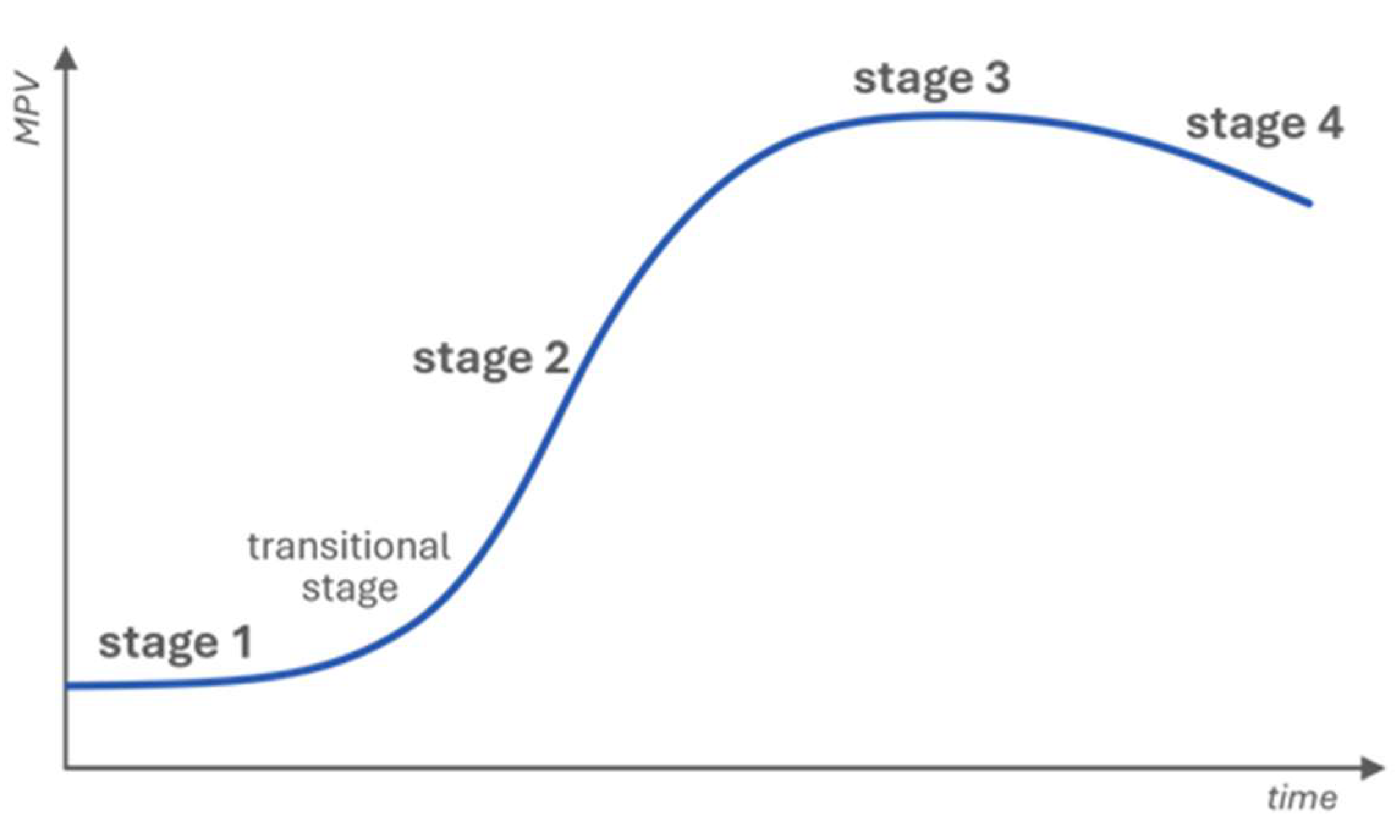
Disclaimer/Publisher’s Note: The statements, opinions and data contained in all publications are solely those of the individual author(s) and contributor(s) and not of MDPI and/or the editor(s). MDPI and/or the editor(s) disclaim responsibility for any injury to people or property resulting from any ideas, methods, instructions or products referred to in the content.

Article Metrics

Citations

Article Access Statistics

Multiple requests from the same IP address are counted as one view.