You are currently viewing a new version of our website. To view the old version click .
Energies
  • Article
  • Open Access

30 October 2025

Optimal Energy Sharing Strategy in Multi-Integrated Energy Systems Considering Asymmetric Nash Bargaining

,
,
and
1
State Grid Integrated Energy Services Group Co., Ltd., Beijing 100053, China
2
School of Energy and Environmental Engineering, The University of Science and Technology Beijing, Haidian, Beijing 100083, China
*
Author to whom correspondence should be addressed.

Abstract

Integrated energy systems (IESs) are increasingly being deployed and expanded, which integrate various energy infrastructures to enable flexible conversion and utilization among different energy forms. To facilitate collaboration among operators of varying scales and fully leverage the economic and environmental benefits of multi-integrated energy systems (MIESs), this study develops a peer-to-peer (P2P) energy sharing framework for MIES based on asymmetric Nash bargaining. First, an IoT-based P2P energy sharing architecture for MIES is proposed, which incorporates coordinated electricity–heat–gas multi-energy synergy within IES models. Carbon capture systems (CCS) and power-to-gas (P2G) units are integrated with carbon trading mechanisms to reduce carbon emissions. Then, an MIES energy sharing operational model is established using Nash bargaining theory, subsequently decoupled into two subproblems: alliance benefit maximization and individual IES benefit distribution optimization. For subproblem 2, an asymmetric bargaining method employing natural exponential functions quantifies participant contributions, enabling fair distribution of cooperative benefits. Finally, the alternating direction method of multipliers (ADMM) is employed to solve both subproblems distributively, effectively preserving participant privacy. The effectiveness of the proposed method is verified by case simulation, demonstrating reduced operational costs across all IESs alongside equitable benefit allocation proportional to energy-sharing contributions. Carbon emission amounts are simultaneously reduced.

1. Introduction

Currently, with the rapid development of the economy, it has become difficult for the inefficient and single energy utilization model to meet the increasing energy demand [1,2]. To cope with this challenge, there is an urgent need to break down the barriers of the energy system and build a stable and reliable integrated energy system (IES) [3,4]. The IES can interconnect the energy subsystems such as electricity, heat, and gas, which efficiently improves the energy utilization efficiency, enhances operational and seasonal flexibility in energy supply, and reduces the reliance on any single energy system [5]. Therefore, it is important to study the optimal operation of IESs for the efficient utilization of energy.
Initially, IESs are mostly centralized operation models. For example, previous literature [6] has investigated a multi-timescale rolling optimization model of IESs with a hybrid energy storage system, aiming to realize the cooperative operation of heterogeneous energy sources and a hybrid energy storage system. On this basis, previous literature [7] developed an IES operation model incorporating photovoltaic battery swapping–charging–storage stations. To address the uncertainty of renewable energy, a two-stage robust optimization approach is employed, establishing a multi-timescale robust scheduling model that balances operational flexibility with computational tractability.
However, the above operational model excessively relies on interactions with power and gas networks to address energy shortages, preventing localized energy sharing with other IESs. Consequently, during energy surpluses or deficits, IESs are unable to optimize their consumption strategies through energy sharing to enhance renewable energy integration or reduce operational costs. Therefore, peer-to-peer (P2P) trading between the subjects of multi-integrated energy systems (MIES) provides a solution to address the above challenges [8]. P2P trading utilizes distributed technologies (e.g., blockchain, internet of things (IoT), and smart contracts) to realize direct trading between energy producers and consumers, which can effectively increase the local consumption rate of renewable energy, optimize the IES’s energy usage cost, and reduce the demand for public utilities, thus promoting the development of energy systems towards decentralization and intelligence [9,10].
Nevertheless, as IES typically operate under distinct operators with access only to localized information, their pursuit of self-interest maximization often leads to uncoordinated competition due to information asymmetry. This significantly undermines overall market efficiency. In existing studies, the energy sharing strategy of MIES can maximize the P2P trading revenue using game theory, such as a non-cooperative game [11] and a cooperative game [12]. For example, previous literature [13] modeled the competition between multiple energy users as a non-cooperative game. Another study [14] proposed a multi-agent game operation strategy consisting of energy retailers, suppliers, and users with an integrated demand response (IDR) and formulated the problem as a non-cooperative game model with one leader and multiple followers.
However, non-cooperative game frameworks prioritize individual rationality and self-interested behaviors, failing to incorporate collective welfare considerations [15]. Conversely, cooperative game theory effectively balances both individual and collective welfare, enabling the achievement of system-wide optimal outcomes through coordinated strategy formulation. This characteristic renders cooperative approaches particularly well-suited for modeling energy sharing in MIES, which realizes overall global optimization. For example, previous literature [16] proposed a bi-level optimization framework based on multi-agent cooperative game theory. The upper-level model determines energy trading volumes through cooperative bargaining governed by interval-based economic dependencies, which then informs the lower-level multi-objective optimization scheduling model.
In cooperative game theory, the Shapley value and the Nash bargaining (NB) solution are standard methods for distributing benefits from cooperation. The Shapley value distributes benefits based on each member’s marginal contribution to every possible coalition. In contrast, the NB solution determines how a cooperative surplus—the additional benefits generated by working together versus independently—is divided among participants through negotiation. Given that energy sharing in MIES typically involves negotiation among multiple independent actors and does not involve the formation of multiple coalitions, the NB approach is extensively adopted in this research context [17]. The core concept involves reframing the distribution problem as a Nash bargaining equilibrium solution, achieved by maximizing the collective welfare of the alliance. For example, previous literature [18] ensured a distribution of benefits proportional to the participants by constructing a generalized NB model. Other literature [19] considered the interests and individual differences in each park subject, established a cooperative game model representing the interests of the multi-park integrated energy system, and determined the energy trading and pricing strategies through the NB method.
Nevertheless, the aforementioned strategies face challenges in quantifying the contribution of each IES during energy sharing. Consequently, the benefits derived from sharing are often allocated equally among participants, without accounting for the varying degrees of contribution from each IES. Since the contributions of IESs are inherently heterogeneous, the fairness of benefit distribution cannot be adequately ensured by the mechanisms proposed in [18,19]. If the perceived fairness of the distribution scheme is compromised, it may diminish the willingness of IESs to engage in energy-sharing initiatives. In addition, some studies solve the energy trading and benefit distribution strategies among MIESs through centralized optimization methods, which violates the privacy of each subject. Therefore, exploring how to determine the energy trading and pricing strategies taking into account the individual and alliance rationality of multiple subjects and protect the privacy of each subject is an urgent problem for MIES energy sharing.
Therefore, this paper proposes an optimization method for energy sharing of MIESs considering asymmetric Nash bargaining, and the main contributions are as follows:
(1)
This study proposes a P2P energy sharing architecture for MIESs utilizing Internet of Things (IoT) technology. Within this framework, an MIES model incorporating electricity, heat, and natural gas networks is developed. The optimization mechanism incorporates carbon trading considerations and integrates both carbon capture systems and power-to-gas conversion devices to effectively reduce carbon emissions from the IES.
(2)
A cooperative operational model for MIES electricity sharing is established based on Nash bargaining theory. This model is decoupled into two subproblems: IES alliance benefit maximization and cooperative benefit distribution. The subproblems are solved in a distributed manner using the alternating direction method of multipliers (ADMM), thereby effectively safeguarding the privacy of all participating entities.
(3)
For the cooperative benefit allocation subproblem, this study proposes an asymmetric bargaining method incorporating nonlinear mapping functions to quantify IES contributions. This enables IESs to negotiate collectively using their energy contribution levels as bargaining capability, thereby achieving equitable distribution of cooperative benefits.
The other chapters of this paper are structured as follows: Section 2 proposes the architecture to realize MIES energy sharing, Section 3 establishes the system model of an MIES, Section 4 proposes the MIES energy sharing and benefit distribution model, Section 5 conducts the simulation analysis, and Section 6 summarizes the whole paper.

2. MIES Energy Sharing Architecture

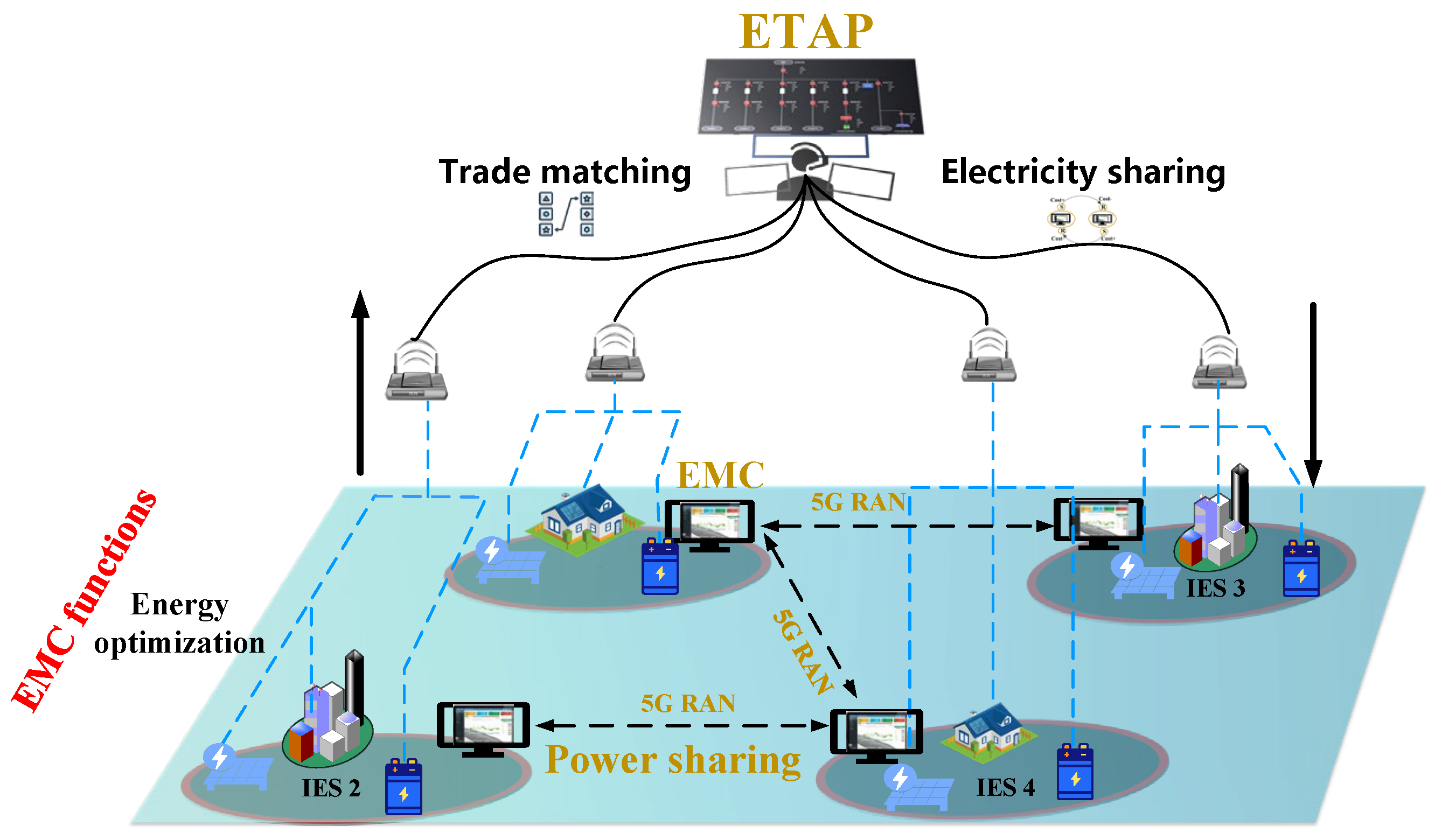
Currently, with the vigorous development of IoT technology, communication technology, and digitalization technology, each IES can be transformed by advanced technology to exhibit autonomous control and interaction capability, so as to realize intelligent energy management. Therefore, this paper proposes a P2P energy trading architecture based on IoT for MIESs, as shown in Figure 1. Each IES is equipped with an energy management client (EMC), which contains modules for energy monitoring, energy optimization, and energy trading. Specifically, the energy monitoring module effectively collects energy operation data through smart meters to provide key information for the EMC. The energy optimization module contains functions such as renewable energy and load forecasting, as well as energy operation strategy optimization. The energy trading module contains functions such as trading strategy generation and real-time control. Simultaneously, the trading communication between IESs utilizes radio access network (RAN) technology (e.g., 5G RAN slicing technology). This enables each network slice to operate as a dedicated private network, immune to interference from public communication infrastructures. Furthermore, to facilitate trading matching and mitigate risks, the proposed architecture incorporates an Energy Trading Agent Platform (ETAP), which allows EMCs to interact with ETAP via public communications to conduct P2P trading. Finally, to prevent market manipulation and disorder stemming from leaks of critical trading information or sensitive data, IESs conduct local optimization of their operational strategies within respective EMCs, while exchanging only essential trading parameters via the ETAP. Upon aggregating this information, the ETAP facilitates secure trading matching.
Figure 1. P2P energy sharing architecture of an MIES.
On the basis of the above energy sharing architecture, MIESs can conduct P2P trading. It is worth noting that any IES with an electricity surplus first supplies power to electricity-deficient peers within the IES alliance. When facing internal power shortages, unmet demand is primarily addressed by procuring excess electricity from other IESs. Concurrently, each IES utilizes its energy storage systems to regulate supply–demand imbalances. Only when internal generation, P2P energy trading, and storage capacity prove insufficient does the system resort to procuring electricity from the power grid. Therefore, under the interference of external power market price, local consumption or energy sharing of MIESs has become a profit-seeking game problem based on cost efficiency. Thus, under the above discussion, MIESs urgently need a new type of energy trading operation framework to maximize the combination of energy efficiency and cost efficiency.

3. MIES Electricity–Heat–Gas Model

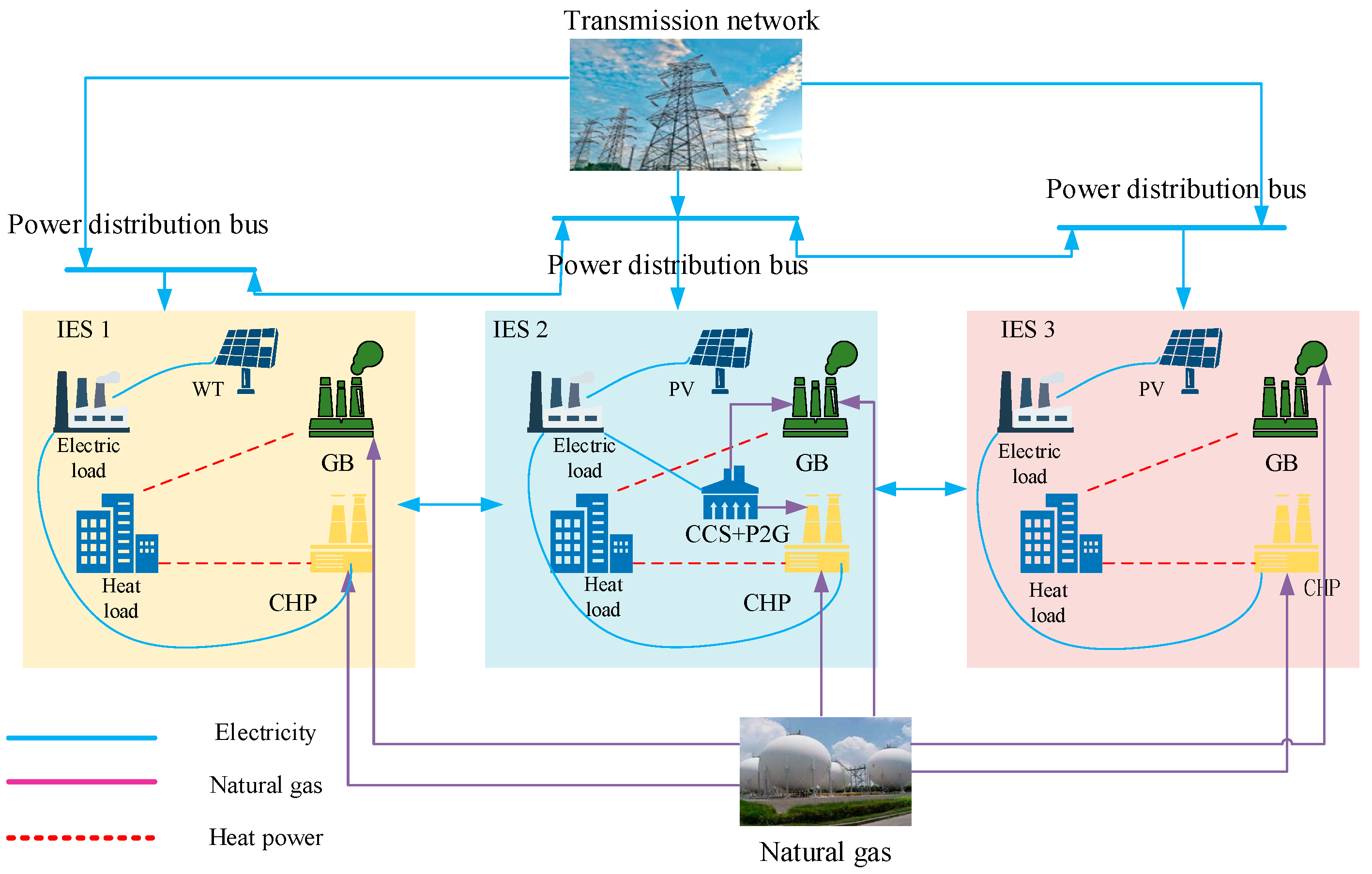
Ideally, all IESs reaching electricity–gas–heat coupling should be equipped with five elements: combined heat and power (CHP) units, gas boiler (GB) units, distributed renewable energy (DRE), a distributed energy storage system (ESS), and electric and thermal loads (commercial buildings or residential houses, etc.). However, CHP units and GB units emit large amounts of CO2 during operation. To advance carbon emission reduction objectives, the operational framework of the IES has been enhanced through the integration of a carbon capture system (CCS) and a power-to-gas (P2G) unit. This configuration not only mitigates carbon emissions but simultaneously facilitates the production of renewable natural gas, thereby enhancing system sustainability. Furthermore, to enhance system component diversity, IES 2 incorporates P2G and CCS beyond baseline requirements, while IES 1 installs decentralized wind turbines (WTs) and IES 3 installs distributed photovoltaic (PV). The overall structure of the IES alliance system constructed in this paper is shown in Figure 2. Additionally, we assume that the IESs are geographically close to each other, making energy transmission losses negligible.
Figure 2. Architecture of each IES.

3.1. Equipment Model

The CHP units generate electricity by consuming natural gas. At the same time, the high-temperature flue gas produced during electricity generation can be used for heating. The mathematical model of CHP is as follows:
P i , t C H P = F i , t C H P H n g η C H P
H i , t C H P = F i , t C H P H n g 1 η C H P η s
where P i . t C H P is the electric power output of the i-th CHP units at time slot t; H i , t C H P is the thermal power output of the i-th CHP units at time slot t; F i , t C H P is the consumption of natural gas of the i-th CHP units at time slot t; η C H P is the power generation efficiency of the CHP units; η s is the rate of energy loss of the CHP units; and H n g is the calorific value of natural gas, which is taken as 9.7 in this study.
The GB units burn natural gas to supply heat, which is modeled as follows:
H i , t G B = F i , t G B H n g η G B
where H i , t G B is the thermal power output of the i-th GB units at time slot t; F i , t G B is the amount of natural gas consumed by the i-th GB units at time slot t; and η G B is the efficiency of the GB units.
The CCS units implemented in this study employ electricity to capture CO2 emissions from CHP unit operations, with the captured carbon dioxide subsequently supplied by the P2G unit facility for synthetic natural gas production.
P i , t g a s = α P i , t P 2 G
C i , t C C S = β P i , t P 2 G
C i , t C C S = P i , t C C S / ε
where P i , t g a s is the amount of natural gas produced by the P2G units at time slot t; P i , t P 2 G is the input electric power of the P2G units at time slot t; C i , t C C S is the amount of CO2 captured by the CCS units at time slot t; P i , t C C S is the electric power consumed by the CCS units at time slot t; α is the efficiency of converting the electric power to natural gas of the P2G; β is the calculation coefficient of CO2; and ε is the relative coefficient of the consumed electric power and the captured CO2.
The ESS model of MIES constructed in this paper is as follows:
S i , t E S S , c h a P i , m i n E S S , c h a P i , t E S S , c h a S i , t E S S , c h a P i , m a x E S , c h a S i , t E S S , d i s P i , m i n E S S , d i s P i , t E S S , d i s S i , t E S S , d i s P i , m a x E S , d i s S i , t E S S , c h a + S i , t E S S , d i s 1 E i , t E S S = E i , t 1 E S S 1 σ i E S S + η i E S S , c h a P i , t E S S , c h a P i , t E S S , d i s / η i E S S , d i s Δ t E i , m i n E S S E i , t + 1 E S S E i , m a x E S S E i , 0 E S S = E i , 24 E S S
where P i , m i n E S S , c h a , P i , m a x E S , c h a , P i , m i n E S S , d i s , and P i , m a x E S , d i s are the minimum and maximum power of charging and discharging of the i-th ESS at time slot t, respectively; σ i E S S is the self-leakage rate of the i-th ESS; η i E S S , c h a and η i E S S , d i s are the charging and discharging efficiencies of the i-th ESS, respectively; E i , t E S S is the state of charge of the i-th ESS at time slot t; and S i , t E S S , c h a and S i , t E S S , d i s are the states of charging and discharging at time slot t.

3.2. Constraints

During the operation phase, IESs usually need to fulfill the constraints of the electricity–heat–gas energy balance.
P i , t g r i d + P i , t D R E + P i , t C H P + P i , t d i s = P i , t C C S + P i , t l o a d + P i , t c h a + P i , t P 2 G + P i j , t P 2 P
H i , t C H P + H i , t G B = H i , t l o a d
F i , t b u y + F i , t P 2 G = F i , t C H P + F i , t G B
The equipment operation constraints are shown in the following equations.
P i , m i n C H P P i , t C H P P i , m a x C H P H i , m i n C H P H i , t C H P H i , m a x C H P H i , m i n G B H i , t G B H i , m a x G B P i , m i n P 2 G P i , t P 2 G P i , m a x P 2 G P i , m i n C C S P i , t C C S P i , m a x C C S
The electricity exchanged between IESs during each time slot t needs to comply with the transmission capacity limits.
P i j t P i j t , m a x
Additionally, the traded electricity price for each period is constrained to the interval between the upper-level grid’s purchase and sale prices.
β t s e l l χ i j t β t b u y
In addition, to alleviate the peak pressure of system energy supply, the demand response (DR) is also considered in this study. In this case, the electric loads are categorized into base loads, transferable loads, and curtailable loads, which can be represented by the following model:
P i , t l o a d , D R = P i , t b a s e + P i , t s h i f t P i , t c u t t = 1 T P i , t s h i f t = P s u m s h i f t 0 P i , t s h i f t P m a x s h i f t 0 P i . t c u t P m a x c u t
where P i , t b a s e , P i , t c u t , and P i , t s h i f t denote the base loads, curtailable loads, and transferable loads of the system at time slot t, respectively; P s u m s h i f t denotes the sum of transferable loads during the response time; and P m a x s h i f t and P m a x c u t denote the upper limit of the transferable and curtailable loads, respectively.
The curtailable heat loads can be modeled as:
H m i n c u t H t c u t H m a x c u t
where H m a x c u t and H m i n c u t are the upper and lower limits of heat load reduction at each moment.

3.3. Objective Function

The objective of IESs in this paper is to minimize the total system cost, which includes the cost of purchased electricity, purchased natural gas, carbon trading cost, CHP operation cost, ESS operation cost, DR subsidy cost, and energy trading cost.
C i I E S = min C i g a s + C i p o w e r + C i C O 2 + C i C H P + C i E S S + C i D R + C i P 2 P
C i g a s = t = 1 T β g a s P i , t g a s
C i p o w e r = ( t = 1 T β i , t b u y P i , t b u y β i , t s e l l P i , t s e l l )
E i I E S = t = 1 T γ C H P P i , t C H P + γ G B H i , t G B
E i I E S = t = 1 T γ C H P P i , t C H P + γ G B H i , t G B C i , t C C S
C i C O 2 = W C O 2 ( E i I E S E i )
C i C H P = t = 1 T α C H P P i , t C H P
C i E S S = t = 1 T α E S S ( P i , t c h a + P i , t d i s )
C i D R = t = 1 T ( ε e c u t P i , t c u t + ε e s h i f t P i , t s h i f t + ε h c u t H i , t c u t )
C i P 2 P = t = 1 T i j I P i j , t P 2 P χ i j P 2 P
where β gas is the purchase price of natural gas; P gas , t b u y is the purchased natural gas amount at time t; P i , t b u y and P i , t s e l l are the purchased and sold electricity; β i , t b u y and β i , t s e l l are the purchased and sold price of electricity of each IES; E i is the total carbon emission allowance given by the government to the IESs; δ is the carbon emission allowance per unit of electricity; δ GB is the carbon emission allowance per unit of heat generated by the gas boiler; E i I E S is the total actual carbon emission of the IES at time t; γ C H P is the carbon emission factor of gas turbine; γ G B is the carbon emission factor of gas boiler; and W C O 2 is the carbon trading price.

4. MIES Energy Sharing and Benefit Distribution Model

4.1. Fundamentals of Nash Bargaining

As independent rational individuals, each IES operator hopes to reach an equilibrium strategy through Nash bargaining to maximize the benefits of each IES. Therefore, determining the energy trading amount and price fairly and reasonably is the focus of all participants. The unique solution that maximizes the Nash product in Equation (26) corresponds precisely to the equilibrium outcome of the Nash bargaining problem [20]. This solution can allow the participants of the cooperative alliance to all obtain the Pareto-optimal benefit [21].
max i Ι C i C i 0   s . t .   C i C i 0
where Ι is the number of subjects participating in bargaining; C i is the benefit after the i-th subject participates in bargaining; C i 0 is the bargaining rupture point, i.e., the benefit before the i-th subject participates in bargaining; and C i C i 0 represents the benefit enhancement value achieved by the i-th subject through cooperation, i.e., the objective of Nash bargaining is to maximize the benefit enhancement value of all cooperative subjects.
Because the above problem is a nonlinear optimization problem, this paper carries out a series of equivalent transformations of Equation (26), which is converted into the following two easy-to-solve subproblems: the benefit maximization of the IES alliance and the benefit distribution maximization of each IES. To protect the privacy of each IES when participating in the bargaining, the alternating direction method of multipliers (ADMM) is used to solve the two subproblems sequentially, and the optimal solution of the original problem can be obtained.

4.2. The Subproblem of Benefit Maximization for the IES Alliance

Maximizing the collective benefits of the IES alliance is strictly equivalent to minimizing its total operational costs, where the overall cost represents the aggregate of individual energy expenditures incurred by all participating systems.
min i Ι C i I E S · P i j t ( P j i t )   s . t .   ( 1 ) ( 24 )
where P i j , t P 2 P denotes the amount of electricity that i-th IES expects to trade with j-th IES; P j i , t P 2 P denotes the amount of electricity that j-th IES expects to trade with i-th IES; and when P i j , t P 2 P = P j i , t P 2 P , it indicates that a consensus on energy trading between i-th IES and j-th IES has been reached. Subsequently, the specific steps for the distributed solution of subproblem 1 based on the ADMM algorithm are as follows:
(1)
Construct the augmented Lagrangian function of subproblem 1.
C i supl = C i I E S + j I t = 1 T λ i j supl P i j t + P j i t + j I ρ i sup 1 2 t = 1 T P i j t + P j i t 2 2
where λ i j supl is the corresponding Lagrange multiplier between the i-th and j-th IESs and ρ i sup 1 is the penalty factor. We take 10−4 in this paper, set the maximum number of iterations τ max as 100 and the convergence accuracy ζ 1 as 10−3, and initialize the electricity trading amount and the Lagrange multiplier as 0.
(2)
Each IES determines its electricity trading strategy through its respective EMC. During every iteration cycle, the following procedural steps are systematically executed:
i-th IES updates its operational decisions P i j t , τ + 1 by the following equation and shares it with other IES subjects:
P i j t , τ + 1 = arg min C i supl λ i j supl , τ , P i j t , τ , P j i t , τ
Other IESs receive the updated decision of the i-th IES and similarly update their own decisions according to the following equation:
P j i t , τ + 1 = arg min C j supl λ j i supl , τ , P i j t , τ + 1 , P j i t , τ
Equations (29) and (30) are repeated until each IES updates its electricity trading strategy in the current iteration.
After completing the variable iterations, we continue to update the Lagrange multipliers.
λ i j sup 1 , τ + 1 = λ i j sup 1 , τ + ρ i sup 1 P i j t , τ + 1 + P j i t , τ + 1
(3)
The number of iterations is updated τ = τ + 1 .
(4)
The algorithm’s convergence is evaluated using Equation (32). Should this criterion be met, the iterative process concludes. If not, the procedure reverts to step (2) and proceeds to the next cycle until either the convergence requirement is fulfilled or the predefined maximum iteration count is attained, whichever occurs first.
j I t = 1 T P i j t , τ + 1 P j i t 2 ζ 1 τ > τ max

4.3. The Subproblem of Benefit Distribution Maximization for IESs

This section examines the benefit distribution mechanism for MIESs following cooperative electricity trading. In P2P electricity trading, both supplying and receiving energy constitute a contribution, as this exchange reduces reliance on the power grid. Typically, supplying a certain amount of power is considered a greater contribution than receiving the same quantity, because the cost of purchasing energy is generally higher than the revenue from selling it back to the power grid.
The concept of asymmetric bargaining, drawn from economics, refers to situations where negotiating parties have different bargaining power due to disparities in information or status. Additionally, the exponential function has the property of being strictly positive and is a monotonically increasing function. Accordingly, this study employs a novel nonlinear function based on the natural exponential to precisely assess the contribution levels of individual IESs in peer-to-peer electricity trading [22,23]. Subsequently, the IESs engage in multi-round negotiations using their calculated contribution values as bargaining capability. This process determines the P2P energy trading prices and ensures a fair distribution of the cooperative surplus [24,25]. The detailed computational procedure is structured as follows:
Initially, the corresponding total electricity provided and acquired for each IES is quantified based on Equations (33) and (34).
P i s u p = t = 1 T max ( 0 , P i j t )
P i r e c = t = 1 T min ( 0 , P i j t )
Then, an exponential function with constant e as the base is chosen to quantify the bargaining capability ψ i of each IES:
ψ i = e P i s u p / P m a x s u p e P i r e c / P m a x r e c
According to Equation (35), the resulting value of ψ i is guaranteed to remain non-negative. When quantifying the contributions of the i-th IES, supplying energy is assigned a higher value than receiving it. Consequently, an increase in P i s u p leads to a greater bargaining weight, whereas an increase in P i r e c reduces it.
Finally, according to the above-established quantitative model of bargaining capability, the optimal amount of trading electricity obtained in subproblem 1 is substituted into subproblem 2. The benefit allocation model of asymmetric bargaining for MIES is shown in the following equation:
max i Ι C i 0 C i I E S + C i P 2 P ψ i   s . t .   ( 1 ) ( 24 )
C i 0 C i I E S + C i P 2 P > 0
Equation (36) formulates the objective of maximizing benefits for the IESs through P2P energy sharing, and Equation (37) ensures that each IES with an energy sharing contribution can obtain the benefit. Given that the exponential function is strictly monotonically increasing, applying the logarithm to Equation (36) transforms the original maximization problem into an equivalent minimization problem, as expressed in the following reformulated equation:
min i = 1 I ψ i ln C i 0 C i I E S + C i P 2 P
When χ i j t = χ j i t , it indicates that there is a consensus on the trading price between the i-th IES and the j-th IES. Subproblem 2 is subsequently addressed using the ADMM algorithm through the following iterative steps:
(1)
Firstly, obtain the electricity trading amount of each IES derived from solving subproblem 1, and calculate the bargaining capability of each IES according to Equations (33)–(35).
(2)
Construct the augmented Lagrangian function for subproblem 2.
C i sup 2 = ψ i ln C i 0 C i I E S + C i P 2 P + j I t = 1 T λ i j sup 2 χ i j t + χ j i t + j I ρ i sup 2 2 t = 1 T χ i j t + χ j i t 2 2
where λ i j sup 2 is the corresponding Lagrange multiplier between the i-th and j-th IESs in solving subproblem 2 and ρ i sup 2 is the penalty coefficient. We take 1 in this paper, set the maximum number of iterations τ max as 100 and the convergence accuracy ζ 2 as 10−3, and initialize the trading price and Lagrange multiplier as 0.
(3)
Each IES determines its trading pricing strategy via its respective EMC. The following steps are systematically executed in each iterative cycle:
The i-th IES updates its decision χ i j t , τ + 1 by the following equation and shares it with other IES subjects:
χ i j t , τ + 1 = arg min C i sup 2 λ i j sup 2 , τ , χ i j t , τ , χ j i t , τ
Other IESs receive the updated decision of the i-th IES and similarly update their own decisions according to the following equation:
χ j i t , τ + 1 = arg min C j sup 2 λ j i sup 2 , τ , χ i j t , τ + 1 , χ j i t , τ
We repeat Equations (40) and (41) until each IES updates its price strategy in the current iteration.
After completing the variable iterations, we continue to update the Lagrange multipliers.
λ i j sup 2 , τ + 1 = λ i j sup 2 , τ + ρ i sup 2 χ i j t , τ + 1 + χ j i t , τ + 1
(4)
Update the number of iterations τ = τ + 1 .
(5)
Convergence of the algorithm is determined using Equation (43). Once this termination criterion is met, the iterative process concludes. Should the convergence criterion remain unmet, the algorithm reverts to step (3) for additional iterations. This cyclic process continues until either the convergence threshold is attained or the predefined maximum iteration count is reached, terminating at whichever condition occurs first.
j I t = 1 T χ i j t , τ + 1 χ j i t 2 ζ 2 τ > τ max
r τ = χ i j t , τ χ j i t , τ 2 , r τ 1 e 3 s τ = ρ i sup 2 λ i j t , τ λ i j t , τ 1 2 , s τ 1 e 3
The distributed computational procedure for solving the subproblems is formally presented in Algorithm 1.
Algorithm 1. The distributed computational procedure for solving the subproblems
Input: Set the maximum number of iterations τ max as 100, the convergence accuracy ζ 1 and ζ 2 as 10−3, and initialize the electricity trading amount, trading price, and the Lagrange multiplier as 0.
//Step 1. Benefit maximization for the IES alliance.
1: Construct the augmented Lagrangian function of subproblem 1 based on the Equation (28)
2: for ( τ = 1 to 100) do
3:  i-th IES updates its decision P i j t , τ + 1 by the Equation (29)
4:  Other IES updates decision according to the Equation (30)
5:  Repeat 3 and 4, until each IES updates its electricity trading strategy in the current iteration
6:  Update the Lagrange multipliers based on the Equation (31)
7:  if ( j I t = 1 T P i j t , τ + 1 P j i t 2 ζ 1 ) then
8:   the iteration is terminated
9:  end if
10: end for
11: Output: the electricity trading amount of each IES
//Step 2. Benefit distribution maximization for IESs
12: Quantify the bargaining capability ψ i of each IES based on the Equations (32)–(35)
13: Construct the augmented Lagrangian function for subproblem 2.
14: for ( τ = 1 to 100) do
15:  i-th IES updates its decision χ i j t , τ + 1 by the Equation (40)
16:  Other IES updates decision according to the Equation (41)
17:  Repeat 15 and 16, until each IES updates its price strategy in the current iteration
18:  Update the Lagrange multipliers based on the Equation (42)
19:  if ( j I t = 1 T χ i j t , τ + 1 χ j i t 2 ζ 2 ) then
20:   the iteration is terminated
21:  end if
22: end for
23: Output: the electricity trading price of each IES

5. Discussion

In this paper, three IESs are taken as research objects to constitute an IES cooperative alliance, and P2P electricity trading among the IESs is analyzed through simulation, so as to verify the validity of the methodology proposed in this paper. Each IES model of the alliance is described in Section 3. The input data for distributed photovoltaic and wind power generation are derived from the typical daily profiles of a specific region. The corresponding operational parameters for each Integrated Energy System are provided in Appendix A Table A1 and Table A2. The purchasing and selling prices of electricity and natural gas are shown in Table A3 in the Appendix A. The simulation of the algorithm is carried out on a computer configured with an Intel Core i7-8700 3.20 GHz processor and 16 GB RAM. Matlab R2021a is used as the programming environment, the Yalmip toolbox (R20230622) is utilized for modeling, and the Cplex 12.10 and Mosek 10.10 commercial solvers are used for the solution.

5.1. Convergence Analysis of ADMM

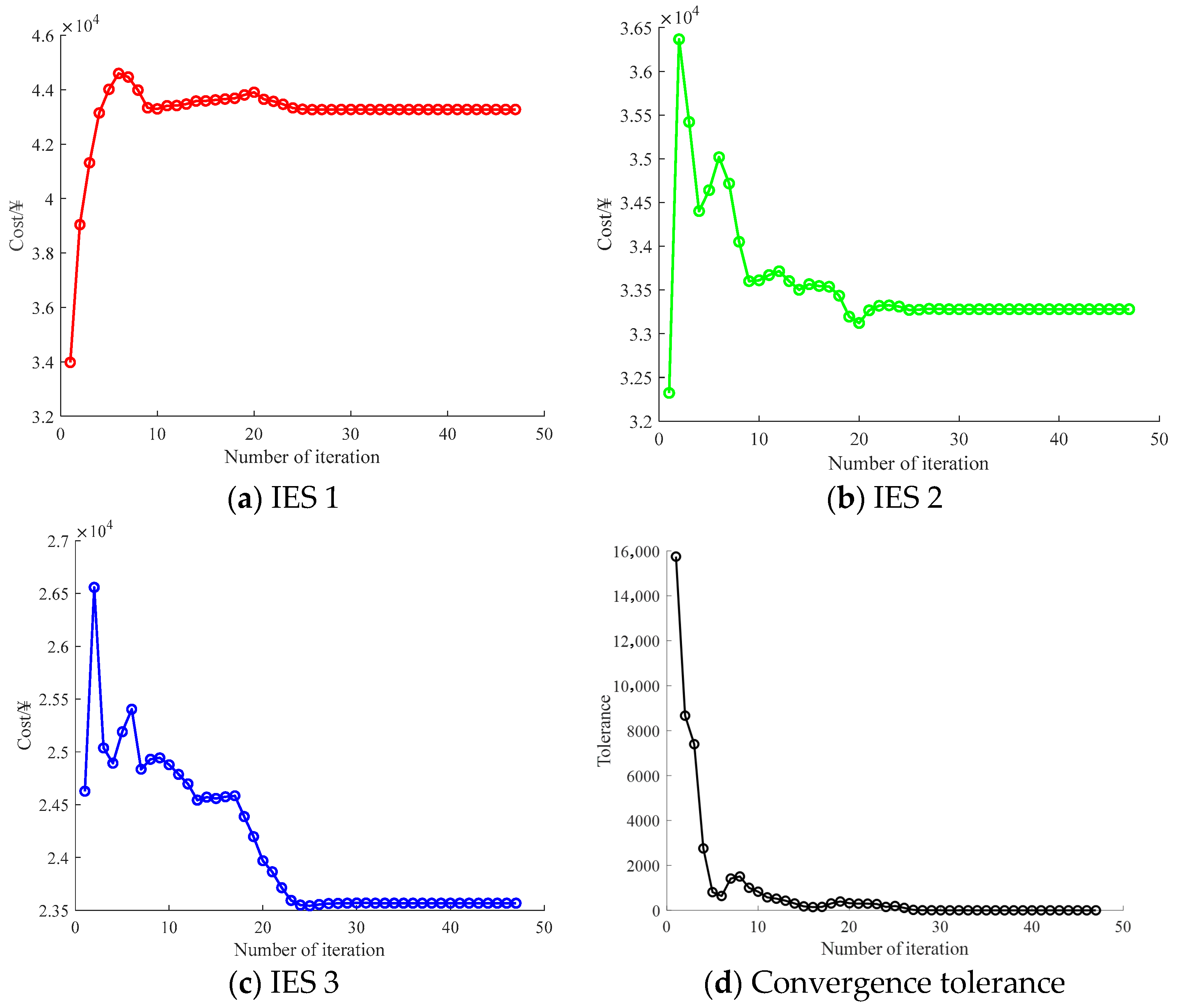
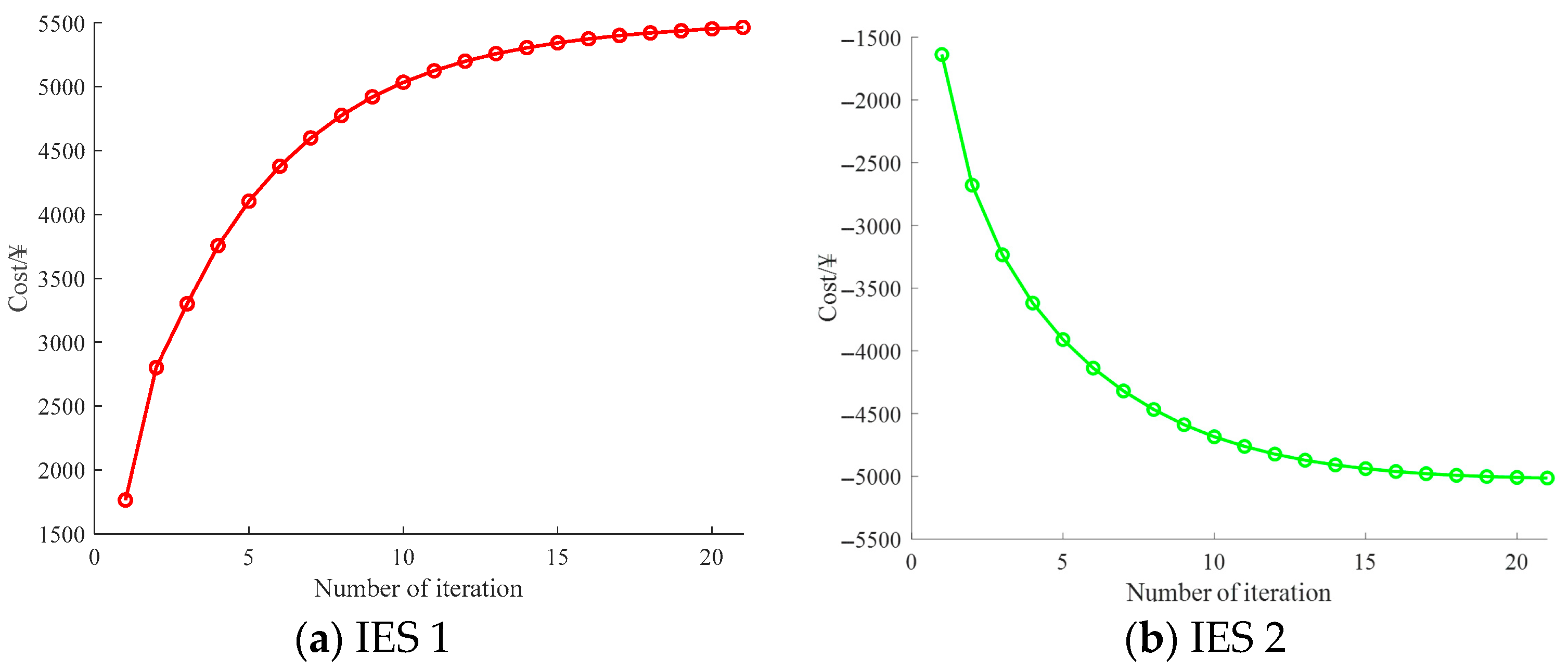
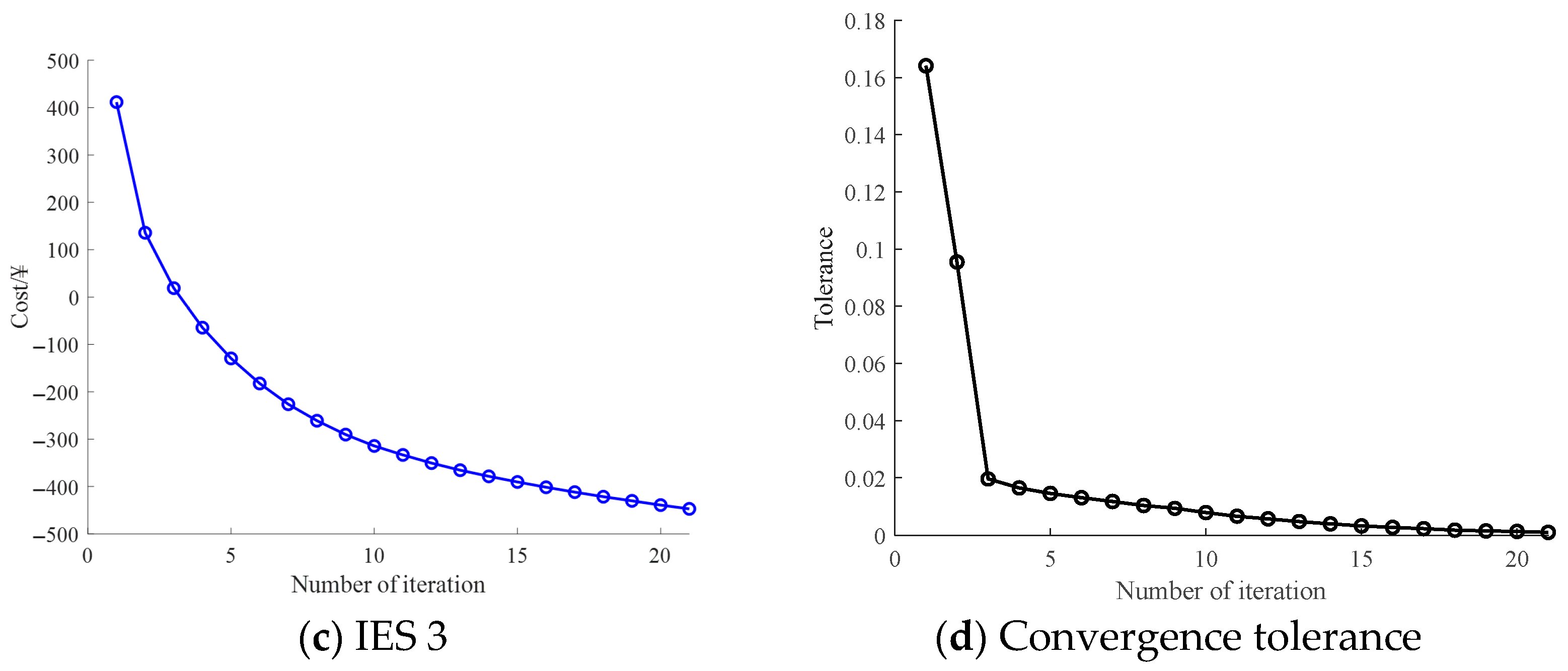
In this section, the iterative processes of two subproblems are shown in Figure 3 and Figure 4, respectively. Figure 3 illustrates the iterative convergence behavior of individual IES costs in subproblem 1. The proposed methodology reaches convergence within 47 iterations, completing the process in 654 s, thereby demonstrating the model’s computational efficiency. Figure 4 shows the iterative convergence results of the bargaining cost in subproblem 2, and the algorithm converges the residuals to within 10−3 after 21 iterations, with a computational time of 215 s. Therefore, the distributed optimization algorithms introduced in this study demonstrate excellent convergence behavior and high computational efficiency, while simultaneously addressing the dual requirements of protecting participant privacy and enabling effective day-ahead optimal scheduling.
Figure 3. Iterative convergence results of subproblem 1.
Figure 4. Iterative convergence results for subproblem 2.

5.2. Analysis of the Results of P2P Electricity Trading of MIES

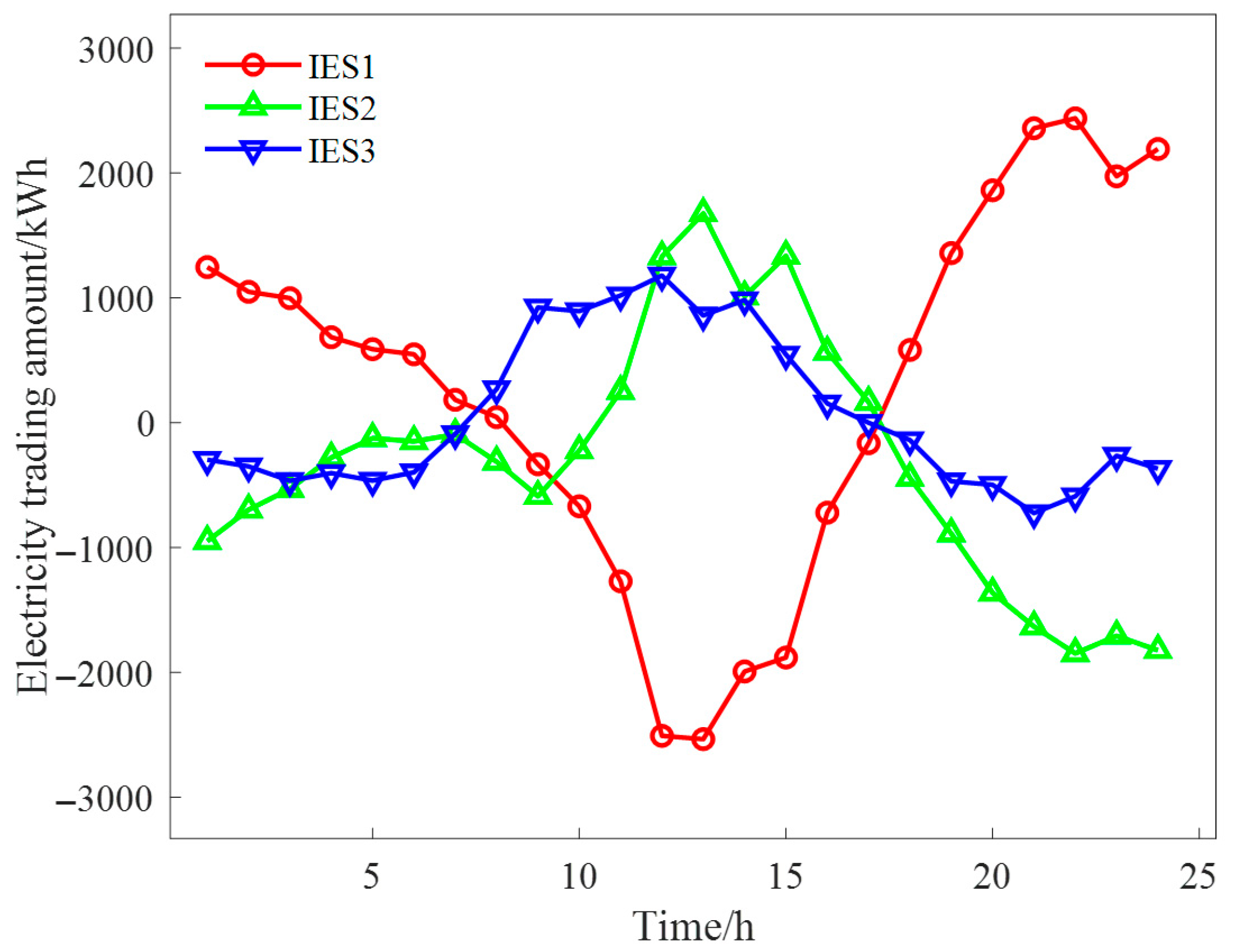
The optimization results of P2P electricity trading among each IES are shown in Figure 5. During the early morning (01:00–08:00) and evening periods (17:00–24:00), IES 1 maintains excess WT generation capacity, enabling it to supply power to both IES 2 and IES 3, which lack nighttime generation capabilities and face electricity shortages. Conversely, from 09:00 to 17:00, IES 1 experiences a significant decline in WT power output coupled with a substantial increase in electrical demand, rendering it unable to meet its own power requirements. During these daylight hours, IES 2 and IES 3 reach their PV generation peaks, allowing them to reciprocally transfer electrical power to IES 1.
Figure 5. Results of electricity trading among multiple IESs.
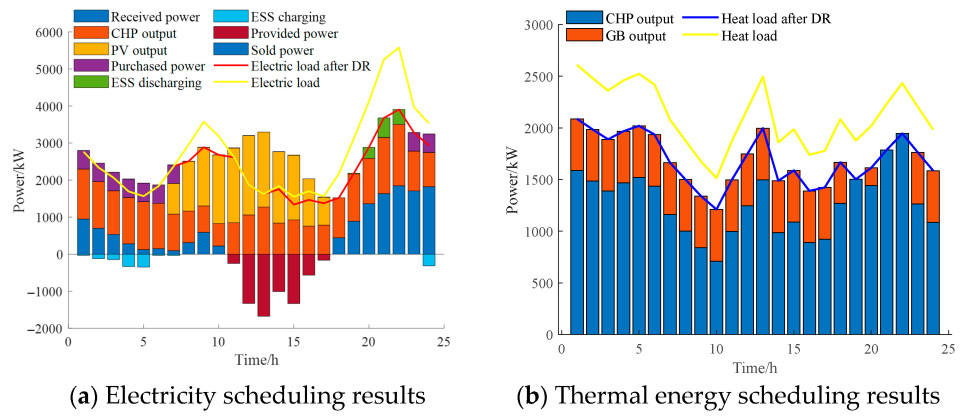
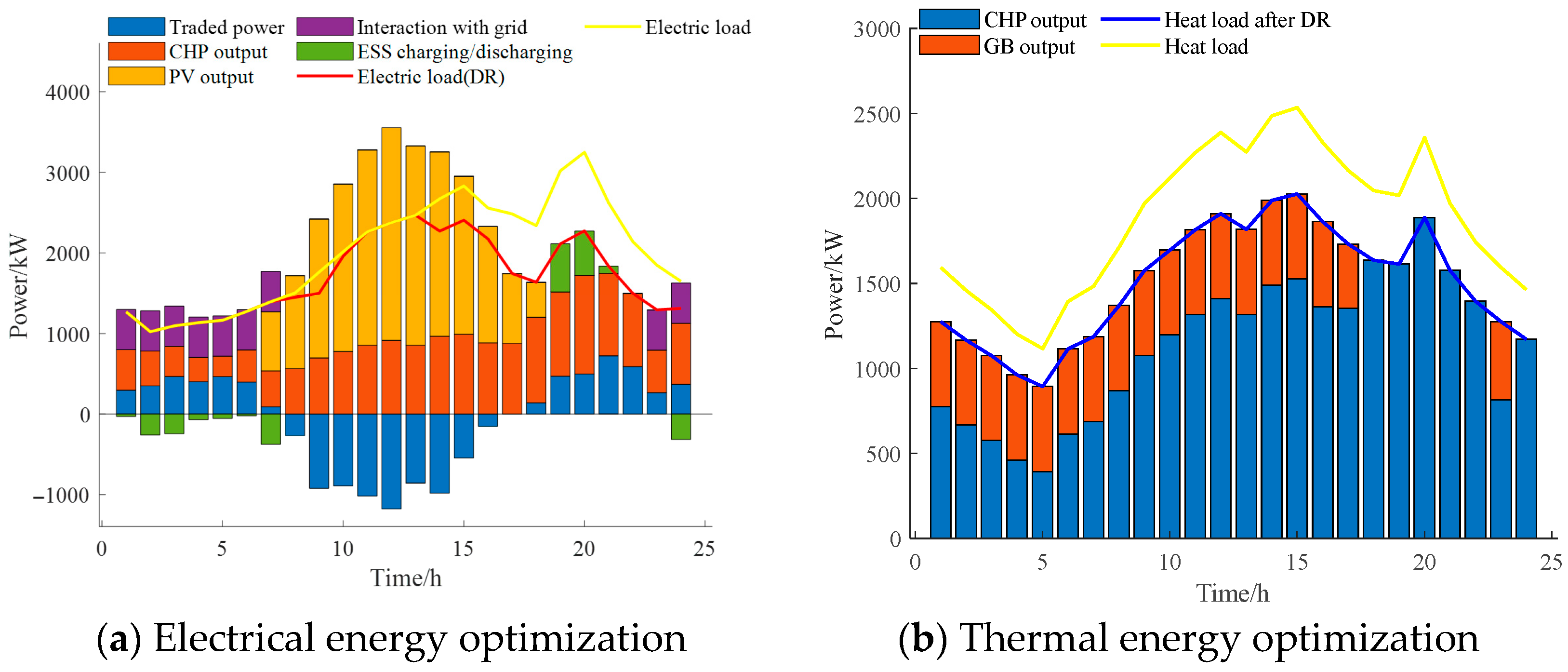
Figure 6 illustrates the optimal electricity and heat scheduling results within IES 2. While maintaining its internal energy dispatch optimization, IES 2 participates in electricity trading within the IES alliance. Following the implementation of demand response, both electric peak loads and heat loads across all periods decrease, alleviating the overall supply–demand pressure. Specifically, the CHP unit operates within its rated capacity for electricity and heat generation. EES charges primarily during off-peak price periods and discharges during peak periods (from 20:00 to 22:00), thereby reducing operation costs. IES 2 purchases minimal electricity from the power grid, limited to specific critical periods. Furthermore, the CHP units supply the majority of heat loads. During periods of insufficient CHP units’ output, the GB units provide supplementary heating. The scheduling results of other IESs are presented in Appendix A.
Figure 6. Day-ahead scheduling results for IES2.
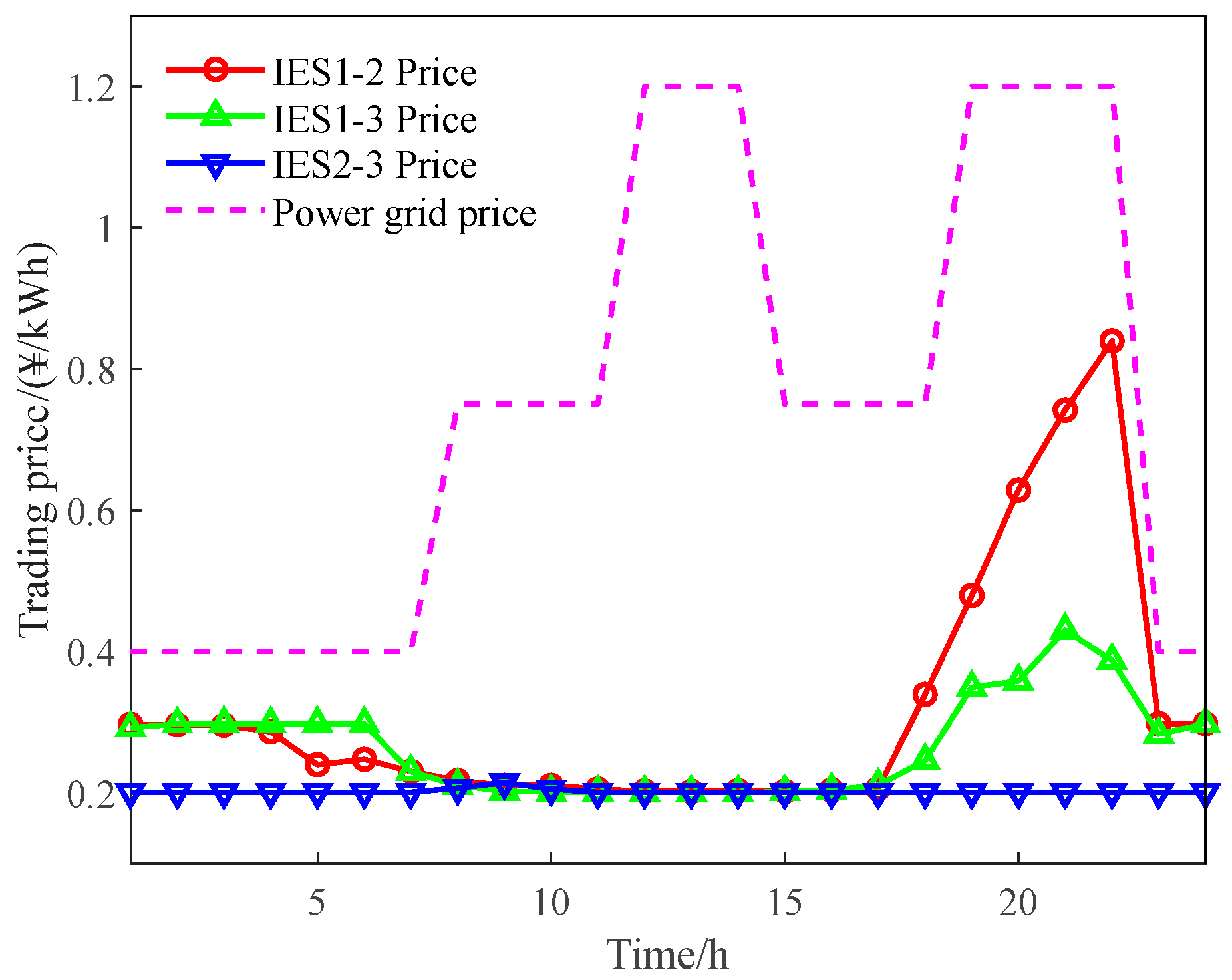
The resulting P2P electricity trading prices established through asymmetric bargaining among the MIES are presented in Figure 7. As illustrated, the trading prices set by each IES for every time period consistently fall between the grid’s selling and purchasing tariffs. This pricing structure enables each system to sell electricity at rates exceeding the grid’s selling price while procuring renewable energy at costs below the grid’s purchasing price, allowing all participants to achieve cost savings in their energy trading.
Figure 7. Trading price of electricity after asymmetric bargaining.

5.3. Analysis of the Benefits and Costs of Each IES

Table 1 presents the operational costs for each IES before and after engaging in cooperative operation. The calculated results indicate that the total cost of the IES alliance decreases by ¥9556.87 through this cooperation. While IES1 experiences an increase in operational costs compared to its pre-cooperation state, both IES2 and IES3 achieve substantial cost reductions, demonstrating the varied impact of the collaborative framework on individual system economics.
Table 1. Cost benefits of each IES before and after participating in P2P trading.
Table 2 and Table 3 compare the benefit distribution results for each IES under different Nash bargaining approaches. Table 2 demonstrates that the standard Nash bargaining method yields nearly equal cost reductions (compared with before P2P trading, approximately ¥3000) for all participants. However, this approach fails to account for significant disparities in electricity trading contributions among IESs, resulting in inequitable distributions. Table 3 shows that under the proposed asymmetric bargaining method, IES 1—with the highest energy contribution—attains a Nash bargaining factor of 2.3053, justifying a proportionally larger share of cooperative benefits. Here, “benefit” refers to the net outcome of revenue minus inherent costs, which may result in either a positive or negative value. Conversely, IES 2 and 3 exhibit lower renewable generation and predominantly receive energy, resulting in smaller bargaining factors (1.0513 and 0.7904, respectively) and consequently reduced benefit allocations. Implementation of the proposed method increases each IES benefit by ¥5163.39, ¥2416.81, and ¥1980.05, corresponding to improvement rates of 12.01%, 5.94%, and 7.62%, respectively. These results confirm that P2P energy sharing effectively enhances all IESs’ profits while ensuring equitable benefit distribution proportional to individual energy contributions.
Table 2. Benefit distribution under the standard Nash negotiation model.
Table 3. Distribution of benefits under the asymmetric Nash negotiation model.

5.4. Analysis of Carbon Emissions by IES

As detailed in Table 4, the carbon emissions and trading data for each IES demonstrate significant environmental improvements following participation in P2P trading. The recorded emission reductions reach 1143.58 kg, 1598.89 kg, and 738.75 kg, respectively, representing decreases of 12.8%, 17.9%, and 8.3% from baseline levels. This reduction stems from decreased power generation by their respective CHP units following participation in electricity trading, thereby lowering carbon emissions from natural gas combustion. Notably, IES 2 achieves the most substantial emission reduction, demonstrating that the integration of CCS and P2G technologies effectively mitigates carbon emissions from CHP unit operation and advances the overall low-carbon transition of integrated energy systems.
Table 4. Carbon emission analysis.

6. Conclusions

In response to the operational demands of energy trading for MIES, this paper proposes an optimization method for energy sharing of MIES considering asymmetric Nash bargaining. Based on Nash bargaining theory, this study establishes a cooperative game framework for MIES. The proposed model is systematically decomposed into two sequential subproblems: alliance benefit maximization and benefit distribution optimization. The asymmetric Nash bargaining method enables equitable allocation of cooperative gains among participants. Finally, the ADMM is employed to iteratively solve the optimization problem. The principal conclusions are summarized as follows:
(1)
Employing the ADMM-based distributed optimization approach offers significant advantages over traditional centralized methods. This method requires only minimal exchange of trading quantities and pricing information among IES participants, thereby effectively preserving the confidentiality of each entity’s operational data while maintaining optimization efficiency.
(2)
Compared with isolated operation, P2P energy sharing achieves operational cost reductions of 12.01%, 5.94%, and 7.62% for the respective IESs. The proposed asymmetric Nash bargaining method ensures equitable benefit distribution, where systems with greater trading amounts appropriately receive larger shares of the cooperative gains.
(3)
Integration of CCS and P2G technologies within the IES framework, combined with inter-system energy sharing, yields carbon emission reductions of 1143.58 kg, 1598.89 kg, and 738.75 kg for the respective systems. This configuration significantly advances the transition toward low-carbon energy system operation.
In future research, we suggest further study of the problem of multi-energy shared operation of electricity, heat, and gas, and exploration of the setting of a more reasonable dynamic bargaining factor. Moreover, expanding the model to include more entities significantly increases the complexity of the optimization problem. This poses substantial challenges for distributed solution methods, typically requiring advanced algorithmic modifications or AI techniques.

Author Contributions

N.L.: conceptualization, methodology, software; D.G.: writing—original draft; G.W.: software, writing—original draft; C.P.: writing—review, and editing. All authors have read and agreed to the published version of the manuscript.

Funding

This paper is supported by the State Grid Integrated Energy Service Group Co., Ltd. Technology Project “Research on Carbon Emission Management Standard System and Key Technical Standards for Integrated Energy Services”, project No. 527899220006.

Data Availability Statement

The original data presented in the study are included in the manuscript; further inquiries can be directed to the corresponding author.

Conflicts of Interest

Authors Na Li and Dongxu Guo were employed by the State Grid Integrated Energy Services Group Co., Ltd. The remaining authors declare that the research was conducted in the absence of any commercial or financial relationships that could be construed as a potential conflict of interest.

Nomenclature

P i . t C H P the electric power output of the i-th CHP units at time slot t, kW
H i , t C H P the thermal power output of the i-th CHP units at time slot t, kW
F i , t C H P the consumption of natural gas of the i-th CHP units at time slot t, m3
η C H P the power generation efficiency of the CHP units
η s the rate of energy loss of the CHP units
H n g the calorific value of natural gas, kWh/m3
H i , t G B the thermal power output of the i-th GB units at time slot t, kW
F i , t G B the amount of natural gas consumed by the i-th GB units at time slot t, m3
η G B the efficiency of the GB units
P i , t g a s the amount of natural gas produced by the P2G units at time slot t, m3
P i , t P 2 G the input electric power of the P2G units at time slot t, kW
C i , t C C S the amount of CO2 captured by the CCS units at time slot t, kg
P i , t C C S the electric power consumed by the CCS units at time slot t, kW
α the efficiency of converting the electric power to natural gas of the P2G
β the calculation coefficient of CO2
ε the relative coefficient of the consumed electricity and the captured CO2
P i , m i n E S S , c h a P i , m a x E S , c h a
P i , m i n E S S , d i s P i , m a x E S , d i s
the minimum and maximum power of charging and discharging of the i-th ESS at time slot t, respectively, kW
σ i E S S the self-leakage rate of the i-th ESS
η i E S S , c h a η i E S S , d i s the charging and discharging efficiencies of the i-th ESS, respectively
E i , t E S S the state of charge of the i-th ESS at time slot t
S i , t E S S , c h a S i , t E S S , d i s the state of charging and discharging at time slot t
P i , t b a s e P i , t c u t P i , t s h i f t the base loads, curtailable loads, and transferable loads of the system at time slot t, respectively, kW
P s u m s h i f t the sum of transferable loads during the response time, kW
P m a x s h i f t   P m a x c u t the upper limit of the transferable and curtailable loads, respectively, kW
H m a x c u t   H m i n c u t the upper and lower limits of heat load reduction at each moment, kW
β gas the purchase price of natural gas, ¥/kg
P gas , t b u y the purchased natural gas amount at time slot t, kg
P i , t b u y   P i , t s e l l the purchased and sold electricity amount, kWh
β i , t b u y   β i , t s e l l the purchased and sold price of electricity of each IES, ¥/kWh
E i the total carbon emission allowance given by the government to the IESs
δthe carbon emission allowance per unit of electricity
δ GB the carbon emission allowance per unit of heat generated by the GB units
E i I E S the total actual carbon emission of the IES at time slot t
γ C H P the carbon emission factor of the CHP units
γ G B the carbon emission factor of the GB units
W C O 2 the carbon trading price, ¥/t
C i the benefit after i-th subject participates in bargaining
C i 0 the bargaining rupture point
P i j , t P 2 P the amount of electricity that i-th IES expects to trade with j-th IES, kWh
P j i , t P 2 P the amount of electricity that j-th IES expects to trade with i-th IES, kWh
λ i j supl the corresponding Lagrange multiplier between i-th and j-th IES in solving subproblem 1
ρ i sup 1 ρ i sup 2 the penalty factor
ψ i the bargaining capability of each IES
P i s u p P i r e c total energy provided and received by each IES, kWh
λ i j sup 2 the corresponding Lagrange multiplier between i-th and j-th IES in solving subproblem 2
ζ 1   ζ 2 the convergence accuracy

Appendix A

Table A1. Parameters of the energy storage system.
Charge/Discharge
Efficiency
Minimum
Capacity (kWh)
Maximum
Capacity (kWh)
Initial
Capacity (kWh)
Maximum Charge/Discharge Rate (kW)Maintenance Cost/(¥·kW−1)
0.955001800800500/6000.01
Table A2. Other equipment’s technical parameters.
EquipmentRated EfficiencyCapacity (kW)Maintenance Cost (¥·kW−1)Carbon Emission Coefficient (kg kW−1)Carbon Emission Quota (kg kW−1)
CHP0.32/0.5450000.0130.550.424
GB0.9800/0.650.424
Table A3. Price parameters of electricity.
TypeTimePurchase Price (¥/(kWh))Sell Price (¥/(kWh))
Peak period12:00–14:00,19:00–22:001.10.2
Off-peak period8:00–11:00, 15:00–18:00, 23:00–24:000.70.2
Valley period1:00–7:000.30.2
Table A4. Demand response parameters.
TypePrice (¥/(kWh))
Curtailable loads0.03
Transferable loads0.01
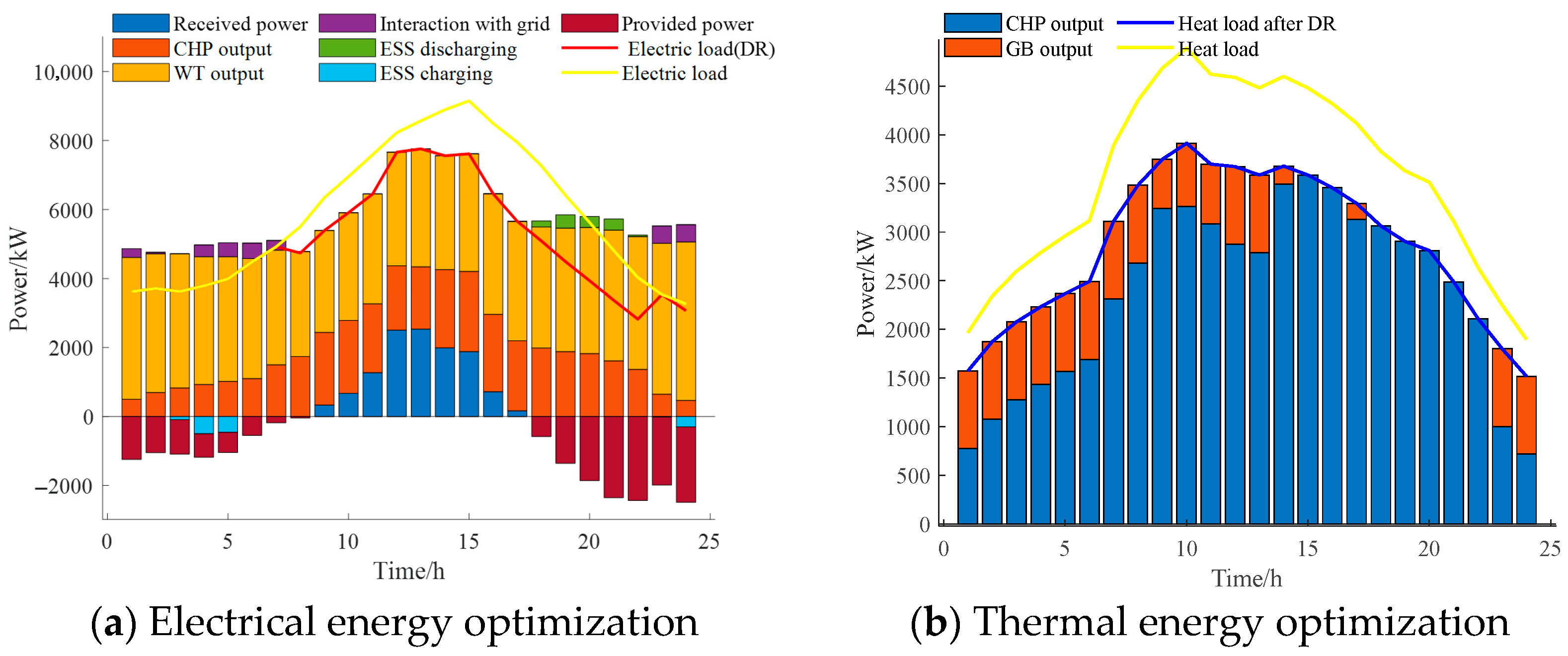
Figure A1. IES 1 internal optimization.
Figure A2. IES 3 internal optimization.

References

  1. Li, Y.; Ma, W.; Li, Y.; Li, S.; Chen, Z.; Shahidehpour, M. Enhancing cyber-resilience in integrated energy system scheduling with demand response using deep reinforcement learning. Appl. Energy 2024, 379, 124831. [Google Scholar] [CrossRef]
  2. Gao, Y.; Tahir, M.; Siano, P.; Bi, Y.; Hu, S.; Yang, J. Optimization of renewable energy-based integrated energy systems: A three-stage stochastic robust model. Appl. Energy 2024, 377, 124635. [Google Scholar] [CrossRef]
  3. Wang, G.; Pan, C.; Wu, W.; Fang, J.; Hou, X.; Liu, W. Multi-time scale optimization study of integrated energy system considering dynamic energy hub and dual demand response. Sustain. Energy Grids Netw. 2024, 38, 101286. [Google Scholar] [CrossRef]
  4. Li, N.; Zheng, B.; Wang, G.; Liu, W.; Guo, D.; Zou, L.; Pan, C. Two-Stage Robust Optimization of Integrated Energy Systems Considering Uncertainty in Carbon Source Load. Processes 2024, 12, 1921. [Google Scholar] [CrossRef]
  5. Pan, C.; Jin, T.; Li, N.; Wang, G.; Hou, X.; Gu, Y. Multi-objective and two-stage optimization study of integrated energy systems considering P2G and integrated demand responses. Energy 2023, 270, 126846. [Google Scholar] [CrossRef]
  6. Shen, W.; Zeng, B.; Zeng, M. Multi-timescale rolling optimization dispatch method for integrated energy system with hybrid energy storage system. Energy 2023, 283, 129006. [Google Scholar] [CrossRef]
  7. Zhang, J.; Li, X.; Tan, Q.; Zhong, Z.; Zhao, Q. Multi-time scale robust optimization for integrated multi-energy system considering the internal coupling relationship of photovoltaic battery swapping-charging-storage station. J. Energy Storage 2025, 109, 115109. [Google Scholar] [CrossRef]
  8. Zhong, W.; Xie, S.; Xie, K.; Yang, Q.; Xie, L. Cooperative P2P Energy Trading in Active Distribution Networks: An MILP-Based Nash Bargaining Solution. IEEE Trans. Smart Grid 2020, 12, 1264–1276. [Google Scholar] [CrossRef]
  9. Shi, M.; Wang, H.; Xie, P.; Lyu, C.; Jian, L.; Jia, Y. Distributed Energy Scheduling for Integrated Energy System Clusters With Peer-to-Peer Energy Transaction. IEEE Trans. Smart Grid 2022, 14, 142–156. [Google Scholar] [CrossRef]
  10. Zhang, R.; Bu, S.; Li, G. Multi-market P2P trading of cooling–heating-power-hydrogen integrated energy systems: An equilibrium-heuristic online prediction optimization approach. Appl. Energy 2024, 367, 123352. [Google Scholar] [CrossRef]
  11. Gao, J.; Shao, Z.; Chen, F.; Lak, M. Robust optimization for integrated energy systems based on multi-energy trading. Energy 2024, 308, 132302. [Google Scholar] [CrossRef]
  12. Cui, S.; Wang, Y.-W.; Shi, Y.; Xiao, J.-W. Community Energy Cooperation With the Presence of Cheating Behaviors. IEEE Trans. Smart Grid 2020, 12, 561–573. [Google Scholar] [CrossRef]
  13. Yang, J.; Xu, W.; Ma, K.; Chen, J.; Guo, W. Integrated demand-side management for multi-energy system based on non-cooperative game and multi-energy pricing. Sustain. Energy Grids Netw. 2023, 34, 101047. [Google Scholar] [CrossRef]
  14. Li, K.; Ye, N.; Li, S.; Wang, H.; Zhang, C. Distributed collaborative operation strategies in multi-agent integrated energy system considering integrated demand response based on game theory. Energy 2023, 273, 127137. [Google Scholar] [CrossRef]
  15. Mei, S.; Liu, F.; Wei, W. Fundamentals of Engineering Game Theory and Power System Application; Beijing Science Press: Beijing, China, 2016. (In Chinese) [Google Scholar]
  16. Liang, W.; Wang, S.; Li, X.; Li, X.; Xu, K. Optimization method of low carbon park integrated energy system based on multi-agent game. Electr. Power Syst. Res. 2025, 243, 111484. [Google Scholar] [CrossRef]
  17. Cui, S.; Wang, P.; Gao, Y.; Zhu, R. Cluster Optimization for Integrated Energy Systems Considering Multi-Energy Sharing and Asymmetric Profit Allocation: A Case Study of China. Processes 2023, 11, 2027. [Google Scholar] [CrossRef]
  18. Pu, Z.; Yi, T. Low-Carbon Economic Energy Sharing and Revenue Distribution Strategy for Multi-Integrated Energy Systems Considering the Uncertainty of New Energy Output. Sustain. Energy Grids Netw. 2025, 43, 101757. [Google Scholar] [CrossRef]
  19. Wang, L.; Xian, R.; Jiao, P.; Liu, X.; Xing, Y.; Wang, W. Cooperative operation of industrial/commercial/residential integrated energy system with hydrogen energy based on Nash bargaining theory. Energy 2023, 288, 129868. [Google Scholar] [CrossRef]
  20. Nash, J.F., Jr. The bargaining problem. Econometrica 1950, 18, 155–162. [Google Scholar] [CrossRef]
  21. Fan, S.; Ai, Q.; Piao, L. Bargaining-based cooperative energy trading for distribution company and demand response. Appl. Energy 2018, 226, 469–482. [Google Scholar] [CrossRef]
  22. Zhu, X.; Liu, S.; Cao, Y.; Zhang, Y. An asymmetric Nash bargaining based day-ahead distributed energy sharing strategy for integrated energy service providers. Int. J. Electr. Power Energy Syst. 2025, 169, 110744. [Google Scholar] [CrossRef]
  23. Dong, L.; Li, Y.; Zhang, T.; Wang, Z.; Pu, T. A Distributionally robust game approach for integrated energy systems with prosumer interactive transactions. Appl. Energy 2025, 396, 126208. [Google Scholar] [CrossRef]
  24. Yang, M.; Liu, Y.; Kobashi, T. Asymmetric Nash bargaining model for operation optimization of multi-integrated energy systems considering peer-to-peer energy trading. Sustain. Cities Soc. 2024, 114, 105791. [Google Scholar] [CrossRef]
  25. Wang, Z.; Hou, H.; Zhao, B.; Zhang, L.; Shi, Y.; Xie, C. Risk-averse stochastic capacity planning and P2P trading collaborative optimization for multi-energy microgrids considering carbon emission limitations: An asymmetric Nash bargaining approach. Appl. Energy 2024, 357, 122505. [Google Scholar] [CrossRef]
Disclaimer/Publisher’s Note: The statements, opinions and data contained in all publications are solely those of the individual author(s) and contributor(s) and not of MDPI and/or the editor(s). MDPI and/or the editor(s) disclaim responsibility for any injury to people or property resulting from any ideas, methods, instructions or products referred to in the content.

Article Metrics

Citations

Article Access Statistics

Multiple requests from the same IP address are counted as one view.