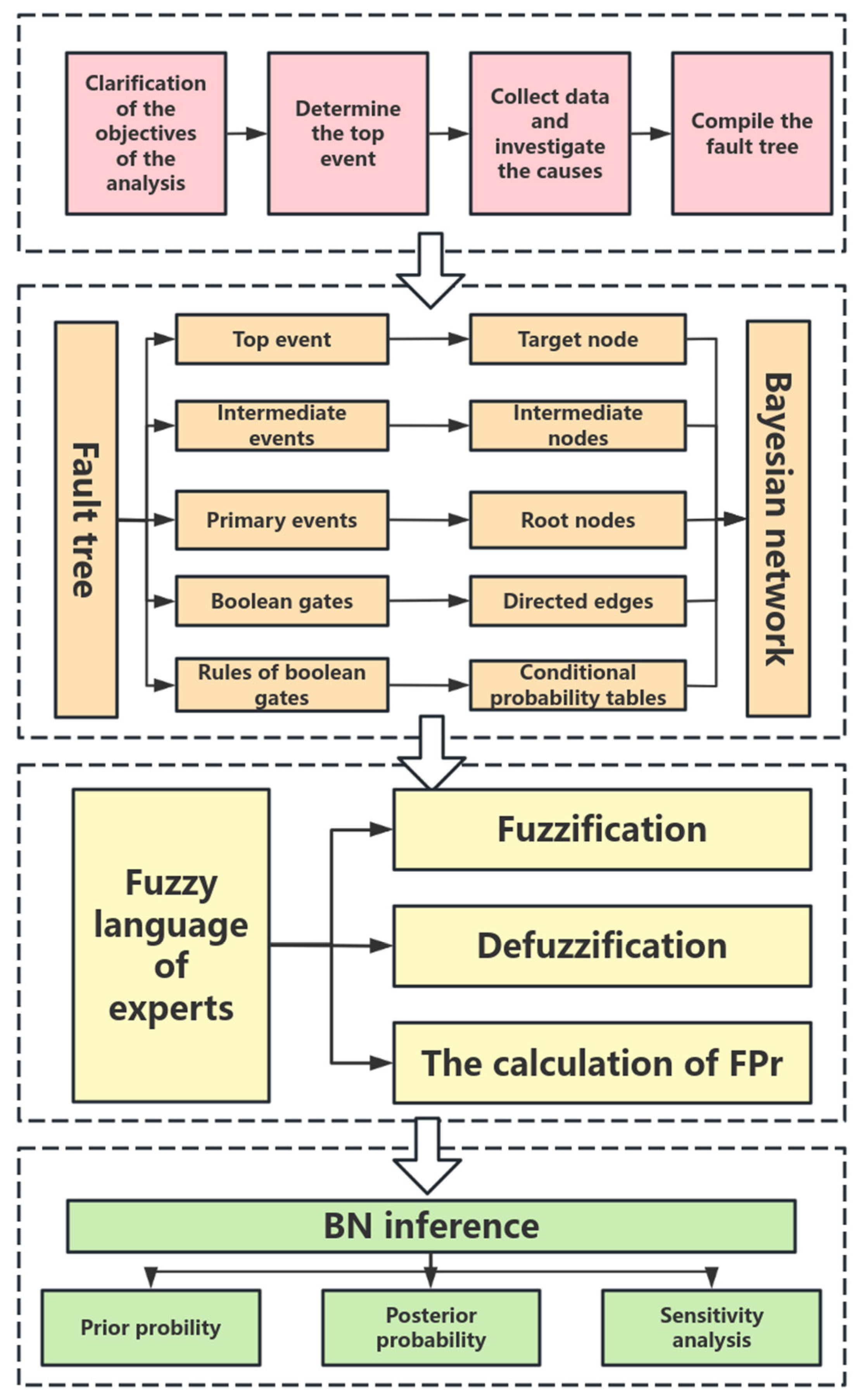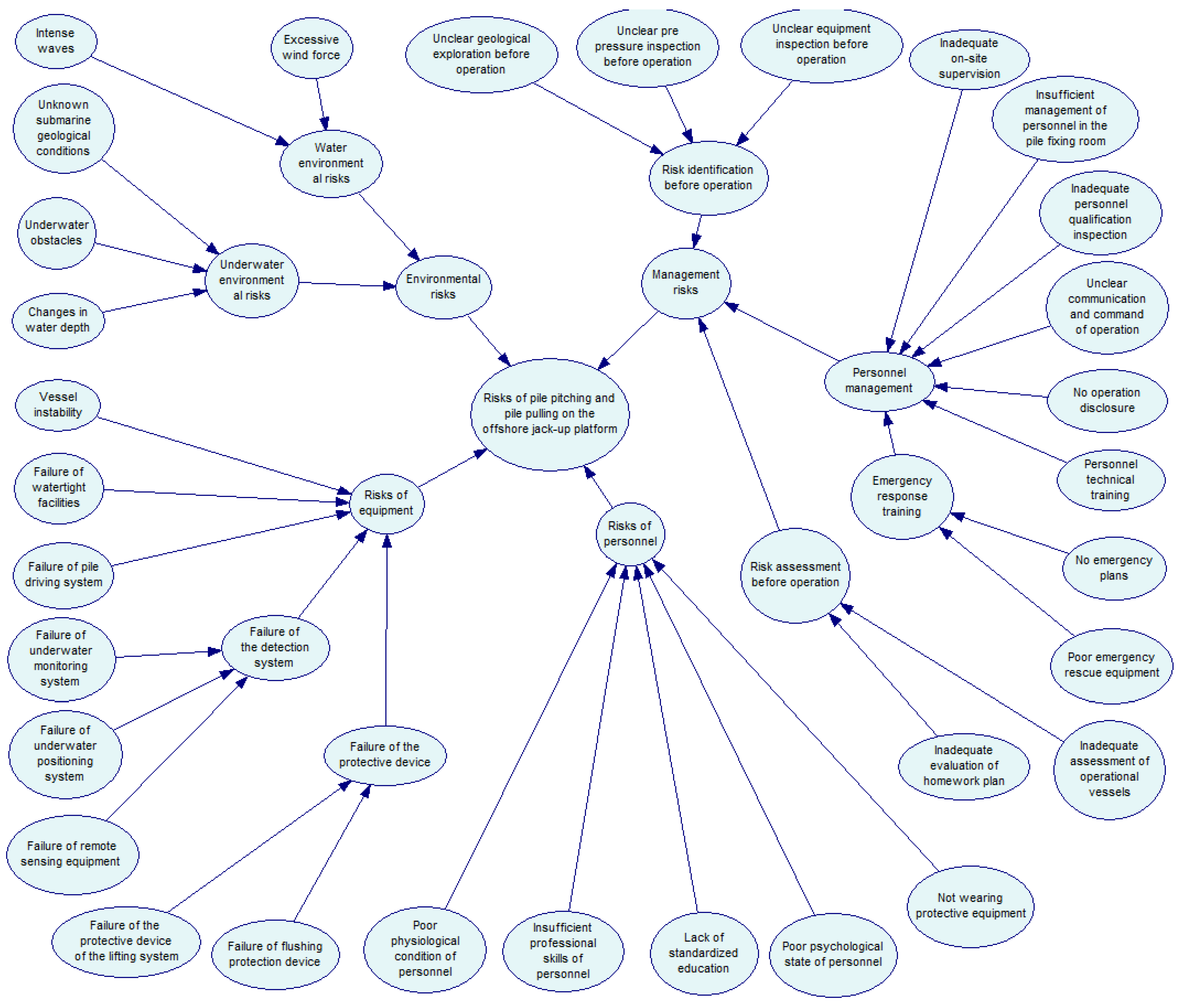



Risk Analysis of Pile Pitching and Pulling on Offshore Wind Power Jack-Up Platforms Based on a Fault Tree and Fuzzy Bayesian Network

 , ,
, ,
Abstract
1. Introduction
2. Methods
2.1. Fault Tree Analysis (FTA)
2.2. Bayesian Network (BN)
2.3. Fuzzy Bayesian Network (FBN)
2.3.1. Capturing Possibilities from Expert Judgment
2.3.2. Fuzzification
2.3.3. Defuzzification
2.3.4. The Calculation of FPr
3. Establishment of a Model for Pile Pitching and Pulling on the Offshore Jack-Up Platform—Results
3.1. Establishment of the Fault Tree
3.2. Mapping Fault Tree to Bayesian Model
4. Quantitative Risk Analysis Based on Bayesian Networks
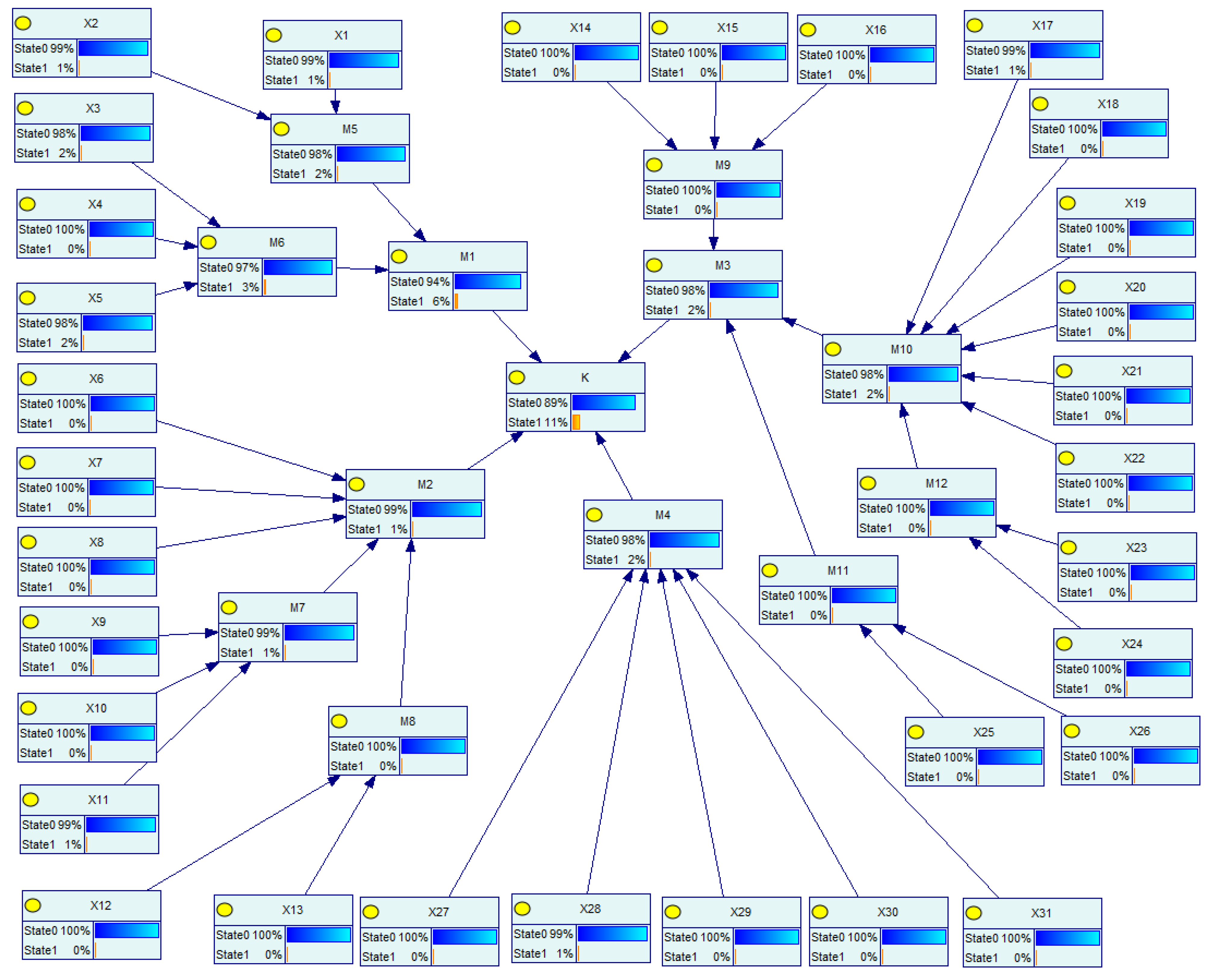
4.1. Information Transmission from Fault Tree to Bayesian Network
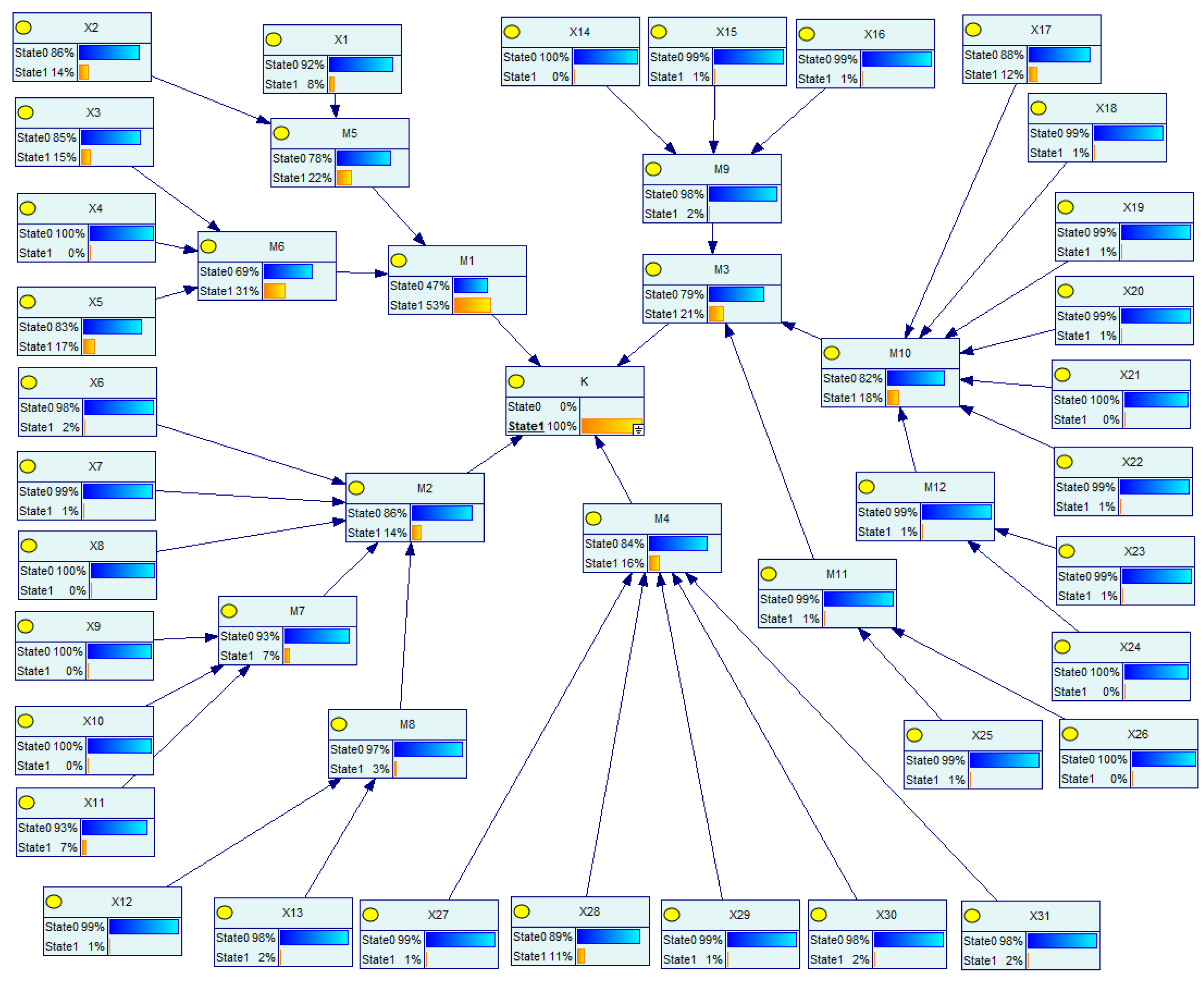
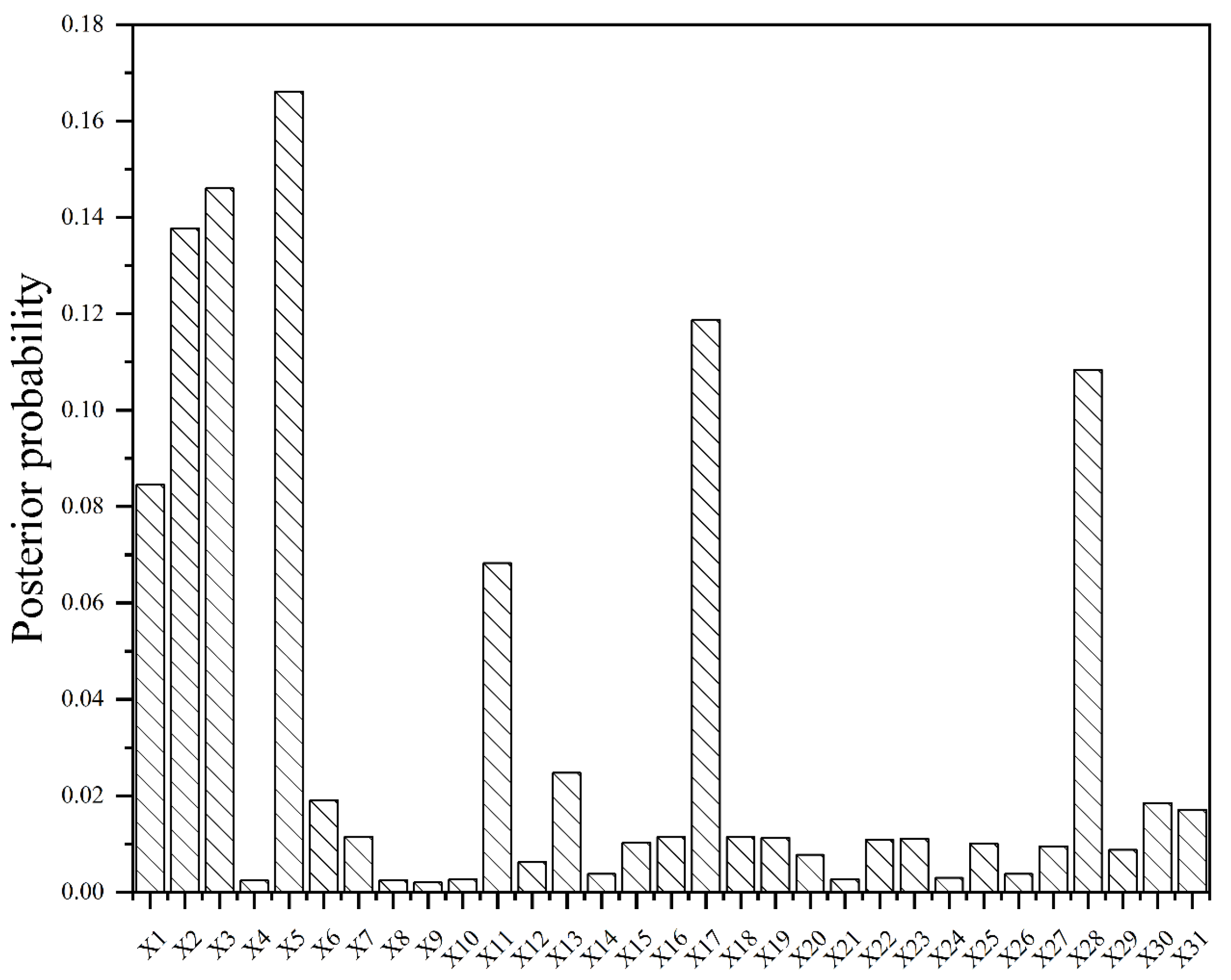
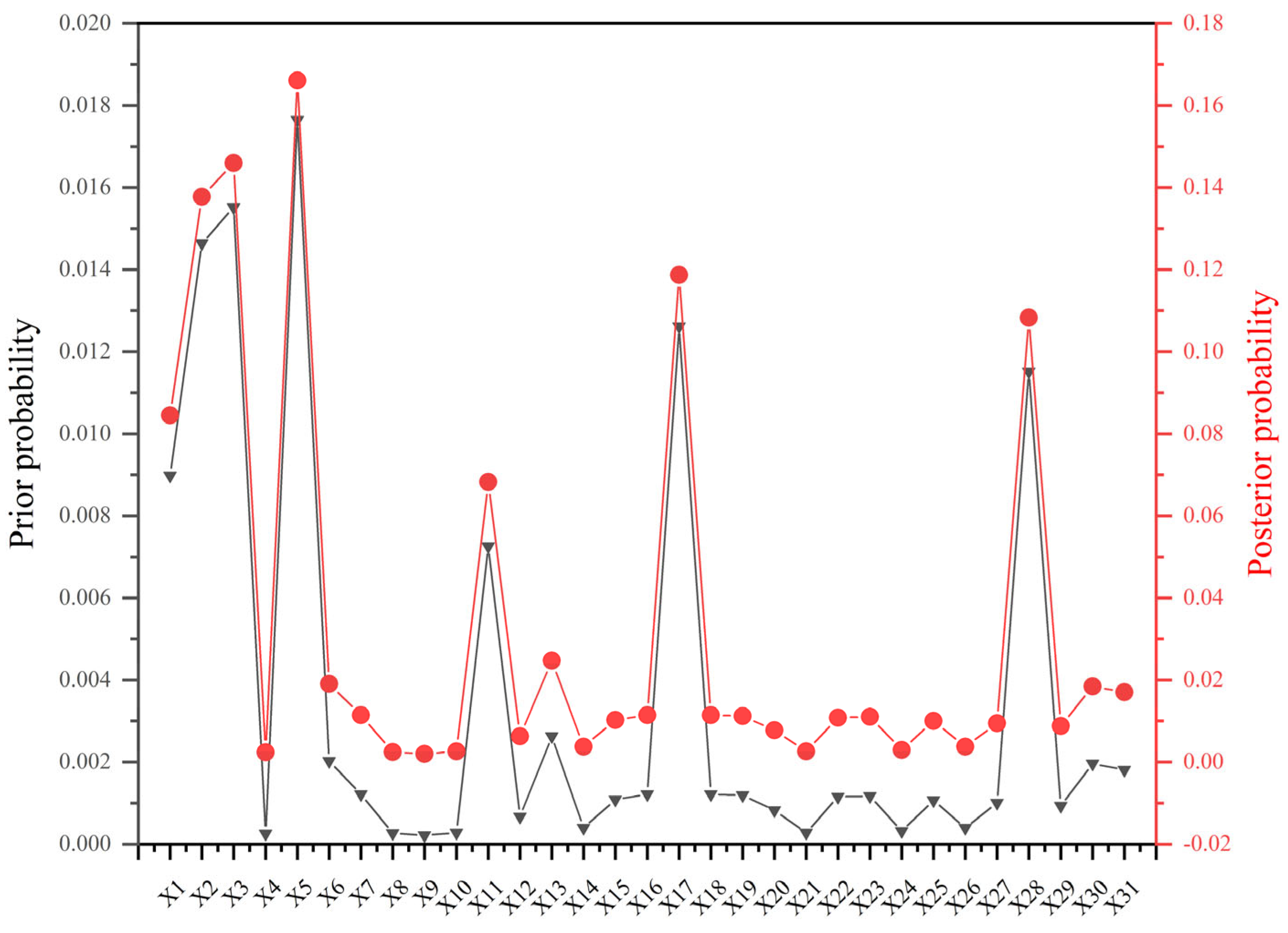
4.2. Probability Update and Sensitivity Analysis
5. Discussion
- (1)
- High-precision underwater terrain and obstacle detection (such as multi-beam sonar, side-scan sonar) should be conducted before the operation. Known obstacles should be removed or marked, pile positions should be adjusted to avoid risk areas, if necessary, real-time monitoring systems should be installed, and changes in pile leg insertion resistance during the operation should be dynamically monitored.
- (2)
- The sensitivity and reliability of safety devices should be regularly verified, mandatory maintenance cycles should be established, redundant design (such as dual-channel sensors) should be adopted to ensure that single-point failures do not affect overall safety. Functional testing should be conducted before operation, and system status should be monitored in real time during operation.
- (3)
- Pre-pressure standards should be established based on the seabed geological report and dynamically adjusted in combination with on-site testing. Pressure sensors should be installed to monitor the pre-pressure values in real time and provide feedback to the control system. Operators need to receive professional training on pre-pressure parameter calculation and adjustment.
- (4)
- A dual-track training system of “theory+practice” should be implemented, covering equipment principles, operating procedures, and emergency plans, with regular retraining and assessment to ensure that personnel qualifications and skills continue to meet standards. Simulator training should be introduced to enhance operational proficiency under complex working conditions.
- (5)
- Before operation, stability checks should be conducted on vessels, the distribution of ballast water should be optimized, and inclinometers and anemometers should be installed to monitor the vessel’s attitude and external loads in real-time. Operations in adverse sea conditions should be suspended, and personnel should be evacuated to a safe area if necessary.
- (6)
- Detailed geological surveys (such as drilling sampling and in situ testing) should be conducted before operation, a geological model should be established, the design parameters of the pile legs should be dynamically adjusted based on historical data and empirical formulas, and pile shoe optimization designs (such as increasing the area and friction surface) should be adopted for complex geological conditions.
- (7)
- A dedicated safety supervision position should be established, on-site supervision should be implemented throughout the entire process, an AI video surveillance system should be introduced to automatically identify violations and issue alarms, a “dual post confirmation” mechanism should be established, and two or more personnel should be required to review key operations.
6. Conclusions
Author Contributions
Funding
Data Availability Statement
Conflicts of Interest
Abbreviations
| FTA | Fault Tree Analysis |
| FBN | Fuzzy Bayesian Network |
| BN | Bayesian Network |
| CM | Centroid Method |
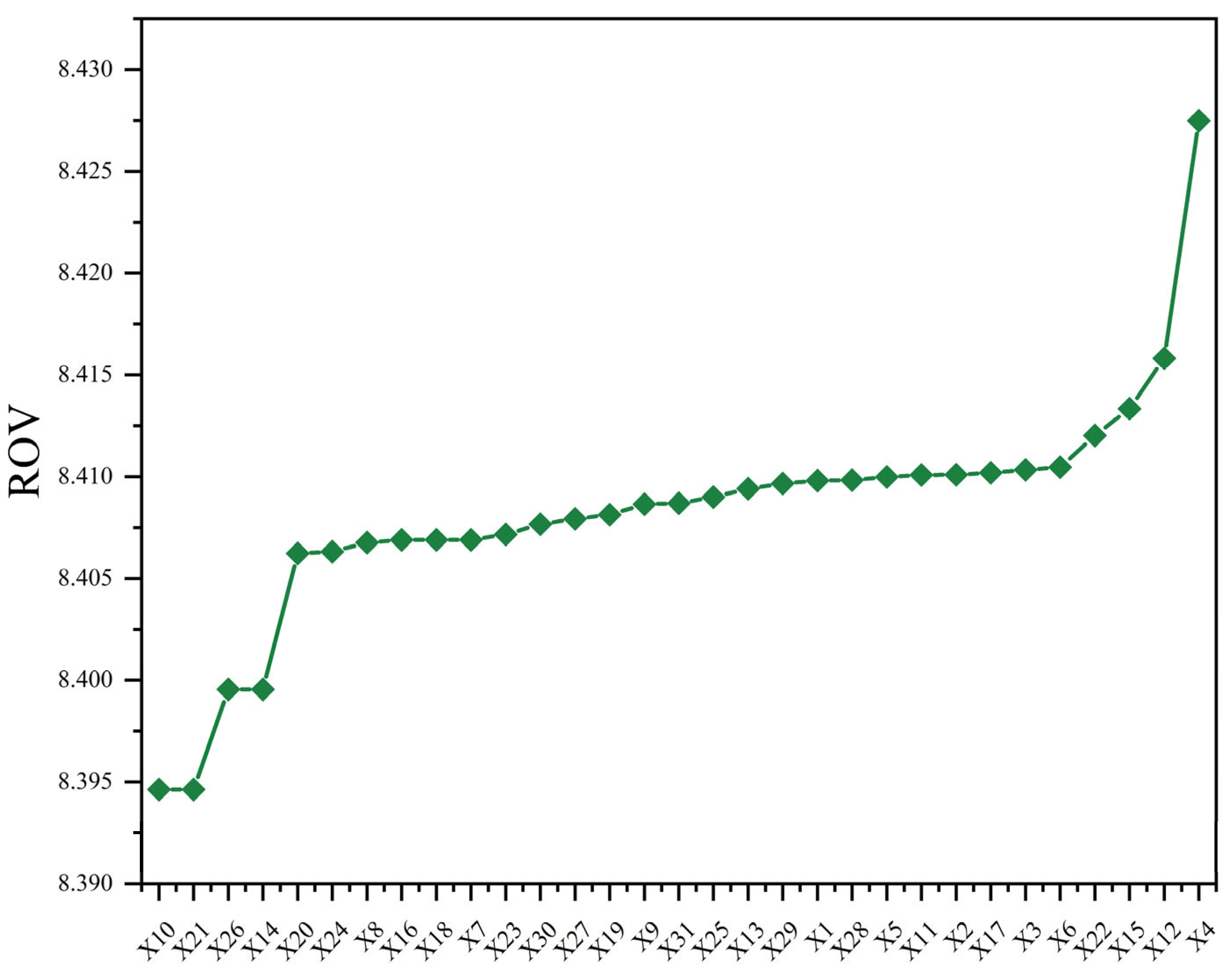
| ROV | Rate of Variation |
| VH | Very High |
| H | High |
| M | Medium |
| L | Low |
| VL | Very Low |
| FPr | Fuzzy Probability |
| DAG | Directed Acyclic Graph |
| CPD | Conditional Probability Distribution |
| FMEA | Fault Mode and Effect Analysis |
| STAMP | Systems-Theoretic Accident Model and Processes |
| CREAM | Cognitive Reliability and Error Analysis Method |
| AHP | Analytic Hierarchy Process |
References
- Wang, J.; Huang, X.; Mai, M.; Fang, S.; Zhang, Q.; Huang, H.; Yang, D. Enhancing maritime safety in offshore wind power engineering: A Holistic approach to accident cause analysis, barrier design, and mitigation strategies—HFACS + Bowtie + C. Ocean Eng. 2025, 316, 119964. [Google Scholar]
- Chen, Y.; Lin, H. Overview of the development of offshore wind power generation in China. Sustain. Energy Technol. Assess. 2022, 53, 102766. [Google Scholar] [CrossRef]
- Ji, J.; Chi, Y.; Yin, X. The blue treasure of hydrogen energy: A research of offshore wind power industry policy in China. Int. J. Hydrogen Energy 2024, 62, 99–108. [Google Scholar] [CrossRef]
- Hou, G.; Xu, K.; Lian, J. A review on recent risk assessment methodologies of offshore wind turbine foundations. Ocean Eng. 2022, 264, 112469. [Google Scholar] [CrossRef]
- Zhai, J.; Yin, Q. Environmental parameter design for jack-up platforms based on FEM-BPNN-JPA coupled approach. Ocean Eng. 2024, 291, 116475. [Google Scholar] [CrossRef]
- Ahmed, K.S.; Keng, A.K.; Ghee, K.C. Stress and stiffness analysis of a 7-teeth pinion/rack jacking system of an Offshore jack-up rig. Eng. Fail. Anal. 2020, 115, 104623. [Google Scholar]
- Phuor, T.; Chen, Y.; Yang, Z.; Zhao, C. Load-controlled element-by-element method incorporating skew-boundary condition for soil-structure interactions: Application to punch-through analysis of the 3D jack-up rig. Comput. Geotech. 2025, 180, 107079. [Google Scholar] [CrossRef]
- Yin, Q.; Yang, J.; Xu, G.; Xie, R.; Tyagi, M.; Li, L.; Zhou, X.; Hu, N.; Tong, G.; Fu, C.; et al. Field experimental investigation of punch-through for different operational conditions during the jack-up rig spudcan penetration in sand overlying clay. J. Pet. Sci. Eng. 2020, 195, 107823. [Google Scholar] [CrossRef]
- Yi, J.T.; Pan, Y.T.; Qiu, Z.Z.; Liu, F.; Zhang, X.Y.; Zhang, L. The post-installation consolidation settlement of jack-up spudcan foundations in clayey seabed soils. Comput. Geotech. 2020, 123, 103611. [Google Scholar] [CrossRef]
- Wang, Y.; Cassidy, M.J.; Bienen, B. Numerical pushover analysis of jack-up units in soft clay overlying sand. Ocean Eng. 2022, 258, 111762. [Google Scholar] [CrossRef]
- Cassidy, M.J.; Taylor, P.H.; Eatock Taylor, R.; Houlsby, G. Evaluation of long-term extreme response statistics of jack-up platforms. Ocean Eng. 2002, 29, 1603–1631. [Google Scholar]
- Feng, Z.; Su, X.; Zhang, Q.; Huang, L.; Huang, Y. Probabilistic time-dependent corrosion wastage model for offshore platforms using stepwise Bayesian inference. Ocean Eng. 2025, 327, 121014. [Google Scholar] [CrossRef]
- Gan, L.; Gao, Z.; Zhang, X.; Xu, Y.; Liu, R.W.; Xie, C.; Shu, Y. Graph neural networks enabled accident causation prediction for maritime vessel traffic. Reliab. Eng. Syst. Saf. 2025, 257, 110804. [Google Scholar] [CrossRef]
- Li, H.; Zhou, K.; Zhang, C.; Bashir, M.; Yang, Z. Dynamic evolution of maritime accidents: Comparative analysis through data-driven Bayesian Networks. Ocean Eng. 2024, 303, 117736. [Google Scholar] [CrossRef]
- Ung, S.-T. Evaluation of human error contribution to oil tanker collision using fault tree analysis and modified fuzzy Bayesian Network based CREAM. Ocean Eng. 2019, 179, 159–172. [Google Scholar] [CrossRef]
- Aydin, M.; Akyuz, E.; Bouatras, G. A holistic safety assessment for cargo holds and decks fire & explosion risks under fuzzy Bayesian network approach. Saf. Sci. 2024, 176, 106555. [Google Scholar] [CrossRef]
- Lutfi Tuncel, A.; Bal Besikci, E.; Akyuz, E.; Arslan, O. Safety analysis of fire and explosion (F&E) accidents risk in bulk carrier vessels under fuzzy fault tree approach. Saf. Sci. 2023, 158, 105972. [Google Scholar]
- Xue, J.; Yang, P.; Wang, Z.; Li, Q.; Hu, H. Cause analysis and management strategies for vessel accidents: A Bayesian decision support model. Ocean Eng. 2025, 320, 120291. [Google Scholar] [CrossRef]
- Mahmood, Y.; Chen, J.; Yodo, N.; Huang, Y. Optimizing natural gas pipeline risk assessment using hybrid fuzzy bayesian networks and expert elicitation for effective decision-making strategies. Gas Sci. Eng. 2024, 125, 205283. [Google Scholar] [CrossRef]
- Zhang, X.; Sun, L.; Sun, H.; Guo, Q.; Bai, X. Floating offshore wind turbine reliability analysis based on system grading and dynamic FTA. J. Wind Eng. Ind. Aerodyn. 2016, 154, 21–33. [Google Scholar] [CrossRef]
- Zhang, J.; Kang, J.; Sun, L.; Bai, X. Risk assessment of floating offshore wind turbines based on fuzzy fault tree analysis. Ocean Eng. 2021, 239, 109859. [Google Scholar] [CrossRef]
- Sokukcn, M.; Sakar, C. Risk analysis of collision accidents during underway STS berthing maneuver through integrating fault tree analysis (FTA) into Bayesian network (BN). Appl. Ocean Res. 2022, 126, 103290. [Google Scholar] [CrossRef]
- Guan, W.; Zhang, C.; Dong, C.; Xia, Y. vessel fire and explosion accident statistical analysis based on fault tree and Bayesian network. Fire Saf. J. 2025, 153, 104358. [Google Scholar] [CrossRef]
- Khakzd, N.; Khan, F.; Amyotte, P. Safety analysis in process facilities: Comparison of fault tree and Bayesian network approaches. Reliab. Eng. Syst. Saf. 2011, 96, 925–932. [Google Scholar] [CrossRef]
- Kamak, B.; Aydn, M. Application of fuzzy Bayesian approach on bankruptcy causes for container liner industry. Res. Transp. Bus. Manag. 2022, 43, 100769. [Google Scholar] [CrossRef]
- Tuncel, A.L.; Sezer, S.I.; Elidolu, G.; Uflaz, E.; Akyuz, E.; Arslan, O. A rule-based Bayesian network modelling under evidential reasoning theory for risk analysis of anchoring operation in maritime transportation. Ocean Eng. 2024, 292, 116521. [Google Scholar]
- Jones, B.; Jenkinson, I.; Yang, Z.; Wang, J. The use of Bayesian network modelling for maintenance planning in a manufacturing industry. Reliab. Eng. Syst. Saf. 2010, 95, 267–277. [Google Scholar] [CrossRef]
- Guo, C.; Wu, W. Risk assessment of disconnect operations of MNPP using similarity aggregation method based fuzzy dynamic Bayesian networks model. Ocean Eng. 2023, 285, 115390. [Google Scholar] [CrossRef]
- Guo, X.; Ji, J.; Khan, F.; Ding, L.; Tong, Q. A novel fuzzy dynamic Bayesian network for dynamic risk assessment and uncertainty propagation quantification in uncertainty environment. Saf. Sci. 2021, 141, 105285. [Google Scholar] [CrossRef]
- Ahmed, S.; Li, T.; Huang, S.; Cao, J. Dynamic and quantitative risk assessment of Cruise vessel pod propulsion system failure: An integrated Type-2 Fuzzy-Bayesian approach. Ocean Eng. 2023, 279, 114601. [Google Scholar] [CrossRef]
- Zhang, G.; Thai, V.V.; Yuwn, K.F.; Loh, H.S.; Zhou, Q. Addressing the epistemic uncertainty in maritime accidents modelling using Bayesian network with interval probabilities. Saf. Sci. 2018, 102, 211–225. [Google Scholar] [CrossRef]
- Zhang, P.; Lan, H.-Q.; Yu, M. Reliability evaluation for ventilation system of gas tunnel based on Bayesian network. Tunn. Undergr. Space Technol. 2021, 112, 103882. [Google Scholar] [CrossRef]
- Yang, F.; Li, S.; Wu, X.; Ge, F. Accident causation analysis of metal processing plants based on questionnaire and Bayesian network. J. Saf. Sustain. 2024, 1, 247–256. [Google Scholar] [CrossRef]
- Kaptan, M. Analysis of accidents during vehicle stowage on RO-RO vessels by using Fuzzy Bayesian networks. Ocean Eng. 2022, 260, 111997. [Google Scholar] [CrossRef]
- Saralioglu, S.; Ugurlu, Ö.; Aydn, M.; Vardar, B.; Wang, J. A hybrid model for human-factor analysis of engine-room fires on vessels: HFACS-PV&FFTA. Ocean Eng. 2020, 217, 107992. [Google Scholar]
- Onisawa, T. An approach to human reliability in man-machine systems using error possibility. Fuzzy Sets Syst. 1988, 27, 87–103. [Google Scholar] [CrossRef]
- Chen, P.; Zhang, Z.; Huang, Y.; Dai, L.; Hu, H. Risk assessment of marine accidents with Fuzzy Bayesian Networks and causal analysis. Ocean Coast. Manag. 2022, 228, 106323. [Google Scholar] [CrossRef]
- Li, P.; Wang, Y.; Yang, Z. Risk assessment of maritime autonomous surface vessels collisions using an FTA-FBN model. Ocean Eng. 2024, 309, 118444. [Google Scholar] [CrossRef]
- Montani, S.; Portinale, L.; Bobbio, A.; Codetta-Raiteri, D. Radyban: A tool for reliability analysis of dynamic fault trees through conversion into dynamic Bayesian networks. Reliab. Eng. Syst. Saf. 2008, 93, 922–932. [Google Scholar] [CrossRef]
- Zhang, Z.; Guo, Y.; Wang, D.; Li, G.; Peng, D. A Noisy-OR gate based fuzzy fault tree approach for micro-leakage evaluation of bolt-gasket-flange connection (BGFC). J. Loss Prev. Process Ind. 2021, 71, 104521. [Google Scholar]



| Standards | Classification | Scores |
|---|---|---|
| Professional positions | Professorate Senior Engineer/Professor | 10 |
| Senior Engineer/Associate Professor/Manager | 8 | |
| Engineer | 6 | |
| Years of experience | 20 | 10 |
| 15–19 | 8 | |
| 10–14 | 6 | |
| 6–9 | 4 | |
| Academic degree | Doctor | 10 |
| Master | 8 | |
| Bachelor | 6 | |
| Age | 50 | 8 |
| 40–49 | 6 | |
| 30–39 | 4 |
| Language Terms | Fuzzy Numbers |
|---|---|
| VL | (0.0, 0.0, 0.1, 0.2) |
| L | (0.1, 0.25, 0.25, 0.4) |
| M | (0.3, 0.5, 0.5, 0.7) |
| H | (0.6, 0.75, 0.75, 0.9) |
| VH | (0.8, 0.9, 1.0, 1.0) |
| Symbol | Meaning | Explanation | Symbol | Meaning | Explanation |
|---|---|---|---|---|---|
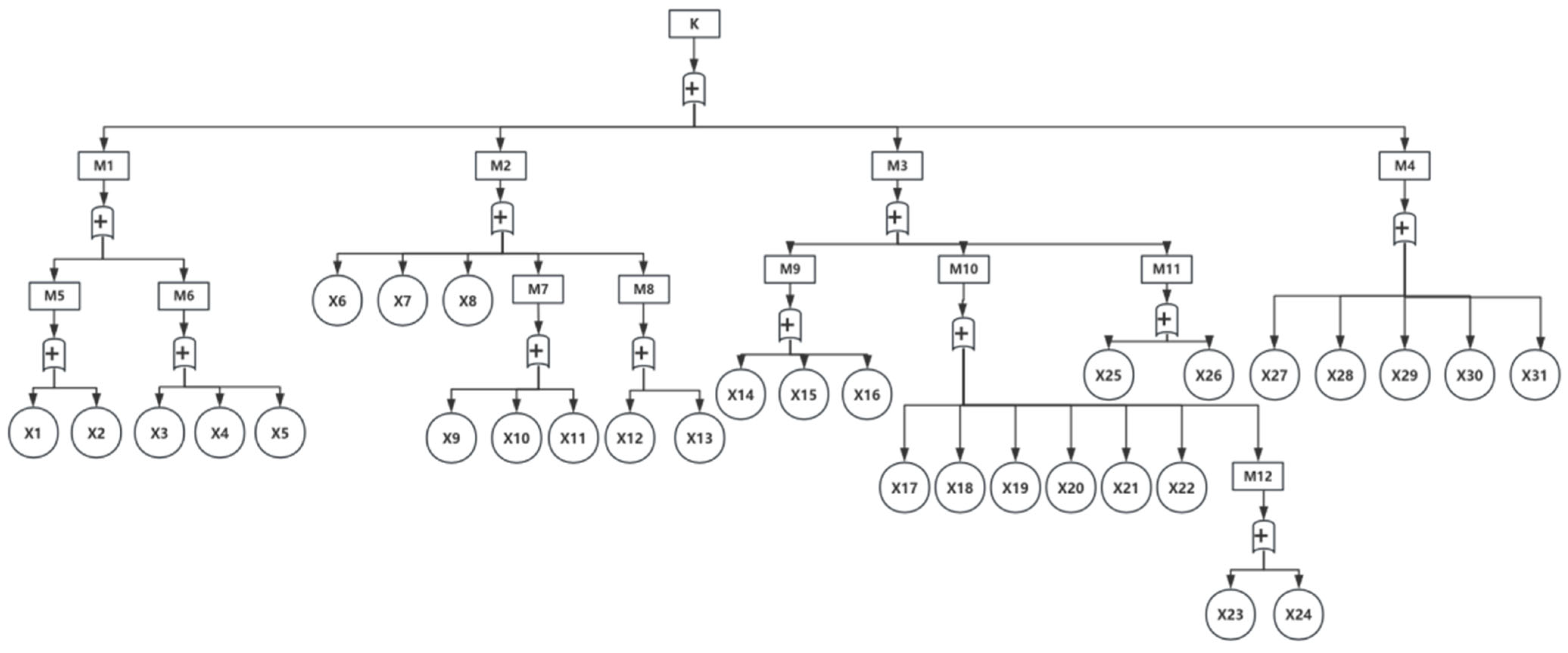
| K | Risks of pile pitching and pulling on the offshore jack-up platform | Potential hazards that may be encountered during the installation, migration, or removing of the platform when its pile legs are inserted or removed from the seabed. | X10 | Failure of underwater positioning system | The failure of the underwater positioning system leads to inaccurate positioning information for each pile leg during vessel lifting. |
| M1 | Environmental risks | An uncertain event caused by natural factors that poses a threat to the operating system. | X11 | Failure of remote sensing equipment | Failure of control and remote sensing equipment (including water meters, load indicators, inclinometers, and hydraulic pressure gauges, etc.). |
| M2 | Risks of equipment | The operational risk directly caused by the failure of equipment. | X12 | Failure of the protective device of the lifting system | Damage or jamming of the pile legs caused by the failure of the safety protection device of the vessel lifting system. |
| M3 | Management risks | Systemic risks caused by management decisions or process defects. | X13 | Failure of flushing protection device | Protecting the soil near the pile foundation to avoid erosion failure. |
| M4 | Risks of personnel | Operational risks caused by personnel behavior or status. | X14 | Unclear geological exploration before operation | Geological survey of the work area has not been conducted, and precise investigation of the strata and geological structures in the work area has not been carried out. |
| M5 | Water environmental risks | The main causes are excessive wind speed, surging waves, and intense waves. | X15 | Unclear pre-pressure inspection before operation | The loading condition of the jack-up platform has not been calculated and checked, and the load on a single pile leg is greater than the maximum jacking load. |
| M6 | Underwater environmental risks | The main underwater environmental risks include unknown seabed geological conditions, obstacles underwater, and changes in water depth. | X16 | Unclear equipment inspection before operation | The pile driving system has not been tested before operation, and the condition of the pile legs and the presence of binding objects have not been checked. |
| M7 | Failure of the detection system | Including underwater monitoring systems, underwater positioning systems, and remote sensing equipment. | X17 | Inadequate on-site supervision | The management personnel did not supervise the entire process of the operation in real-time on site and promptly handle various problems. |
| M8 | Failure of the protective device | Including safety protection devices for the lifting system and erosion protection devices. | X18 | Insufficient management of personnel in the pile fixing room | Unrelated personnel may enter the pile fixing room during platform lifting. |
| M9 | Risk identification before operation | Including geological exploration, pre-pressure inspection, and equipment inspection. | X19 | Inadequate personnel qualification inspection | Personnels do not have health certificates or relevant certificates for pile pitching and pulling. |
| M10 | Personnel management | Including on-site real-time monitoring, personnel management in the pile fixing room, personnel qualification inspection, operation communication and command, emergency response training, operation disclosure, and personnel technical training. | X20 | Unclear communication and command of operation | The lifting personnel did not maintain effective contact information with the responsible on-site personnel. |
| M11 | Risk assessment before operation | Including scheme evaluation and vessel evaluation. | X21 | No operation disclosure | No operation disclosure was conducted on the plan for pile pitching and pulling, risk evaluation, and the condition of the operating vessels to ensure information symmetry. |
| M12 | Emergency response training | Including the existence of emergency plans, insufficient emergency resources, and poor configuration of life-saving devices. | X22 | Personnel technical training | No training was provided to the personnel on pile pitching and pulling, resulting in negligence or inaccurate operation by the personnel. |
| X1 | Excessive wind force | The excessive wind exceeds the wind resistance level of the vessel and the limit of the restoring force arm that can be adjusted in actual operation, resulting in the inability of the vessel to maintain stability and the risk of overturning. | X23 | No emergency plans | Failure to develop a safety emergency plan in advance, including how to respond to piercing risks and personnel safety and evacuation plans, such as closely monitoring weather forecasts and the progress of vessel lifting operations to ensure sufficient time to implement emergency plans before adverse weather conditions occur. |
| X2 | Intense waves | Lifting operations should not be carried out in the condition of intense waves. | X24 | Poor emergency rescue equipment | The operating vessel is not equipped with life-saving equipment to ensure the safety of the personnel in case of risks. |
| X3 | Unknown submarine geological conditions | Leakage or sudden changes in geological exploration work have not been identified, and the existence of weak strata has not been discovered. Blindly pile pitching poses the risk of piercing. | X25 | Inadequate evaluation of homework plan | A suitable and compliant operation plan has not been developed based on the site conditions for the entire process of pre-operation preparation, pile leg lowering, vessel lifting, and pile pulling. |
| X4 | Underwater obstacles | Deformation and sliding of pile shoes caused by the large slope of seabed reefs or strata. | X26 | Inadequate assessment of operational vessels | The necessary data such as deck size, configuration, deck height, deck strength, pile leg size, and pile shoes of the platform have not been evaluated. |
| X5 | Changes in water depth | Large changes in tides affect the draft of vessels, resulting in insufficient buoyancy to support them, and waves have a significant impact on the stability of vessels. | X27 | Poor physiological condition of personnel | Failure to confirm the physical condition of the personnel before operation resulted in operating in unfavorable conditions such as fatigue and drunkenness. |
| X6 | Vessel instability | Vessel is equipped with stabilizing devices such as anti-roll fins and hydraulic controls or not. | X28 | Insufficient professional skills of personnel | The main personnel did not obtain the certificate of pile pitching and pulling or did not meet the technical standards, resulting in the failure of the operation. |
| X7 | Failure of watertight facilities | Defects in the watertight equipment prevent the cabin from maintaining a watertight state. | X29 | Lack of standardized education | Not operating in accordance with the vessel operation manual specifications. |
| X8 | Failure of pile driving system | The vessel system was equipped with a failed pile driving system and cannot be used normally. For vessels without a pile driving system, the pile pulling operation cannot reduce the formation friction resistance through high-pressure water. | X30 | Poor psychological state of personnel | The employees experience persistent negative emotions, mental distress, or impaired cognitive functioning. |
| X9 | Failure of underwater monitoring system | The platform includes an underwater monitoring system that monitors the real-time erosion of sediment near the pile shoes to prevent the occurrence of erosion and emptying. | X31 | Not wearing protective equipment | The safety protection equipment of the personnel was not worn neatly. |
| Expert No. | Degree | Professional Title | Work Experience | Age | Weight |
|---|---|---|---|---|---|
| Expert 1 | Bachelor | Senior Engineer | 15 | 37 | 0.095588 |
| Expert 2 | Master | Engineer | 7 | 33 | 0.073529 |
| Expert 3 | Bachelor | Professorate Senior Engineer | 23 | 45 | 0.117647 |
| Expert 4 | Bachelor | Professorate Senior Engineer | 38 | 63 | 0.125000 |
| Expert 5 | Bachelor | Professorate Senior Engineer | 23 | 56 | 0.125000 |
| Expert 6 | Bachelor | Senior Engineer | 17 | 39 | 0.095588 |
| Expert 7 | Bachelor | Engineer | 12 | 36 | 0.080882 |
| Expert 8 | Master | Senior Engineer | 13 | 39 | 0.088235 |
| Expert 9 | Bachelor | Engineer | 21 | 43 | 0.102941 |
| Expert 10 | Doctor | Senior Engineer | 6 | 36 | 0.095588 |
| Basic Events | Expert 1 | Expert 2 | Expert 3 | Expert 4 | Expert 5 | Expert 6 | Expert 7 | Expert 8 | Expert 9 | Expert 10 |
|---|---|---|---|---|---|---|---|---|---|---|
| X1 | H | H | M | M | M | H | H | M | M | M |
| X2 | H | VH | M | H | H | M | H | M | H | M |
| X3 | VH | H | M | H | M | VH | H | H | M | M |
| X4 | L | VL | L | L | L | VL | VL | L | L | L |
| X5 | H | H | VH | M | H | H | M | H | M | H |
| X6 | M | L | L | M | M | M | L | L | M | L |
| X7 | L | L | L | M | L | M | L | L | M | L |
| X8 | L | L | VL | L | VL | L | L | L | L | L |
| X9 | L | L | L | VL | L | L | L | VL | L | VL |
| X10 | L | L | L | L | VL | L | L | L | L | VL |
| X11 | M | M | M | H | M | H | M | M | M | M |
| X12 | L | L | L | L | L | L | L | L | M | L |
| X13 | M | M | L | M | L | M | M | M | L | M |
| X14 | L | VL | L | L | L | L | L | L | L | L |
| X15 | M | M | L | L | L | M | L | L | L | L |
| X16 | L | L | L | M | L | L | L | L | M | M |
| X17 | H | VH | H | M | H | M | M | M | M | H |
| X18 | L | L | L | L | M | M | L | L | M | L |
| X19 | L | L | M | L | L | L | L | L | M | M |
| X20 | L | M | L | L | L | L | L | L | L | M |
| X21 | L | L | VL | L | L | L | L | L | VL | L |
| X22 | L | M | L | M | L | L | L | L | L | M |
| X23 | L | L | M | L | L | M | L | M | L | L |
| X24 | VL | VL | L | L | L | L | L | L | L | L |
| X25 | L | M | L | L | L | L | L | M | L | M |
| X26 | L | VL | L | L | L | L | L | L | L | L |
| X27 | L | L | L | M | M | L | L | L | L | L |
| X28 | M | H | M | H | VH | M | M | M | M | H |
| X29 | L | L | M | L | L | L | L | L | M | L |
| X30 | L | M | L | M | M | L | L | M | M | L |
| X31 | M | M | M | L | L | L | L | L | M | M |
| Events | Aggregated Fuzzy Numbers | X | FPr | |||
|---|---|---|---|---|---|---|
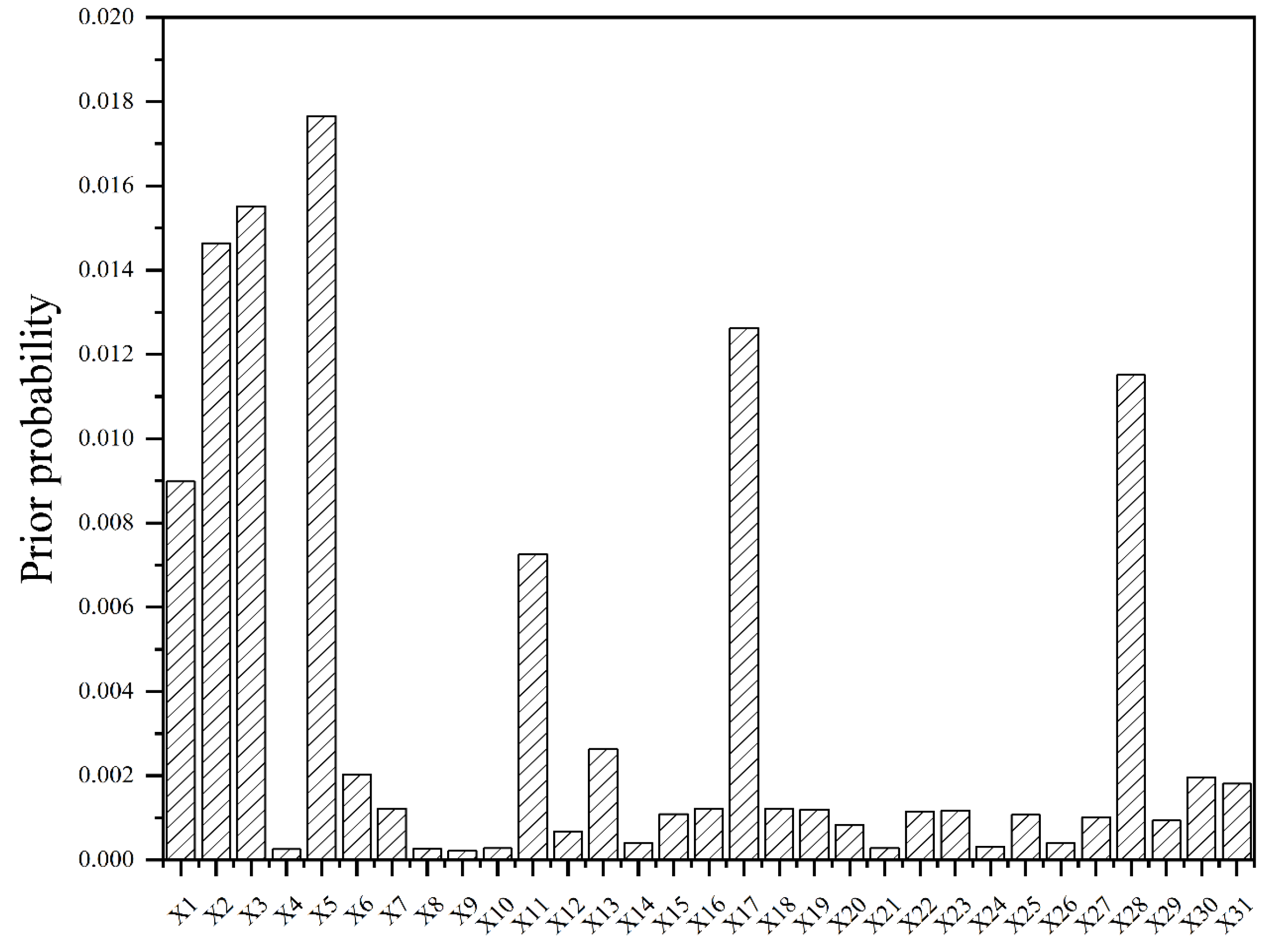
| X1 | 0.404348 | 0.586957 | 0.586957 | 0.769565 | 0.586957 | 0.008981 |
| X2 | 0.496377 | 0.662319 | 0.670290 | 0.828261 | 0.663679 | 0.014639 |
| X3 | 0.507246 | 0.669565 | 0.688406 | 0.831884 | 0.672878 | 0.015514 |
| X4 | 0.074638 | 0.186594 | 0.211957 | 0.349275 | 0.207372 | 0.000253 |
| X5 | 0.531884 | 0.691304 | 0.702899 | 0.850725 | 0.693305 | 0.017650 |
| X6 | 0.207246 | 0.384058 | 0.384058 | 0.560870 | 0.384058 | 0.002026 |
| X7 | 0.163768 | 0.329710 | 0.329710 | 0.495652 | 0.329710 | 0.001216 |
| X8 | 0.076087 | 0.190217 | 0.214130 | 0.352174 | 0.209827 | 0.000263 |
| X9 | 0.068841 | 0.172101 | 0.203261 | 0.337681 | 0.197528 | 0.000213 |
| X10 | 0.078261 | 0.195652 | 0.217391 | 0.356522 | 0.213506 | 0.000279 |
| X11 | 0.365217 | 0.554348 | 0.554348 | 0.743478 | 0.554348 | 0.007252 |
| X12 | 0.120290 | 0.275362 | 0.275362 | 0.430435 | 0.275362 | 0.000666 |
| X13 | 0.231884 | 0.414855 | 0.414855 | 0.597826 | 0.414855 | 0.002627 |
| X14 | 0.092029 | 0.230072 | 0.238043 | 0.384058 | 0.236680 | 0.000398 |
| X15 | 0.155072 | 0.318841 | 0.318841 | 0.482609 | 0.318841 | 0.001088 |
| X16 | 0.163768 | 0.329710 | 0.329710 | 0.495652 | 0.329710 | 0.001216 |
| X17 | 0.468116 | 0.638768 | 0.646739 | 0.809420 | 0.640127 | 0.012616 |
| X18 | 0.163768 | 0.329710 | 0.329710 | 0.495652 | 0.329710 | 0.001216 |
| X19 | 0.162319 | 0.327899 | 0.327899 | 0.493478 | 0.327899 | 0.001194 |
| X20 | 0.134783 | 0.293478 | 0.293478 | 0.452174 | 0.293478 | 0.000824 |
| X21 | 0.078261 | 0.195652 | 0.217391 | 0.356522 | 0.213506 | 0.000279 |
| X22 | 0.159420 | 0.324275 | 0.324275 | 0.489130 | 0.324275 | 0.001151 |
| X23 | 0.160870 | 0.326087 | 0.326087 | 0.491304 | 0.326087 | 0.001172 |
| X24 | 0.082609 | 0.206522 | 0.223913 | 0.365217 | 0.220846 | 0.000314 |
| X25 | 0.153623 | 0.317029 | 0.317029 | 0.480435 | 0.317029 | 0.001067 |
| X26 | 0.092029 | 0.230072 | 0.238043 | 0.384058 | 0.236680 | 0.000398 |
| X27 | 0.149275 | 0.311594 | 0.311594 | 0.473913 | 0.311594 | 0.001007 |
| X28 | 0.450725 | 0.623551 | 0.635870 | 0.796377 | 0.625675 | 0.011511 |
| X29 | 0.143478 | 0.304348 | 0.304348 | 0.465217 | 0.304348 | 0.000931 |
| X30 | 0.204348 | 0.380435 | 0.380435 | 0.556522 | 0.380435 | 0.001962 |
| X31 | 0.197101 | 0.371377 | 0.371377 | 0.545652 | 0.371377 | 0.001810 |
Disclaimer/Publisher’s Note: The statements, opinions and data contained in all publications are solely those of the individual author(s) and contributor(s) and not of MDPI and/or the editor(s). MDPI and/or the editor(s) disclaim responsibility for any injury to people or property resulting from any ideas, methods, instructions or products referred to in the content. |
© 2025 by the authors. Licensee MDPI, Basel, Switzerland. This article is an open access article distributed under the terms and conditions of the Creative Commons Attribution (CC BY) license (https://creativecommons.org/licenses/by/4.0/).
Share and Cite
Xu, H.; Zeng, J.; Xi, L.; Huang, H.; Zhang, Q.; Yang, D.; Wang, R.; Zhang, C.; Li, Z.; Tian, X. Risk Analysis of Pile Pitching and Pulling on Offshore Wind Power Jack-Up Platforms Based on a Fault Tree and Fuzzy Bayesian Network. Energies 2025, 18, 4954. https://doi.org/10.3390/en18184954
Xu H, Zeng J, Xi L, Huang H, Zhang Q, Yang D, Wang R, Zhang C, Li Z, Tian X. Risk Analysis of Pile Pitching and Pulling on Offshore Wind Power Jack-Up Platforms Based on a Fault Tree and Fuzzy Bayesian Network. Energies. 2025; 18(18):4954. https://doi.org/10.3390/en18184954
Chicago/Turabian StyleXu, Hao, Jinqian Zeng, Lingzhi Xi, Hui Huang, Qiang Zhang, Dingding Yang, Rui Wang, Chengyuan Zhang, Zhenming Li, and Xinjiao Tian. 2025. "Risk Analysis of Pile Pitching and Pulling on Offshore Wind Power Jack-Up Platforms Based on a Fault Tree and Fuzzy Bayesian Network" Energies 18, no. 18: 4954. https://doi.org/10.3390/en18184954
APA StyleXu, H., Zeng, J., Xi, L., Huang, H., Zhang, Q., Yang, D., Wang, R., Zhang, C., Li, Z., & Tian, X. (2025). Risk Analysis of Pile Pitching and Pulling on Offshore Wind Power Jack-Up Platforms Based on a Fault Tree and Fuzzy Bayesian Network. Energies, 18(18), 4954. https://doi.org/10.3390/en18184954