Article

Multi-Barrier Framework for Assessing Energy Security in European Union Member States (MBEES Approach)


by
Jarosław Brodny
1,*,
Magdalena Tutak
2,* and
Wieslaw Wes Grebski
3
1
Faculty of Organization and Management, Silesian University of Technology, 44-100 Gliwice, Poland
2
Faculty of Mining, Safety Engineering and Industrial Automation, Silesian University of Technology, 44-100 Gliwice, Poland
3
Penn State Hazleton, The Pennsylvania State University, 76 University Drive, Hazleton, PA 18202, USA
*
Authors to whom correspondence should be addressed.
Energies 2025, 18(18), 4905; https://doi.org/10.3390/en18184905
Submission received: 17 August 2025 / Revised: 5 September 2025 / Accepted: 11 September 2025 / Published: 15 September 2025

Abstract

Assessing energy security in the context of sustainable development, as well as the current geopolitical climate, is a highly important, timely, and complex challenge. Addressing this issue, this paper introduces a new multi-barrier methodological approach to evaluation based on the Multi-Barrier Energy Security System (MBEES) model. This model incorporates five barriers (dimensions) influencing energy security. The MBEES model, along with the developed methodology, was applied to assess the energy security of the EU-27 countries for the period of 2014–2023, in line with EU policy objectives such as Fit for 55 and the Green Deal. The Criteria Importance Through Intercriteria Correlation and Entropy methods, combined with the Laplace criterion, were employed to determine the weights of the model’s sub-indicators. This multi-criteria decision-making (MCDM) approach enabled a synthetic overall evaluation of both the general energy security status of the EU-27 countries and the performance of each barrier examined. The study also identified the weakest elements (barriers) within national energy systems that could potentially threaten their stability and resilience. This identification is essential for effective energy risk management and for enhancing the resilience of energy systems against disruptions. Due to its broad scope—covering availability, self-sufficiency, diversification, energy efficiency, energy costs, as well as environmental and social aspects—the study delivered a comprehensive evaluation of energy security in the EU-27 during the examined period. The findings reveal significant spatial and temporal variations in energy security levels among the EU-27 countries. Scandinavian and Western European nations achieved the highest scores, whereas Central, Eastern, and Southern European countries showed lower MBEES index values, reflecting persistent structural, social, and environmental vulnerabilities. The results hold strong potential for practical application, offering guidance for EU policymakers in aligning national strategies with overarching policy frameworks such as REPowerEU and the European Green Deal.

1. Introduction

One of the pillars of economic, social, and political stability in most countries is energy security [1,2,3]. Ensuring energy security means uninterrupted access to affordable, diversified, secure, and sustainable energy sources [4,5,6]. Energy, in the form of electricity, heat, and fuels, is a fundamental resource for the independent functioning of modern economies and societies. Access to energy has a decisive impact on the development of industry, transport, public services (e.g., health care, education), security, and, in general, on the social, economic, and political existence of countries. Disruptions in energy supplies can have catastrophic consequences for the economy, public safety, citizens’ health, and even social cohesion.
Therefore, the contemporary approach to energy security goes beyond the traditional understanding of securing oil or gas supplies [4]. Nowadays, it also refers to a number of issues such as the reliability of transmission infrastructure, the resilience of energy systems to extreme weather events, cyber-attacks and other threats, the adequacy of generation capacity, the financial stability of suppliers, the diversity of the energy mix, and the ability to respond quickly to disruptions and changes in demand [7,8,9]. At the same time, the environmental and social dimensions of energy security are becoming increasingly important. Energy security cannot be achieved at the expense of excessive greenhouse gas emissions or increased energy poverty.
In an era of growing geopolitical instability, particularly in recent years, including trade tensions, armed conflicts, and the politicization of energy issues, access to energy is no longer just an economic issue, but also a strategic one. The energy crisis triggered by Russia’s aggression against Ukraine in 2022 showed how heavily European countries were dependent on fossil fuel imports from a single region [10]. This dependence created a real threat to the security of supply of these raw materials, price stability, and energy sovereignty. These events have made it clear that energy dependence on imports of energy resources in an unstable geopolitical environment can significantly disrupt economic and, subsequently, social foundations. In this context, it is necessary to seek and activate other ways of obtaining energy.
In the EU-27 countries, processes related to the decarbonization of the economy and the transition to renewable fuels have been underway for many years [11,12,13,14]. The geopolitical situation in Eastern Europe has clearly confirmed the validity of these measures and the need to intensify them [15,16]. The energy transition towards climate neutrality and energy independence is becoming an absolute priority for the EU economy [12,17]. However, the disruption of the energy market caused by the consequences of restrictions on energy supplies from Russia, combined with the European Green Deal [18] program that has been promoted and implemented for several years, poses a huge challenge for the EU countries.
It is therefore clear that the EU-27, as one of the world’s largest energy importers [19,20], faces complex and multi-layered challenges. On the one hand, it must systematically increase its energy independence by becoming less reliant on external, often unstable suppliers of energy resources, and on the other hand, it is committed to accelerating the decarbonization of the economy. This process requires profound changes in the energy, industrial, and transport sectors, as well as in the energy mix, which is particularly important in terms of public awareness. In this context, it is very important to ensure a fair transition that does not exacerbate existing socio-economic inequalities and does not place an excessive burden on regions dependent on traditional energy sources.
These challenges are not easy to meet, particularly given the significant differences between EU Member States in terms of energy, infrastructure and economic conditions. These countries differ, among other things, in their level of energy import dependency, the structure of their energy mix (share of renewable energy, nuclear energy, gas, coal), the energy efficiency of their economies and energy intensity, and the level of energy poverty and vulnerability of their citizens to energy price increases.
In this context, it is entirely justified to develop tools for a multidimensional and comparative assessment of the energy security of these countries, taking into account their economic and social conditions.
In scientific literature and strategic analyses, several approaches to assessing energy security can be distinguished, varying in scope, methodology, and selection of indicators. Security is often equated with the level of dependence on energy imports, the stability of supplies, and the availability of strategic reserves [21]. Approaches focusing on energy efficiency, energy costs, or the diversification of sources and directions of supply are also popular [22].
Existing indices, such as the well-known Energy Trilemma Index [23], although useful, often excessively simplify the multidimensional nature of energy security. They insufficiently account for social and environmental aspects, which are of particular importance in the context of current EU policy objectives (e.g., the European Green Deal [18], Fit for 55 [24], REPowerEU [25]). This creates a gap that justifies the development of a more comprehensive tool, capable of identifying systemic weaknesses and supporting EU policymakers in building appropriate strategies and undertaking concrete actions.
In the context of increasingly complex challenges encompassing energy, economic, environmental, and social dimensions, it is justified to develop a novel, integrated framework for energy security assessment. In this study, a new model, the Multi-Barrier Energy Security System (MBEES), is introduced, building upon the multi-barrier approaches traditionally applied in high-risk domains such as nuclear energy, aviation, and the chemical industry [26,27,28,29].
This model is based on the concept of multi-layered system protection, in which security is not the result of a single factor or indicator, but the effect of parallel, independent functional barriers, each of which is designed to minimize a specific class of threats. According to this logic, even if most of the system components are functioning properly, the weakening of one of the barriers can lead to a serious crisis.
Within the MBEES framework, five barriers are distinguished: resource, structural (mix and diversity), economic (affordability), systemic (efficiency and climate), and social and environmental (equity and environment). Together, these barriers reflect the multidimensional nature of energy security, encompassing the physical availability of resources, the resilience and diversification of the energy mix, the affordability of energy supply, the efficiency and sustainability of the system in the context of climate goals, as well as aspects of equity and environmental justice, which directly affect social acceptance and the long-term stability of the energy transition. The resource barrier refers to the physical availability of raw materials and the level of dependence on imports. The structural barrier (mix and diversity) emphasizes the importance of a diversified portfolio of fuels, technologies, and suppliers, which increases system resilience. The economic barrier (affordability) highlights the risks associated with high energy costs for households, industry, and the entire economy. The systemic barrier (efficiency and climate) integrates issues of energy intensity and emission reduction, underlining the link between security and climate goals. Finally, the social and environmental barrier (equity and environment) concerns fairness in access to energy, social acceptance, and environmental protection, which condition the long-term stability of the energy transition.
In energy terms, this means that security assessments should not only take into account the overall level of resilience of the system, but also identify its weakest links, i.e., areas whose dysfunction could threaten the whole. Applying this concept to the analysis of the energy security of the EU-27 countries allows for:
taking into account the structural and socio-economic diversity of Member States,
identifying risk areas that are not visible in approaches that aggregate data into a single indicator,
better support for decision-making processes in the field of energy policy and transformation.
Taking into account the above-mentioned conditions, a study was conducted to assess the level of energy security in the EU-27 countries between 2014–2023, using a proprietary approach based on the MBEES (Multi-Barrier Energy Security System) model. As already indicated, this model allows for the analysis of complex systems by identifying and assessing independent but complementary “security barriers” responsible for key dimensions of energy resilience. The research presented in this paper therefore takes into account the Resource Barrier, Mix & Diversity Barrier, Affordability Barrier, Efficiency & Climate Barrier, and Equity & Environmental Barrier.
In addition to the scientific objective of the study, a utilitarian objective was also formulated. The result of the research is the development of an energy security assessment framework that can be used by both analytical institutions and policy makers to monitor changes, diagnose weaknesses, and plan interventions to increase the resilience of a given energy system at the national and regional (EU-27) levels.
The originality of the approach presented in the thesis stems from several factors:
the application of the concept of multi-barrier safety to the study of the state of the energy sector, which has so far been rare in energy security research,
the construction of a balanced assessment model (MBEES model), which takes into account both the level of the least developed barrier (the “weakest link” principle) and the average resilience of the system, thus avoiding the simplifications typical of classic indices,
the use of a set of indicators that simultaneously take into account energy, economic, social, and environmental aspects, allowing for an adequate assessment of energy security. This is also in line with the objectives of sustainable development and EU energy policy.
The model and methodology developed can serve as a starting point for building a harmonized approach to energy security assessment at the EU level, taking into account both common climate goals and national circumstances. The universality and flexibility of the approach developed also allow for its modification and adaptation to research capabilities or changing realities.

2. Literature Review

This section presents the background literature on the subject matter under study in terms of concepts related to general energy security and its research and assessment.

2.1. The Concept of Energy Security and Theoretical Framework

Energy security is a multidimensional concept that constantly evolves with geopolitical, technological, and socio-environmental changes. In its simplest sense, it refers to ensuring the continuity of energy supply under acceptable economic and technical conditions. According to the definition of the International Energy Agency (IEA), energy security means “the uninterrupted availability of energy sources at an affordable price” [30]. This is the classic approach, focusing on the stability and availability of raw materials.
In the European Union, energy security also encompasses energy independence, diversification of sources, and system resilience to external disruptions, particularly following the gas crisis related to the war in Ukraine and the implementation of the REPowerEU strategy (European Commission, 2022) [25]. In the scientific literature, it is emphasized that energy security combines economic aspects (e.g., cost optimization and continuity of supply) [31], geopolitical aspects (control over energy sources and supply routes) [32], as well as technical aspects (efficiency and resilience of energy infrastructure, e.g., transmission and storage networks) [4].
Contemporary approaches increasingly also include social aspects [13] and environmental aspects [33,34], such as energy justice, energy poverty, and the pursuit of climate neutrality [13,33,34,35]. Growing importance is also attached to systemic and dynamic approaches, in which energy security is seen as a function of the system’s ability to adapt to variable and unpredictable threats [36].
Thus, energy security is inherently multidimensional and cannot be fully understood without reference to broader theoretical perspectives. Two concepts are particularly important here: resilience theory and sustainable development. From the perspective of resilience theory, energy systems should be viewed as complex socio-technical structures that are constantly exposed to shocks and long-term pressures. Resilience is defined as the ability of a system to absorb disruptions, adapt to changing conditions, and transform in such a way as to maintain its essential functions. This approach shifts the focus from static assessment (e.g., adequacy of supply) toward dynamic analysis of systemic vulnerabilities and adaptive capacities.
The concept of sustainable development constitutes the second theoretical foundation. According to the Brundtland Report [37] and the UN Sustainable Development Goals (SDGs) [38], sustainable development integrates economic growth, environmental protection, and social inclusion. In the energy sector, this means that security cannot be achieved solely by ensuring the availability of supply and price stability—it must also respect environmental boundaries and guarantee fair access to energy resources. Thus, energy security and sustainable development are inextricably linked: a secure energy system must be environmentally responsible and socially just, while a sustainable system must be resilient and reliable.
Building on these perspectives, the proposed Multi-Barrier Energy Security System (MBEES) model conceptualizes energy security as the outcome of the combined impact of five independent yet complementary barriers: resource, structural, economic, systemic, and social-environmental. This framework reflects the logic of resilience, recognizing that the weakening of one barrier may undermine the overall stability of the system (the “weakest link” principle). At the same time, it is consistent with the idea of sustainable development, as it integrates environmental protection, social justice, and economic accessibility into the core assessment of energy security.

2.2. Methods for Measuring and Assessing the Level of Energy Security

The assessment of a country’s energy security is an extremely important element of strategic state management. It allows for the identification of threats related to the availability, continuity, and stability of energy supplies. It therefore forms the basis for economic, political, investment, and social decisions, while enabling the assessment of the resilience of the national energy system to disruptions. A thorough analysis of the level of energy security also allows for the identification of weak links within individual dimensions, which in the event of a crisis may constitute a key source of vulnerability for the system. Therefore, a systematic and multidimensional assessment of energy security is an important diagnostic tool and can be an important factor in supporting the development of long-term strategies to ensure the stability and sustainable development of the energy sector and the economy as a whole.
The assessment of the energy security of countries and groups of countries therefore requires an approach that reflects the complexity and multidimensional nature of this situation.
Various approaches and indicators for measuring and assessing the level of energy security have been proposed in the literature and in strategic documents. These methods differ in the scope of the dimensions taken into account [39,40,41], the methodology used (including indicator analysis, integrated models, composite indices) [2,13,31] and the time horizon of the analysis (short-, medium- and long-term) [13,41,42].
What the known approaches to measuring and assessing the level of energy security have in common is the use of partial indicators that measure specific aspects of security, such as the degree of dependence on energy imports [2,6,43,44,45], diversification of energy sources [13,43], the share of renewable energy in the energy mix [6,13,43,44] or the energy intensity of the economy [6,13,43,46].
These methods are based on multidimensional indicator structures with appropriately selected weights, often covering the four basic dimensions of energy security (the so-called “4A”), namely: Availability, Accessibility, Affordability, Acceptability [47]. Some indices additionally integrate environmental and sustainable development issues [13,43], which allows for a more comprehensive and realistic assessment.
Methods using various multidimensional indices are often used to assess energy security, as they allow for a broad analysis of the situation, taking into account its many aspects. Classic examples include the Energy Security Index (ESI), developed by the Asia Pacific Energy Research Centre (APERC) [48], and the Energy Trilemma Index, published by the World Energy Council (WEC) [23]. The Energy Security Index [48] focuses on three main pillars of energy security: energy availability, market stability, and the environmental aspect of resource use. This index allows for the assessment of the energy situation in the Asia-Pacific region, taking into account the specific characteristics of the markets and challenges there. The Energy Trilemma Index [23] on the other hand, presents a balanced model of energy security, analyzing three key dimensions: security of supply, affordability of energy, and environmental aspects. This index is distinguished by its broad approach, integrating both technical and social issues, and enables comparisons at the global level.
The above indicators are complemented by the International Energy Security Risk Index [49], developed by the U.S. Chamber of Commerce’s Institute for 21st Century Energy. It is a complex index aggregated on the basis of 29 sub-indicators, grouped into eight thematic categories, such as energy resources, net imports, energy prices, energy efficiency, emissions, infrastructure investment, technological innovation, and exposure to external factors. The index is calculated for 25 OECD member states and published every two years. It serves as a tool to support the assessment of the situation and the identification of changes and trends not only in the area of energy security, but also in the context of broadly understood economic, environmental, social, foreign and international security policies, both at the regional and global levels.
In addition to the energy security indices mentioned above, aggregated indices and Multi-Criteria Decision Making (MCDM) methods are also frequently used in the literature. An approach to energy security assessment based on these methods also allows for the consideration of various criteria that influence the level of energy security.
An interesting proposal in this regard was presented by Ziemba [42], who used Dynamic Multi-Criteria Decision Making (DMCDM). His model integrates classic and fuzzy MCDM approaches with the International Energy Security Risk Index (IESRI). It enables the assessment of energy security in a dynamic perspective, taking into account past, current, and forecast conditions. The proposed approach uses the Simple Additive Weighting (SAW)/Fuzzy SAW and New Easy Approach to Fuzzy PROMETHEE II (NEAT F-PROMETHEE) methods, which differ in terms of aggregation algorithms and calculation procedures. Despite noticeable differences in the results obtained, both methods indicated a high level of energy security in countries such as New Zealand, Norway, Denmark, and the United States, and a low level of energy security in Ukraine, Thailand, and South Korea. The main cognitive contribution of this work is the development of a framework for the dynamic assessment of energy security that takes into account the variability of criteria weights over time, changes in the set of alternatives being assessed, and the possibility of aggregating results for different time periods. This approach is particularly useful in long-term and predictive analyses.
The measurement and assessment of energy security using MCDM methods was also carried out by Brodny and Tutak [43]. In their study, they focused on assessing the level of energy security of 27 European Union countries in two variants. The first was based on a traditional approach that took into account the availability of affordable energy sources and energy and economic factors. The second variant extended this assessment to include environmental and social factors corresponding to the principles of sustainable development, which was defined as sustainable energy security. Due to the multi-criteria nature of the analysis, multi-criteria decision-making (MCDM) methods were used. The weights of the indicators were determined using the Criteria Importance Through Intercriteria Correlation (CRITIC) and standard deviation (SD) methods, and the Grey Relational Analysis (GRA) and Technique for Order Preference by Similarity to Ideal Solution (TOPSIS) methods were used for evaluation and ranking. The study covered a period of 11 years (2010–2020), and the results indicate that the level of energy security varies depending on the assessment variant, with the highest level of security recorded in the Scandinavian countries regardless of the method used. Bąk et al. [50] also applied the TOPSIS method to construct synthetic measures for assessing the energy security of European Union countries. The authors considered 21 diagnostic features grouped into three areas: energy production and consumption, energy imports and exports, and socio-economic factors. Based on the obtained indicators, the EU member states were classified into typological groups, which made it possible to determine the spatial differentiation of the energy security level and to indicate that it is conditioned both by strictly energy-related parameters and by the overall level of socio-economic development of a given country.
In turn, Zheng et al. [51] conducted an assessment of the energy security of the Baltic states (Estonia, Latvia, and Lithuania) using multi-criteria decision-making (MCDM) methods that do not require subjective expert assessments of the importance of criteria. They used an approach related to Data Envelopment Analysis (DEA) and a modified Simple Additive Weighting (SAW) method for their analysis. The results of this study show that Latvia maintained the highest level of energy security, regardless of the multi-criteria approach used.
Nihal et al. [52] assessed the energy security of BRICS countries using the Energy Security and Environmental Sustainability Index (ESESI). In their study, they applied an MCDA approach, combining the Weighted Product Method (WPM) and Multiplicative Data Envelopment Analysis (MDEA). The ESESI was based on 11 indicators covering, among others, electrification, diversification of the energy mix, the share of RES, CO2 emissions, and dependence on energy imports. The results indicated significant variation in the level of energy security within the BRICS group—the highest index values were recorded for China and Brazil, mainly due to diversification and the increasing share of renewable energy sources, while the lowest was observed in South Africa, where the key problem remains the dominance of coal in the energy mix and low efficiency.
Approaches based on mathematical and statistical methods, such as nonlinear (more precisely, linear in a segmented system) normalization and the multiplier method, are also used to assess energy security. This approach was adopted in [53], which analyzed 27 European Union countries based on data from 2000 to 2021. The model developed takes into account critical components of energy security, such as raw material supply, availability, consumption, compensability, efficiency, security, and innovation. The results of this study indicate that most EU countries have a moderate or sufficient level of energy security.
One paper [54] presents an energy security assessment model based on China’s Sustainable Energy Security (CSES) Index concept. It takes into account five key dimensions: availability, accessibility, affordability, acceptability, and the developability of the energy system. This model uses both existing indicators from the work of Ang et al. [33] and the World Energy Council [55], as well as specific targets contained in Chinese development plans (e.g., Five-Year Plans). Ultimately, the CSES index structure identifies 15 measurable sub-indicators that allow for a comprehensive and systematic assessment of energy security in a sustainable manner.
Another paper [56] proposes a three-step methodology for assessing energy security in the context of global and local challenges, such as the COVID-19 pandemic. This approach takes into account: (1) an analysis of factors weakening energy security, (2) the extension of the set of indicators with five new ones, including the energy poverty indicator and two “decoupling” indicators for RES and energy efficiency, and (3) the use of econometric models (e.g., Butterworth filters) to analyze the impact of energy consumption fluctuations on Ukraine’s energy security level.
In turn, Kozłowska et al. [57] used the AHP (Analytic Hierarchy Process) method to assess the energy security of European Union countries. The study was quantitative in nature and consisted of a multi-criteria analysis of the impact of various indicators on the energy sector of EU countries. The results of the analysis showed that Malta and Estonia rank highest in terms of energy security.
At the same time, more advanced forecasting tools are also being developed, including so-called soft-linked models, which combine different types of planning and operational models to obtain a more comprehensive assessment of the energy system over a long time horizon. An example of this approach is the study by Deane et al. [58], which combined The Integrated MARKAL-EFOM System (TIMES) with the PLEXOS software (for power market simulation) to analyze scenarios for the security of the Italian power system.
A review of published research indicates that energy security is a complex and multidimensional category, and the methods used to assess it have evolved. In the initial phase, they included the use of simple quantitative indicators, and were later expanded to include more complex decision-making models based on multi-criteria decision-making (MCDM) approaches, soft-linked methods, expert systems, and scenario analysis.
The approaches developed so far to measure and assess energy security represent an important contribution to the advancement of analytical methods, but they are burdened with significant limitations. Many indices offer a broader perspective, yet focus mainly on selected pillars of security (e.g., availability, acceptability, affordability), and less often consistently integrate social and environmental aspects. Other approaches, based on MCDM methods (e.g., TOPSIS, AHP, GRA, DEA), provide significant value in multi-criteria evaluation and allow for the use of various aggregation schemes. In the literature, aggregation-based methods generally dominate, which lead to averaging results. Such an approach masks actual vulnerabilities and prevents the identification of the weakest system dimensions, even though these very dimensions constitute the key source of risk in crisis situations.
Despite the wide range of available tools, from quantitative indicators to simulation models and advanced decision-making methods, there is still a lack of an integrated, multi-barrier approach that would systematically capture the interdependencies between independent protective barriers.
This research gap served as the starting point for developing the MBEES model, which combines multidimensional assessment with the logic of systemic protection based on the “weakest link” principle.

2.3. Research Gap

Despite the wide range of available tools, indicator and aggregation models, simulation models, and developed and applied methods, there is a noticeable lack of an approach that would systematically and comprehensively capture the synergies and interactions between independent protection barriers in the energy system.
In particular, there is a noticeable lack of methodology referring to the multi-barrier defense logic known from high-risk sectors such as nuclear energy and aviation. In these areas, system security is based on a layered security architecture that assumes the existence of multiple, independent, and redundant barriers, each of which performs a specific protective function. Transferring this concept to the field of energy security could be an important step towards a more realistic and resilient approach to its assessment. Undoubtedly, in the current reality, energy security can be classified as a high-risk state.
Therefore, it seems reasonable to develop a new analytical approach, such as MBEES (Multi-Barrier Energy Security System)—a model that reflects the complexity of modern energy security in an integrated, hierarchical, and layered manner. The application of this model (MBEES) not only enables the assessment of the security status in selected areas, but also the identification of weak links (bottlenecks). Such an approach can make a significant contribution to the development of an interdisciplinary and pragmatic model for assessing energy security in an era of energy transition and growing geopolitical uncertainty. It also provides an opportunity to broaden knowledge of a holistic and comprehensive approach to energy security and to study its vulnerability.

3. Research Methodology

This section presents the research methodology developed to measure and assess the level of energy security of the EU-27 Member States. The research methods used are also described in detail, taking into account their purpose and scope of application in the presented study.

3.1. Research Methodology Assumptions

The main reason for undertaking the research was the need for an empirical assessment of the level of energy security of the European Union (EU-27) countries between 2014–2023, using a new approach, i.e., the Multi-Barrier Energy Security System MBEES (MBEES) model. Given the growing importance of energy security as a factor determining economic, social, and political stability, it has become necessary to develop an analytical tool that will allow for a multidimensional and integrated comparison of the effectiveness and resilience of the energy systems of individual EU-27 Member States.
Due to its comprehensive nature, taking into account aspects of accessibility, self-sufficiency, diversification, energy efficiency, energy costs, and the environmental and social dimension, this study required the use of an assessment structure based on a logical division into five main barriers (risk areas). This approach not only allows for a synthetic overall assessment, but above for the identification of the weakest elements (barriers) in national energy systems that may pose a potential threat to their stability and resilience. The identification of weak links is crucial in the context of energy risk management and increasing the resilience of energy systems to disruptions.
The proposed MBEES model is also consistent with the European Union’s energy and climate policy, in particular with the objectives of the European Green Deal [18], the “Fit for 55” package [24], the EU Energy Strategy [59], and the principle of a just transition [60]. The European Union is committed to building resilient, low-carbon, and sustainable energy systems, which requires a holistic and data-driven approach. In this context, the MBEES structure, which integrates energy, economic, environmental, and social aspects of energy security, responds to the need for comprehensive diagnostics and support for strategic decisions on energy transition planning.

3.2. Multi-Barrier Energy Security System Model

The MBEES model is based on the concept of a multi-barrier safety approach, known from high-risk systems engineering, e.g., nuclear energy, aviation, or critical infrastructure. In such systems, it is not assumed that risk can be completely eliminated; instead, a multi-layered security system is designed to minimize the likelihood of a disaster through redundancy and independence of barriers.
Applying this to energy security, it is assumed that the security of the system is not determined solely by a single indicator (e.g., the share of renewable energy sources), but by the parallel operation of several independent “safety barriers.”
The proposed model consists of five main barriers (layers, dimensions), each representing a different dimension of energy security (Table 1). Their purpose is to capture the complexity of energy security by addressing physical (resource availability), structural (source diversification), economic (affordability), systemic (efficiency and climate), and socio-environmental (equity and environmental protection) aspects. The selection of these five barriers in the Multi-Barrier Energy Security System (MBEES) model is not accidental but derives both from the logic of a multidimensional understanding of energy security and from consistency with the strategic objectives of the European Union. Within the EU’s climate and energy policy frameworks (including Fit for 55, REPowerEU, and the European Green Deal [18]), emphasis is placed on the need to simultaneously ensure security of supply, energy transition, economic competitiveness, and social justice.
The selection of these barriers in the MBEES model ensures consistency between the theoretical concept of energy security as a multidimensional system and the practical priorities of EU policy. Thanks to this, the model serves not only as a research tool but also as an application-oriented instrument—enabling the identification of “weakest links” and the formulation of recommendations for policymakers regarding targeted actions to strengthen energy resilience.
Each of the adopted barriers is represented by a set of detailed quantitative indicators that can be modified depending on the availability of statistical data or changing geopolitical and technological conditions.
All indicators are first normalized to enable comparison and aggregation. This process ensures a uniform assessment scale (e.g., from 0 to 1), where values closer to 1 indicate the highest level of energy security. Each indicator was normalized according to the following equations:
for stimulants (the more, the better):
x = x x m i n x m a x x m i n
for destimulants (the less, the better):
x = 1 x x m i n x m a x x m i n
Each barrier is assessed on the basis of a weighted average of the indicator values, with the weights being determined by expert methods (involving specialists) or objective methods (based on statistical data analysis, e.g., the entropy or CRITIC method), or by an expert-objective method (a combination of both approaches, in which the initial weights are determined statistically and then verified and calibrated with the participation of experts).
The value of the Partial Barrier Index Bi is calculated as a weighted average:
B i = j = 1 n w j × x i j
To calculate the final MBEES Index, a balanced approach with weakness penalty was used, in line with the weakest link concept used in system resilience assessment. The final value is determined according to the following formula:
M B E E S   I n d e x = α × m i n B i + 1 α × i = 1 n w i × B i
where α denotes the weight assigned to the “weakest link” logic and takes values in the range [0, 1] (α = 0 means that the system assessment is based solely on the arithmetic mean of all barriers, while α = 1 means that the assessment is determined exclusively by the critical barrier), wi are the barrier weights satisfying the condition i = 1 n w i = 1 , n is the number of barriers, B i is the assessment value for each of the five barriers (from B1 to Bn), and m i n B i is the lowest of the assessed barriers (critical barrier).
In the present study, the assessment of energy security was carried out with respect to five barriers. Therefore, the final index value was determined according to the following equation:
M B E E S   I n d e x = 0.5 × m i n B i + 0.5 × 1 5 i = 1 5 B i
where 1 5 i = 1 5 B i is the arithmetic mean of the assessments of all barriers.
In the presented approach, the value of α = 0.5 was adopted, which means an equal division of importance between the “weakest link” logic and the average level of system performance. This choice follows Laplace’s principle of insufficient reason—at the inter-barrier level, there was no objective empirical basis for assigning greater weight to either of these dimensions. This solution ensures neutrality with respect to political preferences, comparability over time and across countries, and preserves the desirable mathematical properties of the constructed index (including monotonicity and confinement to the [0, 1] interval).
This study takes an objective approach to determining the weights of indicators, ensuring repeatability, transparency, and neutrality of the analysis. Due to the fact that different objective methods generate different weighting systems, which often differ significantly from each other, the study uses an approach combining two independent objective methods:
CRITIC (Criteria Importance Through Intercriteria Correlation)—which takes into account variability (dispersion) and correlations between indicators, assigning higher weights to those indicators that are more diverse and less redundant in relation to the others;
Shannon Entropy (information entropy)—which is based on the analysis of the information content of data, assigning higher weights to those indicators that carry more information (i.e., show greater heterogeneity between countries).
To obtain the final weight values, Laplace’s rule was applied, which assumes an equal probability of accuracy for both methods and makes it possible to balance their different methodological approaches. This choice is justified by the lack of empirical grounds for privileging the results of either method, which ensures methodological neutrality. The final weights for each indicator wj were determined according to Formula (6):
w j = w j C R I T I C + w j E n t r o p y 2
This approach allows for limiting the impact of one-sided methodological assumptions and ensures greater stability, transparency, and representativeness of the weights assigned to individual indicators. By combining two independent and complementary objective methods and averaging their results according to Laplace’s criterion, the model achieves methodological neutrality and robustness. This solution significantly minimizes the risk of distortions caused by the dominance or bias of a single analytical method, while at the same time strengthening the credibility, repeatability, and comparability of the obtained results.
For each barrier, the total sum of the weights assigned to the indicators is 1, which ensures:
internal consistency of the assessment,
comparability between barriers,
balance between different dimensions of energy security.
As a result, each barrier is assessed in a balanced manner and the importance of individual indicators is adequately reflected in the synthetic sub-indices. In such a case, following the recommendations presented in earlier studies [13], sensitivity analysis may be omitted, since the use of two independent objective methods and their averaging already provides a sufficiently robust and methodologically neutral weighting system.

3.3. Characteristics of Methods for Determining the Weights of Partial Indicators

3.3.1. Criteria Importance Through Intercriteria Correlation (CRITIC) Method

This method is used to determine objective weights for individual evaluation criteria in multi-criteria decision-making. Its main assumption is that the importance of a given criterion can be determined on the basis of two aspects:
contrast strength, i.e., data variability (measured by standard deviation),
the level of information conflict, i.e., independence from other criteria (measured by correlation).
The greater the variability of a criterion and the lower its correlation with others, the greater its informational value—and therefore the higher weight it should be assigned.
The stages of determining the weights of indicators in the CRITIC method are as follows [63]:
(1)
Creation of a decision matrix;
(2)
Normalization of input data (Equations (1) and (2));
(3)
Calculation of standard deviation (SD) for each criterion:
S D j = i = 1 n x i j x j ¯ 2 n 1
(4)
Calculation of correlation coefficients between criteria (rjk):
r j k = i = 1 n x i j x ¯ j x i k x ¯ k i = 1 n x i j x ¯ j 2 × i = 1 n x i k x ¯ k 2
(5)
Determination of the information capacity (Cj) of each criterion:
C j = S D j i = 1 m 1 r j k
(6)
Calculation of evaluation criteria weights:
w j = C j i = 1 m C j

3.3.2. Entropy Method

The information entropy method is used to objectively determine the weights of evaluation criteria in decision-making problems. Unlike subjective methods (e.g., AHP), it is based solely on input data, without the involvement of experts. It assumes that the greater the diversity of data within a given criterion, the more information that criterion provides, and the greater weight it should have.
The stages of determining weights in the Entropy method are as follows [64,65]:
(1)
Creation of a decision matrix;
(2)
Normalization of input data;
(3)
Calculation of shares (pij). Each normalized value is converted into a share (proportion) of a given variant within a given criterion:
p i j = x i j i = 1 n x i j
(4)
Calculation of entropy for each criterion, which expresses the level of disorder of information in a given criterion. It is calculated according to the following formula:
E j = k i = 1 n p i j × ln p i j
where
k = 1 ln n
where k is normalization coefficient (n is number of variants).
(5)
Determination of the level of diversification (dj):
d j = 1 E j
(6)
Calculation of evaluation criteria weights ( w i j ):
w j = d j j = 1 m d j

3.4. Data

The research was conducted based on publicly available statistical data, mainly from reputable and internationally recognized sources such as Eurostat [66] and OECD [67]. The use of data from these databases ensures a high level of reliability, comparability between countries, and consistency in terms of time and content of the information used. Consequently, there was no need to apply data imputation methods, such as interpolation or exclusion, since all variables used were available as complete time series for all EU-27 countries and all years examined (2014–2023).
The data covers a wide range of indicators related to production, consumption, energy mix, energy prices, energy efficiency, greenhouse gas emissions, as well as social and environmental aspects, enabling a comprehensive assessment of the energy security of the EU-27 countries within the MBEES model.
Table 2 lists the 21 indicators used to assess energy security within the MBEES model. Each of the five identified dimensions (barriers) of security has been linked to appropriate quantitative measures that reflect its systemic function. The indicators were selected based on their diagnostic significance, data availability for the EU-27 countries, and consistency with the European Union’s energy and climate policy objectives. This selection enables a comprehensive and comparative assessment and allows for the identification of weaknesses (critical barriers) in each country’s energy system.

4. Results

This section presents the results of the analysis, which consisted of two stages: measurement and assessment of energy security in the EU countries between 2014–2023 (first stage). All results are presented in accordance with the adopted research methodology and arranged in the order corresponding to the course of the analytical work.

4.1. Analysis of Basic Descriptive Statistics of the Indicators Included in the Study

As part of the preliminary research, statistical analysis was conducted on the average values of the indicators calculated for the period 2014–2023. For each of them, basic descriptive statistics were determined, including the minimum and maximum values, arithmetic mean, median, standard deviation, coefficient of variation, as well as distribution shape measures such as skewness and kurtosis (Table 3). This compilation makes it possible to assess both the level of central tendency and the degree of variability of individual variables, as well as to identify potential deviations from the normal distribution. It also serves as a starting point for further comparative analysis in both spatial (between countries) and temporal (across individual years) dimensions.
The analysis of average indicator values calculated for the period of 2014–2023, which were used in the study, shows significant variation in their levels across EU-27 countries. This variation applies both to variables characterizing energy supply and consumption, as well as to economic, social, and environmental indicators, confirming the necessity of adopting a multidimensional approach in assessing energy security.
These differences are evident both in relation to variables describing energy supply and consumption, and in the areas of affordability, social well-being, and environmental quality. For example, total primary energy supply per capita (average 3.15 toe) showed a wide range of values—from a minimum of 1.44 toe to a maximum of 5.9 toe. High skewness (1.00) and positive kurtosis (0.78) suggest that the distribution is asymmetric, with a predominance of countries at relatively low levels of energy use, while a few countries display significantly higher consumption. This confirms that energy availability and utilization remain highly dependent on the structural and economic conditions of individual states.
The energy import dependency ratio (average 68.7%, ranging from 4.5% to 100%) and the energy sufficiency ratio (average 0.46) highlight two complementary aspects of the resource base of energy security. The relatively low variability of the import dependency ratio (39.40%) compared with the very wide range of self-sufficiency (from 0.05 to 1.0) indicates that the EU includes both fully import-dependent economies and nearly self-sufficient ones. These differences directly affect the degree of vulnerability of Member States to external shocks.
In the case of household electricity prices, the average value was 0.19 euro/kWh, with substantial variation from 0.10 to 0.30 euro/kWh. The high coefficient of variation (30.33%) shows that affordability of energy remains one of the main sources of inequality within the EU-27. This means that even in countries with similar levels of economic development, energy costs for individual consumers can differ significantly, directly influencing social acceptance of the energy transition.
A particularly important indicator is energy poverty, measured by the share of the population unable to maintain adequate home heating. The EU-27 average was 8.92%, with a median of 6.07%. The very high coefficient of variation (88.20%) and considerable skewness (1.48) indicate strong disparities between countries. While in some Member States this problem is marginal, in others it affects a significant share of society, posing a serious threat to social cohesion.
Indicators of energy efficiency highlight further areas of substantial divergence. Energy productivity (average 7.68 euro/kg toe, ranging from 2.44 to 20.7) is characterized by a very high coefficient of variation (51.61%), suggesting that energy is used much more efficiently in some states than in others. In contrast, the energy intensity of the economy (average 115.55 kgoe/1000 PPS) points to significant differences in the degree of energy use relative to economic development.
Regarding the energy mix, the share of renewables averaged 23.08%, with very high variability (from 9.41% to 58.1%) and a coefficient of variation of 51.84%. These data demonstrate that the energy transition is progressing very unevenly across the EU-27: some states have already achieved significant positive results in decarbonization, while others remain at an early stage of this process.
The descriptive statistics confirm that the energy systems of EU-27 countries are characterized by deep internal disparities across resource, economic, efficiency, and socio-environmental dimensions.

4.2. Assessment of the Energy Security of the EU-27 Countries in 2014–2023

In accordance with the methodology developed, the first stage involved assigning weights to the indicators assigned to individual barriers in the MBEES (Multi-Barrier Energy Security System) model. The aim of this work was to determine the relative importance of each indicator in the context of assessing a given barrier. The assigned weight reflected the importance of a given indicator for the functioning and resilience of the energy system. The analysis took into account five key barriers: resource, structural, economic, systemic, and socio-environmental, which, according to the MBEES model, form the basis for a comprehensive assessment of the energy security level of the EU-27 countries.

4.2.1. Determination of Indicator Weights

The weights of the partial indicators assigned to each of the barriers of the MBEES model were determined using two objective analytical methods: the CRITIC method and the information entropy method. The results obtained were combined using the equal probability principle (Laplace criterion). The weights were determined independently for each year in the period of 2013–2023 (Table 4).
Although the weights varied slightly from year to year, an analysis of the coefficients of variation showed that for almost all indicators, their value did not exceed the 10% threshold. The only exception was indicator Premature deaths due to exposure to fine particulate matter (PM2.5, rate), for which the coefficient of variation reached 11.7%. Due to the overall stability of the weight values in the analyzed period and in order to ensure consistency and comparability of results, a decision was made to use the average weight values from 2013–2023 for the study (Table 5). This approach also allows for limiting the impact of short-term fluctuations and individual deviations on the final energy security assessment result.
In the case of the resource barrier, the highest weight was assigned to the energy sufficiency ratio (0.268), which reflects a country’s ability to meet its energy needs from its own sources. A slightly lower, but still high weight was given to the primary energy consumption per capita indicator (0.253), underlining its key importance in assessing the resource potential of the energy system. The remaining indicators—TPES per capita (0.242) and energy imports dependency (0.237)—received similar, moderately lower weights.
In the case of the structural barrier (Mix & Diversity Barrier), the highest weight was given to the share of zero-emission energy sources (0.440), reflecting the growing importance of the energy transition and the implementation of the European Union’s climate policy towards decarbonization. A high weight was also assigned to the HHI energy diversification indicator (0.378), emphasizing the importance of structural diversity in ensuring the resilience of the energy system. The lowest weight was given to the share of emission-intensive energy sources (0.182), which can be interpreted as a result of its negative impact on security and sustainable development.
For the affordability barrier, the highest weight was assigned to GDP per capita (0.416), which indicates the fundamental role of this indicator in assessing the ability of the economy to ensure energy availability for citizens and the economic sector. The second most important factor was household energy prices (0.240), followed by disposable income per capita (0.184), which reflects its role in mitigating the impact of energy costs on social well-being. The lowest weight was assigned to non-household energy prices (0.160), indicating their relatively smaller, though still relevant, influence on energy affordability.
In the case of the Efficiency & Climate Barrier, the highest weight was assigned to energy productivity (0.416), confirming the key role of efficient energy use in the context of system resilience and efficiency. Significant, albeit slightly lower, values were obtained for GHG Intensity of Energy (0.332) and Energy intensity of GDP (0.252), which highlights their importance for assessing the stability of the energy system.
Within the social and environmental barrier (Equity & Environmental Barrier), the highest weight was assigned to the percentage of the population unable to maintain adequate temperature in their homes (0.305), which emphasizes the social justice dimension of energy security. The next important factor was premature deaths due to PM2.5 air pollution (0.238), highlighting the direct impact of environmental quality on public health. GHG emissions per capita (0.174) were assessed as moderate, indicating their significance, although they do not play a dominant role in this dimension. Lower weights were attributed to the share of forested areas (0.150) and the share of renewable energy sources (0.133), which can be explained by their indirect and long-term impact.

4.2.2. Determination of the MBEES Index—A Measure of Energy Security

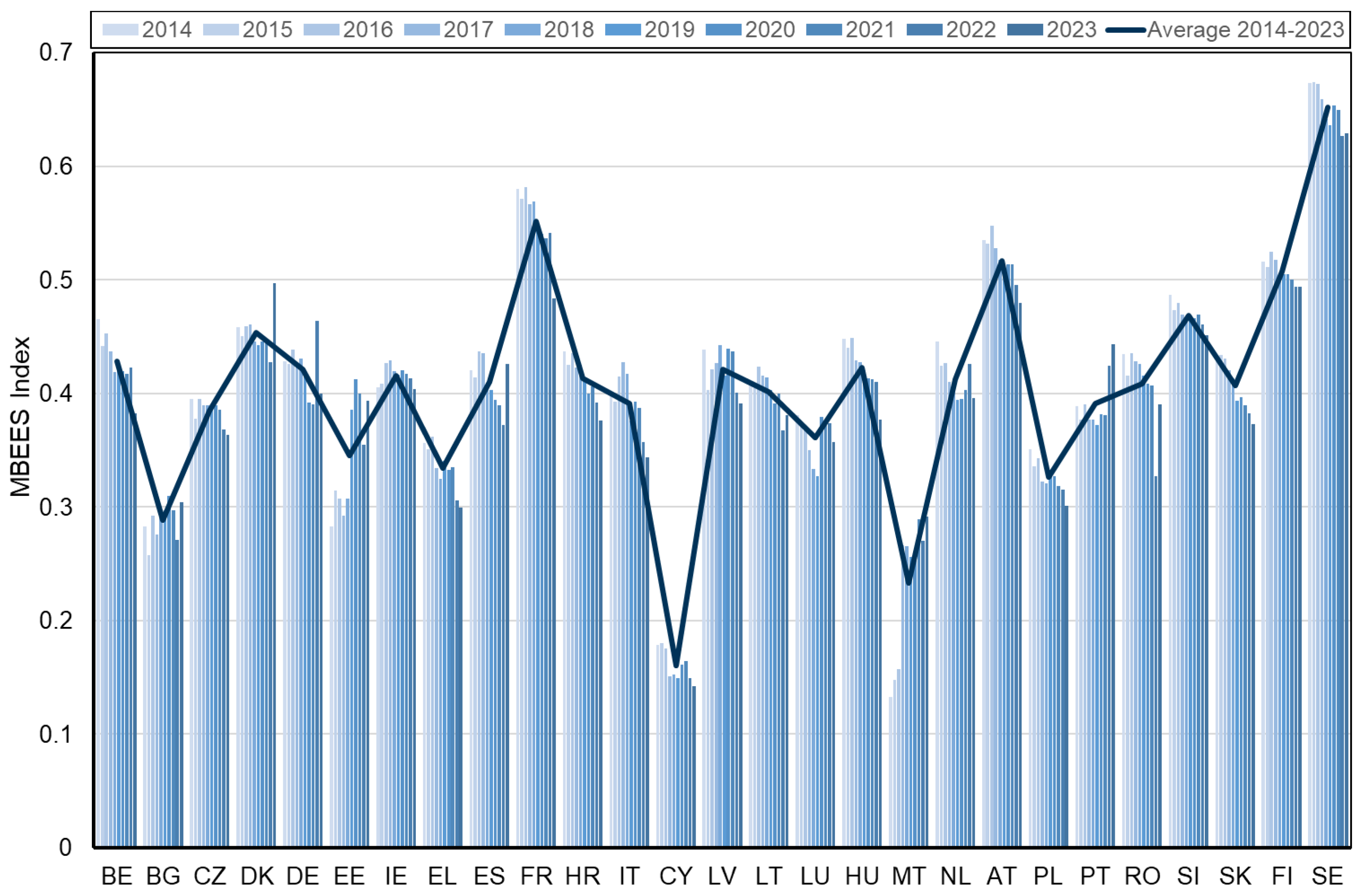
The value of the aggregate MBEES Index for the period of 2014–2023 (Figure 1) was determined on the basis of previously calculated values of the Partial Barrier Index for each barrier (Figure 2, Figure 3, Figure 4 and Figure 5). Their values were determined using the weights assigned to individual sub-indicators and then integrated using a developed aggregation Equation (3), enabling a synthetic assessment of systemic energy security in a multidimensional approach.
The results of the aggregated MBEES Index for European Union member states between 2014–2023 provide synthetic information on the level of systemic energy security. A temporal and comparative analysis of the index values reveals significant differences between the EU-27 countries, both in terms of the level of energy security and its dynamics.
The highest average MBEES Index values in the period under review were achieved by Sweden (0.652), France (0.552), Austria (0.517), and Finland (0.507), confirming the stability and multidimensional balance of their energy policies (Figure 1). The energy systems of these countries are characterized by a high share of zero-emission sources, well-developed infrastructure, low emissions, and a strong social and environmental component.
The group of countries with high MBEES values also included Slovenia (0.469), Denmark (0.454), Hungary (0.423), Latvia (0.422), and Germany (0.421). In the case of Slovenia and Denmark, these results are the outcome of a well-balanced energy mix and high energy efficiency. Germany, despite its advanced energy transition, shows relatively lower stability over time, with a noticeable decline in the index value between 2020 and 2023.
The average index values were recorded in Ireland (0.416), Spain (0.410), Romania (0.409) and Slovakia (0.407), among others. These countries have a moderate level of energy security, often with strong infrastructure and social components, but limited diversification of sources or dependence on imports.
In contrast, the lowest index values in the period under review were recorded for Cyprus (0.160), Malta (0.233), and Bulgaria (0.288). These results point to structural and resource deficits in energy security, particularly in terms of import dependence, low share of zero-emission sources, and socio-economic challenges. Poland (0.327) and Greece (0.334) also rank below the EU-27 average, mainly due to the high emissions of their energy mix and low energy efficiency, despite relatively good results in terms of energy availability.
From a temporal perspective, most countries showed relative stability in the MBEES index between 2014–2019, while after 2020, declines in the index values are visible in some countries. This is due to global turmoil in energy markets, the effects of the COVID-19 pandemic, and geopolitical tensions related to the war in Ukraine. Examples include Belgium, which fell from around 0.466 in 2014 to 0.382 in 2023, and Poland, where the value decreased from 0.351 to 0.301. This indicates that there is significant room for improvement in energy security, particularly in the structural and environmental areas. This is also confirmed by the relatively low share of zero-emission sources and high greenhouse gas emissions per unit of energy consumed.
The MBEES Index analysis points to strong spatial and structural differences in the level of energy security among the EU-27 countries. The highest level of security is found in northern and western European countries, while countries in the southern and eastern parts of the EU-27 face numerous barriers limiting their energy resilience from a systemic perspective.

4.3. Assessment of the Effectiveness of Each Energy Security Barrier

The MBEES Index values were determined by first calculating the values of the Partial Barrier Index for each barrier and for each year covered by the study, taking into account the established weights of the partial indicators.

4.3.1. Resource Barrier

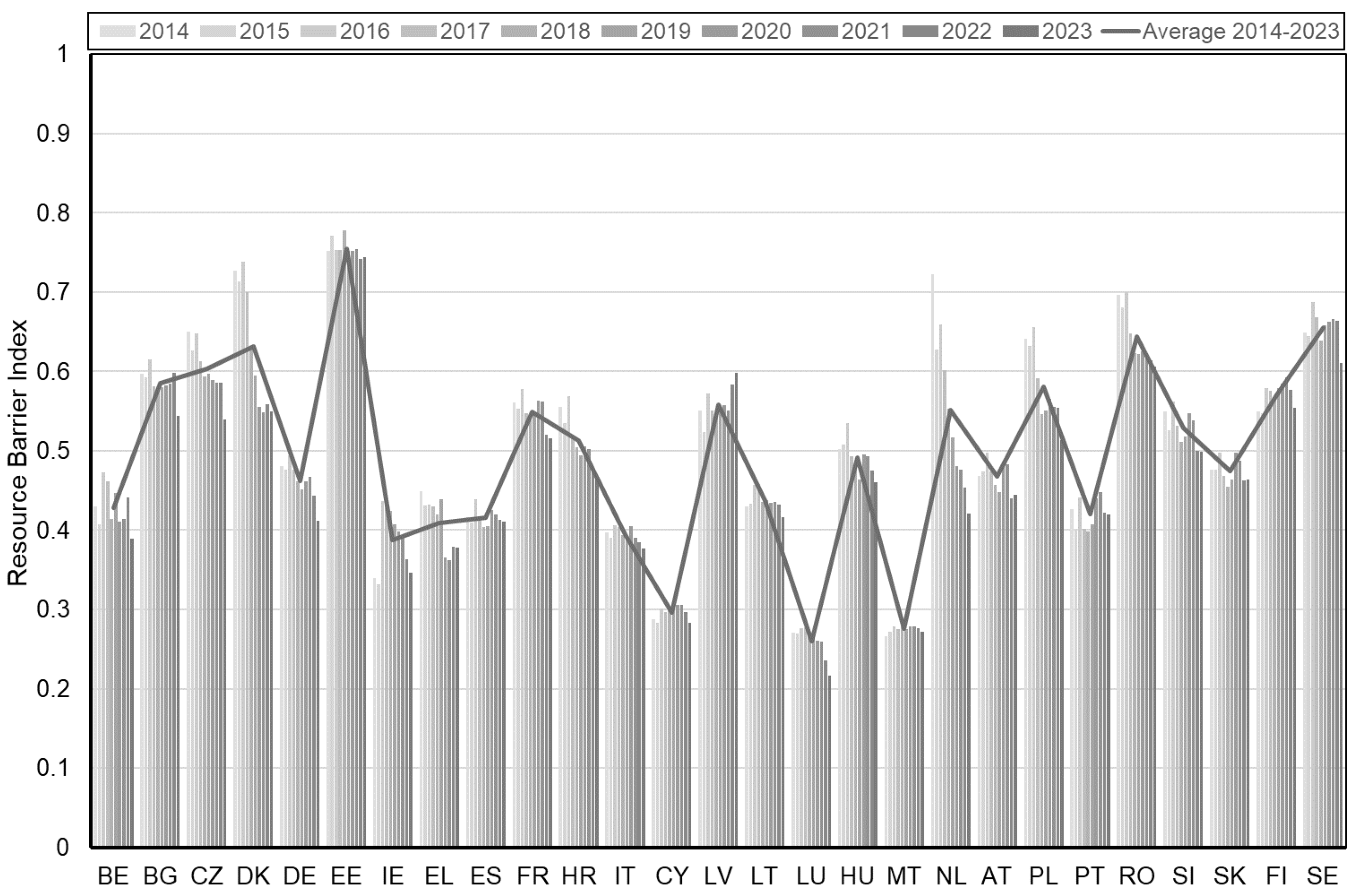
With regard to the Resource Barrier (Figure 2), an analysis of the index value for this barrier in 2014–2023 indicates significant differences in the level of energy security in individual EU-27 Member States.
The highest average values of this index were recorded in Estonia (0.755), Sweden (0.655), Romania (0.643), Denmark (0.632), and the Czech Republic (0.603), which may indicate a relatively high level of energy self-sufficiency, lower dependence on energy imports, and efficient use of available energy resources.
In contrast, the lowest average values of this index were recorded in Luxembourg (0.260), Malta (0.275) and Cyprus (0.296). These countries have significant limitations in terms of energy resource availability, which translates into high dependence on energy imports and limited ability to meet domestic demand on their own. The low index values for Ireland (0.387) and Italy (0.394) confirm similar structural challenges, resulting, among other things, from limited domestic energy resources or a suboptimal primary energy consumption structure.
It is also worth noting the changes in the index value over time. For example, in the case of the Netherlands, there is a noticeable systematic decline in its value from 0.722 in 2014 to 0.421 in 2023, which may indicate a deteriorating resource situation—an increase in energy imports. A similar trend can be observed in Germany and Austria. On the other hand, Estonia shows a stable high level of this index throughout the entire period analyzed, which indicates a continuing favorable resource potential.
Overall, the resource barrier strongly differentiates EU-27 countries in terms of their ability to meet their energy needs independently. The observed index values suggest that Central and Eastern European countries and Scandinavia have an advantage in this respect. Smaller countries and highly urbanized Western European countries have greater resource deficits, which may pose challenges in terms of long-term energy security.

4.3.2. Mix & Diversity Barrier

The assessment of the energy security of European countries also took into account the structural barrier (Mix & Diversity Barrier), the main purpose of which was to analyze the diversity of the energy mix of individual countries and the share of emission-generating and zero-emission sources in the energy balance. Three indicators were used to assess this barrier: the energy diversity index (Herfindahl-Hirschman Index—HHI), the share of emission-emitting energy sources, and the share of zero-emission sources. A high level of diversification and a significant share of low-emission sources are considered key determinants of the energy system’s resilience to market fluctuations and external disruptions.
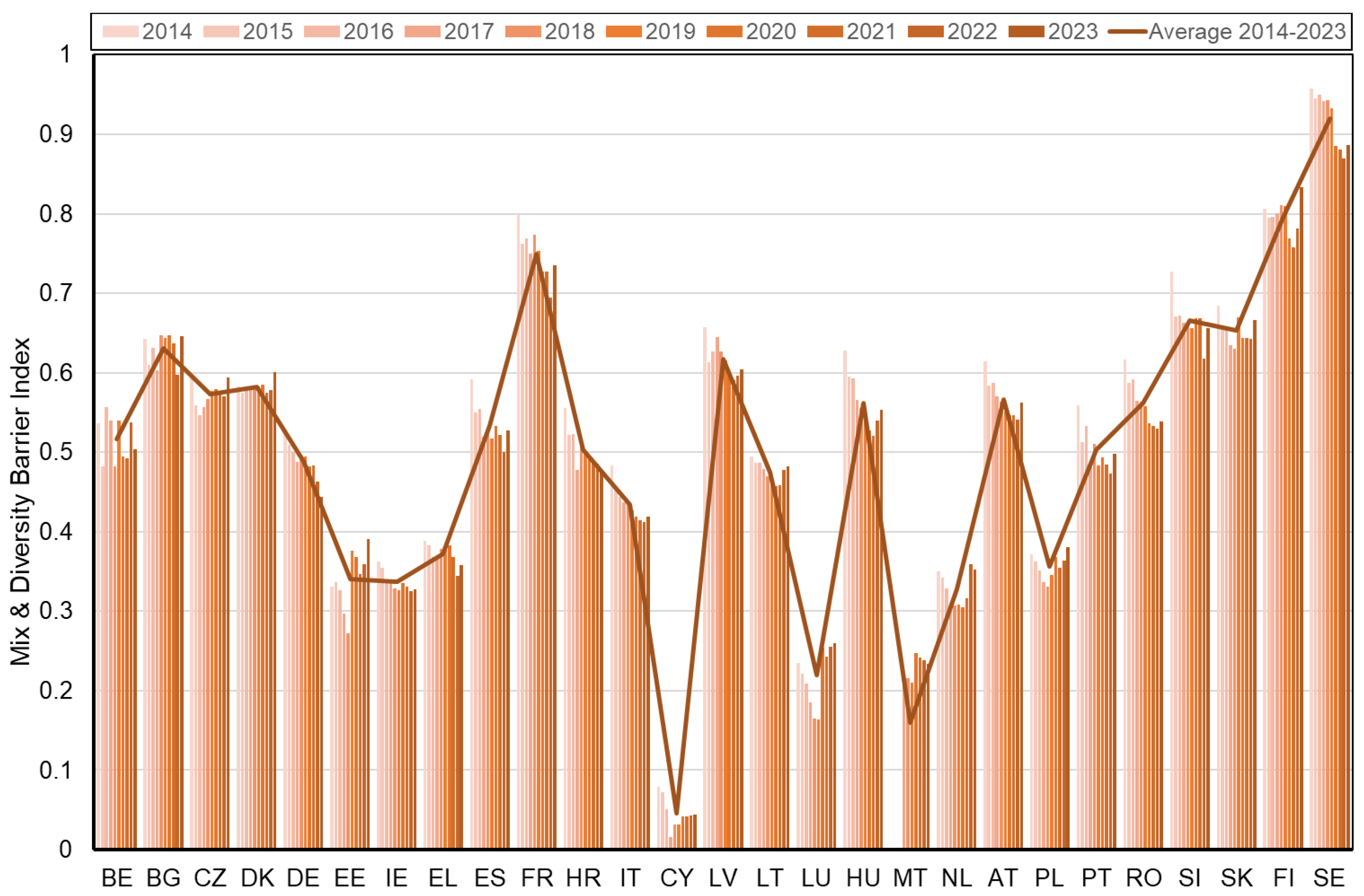
An analysis of the results of this index for 2014–2023 shows significant differences in the level of this barrier among the EU-27 countries (Figure 3).
The highest values of this index are found in Sweden, Finland and France. In Sweden, the average value was as high as 0.919, which indicates a very favorable energy mix structure, dominated by zero-emission sources (hydropower, nuclear and renewable energy), with a high level of diversification of sources. Similarly, in Finland (0.796) and France (0.749) the energy structure was characterized by a high share of nuclear and renewable energy (i.e., zero-emission sources) and relatively low dependence on a single energy carrier, which translates into a strong structural barrier limiting vulnerability to supply crises.
On the other hand, the lowest values were recorded in Cyprus—0.045, Malta—0.160 and Luxembourg—0.219. These countries are characterized by limited diversification of energy sources, with a predominance of fossil fuels. In particular, Cyprus remained almost entirely dependent on emission-intensive fuels for most of the period analyzed, which clearly had a negative impact on its level of structural security.
In contrast, Germany, Italy and Poland achieved moderate average values (0.489, 0.435 and 0.357). Although these countries have taken measures to accelerate the energy transition and increase the share of renewable energy sources, fossil fuels still play an important role in their energy mix, which limits the effectiveness of this barrier.
It is worth noting that for many countries, the structural index values show relative stability over time, suggesting slow but steady progress towards a sustainable energy structure. Examples include Denmark, Ireland and Austria, which recorded relatively stable, medium-high levels of the structural barrier during the period under review.
The results obtained (for the structural barrier) show that the structure of the energy mix remains one of the key elements of energy security. This is because it determines the resilience of the system to crises and its ability to adapt to the energy transition. Significant differences between EU-27 countries point to the need for a tailored approach to energy policy, taking into account local resource and technological conditions.

4.3.3. Affordability Barrier

In the assessment of the energy security of European countries, the third key element was the so-called affordability barrier, which reflects the economic ability of households and businesses to bear the costs associated with electricity consumption. Three indicators were taken into account in this analysis: electricity prices for households (including taxes and charges), prices for non-household consumers, and adjusted disposable household income per capita. It was assumed that a higher level of income in relation to energy prices translates into greater resilience of the system to cost shocks and a lower risk of energy poverty.
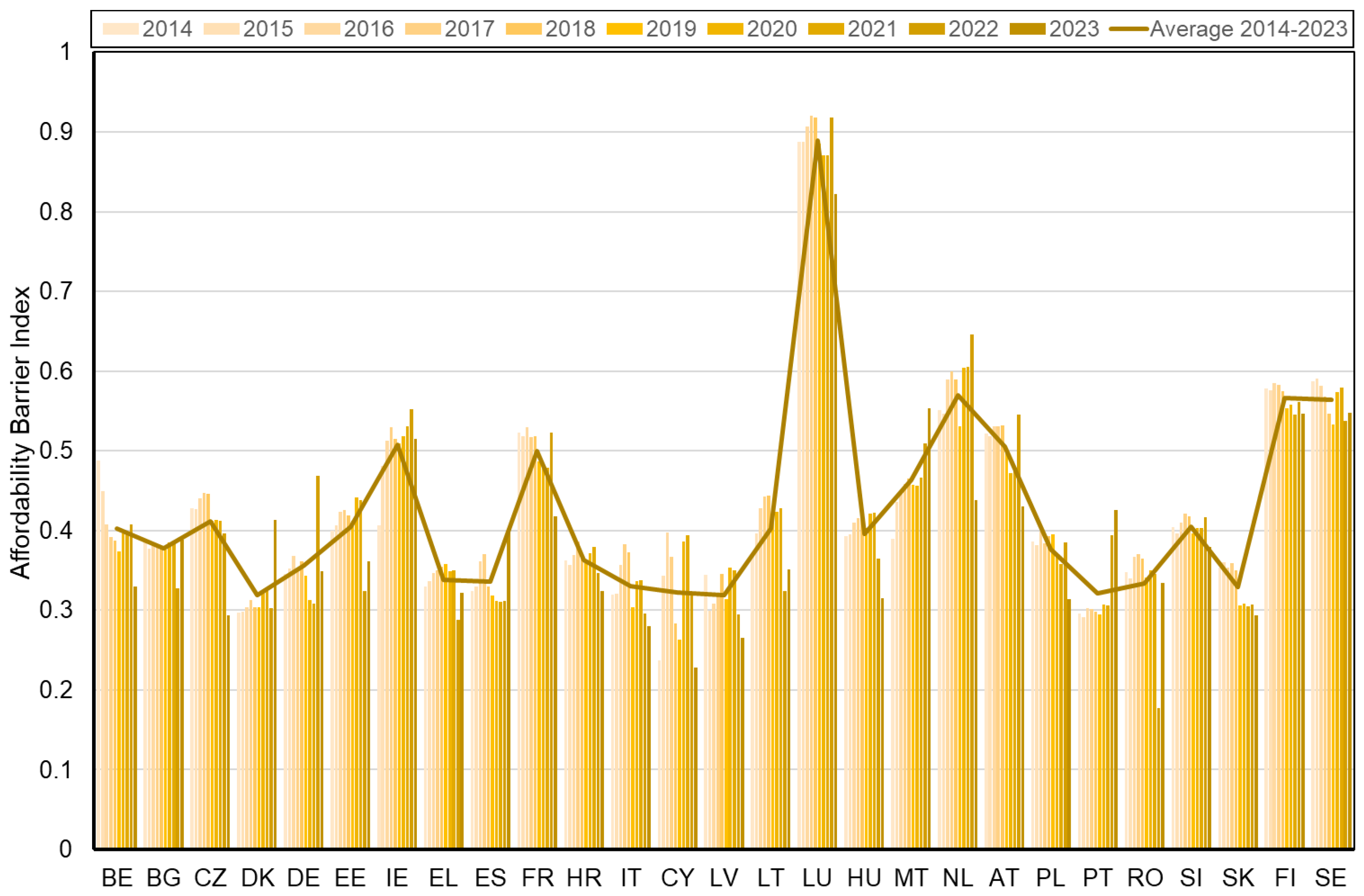
The index values for the energy affordability barrier between 2014–2023 showed significant differences between the EU-27 countries (Figure 4).
The highest annual values, and consequently the highest average values, i.e., the highest level of protection against this barrier, were recorded in Luxembourg (0.889), the Netherlands (0.570), Finland (0.566) and Sweden (0.565), Ireland (0.504) and Austria (0.505). In the case of Luxembourg, high disposable income per capita and relatively favorable electricity prices resulted in an exceptionally strong price barrier. Similarly, the Nordic countries (Sweden and Finland), compared to the rest of Europe, are characterized by relatively low energy prices, which, combined with high income levels, results in an exceptionally strong price accessibility barrier.
On the other hand, the lowest accessibility index values were recorded in countries such as Portugal (0.322), Cyprus (0.322), Romania (0.334), Spain (0.337), and Greece (0.338). In these cases, relatively low disposable incomes combined with moderately high energy prices resulted in reduced resilience of households and the national economy to price fluctuations. The situation in Romania and Greece was particularly significant, where the accessibility barrier remained relatively weak throughout the entire period under review, which may indicate a systemic risk of energy poverty. It is also worth noting the situation in Denmark, where despite high income levels, energy prices—among the highest in the European Union—had a significant impact on the affordability index. This resulted in a relatively low level of this index (the average value for the period of 2014–2023 was 0.319). This indicates that even in countries with high GDP per capita, high energy costs can place a significant burden on consumers and negatively affect the perceived affordability of energy.
It is also worth noting that in many countries, the accessibility index values showed significant variability over time. An example is Malta, where the index rose steadily, reaching a value of 0.553 in 2023, which may indicate a significant improvement in the income situation in relation to energy costs. In contrast, in Germany (0.356), Poland (0.376), and the Czech Republic (0.412), the index values were moderate and relatively stable, suggesting a balanced relationship between income and energy costs, although without clear signs of resilience to potential price shocks.
In Poland, the relatively balanced relationship between income and energy prices in recent years has been mainly influenced by protective measures in the state’s energy policy. This mechanism has effectively mitigated the increase in energy costs for end users, while disposable income has grown relatively steadily. However, their interventionist and temporary nature raises questions about the sustainability of the positive effects and the actual resilience of the system in the longer term.
In the case of Central and Eastern European countries such as Bulgaria (0.177), Slovakia (0.355), and Hungary (0.378), the affordability index remained at relatively low to moderate levels, reflecting limited effectiveness of this barrier. Although energy prices in these countries were among the lowest in Europe, relatively low per capita incomes constrained the real economic accessibility of energy.
The affordability barrier is one of the key dimensions of energy security, as it indicates the ability of societies to adapt to rising energy costs. The results show that, in general, countries with higher levels of prosperity and stable price systems are more resilient to disruptions in affordability, while low-income or high-energy-cost countries are more vulnerable to energy-related socio-economic crises.

4.3.4. Efficiency & Climate Barrier

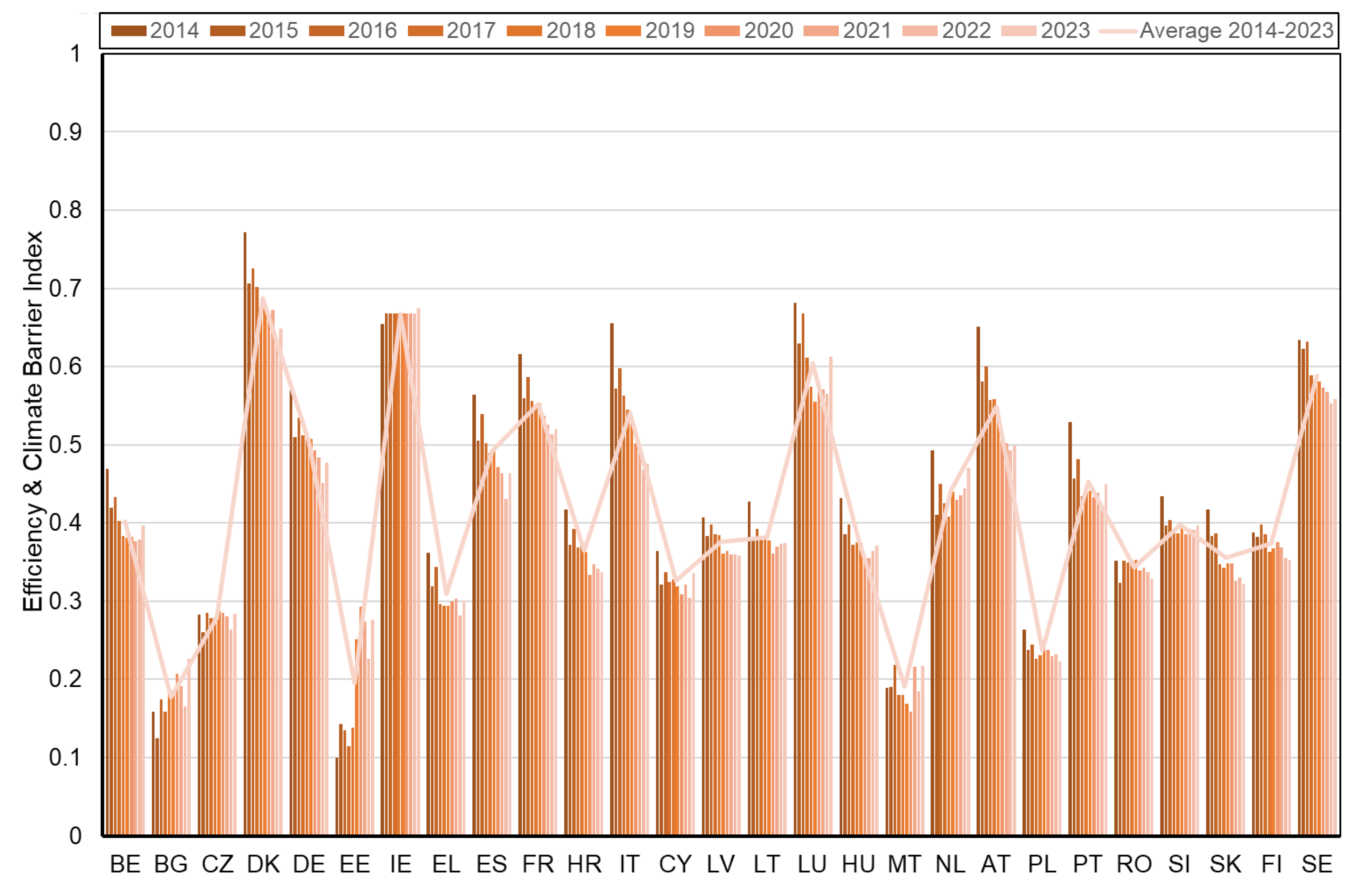
Another element of the energy security assessment was the Efficiency & Climate Barrier, which was constructed based on three indicators of key importance for the sustainable functioning of the energy sector. The assessment therefore took into account energy productivity expressed as value added (EUR) per unit of energy consumption, GDP energy intensity in purchasing power standard, and greenhouse gas emissions per ton of oil equivalent. These indicators enable a comprehensive assessment of the efficiency of energy use in both economic and environmental terms. A high index value indicates favorable relations, i.e., low energy intensity, high energy productivity, and relatively low greenhouse gas emissions per unit of energy.
The results obtained for this barrier also indicate significant differences between the EU-27 countries (Figure 5).
The highest average values of the efficiency and climate index between 2014–2023 were recorded in countries such as Denmark (0.688), Ireland (0.667), Luxembourg (0.604), Sweden (0.589), and France (0.552). These countries are characterized by relatively low emissions from the energy sector, efficient energy use, and high value added per unit of energy consumption, which reflects well-developed economic structures and climate and energy policies. Ireland’s high ranking is due, among other things, to its high value added with relatively low per capita energy consumption [68,69]. Denmark and Sweden, on the other hand, make extensive use of renewable energy sources, resulting in low emissions. Luxembourg, despite its small economy, achieves high scores thanks to its very high GDP per capita and efficient energy use in the industrial and service sectors.
Austria (0.549), Germany (0.505), Spain (0.492), and the Netherlands (0.441) also recorded relatively high index values. These countries are characterized by relatively high energy efficiency and relatively low CO2 emissions. However, remnants of traditional, high-emission energy technologies are still visible in their structures, especially in heavy industry and transport.
The average index values were achieved by Italy (0.541), Portugal (0.453), Slovenia (0.397), Lithuania (0.382), and Finland (0.374), among others. Although they do not achieve the highest values, their results are relatively stable, which indicates ongoing energy transition processes and improvements in efficiency. In the case of Italy, the service-based structure of the economy plays an important role, while Portugal and Finland show a favorable relationship between value added and energy consumption, despite continuing challenges in reducing emissions.
In contrast, the lowest index values were recorded in Central and Eastern European countries and on the periphery of the European Union, including Bulgaria (0.177), Malta (0.190), Estonia (0.195), and Poland (0.237). These countries are characterized by high greenhouse gas emissions per unit of energy and lower value added per primary energy consumption. Estonia is particularly dependent on fossil fuels, especially oil shale, which translates into very high emissions. In Bulgaria and Malta, energy efficiency growth is weak and investment in low-carbon technologies is limited. Despite the ongoing modernization of its energy sector, Poland still shows a significant dependence on hard coal and lignite and relatively low energy conversion efficiency in the industrial sector.
The results clearly show that the level of energy efficiency and emissions in the EU-27 countries varies greatly. High index values correlate with high levels of economic development and advanced climate policy. In contrast, countries with low index values require urgent investment and technological support under EU cohesion and energy transition policies.

4.3.5. Equity & Environmental Barrier

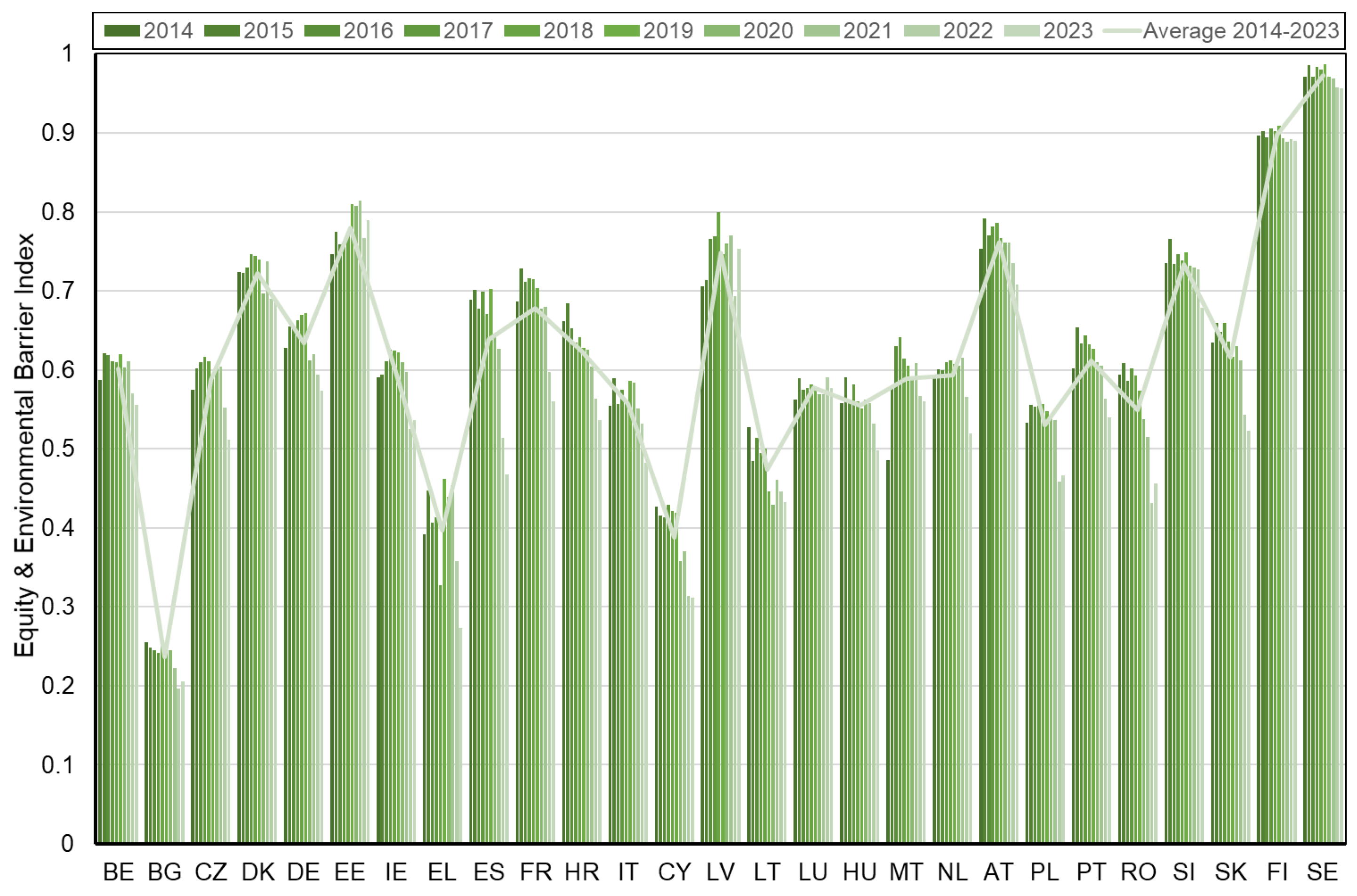
The results obtained for this barrier also indicate significant differences between the EU-27 countries (Figure 5). The last barrier included in the assessment of the energy security system of European Union countries was the Equity & Environmental Barrier. Its inclusion was intended to determine the level of energy justice and environmental resilience of the system. This component was determined on the basis of five indicators: greenhouse gas emissions per capita (Total GHG per capita), share of renewable energy sources in gross final energy consumption (RES share), share of forest area, percentage of the population unable to maintain adequate temperature in their place of residence (taking into account poverty status), and the rate of premature deaths due to exposure to PM2.5 particulate matter. The results obtained for 2014–2023 show clear differences between the EU-27 countries, both in terms of average index values and dynamics of change over time (Figure 6).
The highest average values for this component were recorded in the Scandinavian countries, i.e., Sweden (0.9733) and Finland (0.8972), as well as Estonia (0.7798), Austria (0.7612), Slovenia (0.7334) Denmark (0.7221) and Latvia (0.7476). These high results reflect the high share of renewable energy sources in the energy mix, extensive forest cover, low levels of energy poverty and effective policies to reduce emissions and improve air quality.
The group of countries with moderate Equity & Environmental Barrier Index scores includes Germany (0.6339), Spain (0.6389), France (0.6776), the Czech Republic (0.5881), Ireland (0.5936), the Netherlands (0.5931), Portugal (0.6109), Hungary (0.5549), Italy (0.5568) and Croatia (0.6234). These countries have made noticeable progress in their energy transition, including reducing greenhouse gas emissions and increasing the share of energy from renewable sources. Another characteristic feature is the gradual decline in the index value after 2020, which is a consequence of the COVID-19 pandemic, the growing problem of energy poverty and geopolitical tensions, which have slowed down the pace of transformation.
The lowest average index values were observed in Southern and Central and Eastern European countries, such as Bulgaria (0.2370), Cyprus (0.3879), Greece (0.3974), Lithuania (0.4732), Romania (0.5497) and Poland (0.5306). These countries face a number of structural barriers, such as high GHG emissions per capita, relatively low RES energy consumption, insufficient forest cover, and a high percentage of the population affected by energy poverty and the effects of air pollution (high rate of premature deaths due to exposure to PM2.5 particulate matter). In the case of Bulgaria, there is a particularly worrying trend of a significant and continuous decline in the index value, which indicates deepening environmental and social inequalities.
An analysis of the results for the Equity & Environmental Barrier confirms a strong correlation between the level of socio-economic development, the implementation of environmental policies, and the quality of life in the context of energy security. High index values are characteristic of countries with well-established energy infrastructure, a high share of renewable energy sources, and effective mechanisms for reducing inequalities. Low values, on the other hand, highlight the need to intensify efforts aimed at a just energy transition, particularly in Central and Eastern Europe and Southern Europe.
The research conducted, which included determining the values of indices characterizing individual barriers (dimensions) within the MBEES model, made it possible to identify the weakest links in the energy security system in individual EU-27 countries. An analysis of their values indicates significant differences in the strengths and weaknesses of individual components in the countries studied (Table 6). These results therefore make it possible to identify which barriers pose the greatest structural challenge to energy security (in line with EU policy) in individual EU-27 countries. (Table 6).
The barrier (dimension) that proved to be the weakest in most countries was the Efficiency & Climate Barrier, relating to energy efficiency and the impact of the energy sector on the climate. It is in this category that the lowest index values were identified in countries such as Belgium, Bulgaria, the Czech Republic, Estonia, Greece, Lithuania, Hungary, Poland, Slovenia and Finland. The low values of this component in the countries mentioned above indicate persistent problems with energy efficiency, high energy intensity of economies and high greenhouse gas emissions per unit of energy consumption. In the case of Bulgaria, the Czech Republic, Estonia, Greece, Lithuania, Hungary and Poland, these results are correlated with low levels of innovation [70,71,72,73], a high share of emission sources in the energy mix and insufficient modernization of the energy sector.
The second most common barrier was the Affordability Barrier, which covers the availability of energy in relation to income and prices. This was the weakest component in Denmark, Germany, Spain, France, Croatia, Italy, Latvia, Portugal, Romania, Slovakia, and Sweden. Although these are countries with varying levels of economic development, a common problem remains their sensitivity to energy price fluctuations and, in most countries, relatively high energy costs for households and industry. Low index values for this barrier (dimension) may therefore indicate deepening challenges related to so-called energy poverty.
The Mix & Diversity Barrier, related to the diversification of energy sources and the share of zero-emission and emission sources in the energy mix, was the weakest link in countries such as Ireland, Cyprus, Luxembourg, Malta, and the Netherlands. This is mainly due to unfavorable results obtained for three indicators: the Herfindahl-Hirschman Index of energy diversification, the share of emission sources, and the share of zero-emission sources in the energy mix. A high Herfindahl-Hirschman Index value indicates a high concentration of the energy mix and a low level of diversification, which significantly reduces the system’s resilience to external supply disruptions. In particular, Cyprus and Malta show a high level of dependence on fossil fuels, especially oil and gas, while Ireland and Luxembourg, despite the partial development of RES, still rely heavily on a small number of energy sources. The high share of emission-intensive sources in these countries’ energy mix points to the need to accelerate decarbonization and increase the share of renewable, distributed, and low-emission energy sources.
Only in Austria was the Resource Barrier identified as the weakest component of energy security, mainly due to the relatively high total primary energy consumption [74,75] per capita and significant dependence on energy imports. Despite a relatively balanced energy mix, Austria did not achieve high energy self-sufficiency rates, which weakens its resilience to external disruptions. This points to the need for further improvements in the efficiency of energy use and the strengthening of domestic energy supply.
The results obtained indicate that there is no single universal pattern of energy vulnerability in the EU-27 countries. These countries face different types of risks, resulting from their specific and individual energy, economic, environmental, and social conditions. Identifying the weakest barriers in energy security systems therefore allows for better alignment of public policies and infrastructure investments with local needs, which is the foundation for an effective and fair energy transition within the EU’s sustainable development strategy.

5. Discussion

In the current global economic reality, energy security is one of the most important global megatrends. It affects not only the stability of economies and societies, but also the direction of technological development, the shaping of climate policies, and the sovereignty of states [75,76,77]. The dependence of global economic stability on energy, the growing demand for clean sources, geopolitical instability, and the effects of pandemics and hybrid wars show how easily the energy balance and supply chains can be disrupted. This easily leads to socio-economic crises, the effects of which can be catastrophic [76,77,78].
In this context, the perception of energy security is also changing, as it can no longer be considered solely in terms of supply and availability of raw materials [13,31,36,53,79]. Security requires an integrated, multidimensional approach that also takes into account aspects such as diversification of sources, system resilience, energy efficiency, environmental impact, and social justice [13,35,80]. The energy transition towards climate neutrality further complicates the understanding of energy security and forces countries and societies to simultaneously take into account economic competitiveness, emission reductions, and equal access to energy [81,82]. This highly complex and dynamically changing situation necessitates a new approach to energy security research and support for the development of energy strategies for individual countries and regions. For this reason, it is very important to develop new research tools that will enable the assessment of energy security and identify structural barriers limiting its development, including potential sources of risk.
One such tool is the Multi-Barrier Energy Security System (MBEES) model proposed in this paper, based on a concept of five systemic barriers affecting the level of energy security in the EU-27 countries.
Compared to classic index-based security assessment methods, such as the Energy Trilemma Index [23] or the Energy Security Index (ESI) [48], the MBEES model takes greater account of contemporary challenges related to energy transition and social justice. While the ESI focuses on the availability and stability of supply, and the Trilemma Index takes into account only three components (security, sustainability, equity), the MBEES model allows for the identification and assessment of systemic weaknesses, including rising energy costs and energy poverty. The developed MBEES model introduces an additional logic of systemic defense by explicitly identifying the “weakest barriers,” i.e., vulnerabilities within specific areas, rather than relying solely on aggregated results. An empirical comparison for selected countries shows a high degree of consistency with the Trilemma Index [23] in terms of the ranking of Scandinavian and Western European states. However, MBEES provides additional insights by highlighting critical weaknesses of individual barriers, such as affordability issues in Germany or efficiency deficits in Poland, which are not as clearly visible in the classic Trilemma index. Interestingly, the analysis also reveals outliers, such as Denmark, which, despite its high GDP and advanced energy transition, scores relatively poorly in the affordability barrier. This paradox is mainly due to high household electricity prices, driven by taxation and the costs of supporting the development of renewable energy sources.
Its structure of five interrelated components (Resource, Mix & Diversity, Affordability, Efficiency & Climate, and Equity & Environmental) allows for a broader and more in-depth assessment of energy systems than traditional approaches.
The results of the study, based on the application of this model (MBEES) for the EU-27 countries in 2014–2023, indicate significant differences in the level of energy security in these countries, both in terms of geography and time.
The results obtained in many areas are also consistent with the findings of earlier studies [13,21,42,43,53], which indicate strong regional differences in the level of energy security in Europe. The advantage of countries with a high share of renewable energy sources and efficient energy systems, such as Sweden, Denmark, and Austria, is also confirmed. Similarly to the current study [13,21,42,43,53] and slightly older ones [35], the MBEES model also shows that a high level of energy security correlates with a low-emission energy mix. However, the results obtained in this study differ from those presented in the publication [57], in which Estonia, Malta, and Cyprus occupy the top positions in terms of energy security.
In general, it can be observed that despite the passage of time and changing geopolitical and climatic conditions, the main determinants of energy security remain unchanged: these are diversification of sources, integration of RES, and energy efficiency. However, it is worth noting that contemporary approaches, exemplified by the MBEES model, are increasingly integrating energy equity and environmental and social justice components which, a decade ago, were only mentioned in general terms in system assessments. This shift in emphasis reflects the evolution of the energy security paradigm from narrowly understood security of supply towards complex, multidimensional system security.
In general, it can be observed that despite the passage of time and changing geopolitical and climatic conditions, the main determinants of energy security remain unchanged: diversification of sources, integration of RES, and energy efficiency. However, it is worth noting that contemporary approaches, exemplified by the MBEES model, are increasingly integrating energy equity, environmental, and social justice components, which a decade ago were mentioned only in general terms in system assessments [83]. This shift in emphasis reflects the evolution of the energy security paradigm from narrowly understood supply security towards complex, multidimensional system security.
The war in Ukraine has significantly affected energy security in Europe, acting as a major external shock. This situation accelerated efforts toward energy source diversification, forced EU-27 countries to redefine their gas supply chains, and highlighted the risks associated with excessive dependence on a single supplier [84,85]. The MBEES results clearly reflect these changes, showing a sharp decline in affordability and resource barrier values in several Central and Eastern European countries in 2022–2023. At the same time, the crisis stimulated structural changes, including the accelerated deployment of renewable energy sources, investments in LNG infrastructure, and a stronger emphasis on energy efficiency, which was reflected in the subsequent stabilization of the systemic barrier.
A detailed analysis of the results obtained, particularly those related to the decline in the MBEES index in Germany, the Czech Republic, and Bulgaria between 2021–2022, confirms the theses presented in [86] on the vulnerability of countries with high dependence on fossil fuels and external imports to external shocks.
In turn, the study of barriers: Equity & Environmental (in the MBEES model) also shows problems occurring in many EU-27 countries, including Bulgaria, Romania, and Hungary, where despite relatively stable energy availability, a significant part of the population is in a state of energy poverty [87]. The lack of energy availability directly translates into a deterioration in the quality of life, limited digital development, and social marginalization, which is why “energy should be treated as a public good” [88].
At the same time, unexpected results are observed in high-income countries such as Germany and Denmark, where affordability scores remain low despite overall economic prosperity. This indicates that energy security cannot be assessed solely on the basis of macroeconomic indicators such as GDP, but requires a multidimensional evaluation that includes accessibility, equity, and environmental justice.
The developed model (MBEES), by taking into account cost, emission, and social accessibility components of energy, therefore offers greater precision in assessing systemic risks and remedial potential than the Energy Trilemma Index [23] or the Energy Security Index (ESI) [48]. This model is also in line with EU strategic documents such as the European Green Deal [18], Fit for 55 [24] and REPowerEU [25], which also adopt a multidimensional approach to energy security, integrating not only energy aspects but also social, environmental and economic aspects.
The dynamics of the MBEES index also show how different political trajectories affect the performance of individual countries. A good example is Germany, where the Energiewende policy, despite its undeniable long-term benefits related to the transition toward a low-carbon economy [89], has at the same time contributed to the emergence of temporary gaps in energy security. This results primarily from the rapid phase-out of nuclear power, which previously constituted a stable and low-emission energy source, as well as from the persistently high dependence on natural gas imports, especially from Russia [90,91]. As a consequence, during the transition period, the German energy system became more vulnerable to external supply shocks and fluctuations in commodity prices. This was manifested in problems resulting from the one-sided orientation of energy policy and the too slow development of storage infrastructure and renewable technologies ensuring diversification and system stability. In Poland, the slow pace of phasing out coal-based energy continues to limit this progress [92,93]. However, new investments in offshore wind energy and photovoltaics may improve results in the future. Overall, Poland has been expanding its renewable energy capacities quite decisively and effectively, especially in recent years [94]. Spain and Portugal have also made significant progress in the development of renewable energy—both countries are creating structural conditions and a favorable investment environment that support the availability of RES at relatively low costs [95]. In Portugal, renewable energy is dynamically replacing fossil fuels while maintaining energy affordability [96]. In Spain, the share of renewables in electricity generation already exceeds 55%, while in Portugal it amounts to 61%, with a plan to increase it to 85% by 2030. Nevertheless, issues of energy affordability still pose a challenge in Southern Europe, as confirmed by studies on the impact of the energy transition on energy poverty [97]. In turn, the Nordic countries demonstrate that a consistent, long-term policy combined with high social acceptance leads to balanced results across all five analyzed barriers. These examples confirm that energy security cannot be interpreted in a static manner but requires a multidimensional assessment that enables the identification of the system’s weakest links and a more comprehensive capture of its vulnerabilities (and variability).
The method developed based on the MBEES model therefore complements existing index methods used to assess energy security. Its multi-barrier structure allows for not only ongoing diagnosis, but also for identification of areas requiring intervention (so-called weak links). In the context of growing geopolitical instability, accelerating energy transition, and a number of other challenges (e.g., climate, political, etc.), such tools can play an important role in supporting decision-making on effective and fair energy and social policies in Europe and other regions of the world.

6. Conclusions and Recommendations

This paper presents an original framework for assessing systemic energy security based on a barrier approach. The Multi-Barrier Energy Security System (MBEES) Index takes into account five key components (barriers), namely the Resource Barrier, Mix & Diversity Barrier, Affordability Barrier, Efficiency & Climate Barrier, and Equity & Environmental Barrier, treating them as equal and interrelated dimensions determining energy security in a systemic perspective.
The proposed MBEES model was used to assess the level of energy security in the 27 Member States of the European Union between 2014–2023. The results obtained not only allow the position of individual countries in dynamic and spatial terms to be determined, but also help identify their specific weaknesses and strengths within each of the analyzed barriers (dimensions).
The analysis of the systemic energy security level of the European Union member states between 2014–2023, using the multidimensional MBEES Index model, allows for a number of important conclusions to be drawn, the most important of which are as follows:
There are significant spatial differences between EU-27 countries in terms of energy security, as confirmed by the MBEES Index values. The highest values of this index are recorded in the Scandinavian and Western European countries, which are characterized by a balanced energy mix, a high share of RES, low emissions, and high energy efficiency. In contrast, Central and Eastern European and Southern European countries have lower index values, indicating persistent structural, social, and environmental weaknesses.
The most common barrier in the EU-27 countries is the Efficiency & Climate Barrier. This barrier includes, among other things, high emissions, low energy productivity, and significant energy intensity of the economy. The situation is particularly worrying in Bulgaria, Malta, Poland, Estonia, and Lithuania.
Affordability is a critical barrier in EU-27 countries located in the west and south of the continent. In many highly developed countries (including Germany, France, and Spain), the Affordability Barrier is a significant challenge, despite relatively high incomes. High energy costs, especially after 2020, increase the risk of energy poverty and exacerbate social inequalities.
There are gaps in the diversity of the energy mix in the EU-27 countries. The low value of the Mix & Diversity Barrier in countries such as Cyprus, Malta, and Luxembourg indicates the need to intensify efforts to diversify energy sources and increase the share of low-carbon sources.
The results of the Equity & Environmental Barrier provide valuable information on the social resilience of the energy system. The high value of the index in the Scandinavian countries confirms the effectiveness of combining climate policy with social policy, while low values in countries such as Bulgaria, Poland, and Greece indicate the need to implement more inclusive solutions as part of a just transition.
The results of the study show that the EU-27 Member States face a variety of challenges, depending on their economic structure, resource availability, level of socio-economic development, and the state of their energy infrastructure.
In light of the results and conclusions, the following recommendations have been proposed:
Countries with low Efficiency & Climate Barrier levels should receive priority financial and technological support, including through cohesion funds and the European Green Deal.
In the context of rising energy prices, it is necessary to develop sustainable, non-interventionist mechanisms to support consumers at risk of energy poverty.
Particular attention should be paid to countries with a highly concentrated energy mix. Support programs are needed, including the exchange of good practices for the development of distributed renewable energy sources and flexible energy management systems.
The energy transition should not only cover technological and infrastructural aspects, but also take into account social justice, public health, and quality of life.
For high-emission economies such as Poland or Bulgaria, accelerating the development of renewable energy sources and implementing carbon capture and storage (CCS) projects can reduce emissions in the existing fossil fuel–based energy mix.
For countries facing affordability issues (e.g., Germany, Spain, Portugal), introducing stronger social protection mechanisms against energy poverty, along with price stabilization instruments and incentives to improve household energy efficiency, can yield benefits.
For countries with low diversification of sources (e.g., Cyprus, Malta, Luxembourg), the priority should be diversification of energy sources and suppliers, including investments in LNG terminals, cross-border interconnections, and decentralized RES.
For countries with high efficiency and stability (e.g., Sweden, Finland, Denmark), maintaining resilience through further investments in energy storage, smart grids, and sectoral integration, as well as sharing best practices with other EU members is recommended.
In view of the significant differences in the weaknesses of individual Member States, it is necessary to implement energy policies based on local diagnoses and analysis of weak links related to a multidimensional approach to energy security. It is recommended that the MBEES model be further developed and updated on a regular basis as one of the tools to support decision-makers in the systemic assessment of the energy resilience of EU countries and regions:
Despite the cognitive and practical value indicated, the research conducted also has its limitations, which should serve as an impetus for further research and analysis. Due to the limited availability of reliable quantitative data in international, reputable statistical databases, the analysis did not take into account barriers such as the security of technological component supplies (e.g., energy storage facilities, renewable energy installations), cybersecurity of critical infrastructure, or the resilience of energy systems to geopolitical threats (including supply chain destabilization). As quantitative data becomes more widely available, future extensions of the model could include the incorporation of additional barriers, particularly those related to cybersecurity, infrastructure resilience, and the development of AI. Unfortunately, such indicators are currently not available in international, comparable databases, which makes their systematic inclusion in the model impossible. However, with the advancement of public statistics and the wider use of tools monitoring digital security and the stability of critical infrastructure, it will be possible to capture these dimensions in an even more comprehensive way within the MBEES framework.
Examples of potential indicators for the new “Cybersecurity and Infrastructure Resilience” barrier could include the number of registered cyberattack incidents on energy infrastructure (e.g., transmission networks, distribution system operators), the share of energy companies holding certified information security management systems (ISO/IEC 27001), the mean time to recovery (MTTR) of energy supply continuity after disruptions, the number of supply interruptions resulting from failures of critical infrastructure (SAIDI/SAIFI adjusted for extreme events), the share of modernized transmission and distribution infrastructure in total assets, as well as the level of system redundancy and flexibility (e.g., the share of energy storage and cross-border interconnections in the energy balance).
The MBEES model also has clear potential for adaptation beyond Europe. Its multi-barrier logic could be applied in non-EU regions such as Asia or Africa, where energy systems face different but equally complex challenges. For example, in Sub-Saharan Africa the Equity & Environmental Barrier may play a central role, while in Southeast Asia the Mix & Diversity Barrier is often the most critical. Discussing these applications would not only broaden the relevance of the model but also provide a framework for comparative global research.

Author Contributions

Conceptualization, M.T. and J.B.; methodology, J.B. and M.T.; software, M.T. and J.B.; formal analysis, J.B. and M.T.; investigation, J.B. and M.T.; resources, M.T., J.B. and W.W.G.; data curation, M.T. and J.B.; writing—original draft preparation, M.T., J.B. and W.W.G.; writing—review and editing, J.B. and M.T.; visualization, M.T.; supervision, M.T. and J.B.; project administration, M.T. and J.B.; funding acquisition, M.T. All authors have read and agreed to the published version of the manuscript.

Funding

This publication was funded by the statutory research performed at Silesian University of Technology, Department of Production Engineering (13/030/BK_25/0089), Faculty of Management and Organization.

Data Availability Statement

The raw data supporting the conclusions of this article will be made available by the authors on request.

Conflicts of Interest

The authors declare no conflicts of interest.

References

  1. Wang, Q.; Ren, F.; Li, R. Geopolitics and Energy Security: A Comprehensive Exploration of Evolution, Collaborations, and Future Directions. Humanit. Soc. Sci. Commun. 2024, 11, 1071. [Google Scholar] [CrossRef]
  2. Siksnelyte-Butkiene, I.; Streimikiene, D.; Karpavicius, T.; Balezentis, T. Societal Challenges to Ensure Energy Security: A Systematic Critical Review of the Concept, Indicators, and Low-Carbon Transition Policies. Energy Res. Soc. Sci. 2025, 127, 104219. [Google Scholar] [CrossRef]
  3. Strojny, J.; Krakowiak-Bal, A.; Knaga, J.; Kacorzyk, P. Energy Security: A Conceptual Overview. Energies 2023, 16, 5042. [Google Scholar] [CrossRef]
  4. Cherp, A.; Jewell, J. The Concept of Energy Security: Beyond the Four As. Energy Policy 2014, 75, 415–421. [Google Scholar] [CrossRef]
  5. Thaler, P.; Hofmann, B. The Impossible Energy Trinity: Energy Security, Sustainability, and Sovereignty in Cross-Border Electricity Systems. Political Geogr. 2022, 94, 102579. [Google Scholar] [CrossRef]
  6. Brodny, J.; Tutak, M.; Grebski, W. Empirical Assessment of the Efficiency of Poland’s Energy Transition Process in the Context of Implementing the European Union’s Energy Policy. Energies 2024, 17, 2689. [Google Scholar] [CrossRef]
  7. Zhou, Y.; Dan, Z. Modern Energy Resilience Studies with Artificial Intelligence for Energy Transitions. Cell Rep. Phys. Sci. 2025, 6, 102508. [Google Scholar] [CrossRef]
  8. Mohanty, A.; Ramasamy, A.K.; Verayiah, R.; Bastia, S.; Dash, S.S.; Cuce, E.; Khan, T.M.Y.; Soudagar, M.E.M. Power System Resilience and Strategies for a Sustainable Infrastructure: A Review. Alex. Eng. J. 2024, 105, 261–279. [Google Scholar] [CrossRef]
  9. Jasiūnas, J.; Lund, P.D.; Mikkola, J. Energy System Resilience—A Review. Renew. Sustain. Energy Rev. 2021, 150, 111476. [Google Scholar] [CrossRef]
  10. Colgan, J.D.; Gard-Murray, A.S.; Hinthorn, M. Quantifying the Value of Energy Security: How Russia’s Invasion of Ukraine Exploded Europe’s Fossil Fuel Costs. Energy Res. Soc. Sci. 2023, 103, 103201. [Google Scholar] [CrossRef]
  11. Boitier, B.; Nikas, A.; Gambhir, A.; Koasidis, K.; Elia, A.; Al-Dabbas, K.; Alibaş, Ş.; Campagnolo, L.; Chiodi, A.; Delpiazzo, E.; et al. A Multi-Model Analysis of the EU’s Path to Net Zero. Joule 2023, 7, 2760–2782. [Google Scholar] [CrossRef]
  12. Igliński, B.; Kiełkowska, U.; Mazurek, K.; Drużyński, S.; Pietrzak, M.B.; Kumar, G.; Veeramuthu, A.; Skrzatek, M.; Zinecker, M.; Piechota, G. Renewable Energy Transition in Europe in the Context of Renewable Energy Transition Processes in the World: A Review. Heliyon 2024, 10, e40997. [Google Scholar] [CrossRef] [PubMed]
  13. Brodny, J.; Tutak, M. Decade of Progress: A Multidimensional Measurement and Assessment of Energy Sustainability in EU-27 Nations. Appl. Energy 2025, 382, 125222. [Google Scholar] [CrossRef]
  14. Török, L. Economic Drivers of Renewable Energy Growth in the European Union: Evidence from a Panel Data Analysis (2015–2023). Energies 2025, 18, 3363. [Google Scholar] [CrossRef]
  15. Tichý, L.; Dubský, Z. The EU Energy Security Relations with Russia until the Ukraine War. Energy Strategy Rev. 2024, 52, 101313. [Google Scholar] [CrossRef]
  16. Kuzemko, C.; Blondeel, M.; Dupont, C.; Brisbois, M.C. Russia’s War on Ukraine, European Energy Policy Responses & Implications for Sustainable Transformations. Energy Res. Soc. Sci. 2022, 93, 102842. [Google Scholar]
  17. European Commission. Europeans Consider Tackling Climate Change a Priority and Support Energy Independence. Available online: https://ec.europa.eu/commission/presscorner/detail/en/ip_25_1376 (accessed on 13 August 2025).
  18. European Commission. The European Green Deal; Publications Office of the European Union: Luxembourg, 2019; Available online: https://eur-lex.europa.eu/legal-content/EN/TXT/?uri=CELEX:52019DC0640 (accessed on 13 August 2025).
  19. Román-Collado, R.; Casado Ruíz, V. Key Effects Contributing to Changes in Energy Imports in the EU-27 between 2000 and 2020: A Decomposition Analysis Based on the Sankey Diagram. Energy Econ. 2024, 140, 108009. [Google Scholar] [CrossRef]
  20. Russell, C. EU’s Pledge for $250 Billion of US Energy Imports Is Delusional. Available online: https://www.reuters.com/business/energy/eus-pledge-250-billion-us-energy-imports-is-delusional-2025-07-28/ (accessed on 13 August 2025).
  21. Streimikiene, D.; Siksnelyte-Butkiene, I.; Lekavicius, V. Energy Diversification and Security in the EU: Comparative Assessment in Different EU Regions. Economies 2023, 11, 83. [Google Scholar] [CrossRef]
  22. Cooray, A.; Shahbaz, M.; Kuziboev, B.; Çatık, A.N. Mitigating Energy Risk through Energy Sources Diversification. J. Environ. Manag. 2025, 380, 124955. [Google Scholar] [CrossRef]
  23. World Energy Council (WEC). World Energy Trilemma Index 2023; World Energy Council: London, UK, 2023; Available online: https://www.worldenergy.org/transition-toolkit/world-energy-trilemma-framework (accessed on 13 August 2025).
  24. European Commission. ‘Fit for 55’: Delivering the EU’s 2030 Climate Target on the Way to Climate Neutrality; Publications Office of the European Union: Luxembourg, 2021; Available online: https://eur-lex.europa.eu/legal-content/EN/TXT/?uri=CELEX:52021DC0550 (accessed on 13 August 2025).
  25. European Commission. REPowerEU Plan; European Commission: Brussels, Belgium, 2022; Available online: https://commission.europa.eu/topics/energy/repowereu_en (accessed on 13 August 2025).
  26. Larouzee, J.; Le Coze, J.-C. Good and Bad Reasons: The Swiss Cheese Model and Its Critics. Saf. Sci. 2020, 126, 104660. [Google Scholar] [CrossRef]
  27. Yuan, S.; Yang, M.; Reniers, G.; Chen, C.; Wu, J. Safety Barriers in the Chemical Process Industries: A State-of-the-Art Review on Their Classification, Assessment, and Management. Saf. Sci. 2022, 148, 105647. [Google Scholar] [CrossRef]
  28. World Nuclear Association. Storage and Disposal of Radioactive Waste. In Proceedings of the World Nuclear Association 2024, London, UK, 4–6 September 2024; Available online: https://world-nuclear.org/information-library/nuclear-fuel-cycle/nuclear-waste/storage-and-disposal-of-radioactive-waste (accessed on 13 August 2025).
  29. Kentucky Energy and Environment Cabinet. Kentucky Energy Security Plan. In Proceedings of the Kentucky Energy and Environment Cabinet 2022. Available online: https://eec.ky.gov/Energy/Documents/KY%20Energy%20Security%20Plan%20FINAL%208.17.22.pdf (accessed on 13 August 2025).
  30. International Energy Agency (IEA). Energy Security. In International Energy Agency 2019; International Energy Agency: Paris, France, 2019; Available online: https://www.iea.org/topics/energy-security (accessed on 13 August 2025).
  31. Kruyt, B.; van Vuuren, D.P.; de Vries, H.J.M.; Groenenberg, H. Indicators for Energy Security. Energy Policy 2009, 37, 2166–2181. [Google Scholar] [CrossRef]
  32. Yergin, D. Ensuring Energy Security. Foreign Aff. 2006, 85, 69–82. [Google Scholar] [CrossRef]
  33. Ang, B.W.; Choong, W.L.; Ng, T.S. Energy Security: Definitions, Dimensions and Indexes. Renew. Sustain. Energy Rev. 2015, 42, 1077–1093. [Google Scholar] [CrossRef]
  34. Sovacool, B.K.; Brown, M.A. Competing Dimensions of Energy Security: An International Perspective. Annu. Rev. Environ. Resour. 2010, 35, 77–108. [Google Scholar] [CrossRef]
  35. Sovacool, B.K.; Mukherjee, I. Conceptualizing and Measuring Energy Security: A Synthesized Approach. Energy 2011, 36, 5343–5355. [Google Scholar] [CrossRef]
  36. Winzer, C. Conceptualizing Energy Security. Energy Policy 2012, 46, 36–48. [Google Scholar] [CrossRef]
  37. World Commission on Environment and Development. Our Common Future; Oxford University Press: Oxford, UK, 1987; Available online: https://sustainabledevelopment.un.org/content/documents/5987our-common-future.pdf (accessed on 30 August 2025).
  38. United Nations. Transforming Our World: The 2030 Agenda for Sustainable Development (A/RES/70/1); United Nations: New York, NY, USA, 2015; Available online: https://sdgs.un.org/2030agenda (accessed on 30 August 2025).
  39. Azzuni, A.; Breyer, C. Definitions and Dimensions of Energy Security: A Literature Review. Wiley Interdiscip. Rev. Energy Environ. 2018, 7, e268. [Google Scholar] [CrossRef]
  40. Stavytskyy, A.; Kharlamova, G.; Komendant, O.; Andrzejczak, J.; Nakonieczny, J. Methodology for Calculating the Energy Security Index of the State: Taking into Account Modern Megatrends. Energies 2021, 14, 3621. [Google Scholar] [CrossRef]
  41. International Energy Agency (IEA). The IEA Model of Short-Term Energy Security (MOSES): Primary Energy Sources and Secondary Fuels; International Energy Agency: Paris, France, 2011; Available online: https://www.oecd.org/content/dam/oecd/en/publications/reports/2011/12/the-iea-model-of-short-term-energy-security-moses_g17a20c3/5k9h0wd2ghlv-en.pdf?utm_source=chatgpt.com (accessed on 13 August 2025).
  42. Ziemba, P. Energy Security Assessment Based on a New Dynamic Multi-Criteria Decision-Making Framework. Energies 2022, 15, 9356. [Google Scholar] [CrossRef]
  43. Brodny, J.; Tutak, M. Assessing the Energy Security of European Union Countries from Two Perspectives—A New Integrated Approach Based on MCDM Methods. Appl. Energy 2023, 347, 121443. [Google Scholar] [CrossRef]
  44. Jonek-Kowalska, I. Multi-Criteria Evaluation of the Effectiveness of Energy Policy in Central and Eastern European Countries in a Long-Term Perspective. Energy Strategy Rev. 2022, 44, 100973. [Google Scholar] [CrossRef]
  45. Solaymani, S. Energy Security and Its Determinants in New Zealand. Environ. Sci. Pollut. Res. 2024, 31, 51521–51539. [Google Scholar] [CrossRef]
  46. Man, O.R.; Radu, R.I.; Mihai, I.O.; Enache, C.M.; David, S.; Moisescu, F.; Ibinceanu, M.C.O.; Zlati, M.L. Approaches to a New Regional Energy Security Model in the Perspective of the European Transition to Green Energy. Economies 2024, 12, 61. [Google Scholar] [CrossRef]
  47. Amin, S.B.; Chang, Y.; Khan, F.; Taghizadeh-Hesary, F. Energy Security and Sustainable Energy Policy in Bangladesh: From the Lens of 4As Framework. Energy Policy 2022, 161, 112719. [Google Scholar] [CrossRef]
  48. Asia Pacific Energy Research Centre (APERC). A Quest for Energy Security in the 21st Century: Resources and Constraints; Institute of Energy Economics: Tokyo, Japan, 2007; Available online: https://aperc.or.jp/file/2010/9/26/APERC_2007_A_Quest_for_Energy_Security.pdf (accessed on 13 August 2025).
  49. Global Energy Institute. US Chamber of Commerce; Global Energy Institute: Washington, DC, USA. Available online: https://www.globalenergyinstitute.org/ (accessed on 13 August 2025).
  50. Bąk, I.; Wawrzyniak, K.; Szczecińska, B.; Barej-Kaczmarek, E.; Oesterreich, M. Spatial Differentiation of EU Countries in Terms of Energy Security. Energies 2025, 18, 4310. [Google Scholar] [CrossRef]
  51. Zeng, S.; Streimikiene, D.; Baležentis, T. Review of and Comparative Assessment of Energy Security in Baltic States. Renew. Sustain. Energy Rev. 2017, 76, 185–192. [Google Scholar] [CrossRef]
  52. Nihal, A.; Areche, F.O.; Araujo, V.G.S.; Ober, J. Synergistic evaluation of energy security and environmental sustainability in BRICS geo-political entities: An integrated index framework. Equilibrium Q. J. Econ. Econ. Policy 2024, 19, 793–839. [Google Scholar] [CrossRef]
  53. Kuzior, A.; Kovalenko, Y.; Tiutiunyk, I.; Hrytsenko, L. Assessment of the Energy Security of EU Countries in Light of the Expansion of Renewable Energy Sources. Energies 2025, 18, 2126. [Google Scholar] [CrossRef]
  54. Fang, D.; Shi, S.; Yu, Q. Evaluation of Sustainable Energy Security and an Empirical Analysis of China. Sustainability 2018, 10, 1685. [Google Scholar] [CrossRef]
  55. World Energy Council. Energy Sustainability Index 2013; World Energy Council: London, UK, 2013. [Google Scholar]
  56. Sotnyk, I.; Kurbatova, T.; Kubatko, O.; Prokopenko, O.; Prause, G.; Kovalenko, Y.; Trypolska, G.; Pysmenna, U. Energy Security Assessment of Emerging Economies under Global and Local Challenges. Energies 2021, 14, 5860. [Google Scholar] [CrossRef]
  57. Kozłowska, J.; Benvenga, M.A.; Nääs, I.d.A. Investment Risk and Energy Security Assessment of European Union Countries Using Multicriteria Analysis. Energies 2023, 16, 330. [Google Scholar] [CrossRef]
  58. Deane, J.; Gracceva, F.; Chiodi, A.; Gargiulo, M.; Gallachóir, B.P. Assessing Power System Security: A Framework and a Multi Model Approach. Int. J. Electr. Power Energy Syst. 2015, 73, 283–297. [Google Scholar] [CrossRef]
  59. European Commission. Affordable Energy Action Plan (COM/2025/79); Publications Office of the European Union: Luxembourg, 2025; Available online: https://energy.ec.europa.eu/strategy/affordable-energy_en (accessed on 13 August 2025).
  60. European Commission. The European Green Deal Investment Plan and Just Transition Mechanism (COM/2020/21 Final); Publications Office of the European Union: Luxembourg, 2020; Available online: https://eur-lex.europa.eu/legal-content/EN/TXT/?uri=CELEX:52020DC0021 (accessed on 13 August 2025).
  61. European Commission. Directive (EU) 2024/1711 and Regulation (EU) 2024/1747 Amending the EU’s Electricity Market Design; Publications Office of the European Union: Luxembourg, 2024; Available online: https://energy.ec.europa.eu/topics/markets-and-consumers/electricity-market-design_en (accessed on 13 August 2025).
  62. European Union. Regulation (EU) 2021/1119 of the European Parliament and of the Council of 30 June 2021 establishing the framework for achieving climate neutrality (European Climate Law). Off. J. Eur. Union 2021, L 243, 1–17. Available online: https://eur-lex.europa.eu/legal-content/EN/TXT/?uri=CELEX:32021R1119 (accessed on 13 August 2025).
  63. Diakoulaki, D.; Mavrotas, G.; Papayannakis, L. Determining Objective Weights in Multiple Criteria Problems: The CRITIC Method. Comput. Oper. Res. 1995, 22, 763–770. [Google Scholar] [CrossRef]
  64. Zhu, Y.; Tian, D.; Yan, F. Effectiveness of Entropy Weight Method in Decision-Making. Math. Probl. Eng. 2020, 2020, 3564835. [Google Scholar] [CrossRef]
  65. Song, M.; Zhu, Q.; Peng, J.; Santibanez Gonzalez, E. Improving the evaluation of cross efficiencies: A method based on Shannon entropy weight. Comput. Ind. Eng. 2017, 112, 99–106. [Google Scholar] [CrossRef]
  66. EUROSTAT Database. Available online: https://ec.europa.eu/eurostat/data/database?gclid=CjwKCAiA2pyuBhBKEiwApLaIO8iQvu_6cM_yhwD3iQsRLSVwAJQmaF5zehH8buKu9HCB2ejTmNKkrxoCbUgQAvD_BwE (accessed on 13 August 2025).
  67. Organisation for Economic Co-operation and Development (OECD). OECD Data; OECD: Paris, France. Available online: https://www.oecd.org/en/data.html (accessed on 13 August 2025).
  68. World Bank. Energy Use (kg of Oil Equivalent) per Capita—Ireland; The World Bank Group: Washington, DC, USA, 2024; Available online: https://data.worldbank.org/indicator/EG.USE.PCAP.KG.OE?locations=IE (accessed on 13 August 2025).
  69. International Energy Agency (IEA). Energy Efficiency Indicators Database; International Energy Agency: Paris, France, 2024; Available online: https://www.iea.org/data-and-statistics/data-product/energy-efficiency-indicators (accessed on 13 August 2025).
  70. Mengxuan, T.; Khan, K.; Cifuentes-Faura, J.; Sukumaran, S. Technological Innovation and Energy Efficiency in Central Eastern European Countries. Util. Policy 2024, 88, 101761. [Google Scholar] [CrossRef]
  71. Brodny, J.; Tutak, M.; Grebski, W.; Bindzár, P. Assessing the Level of Innovativeness of EU-27 Countries and Its Relationship to Economic, Environmental, Energy and Social Parameters. J. Open Innov. Technol. Mark. Complex. 2023, 9, 100073. [Google Scholar] [CrossRef]
  72. European Commission. European Innovation Scoreboard 2024; Publications Office of the European Union: Luxembourg, 2024; Available online: https://european-union.europa.eu/institutions-law-budget/institutions-and-bodies/search-all-eu-institutions-and-bodies/publications-office-european-union-op_en (accessed on 13 August 2025).
  73. Brown, S.; Jones, D. European Electricity Review 2024: Europe’s Electricity Transition Takes Crucial Strides Forward; Ember: London, UK, 2024; Available online: https://ember-energy.org/insights/research/european-electricity-review-2024 (accessed on 13 August 2025).
  74. International Energy Agency (IEA). Total Primary Energy Supply (TPES) per Capita—Austria; International Energy Agency: Paris, France, 2024; Available online: https://www.iea.org/data-and-statistics/data-product/world-energy-balances (accessed on 13 August 2025).
  75. Luty, L.; Zioło, M.; Knapik, W.; Bąk, I.; Kukuła, K. Energy Security in Light of Sustainable Development Goals. Energies 2023, 16, 1390. [Google Scholar] [CrossRef]
  76. Smal, T.; Wieprow, J. Energy Security in the Context of Global Energy Crisis: Economic and Financial Conditions. Energies 2023, 16, 1605. [Google Scholar] [CrossRef]
  77. Banna, H.; Alam, A.; Chen, X.H.; Alam, A.W. Energy Security and Economic Stability: The Role of Inflation and War. Energy Econ. 2023, 126, 106949. [Google Scholar] [CrossRef]
  78. International Energy Agency (IEA). Net Zero by 2050: A Roadmap for the Global Energy Sector; IEA: Paris, France, 2021; Available online: https://iea.blob.core.windows.net/assets/7ebafc81-74ed-412b-9c60-5cc32c8396e4/NetZeroby2050-ARoadmapfortheGlobalEnergySector-SummaryforPolicyMakers_CORR.pdf (accessed on 13 August 2025).
  79. Czerwińska, K.; Pacana, A. Analysis of Energy Security Based on Level of Alignment with the Goals of Agenda 2030. Energies 2024, 17, 2813. [Google Scholar] [CrossRef]
  80. Di Loreto, S.; Sangiorgio, V.; Bagagli, M.; Montelpare, S. Multi-Criteria Approach for the Energy and Environmental Impact Evaluation in Urban Districts in the Central Mediterranean Area. Sustain. Cities Soc. 2025, 120, 106179. [Google Scholar] [CrossRef]
  81. Kim, J.; Jaumotte, F.; Panton, A.J.; Schwerhoff, G. Energy Security and the Green Transition. Energy Policy 2025, 198, 114409. [Google Scholar] [CrossRef]
  82. Li, F.; Zhang, J.; Li, X. Energy Security Dilemma and Energy Transition Policy in the Context of Climate Change: A Perspective from China. Energy Policy 2023, 181, 113624. [Google Scholar] [CrossRef]
  83. Sovacool, B.K.; Sidortsov, R.V.; Jones, B.R. Energy Security, Equality and Justice, 1st ed.; Routledge: London, UK, 2013. [Google Scholar] [CrossRef]
  84. Shoukat, W.; Mustafa, Z.; Muneer, M.U.; Shahzadi, A. The Impact of the Russia–Ukraine War on EU Energy Security. Soc. Sci. Spectr. 2024, 3, 337–351. [Google Scholar] [CrossRef]
  85. Al-Saidi, M. White Knight or Partner of Choice? The Ukraine War and the Role of the Middle East in the Energy Security of Europe. Energy Strategy Rev. 2023, 49, 101116. [Google Scholar] [CrossRef]
  86. Hille, E.; Angerpointner, C. Did Geopolitical Risks in Supplier Countries of Fossil Fuels Lead to Reduced Domestic Energy Consumption? Evidence from Europe. Energy Policy 2025, 198, 114499. [Google Scholar] [CrossRef]
  87. Kashour, M.; Jaber, M.M. Revisiting Energy Poverty Measurement for the European Union. Energy Res. Soc. Sci. 2024, 109, 103420. [Google Scholar] [CrossRef]
  88. Valdes, J. Participation, Equity and Access in Global Energy Security Provision: Towards a Comprehensive Perspective. Energy Res. Soc. Sci. 2021, 78, 10209. [Google Scholar] [CrossRef]
  89. Beck, H.-P.; Hou, Z.; Wang, Q.; Guo, Y.; Huang, L.; Yue, Y.; Fang, Y.; Zhang, T.; Shi, T.; Zhang, R. The German Energy Transition after the Russia–Ukraine War—Challenges and Opportunities. Carbon Neutral Syst. 2025, 1, 4. [Google Scholar] [CrossRef]
  90. Sacco, R.L.; Megre, M.; de Medeiros Costa, H.K.; Brito, T.L.F.; dos Santos, E.M. Energy Transition Policies in Germany and the United Kingdom. Energy Res. Soc. Sci. 2024, 110, 103460. [Google Scholar] [CrossRef]
  91. Chang, Y.; Rusli, R.D.; Teh, J. German Energy Transition and Energy Security. In Department of Economics and Management Discussion Paper 2024; University of Luxembourg: Luxembourg, 2024; Available online: https://www.uni.lu/wp-content/uploads/sites/3/2024/09/DP2024-09-German-Energy-Transition-and-Energy-Security.pdf (accessed on 30 August 2025).
  92. Sokołowski, J.; Frankowski, J.; Mazurkiewicz, J.; Lewandowski, P. Hard Coal Phase-Out and the Labour Market Transition Pathways: The Case of Poland. Environ. Innov. Soc. Transit. 2022, 43, 80–98. [Google Scholar] [CrossRef]
  93. Brauers, H.; Oei, P.-Y. The Political Economy of Coal in Poland: Drivers and Barriers for a Shift Away from Fossil Fuels. Energy Policy 2020, 144, 111621. [Google Scholar] [CrossRef]
  94. Bachanek, K.H.; Drożdż, W.; Kolon, M. Development of Renewable Energy Sources in Poland and Stability of Power Grids—Challenges, Technologies, and Adaptation Strategies. Energies 2025, 18, 2036. [Google Scholar] [CrossRef]
  95. Anacleto, A.; González, D.; Pimenta da Gama, J.; Ribeirinho, M.J.; Georgieva, D.; Riba, X. The Iberian Green Industrial Opportunity: Seizing the Moment; McKinsey & Company: Chicago, IL, USA, 30 July 2024; Available online: https://www.mckinsey.com/industries/electric-power-and-natural-gas/our-insights/the-iberian-green-industrial-opportunity-seizing-the-moment (accessed on 30 August 2025).
  96. International Energy Agency. Portugal 2021: Energy Policy Review; IEA: Paris, France, 2021; Available online: https://www.iea.org/reports/portugal-202 (accessed on 30 August 2025).
  97. Soto, G.H.; Martinez-Cobas, X. Green Energy Policies and Energy Poverty in Europe: Assessing Low Carbon Dependency and Energy Productivity. Energy Econ. 2024, 136, 107677. [Google Scholar] [CrossRef]
Figure 1. MBEES index values for EU countries between 2014–2023.
Energies 18 04905 g001
Figure 2. Partial Barrier Index value for the Resource Barrier.
Energies 18 04905 g002
Figure 3. Partial Barrier Index values for Mix & Diversity Barrier.
Energies 18 04905 g003
Figure 4. Partial Barrier Index value for the Affordability Barrier.
Energies 18 04905 g004
Figure 5. Partial Barrier Index value for Efficiency & Climate Barrier.
Energies 18 04905 g005
Figure 6. Partial Barrier Index value for Equity & Environmental Barrier.
Energies 18 04905 g006
Table 1. Barriers (layers) to energy security.
BarrierNameSystem FunctionThe Relationship Between the Barrier and EU Energy Policy
B1Resource BarrierThis barrier refers to the fundamental dimension of energy security—the availability of energy resources. Countries must have stable, predictable, and independent energy sources to ensure the continuity of the economy and public services. High levels of energy imports from unstable regions or a lack of domestic resources increase the system’s vulnerability to external shocks (e.g., conflicts, sanctions, supply crises). Therefore, assessing this barrier allows for determining a country’s resilience to energy supply disruptions and its ability to act autonomously.This barrier is aligned with the objectives of REPowerEU [25], which aim to reduce dependence on fossil fuel imports and diversify supply sources.
B2Structural (Mix & Diversity Barrier)A diversified energy mix reduces the risk of excessive dependence on a single energy source or supplier. Diversification of energy carriers (oil, gas, RES, nuclear energy, etc.) and their geographical sources allows for flexible response to disruptions, cost optimization, and better alignment with environmental objectives. The balance between renewable and non-renewable sources also contributes to the long-term stability of the energy transition.This barrier is consistent with the European Green Deal [18] and the Fit for 55 package [24], which emphasize the importance of balancing renewable and low-emission sources with conventional ones.
B3Economic (Affordability Barrier)Energy security is not only about the physical availability of energy, but also its affordability. High energy costs can lead to energy poverty, social exclusion, and a decline in the competitiveness of the economy. This barrier assesses the financial burden on households and businesses by analyzing, among other things, energy prices and household income. Ensuring affordability is particularly important during periods of energy transition, when the costs of investment and system modernization are rising.This barrier is strongly reflected in the REPowerEU program [25] and the 2024 EU electricity market reform [61], which aim to protect vulnerable consumers and stabilize prices
B4Systemic (Efficiency & Climate Barrier)Energy efficiency is a key aspect of modern energy systems—it allows for reduced energy consumption while maintaining the same useful effect. High efficiency means lower costs, lower raw material consumption, and lower greenhouse gas emissions. This barrier also includes a climate component, i.e., the level of emissions per unit of energy.This barrier, related to lower energy intensity and emission reductions, is a cornerstone of the Fit for 55 package [24] and the EU’s climate neutrality policy by 2050 [62].
B5Social and environmental (Equity & Environmental Barrier)Energy should not be a luxury—equal access to energy is a cornerstone of social justice and one of the pillars of EU policy. At the same time, the energy system must minimize its negative impact on the environment, not only by reducing emissions, but also by, for example, limiting air pollution and landscape degradation. This barrier assesses social justice and environmental responsibility.This barrier, associated with equal access to energy and the protection of public health from the effects of pollution, represents a pillar of the just transition concept, embedded in the European Green Deal [18] and the funds dedicated to supporting regions dependent on fossil fuels.
Table 2. Characteristics of the sub-indicators included in the study.
BarrierNameIndicatorsRationale
B1Resource BarrierTotal primary energy supply per capita, tons of oil equivalentTotal primary energy supply per capita (toe) reflects the average availability of primary energy resources for a country’s citizens. A higher value of this indicator generally points to greater access to energy, which can support economic development and energy security. Although excessively high values may, in some cases, indicate structural inefficiency or excessive dependence on energy-intensive sectors, in this study the indicator was unequivocally treated as a stimulant, meaning that higher values are considered beneficial from the perspective of energy security.
Primary energy consumption, tons of oil equivalent per capitaThis indicator reflects the amount of energy consumed per person, illustrating both the scale of societal energy needs and the level of economic and infrastructural development. High values usually indicate industrialized economies with intensive energy demand, while lower ones may result from higher energy efficiency or less energy-intensive structures. From an energy security perspective, it highlights the demand level that must be met to ensure system stability and resilience to external shocks.
Energy imports dependency, %This indicator measures the extent to which a country relies on external energy supplies. A higher value signals greater vulnerability to geopolitical tensions or market disruptions, while a lower value indicates stronger self-sufficiency and resilience of the energy system.
Energy sufficiency ratioThis indicator expresses the share of domestic energy production in meeting national demand. A higher ratio reflects greater energy independence and lower vulnerability to external supply disruptions.
B2Structural (Mix & Diversity Barrier)Energy diversification index—Herfindahl-Hirschman Index (HHI)This indicator measures the concentration of energy sources in a country’s energy mix. A lower HHI value indicates higher diversification and thus lower dependence on a single source, enhancing system resilience.
Share of emission-generating energy sources in the energy mix, %This indicator shows the proportion of fossil fuels (coal, gas, oil) in the national energy mix. A high share reflects greater dependence on emission-intensive sources, which increases vulnerability to climate policy restrictions and global fuel market fluctuations. At the same time, it highlights the environmental unsustainability of the system and the potential social costs linked to air pollution and greenhouse gas emissions.
Share of zero-emission energy sources in the energy mix, %This indicator measures the share of renewable and other zero-emission sources in the energy mix. A higher share indicates greater progress in the energy transition, reduced dependence on fossil fuels, and stronger alignment with EU climate policy goals. It also reflects long-term system stability and resilience to environmental and geopolitical challenges.
B3Economic (Affordability Barrier)Gross Domestic Product Per Capita, EuroThis indicator reflects the overall level of economic development and prosperity of a country. Higher GDP per capita suggests a stronger financial capacity to invest in zero-emission technologies, expand renewable energy, and modernize energy infrastructure. It also indicates greater resilience of the economy to energy transition costs.
Electricity prices for non-household consumers (consumption from 500 MWh to 1999 MWh), euro/kilowatt (all taxes and levies included)This indicator reflects the cost competitiveness of energy for the industrial and service sectors. Higher prices may reduce economic competitiveness and increase production costs, while lower prices support industrial development and investment attractiveness. It is also a key factor influencing the resilience of businesses to market and geopolitical shocks.
Electricity prices for household consumers (consumption from 2500 kWh to 4999 kWh) euro/kilowatt all taxes and levies included)This indicator shows the real financial burden on households, directly affecting their disposable income and quality of life. Higher electricity prices increase the risk of energy poverty and social exclusion, especially in low-income groups. Conversely, affordable prices strengthen social resilience and support a just energy transition.
Adjusted gross disposable income of households per capita, EuroThis indicator reflects the real purchasing power of citizens, taking into account taxes and social transfers, which makes it a more accurate measure of households’ ability to cover energy costs than gross income alone. Higher disposable income improves energy affordability, reducing the risk of energy poverty. At the same time, it highlights socio-economic differences between countries that directly affect the equity dimension of energy security.
B4Systemic (Efficiency & Climate Barrier)Energy productivity, Euro per kilogram of oil equivalentThis indicator measures the amount of economic value (GDP) generated per unit of energy consumed. A higher value reflects greater energy efficiency, meaning that the economy can achieve higher output with lower energy inputs. It is also a key benchmark for sustainable growth, linking competitiveness with reduced resource use and emissions.
Energy intensity of GDP in purchasing power standards (PPS), kilograms of oil equivalent per thousand euro in PPSThis indicator reflects how much energy is required to generate a unit of economic output. A higher value indicates lower efficiency, greater energy dependence, and higher vulnerability to supply or price shocks. Conversely, a lower energy intensity signals more sustainable growth and stronger systemic resilience.
Greenhouse gases intensity of Energy, kg CO2 eq./toeThis indicator measures how many greenhouse gases are emitted per unit of energy produced. A high value reflects strong environmental pressure and highlights the unsustainability of the energy mix. Lower values indicate cleaner energy production and better alignment with climate policy goals.
B5Social and environmental (Equity & Environmental Barrier)Total greenhouse gases per capita, t CO2 eq./capitaThis indicator measures the total greenhouse gas emissions generated per inhabitant. Higher values indicate a greater environmental and social burden, reflecting both the energy mix and consumption patterns of a country. Lower values, in turn, point to progress in decarbonization and improved sustainability.
Share of energy consumption from renewable sources, %This indicator shows the share of renewable energy sources (RES) in total energy consumption. A higher value means greater alignment with sustainable development goals, reduced dependence on fossil fuels, and progress toward intergenerational energy justice. It also reflects the long-term stability and resilience of the energy system in line with EU climate policy.
Forested areas, %This indicator reflects a country’s ability to maintain environmental resources and ecosystem services, which are crucial for mitigating climate change—including through carbon dioxide sequestration—supporting biodiversity, and improving citizens’ quality of life and health. In this sense, the share of forested areas constitutes an indirect indicator of a country’s ecological stability: the higher it is, the greater the capacity to absorb CO2 and to ensure the long-term environmental justice of the energy transition.
Population unable to keep home adequately warm by poverty status, %This indicator measures the scale of energy poverty by showing the share of people unable to maintain adequate home temperature. A higher value signals an increased risk of social exclusion and reduced quality of life, especially in vulnerable groups.
Premature deaths due to exposure to fine particulate matter (PM2.5), rateThis indicator reflects the health burden of air pollution caused mainly by fossil fuel combustion. A higher rate indicates stronger negative effects on public health and underscores the urgency of reducing emissions through cleaner energy sources.
Table 3. Basic descriptive statistics of the indicators used in the study.
MeanMedianMinimumMaximumStandard DeviationCoefficient of Variation (%)SkewnessKurtosis
Total primary energy supply per capita, tons of oil equivalent3.152.771.445.91.1436.161.000.78
Primary energy consumption, tons of oil equivalent per capita3.062.851.636.71.1537.601.613.28
Energy imports dependency, %68.773.54.51002.7139.40−0.29−0.20
Energy sufficiency ratio0.460.450.051.00.2451.190.18−0.14
Energy diversification index—HHI (Herfindahl-Hirschman Index)0.330.310.210.80.1337.972.346.47
Share of emission-generating energy sources in the energy mix, %0.720.730.250.90.1621.87−1.041.74
Share of zero-emission energy sources in the energy mix, %0.280.270.060.70.1656.631.041.74
Gross Domestic Product Per Capita, Euro32,272.2625,912.229711.11104,727.821,489.1266.591.814.05
Electricity prices for non-household consumers (consumption from 500 MWh to 1999 MWh), euro/kilowatt (all taxes and levies included)0.150.150.100.30.0423.901.191.82
Electricity prices for household consumers (consumption from 2500 kWh to 4999 kWh) euro/kilowatt all taxes and levies included)0.190.180.100.30.0630.330.770.21
Adjusted gross disposable income of households per capita, Euro21,198.4320,369.1112,514.7834,292.85315.7525.080.53−0.16
Energy productivity, Euro per kilogram of oil equivalent7.686.702.4420.73.9651.611.693.68
Energy intensity of GDP in purchasing power standards (PPS), kilograms of oil equivalent (KGOE) per thousand euro in purchasing power standards (PPS)115.55112.3648.01179.230.8526.700.260.11
Greenhouse gases intensity of Energy, kg CO2 eq./toe2762.682746.101070.594346.7705.3825.53−0.010.83
Total greenhouse gases per capita, t CO2 eq./capita8.648.095.0618.22.9033.551.453.25
Share of energy consumption from renewable sources, %23.0819.359.4158.111.9651.841.191.32
Forested areas, %34.8634.461.3673.717.2149.360.470.31
Population unable to keep home adequately warm by poverty status, %8.926.071.8430.67.8788.201.481.27
Premature deaths due to exposure to fine particulate matter (PM2.5), rate60.1049.674.67170.740.5467.460.760.44
Table 4. Partial indicator weights obtained using the CRITIC and entropy methods and the Laplace criterion.
BarrierPartial Indicators2014201520162017201820192020202120222023Variability
Coefficient, %
Resource barrierTotal primary energy supply per capita, tons of oil equivalent0.2350.2470.250.240.2450.2530.2480.2470.2280.2293.6
Primary energy consumption, tons of oil equivalent per capita0.2390.2430.2560.250.2560.2570.2630.2640.2570.2523.1
Energy imports dependency, %0.2690.2330.2340.2430.2370.220.220.2220.2330.2466.3
Energy sufficiency ratio0.2560.2770.2590.2640.2620.2700.2670.2670.2820.2733.0
Structural (Mix & Diversity Barrier)Energy diversification index—HHI (Herfindahl-Hirschman Index)0.4080.4060.4100.3740.3770.3740.3640.3610.3510.3575.8
Share of emission-generating energy sources in the energy mix, %0.1620.1650.1640.1700.1710.1770.1910.1920.2010.2038.8
Share of zero-emission energy sources in the energy mix, %0.430.4290.4260.4560.4520.4490.4450.4480.4480.4402.4
Economic (Affordability Barrier)Gross Domestic Product Per Capita, Euro0.4180.4310.4200.4160.4160.4280.4440.4470.4000.3944.0
Electricity prices for non-household consumers (consumption from 500 MWh to 1999 MWh), euro/kilowatt (all taxes and levies included)0.1560.1490.160.1610.1590.1480.1430.1450.1450.1786.9
Electricity prices for household consumers (consumption from 2500 kWh to 4999 kWh) euro/kilowatt all taxes and levies included)0.2290.220.2290.2310.2390.2400.2300.2300.2920.2538.6
Adjusted gross disposable income of households per capita, Euro0.1980.1950.1910.1910.1870.1850.1830.1780.1630.1755.7
Systemic (Efficiency & Climate Barrier)Energy productivity, Euro per kilogram of oil equivalent0.3980.4120.4070.4140.4180.4160.4330.4230.4290.4132.5
Energy intensity of GDP in PPS kilograms of oil equivalent per thousand euro in PPS0.2530.2480.260.250.2510.2540.2400.2440.2490.2622.7
Greenhouse gases intensity of Energy, kg CO2 eq./toe0.3490.3400.3330.3330.3310.3290.3280.3320.3220.3252.3
Social and environmental (Equity & Environmental Barrier)Total greenhouse gases per capita, t CO2 eq./capita0.1870.1750.170.170.1730.1710.1710.1730.1730.1702.9
Share of energy consumption from renewable sources, %0.1490.1540.1440.1300.1290.1370.1230.1170.1240.1279.1
Forested areas, %0.1440.1490.1460.1440.1420.1500.1530.1480.1590.1695.5
Population unable to keep home adequately warm by poverty status, %0.3220.3220.3180.3070.3090.3180.3180.3020.2690.2627.1
Premature deaths due to exposure to fine particulate matter (PM2.5), rate0.1980.2010.2150.250.2470.2240.2350.2600.2750.27211.7
Table 5. Final weight values included in the study.
BarrierSub-IndicatorsWeightTotal
Resource BarrierTotal primary energy supply per capita, tons of oil equivalent0.2421
Primary energy consumption, tons of oil equivalent per capita0.253
Energy imports dependency, %0.237
Energy sufficiency ratio0.268
Structural (Mix & Diversity Barrier)Energy diversification index—HHI (Herfindahl-Hirschman Index)0.3781
Share of emission-generating energy sources in the energy mix, %0.182
Share of zero-emission energy sources in the energy mix, %0.440
Economic (Affordability Barrier)Gross Domestic Product Per Capita, Euro0.4161
Electricity prices for non-household consumers (consumption from 500 MWh to 1999 MWh), euro/kilowatt (all taxes and levies included)0.160
Electricity prices for household consumers (consumption from 2500 kWh to 4999 kWh) euro/kilowatt all taxes and levies included)0.240
Adjusted gross disposable income of households per capita, Euro0.184
Systemic (Efficiency & Climate Barrier)Energy productivity, Euro per kilogram of oil equivalent0.4161
Energy intensity of GDP in PPS, kilograms of oil equivalent per thousand euro in PPS0.252
Greenhouse gases intensity of Energy, kg CO2 eq./toe0.332
Social and environmental (Equity & Environmental Barrier)Total greenhouse gases per capita, t CO2 eq./capita0.1741
Share of energy consumption from renewable sources, %0.133
Forested areas, %0.150
Population unable to keep home adequately warm by poverty status, %0.305
Premature deaths due to exposure to fine particulate matter (PM2.5), rate0.238
Table 6. Weakest barriers (dimensions) of the energy security system in individual EU-27 countries.
CountriesWeakest Barriers (Dimensions)
BelgiumEfficiency & Climate Barrier
BulgariaEfficiency & Climate Barrier
Czech RepublicEfficiency & Climate Barrier
DenmarkAffordability Barrier
GermanyAffordability Barrier
EstoniaEfficiency & Climate Barrier
IrelandMix & Diversity Barrier
GreeceEfficiency & Climate Barrier
SpainAffordability Barrier
FranceAffordability Barrier
CroatiaAffordability Barrier
ItalyAffordability Barrier
CyprusMix & Diversity Barrier
LatviaAffordability Barrier
LithuaniaEfficiency & Climate Barrier
LuxembourgMix & Diversity Barrier
HungaryEfficiency & Climate Barrier
MaltaMix & Diversity Barrier
NetherlandsMix & Diversity Barrier
AustriaResource Barrier
PolandEfficiency & Climate Barrier
PortugalAffordability Barrier
RomaniaAffordability Barrier
SloveniaEfficiency & Climate Barrier
SlovakiaAffordability Barrier
FinlandEfficiency & Climate Barrier
SwedenAffordability Barrier
Disclaimer/Publisher’s Note: The statements, opinions and data contained in all publications are solely those of the individual author(s) and contributor(s) and not of MDPI and/or the editor(s). MDPI and/or the editor(s) disclaim responsibility for any injury to people or property resulting from any ideas, methods, instructions or products referred to in the content.