


Model of a Quarter Car Suspension with a Damper Containing Magnetorheological Fluid and with Damaged Parts Controlled by Backstepping Method


Abstract
1. Introduction
2. Practical Use—Physical Model
3. Backstepping
4. Numerical Experiment of Backstepping Control
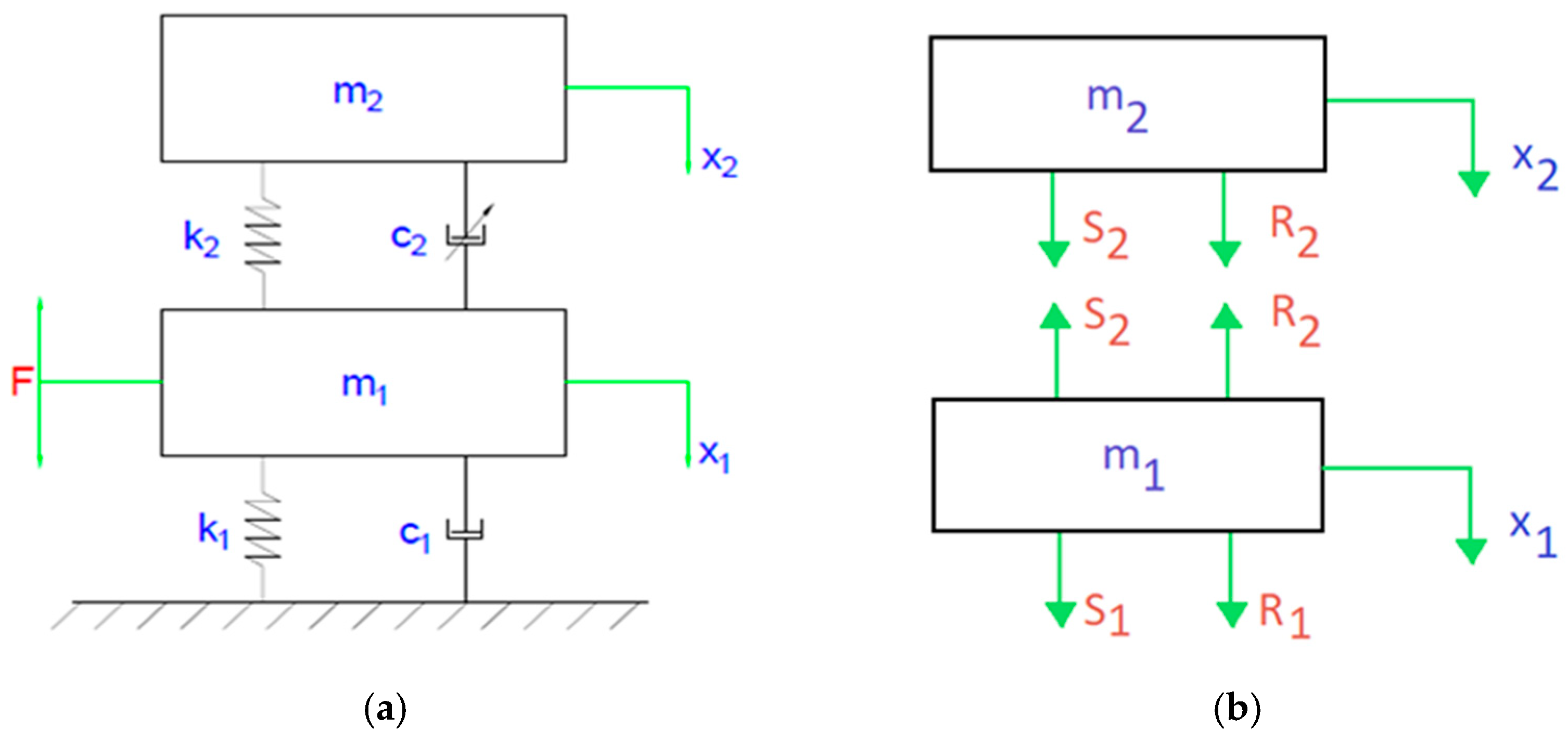
- Even vehicle mass distribution for each wheel.
- Force applied to the wheel is in the system symmetry axis.
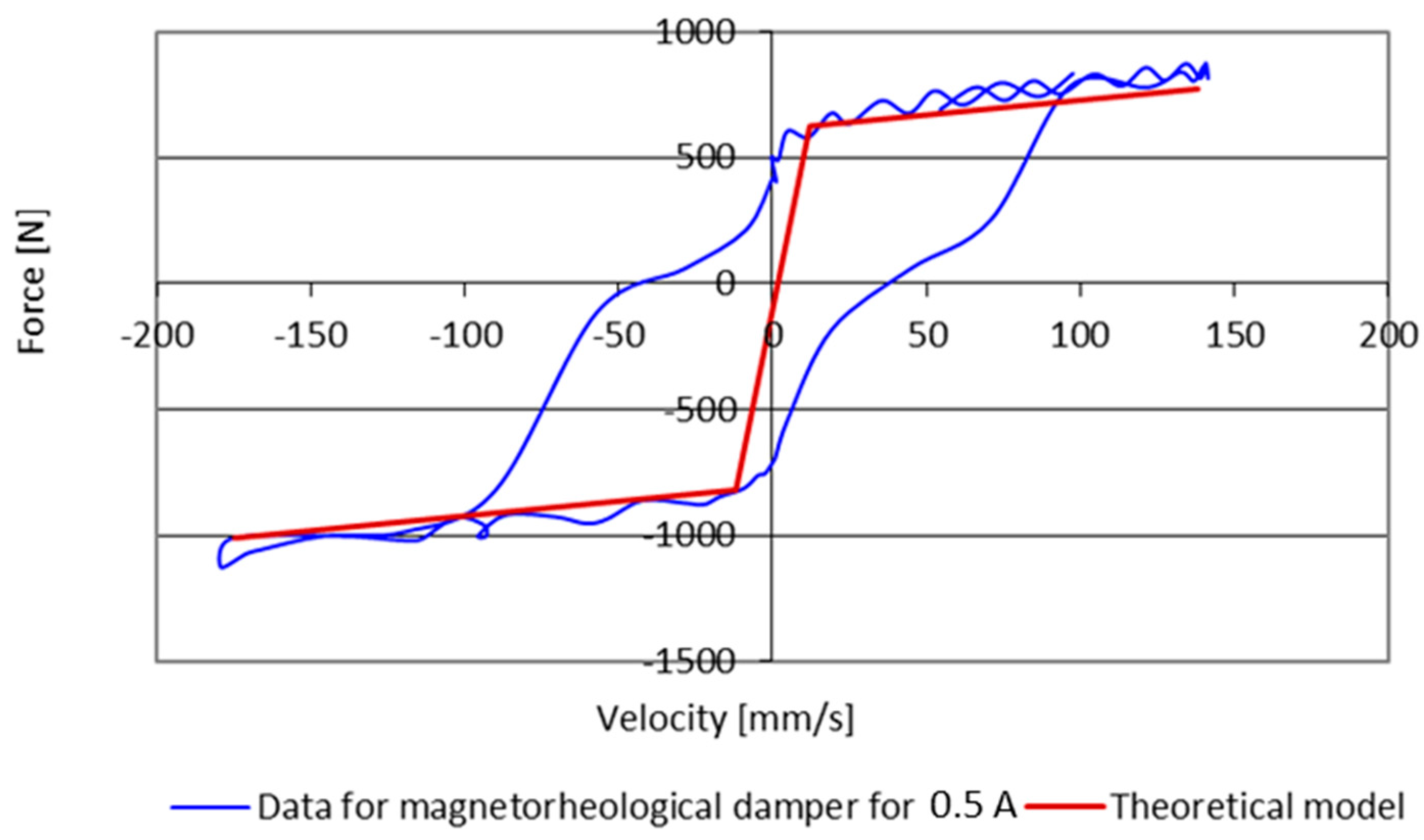
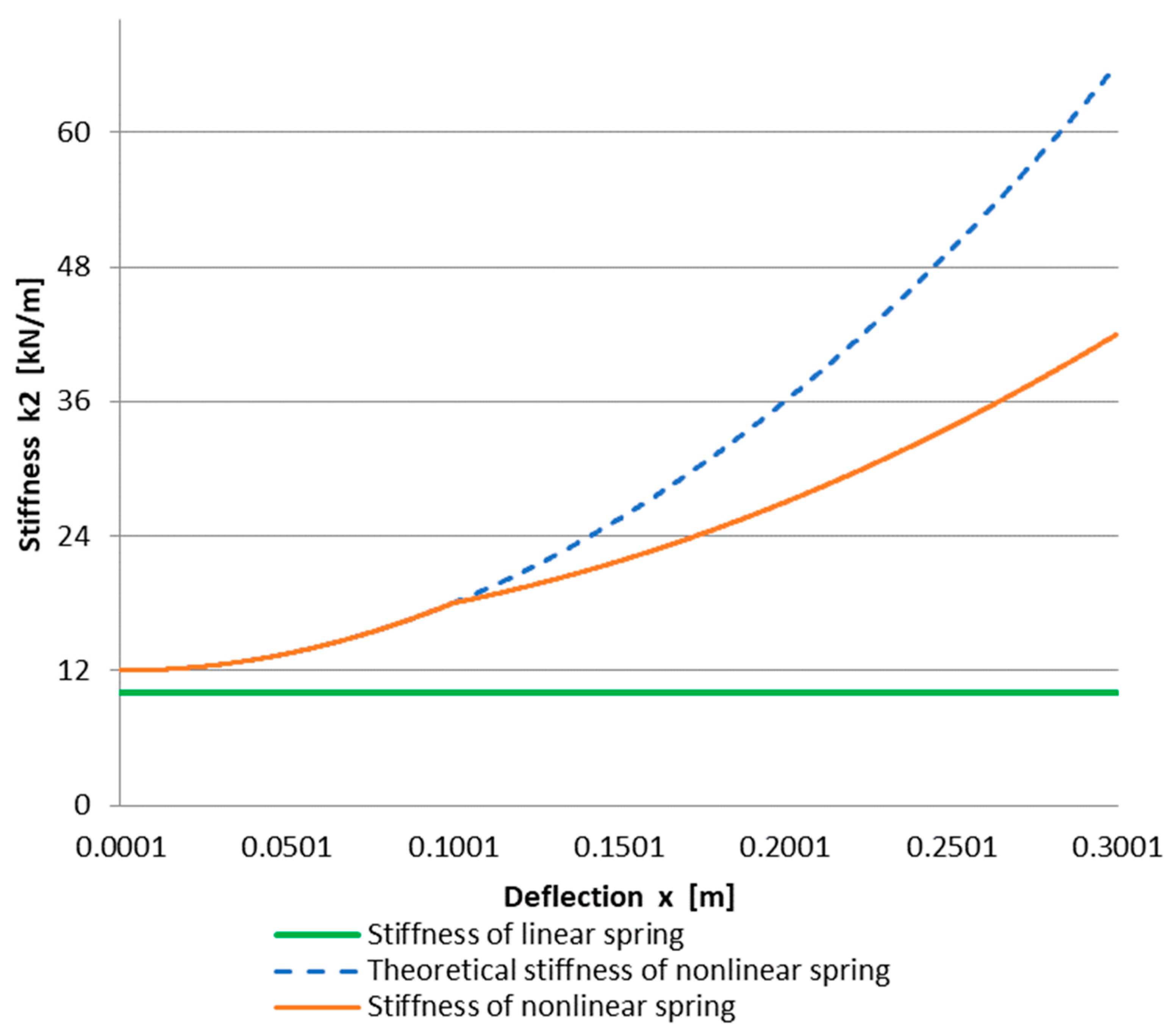
- The model does not take into account any errors in calculated values (Figure 4 shows the already mentioned spring with nonlinear characteristics).
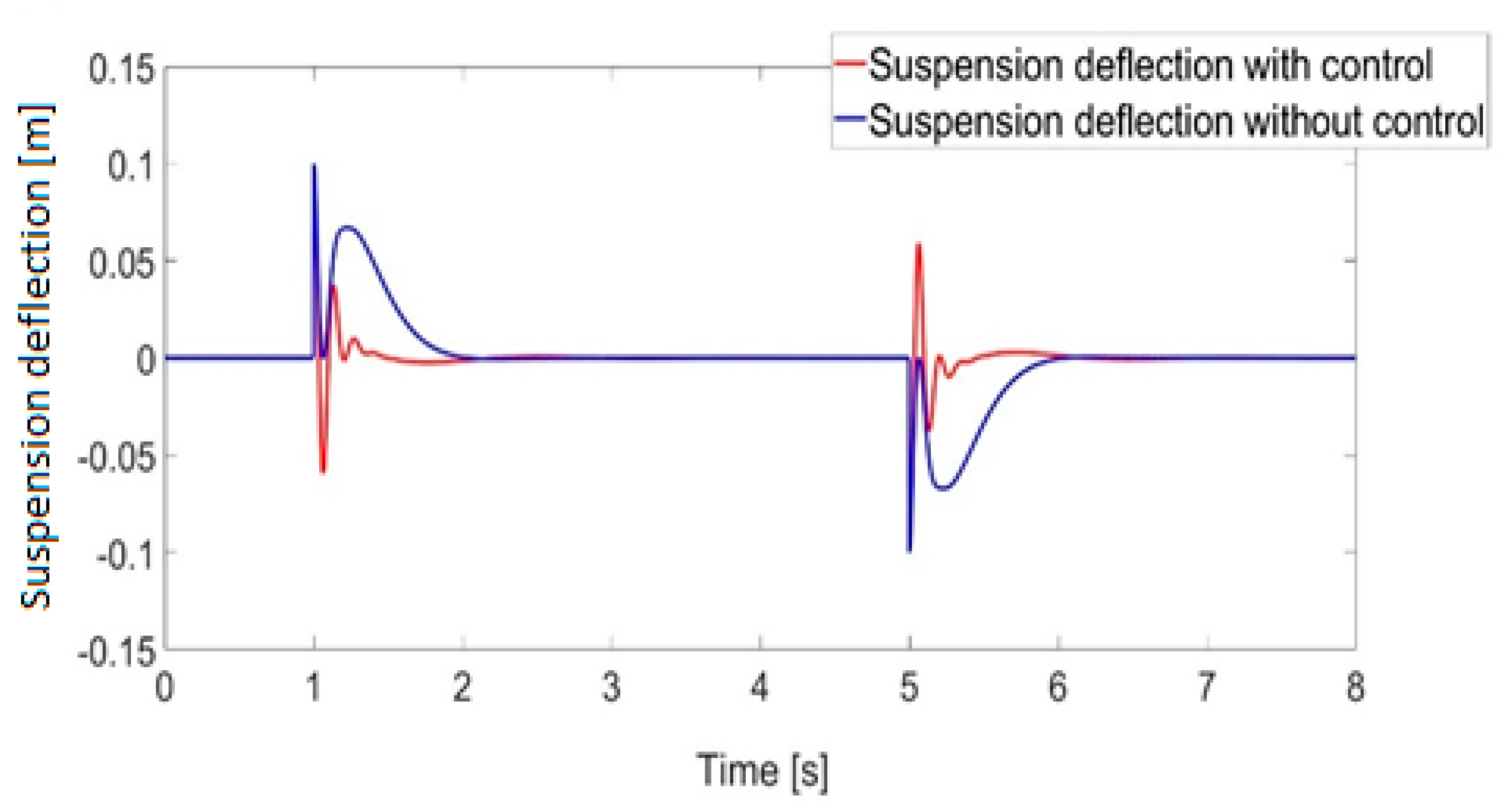
- —the maximum value of displacement of unsprung mass;
- —the maximum value of displacement of the body;
- —basic displacement of the piston; a value of 0.1 (m) was used in the investigation.
5. Simulation Results
6. Conclusions
Author Contributions
Funding
Conflicts of Interest
References
- Grzesikiewicz, W.; Makowski, M. Semi-Active System of the Vehicle Vibration Damping. Appl. Sci. 2021, 11, 4577. [Google Scholar] [CrossRef] [Scilit]
- Olivier, M.; Sohn, J.W. Design and geometric parameter optimization of hybrid magnetorheological fluid damper. J. Mech. Sci. Technol. 2020, 34, 2953–2960. [Google Scholar] [CrossRef] [Scilit]
- Dyke, S.J.; Spencer, B.F., Jr.; Sain, M.K.; Carlson, J.D. Modelling and control of magnetorheological dampers for seismic response reduction. Smart Mater. Struct. 1996, 5, 565. [Google Scholar] [CrossRef] [Scilit]
- Vaiana, N.; Sessa, S.; Rosati, L. A generalized class of uniaxial rate-independent models for simulating asymmetric mechanical hysteresis phenomena. Mech. Syst. Signal Process. 2021, 146, 106984. [Google Scholar] [CrossRef] [Scilit]
- Phu, D.X.; An, J.-H.; Choi, S.-B. A Novel Adaptive PID Controller with Application to Vibration Control of a Semi-Active Vehicle Seat Suspension. Appl. Sci. 2017, 7, 1055. [Google Scholar] [CrossRef] [Scilit]
- Warczek, J.; Burdzik, R.; Konieczny, Ł. The Concept of Autonomous Damper in Vehicle Suspension. In Dynamical Systems in Applications. DSTA 2017; Awrejcewicz, J., Ed.; Springer International Publishing: Berlin/Heidelberg, Germany, 2017; p. 249. [Google Scholar]
- Yoon, D.S.; Kim, D.S.; Choi, S.B. Response time of magnetorheological dampers to current inputs in a semi-active suspension system: Modeling, control and sensitivity analysis. Mech. Syst. Signal Process. 2021, 146, 106999. [Google Scholar] [CrossRef] [Scilit]
- Faraj, R.; Graczykowski, C. Hybrid Prediction Control for self-adaptive fluid-based shock-absorbers. J. Sound Vib. 2019, 449, 427–446. [Google Scholar] [CrossRef] [Scilit]
- Batterbee, D.C.; Sims, N.D. Hardware in the loop simulation (HILS) of magnetorheological damper for vehicle suspension system. J. Syst. Control. Eng. 2007, 221, 265–278. [Google Scholar]
- Heidarian, A.; Wang, X. Review on Seat Suspension System Technology Development. Appl. Sci. 2019, 9, 2834. [Google Scholar] [CrossRef] [Scilit]
- Peng, Y.; Yang, J.; Li, J. Parameter identification of modified Bouc–Wen model and analysis of size effect of magnetorheological dampers. J. Intell. Mater. Syst. Struct. 2018, 29, 1464–1480. [Google Scholar] [CrossRef] [Scilit]
- Karnopp, D.C.; Crosby, M.J. Vibration Control Semi-Active Force Generators. ASME J. Eng. Ind. 1974, 96, 619–626. [Google Scholar] [CrossRef] [Scilit]
- Karnopp, D.C. Active damping in road vehicle suspension system. Veh. Syst. Dyn. 1983, 12, 183–188. [Google Scholar] [CrossRef] [Scilit]
- Benaoumeur, I.; Benchikh, L.; Amar, H.; Elhachimi, H.; Ahmed-Foitih, Z. Backstepping Approach for Autonomous Mobile Robot Trajectory Tracking. Indones. J. Electr. Eng. Comput. Sci. 2016, 2, 478–485. [Google Scholar] [CrossRef] [Scilit]
- Fossen, T.I.; Strand, J.P. Tutorial on nonlinear backstepping. Applications to ship control. MIC 1999, 20, 83–135. [Google Scholar] [CrossRef] [Scilit]
- Tanner, H.G.; Kyriakopoulos, K.J. Discontinuous Backstepping for Stabilization of Nonholonomic Mobile Robots. In Proceedings of the 2002 IEEE International Conference on Robotics and Automation (Cat. No. 02CH37292), Washington, WA, USA, 11–15 May 2002; IEEE: New York, NY, USA, 2002; pp. 25–38. [Google Scholar] [CrossRef] [Scilit]
- Yilmaz, C.T.; Basturk, H.I. Adaptive Backstepping Control Design for Active Suspension Systems with Output Feedback. In Proceedings of the American Control Conference (ACC), Philadelphia, PA, USA, 10–12 July 2019; pp. 1712–1717. [Google Scholar] [CrossRef] [Scilit]
- Vaiana, N.; Capuano, R.; Rosati, L. Evaluation of path-dependent work and internal energy change for hysteretic mechanical systems. Mech. Syst. Signal Process 2016, 186, 109862. [Google Scholar] [CrossRef] [Scilit]
- Su, X.; Lin, B.; Liu, S. Composite adaptive backstepping controller design and the energy calculation for active suspension system. Sci. Prog. 2021, 104. [Google Scholar] [CrossRef] [Scilit] [PubMed]
- Raizada, A.; Singru, P.; Krishnakumar, V.; Raj, V. Development of an experimental model for a magnetorheological damper using artificial neural networks (Levenberg-Marquardt Algorithm). Adv. Acoust. Vib. 2016, 2016, 1–6. [Google Scholar] [CrossRef] [Scilit]
- Baratta, A.; Corbi, I.; Corbi, O.; Barros, R.C.; Bairrão, R. Shaking Table Experimental Researches Aimed at the Protection of Structures Subject to Dynamic Loading. Open Constr. Build. Technol. J. 2012, 6, 355–360. [Google Scholar] [CrossRef] [Scilit]
- Zhao, Y.J.; Zhou, D.; Huang, Z.; Deng, L.Y. Improved dynamic matrix predictive control for structural vibration reduction of spatial latticed structures with variable time delay. Eng. Mech. 2010, 27, 108543. [Google Scholar] [CrossRef] [Scilit]
- Chen, C.X.; Xie, Y.X.; Lan, Y.H. Backstepping control of speed sensorless permanent magnet synchronous motor based on slide model observer. Int. J. Autom. Comput. 2015, 12, 149–155. [Google Scholar] [CrossRef] [Scilit]
- Liu, J.; Eker, J.; Janneck, J.W.; Liu, X.; Lee, E.A. Fellow Actor-Oriented Control System Design: A Responsible Framework Perspective. IEEE Trans. Control Syst. Technol. 2003, 12, 78–89. [Google Scholar]
- Skjetne, R.; Thor, I.; Fossen, T.I. On Integral Control in Backstepping: Analysis of Different Techniques. In Proceedings of the 2004 American Control Conference, Boston, MA, USA, 30 June–2 July 2004; pp. 59–67. [Google Scholar]
- Santibanez, V.; Kelly, R.; Sandoval, J. Control of the Inertia Wheel Pendulum by Bounded Torques. In Proceedings of the 44th IEEE Conference on Decision and Control, and European Control Conference ECC0̕5, Seville, Spain, 12–15 December 2005; IEEE: Piscataway, NJ, USA; pp. 34–62. [Google Scholar]
- Available online: http://www.lordfulfillment.com/upload/DS7016.pdf (accessed on 20 December 2022).
- Salmanpour, M.S.; Khodaei, Z.S.; Aliabadi, M.H. Towards real-time structural health monitoring damage detection without user input. In Proceedings of the ECCOMAS Congress 2016, Crete Island, Greece, 5–10 June 2016. [Google Scholar]
- Yazdi, H.A.; Saberi, H.; Hatami, F. Designing optimal tuned mass dampers using improved harmony search algorithm. Adv. Struct. Eng. 2016, 19, 1620–1636. [Google Scholar] [CrossRef] [Scilit]
- Suresh, B.; Chee, K.S. Structural impedance based damage diagnosis by piezo-transducers. Earthq. Eng. Struct. Dyn. 2003, 32, 1897–1916. [Google Scholar]
- Chong, J.W.; Kim, Y.; Chon, K.H. Nonlinear multiclass support vector machine–based health monitoring system for buildings employing magnetorheological dampers. J. Intell. Mater. Syst. Struct. 2014, 25, 1456–1468. [Google Scholar] [CrossRef] [Scilit]
- Vaiana, N.; Rosati, L. Classification and unified phenomenological modeling of complex uniaxial rate-independent hysteretic responses. Mech. Syst. Signal Process. 2023, 182, 109539. [Google Scholar] [CrossRef] [Scilit]
- Jackson, M.I.; Yeadon, M.R.; Hiley, M.J. Modeling friction to incorporate sliding and stiction: Application to the contact phase of gymnastics vaulting. IFMBE Proc. 2010, 31, 236–239. [Google Scholar]
- Lim, Y.Y.; Bhalla, S.; Soh, C.K. Structural identification and damage diagnosis using self-sensing piezo-impedance transducers. Smart Mater. Struct. 2006, 15, 987–995. [Google Scholar] [CrossRef] [Scilit]
- Yi, T.H.; Li, H.N.; Sun, H.M. Multi-stage structural damage diagnosis method based on “energy-damage” theory. Smart Struct. Syst. 2013, 12, 345–361. [Google Scholar] [CrossRef] [Scilit]
- Buchacz, A.; Płaczek, M.; Wróbel, A. Modelling of passive vibration damping using piezoelectric transducers—The mathematical model. Eksploat. Niezawodn. Maint. Reliab. 2014, 16, 301–306. [Google Scholar]
- Makowski, M.; Knap, L. Study of a Controlled Piezoelectric Damper. Sensors 2021, 21, 3509. [Google Scholar] [CrossRef] [Scilit]
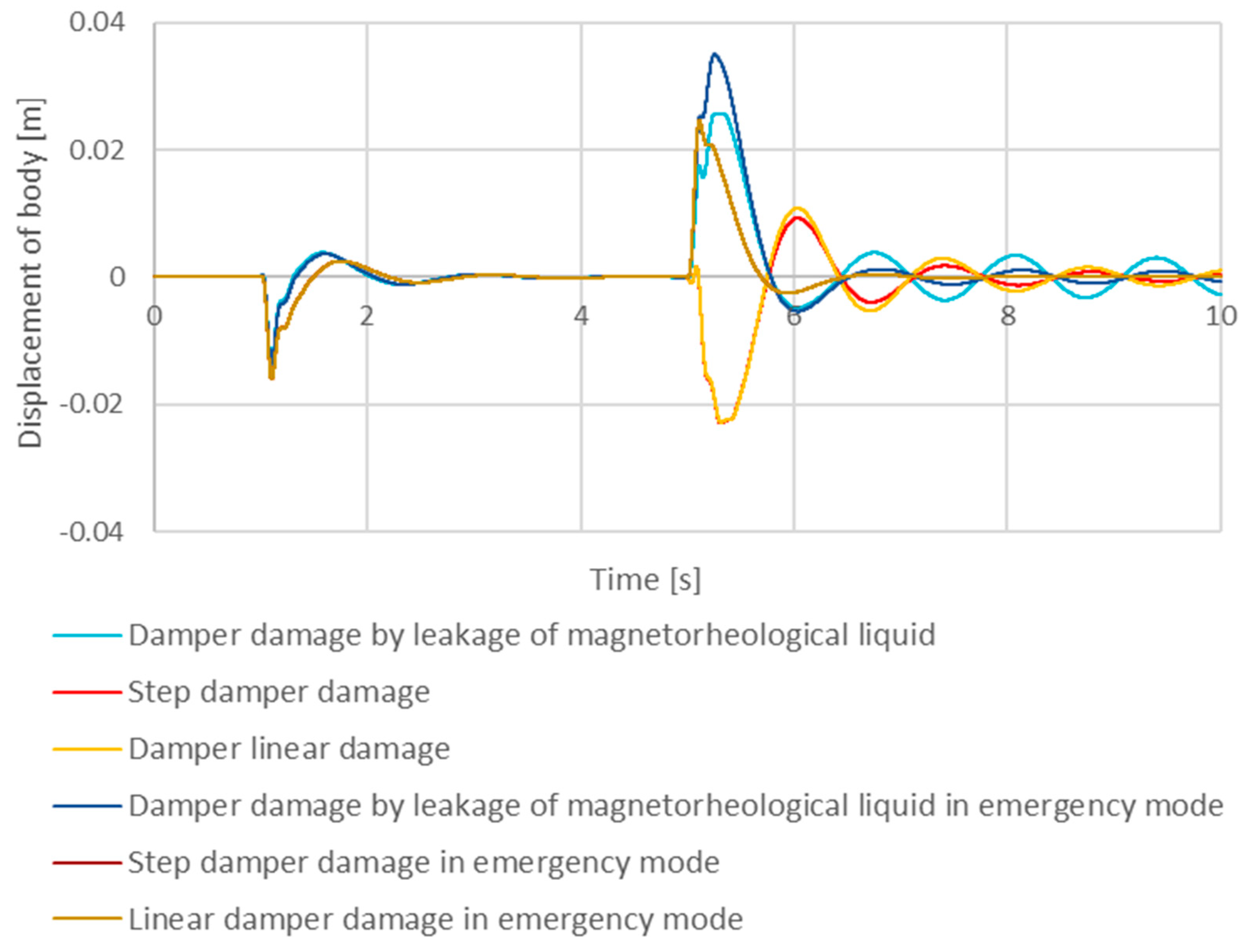
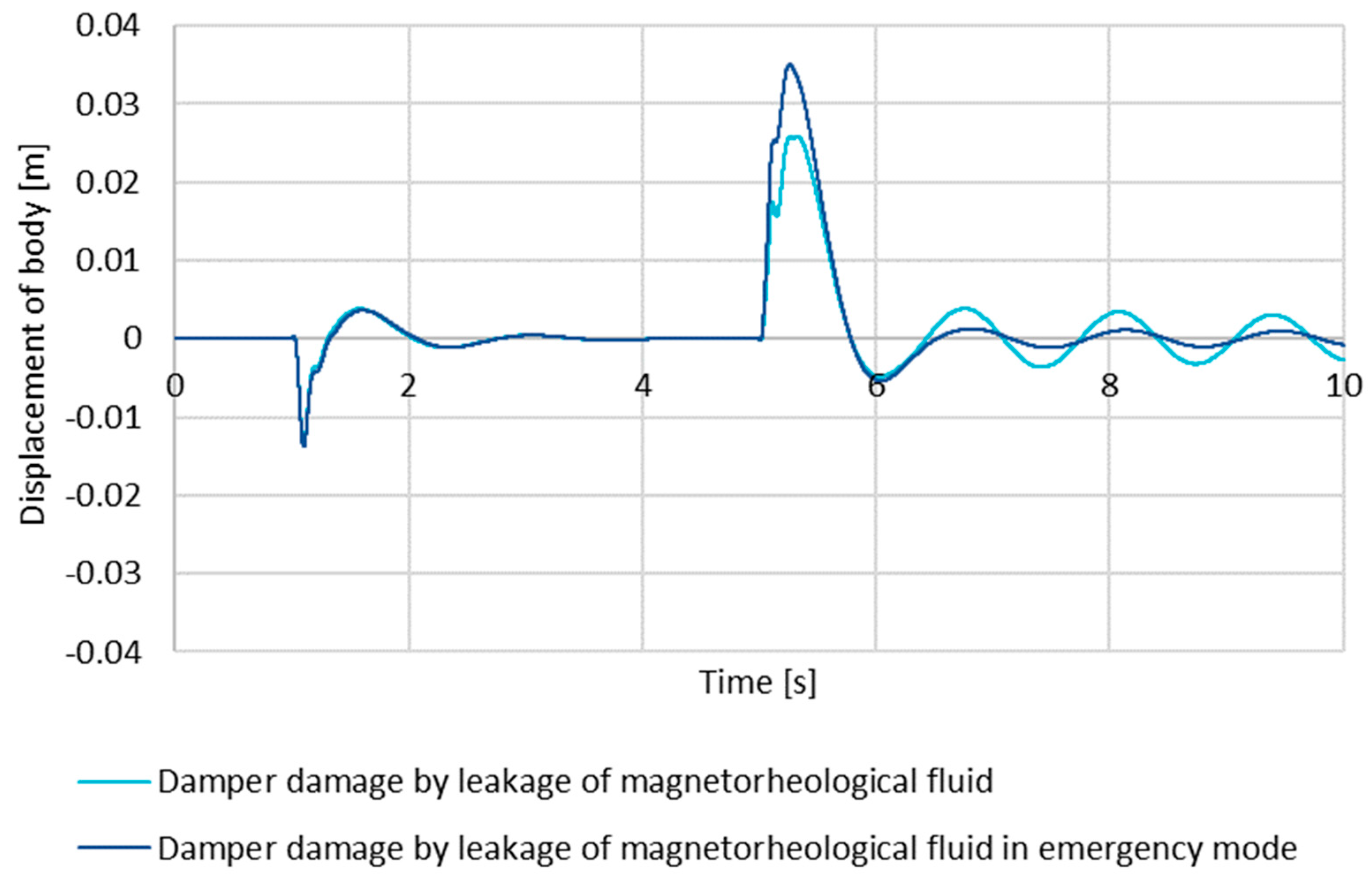
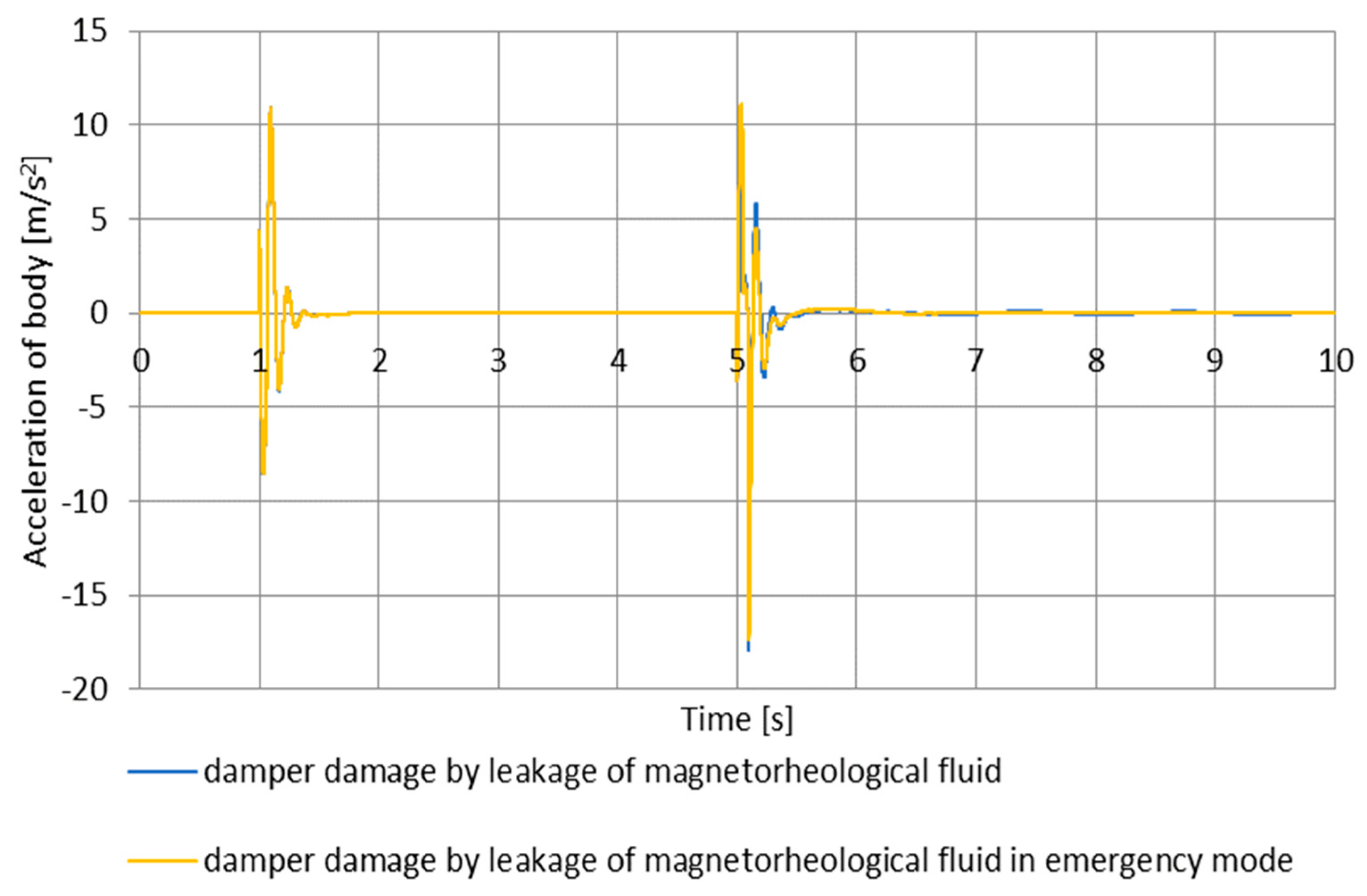
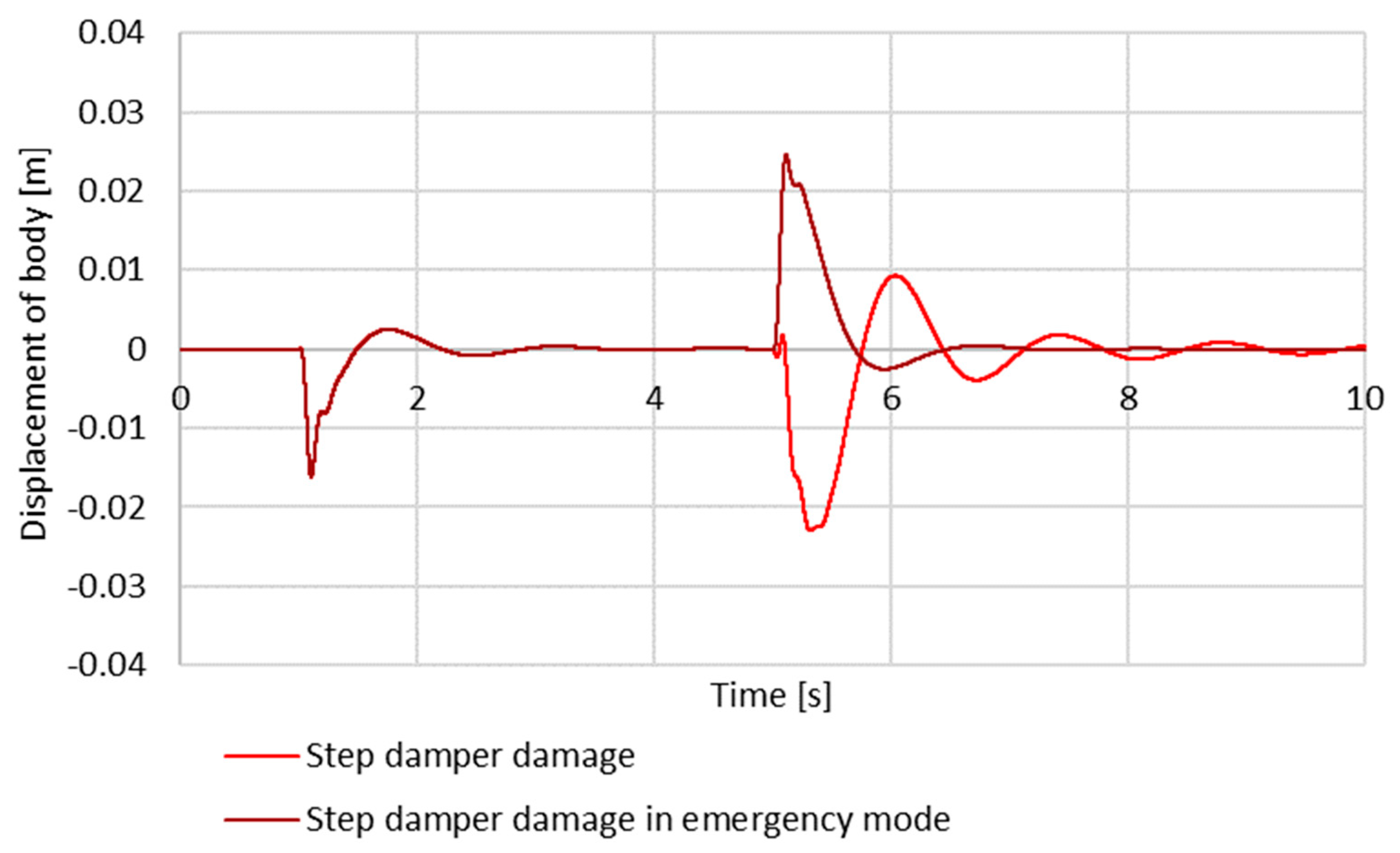
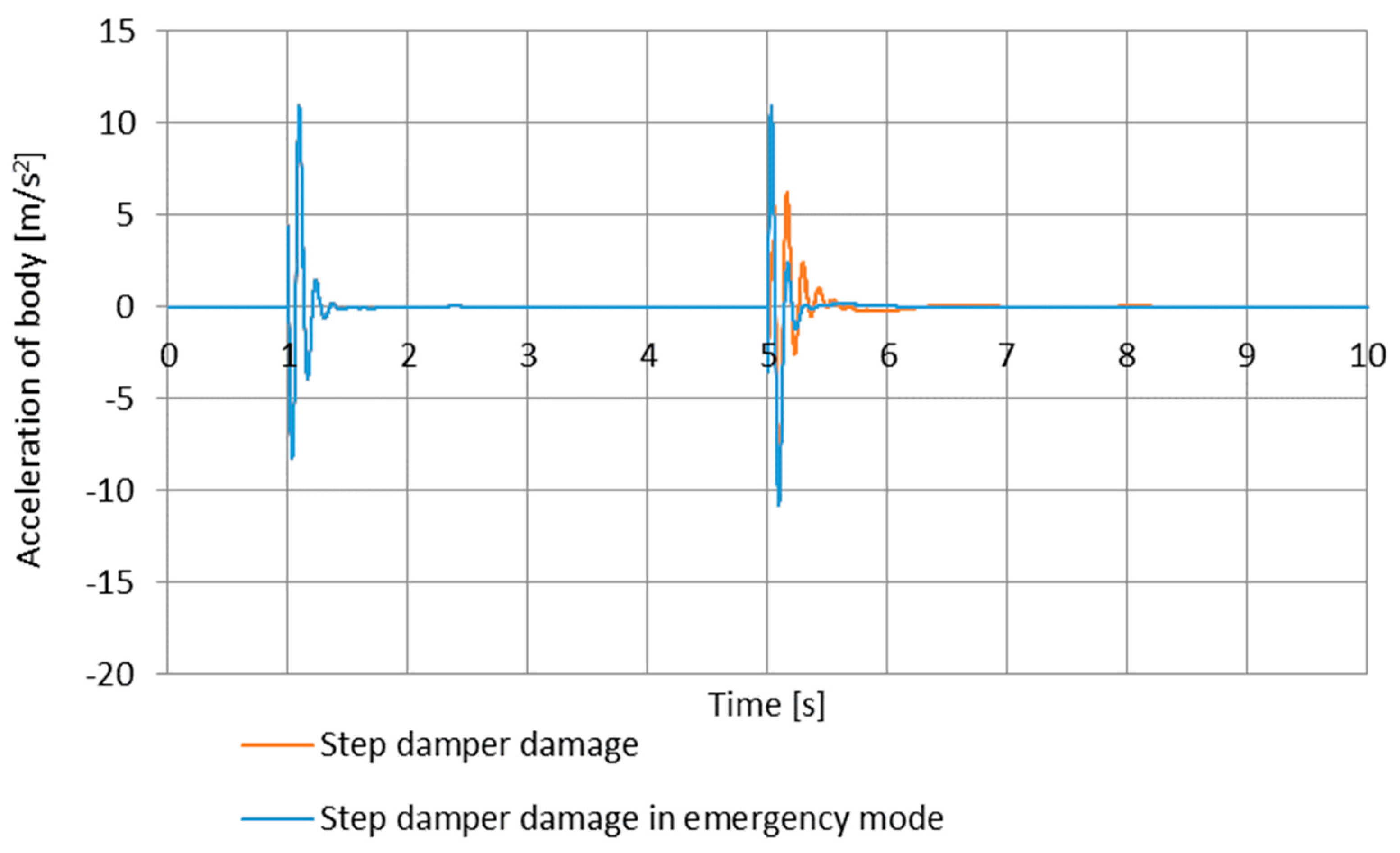
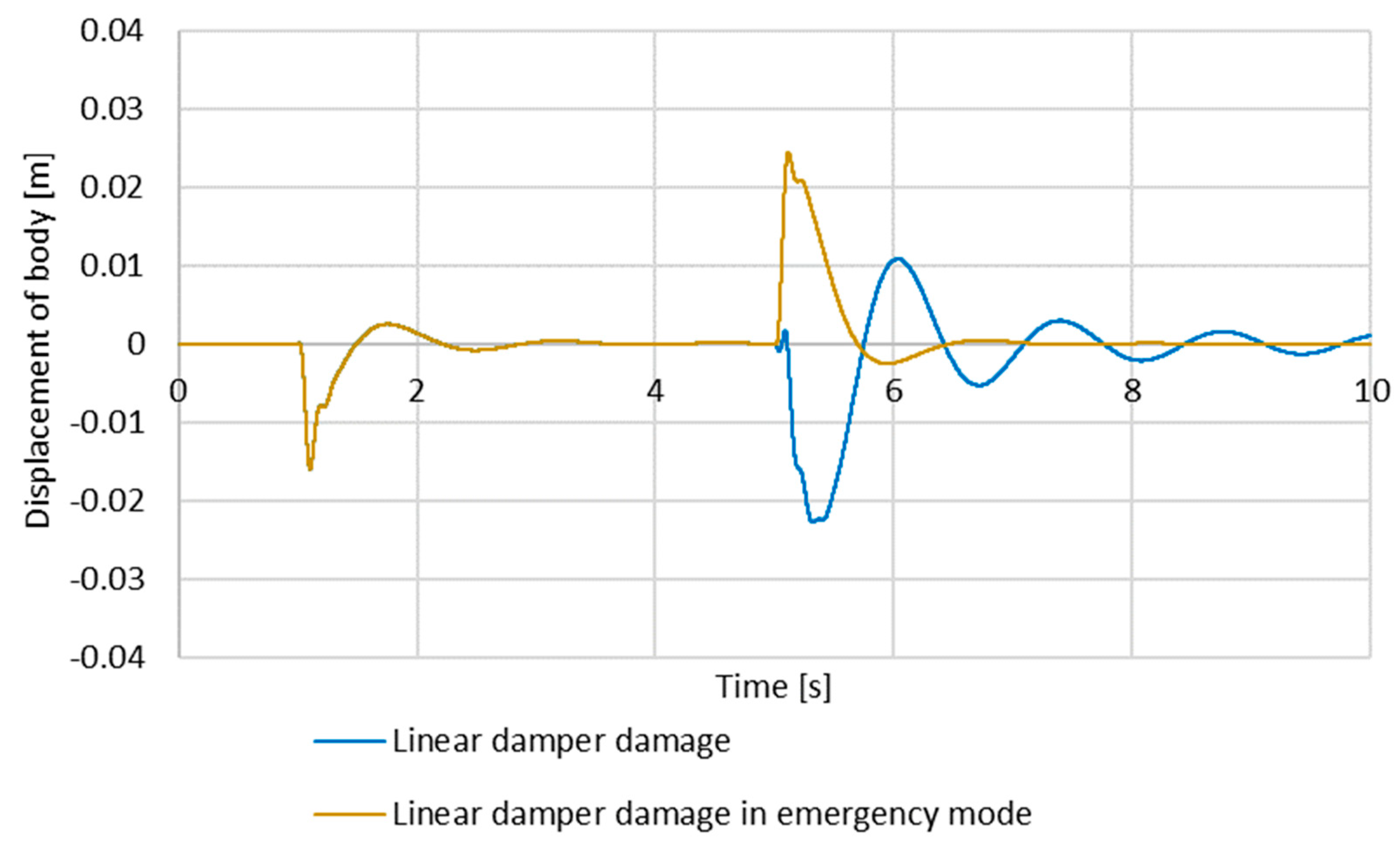
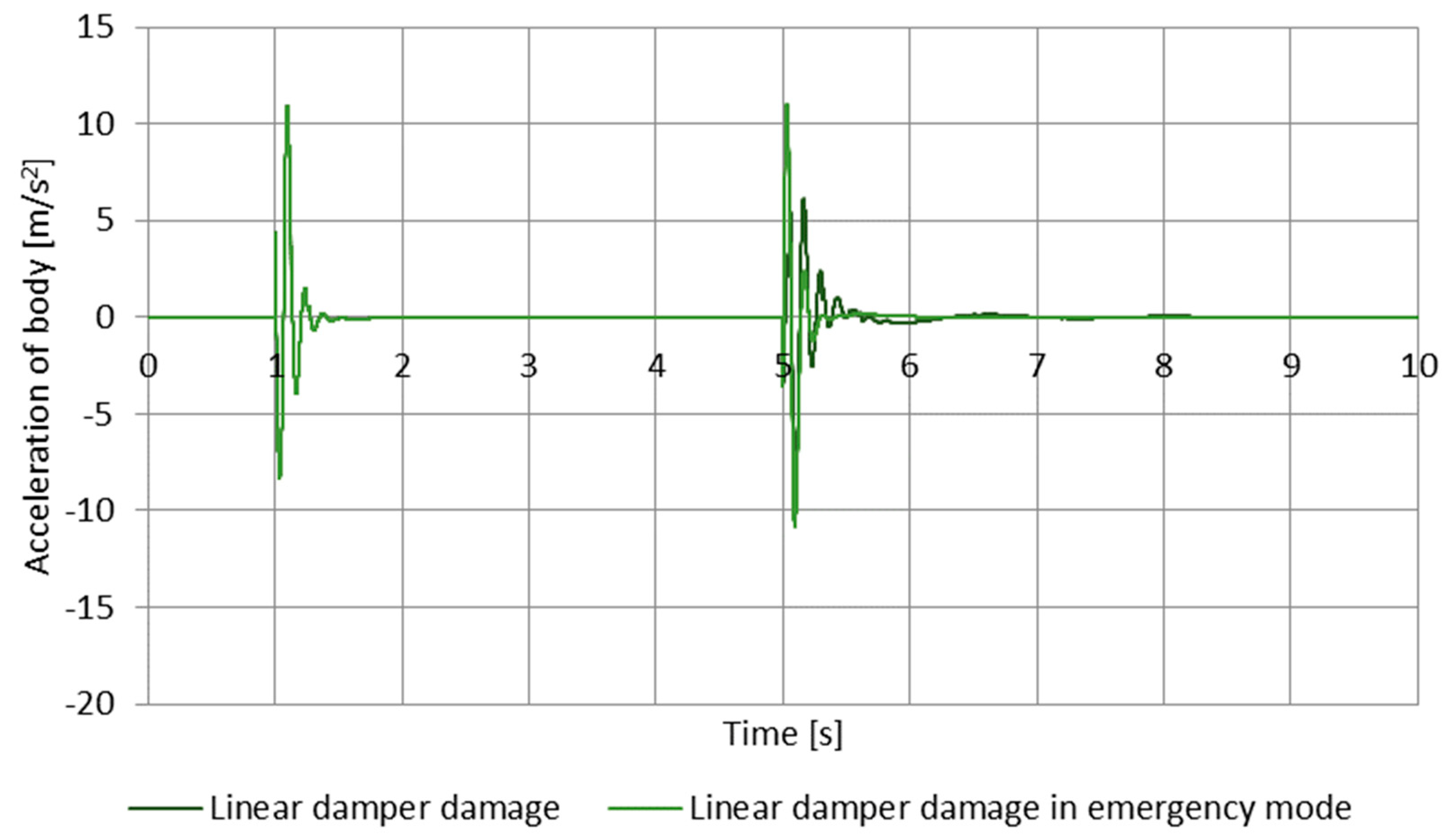
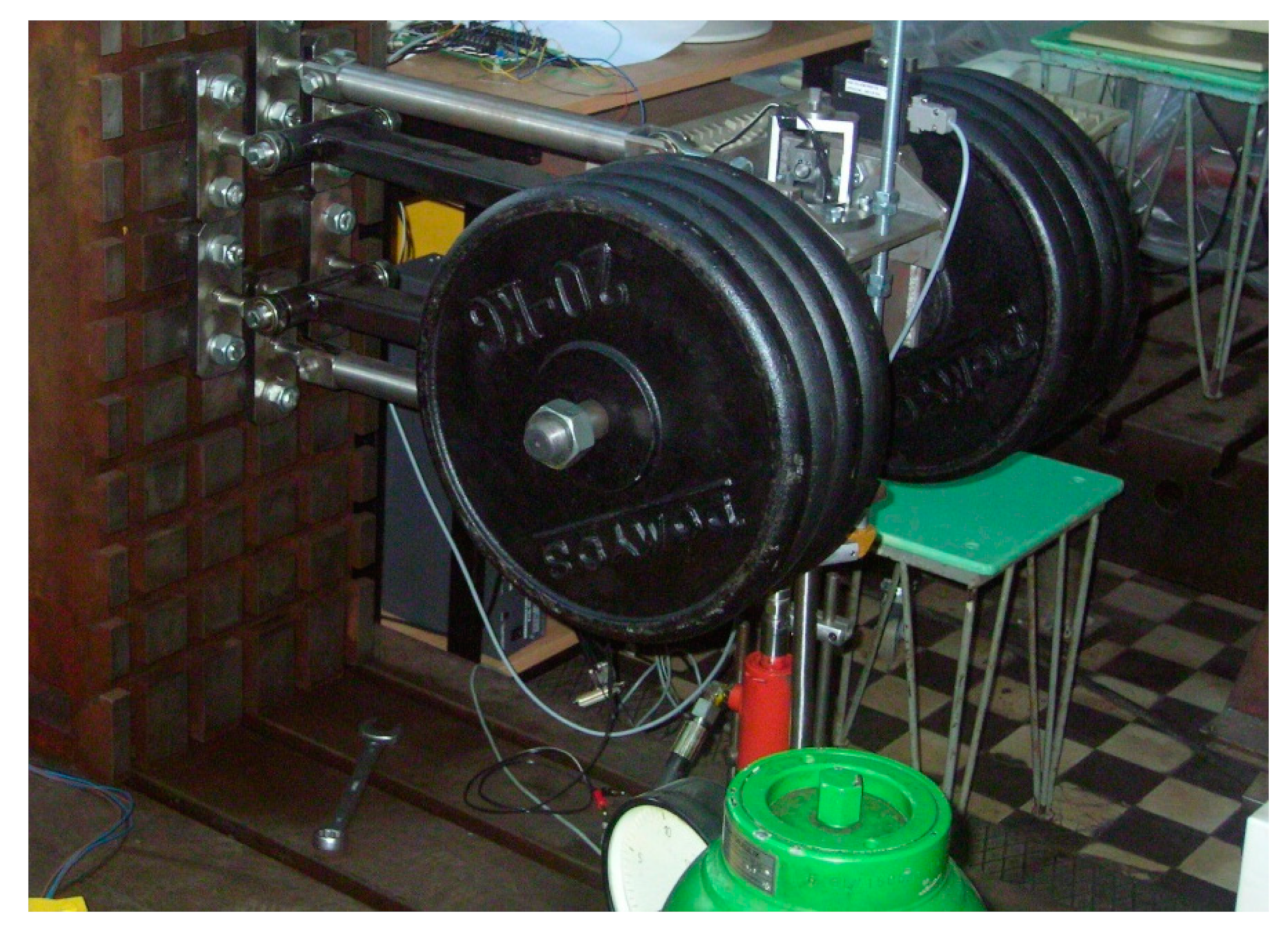

| Body | Stabilization Time [s] | ||
|---|---|---|---|
| Leakage from magnetorheological damper | 0.025 | 17.94 | 31 |
| Damper linear damage | 0.022 | 10.93 | 36 |
| Damper step damage | 0.022 | 10.93 | 40 |
| Leakage from magnetorheological damper in emergency mode | 0.037 | 19.44 | 8.75 |
| Linear damage of damper in emergency mode | 0.024 | 10.97 | 8.25 |
| Step damage of damper in emergency mode | 0.040 | 12.15 | 8.45 |
Disclaimer/Publisher’s Note: The statements, opinions and data contained in all publications are solely those of the individual author(s) and contributor(s) and not of MDPI and/or the editor(s). MDPI and/or the editor(s) disclaim responsibility for any injury to people or property resulting from any ideas, methods, instructions or products referred to in the content. |
© 2023 by the authors. Licensee MDPI, Basel, Switzerland. This article is an open access article distributed under the terms and conditions of the Creative Commons Attribution (CC BY) license (https://creativecommons.org/licenses/by/4.0/).
Share and Cite
Słomczyński, M.; Radkowski, S.; Makowski, M. Model of a Quarter Car Suspension with a Damper Containing Magnetorheological Fluid and with Damaged Parts Controlled by Backstepping Method. Energies 2023, 16, 3044. https://doi.org/10.3390/en16073044
Słomczyński M, Radkowski S, Makowski M. Model of a Quarter Car Suspension with a Damper Containing Magnetorheological Fluid and with Damaged Parts Controlled by Backstepping Method. Energies. 2023; 16(7):3044. https://doi.org/10.3390/en16073044
Chicago/Turabian StyleSłomczyński, Maciej, Stanisław Radkowski, and Michał Makowski. 2023. "Model of a Quarter Car Suspension with a Damper Containing Magnetorheological Fluid and with Damaged Parts Controlled by Backstepping Method" Energies 16, no. 7: 3044. https://doi.org/10.3390/en16073044
APA StyleSłomczyński, M., Radkowski, S., & Makowski, M. (2023). Model of a Quarter Car Suspension with a Damper Containing Magnetorheological Fluid and with Damaged Parts Controlled by Backstepping Method. Energies, 16(7), 3044. https://doi.org/10.3390/en16073044



