Article

Analysis of Cavity PD Characteristics’ Sensitivity to Changes in the Supply Voltage Frequency


by
Tapiwa Venge
* and
Cuthbert Nyamupangedengu
*
School of Electrical and Information Engineering (EIE), Faculty of Engineering and the Built Environment (EBE), University of the Witwatersrand Johannesburg, Private Bag 3, Johannesburg 2050, South Africa
*
Authors to whom correspondence should be addressed.
Energies 2021, 14(2), 478; https://doi.org/10.3390/en14020478
Submission received: 3 December 2020 / Revised: 22 December 2020 / Accepted: 13 January 2021 / Published: 18 January 2021
(This article belongs to the Special Issue Partial Discharge Monitoring and Analysis)

Abstract

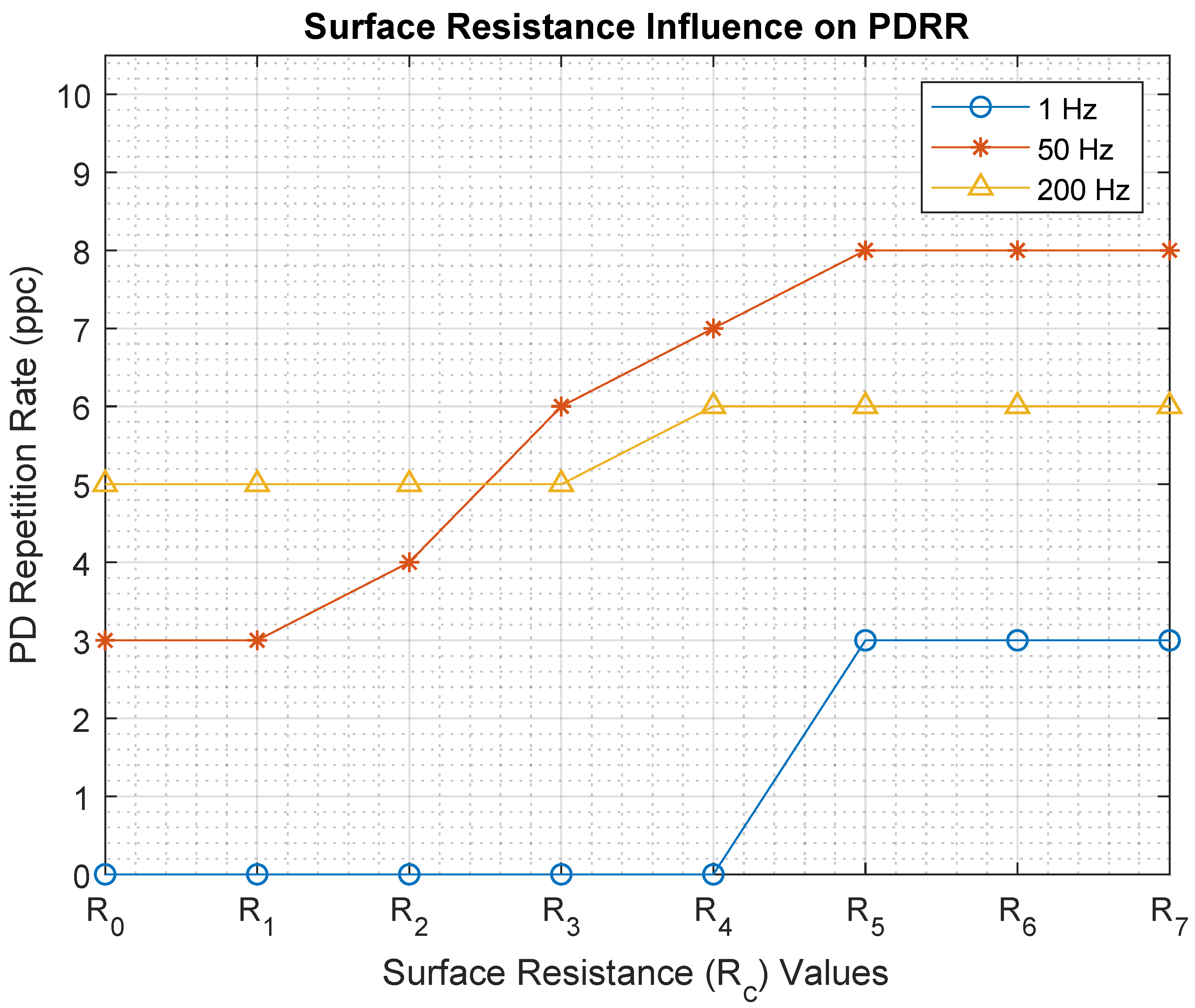
The supply voltage frequency effect on partial discharge (PD) phenomena has continued to draw research interest. Although most high voltage equipment operates at power frequency (50/60 Hz), testing is often done at different frequencies for various reasons. Despite some agreements and inconsistencies for the research findings of PD activity’s frequency dependence, there has been consensus on the recognition of the discharge mechanism parameters that influence how the supply voltage frequency affects PD activity. These parameters include statistical time lag, discharge area surface conductivity, and the residual charge decay. In this paper, a 3-capacitor model (ABC) is used to simulate how the changes in the discharge mechanism parameters influence PD characteristics as a function of the supply voltage frequency. The findings are that the phase-resolved partial discharge pattern (PRPDP) and PD repetition rate (PDRR) characteristics are more sensitive to variations in the probability of the seed electron availability at higher frequencies of the supply voltage. The opposite trend is observed for the cavity surface resistance. At lower resistance of cavity surface, the PRPDP and PDRR characteristics are more sensitive to changes in the supply voltage frequency than at higher resistances. The paper also confirms that incorporating equivalent resistances in the ABC model makes it more authentic than the model comprising of capacitors only.
Keywords: 3-capacitor model; ABC model; frequent dependent mechanisms; partial discharges; statistical time lag; supply voltage frequency; surface conductivity 3-capacitor model; ABC model; frequent dependent mechanisms; partial discharges; statistical time lag; supply voltage frequency; surface conductivity