Article

Detection of Knocking Combustion Using the Continuous Wavelet Transformation and a Convolutional Neural Network


1
Institute of Internal Combustion Engines and Thermodynamics, Graz University of Technology, 8010 Graz, Austria
2
Know-Center GmbH, Research Center for Data-Driven Business & Big Data Analytics, 8010 Graz, Austria
3
LEC GmbH, Large Engine Competence Center, 8010 Graz, Austria
*
Author to whom correspondence should be addressed.
Energies 2021, 14(2), 439; https://doi.org/10.3390/en14020439
Submission received: 21 December 2020 / Revised: 11 January 2021 / Accepted: 12 January 2021 / Published: 15 January 2021

Abstract

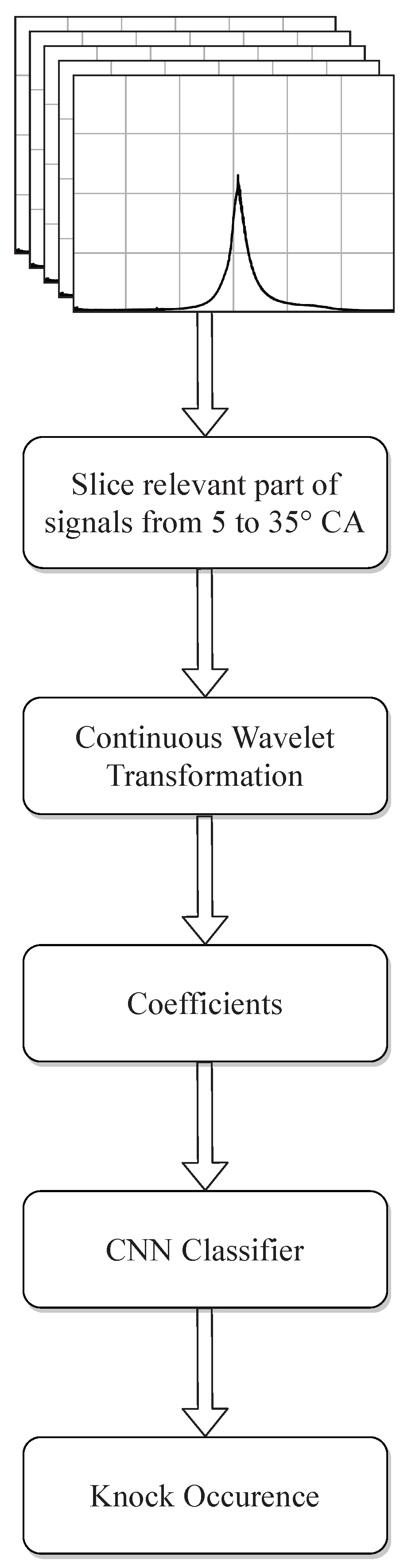
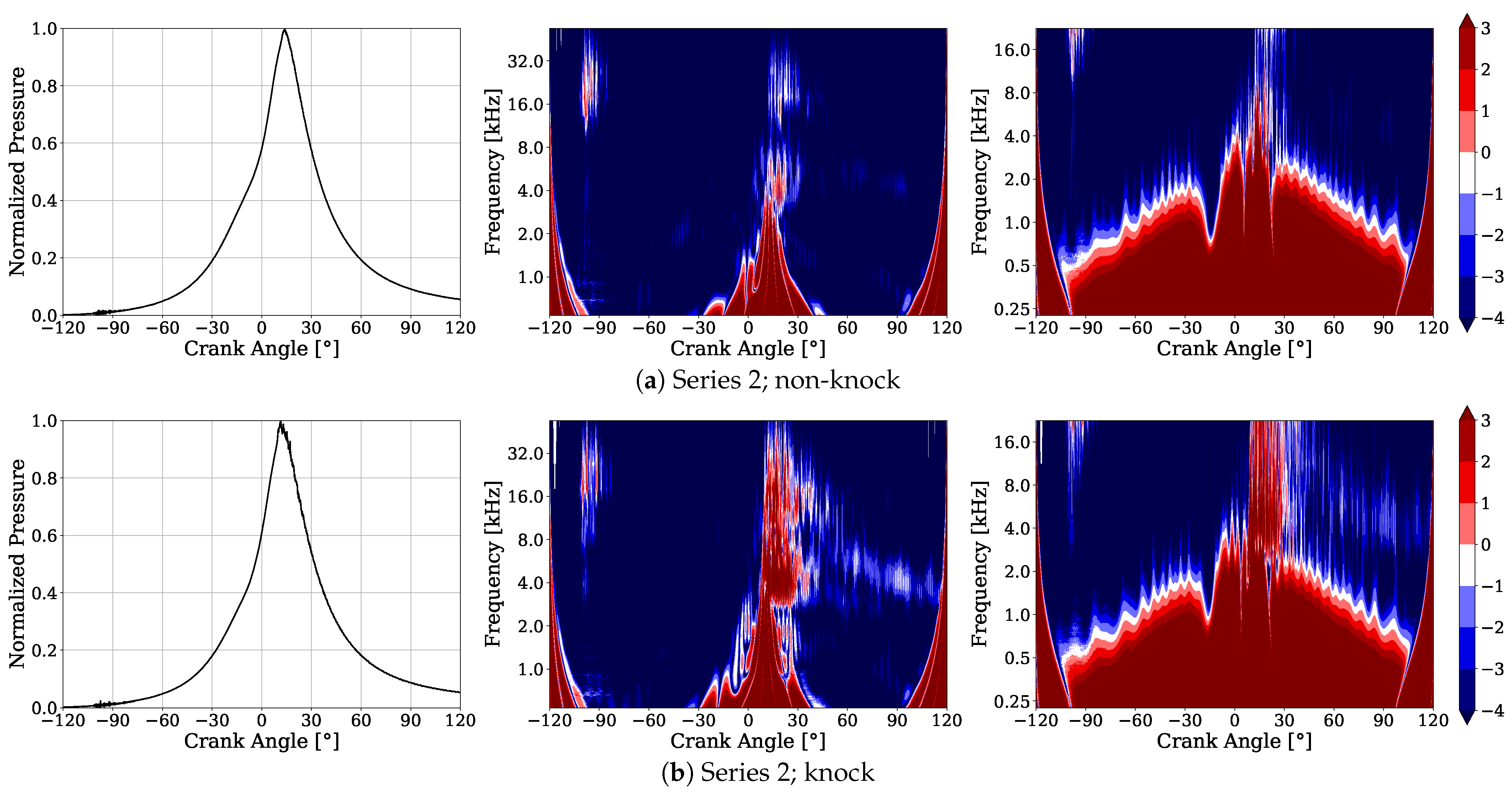
The phenomenon of knock is an abnormal combustion occurring in spark-ignition (SI) engines and forms a barrier that prevents an increase in thermal efficiency while simultaneously reducing CO2 emissions. Since knocking combustion is highly stochastic, a cyclic analysis of in-cylinder pressure is necessary. In this study we propose an approach for efficient and robust detection and identification of knocking combustion in three different internal combustion engines. The proposed methodology includes a signal processing technique, called continuous wavelet transformation (CWT), which provides a simultaneous analysis of the in-cylinder pressure traces in the time and frequency domains with coefficients. These coefficients serve as input for a convolutional neural network (CNN) which extracts distinctive features and performs an image recognition task in order to distinguish between non-knock and knock. The results revealed the following: (i) The CWT delivered a stable and effective feature space with the coefficients that represents the unique time-frequency pattern of each individual in-cylinder pressure cycle; (ii) the proposed approach was superior to the state-of-the-art threshold value exceeded (TVE) method with a maximum amplitude pressure oscillation (MAPO) criterion improving the overall accuracy by 6.15 percentage points (up to 92.62%); and (iii) The CWT + CNN method does not require calibrating threshold values for different engines or operating conditions as long as enough and diverse data is used to train the neural network.
Keywords: knocking combustion; SI engines; continuous wavelet transformation; convolutional neural networks; pressure trace; time series knocking combustion; SI engines; continuous wavelet transformation; convolutional neural networks; pressure trace; time series