Article

Exploring the Distribution of Traffic Flow for Shared Human and Autonomous Vehicle Roads
1
School of Transportation Science and Engineering, Harbin Institute of Technology, Harbin 150090, China
2
Department of Civil and Environmental Engineering, University of Macau, Taipa, Macau 999078, China
*
Author to whom correspondence should be addressed.
Energies 2021, 14(12), 3425; https://doi.org/10.3390/en14123425
Submission received: 2 May 2021 / Revised: 4 June 2021 / Accepted: 7 June 2021 / Published: 10 June 2021
(This article belongs to the Section G1: Smart Cities and Urban Management)

Abstract

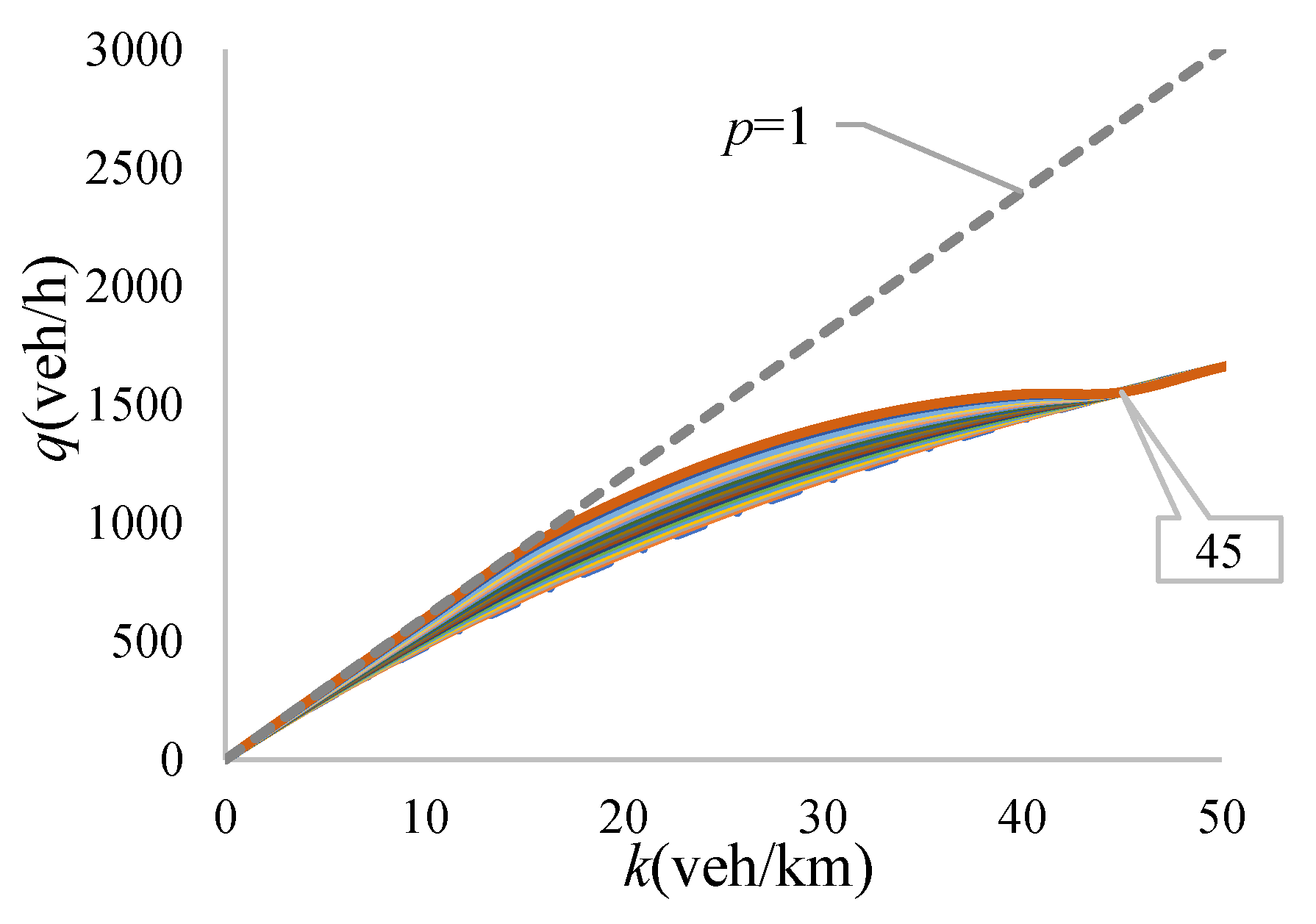
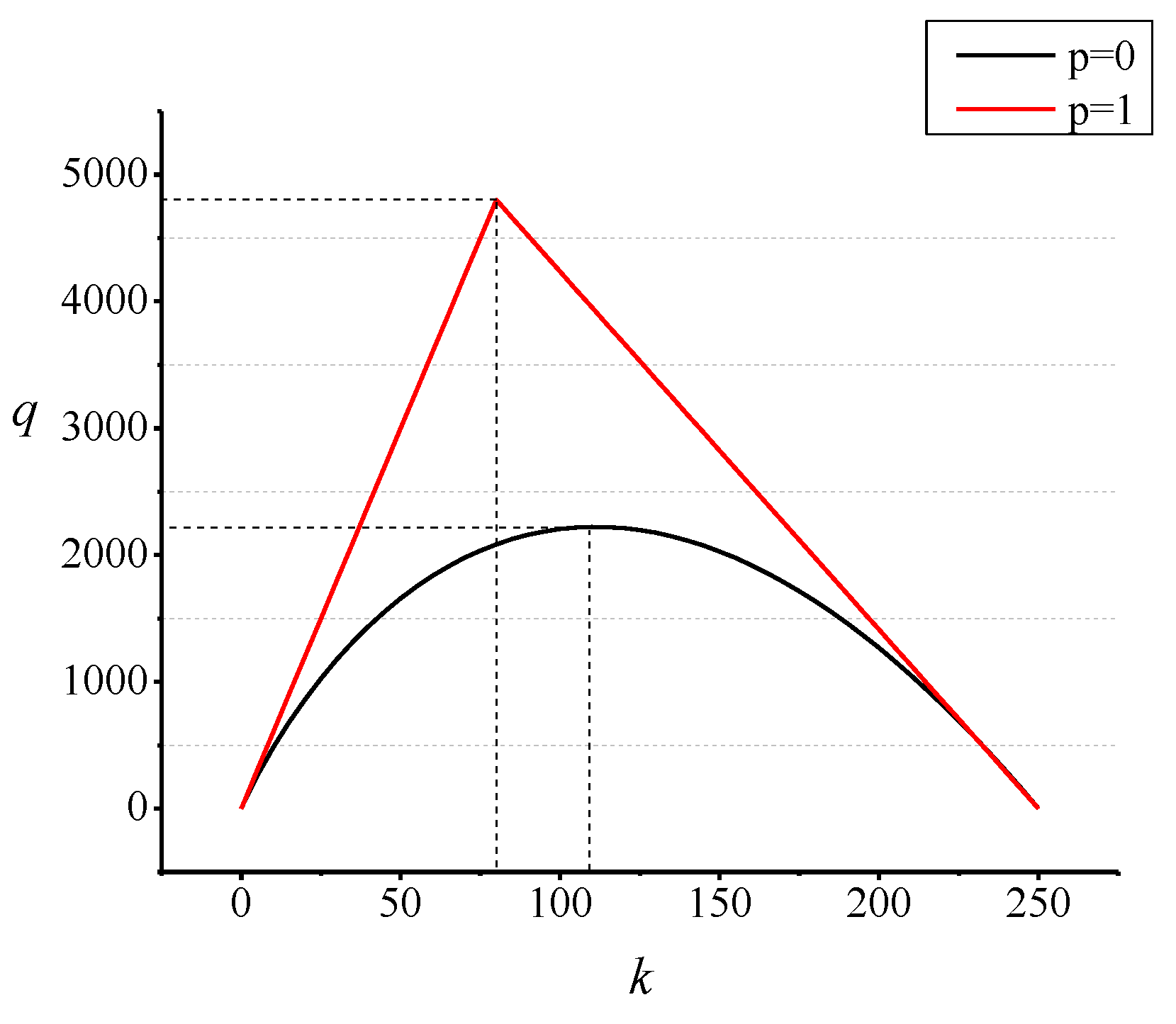
In order to explore the changes that autonomous vehicles would bring to the current traffic system, we analyze the car-following behavior of different traffic scenarios based on an anti-collision theory and establish a traffic flow model with an arbitrary proportion (p) of autonomous vehicles. Using calculus and difference methods, a speed transformation model is established which could make the autonomous/human-driven vehicles maintain synchronized speed changes. Based on multi-hydrodynamic theory, a mixed traffic flow model capable of numerical calculation is established to predict the changes in traffic flow under different proportions of autonomous vehicles, then obtain the redistribution characteristics of traffic flow. Results show that the reaction time of autonomous vehicles has a decisive influence on traffic capacity; the q-k curve for mixed human/autonomous traffic remains in the region between the q-k curves for 100% human and 100% autonomous traffic; the participation of autonomous vehicles won’t bring essential changes to road traffic parameters; the speed-following transformation model minimizes the safety distance and provides a reference for the bottom program design of autonomous vehicles. In general, the research could not only optimize the stability of transportation system operation but also save road resources.
Keywords: autonomous vehicles; arbitrary proportion; speed change; redistribution autonomous vehicles; arbitrary proportion; speed change; redistribution