Article

Isomerization of n-C5/C6 Bioparaffins to Gasoline Components with High Octane Number


1
Department of MOL Hydrocarbon and Coal Processing, University of Pannonia, 10 Egyetem Street, H-8200 Veszprém, Hungary
2
MOL Plc., 2 Olajmunkás Street, H-2440 Százhalombatta, Hungary
*
Author to whom correspondence should be addressed.
Energies 2020, 13(7), 1672; https://doi.org/10.3390/en13071672
Submission received: 13 March 2020 / Accepted: 27 March 2020 / Published: 3 April 2020

Abstract

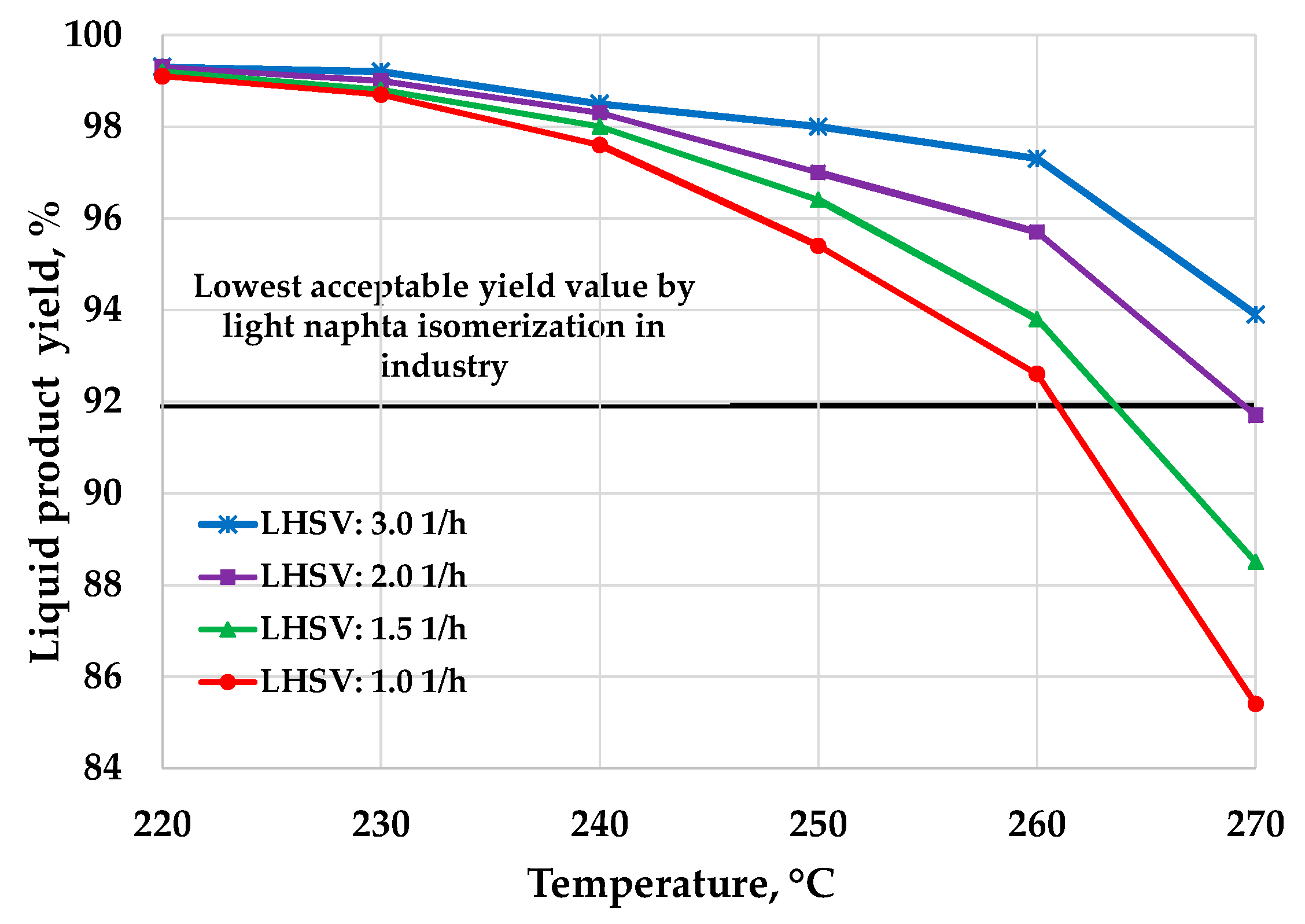
The thermal and catalytic conversion processes of alternative feedstocks (e.g., waste and biomass) to different engine fuels can result in the formation of a significant amount of light hydrocarbons as by-products in the boiling range of gasoline. The properties of these C5/C6 hydrocarbons need to be improved due to many reasons, e.g., their benzene content, and/or poor oxidation stability (high olefin content) and low octane number (<60). The aim of the research work was to increase the octane number of benzene containing C5/C6 bioparaffin fractions by catalytic isomerization. These by-products were obtained from special hydrocracking of waste cooking oil to hydrocarbons in the boiling range of aviation turbine fuels (JET fuels)/diesel fuels. Experiments were carried out in a reactor system containing down-flow tubular reactors over Pt/Al2O3/Cl and Pt/H-Mordenite/Al2O3 catalysts at 115–145 °C and 230–270 °C, respectively. Based on the results obtained at different process parameter combinations, it was concluded that the hydrogenation of benzene was complete over both catalysts, and the liquid yields were higher (ca. 98% > ca. 93 %) in the case of Pt/Al2O3/Cl. In addition, the octane number was also enhanced (ca. 32 > ca. 27 unit) in the products compared to the feedstock. This was because a higher isoparaffin content can be obtained at a lower operating temperature. Moreover, cracking side reactions take place to a lesser extent. The utilization of these isomerized bio-origin light fractions can contribute to the competitiveness of second-generation biofuels.
Keywords: waste-originated feedstock; isomerization; biogasoline; benzene-free; increased octane number waste-originated feedstock; isomerization; biogasoline; benzene-free; increased octane number