

Life Cycle Assessment of the New Generation GT-MHR Nuclear Power Plant



Abstract
1. Introduction
- (a)
- coupling of gas turbine with a high temperature gas-cooled reactor (HTGR) allows a net electrical efficiency in the range of 50% to be achieved;
- (b)
- building modular HTGR (usually called GT-MHR) results in lower capital cost due to plant simplification and time reduction for construction;
- (c)
- use of the ceramic TRISO (triple coated small balls) fuel specifically developed for this type of reactors. This fuel has a high degree of passive safety and flexibility to adopt uranium/plutonium, thorium (Th) based fuel cycle and reprocess spent nuclear fuel (SNF) from currently used reactors;
- (d)
- high burn-up of the reactor (between 80–120 GWd/ton (1 GWd = 109 W·day)). This substantially decreases radioactive waste from SNF and makes its SNF much less radioactive [7];
- (e)
- high temperature, which allows HTGR to be applied to hydrogen production. Due to this circumstance HTGRs may be also applied to other high and low temperature process heat applications such as water desalination. In this way non-electric energy needs may be efficiently addressed [8]. Some such reactors already have been built, for example HTR-PM, China (first operation expected in 2019) [9] and GTHTR300, Japan (planned to test in 2020). Few such reactors are working in the Russian Federation (RF) (GT-MHR is working from 2014, MHR-T for hydrogen production is working from 2017).
2. Purpose of the Study and Methodology
3. Nuclear Power Generation Life Cycle.
3.1. Main Phases of Nuclear Power (NP) Cycles
- (a)
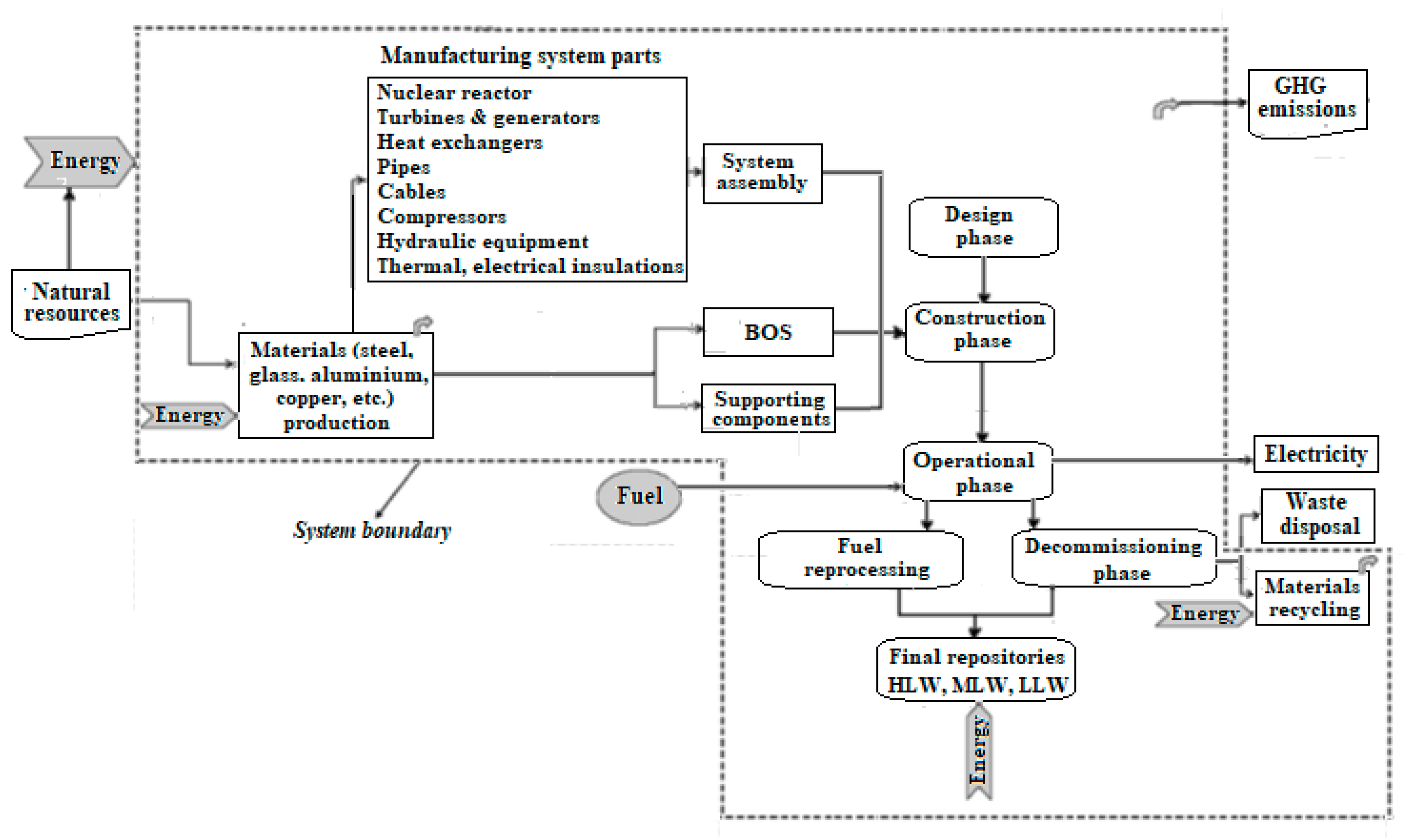
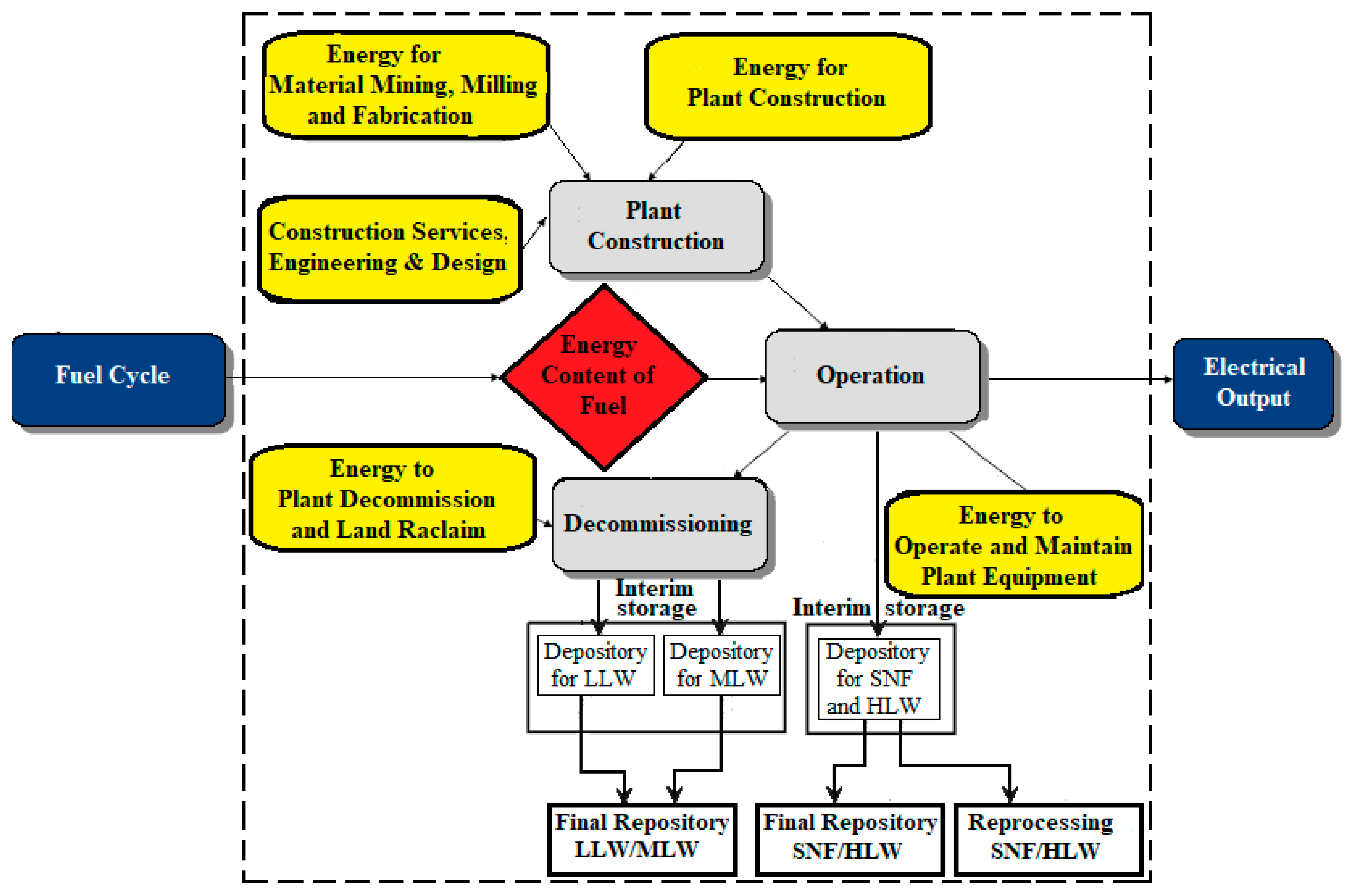
- power plant design and construction;
- (b)
- power plant operation,
- (c)
- spent fuel storage;
- (d)
- back end of the cycle involving decommissioning the power plant, land reclamation, final storage (repository) of high, medium and low-level radioactive wastes (HLW, MLW and LLW) disposal. The LCA study of nuclear power generation cycle is also based on a production capacity of 1 Giga Watts of electricity (1 GWe) during life time span of the power plant (average 60 years) and a load factor during life span of the power plant of between 80–90% (average 85%). Such values are commonly used in designs of HTGR (for example, [13,14]).
3.2. Main Phases of Nuclear Power (NP) Cycles
- (a)
- local infrastructure impacts and related road modifications;
- (b)
- some subsidiary materials due to a lack of available data, such as personal protective equipment, solvents used in cleanup, etc.
- (c)
- material production burdens for office equipment, moveable partitions, and furniture;
- (d)
- custodial and small replacement materials (e.g., light bulbs, window glass, air filters, cleaning supplies, etc.).
3.3. Major Assumptions
4. Results and Discussion
5. Conclusions
- High Plant Efficiency—Use of the Brayton Cycle helium gas turbine in the GT-MHR provides electric generating capacity at a net plant efficiency of 47.5%. The high plant efficiency reduces power generation costs, thermal discharge to the environment and high-level waste generation per unit electricity produced.
- Superior High-Level Waste Form—Coated particle fuel (TRISO) provides a superior spent fuel waste form for both long-term interim storage and permanent geologic disposal. As such, they provide defense-in-depth to ensure that the spent fuel radionuclides are contained for geologic time frames and do not migrate to the biosphere.
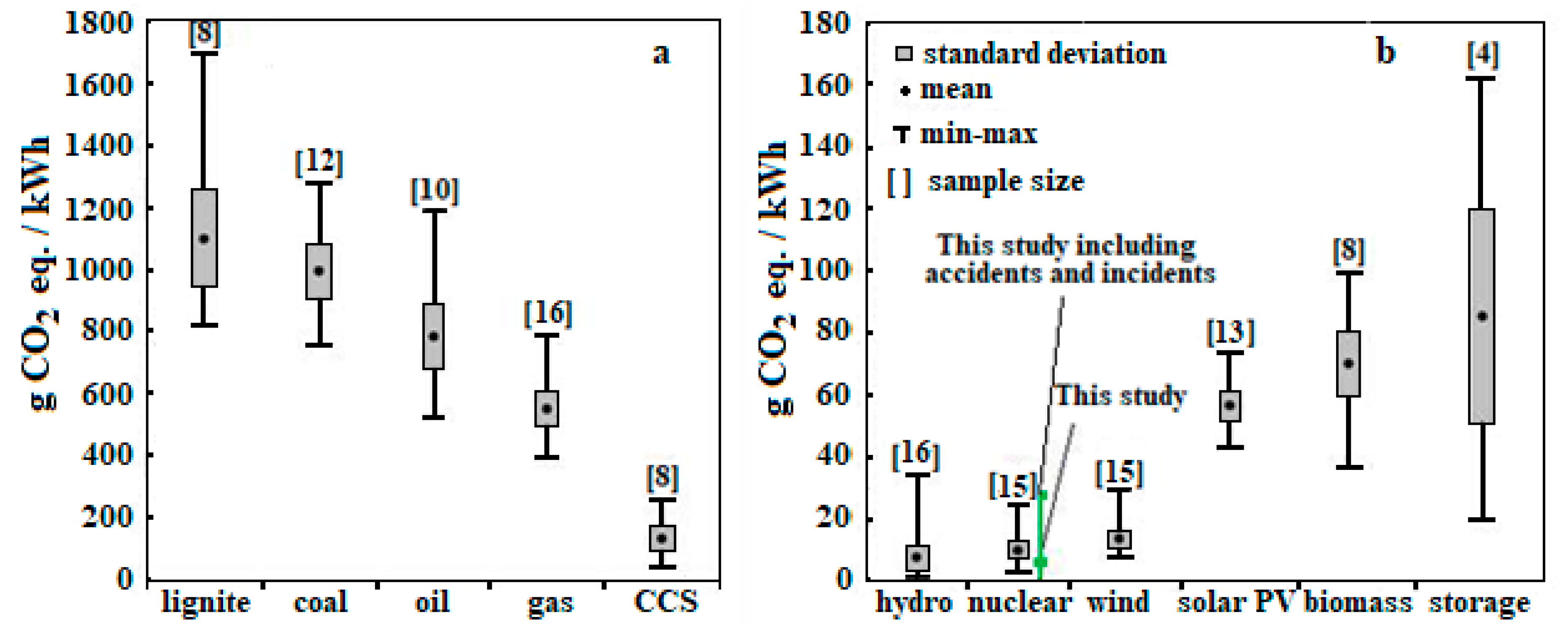
- Low Carbon Impact—The GT-MHR has very low GHG emissions per unit of electricity production of about 6.5 g CO2 eq./kWh for the GT-MHR NP plant life cycle. With all fuel enrichment by gas centrifuge technology in combination with the GT-MHR, the overall GHG footprint of nuclear was estimated to be: −9.6 g CO2 eq./kWh.
Author Contributions
Funding
Acknowledgments
Conflicts of Interest
Abbreviations
| 4G | Fourth generation |
| AI | Accidents and Incidents |
| BOP | Balance of plant |
| CO2 | Carbon dioxide |
| GHG | Greenhouse gases |
| GIF | Generation IV International Forum |
| GT-MHR | Gas-turbine modular helium reactor |
| GWd/ton | Giga Watt*days/ton |
| HLW | High level radioactive waste |
| HTGR | High temperature gas-cooled reactor |
| HTR-PM | The name of a small modular nuclear reactor developed in China |
| I/O | Input/Output |
| IHX | Intermediate heat exchanger |
| ISO | International Organisation for Standardisation |
| LCA | Life cycle assessment |
| LCI | Life cycle inventory |
| LLW | Low level radioactive waste |
| LME | London Metal Exchange |
| MLW | Medium level radioactive waste |
| MWhe | Mega Watt (109 Watt)*hours (electricity) |
| NGNP | Next Generation Nuclear Plant |
| NP | Nuclear power |
| PBT | Pay back time |
| PCA | Process chain analysis |
| PCS | Power conversion system |
| PWR | Pressurised water reactor |
| SNF | Spent nuclear fuel |
| SWU/GWY | Separative work unit (the amount of separation done by an enrichment process)/Giga Watt*year |
| TRISO | The ceramic fuel: –triple coated small balls |
| TW | Terra Watt = 1012 Watt |
| VHTR | Very high temperature reactor |
References
- Dresselhaus, M.S.; Crabtree, G.W.; Buchanan, M.V. Addressing Grand Energy Challenges through Advanced Material. Mater. Res. Soc. Bull. 2005, 30, 518–524. [Google Scholar] [CrossRef][Green Version]
- Ashby, M.F. Materials and the Environment. Eco-Informed Materials Choice; Butterworth Heinemann: Boston, MA, USA, 2009. [Google Scholar]
- International Atomic Energy Agency. Design Features to Achieve Defence in Depth in Small and Medium Sized Reactors; Report, Vienna, STI/PUB/1399; International Atomic Energy Agency: Vienna, Austria, 2009. [Google Scholar]
- Reuters. Developing Countries Eye Nuclear Power. Report. 12 May 2010. Available online: http://uk.reuters.com/article/worldNews/idUKN1253956420080512 (accessed on 10 September 2018).
- Bouchard, J.; Bennett, R. Generation IV Advanced Nuclear Energy Systems. Nucl. Plant J. 2008, 26, 42–45. [Google Scholar]
- Adamantiades, A.; Kessides, I. Nuclear Power for Sustainable Development: Current Status and Future Prospects. Energy Policy 2009, 37, 5149–5166. [Google Scholar] [CrossRef]
- International Atomic Energy Agency. Technology Review; IAEA/NTR/2006; International Atomic Energy Agency: Vienna, Austria, 2006. [Google Scholar]
- Kuhr, R. HTR’s Role in Process Heat Applications. Nuclear Eng. Des. 2008, 238, 3013–3017. [Google Scholar] [CrossRef]
- IAEA. Advances in Small Modular Reactor Technology Developments. Available online: https://aris.iaea.org/publications/smr-book_2018.pdf (accessed on 10 September 2018).
- Perrow, C. Normal Accidents: Living with High Risk Technologies; Princeton University Press: New York, NY, USA, 1984; p. 441. ISBN 0-691-00412-9. [Google Scholar]
- International Organisation for Standardisation (ISO). Environmental Management—Life Cycle Assessment—Principles and Framework (ISO 14040); ISO: Geneva, Switzerland, 2006. [Google Scholar]
- ISO. Environmental Management—Life Cycle Assessment—Requirements and Guidelines (ISO 14044); ISO: Geneva, Switzerland, 2006. [Google Scholar]
- World Energy Council. Comparison of Energy Systems Using Life Cycle Assessment; A Special Report of the World Energy Council; World Energy Council: London, UK, 2004; ISBN 0-94612116-8. [Google Scholar]
- Massara, S.; Tetart, O.; Lecarpentier, D.; Garzenne, C. Prospective Scenarios of Nuclear Energy Evolution on the XXIst Century over the World Scale. Nucl. Eng. Des. 2009, 239, 1708–1717. [Google Scholar] [CrossRef]
- General Atomic. Pre-Conceptual Engineering Services for the Next Generation Nuclear Plant (NGNP) with Hydrogen Production; Executive Summary Report, Project 30283; General Atomic: San-Diego, CA, USA, 2007. [Google Scholar]
- Yan, X. GTHTR300 Design and Development. Nucl. Eng. Des. 2003, 222, 247–262. [Google Scholar] [CrossRef]
- Idaho National Laboratory. Next Generation Nuclear Plant, Pre-Conceptual Design; DOE, INL/EXT-07-12967; Idaho National Laboratory: Idaho Falls, ID, USA, 2007. [Google Scholar]
- Weidema, B.; Wesnaes, M. Data Quality Management for Life Cycle Inventories: An Example of Using Data Quality Indicators. J. Clean. Prod. 1996, 4, 3–4. [Google Scholar] [CrossRef]
- Norgate, T.; Koltun, P.; Tharumarajah, A.; Haque, N. Life Cycle Assessment of Uranium Nuclear Power Sycle, Part 1: Once Trough Cycle with Current Technologies; CSIRO, MDU: Canberra, Australia, 2010. [Google Scholar]
- Amersfoort, B.V. SimaPro 7.1: The Software Tool to Analyse and Develop Environmentally Sound Products; Pre Consultants: Amersfoort, The Netherlands, 2009. [Google Scholar]
- International Project on Innovative Nuclear Reactors and Fuel Cycles. Status and Trends of Nuclear Technologies; Report, IAEA-TECDOC-1622; International Atomic Energy Agency: Vienna, Austria, 2009. [Google Scholar]
- Nuclear Radiation Accidents and Incidents. Wikipedia. Available online: https://en.wikipedia.org/wiki/Nuclear_and_radiation_accidents_and_incidents#cite_note-critev-10 (accessed on 10 September 2018).
- List of Waste Disposal Incidents. Wikipedia. Available online: https://en.wikipedia.org/wiki/List_of_waste_disposal_ incidents (accessed on 10 September 2018).
- Global Carbon Capture & Storage Institute. Project Pioneer. Report, Published: 22 April 2012. Available online: https://hub.globalccsinstitute.com/publications/final-report-project-pioneer/cost-co2-abatement (accessed on 10 September 2018).
- Defulf, J.; van Langenhove, H.; Mulder, J.; van den Berg, M.M.D.; van der Kooi, H.J.; de Arons, J. Illustration towards quantifying the sustainability of technology. Green Chem. 2000, 2, 108–114. [Google Scholar]
- Jackson, I. Nukenomics: The Commercialisation of Britain’s Nuclear Industry; Nuclear Engineering International: Kent, UK, 2008; ISBN 978-1-903077-55-9. [Google Scholar]
- BDA Group. The Full Cost of Landfill Disposal in Australia. 2009. Available online: http://www.environment.gov.au/system/files/resources/685d170f-9275-4ab5-8fde-5015ef43920d/files/peer-review.pdf (accessed on 10 September 2018).
- Koltun, P.; Tharumarajah, A. Environmental Assessment of Small Scale Solar Thermal Electricity Generation Unit Based on LCA Study. In Proceedings of the 15th International Conference on Life Cycle Engineering, Sydney, Australia, 17–19 March 2008. [Google Scholar]
- Van Leeuwen, S. Nuclear Power—The Energy Balance; Report, Part E; Ceedata Consultancy: Cham, The Netherlands, 2007. [Google Scholar]
- Weisser, D. A Guide to Life-Cycle Greenhouse Gas Emissions from Electric Supply Technologies. Energy 2007, 32, 1543–1559. [Google Scholar] [CrossRef]
- ISA. Life-Cycle Energy Balance and Greenhouse Gas Emissions of Nuclear Energy in Australia; The University of Sydney: Sydney, Australia, 2006. [Google Scholar]
- Fthenakis, V.M.; Kim, H.C. Greenhouse-Gas Emissions from Solar Electric- and Nuclear Power: A Life-Cycle Study. Energy Policy 2007, 35, 2549–2557. [Google Scholar] [CrossRef]
- Hondo, H. Life Cycle GHG Emission Analysis of Power Generation Systems: Japanese Case. Energy 2005, 30, 2042–2056. [Google Scholar] [CrossRef]
- Tokimatsu, K. Evaluation of Lifecycle CO2 Emissions from the Japanese Electric Power Sector in the 21st Century under Various Nuclear Scenarios. Energy Policy 2006, 34, 833–852. [Google Scholar] [CrossRef]
- White, W.; Kulcinski, G.L. Birth to Death Analysis of the Energy Payback Ratio and CO2 Gas Emission Rates from Coal, Fission, Wind, and DT-fusion Electrical Power Plants. Fusion Eng. Des. 2000, 48, 473–481. [Google Scholar] [CrossRef]

| Feature/Parameter | Unit | Value | |
|---|---|---|---|
| HTGR | PWR | ||
| Plant thermal power | GWth | 2.4 [2.1] | 3.12 |
| Net power output | MWe | 1140 [1000] | 1000 |
| Number of units per site | - | 4 (600 MWth each) | 1 |
| Thermodynamic efficiency | % | 47.5 | 32 |
| Load factor | % | 90 | 85 |
| Plant life time | Years | 60 | 40 |
| Cycle Length | Months | 18 | 18 |
| Lifetime gross (net) electricity production | TWh | 539.2 (534.1) [473.0 (469.5)] | 297.8 (294.8) |
| Average burnup | GWd/tU | 100 | 35 |
| Average uranium enrichment | % | 10.0 | 3.2 |
| Total (per GWh) mass of enriched uranium | t (kg/GWh) | 421.2 [369.5] (0.781) | 413.6 (1.389) |
| SWU Demand (average) | 103 kg-SWU/GWY | 221 | 135 |
| Turbine type | - | Gas (Brayton cycle) | Steam (Rankine cycle) |
| Cooling/working primary (secondary) fluid | - | Helium (Nitrogen/Helium mixture) | Water (Water) |
| Reactor safety system | - | No active emergency system | 3–4 independent emergency systems |
| Stage | Location | Transportation Distance, km | Form of Transport |
|---|---|---|---|
| Main equipment manufacturing (reactor, turbines, etc.) | Europe | 300 + 20,000 | Roads to ports + Sea |
| Auxiliary equipment (pipes, cables, BOS, etc.) | Australia | 500 | Rails & Roads |
| Constructions | Australia | 300–500 (average) | Roads |
| Waste disposal (radioactive waste disposal) | Australia | 150 (1000-2000) | Roads (Rails) |
| Date (Day/Month/Year) | Location | Description | Dead | Cost ($US Mln) | INES Level |
|---|---|---|---|---|---|
| 05/10/1966 | Michigan, USA | Partial core meltdown at the Enrico Fermi Nuclear Generating Station | 0 | 132 | |
| 21/01/1969 | Vaud, Switzerland | Loss-of-coolant accident, leading to a partial core meltdown | 0 | 5 | |
| 06/02/1975 and 15/03/1992 | Leningrad Oblast, Russia | Partial nuclear meltdown in reactor unit. Leaked radioactive gases. | 3 | 1500 | |
| 07/12/1975 | Greifswald, Germany | Electrical error causes fire five main coolant pumps | 0 | 443 | 3 |
| 05/01/1976 and 22/02/1977 | Bohunice, Slovakia | Corrosion of reactor and release of radioactivity | 2 | 1700 | 4 |
| 28/03/1979 | Pennsylvania, USA | Loss of coolant and partial core meltdown. | 0 | 2400 | 5 |
| 15/09/1984 | Alabama, USA | Safety violations, operator error. | 0 | 110 | |
| 09/03/1985 | Alabama, USA | Systems malfunction during start-up | 0 | 1830 | |
| 11/04/1986 | Massachusetts, USA | Recurring equipment problems. | 0 | 1001 | |
| 26/04/1986 | Chernobyl, Ukraine | Overheating, steam explosion. | 61 | 6700 | 7 |
| 04/05/1986 | Hamm-Uentrop, Germany | Experimental THTR-300 reactor releases small amounts of fission products. | 0 | 267 | |
| 31/03/1987 | Pennsylvania, USA | Peach Bottom units 2 and 3 shutdown due to cooling malfunctions. | 0 | 400 | |
| 19/12/1987 | New York, USA | Malfunctions, force to shut down Nine Mile Point Unit 1 | 0 | 150 | |
| 17/03/1989 | Maryland, USA | Inspections at reveal cracks at pressurized heater sleeves | 0 | 120 | |
| 20/02/1996 | Connecticut, USA | Leaking valve, multiple equipment failures. | 0 | 254 | |
| 02/09/1996 | Florida, USA | Balance-of-plant equipment malfunction | 0 | 384 | |
| 30/09/1999 | Ibaraki, Japan | Radiation levels above permissible limits. | 2 | 54 | 4 |
| 16/02/2002 | Ohio, USA | Severe corrosion of control rod | 0 | 143 | 3 |
| 09/08/2004 | Fukui, Japan | Steam explosion | 4 | 9 | 1 |
| 25/07/2006 | Forsmark, Sweden | An electrical fault | 0 | 100 | 2 |
| 11/03/2011 | Fukushima, Japan | A tsunami flooded and damaged the plant’s 5 active reactors. | 2 | 187,000 | 7 |
| 12/09/2011 | Marcoule, France | The explosion took place in a furnace used to melt metallic waste. | 1 | 10 | 1 |
| Waste Disposal Accidents and Incidents | |||||
| 15/05/1988 | Cádiz, Spain | Radioactive contamination in scrap metal processing plant by a caesium-137 (up to 1000 times higher than normal) | 0 | 132 | |
| From 1951 up to 2016 | Lake Karachay, Cheliabinsk Oblast, Russia | The lake accumulated about 4.44 exabecquerels (EBq) of radioactivity, including 3.6 EBq of caesium-137and 0.74 EBq of strontium-90. | 0 | 263 | |
| From 1980 up to 2000 | Somalia | A criminal organisation from Calabria (Italy) has been involved in radioactive waste dumping | 0 | 0.26 | |
| Start 1949 up to now | River “Techa”, Cheliabinsk Oblast, Russia | The Mayak complex dumped radioactive waste water, a cumulative dispersal of 102 Petabecquerel (PBq) of radioactivity. | 21 | 6 | |
| Required Main Materials | Amount (t) |
| Concrete | 440,000 |
| Iron and Steel | 132,000 |
| Other metals | 10,000 |
| Uranium (10% enriched) | 369.5 |
| Plastics | 3000 |
| Other materials | 53,000 |
| Main Waste Streams | Amount (t) |
| LLW | 18,600 |
| MLW | 11,300 |
| HLW | 2930 |
| Inert waste | 460,000 |
| Recyclable waste | 146,000 |
| LCA Phase | Cost (M$) | Energy Consumption (TJ) | GHG Emissions (103 t CO2 eq.) | |
|---|---|---|---|---|
| Pre-use | Engineering & Design | 115.5 | 381.3 | 60.17 |
| Equipment fabrication | 1163.2 | 15014.2 | 1503.42 | |
| Construction materials | 286.2 | 3697.1 | 239.08 | |
| Non-process equipment | 69.3 | 553.5 | 45.87 | |
| Construction works | 462.8 | 356.7 | 74.74 | |
| Use | Use | 1452 | 9422.0 | 739.00 |
| Post-use | Decommissioning (decontamination & demolition works) | 342.4 | 1638.7 | 106.43 |
| LLW disposal | LLW waste site construction and maintenance | 31.70 | 1375.6 | 72.70 |
| Drums &Cement | 66.9 | |||
| Transportation | 3.8 | |||
| MLW/HLW disposal | Geological repository: construction & maintenance | 375.3 | 4803 | 290.42 |
| TAD and drums | 89.3 | |||
| Transportation | 9.9 | |||
| Non-radioactive waste disposal | Landfill disposal | 13.8 | 13.3 | 0.73 |
| Transportation | 11 | 346 | 23.37 | |
| Recycling credits | Concrete | 1.5 | 149 | 17.9 |
| Carbon Steel | 9.6 | 614.4 | 26.88 | |
| Stainless Steel | 12 | 209.4 | 14.36 | |
| Copper | 6.4 | 211.5 | 18.43 | |
| Aluminium | 7.7 | 878.4 | 58.51 | |
| Glass | 0.03 | 27.6 | 1.28 | |
| Total (without recycling) | 4493.1 | 37,601.4 | 3155.93 | |
| Total (including recycling) | 4455.87 | 35,511.1 | 3018.57 | |
| Additions (due to accidents and incidents) | 447.58 | 40,351.0 | 6686.00 | |
© 2018 by the authors. Licensee MDPI, Basel, Switzerland. This article is an open access article distributed under the terms and conditions of the Creative Commons Attribution (CC BY) license (http://creativecommons.org/licenses/by/4.0/).
Share and Cite
Koltun, P.; Tsykalo, A.; Novozhilov, V. Life Cycle Assessment of the New Generation GT-MHR Nuclear Power Plant. Energies 2018, 11, 3452. https://doi.org/10.3390/en11123452
Koltun P, Tsykalo A, Novozhilov V. Life Cycle Assessment of the New Generation GT-MHR Nuclear Power Plant. Energies. 2018; 11(12):3452. https://doi.org/10.3390/en11123452
Chicago/Turabian StyleKoltun, Paul, Alfred Tsykalo, and Vasily Novozhilov. 2018. "Life Cycle Assessment of the New Generation GT-MHR Nuclear Power Plant" Energies 11, no. 12: 3452. https://doi.org/10.3390/en11123452
APA StyleKoltun, P., Tsykalo, A., & Novozhilov, V. (2018). Life Cycle Assessment of the New Generation GT-MHR Nuclear Power Plant. Energies, 11(12), 3452. https://doi.org/10.3390/en11123452

