1. Introduction
Benign tumors are the most common parotid neoplasms with pleomorphic adenoma and Warthin tumor representing the most frequent histologic subtypes usually encountered [
1]. Surgical excision remains the definitive treatment; however, the optimal extent of parotid resection has progressively evolved. In appropriately selected benign lesions, contemporary surgery increasingly favors conservative, nerve-sparing techniques—such as extracapsular dissection and enucleation—aimed at limiting facial nerve manipulation, reducing operative morbidity, and preserving functioning glandular parenchyma while maintaining satisfactory oncologic safety for benign disease [
2,
3]. This transition has been supported by evidence that less extensive resections can achieve favorable functional outcomes with acceptable recurrence profiles when careful patient selection and meticulous technique are applied [
4,
5,
6,
7].
Despite these advantages, conservative parotid surgery is associated with a characteristic pattern of postoperative morbidity that is clinically relevant and often underestimated. By preserving secretory tissue and leaving a functioning residual parotid remnant, enucleation may predispose to early saliva-related wound complications, particularly sialocele and salivary fistula [
8]. Even when absolute incidence is modest in some series, these events are clinically meaningful because they frequently require repeated aspirations and compressive dressings, increase unplanned outpatient visits, and delay recovery. In parallel, Frey syndrome is not only a cosmetic complaint but a functional, patient-reported sequela that may persist and impair quality of life. Therefore, prevention strategies that reduce the management burden of salivary collections and mitigate late gustatory symptoms are clinically relevant in contemporary conservative parotid surgery. These events can prolong drainage, necessitate repeated aspirations and compressive dressings, increase outpatient visits, and delay recovery [
9,
10,
11,
12]. Beyond the direct burden of management, persistent salivary collections may compromise wound stability and create a permissive environment for bacterial proliferation, potentially contributing to surgical-site infection (SSI) and additional antibiotic exposure [
13]. In parallel, Frey syndrome remains among the most troublesome late sequelae of parotid surgery. Caused by aberrant regeneration of parasympathetic fibers toward cutaneous sweat glands, it manifests as gustatory sweating and flushing over the parotid region and can meaningfully affect quality of life even when facial nerve function is preserved [
12,
14,
15]. Reported rates of salivary complications and Frey syndrome vary widely across studies due to differences in operative extent, use of interposition techniques, definitions, and ascertainment methods; accordingly, clinically relevant symptom-based endpoints remain important for real-world care.
Preventive strategies have traditionally targeted one of two mechanisms: temporary reduction in salivary output during the vulnerable early healing phase or mechanical separation between the parotid bed and the overlying skin to reduce aberrant reinnervation. Botulinum toxin A (BTX-A) decreases salivary secretion by inhibiting acetylcholine release at cholinergic neuroglandular junctions and has an established therapeutic role in the management of postoperative sialocele and salivary fistula. Building on this rationale, prophylactic intraparotid BTX-A delivered intraoperatively has been explored [
16,
17,
18] to mitigate saliva-related complications after parotid resections, with reports suggesting reduced sialocele rates and postoperative drainage without an apparent increase in facial nerve morbidity.
Conversely, Frey syndrome prevention has been approached through interposition techniques designed to physically dissociate regenerating parasympathetic fibers from dermal sweat glands, superficial musculoaponeurotic system (SMAS)-based reconstruction, fat grafting, and biologic materials—including acellular dermal matrices and collagen-based membranes—have been applied to the parotid bed with the aim of reducing both subjective symptoms and objective Minor test positivity. However, heterogeneity in materials, fixation methods, and diagnostic criteria has limited consensus, and no single approach has been universally adopted as a reproducible standard in everyday practice [
19,
20,
21,
22].
Notably, most strategies are deployed as stand-alone measures and therefore address either early salivary morbidity or later gustatory sweating rather than both. To our knowledge, the combined intraoperative use of prophylactic intraparotid BTX-A and bovine collagen membrane interposition as a standardized adjunctive bundle after benign parotid tumor enucleation has not been specifically evaluated.
Within this framework, a dual-mechanism intraoperative strategy is conceptually attractive. We hypothesized that intraparotid BTX-A infiltration performed at the end of surgery could suppress salivary output during the critical early phase of wound healing, while a bovine collagen membrane placed over the repaired parotid fascia could provide durable separation of tissue planes by recreating a stable fascial-like interposition layer over the parotid bed, thereby improving wound interface stability and reducing the likelihood of aberrant parasympathetic reinnervation.
The primary objective of this study was to evaluate whether a standardized intraoperative protocol reduces clinically meaningful postoperative morbidity after benign parotid tumor enucleation, focusing on saliva-related wound complications (sialocele/salivary fistula) and clinically recorded Frey syndrome as endpoints that drive outpatient burden and patient-reported quality of life.
2. Materials and Methods
The study was conducted in accordance with the ethical standards as laid down in the 1964 Declaration of Helsinki and its later amendments or comparable ethical standards. To ensure patient confidentiality, all personal identifiers were removed or coded during data collection, and access to sensitive information was restricted to authorized personnel only.
Consecutive adult patients (≥18 years) who underwent conservative removal of a benign parotid tumor by extracapsular enucleation between January 2010 and December 2025 were screened. To ensure a homogeneous cohort, eligibility was restricted to primary benign epithelial tumors with definitive histopathologic diagnosis of pleomorphic adenoma or Warthin tumor on final pathology.
Exclusion criteria were predefined to minimize confounding related to wound healing and salivary morbidity and included diabetes mellitus, malignant disease on final histology, recurrent tumors, previous parotid surgery, prior sialadenitis, and any history of postoperative sialocele or salivary fistula. Patients were also excluded if follow-up was insufficient to assess the prespecified endpoints through 6 months.
For Warthin tumor, surgery was performed according to institutional practice in selected cases (e.g., symptomatic lesions, documented growth, diagnostic uncertainty, or patient preference), while asymptomatic stable lesions were commonly observed.
Patients were allocated into two cohorts according to the standardized intraoperative protocol adopted during the study period. Group A comprised patients treated from 2010 to 2017 with standard extracapsular enucleation alone. Group B comprised patients treated from 2018 to 2025 with extracapsular enucleation followed by intraoperative intraparotid botulinum toxin A (BTX-A) infiltration and placement of a bovine collagen membrane over the repaired parotid fascia.
All procedures were carried out under general anesthesia using a standard parotid approach [
23]. A modified Blair incision was used with subplatysmal flap elevation to expose the parotid fascia. After identifying the tumor and planning safe margins, extracapsular enucleation was performed by developing a dissection plane immediately outside the tumor capsule using a combination of blunt and sharp dissection under magnification, with the goal of preserving uninvolved parotid parenchyma. Facial nerve branches encountered within the operative field were identified and preserved; the main trunk was dissected only when required by tumor location and exposure. Meticulous hemostasis was achieved (primarily bipolar cautery). At the completion of tumor removal, the parotid fascia was closed with interrupted absorbable sutures to reduce dead space prior to drain placement. In Group B, once tumor removal and hemostasis were completed, onabotulinumtoxinA (BOTOX
®; Allergan, an AbbVie Company, Irvine, CA, USA) diluted in sterile saline was injected into the residual parotid parenchyma at 4–5 evenly distributed intraglandular sites for a total dose of 50 IU and never repeated after surgery. The injection was performed at the end of resection to maximize diffuse parenchymal exposure while avoiding superficial placement, consistent with prophylactic intraparotid approaches described for salivary complication prevention.
After BTX-A infiltration, the parotid fascia was closed with interrupted 4-0 absorbable sutures. A bovine collagen membrane (Lyoplant®, B. Braun, Germany) was then tailored and positioned over the repaired fascia with at least a 2 cm overlap beyond the dissection margins and secured with interrupted absorbable sutures to minimize displacement, providing stable interposition and recreating a fascial-like barrier between the parotid bed and the overlying tissues. A closed-suction drain was placed in all patients and managed according to institutional protocol. Drains were removed when the daily output was <30 mL/day. Standard postoperative instructions, wound care, and antibiotic policies were applied according to institutional practice and remained consistent across the study period. Postoperative follow-up was standardized for both groups, with scheduled visits at approximately 1, 3, and 6 months. At each visit, the operative site was examined for evidence of salivary complications, infection, and symptoms consistent with Frey syndrome. Facial nerve function was assessed in the immediate postoperative period and at follow-up visits using a branch-specific clinical examination.
The prespecified primary endpoints were saliva-related wound complications (sialocele and/or salivary fistula), surgical-site infection (SSI), and clinically recorded Frey syndrome within 6 months. A sialocele was defined as a postoperative, clinically evident fluctuant collection in the operative field consistent with salivary accumulation, confirmed by the treating surgeon and requiring aspiration and/or compressive management. A salivary fistula was defined as persistent external salivary leakage through the wound or drain site beyond the expected immediate postoperative period, documented on clinical examination and requiring continued local wound care and/or pressure dressings. When applicable, cases were classified according to the predominant clinical manifestation at presentation.
SSI was defined as an infection involving the operative site occurring within 30 days of surgery, diagnosed when purulent drainage was present and/or when a surgeon-diagnosed infection occurred in association with local inflammatory signs (erythema, warmth, tenderness, swelling) and/or systemic features requiring antibiotic therapy, with or without microbiologic confirmation from an aseptically obtained culture. This 30-day timeframe was used as the standard postoperative window for SSI reporting [
23,
24,
25]. Frey syndrome was assessed during follow-up and recorded as clinically evident symptoms and/or objective confirmation when available. Clinically recorded Frey syndrome was defined as patient-reported gustatory sweating and/or flushing over the parotid region documented at follow-up visits. Objective Frey syndrome was defined as a positive Minor’s starch–iodine test when performed as part of routine clinical care in patients with symptoms or clinical suspicion. Minor testing was not protocolized for all patients; therefore, for analysis, Frey syndrome was considered present when clinically recorded symptoms were reported, with objective confirmation when available. Secondary safety outcomes included postoperative hematoma and facial nerve dysfunction. Facial nerve deficits were categorized as transient or permanent according to persistence at follow-up.
Statistical Analysis
All analyses were two-sided, with statistical significance set at p < 0.05. Continuous variables were summarized as mean ± standard deviation and compared between groups using Student’s t-test. Categorical variables were reported as counts and percentages and compared using Fisher’s exact test when expected cell counts were low; chi-square testing was reserved for comparisons in which expected counts were adequate. In addition to p-values, absolute risk differences with 95% confidence intervals were calculated for binary endpoints to support clinical interpretation of effect magnitude. To aid clinical interpretability, numbers needed to treat (NNT) were calculated from absolute risk reductions. Finally, given the era-based allocation, E-values were calculated for relative risks to quantify the robustness of observed associations to potential unmeasured confounding. E-values were computed on the relative-risk scale following the approach of VanderWeele and Ding, and the ‘upper CI’ E-value was derived from the confidence-limit closest to the null (RR = 1).
3. Results
A total of 188 patients met the eligibility criteria and were included in the analysis, with 94 patients in each cohort according to the institutional protocol adopted during the study period. Group A comprised patients treated with standard extracapsular enucleation alone between 2010 and 2017, whereas Group B comprised patients treated between 2018 and 2025 with extracapsular enucleation followed by intraoperative intraparotid botulinum toxin A (BTX-A) infiltration and placement of a bovine collagen membrane over the repaired parotid fascia. Baseline clinical comparability between cohorts was supported by the absence of statistically meaningful differences in demographic or tumor characteristics. Mean age was 51.3 ± 11.2 years in Group A and 52.1 ± 10.8 years in Group B (
p = 0.619), and sex distribution was similar (44/50 vs. 46/48 male/female;
p = 0.884). Histopathologic composition was also comparable, with pleomorphic adenoma representing most lesions in both groups (62/94 [66%] in Group A and 58/94 [62%] in Group B) and Warthin tumor accounting for the remaining cases (32/94 [34%] and 36/94 [38%], respectively;
p = 0.649) (
Table 1).
At 6-month follow-up, the combined intraoperative protocol was associated with lower complication rates across all prespecified endpoints (
Table 2).
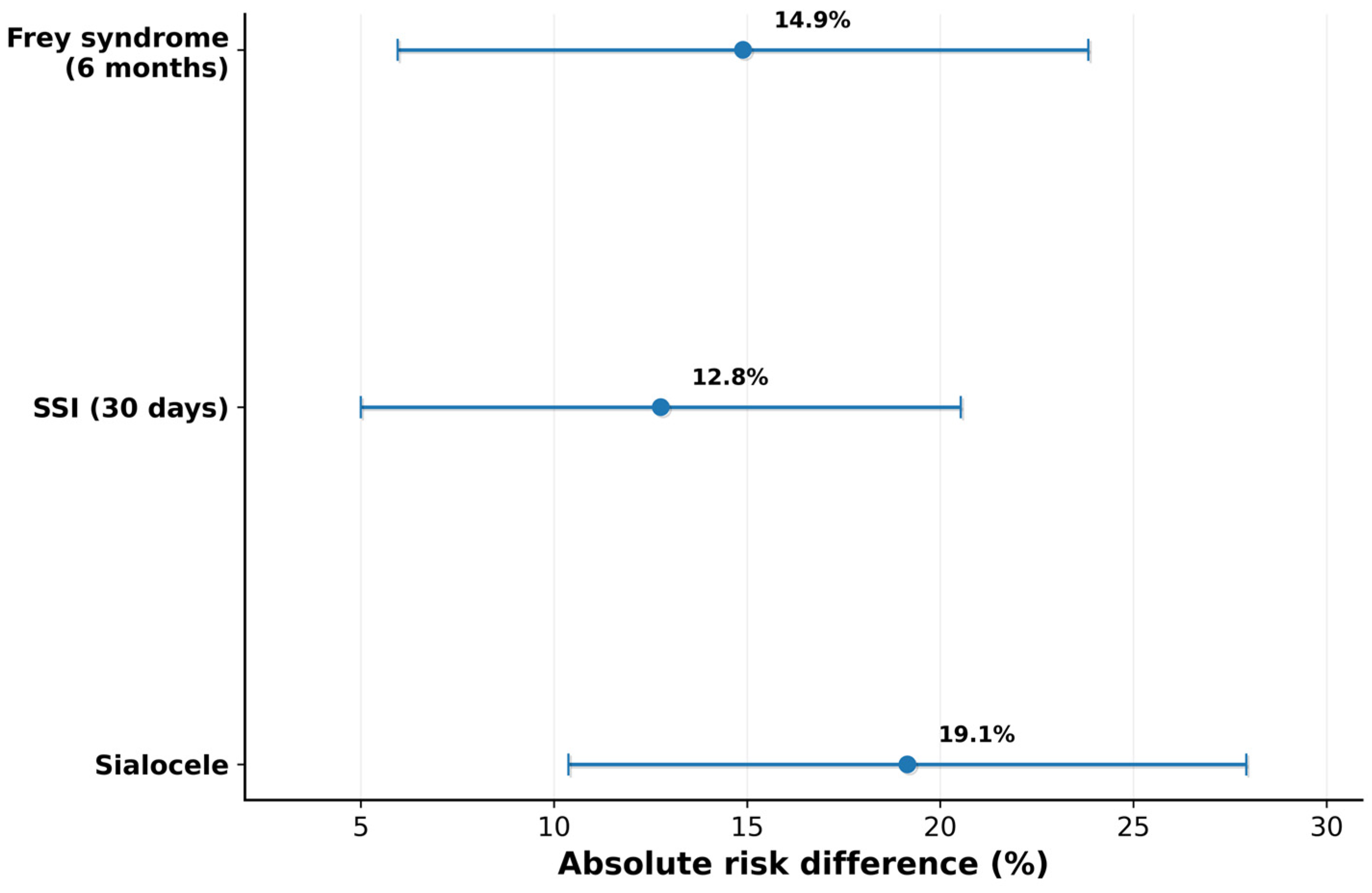
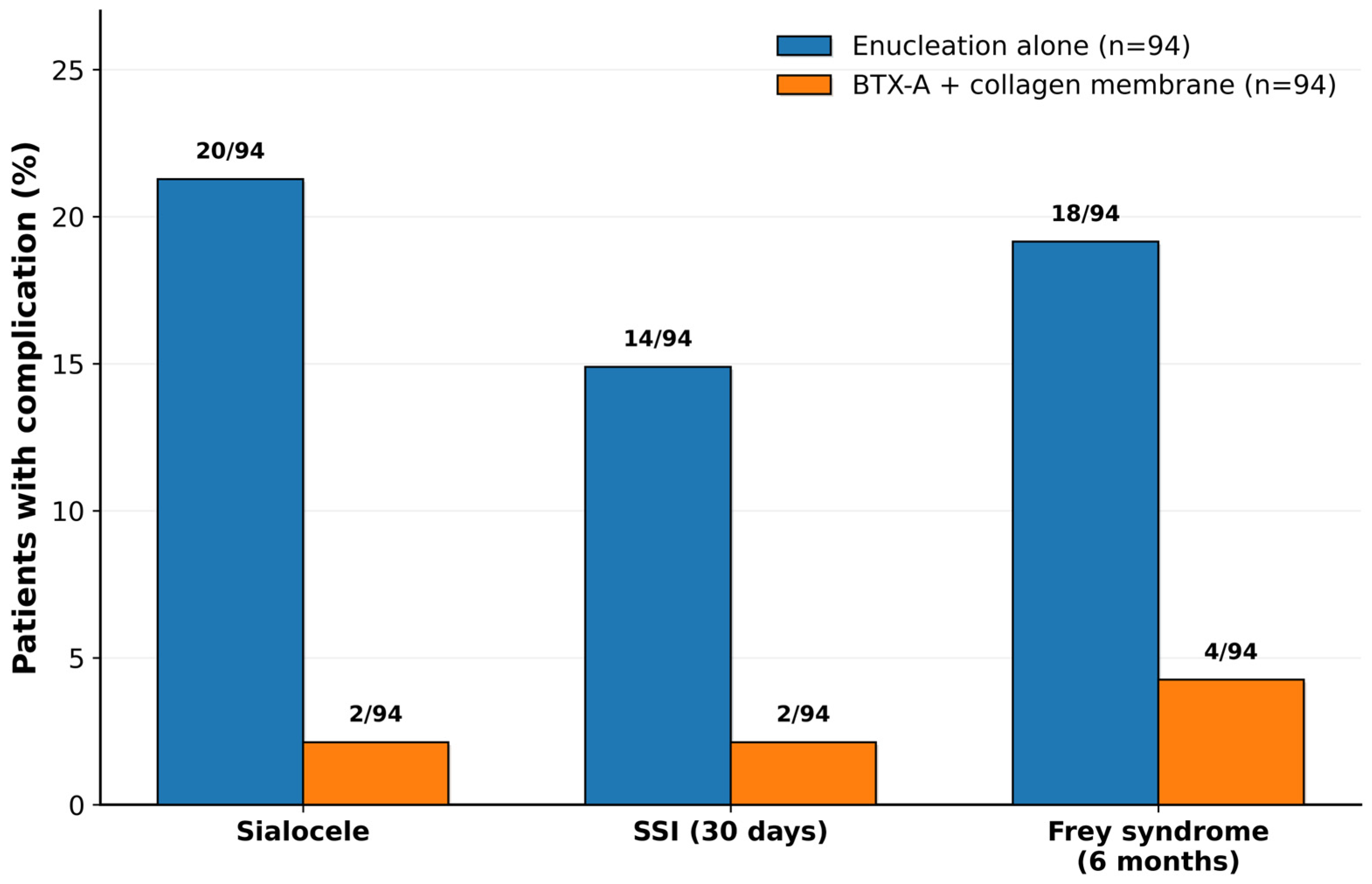
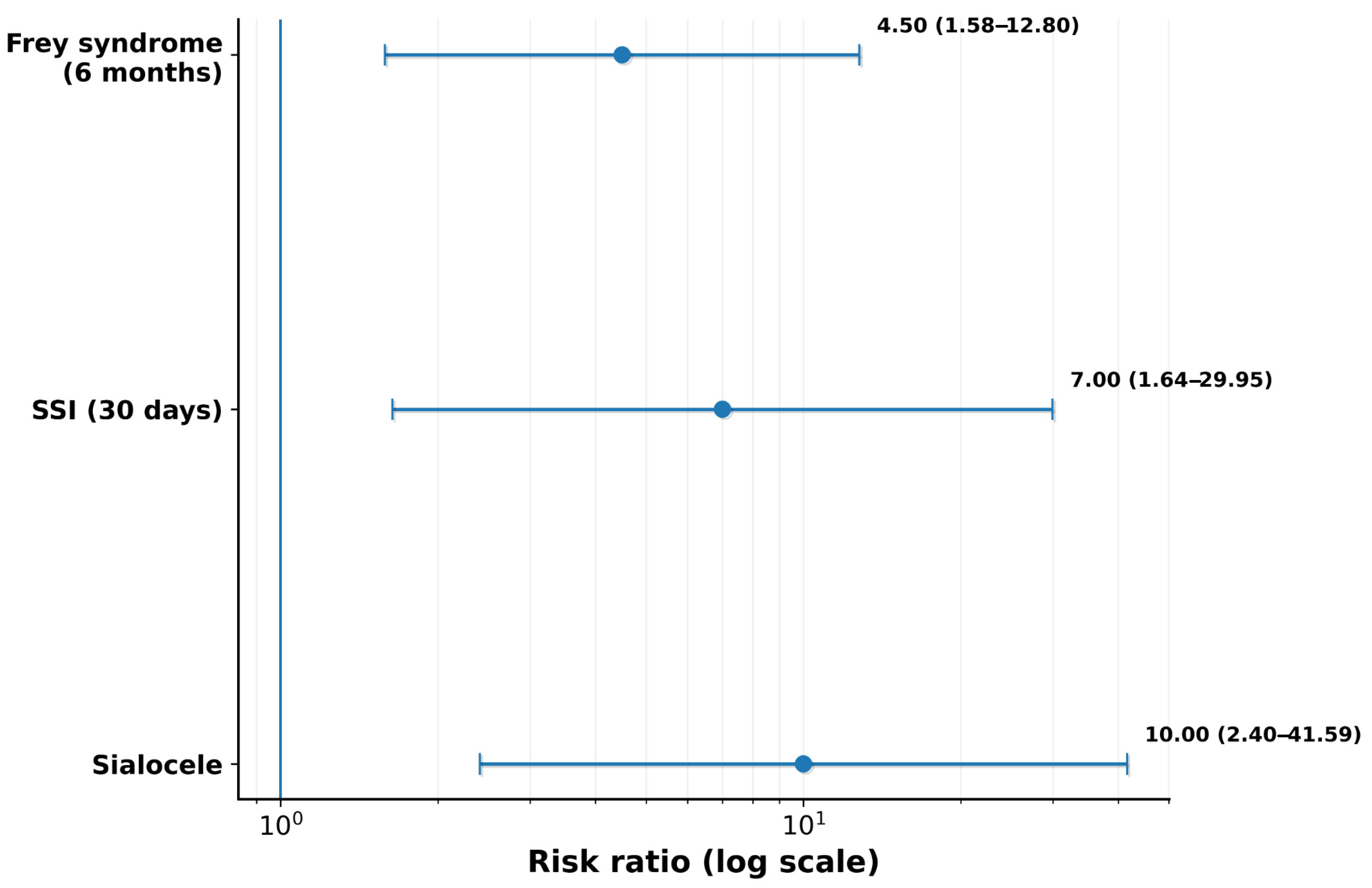
The most pronounced difference involved saliva-related wound morbidity. Sialocele occurred in 20/94 patients (21.3%) in Group A compared with 2/94 patients (2.1%) in Group B (Fisher’s exact p = 0.0000478), corresponding to an absolute risk difference of −19.1% (95% CI −30.0 to −6.8) and concordant effect size estimates (relative risk 0.10 [95% CI 0.024–0.416] and odds ratio 0.080 [95% CI 0.018–0.355]). This corresponded to an estimated number needed to treat (NNT) of 5.2.
Surgical-site infection within 30 days was recorded in 14/94 patients (14.9%) after standard enucleation and in 2/94 patients (2.1%) after the combined protocol (Fisher’s exact
p = 0.00283), with an absolute risk difference of −12.8% (95% CI −22.9 to −1.7), a relative risk of 0.143 (95% CI 0.033–0.611), and an odds ratio of 0.124 (95% CI 0.027–0.563); the corresponding NNT estimate was approximately 8. Clinically recorded Frey syndrome at 6 months was observed in 18/94 patients (19.1%) following standard enucleation and in 4/94 patients (4.3%) after BTX-A infiltration and collagen membrane placement (Fisher’s exact
p = 0.00247), translating into an absolute risk difference of −14.9% (95% CI −26.6 to −2.0), a relative risk of 0.222 (95% CI 0.078–0.632), and an odds ratio of 0.188 (95% CI 0.061–0.578); the corresponding NNT estimate was approximately 7. Complication rates by cohort are summarized visually in
Figure 1.
In sensitivity analyses addressing potential unmeasured confounding in this era-defined comparison, E-values for the relative-risk estimates suggested substantial robustness of the association for sialocele (E-value 19.49; upper-CI E-value 4.24), with supportive robustness metrics for surgical-site infection (E-value 13.48; upper-CI E-value 2.66) and Frey syndrome (E-value 8.47; upper-CI E-value 2.54). Absolute risk differences with 95% confidence intervals are displayed in
Figure 2.
Relative risks with 95% confidence intervals for each endpoint are additionally summarized in a forest plot (
Figure 3).
Moreover, the sensitivity to potential unmeasured confounding in this era-defined comparison is summarized using E-values in
Table 3.
From a safety standpoint, adjunctive intraoperative BTX-A infiltration and collagen membrane placement did not appear to introduce additional morbidity within the limits of the available dataset. No permanent facial nerve deficits were recorded, and there was no apparent signal suggesting increased perioperative risk attributable to BTX-A infiltration or membrane placement.
4. Discussion
In this retrospective comparative cohort of patients undergoing extracapsular enucleation for benign parotid tumors, a standardized intraoperative protocol combining intraparotid botulinum toxin A (BTX-A) infiltration with placement of a bovine collagen membrane over the repaired parotid fascia was associated with a lower postoperative complication burden. Accordingly, these results should be interpreted as hypothesis-generating real-world evidence and warrant prospective validation with protocolized surveillance. The effect was most pronounced for early saliva-related wound morbidity, with a marked reduction in sialocele, and was accompanied by parallel reductions in surgical-site infection and clinically recorded Frey syndrome at 6 months. Although these sequelae are variably reported and may be considered infrequent in some series, they are high-impact complications when they occur: sialocele typically prompts repeated interventions and unplanned care, and Frey syndrome represents a durable late symptom complex with quality-of-life implications. The magnitude of benefit was clinically meaningful, with low numbers needed to treat and concordant effects across endpoints, supporting a pragmatic dual-mechanism strategy: temporary hyposecretion during early wound healing and mechanical separation of tissue planes to mitigate aberrant reinnervation.
The reduction in sialocele is biologically coherent with established BTX-A pharmacology in salivary disorders [
26]. By inhibiting acetylcholine release at cholinergic neuroglandular junctions, BTX-A reduces salivary secretion in a localized, reversible manner and has long been used to treat postoperative salivary fistula and sialocele in head and neck practice. Prophylactic intraoperative BTX-A has also been explored as a preventive approach. Different published articles reported fewer salivary complications and lower postoperative drainage without an apparent penalty in facial nerve safety [
14,
27,
28]. Our data extend this concept specifically to conservative enucleation—an increasingly utilized technique that preserves parenchyma and may therefore maintain higher secretory potential in the remnant gland—where early salivary leakage and collections can be particularly consequential for recovery and outpatient burden [
29]. This large absolute risk reduction supports the hypothesis that temporary suppression of salivary output during early fascial healing reduces clinically relevant collections requiring aspiration or compression.
The lower SSI rate in the combined protocol group is biologically plausible in the setting of reduced salivary leakage and fluid collections, which may improve wound stability and reduce bacterial proliferation. This interpretation is indirectly supported by the prior literature on salivary complication burden and postoperative morbidity after parotid surgery [
11,
30,
31,
32,
33]. However, because SSI was not independently adjudicated and allocation was era-based, this finding should be interpreted as supportive rather than causal. With respect to Frey syndrome, our findings align with the prevailing mechanistic framework in which aberrant parasympathetic reinnervation of dermal sweat glands occurs when the parotid bed is not adequately separated from the overlying skin [
34,
35,
36,
37,
38,
39,
40,
41]. Multiple interpositional strategies, including autologous flaps, fat grafting, and biologic matrices, have been evaluated to reduce Frey syndrome. Systematic reviews and meta-analyses generally support the effectiveness of barrier approaches compared with no interposition, while comparative superiority among techniques is not consistently demonstrated, highlighting that feasibility, reproducibility, operative time, and donor-site morbidity often determine what is most practical in everyday practice [
15,
42,
43,
44,
45,
46,
47,
48]. Clinical studies of ADM report reductions in subjective symptoms and objective starch–iodine test positivity, with potential benefits on contour deformity [
21,
49,
50,
51]. A key limitation is Frey syndrome ascertainment and follow-up. Objective Minor testing was not protocolized and was performed selectively in routine care; therefore, mild or subclinical cases may have been under-detected. In addition, follow-up was limited to 6 months, and Frey syndrome can manifest later. Accordingly, our findings should be interpreted as a reduction in clinically recorded Frey symptoms within 6 months, and prospective studies with scheduled Minor testing and longer follow-up are needed to confirm differences in cumulative incidence. Our data are compatible with this literature and suggest that a collagen-based membrane—applied rapidly and reproducibly without donor-site morbidity—provide a similar “separation” effect. Pairing barrier interposition with temporary salivary suppression may also stabilize the early wound milieu (less leakage, less inflammation, better tissue apposition) and, conceptually, reduce the disorganized regenerative environment that facilitates misdirected nerve growth. This proposed synergy is plausible but remains inferential and should be tested in prospective studies designed to disentangle the independent contributions of BTX-A and membrane interposition. Although the largest absolute effect in this cohort was observed for sialocele, the reduction in Frey syndrome is clinically central because it reflects a late functional sequela that may persist and meaningfully affect long-term postoperative quality of life.
Reported rates of salivary complications and Frey syndrome vary widely across series due to differences in operative extent, use of interposition/barrier techniques, and—critically—endpoint definitions and ascertainment (symptom-based reporting versus protocolized objective screening) [
52,
53,
54,
55]. In a parenchyma-sparing setting such as extracapsular enucleation, preserved secretory tissue may increase susceptibility to early salivary collections compared with more extensive resections. Together with symptom-based Frey ascertainment and institution-specific thresholds for documentation, these factors may contribute to higher observed control-group rates relative to studies using different definitions or systematic Minor testing.
A key interpretive consideration is that the protocol was adopted by era (2010–2017 vs. 2018–2025) rather than randomized contemporaneous allocation, making the comparison vulnerable to secular changes in perioperative care, documentation, and surgical practice. We therefore framed the results as associations and reported E-values on the relative-risk scale (
Table 3) as a transparent sensitivity analysis for unmeasured confounding. These approaches cannot eliminate confounding, but they improve transparency and help contextualize inference in an era-defined retrospective comparison.
Outcome ascertainment also warrants emphasis, particularly for Frey syndrome. Objective testing with a standardized Minor starch–iodine protocol is often expected in head and neck literature, and selective symptom-driven testing may under-detect mild or subclinical cases. Importantly, the primary endpoints of this study were clinically diagnosed outcomes managed in routine practice and did not require imaging-based surveillance. Although subjective symptoms remain clinically meaningful and guide treatment—especially as botulinum toxin is widely used for symptomatic Frey syndrome [
17,
18,
22]. the absence of protocolized objective screening may bias absolute rates downward and may differ by era if clinical awareness or documentation evolved. Moreover, follow-up was limited to 6 months, and Frey syndrome can emerge later; longer follow-up would better estimate cumulative incidence [
14,
16,
56,
57].
Future prospective studies should incorporate scheduled objective Frey testing and longer follow-up to capture cumulative incidence more reliably. Despite these constraints, the present study has pragmatic strengths. The cohort was intentionally homogeneous, restricted to benign pleomorphic adenoma and Warthin tumors treated with a consistent conservative approach, limiting heterogeneity related to tumor biology and extent of resection. The intervention is operationally simple and reproducible, performed at the end of the case without additional incisions or donor-site morbidity, and its clinical impact is readily interpretable through absolute risk reductions and NNT.
Future studies should use prospective contemporaneous controls, protocolized drain metrics and aspiration recording, standardized SSI adjudication, and structured Frey assessment with predefined symptom instruments and scheduled Minor testing. If feasible, factorial or multi-arm designs could clarify the independent contributions of BTX-A and membrane interposition. Systematic perioperative and follow-up data capture may also support transparent AI-enabled prediction models [
58,
59,
60,
61,
62] for selective use of prophylactic bundles, provided rigorous methodology and standardized outcome ascertainment are maintained.
5. Conclusions
In patients undergoing extracapsular enucleation for benign parotid tumors, an intraoperative adjunctive protocol combining intraparotid botulinum toxin A infiltration with bovine collagen membrane interposition over the repaired parotid fascia was associated with a clinically meaningful reduction in postoperative morbidity. The largest benefit was observed for sialocele, with parallel reductions in surgical-site infection and Frey syndrome at 6 months, and no signal of added safety concerns within the limits of this cohort. Given the non-randomized, era-based allocation and the absence of protocolized objective Frey testing, these findings should be interpreted as associative and warrant prospective confirmation. Future studies with contemporaneous controls, standardized outcome ascertainment (including protocolized Minor testing), and detailed perioperative metrics are needed to define the independent and potentially synergistic contributions of temporary salivary suppression and barrier interposition in conservative parotid surgery.
Author Contributions
Conceptualization, G.C. (Giuseppe Consorti) and G.C. (Giulio Cirignaco); methodology, E.B., M.P. and L.C.; validation, M.G., G.M. and L.A.V.; formal analysis, G.C. (Giulio Cirignaco) and G.C. (Giuseppe Consorti); investigation, E.B. and M.P.; data curation, M.G., G.M. and L.C.; writing—original draft preparation, G.C. (Giulio Cirignaco); writing—review and editing, G.C. (Giuseppe Consorti) and G.C. (Giulio Cirignaco); visualization, S.T., L.A.V. and C.M.C.-E.; supervision, S.T., L.A.V., C.M.C.-E. and G.C. (Giuseppe Consorti). All authors have read and agreed to the published version of the manuscript.
Funding
This research received no external funding.
Institutional Review Board Statement
The study was conducted in accordance with the Declaration of Helsinki. Ethical review and approval were waived for this study due to the retrospective nature of the study.
Informed Consent Statement
Informed consent was obtained from all subjects involved in the study. Written informed consent has been obtained from the patients to publish this paper.
Data Availability Statement
The data generated and analyzed during this study are not publicly available due to institutional and privacy policies but are available from the corresponding author upon reasonable request.
Conflicts of Interest
The authors declare no conflicts of interest.
References
- Salzano, G.; Scocca, V.; Committeri, U.; Troise, S.; Vaira, L.A.; Lechien, J.R.; Abbate, V.; Orabona, G.D. Parotid Gland Sialolithiasis: A Comprehensive Systematic Review and Meta-Analysis. Eur. Arch. Oto-Rhino-Laryngol. 2026, 283, 1337–1352. [Google Scholar] [CrossRef] [Scilit] [PubMed]
- Troise, S.; Calabria, F.; Merola, R.; Calvanese, C.; Arena, A.; Abbate, V.; Bonavolontà, P.; Dell’Aversana Orabona, G. Extracapsular Dissection Versus Superficial Parotidectomy for Benign Parotid Tumors: A Bibliometric and Visual Analysis. J. Craniofacial Surg. 2025, 36, 1337–1341. [Google Scholar] [CrossRef] [Scilit]
- Klintworth, N.; Zenk, J.; Koch, M.; Iro, H. Postoperative Complications after Extracapsular Dissection of Benign Parotid Lesions with Particular Reference to Facial Nerve Function. Laryngoscope 2010, 120, 484–490. [Google Scholar] [CrossRef] [Scilit] [PubMed]
- Grosheva, M.; Klussmann, J.P.; Grimminger, C.; Wittekindt, C.; Beutner, D.; Pantel, M.; Volk, G.F.; Guntinas-Lichius, O. Electromyographic Facial Nerve Monitoring during Parotidectomy for Benign Lesions Does Not Improve the Outcome of Postoperative Facial Nerve Function: A Prospective Two-center Trial. Laryngoscope 2009, 119, 2299–2305. [Google Scholar] [CrossRef] [Scilit] [PubMed]
- Jin, H.; Kim, B.Y.; Kim, H.; Lee, E.; Park, W.; Choi, S.; Chung, M.K.; Son, Y.-I.; Baek, C.-H.; Jeong, H.-S. Incidence of Postoperative Facial Weakness in Parotid Tumor Surgery: A Tumor Subsite Analysis of 794 Parotidectomies. BMC Surg. 2019, 19, 199. [Google Scholar] [CrossRef] [Scilit] [PubMed]
- Régloix, S.B.; Grinholtz-Haddad, J.; Maurin, O.; Genestier, L.; Lisan, Q.; Pons, Y. Facial Nerve Monitoring During Parotidectomy: A Two-Center Retrospective Study. Iran. J. Otorhinolaryngol. 2016, 28, 255–260. [Google Scholar]
- Cirignaco, G.; Monarchi, G.; Betti, E.; Paglianiti, M.; Catarzi, L.; Tel, A.; Vaira, L.A.; Balercia, P.; Consorti, G. Outcome of Facial Nerve Integrity After Parotid Gland Surgery With and Without Intraoperative Monitoring: A Ten-Year Retrospective Study. J. Clin. Med. 2025, 14, 1156. [Google Scholar] [CrossRef] [Scilit] [PubMed]
- Roh, J. Sialocele Formation after Partial Parotidectomy: Dependent on Remnant Parotid Exposure. Head Neck 2023, 45, 1299–1304. [Google Scholar] [CrossRef] [Scilit] [PubMed]
- Santos, P.J.F.; McGill, M.A.; Kerendi, A.N.; Nahai, F. Update: Prevention and Treatment of Parotid/Submandibular Gland Fistula/Sialocele Following Rhytidectomy With Botulinum Toxin A. Aesthetic Surg. J. 2025, 45, 113–116. [Google Scholar] [CrossRef] [Scilit]
- Send, T.; Bertlich, M.; Eichhorn, K.W.; Bootz, F.; Jakob, M. Management and Follow-up Results of Salivary Fistulas Treated With Botulinum Toxin. Laryngoscope 2019, 129, 403–408. [Google Scholar] [CrossRef] [Scilit]
- Britt, C.J.; Stein, A.P.; Gessert, T.; Pflum, Z.; Saha, S.; Hartig, G.K. Factors Influencing Sialocele or Salivary Fistula Formation Postparotidectomy. Head Neck 2017, 39, 387–391. [Google Scholar] [CrossRef] [Scilit]
- Chai, X.-D.; Jiang, H.; Tang, L.-L.; Zhang, J.; Yue, L.-F. Factors Influencing Frey Syndrome after Parotidectomy with Acellular Dermal Matrix. World J. Clin. Cases 2024, 12, 1578–1584. [Google Scholar] [CrossRef] [Scilit]
- Cirignaco, G.; Rosettani, P.; Catarzi, L.; Paglianiti, M.; Betti, E.; Committeri, U.; Vaira, L.A.; Santarelli, A.; Consorti, G. Surgical Site Infections in Oral Cavity Carcinoma: Predictive Factors, Microbiological Trends, and Clinical Implications—Experience of a Major Italian Medical Center. Oral Surg. Oral Med. Oral Pathol. Oral Radiol. 2025, 141, 583–592. [Google Scholar] [CrossRef] [Scilit]
- Lee, C.C.; Chan, R.C.-L.; Chan, J.Y.-W. Predictors for Frey Syndrome Development After Parotidectomy. Ann. Plast. Surg. 2017, 79, 39–41. [Google Scholar] [CrossRef] [Scilit]
- De Virgilio, A.; Costantino, A.; Russo, E.; Ferreli, F.; Pellini, R.; Petruzzi, G.; Zocchi, J.; Spriano, G.; Mercante, G. Different Surgical Strategies in the Prevention of Frey Syndrome: A Systematic Review and Meta-analysis. Laryngoscope 2021, 131, 1761–1768. [Google Scholar] [CrossRef] [Scilit]
- Golding, C.N.; Larsen, D.G. The Incidence of Frey Syndrome and Treatment with Botulinum Toxin in the Central Denmark Region. Laryngoscope Investig. Otolaryngol. 2022, 7, 1814–1819. [Google Scholar] [CrossRef] [Scilit]
- Fiedler, L.S.; Burk, F. Treatment of Frey Syndrome with Botulinum Toxin-A: A Practical Approach from Minor’s Test to Injection. J. Maxillofac. Oral Surg. 2024, 23, 337–339. [Google Scholar] [CrossRef] [Scilit]
- Freni, F.; Gazia, F.; Stagno d’Alcontres, F.; Galletti, B.; Galletti, F. Use of Botulinum Toxin in Frey’s Syndrome. Clin. Case Rep. 2019, 7, 482–485. [Google Scholar] [CrossRef] [Scilit] [PubMed]
- Ye, W.M.; Zhu, H.G.; Zheng, J.W.; Wang, X.D.; Zhao, W.; Zhong, L.P.; Zhang, Z.Y. Use of Allogenic Acellular Dermal Matrix in Prevention of Frey’s Syndrome after Parotidectomy. Br. J. Oral Maxillofac. Surg. 2008, 46, 649–652. [Google Scholar] [CrossRef] [Scilit] [PubMed]
- Kim, J.H.; Kim, D.H.; Lim, J.-Y.; Won, H.-R.; Shin, Y.S.; Kim, C.-H.; Ban, M.J.; Park, J.H.; Byeon, H.K.; Hong, H.J.; et al. Effect of Human Acellular Dermal Matrix (MegadermTM) on Infra-Auricular Depressed Deformities, Frey’s Syndrome, and First Bite Syndrome Following Parotidectomy: A Multi-Center Prospective Study. Gland Surg. 2021, 10, 670–677. [Google Scholar] [CrossRef] [Scilit] [PubMed]
- Le Linn, Y.; Khoo, M.S.Q.; Sultana, R.; Iyer, N.G.; Dharmawan, R. Comparison of the Use of Allogenic Acellular Dermal Matrix on Rates of Frey Syndrome Post Parotidectomy: A Systematic Review and Meta-Analysis. Oral Surg. Oral Med. Oral Pathol. Oral Radiol. 2022, 134, 49–56. [Google Scholar] [CrossRef] [Scilit]
- Marchese, M.R.; Bussu, F.; Settimi, S.; Scarano, E.; Almadori, G.; Galli, J. Not Only Gustatory Sweating and Flushing: Signs and Symptoms Associated to the Frey Syndrome and the Role of Botulinum Toxin A Therapy. Head Neck 2021, 43, 949–955. [Google Scholar] [CrossRef] [Scilit] [PubMed]
- Cannon, R.B.; Houlton, J.J.; Mendez, E.; Futran, N.D. Methods to Reduce Postoperative Surgical Site Infections after Head and Neck Oncology Surgery. Lancet Oncol. 2017, 18, e405–e413. [Google Scholar] [CrossRef] [Scilit]
- Vaira, L.A.; Massarelli, O.; Polesel, J.; Ferri, A.; Chiesa-Estomba, C.M.; Cuéllar, I.N.; Consorti, G.; Cirignaco, G.; Cucurullo, M.; Salzano, G.; et al. Oncologic Safety of Facial-Vessel–Based Buccinator Myomucosal Flaps for Tongue and Oral Floor Reconstruction: A Retrospective Multicenter Case–Control Study. Head Neck 2026, 48, 827–836. [Google Scholar] [CrossRef] [Scilit]
- Goyal, N.; Yarlagadda, B.B.; Deschler, D.G.; Emerick, K.S.; Lin, D.T.; Rich, D.L.; Rocco, J.W.; Durand, M.L. Surgical Site Infections in Major Head and Neck Surgeries Involving Pedicled Flap Reconstruction. Ann. Otol. Rhinol. Laryngol. 2017, 126, 20–28. [Google Scholar] [CrossRef] [Scilit] [PubMed]
- Sheykhveisi, M.; Khadivi, E.; Mashhadi, L.; Esmaily, H.; Khazaeni, K. The Role of Botulinum Toxin for the Management of Post Parotidectomy Sialocele: A Randomized Controlled Trial. Indian J. Otolaryngol. Head Neck Surg. 2025, 77, 1215–1219. [Google Scholar] [CrossRef] [Scilit] [PubMed]
- Lee, D.; Lee, Y.; Park, H.; Lee, J.W.; Cha, W. Intraoperative Botulinum Toxin Injection for Superficial Partial Parotidectomy: A Prospective Pilot Study. Clin. Otolaryngol. 2021, 46, 998–1004. [Google Scholar] [CrossRef] [Scilit] [PubMed]
- Alicandri-Ciufelli, M.; Cantaffa, C.; Maccarrone, F.; Lo Manto, A.; Russo, P.; Gibertini, M.; Giordano, F.S.; Amato, N.; Di Bartolomeo, M.; Anesi, A.; et al. Influence of Parotidectomy Extent on Complications after Benign Parotid Surgery. J. Cranio-Maxillofac. Surg. 2025, 53, 1379–1384. [Google Scholar] [CrossRef] [Scilit]
- Liu, Y.; Yuan, W.; Sun, H.; Su, M.; Kong, X.; Huang, X. Predictors of Sialocele or Salivary Fistula After Partial Superficial Parotidectomy for Benign Parotid Tumor: A Retrospective Study. J. Oral Maxillofac. Surg. 2022, 80, 327–332. [Google Scholar] [CrossRef] [Scilit]
- Germano, C.; Borriello, G.; Corazzelli, G.; Abbate, V.; Troise, S.; Dell’Aversana Orabona, G.; Piombino, P.; Romano, A.; Collà Ruvolo, C.; Bonavolontà, P. Mitigating Complications Rate in Parotid Gland Tumor Surgery by Reconstruction Technique with SurgiMend®: A Retrospective, Single-Center, Observational Study on 300 Consecutive Patients. J. Cranio-Maxillofac. Surg. 2025, 53, 1129–1134. [Google Scholar] [CrossRef] [Scilit]
- Cirignaco, G.; Monarchi, G.; Catarzi, L.; Paglianiti, M.; Betti, E.; Committeri, U.; Bianchi, A.; Balercia, P.; Consorti, G. Airway Management in Complex Maxillofacial Trauma: Evaluating the Role of Submental Intubation as a Viable Alternative to Tracheostomy. Craniomaxillofac. Trauma Reconstr. 2025, 18, 21. [Google Scholar] [CrossRef] [Scilit]
- Consorti, G.; Cirignaco, G.; Catarzi, L.; Paglianiti, M.; Betti, E.; Committeri, U.; Balercia, P.; Bianchi, A.; Monarchi, G. Tunneled Flaps Reconstruction after Facial Tumor Resection: Retrospective Study and New Forehead Flap. JPRAS Open 2025, 46, 559–569. [Google Scholar] [CrossRef] [Scilit]
- Consorti, G.; Cirignaco, G.; Monarchi, G.; Catarzi, L.; Paglianiti, M.; Betti, E.; Committeri, U.; Togni, L.; Mascitti, M.; Balercia, P.; et al. The Role of Professional Oral Hygiene in Enhancing Outcomes of Maxillofacial Trauma Surgery. J. Stomatol. Oral Maxillofac. Surg. 2025, 126, 102269. [Google Scholar] [CrossRef] [Scilit] [PubMed]
- Cortez Fuentes, C.; Astorga Mori, F.; Valladares Pérez, S.; Gahona Gutiérrez, O.; Sepúlveda Troncoso, G.; Dallaserra Albertini, M.; Vargas Buratovic, J.P. Clinical Experience With a Less Invasive Surgical Transparotid Approach and Trapezoidal Plate for Neck and Base Condylar Fractures: A Retrospective Study. Craniomaxillofac. Trauma Reconstr. 2024, 17, NP44–NP50. [Google Scholar] [CrossRef] [Scilit]
- Radermacher, A.; Horn, D.; Fehrenz, M.; Semmelmayer, K.; Ristow, O.; Engel, M.; Hoffmann, J.; Freier, K.; Moratin, J. Microvascular Reconstructions in Elderly Patients With Oral Squamous Cell Carcinoma—Too Old for Surgical Treatment? Craniomaxillofac. Trauma Reconstr. 2024, 17, NP281–NP289. [Google Scholar] [CrossRef] [Scilit]
- Imanol, Z.I.; Leonardo, F.; Paolo, C.; Fernando, M.; Ildefonso, M.L. The Versatility of the Supraclavicular Flap for Head and Neck Reconstruction. Craniomaxillofac. Trauma Reconstr. 2024, 17, 306–313. [Google Scholar] [CrossRef] [Scilit] [PubMed]
- Hameed, I.; Khan, M.O.; Samad, S.A.; Mahmood, S.; Siddiqui, O.M.; Hameed, I.; Nashit, M.; Iqbal, A.; Marsia, S.; Al Shetawi, A.H. Is Using the Harmonic Scalpel Better than Conventional Hemostasis in Neck Dissection? A Meta-Analysis. Craniomaxillofac. Trauma Reconstr. 2024, 17, 74–86. [Google Scholar] [CrossRef] [Scilit]
- Duque, C.S.; Londoño, A.F.; Duque, A.M.; Zuleta, J.J.; Marulanda, M.; Otálvaro, L.M.; Agudelo, M.; Dueñas, J.P.; Palacio, M.F.; Dionigi, G. Facial Nerve Monitoring in Parotid Gland Surgery: Design and Feasibility Assessment of a Potential Standardized Technique. World J. Otorhinolaryngol. Head Neck Surg. 2023, 9, 280–287. [Google Scholar] [CrossRef] [Scilit] [PubMed]
- Sood, A.J.; Houlton, J.J.; Nguyen, S.A.; Gillespie, M.B. Facial Nerve Monitoring during Parotidectomy. Otolaryngol.—Head Neck Surg. 2015, 152, 631–637. [Google Scholar] [CrossRef] [Scilit]
- Chiang, F.-Y.; Lien, C.-F.; Wang, C.-C.; Wang, C.-C.; Hwang, T.-Z.; Shih, Y.-C.; Tseng, H.-Y.; Wu, C.-W.; Huang, Y.-C.; Huang, T.-Y. Proposals for Standardization of Intraoperative Facial Nerve Monitoring during Parotid Surgery. Diagnostics 2022, 12, 2387. [Google Scholar] [CrossRef] [Scilit]
- Salim, S.B.; Amuti, T.; Butt, F. Anatomical Landmarks and Branching Patterns of the Greater Auricular Nerve. Craniomaxillofac. Trauma Reconstr. 2024, 17, 186–193. [Google Scholar] [CrossRef] [Scilit]
- Ye, L.; Cao, Y.; Yang, W.; Wu, F.; Lin, J.; Li, L.; Li, C. Graft Interposition for Preventing Frey’s Syndrome in Patients Undergoing Parotidectomy. Cochrane Database Syst. Rev. 2019, 2019, CD012323. [Google Scholar] [CrossRef] [Scilit]
- Wu, J.-H.; Zeng, W.; Fu, M.-Y.; Ye, F. Effects of Acellular Dermal Matrix on the Prevention of Complications and Esthetic Outcome after Parotidectomy: A Propensity Score Matched Analysis. Ear Nose Throat J. 2024, 103, 344–350. [Google Scholar] [CrossRef] [Scilit]
- Mashrah, M.A.; Aldhohrah, T.; Abdelrehem, A.; Koraitim, M.; Wang, L. What Is the Best Method for Prevention of Postparotidectomy Frey Syndrome? Network Meta-analysis. Head Neck 2021, 43, 1345–1358. [Google Scholar] [CrossRef] [Scilit]
- ten Brink, R.S.A.; Merema, B.J.; den Otter, M.E.; van Veldhuizen, W.A.; Witjes, M.J.H.; Kraeima, J. Towards MRI-Only Mandibular Resection Planning: CT-like Bone Segmentation from Routine T1 MRI Images Using Deep Learning. Craniomaxillofac. Trauma Reconstr. 2025, 18, 40. [Google Scholar] [CrossRef] [Scilit]
- Lievens, M.; De Kock, L.; Ureel, M.; Villeirs, G.; Van Paepegem, W.; Coopman, R. The Accuracy of an Optical White Light Desktop 3D Scanner and Cone Beam CT Scanner Compared to a Multi-Slice CT Scanner to Digitize Anatomical 3D Models: A Pilot Study. Craniomaxillofac. Trauma Reconstr. 2025, 18, 27. [Google Scholar] [CrossRef] [Scilit] [PubMed]
- Schutte, H.; Maat, R.; Muradin, M.S.M.; Rosenberg, A.J.W.P. Technique and Muscle Preferences for Dynamic Facial Reanimation in Irreversible Facial Paralysis—A Literature Review. Craniomaxillofac. Trauma Reconstr. 2025, 18, 20. [Google Scholar] [CrossRef] [Scilit]
- Cirignaco, G.; Paglianiti, M.; Catarzi, L.; Betti, E.; Monarchi, G.; Gilli, M.; Vaira, L.A.; Consorti, G. Patient Satisfaction in Orthognathic Surgery and the Role of Expectations. J. Cranio-Maxillofac. Surg. 2026, 54, 104530. [Google Scholar] [CrossRef] [Scilit] [PubMed]
- Choi, J.; Park, S.I.; Rha, E.Y.; Seo, B.F.; Kwon, H.; Jung, S.-N. Acellular Dermal Matrix (Insuregraf) in the Prevention of Frey’s Syndrome and Surgical Site Depression after Parotidectomy. Arch. Craniofac. Surg. 2019, 20, 176–180. [Google Scholar] [CrossRef] [Scilit]
- Al-Aroomi, M.A.; Mashrah, M.A.; Al-Aroomi, O.A.; Al-Worafi, N.A.; Al-Sharani, H.M.; Sun, C.; Xie, F. Acellular Dermal Matrix for Prevention of Frey’s Syndrome after Superficial Parotidectomy of Benign Tumors. Am. J. Otolaryngol. 2021, 42, 102893. [Google Scholar] [CrossRef] [Scilit] [PubMed]
- Zeng, X.-T.; Tang, X.-J.; Wang, X.-J.; Li, M.-Z.; Guo, Y.; Huang, W.; Niu, Y.-M.; Leng, W.-D. AlloDerm Implants for Prevention of Frey Syndrome after Parotidectomy: A Systematic Review and Meta-Analysis. Mol. Med. Rep. 2012, 5, 974–980. [Google Scholar] [CrossRef] [Scilit]
- Abdel-Galil, K.; Tekeli, K.M. Expanding Horizons in Craniomaxillofacial Reconstruction: The Role of Exoscopic Microsurgery in Head and Neck Surgery. Craniomaxillofac. Trauma Reconstr. 2026, 19, 10. [Google Scholar] [CrossRef] [Scilit]
- Bengtsson, M.; Naimi-Akbar, A.; Johansson-Berggren, J.; Dybeck-Udd, S.; Magnusson, M.; Lund, B. The Importance of Antibiotics in Facial Fracture Treatment—A Systematic Meta-Review. Craniomaxillofac. Trauma Reconstr. 2025, 18, 48. [Google Scholar] [CrossRef] [Scilit] [PubMed]
- Alhudaithi, A.S.; Almutairi, F.J.; Almansour, A.S.; Aljeadi, A.A.; Kolarkodi, S.H. Optimal Duration of Antibiotic Therapy for Space Infections in the Maxillofacial Region: A Systematic Review. Craniomaxillofac. Trauma Reconstr. 2025, 18, 31. [Google Scholar] [CrossRef] [Scilit]
- Zhuang, Y.; Dyas, A.; Meguid, R.A.; Henderson, W.; Bronsert, M.; Madsen, H.; Colborn, K. Preoperative Prediction of Postoperative Infections Using Machine Learning and Electronic Health Record Data. Ann. Surg. 2024, 279, 720–726. [Google Scholar] [CrossRef] [Scilit]
- Mosquera, C.; Silva, M.M.; Weyh, A.M.; Malik, M.A.; Fernandes, R. Can the Malnutrition Universal Screening Tool (MUST) Predict Healing Complications Following Microvascular Reconstruction of the Head and Neck? Craniomaxillofac. Trauma Reconstr. 2024, 17, 34–39. [Google Scholar] [CrossRef] [Scilit]
- Mosquera, C.; Ramirez, C. Narrative Review: Submental Artery Island Pedicled Flap, Indications, Tips, and Pitfalls. Craniomaxillofac. Trauma Reconstr. 2023, 17, 244–252. [Google Scholar] [CrossRef] [Scilit]
- Vaira, L.A.; De Riu, G.; Salzano, G.; Chiesa-Estomba, C.M.; Consorti, G.; Cirignaco, G.; Maglitto, F.; Maniaci, A.; Mayo-Yanez, M.; Petrocelli, M.; et al. Validation of the QAMAI Tool in Italian for the Evaluation AI-Generated Health Information in Head and Neck Surgery. Otorhinolaryngology 2026, 75, 120–126. [Google Scholar] [CrossRef] [Scilit]
- Vaira, L.A.; Micheluzzi, V.; Lechien, J.R.; Maniaci, A.; Maglitto, F.; Cammaroto, G.; Troise, S.; Chiesa-Estomba, C.M.; Consorti, G.; Cirignaco, G.; et al. Telemedicine in Oral and Maxillofacial Surgery: A Narrative Review of Clinical Applications, Outcomes and Future Directions. J. Clin. Med. 2026, 15, 452. [Google Scholar] [CrossRef] [Scilit] [PubMed]
- Consorti, G.; Catarzi, L.; Frosolini, A.; Vaira, L.A.; Committeri, U.; Cirignaco, G. Artificial Intelligence in Oral and Maxillofacial Surgery: A Scoping Review of Clinical Applications, Ethical Challenges, and Legal Considerations. Int. J. Oral Maxillofac. Surg. 2026; in press. [CrossRef] [Scilit] [PubMed]
- Gerke, S.; Minssen, T.; Cohen, G. Ethical and Legal Challenges of Artificial Intelligence-Driven Healthcare. In Artificial Intelligence in Healthcare; Elsevier: Amsterdam, The Netherlands, 2020; pp. 295–336. [Google Scholar]
- Mohan, S.; Souza, S.; Fakurnejad, S.; Knott, P.D. Utility of an Artificial Intelligence Language Model for Post-Operative Patient Instructions Following Facial Trauma. Craniomaxillofac. Trauma Reconstr. 2024, 17, 291–294. [Google Scholar] [CrossRef] [Scilit] [PubMed]
| Disclaimer/Publisher’s Note: The statements, opinions and data contained in all publications are solely those of the individual author(s) and contributor(s) and not of MDPI and/or the editor(s). MDPI and/or the editor(s) disclaim responsibility for any injury to people or property resulting from any ideas, methods, instructions or products referred to in the content. |
© 2026 by the authors. Published by MDPI on behalf of the AO Foundation. Licensee MDPI, Basel, Switzerland. This article is an open access article distributed under the terms and conditions of the Creative Commons Attribution (CC BY) license.




 ,
,