


Abstract
Background: StepIt is a device for active movement of the foot that simulates normal walking with calf muscle contractions. Methods: In 40 healthy volunteers with predominantly office work and sitting conditions, StepIt was used regularly for 1 day, and the volume of the calf, approximated to a truncated cone, was measured before and after using StepIt. One leg was used as a control, and after 5 days, the exercise was repeated, with the other leg as the control. Results: The volume of the leg increased during the day and the increase was significantly smaller in the leg that used StepIt. Conclusions: By using a device for active foot movement in healthy people, it is possible, in some individuals, to reduce the swelling that occurs during sitting conditions. (J Am Podiatr Med Assoc 99(1): 20–22, 2009)
When sitting immobile for a long period, for example, in the office, in a meeting, or during long-distance flights, many individuals experience ankle swelling and discomfort. During long-distance travels, passengers often have limited space for legs and feet and limited possibilities to get up and walk. The calf muscles become inactivated, which counteracts the emptying of the veins of the feet and lower legs.
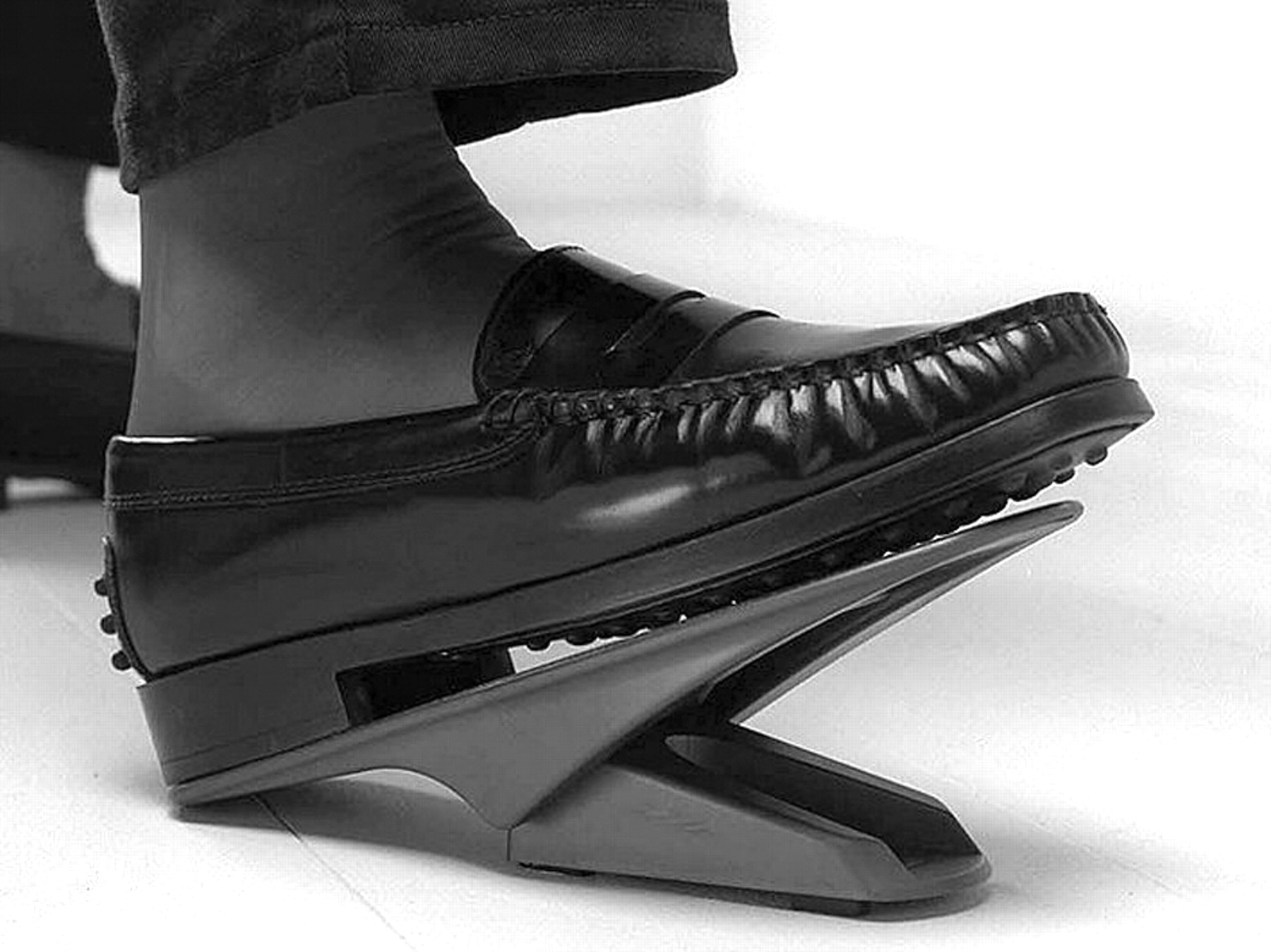
Several studies [1-3] have been performed to investigate whether change of position or body movement could affect ankle and lower-leg swelling. The rate of emptying of the veins can be increased by various passive measures, such as elastic compression with special stockings or bandages and various calf muscle pumps. This can also be achieved by active movement. StepIt (StepIt.com LLC, Clearwater Beach, Florida) is a pedal device designed to simulate the movement of normal walking, which, by contraction of the calf muscle pump, would assist in emptying the veins of the feet and lower leg (Fig. 1). Theoretically, this would counteract swelling of the ankle and lower leg.
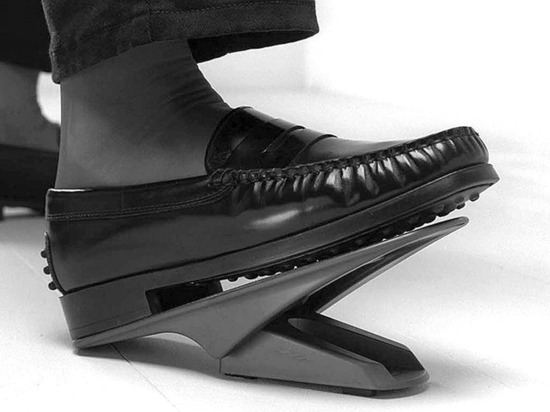
Figure 1.
The design of StepIt, which at plantar compression stimulates venous emptying.
Some measures that stimulate calf muscle-mediated vein emptying have been shown to have a prophylactic effect against the development of postoperative deep venous thrombosis. [4-6] One effect of using StepIt as a walking substitute could, therefore, be prophylactic against thrombosis. The aim of the present study was to evaluate whether StepIt could affect the tendency toward ankle swelling in individuals who are sedentary at work.
Materials and Methods
This study was conducted in two parts. In part 1, 20 healthy volunteers (19 women and one man; mean age, 50 years; age range, 29–64 years) who performed office work predominantly while sitting were included. Exclusion criteria included a history of deep venous thrombosis, bone fracture, and surgery in the pelvic region. In part 2, 20 healthy volunteers (16 women and four men; mean age, 50 years; age range, 23–59 years) who performed mostly sitting work were included. A history of deep venous thrombosis, bone fracture, and pregnancy were exclusion criteria. During the days of testing, the participants in both parts of the study were asked to sit as much as possible. At least 30 to 40 pumping movements per hour were performed.
Lower-leg volume was calculated by measuring the largest calf circumference and the smallest ankle circumference and using these values in the formula for the volume of a truncated cone (this is directly comparable with measurement of displaced water volume). [7] The formula for the volume (V) of a truncated cone is V = h/12π (C2 + c2 + Cc), where C indicates maximal calf circumference (in centimeters); c, minimal ankle circumference (in centimeters); and h, the distance between C and c (in centimeters).
The test participants received one demonstration and verbal explanation on how to use StepIt, the number of pumping movements, and how often. They were instructed to otherwise behave as normally as possible and to avoid longer walks. In part 2, the test participants were instructed to document every pumping period in an activity diary. The volume was measured bilaterally in the morning, and the point of measurement was marked on the leg with a line. Then, StepIt was used with one leg (right or left at random) with at least 30 to 40 pumping movements per hour. The pressure needed to fully depress the StepIt is approximately 6 kg. After 6 hours of intermittent pumping, the circumferences were again measured bilaterally at the same levels as previously marked. After 5 days, the procedure was repeated using the other leg for pumping with StepIt.
Tables and calculations were performed with Microsoft Excel 97 (Microsoft Corp, Redmond, Washington). Nonparametric statistics were chosen because the values could not be assumed to be distributed in a normal Gaussian manner. The Wilcoxon signed rank test for paired data was used, and median (range) values were noted. The level of significance was determined at P < .05.
Results
Part 1
At both measurements, the leg using StepIt showed a smaller increase in volume versus the contralateral unpumped leg (first measurement: 2.0% versus 2.9% and second measurement: 2.5% versus 3.6%) (P < .05) (Table 1). Of the 40 legs, 30 showed a smaller volume in the afternoon after pumping than the initial volume in the morning; nine showed an increase in volume; and one showed no difference. The difference in the number of legs with prevention of volume increase by using StepIt was significant (P < .05).

Table 1.
Volume Change Between the Second and First Measurements (After and Before Use of StepIt)

Part 2
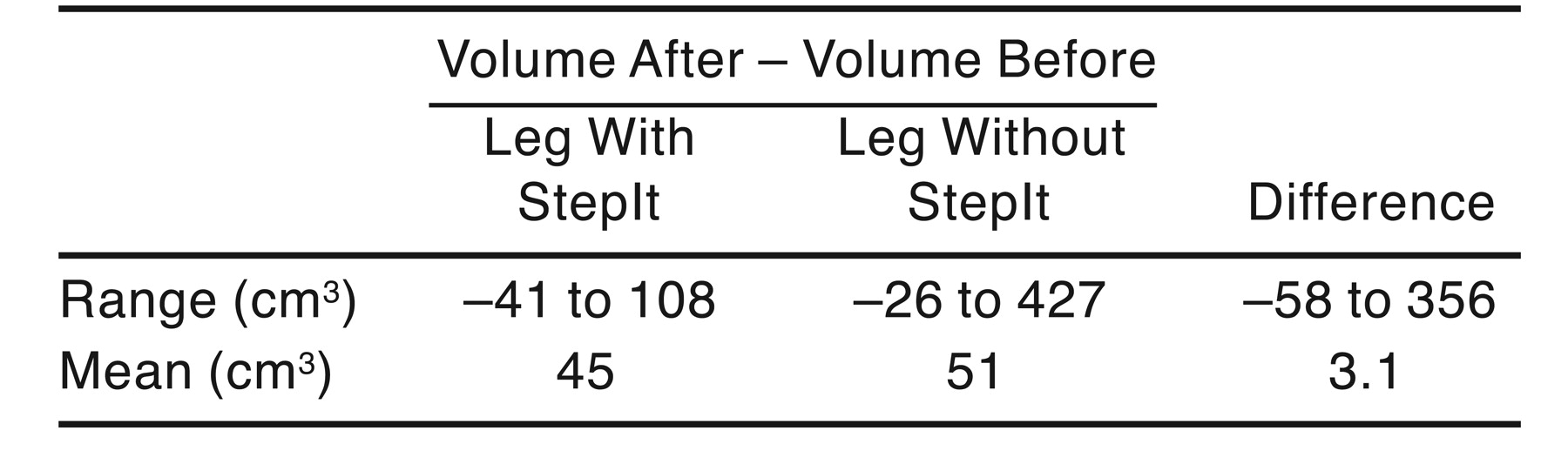
At both measurements, there was a significant increase in leg volume during the observation period (P < .001) (Table 2). There was no significant difference in volume increase between pumped and unpumped legs, the increase being on average 3.1% in the pumped leg and 3.2% in the unpumped leg. In legs for which the increase in volume was more than 4.9%, there was, however, a significant difference between pumped and unpumped legs, with a smaller volume increase after the use of StepIt (P < .05). The median value for volume increase was 2.9% in pumped and unpumped legs. The range of values for pumped and unpumped legs were −2.2% to 6.4% and −1.5% to 17.1%, respectively. The pump diary was well kept (441/444 notes, or 99.3%).
Table 2.
Volume Differences Between the Second and First Measurements (After and Before Use of StepIt)
Discussion
These studies show that intermittent use of a foot pedal that simulates walking when sitting can diminish the leg volume increase of healthy volunteers with a sitting work situation. How the force necessary to depress the device will affect the antiswelling effect is not known, but the higher the pressure, the greater the muscle contraction. Whether passive movement will reduce swelling is not known. Patients with pathologic swelling have not yet been studied, but it can be assumed that the relative effect should be larger. In favor of this assumption is the fact that in part 2, an effect was seen in those with the largest increase in volume. Several studies have indicated a correlation between long-term sitting and lower-leg swelling. Winkel [8] investigated lower-leg swelling and discomfort during an 8-hour workday. The tested persons were examined during three normal workdays and three experimental workdays with a 2-min walk every 15 min during the whole day. The swelling was, on average, 4.0% during the normal workdays and 2.3% during the experimental workdays. The feeling of discomfort was correlated to the increase in lower-leg swelling. In further studies, [1,9,10] the same research group showed the importance of activity in diminishing leg swelling.
There are different methods for the measurement of lower-leg volume; water volumetry gives an exact measure, but the calculation of volume from the formula of a truncated cone gives a good correlation (0.97, P < .001, Persson et al [7]). The method is simple and reliable, requires little equipment, and saves time. Therefore, it can be used in field studies of volume changes in the lower legs.
In part 1, the test participants did not use a pump protocol but were told to pump 30 to 40 times per hour. In the normal work of these test participants, movement is part of normal behavior, and it is difficult to determine what is small or large movement. At this point, it cannot be determined whether the number of pumping movements would affect the results. The frequency with which the test participants pumped and the technique of their pumping were not controlled. According to the pumping diary control in part 2, the participants showed high compliance, which indicates good motivation.
The optimal pumping method (frequency, duration, and technique) still needs to be determined, as does the question of whether using StepIt has different effects on different types of edema. Another problem to study is whether any prophylactic effect on deep venous thrombosis can be demonstrated. Whether the pumping has effects other than the hemodynamic (eg, release of endothelial factors) is not known. An interesting application would be to use StepIt on individuals with limited ability to move for a long period, such as during long-distance flights.
Conclusions
In healthy volunteers with mainly sitting working conditions, it is possible in some people, with the use of StepIt, to significantly reduce swelling of the lower legs during a workday.
Financial Disclosure
None reported.
Conflict of Interest
None reported.
References
- Winkel J, Jorgensen K: Evaluation of foot swelling and lower-limb temperatures in relation to leg activity during long-term seated office work. .Ergonomics29::313. ,1986.
- Paul R: “Foot swelling in sedentary VDT operators,” Advances in Industrial Ergonomics and Safety VII, p623, Taylor and Francis, London. ,1995.
- Stranden E: Dynamic leg volume changes when sitting in a locked and free floating tilt office chair. .Ergonomics43::421. ,2000.
- Wells PS, Lensing AW, Hirsh J: Graduated compression stockings in the prevention of postoperative venous thromboembolism: a meta-analysis. .Arch Intern Med154::67. ,1994.
- Vanek VW: Meta-analysis of effectiveness of intermittent pneumatic compression devices with a comparison of thigh-high to knee-high sleeves. .Am Surg64::1050. ,1998.
- Agu O, Hamilton G, Baker D: Graduated compression stockings in the prevention of venous thromboembolism. .Br J Surg86::992. ,1999.
- Persson NH, Takolander R, Bergqvist D: Lower limb oedema after arterial reconstructive surgery: influence of preoperative ischaemia, type of reconstruction and postoperative outcome. .Acta Chir Scand155::259. ,1989.
- Winkel J: Swelling of the lower leg in sedentary work: a pilot study. .J Hum Ergol (Tokyo)10::139. ,1981.
- Noddeland H: Foot swelling and the significance of leg activity during simulated long-distance flying. .Acta Physiol Scand Suppl542::130. ,1985.
- Winkel J, Jorgensen K: Swelling of the foot, its vascular volume and systemic hemoconcentration during long-term constrained sitting. .Eur J Appl Physiol Occup Physiol55::162. ,1986.
© 2009 American Podiatric Medical Association