Diabetes mellitus and its complications are the sixth leading cause of death in the United States.
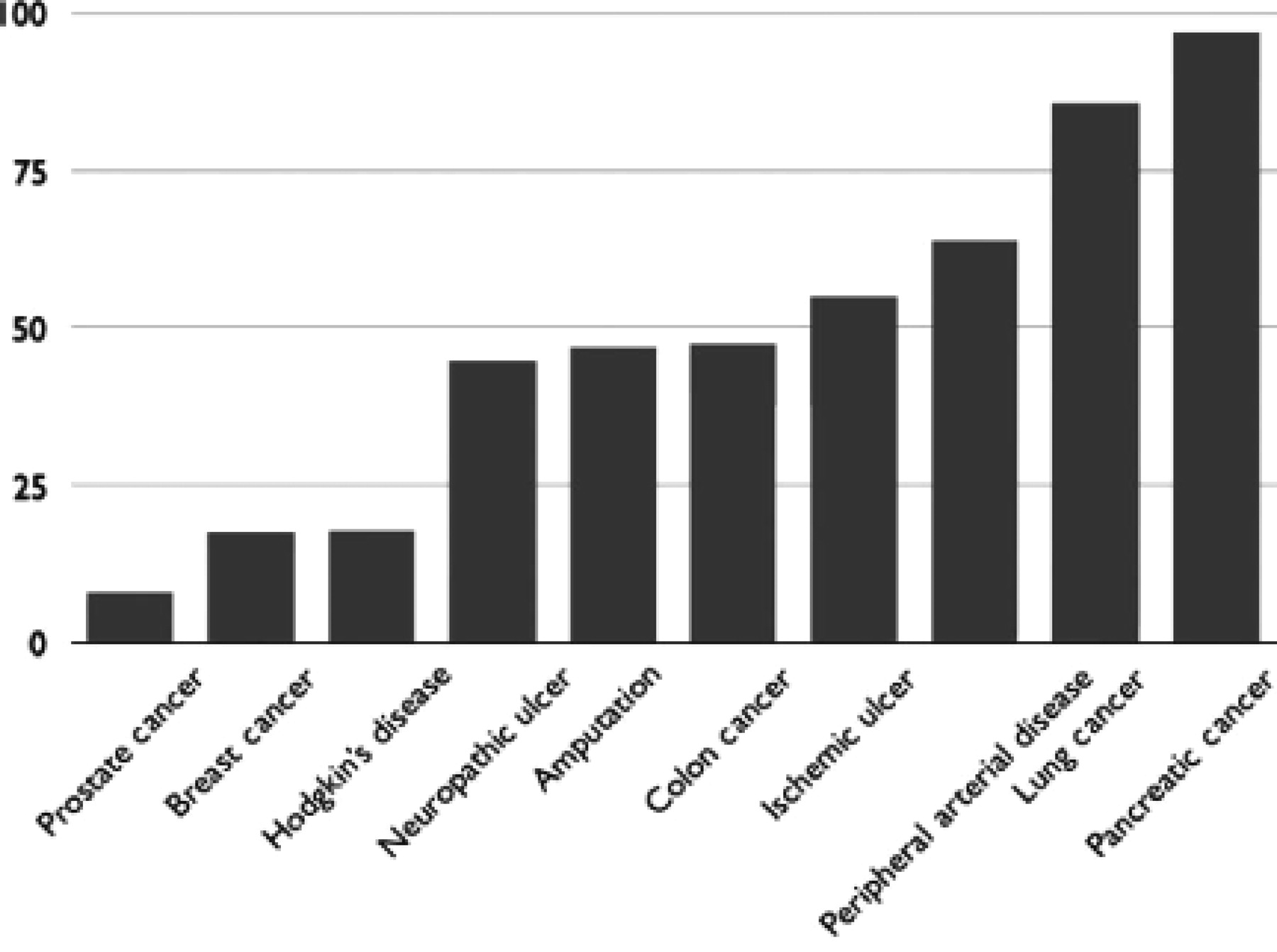
1 However, the diagnosis of diabetes mellitus is not generally addressed clinically as potentially fatal by patients or their providers. It is managed as a chronic disease with lifestyle changes and medical care. One of the more common complications of diabetes is the diabetic foot ulcer. Here again the diagnosis of a foot ulcer is generally followed by discussion of possible amputation, but rarely if ever is increased mortality addressed, despite 5-year mortality rates for new-onset diabetic ulcers, amputation, or both reported as high as 74% in some studies.
2–8 This is higher than the 5-year mortality rates for breast cancer, colon cancer, and prostate cancer. Cardiovascular-related mortality is the most common cause of death in this patient cohort.
2,3,9–13When patients with diabetes present with a foot ulcer, attention is drawn to wound management. Systemic control is also addressed and either referral or consultation is made with the primary-care provider to encourage optimal control. However, a cardiology consult is rarely obtained in cases of first-onset diabetic ulcers, although many of these patients are already receiving care for cardiovascular disease.
There is a two-fold increase in both coronary artery disease (CAD)
10 and peripheral vascular disease (PVD)
14 in patients with diabetes. The correlation between CAD and PVD and mortality in patients with diabetes is well established,
2,3,5,6,9,11,13,15 as is the association between PVD and CAD with foot ulcers and amputation.
2–6,9,12,14,16–18 Some studies have suggested that mortality rates are highest in patients who undergo an amputation.
2,9,11 In our experience, even for those who did not have an amputation, 5-year mortality rates were 46% compared to 48% for those patients who did have an amputation.
Attitudinal Factors
Diabetes could be viewed as a malignant disease. A
malignant disease is defined as a disease that does harm, inflicts suffering, causes distress, is highly injurious, is virulent, and tends to produce death. Figure 1
19 clearly shows that the mortality rates for patients with an amputation or a neuropathic ulcer have a higher mortality rate than patients with Hodgkin’s disease, breast cancer, and prostate cancer. Patients with ischemic ulcers and peripheral vascular disease have a higher mortality rate than those with colon cancer as well as Hodgkin’s disease, breast cancer, and prostate cancer. A diagnosis of cancer is perceived as more life threatening than a diagnosis of diabetes. Once a patient comes to grips with a cancer diagnosis, a conversation with his or her physician about survival rates and treatment options is customary. Most patients become highly motivated to fight their cancer in order to survive. Although the medical treatment of cancer is sometimes more passive (ie, intravenous, oral drugs, radiation) many cancer patients take a very active role in their care and seek out other forms of therapy in addition to the medical care they are receiving. The diagnosis of diabetes on the other hand, is followed by a discussion of the potential complications (heart, kidney, eye, foot) and generally does not focus on mortality issues. The medical management, however, is much more dependent on the patients’ active involvement. Patients are advised to change their behaviors, eat right, exercise, stop smoking, take medications, and possibly monitor their blood sugar levels regularly. In many health-care organizations, the job of education for many of these preventive interventions is delegated to a diabetes educator, and a detailed discussion with the physician is less common. Diabetes educators do an outstanding job with this education and training; however, an unanticipated consequence may be the de-emphasis on the mortality of diabetes. Certainly by the time the diagnosis of the diabetic foot ulcer is made, 5-year mortality rates are already close to 50%. The best time to begin a discussion about mortality rates for diabetes is at the initial diagnosis in order to muster vigilance for maintaining healthy behaviors to prevent the complications of diabetes. Once a diabetic foot wound or ulcer is present, discussion about mortality rates should be essential. The podiatrist or foot-care specialist treating diabetic foot wounds should consider primary-care or cardiology consultation for assessment, considering the strong association between CAD, PAD, and diabetic foot wounds, as well as the mortality associated with all three. As such, our approach to patient communication and education may need to change in order to properly communicate the risks to patients with diabetes. The message needs to come from the entire health-care team and should be consistent and clear.
Traditional medical education does not adequately prepare providers in complex informational-motivational-behavior skills. Additionally, there is precious little time to provide this type of psychological counseling to patients. This is possibly due to the view that it is not an important part of the therapeutic regimen. We would argue that the clear communication of risk is indeed an essential part of the treatment plan, as it may very well provide the motivation for better compliance with controllable factors such as adherence to wound care and off-loading instructions, limitation of weightbearing, tighter control of diet and exercise, and judicious use of prescribed medications.
Strategies for Risk Communication and Motivating Self-Management
The biomedical model of health and illness makes an assumption that patients should be motivated by their illness to obey instructions. Unfortunately, this assumption reflects a bias toward treating a disease while failing to address the behavioral requirements of the treatment. Treatments are often offered to patients who are not ready to hear about or follow them, and interventions following this model are unlikely to cause sustained changes in adherence.
20It is abundantly clear that providing patients with information alone about desired behavior change has been a failure in fostering adherence. Instead, it is suggested that the information-motivation-behavior skills (IMB) model
21,22 may be one way to advance behavior change. The IMB model posits that exchanging information and fostering motivation increases the likelihood of adherence with behavioral change. It also requires that patients and providers discuss levels of interest in change, what sense the patient has about his or her level of self-efficacy in his or her ability to institute those changes, and what skills will be necessary to effectively make the behavioral changes.
One way to implement the IMB model and facilitate behavior change is to use motivational interviewing (MI)
23 techniques within the framework of the transtheoretical or stages-of-change model
24 of behavior change. Motivational interviewing is a strategy and collection of methods geared to a brief patient-centered consultation that is directive, a method of communication, and a means to explore and resolve ambivalence and resistance to behavior change. The transtheoretical model (TM) “is an integrative framework for understanding how individuals and populations progress toward adopting and maintaining health behavior change for optimal health.”
25 The TM or stages-of-change model describes five stages (precontemplation, contemplation, preparation, action, and maintenance) that are useful in matching interventions with a patient’s level of desire to change behavior. The focus is not to convince or intimidate patients to change; but rather, to help them move along the stages of change until they are self-motivated to engage in healthy behaviors and believe they have mastery over the skills needed to attain and maintain the changes. Motivational interviewing techniques and the stages-of-change model go hand in hand.
Motivational interviewing techniques have been effective in fostering behavior change in patients with diabetes, hypertension, and bulimia. They have also been effective in treating alcohol and drug problems.
26 Additionally, MI has been found to be superior to no-treatment control groups in fostering adherent health-behavior change.
The spirit of health-behavior change entails collaborating with the patient, evoking their readiness to take action, and developing the patient’s autonomy to take responsibility for their own health.
26 It also entails addressing two common issues among patients that prevent health-behavior change: ambivalence and resistance to change. Ambivalence is the inclination to maintain the status quo even if the person is not pleased with how he or she feels. The ambivalent cognitive mindset must be resolved before behavior change can be initiated.
27 Similarly, resistance to change keeps the patient stuck with counterproductive health behaviors. Resistance can disrupt and negatively impact the rapport between the patient and the health-care provider. Furthermore, resistance can be a sign of the patient’s internal conflict between current behavior and desired behavior.
23Miller et al
26 describe four categories of resistance commonly observed in patients and professionals: 1) negating, which includes blaming, disagreeing, excusing, minimizing, pessimism, reluctance, and unwillingness to change; 2) arguing, which includes challenging, discounting, and open hostility; 3) interrupting; and 4) ignoring, which includes inactivity (eg, the patient does not fill the prescription).
Motivational Interviewing Techniques
One method of using MI is to engage in the elicit-provide-elicit technique.
23 The first
elicit is an opening strategy of gathering information in a way that enhances rapport building. It may include gathering traditional medical and surgical information but, equally if not more importantly, it must include psychosocial information that focuses on how patients view their health, health behaviors, and whether change is perceived as being needed. The next step is to
provide information. It is important to determine if the patient is ready to hear information or feedback about his or her condition. In this step, the clinician is attempting to give the patient a sense of the diagnosis and a potential plan of action. In the second
elicit, a list of “good and bad things” is proposed to the patient as the clinician invites the patient to be part of the decision-making process. The clinician might ask the patient, “What do you like and dislike about the proposed treatment plan for your foot ulcer?”, “What is your sense of this wound?”, “Do you agree with the plan or think another option needs to be entertained?”, “Do you believe you can follow the plan and what barriers might get in the way?”, “What are some ways to move beyond the barriers?” In concluding this patient–clinician interaction, the patient may be asked, “What are your thoughts now about managing your diabetic foot wound?”, “Where does this leave you now?”, and “Do you anticipate having any problems and do you have support to carry this plan out?”
Five General Principles of MI Leading to Health-Behavior Change
The mnemonic READS depicts the general principles of MI: Roll with resistance, Express empathy, Avoid arguing, Develop discrepancy, Supporting self-efficacy.
Roll with resistance.
This first principle recommends that the clinician use understanding and empathy, get clarification, invite new perspectives from the patient, do not give the patient reason to resist more, and understanding that sensing resistance from the patient means you have to respond differently.
Express empathy.
This is an expression of another person’s emotions and can be elicited by paraphrasing what the patient has said and by wondering aloud what emotions the patient is feeling about the discussion of the diagnosis and action plan. This is accomplished throughout the time spent with the patient and helps identify and understand ambivalence and resistance to health-behavior change. It also creates a climate for change as trust is developed between the patient and clinician.
Avoid arguing.
Arguing adds to the patient’s resistance and forces people to defend the behavior that is trying to be changed. Conversely, empathic behavior toward the patient allows the clinician to be viewed as being “on their side.” It is perfectly fine for the clinician to challenge the patient’s ambivalence or resistance, but don’t argue.
Develop discrepancy.
Discrepancy is essentially the same as dissonance. The clinician can help the patient examine the good (pros) and bad (cons) aspects about change. The goal here is to throw out of kilter the patient’s cognitive schema of why he/she should not change. The tact is for the clinician to restate the discrepancy heard from the patient. Change is motivated by a perceived discrepancy between present behavior and important personal goals or values of the patient.
26 An example of a challenging statement that highlights the dissonance might be, “I’m confused about something. You mentioned before that you are very worried about the prospects of the ulcer on your foot getting worse and eventually losing your foot to amputation. But at the same time I’m hearing you say that you don’t like taking the antibiotics. Help me understand the conflict you have with this. Do you have other suggestions about how we might get around this barrier?”
Supporting self-efficacy.
A person’s belief in the possibility of change is an important motivator. It is important that the clinician reinforce the patient for positive attempts toward change and that the efforts have been noticed. One way to assess the patient’s motivation for change (stage of change) and level of self-efficacy is to ask a few questions that require the patient to respond on a 0–10 scale, with 0 equaling no motivation and no belief that he/she could actually be successful with the behavior change, and 10 depicting 100% motivation to change as well as the belief in one’s self that the behavior change will be fully successful. The questions to be asked are: “How important is this change for you?”, “How confident are you that you can make this change if you want to?”, “Why did you choose a ____, and not a 1?”, and “What would have to happen for the number to be a ____?” (next highest number from what they stated.)
28 Conclusion
The biomedical model of health care has often assumed that patient education fostered behavior change. It is now clear that education alone does not ensure adherence to treatment plans. As such, clinicians need to assume some of the responsibility in their patient’s nonadherence. By understanding the transtheoretical model of behavior change and practicing and using the information-motivation-behavior skills model as well as MI techniques, the clinician can unite with their patients in finding the best means to advance positive behavior change to effect good health practices.
Patients with a diagnosis of diabetes mellitus might benefit from more complete and accurate risk communication about the mortality associated with diabetes at the time of initial diagnosis. At the onset of a diabetic ulcer, a cardiovascular examination by either the primary-care provider or cardiologist would be advisable, because cardiovascular disease is the major cause of death in these patients. Further, a case is made for more complete and accurate risk communication, in a patient-centered care model, at the time of diagnosis of foot ulcer so that patients can make informed decisions about their role in the management of their condition.