


Abstract
A new technique for interposition arthroplasty of the first metatarsoplalangeal joint is described. It involves minimal resection of the base of the proximal phalanx and the use of a fascia lata allograft. The method is simple, safe, and easily reproducible. In selected cases it can offer restoration of pain-free motion in a nonsalvable joint.
Interposition arthroplasty of the first metatarsophalangeal (MTP) joint is a valid alternative in cases of severe joint degeneration, especially in low-demand patients.[1,2] Various modifications of the method have been described.[3–10] These refer mainly to the type of proximal phalanx osteotomy and to the tissue used for interposition. This tissue is either the first MTP joint capsule or a tendon autograft that is usually harvested from the ipsilateral leg. During the past decade, there has been no paucity in the literature considering the introduction of new modifications of interpositional arthroplasty. However, none of these have gained wide acceptance.
We present a new technique of the first MTP joint interposition arthroplasty. It includes minimal resection of the proximal phalanx and the use of a fascia lata allograft as a permanent spacer in order to avoid both the shortening of the great toe and the possible complications of the donor site. Our main indication for the method is an arthritic, painful first MTP joint with either an advanced hallux rigidus or hallux valgus pathology as assessed clinically and confirmed radiologically.
The ideal candidates for the technique are the elderly or low-demand patients. During informed consent, the patients are offered the alternative of a fusion or, in certain cases, a first MTP joint replacement. They are also informed that the final decision for the joint sacrifice will be taken intraoperatively. Patients with a history of infection in the region or a history of severe allergic reactions and a short first ray as measured preoperatively are excluded from the procedure.
Procedure
After the usual preparation of the patient, either a dorsal or a dorsomedial approach to the first MTP joint is used, depending of the primary pathology of hallux rigidus or hallux valgus respectively. After the resection of osteophytes (either cheilectomy or bunionectomy), the joint surface is inspected. The final decision of whether the joint can be preserved or not is made at this stage. If a joint salvage procedure is decided, the surgeon proceeds with the technique of his choice. Otherwise the next step is the resection of the base of the proximal phalanx with a 1-cm power saw. The line of the osteotomy is vertical at the level of subchondral bone. A thin wafer of bone is excised, ideally not exceeding 10% of the length of the phalanx (Fig. 1A). At the same time, the fascia lata allograft (Tutoplast, Tutogen Medical, Neukirchen am Brand, Germany) is opened and prepared by an assistant. The allograft is soaked in a warm normal saline solution for 5 minutes; this rehydration process restores the fascia’s pliability and improves its handling properties. A 3 × 4-cm piece is cut and folded on itself three to four times in order to form a quadriparallel pack, and its corners are stitched with a 3-0 Vicryl suture (Johnson and Johnson, Hamburg, Germany). The pack is introduced to the joint space and the tension of the surrounding tissues is tested. The first toe should not dislocate through a normal range of motion but should be able to just disengage from the allograft with a telescopic maneuver. If the articulation is found to be too loose, a second spacer can be prepared from the same allograft.
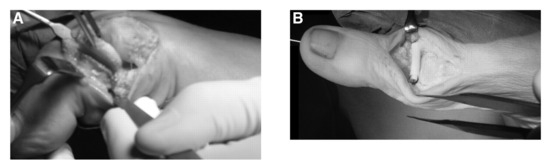
Figure 1.
A, Osteotomy of the base of the proximal phalanx at the subchondral bone level. The minimal bone resection is noted. B, Fascia lata allograft folded and packed.
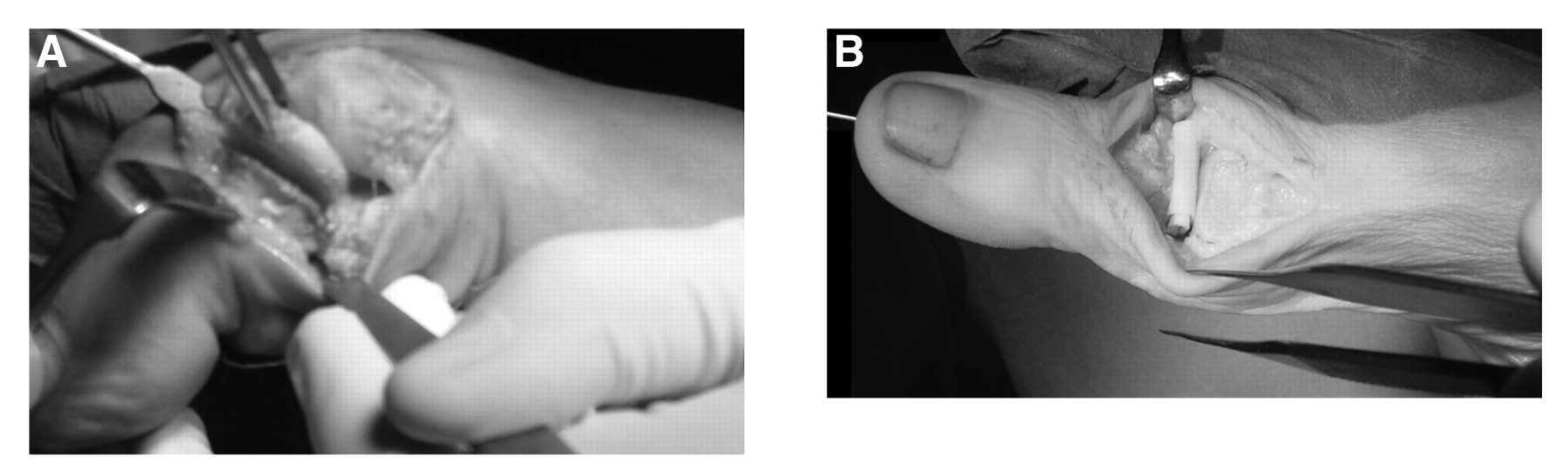
Once soft tissue balancing is considered satisfactory, the graft is temporarily removed, the toe is flexed to 90°, and a double-ended 1.6-mm Kirschner wire (Synthes, Bochum, Germany) is introduced to the first phalanx pointing distally. It should penetrate the distal phalanx and exit underneath the nail bed, at the center of the toe. It is advanced until the proximal end protrudes from the resected phalanx base by only a few millimeters. Then, the allograft is placed in situ and the Kirschner wire is driven in a retrograde fashion through the spacer and the head, to the shaft of the first metatarsal (Fig. 1B). Any protruding “dog ears” from the graft are trimmed and the distal end of the Kirschner wire is cut and bent. The wound is irrigated and closed in layers.
An intraoperative radiograph or C-arm imaging is obtained to check the correct placement of the Kirschner wire. The foot is bandaged, and patients are allowed to mobilize and bear full weight on the heel the first postoperative day. Patients are routinely reviewed for dressing changes and removal of sutures. The Kirschner wire is removed 6 weeks postoperatively and radiographs are taken at 3 and 6 months postoperatively during the final review.
Discussion
A number of techniques for an interposition arthroplasty of the first MTP joint have been described. There is an ongoing interest in the literature about new methods that attempt to overcome an old challenge: how to restore pain-free function in a nonsalvable joint. Tissues that have been used as spacers for this purpose are the first MTP joint capsule; human dermal tissue matrix; and the extensor digitorum brevis, flexor hallucis longus, palmaris longus, plantaris, and gracilis tendons.[3,5,6,8–11] Various modifications of the type of the proximal phalanx osteotomy have also been proposed, such as an oblique osteotomy and minimal bone resection.[7,11,12] Up to the present, none of these modifications has managed to withstand the test of time and enjoy wide acceptance. Their routine use has been partly hampered by concerns regarding the donor-site morbidity (mainly wound healing, infection, neurovascular complications, and muscle weakness) and technical difficulties that make certain techniques less easily reproducible. The current technique is an effort to overcome these limitations.
Fascia lata grafts have long been used in orthopedic surgery. When used as allografts, they have a predictably benign biological behavior and a high safety profile. Their clinical applications include, among others, the elbow, knee, proximal tibiofibular, and radiolunate joints.[13–17] Although not reported, they carry the potential risk of foreign-body reaction. The allograft used in our department (Tutoplast) is a dehydrated human fascia lata specimen. Each square centimeter of it contains approximately 25 mg of human connective tissue. It is sterilized by γ irradiation and has been used for more than 20 years in humans without any report of immunological rejection. The allograft transforms to a dense connective tissue and provides a stable platform for joint motion.
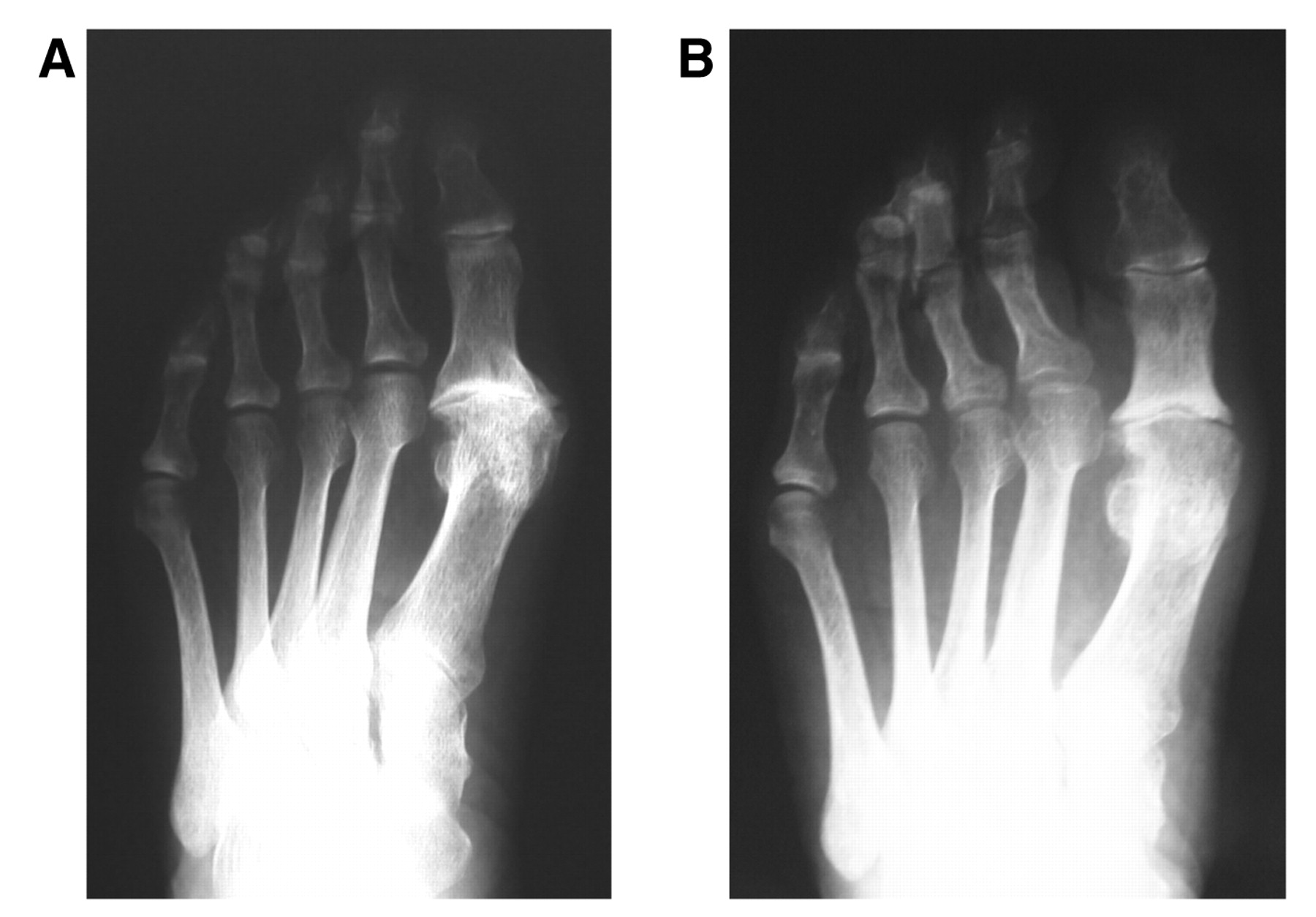
The technique described here has certain theoretical advantages. No normal structures from the adjacent or distal tissues are being sacrificed in order to be used as spacers. Therefore, there is no donor-site morbidity and the duration of the procedure is kept to a minimum. The technique allows minimal bone resection from the proximal phalanx, as proposed in other published series (Fig. 2).[12] As a result, the correct tension of the soft tissues about the joint is maintained, which can lead to an improved functional and cosmetic outcome. Moreover, in case of failure, a conversion to an MTP arthrodesis is much easier compared to other methods. So far, no interposition arthroplasty has been converted to a fusion in our series. The shape of the allograft seems to offer an improved stability to the first toe. Additionally, soft tissue balancing can be tested and corrected intraoperatively. The technique can be utilized either from a dorsal or a dorsomedial first MTP joint approach and therefore is applicable to different underlying MTP joint pathologies. Technically, the modification is not demanding and is easily reproducible. No postoperative period of nonweightbearing status is needed, which is suitable for less compliant elderly patients in particular. Finally, the technique is suitable for elderly smokers for whom fusions carry an increased risk of failure.
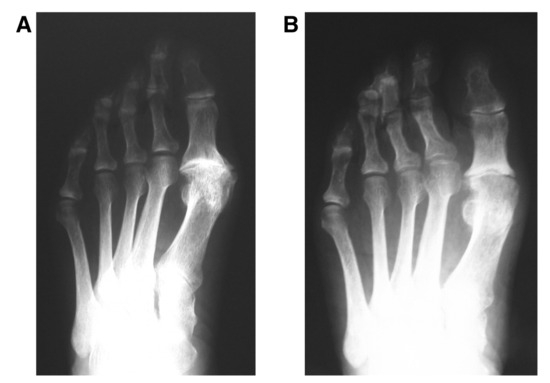
Figure 2.
Anteroposterior radiograph showing weightbearing of a 70-year-old patient preoperatively (A) and at the 3.5-year follow-up (B).
A prospective study has been launched in our center to validate the long-term clinical outcomes of the method. The 1-year follow-up results in 11 cases are good to excellent, according to both the American Orthopaedic Foot and Ankle Society scores and the patients’ satisfaction. We agree with other authors that the implication of interposition arthroplasty as a salvage procedure in low-demand patients alone needs to be challenged.
In summary, interposition arthroplasty of the first MTP joint with a fascia lata allograft is a simple, easily reproducible, and safe technique. In selected cases it can offer restoration of pain-free motion in a nonsalvable joint.
Financial Disclosures: None reported. | |
Conflict of Interest: None reported. |
References
- Brage ME, Ball ST: Surgical options for salvage of end-stage hallux rigidus. Foot Ankle Clin 7: 49, 2002.
- Keiserman LS, Sammarco VJ, Sammarco GJ: Surgical treatment of the hallux rigidus. Foot Ankle Clin 10: 75, 2005.
- Hamilton WG, O’malley MJ, Thompson FM, et al: Capsular interposition arthroplasty for severe hallux rigidus. Foot Ankle Int 18: 68, 1997.
- Coughlin MJ, Shurnas PJ: Soft-tissue arthroplasty for hallux rigidus. Foot Ankle Int 24: 661, 2003.
- Lau JTC, Daniels TR: Outcomes following cheilectomy and interpositional arthroplasty in hallux rigidus. Foot Ankle Int 22: 462, 2001.
- Roukis TS, Landsman AS, Ringstrom JB, et al: Distally based capsule-periosteum interpositional arthroplasty for hallux rigidus: Indications, operative technique, and short-term follow-up. JAPMA 93: 349, 2003.
- Mroczek KJ, Miller SD: The modified oblique Keller procedure: a technique for dorsal approach interposition arthroplasty sparing the flexor tendons. Foot Ankle Int 24: 521, 2003.
- Miller D, Maffulli N: Free gracilis interposition arthroplasty for severe hallux rigidus. Bull Hosp Jt Dis 62: 121, 2005.
- Cosentino G: The Cosentino modification for tendon interpositional arthroplasty. J Foot Ankle Surg 34: 501, 1995.
- Berlet GC, Hyer CF, Lee TH, et al: A soft-tissue interpositional arthroplasty technique of the first metatarsophalangeal joint for the treatment of advanced hallux rigidus using a human acellular dermal regenerative tissue matrix. Techniques Foot Ankle Surg 5: 257, 2006.
- Barca F: Tendon arthroplasty of the first metatarsophalangeal joint in hallux rigidus: preliminary communication. Foot Ankle Int 18: 222, 1997.
- Kennedy JG, Chow FY, Dines J, et al: Outcomes after interposition arthroplasty for treatment of hallux rigidus. Clin Orthop Relat Res 445: 210, 2006.
- Carroll RE: Long term review of fascial replacement after excision of the carpal lunate bone. Clin Orthop Relat Res 342: 59, 1997.
- Friedrich JB, Hanel DP, Chilcote H, et al: The use of tensor fascia lata interposition grafts for the treatment of posttraumatic radioulnar synostosis. J Hand Surg [Am] 31: 785, 2006.
- Cheng SL, Morrey BF: Treatment of the mobile, painful arthritic elbow by distraction interposition arthroplasty. J Bone Joint Surg Br 82: 233, 2000.
- Koga Y, Kono S, Mabuchi K: A long term follow up of resection interposition arthroplasty of the knee using chromicized fascia lata. Int Orthop 12: 9, 1988.
- Yaniv M, Koenig U, Imhoff AB: A technical solution for secondary arthritis due to chronic proximal tibiofibular joint instability. Knee Surg Sports Traumatol Arthrosc 7: 334, 1999.
© 2008 American Podiatric Medical Association