Next Article in Journal
Transfer of the Flexor Digitorum Brevis Tendon
Previous Article in Journal
Ability of Foot Care Professionals to Cast Feet Using the Nonweightbearing Plaster and the Gait-Referenced Foam Casting Techniques
 
 
Journal of the American Podiatric Medical Association is published by MDPI from Volume 116 Issue 1 (2026). Previous articles were published by another publisher in Open Access under a CC-BY (or CC-BY-NC-ND) licence, and they are hosted by MDPI on mdpi.com as a courtesy and upon agreement with American Podiatric Medical Association.
Article

Functional Outcome of Meniscal-Bearing Total Ankle Replacement. A Gait Analysis Study

by
Maria Grazia Benedetti
1,*,
Alberto Leardini
1,
Matteo Romagnoli
2,
Lisa Berti
1,
Fabio Catani
2 and
Sandro Giannini
2
1
Movement Analysis Laboratory, Rizzoli Orthopedic Institute, University of Bologna, Bologna, Italy
2
Department of Orthopedic Surgery, Rizzoli Orthopedic Institute, University of Bologna, Bologna, Italy
*
Author to whom correspondence should be addressed.
J. Am. Podiatr. Med. Assoc. 2008, 98(1), 19-26; https://doi.org/10.7547/0980019
Published: 1 January 2008

Abstract

Background: Most clinical studies on total ankle replacement (TAR) report assessments based on traditional clinical scores or radiographic analysis. Only a few studies have used modern instrumentation for quantitative functional analysis during the execution of activities of daily living. The aim of this study was to use gait analysis to compare the functional performance of patients who underwent TAR versus a control population. Methods: A retrospective analysis was performed of ten consecutive patients who had undergone meniscal-bearing TAR. Clinical and functional assessments were performed at a mean follow-up of 34 months with a modified Mazur scoring system and state-of-the-art gait analysis. Results: Gait analysis assessment of TAR at medium-term follow-up showed satisfactory results for all patients, with adequate recovery of range of motion. Because the literature reports unsatisfying long-term results, it is important to evaluate these patients over a longer follow-up period. Conclusions: This study showed that TAR yields satisfactory, but not outstanding, general functional results at nearly 3 years’ follow-up. These gait analysis results highlight the importance of integrating in vivo measurements with the standard clinical assessments of patients who underwent TAR while they perform activities of daily living. These results also emphasize the importance of evaluating the functional outcome of TAR over time.

Most of the recently developed designs for total ankle replacement (TAR) employ fully congruent meniscal bearings that are free to slide on both the tibial and talar articular surfaces.[13] These designs are said to provide translational movement with maintenance of full conformity of the articulating surfaces throughout the ankle range of motion. To allow internal/external rotation as well as translational movement, the tibial component has a flattened articulating surface that is capable of accommodating slight inaccuracies in surgical implantation. Dislocation of the meniscal bearing is supposed to be resisted by the penetration of the convex bone-anchored talar component into the corresponding concavity of the bearing, in which it should be held by the tension of the ligaments.
Recent clinical reports on the meniscal-bearing TAR designs[411] are encouraging, but the results are still not as good as those for the replacement of human hip and knee joints. Radiographic and clinical studies over the medium and long terms showed better results than with previous two-component designs (ie, without meniscal bearing).[1218] Although TAR is now considered a viable alternative to ankle arthrodesis,[15,1921] the clinical reports published so far, with assessments based on traditional clinical scores or radiographic analyses, are still generally disappointing. A recent meta-analysis[22] showed improvement in pain and joint mobility after TAR but concluded that scientific evidence of the benefits of this treatment is still lacking. One of the problems is the heavy loads that this small joint has to bear. The ankle endures compression and shear forces produced by a complex triplanar movement,[2325] and absorption of these forces by the prosthesis can be insufficient.[15] An incomplete knowledge of the function of the ankle joint structures during activities may also be a factor.[23,26] Clinical studies alone cannot reveal the functional performance of these prostheses and the mechanisms that lead to failure. Studies that combine traditional clinical assessment and functional evaluation based on modern instrumentation are rare.[2729] A quantitative analysis of functional outcome during activities of daily living after TAR can facilitate understanding of the actual performance of the prosthesis in vivo.
The aim of the present study was to use clinical assessment, and especially instrumental gait analysis, to objectively analyze the functional outcome of a retrospective series of TAR patients with osteoarthritis (OA) or rheumatoid arthritis (RA) who were treated with a meniscal-bearing ankle prosthesis.

Materials and Methods

Ten patients who underwent TAR at the Rizzoli Orthopedic Institute, University of Bologna, Bologna, Italy, gave their informed consent to undergo gait analysis. The patients consisted of nine women and one man with a mean age of 63 years (range, 52–72 years). Three patients had NJ (New Jersey Total Ankle; De Puy, Warsaw, Indiana) prostheses and seven patients had STAR (Scandinavian Total Ankle Replacement; Waldemar Link, Hamburg, Germany) prostheses. These designs both have a flat tibial component and a generally convex talar component, with a radius of curvature in the sagittal plane replicating that of the natural talus.[6,7] A meniscal bearing in between fully conforms to these two metal bone-anchored components. The two designs are distinguished mainly by the fixation elements and by the presence of lateral shoulders and guiding elements for the meniscus on the talar component in the STAR prosthesis. The inclusion of two different designs in the study is due to the surgeon’s choice to use different models over time; no specific inclusion criteria were developed for each model. Biomechanically and functionally, these two models are very similar. The mean follow-up time was 34 months. The cause of the ankle lesion was RA in four cases, and primary or secondary OA in six cases.
The implant, evaluated radiographically, showed no signs of loosening at the time of gait analysis. In addition, no lower-limb discrepancy was found at the time of gait analysis. Clinical and functional assessment was performed with the Mazur scoring system (0–100),[30] slightly modified as follows: The maximum score assigned to the item “pain” was reduced from 50 to 47. For the item “range of motion of the ankle,” the maximum score (5) was assigned at 20° of dorsiflexion, rather than 40°, and the range of pronation/supination was also included (3 = some motion; 0 = no motion). To measure both ankle dorsiflexion/plantarflexion and pronation/supination, the procedures described by Root et al[31] were followed. The item “ability to run” (maximum score, 5) was removed and replaced with the item “ability to stand on the involved leg” in unipedal stance (5 = able; 3 = needs help; 0 = unable). Patients were also asked to report their degree of satisfaction with the surgery outcome as follows: very satisfied, satisfied, poorly satisfied, dissatisfied.
The system of measurement used to analyze gait consisted of a force plate (Kistler, Winterthur, Switzerland) and the ELITE 3-D stereophotogrammetric system (BTS, Milan, Italy). To retrace the corresponding movement of the underlying bony segments, the experimental protocol “Calibrated Anatomical System Technique” (CAST) was used.[32] Muscular activity was measured with electromyography using surface electrodes (TELEMG; BTS, Milan, Italy) for the peroneus longus, tibialis anterior, and gastrocnemius muscles. Functional assessment consisted of the acquisition of at least three trials of the entire stride with the patient barefoot. Rotation of the ankle in the sagittal plane (dorsiflexion/plantarflexion) and joint moment in the sagittal (dorsiflexion/plantarflexion) and frontal (eversion/inversion) planes were calculated. Kinematic, kinetic, and electromyographic parameters of movement were assessed. The results were compared with those of a control population of 20 subjects matched for age and sex.
Statistical analysis was performed with one-way analysis of variance (ANOVA) for parametric analysis and the Kruskal-Wallis test, evaluated by the Monte Carlo method for small samples, for nonparametric analysis. The Scheffé test (Dunn test for nonparametric analysis) was used for paired post hoc analysis of both the prosthesis model (NJ or STAR) and the etiology of the disease (OA or RA).
Gait analysis data consisted of time–distance parameters (stance phase duration, gait cycle duration, stride length, progression velocity) and peak values extracted from ankle joint kinematics (flexion angle at initial contact, maximum dorsiflexion during stance, maximum plantarflexion during swing) and kinetics (maximum dorsiflexion moment peak, second dorsiflexion moment peak).

Results

Clinical Score

The modified Mazur score was excellent in three patients (two STAR with OA; one NJ with OA), good in five patients (four STAR, two with OA and two with RA; one NJ with RA), fair in one patient (STAR with RA) and poor in one patient (NJ with OA). The latter patient also had hip arthrodesis on the same side. Pain was absent in three cases, mild in four cases, and moderate in three cases. Walking down a slope was the most critical motor task for the patients to perform. They reported needing a support or needing to walk very slowly when performing this task. Three patients were very satisfied, four patients were satisfied, two patients were poorly satisfied, and one patient (the patient with hip arthrodesis) was dissatisfied.

Time–Distance Parameters

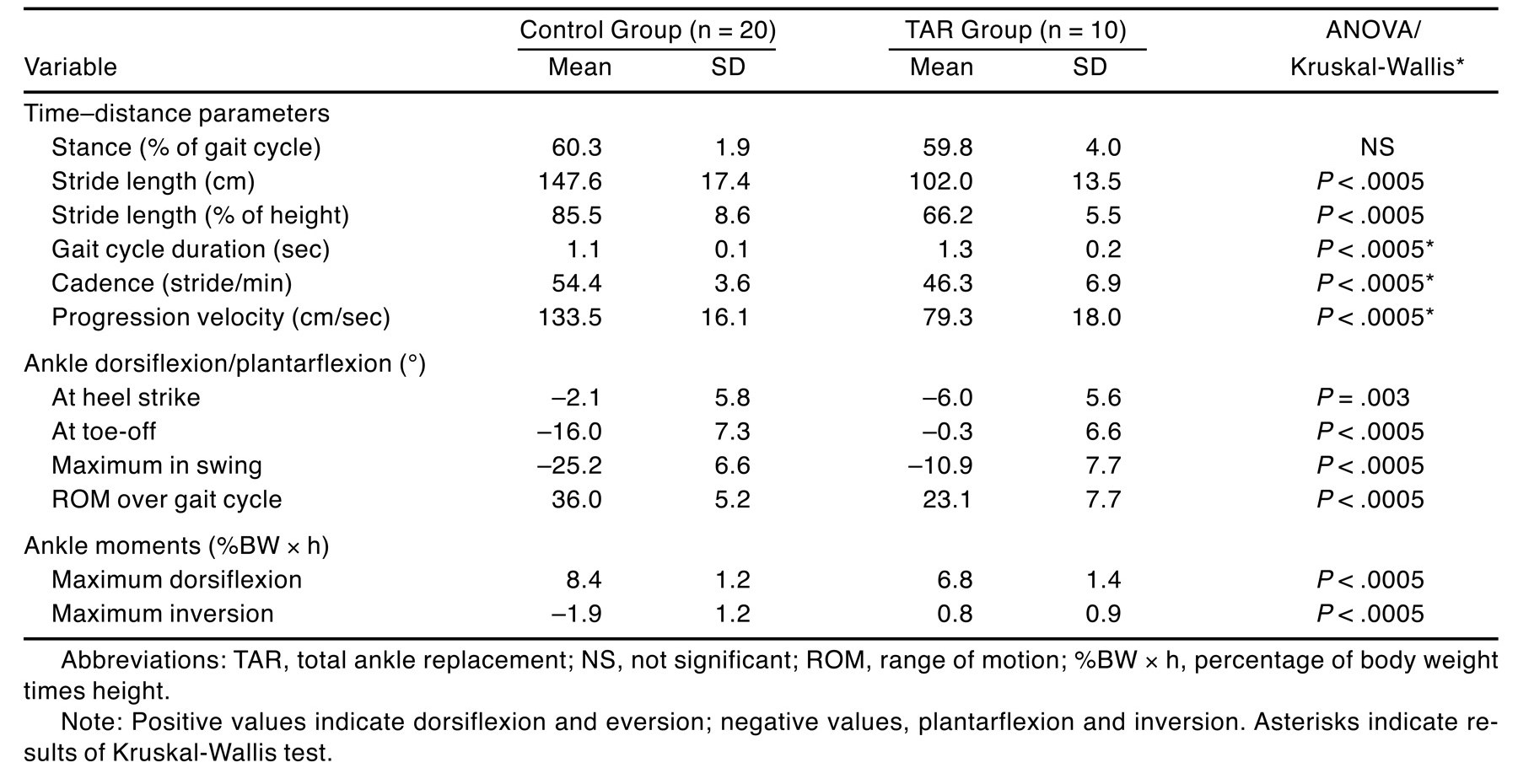
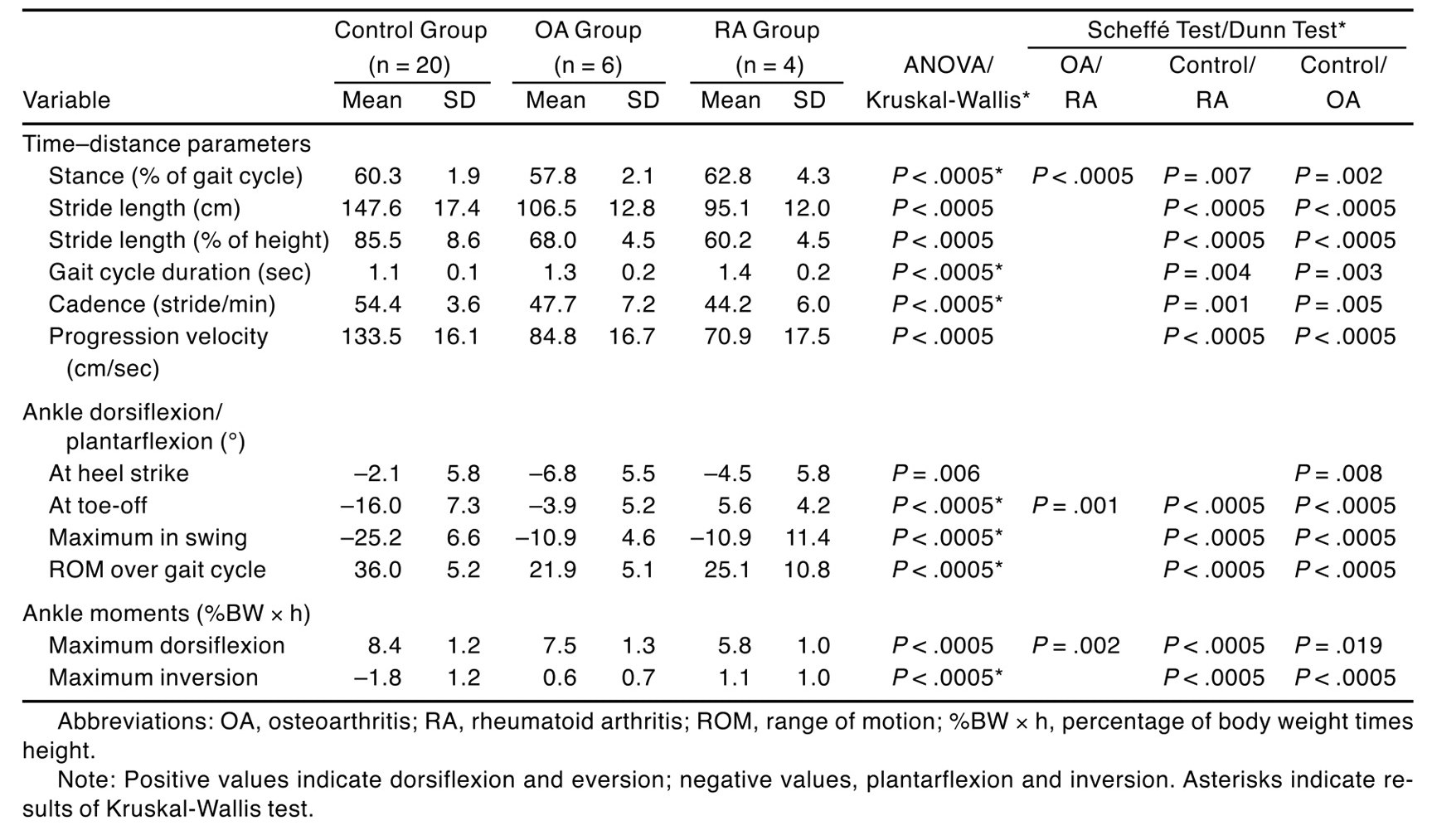
Statistically significant decreases in mean progression velocity, stride length, and cadence were found in the TAR patients compared with the control group (Table 1). Patients with RA had greater reductions in these parameters than patients with OA, although the differences were not statistically significant. Patients with RA had a longer stance phase duration on the treated limb compared with the OA group (P < .0005) (Table 2).

Kinematics and Joint Moments at the Ankle

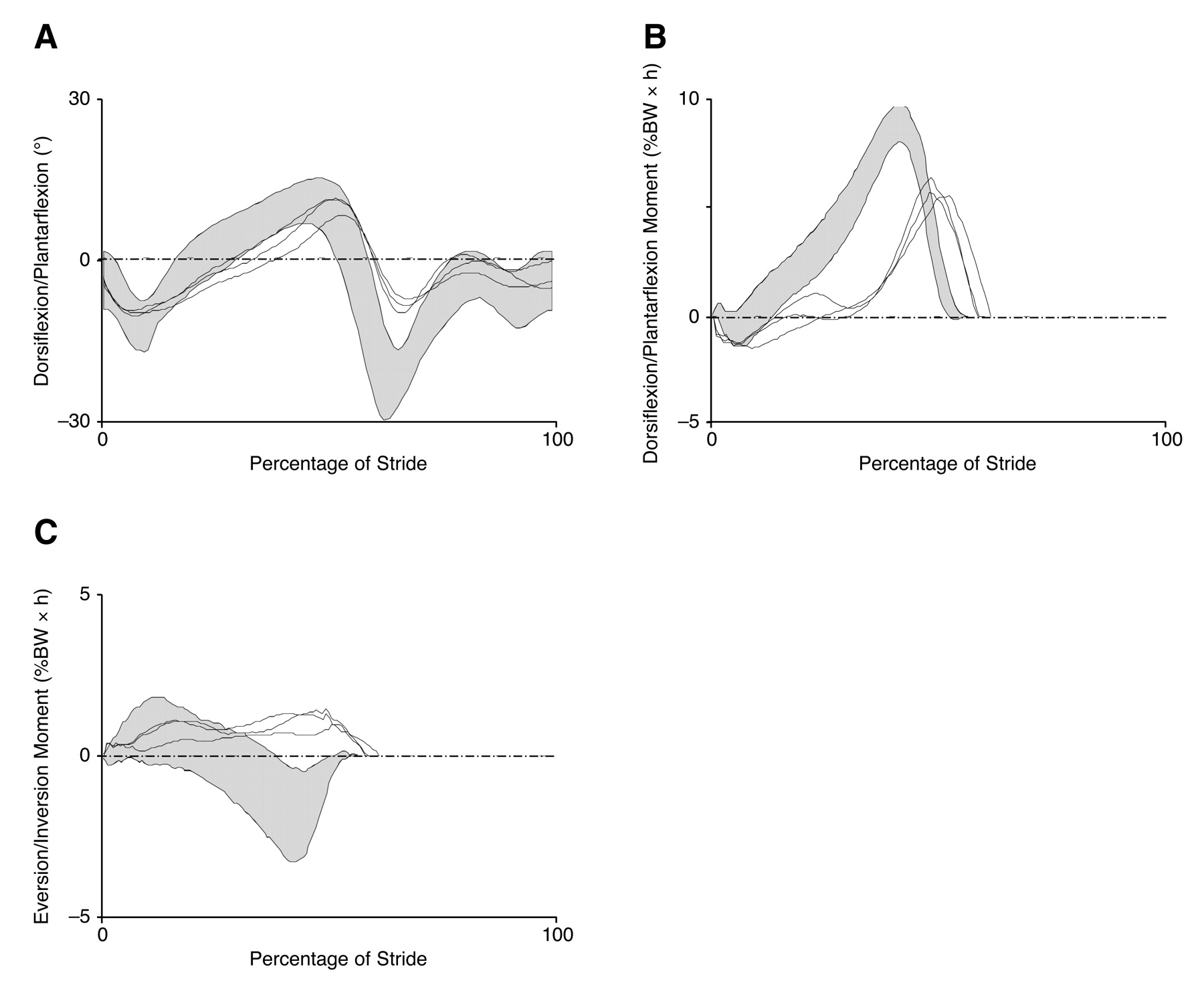
The TAR patients showed increased ankle joint plantarflexion at heel strike (mean ± SD, 6.0° ± 5.6°) compared with the control group (2.1° ± 5.8°) (Table 1; Fig. 1A). A similar pattern of foot landing was observed for RA and OA patients, although a statistically significant increase in plantarflexion was found for the latter group compared with the control group (Table 2). In both patient groups there were reductions in plantarflexion at toe-off and during swing compared with the control group (Table 1). In the comparison of the two patient groups, the RA group tended to detach the foot from the ground with increased dorsiflexion (5.6° ± 4.2°), with a statistically significant difference observed from the OA group (Table 2).
The mean range of ankle motion over the gait cycle was much smaller in the TAR patients (23.1°) than in the control group (36.0°) (Table 1), but with no statistically significant difference observed between the RA and OA groups (Table 2). The dorsiflexion moment in the ankle at the push-off phase was also reduced in the TAR patients compared with the control group (Table 1; Fig. 1B). This reduction was observed in both patient groups (OA and RA) but was more pronounced in the RA group, with a statistically significant difference between the two patient groups (Table 2). The maximum inversion moment during the second half of the stance phase was decreased in the TAR group compared with the control group (Table 1; Fig. 1C). Once again, the RA patient group had values most different from the control group (Table 2).

Dynamic Electromyography

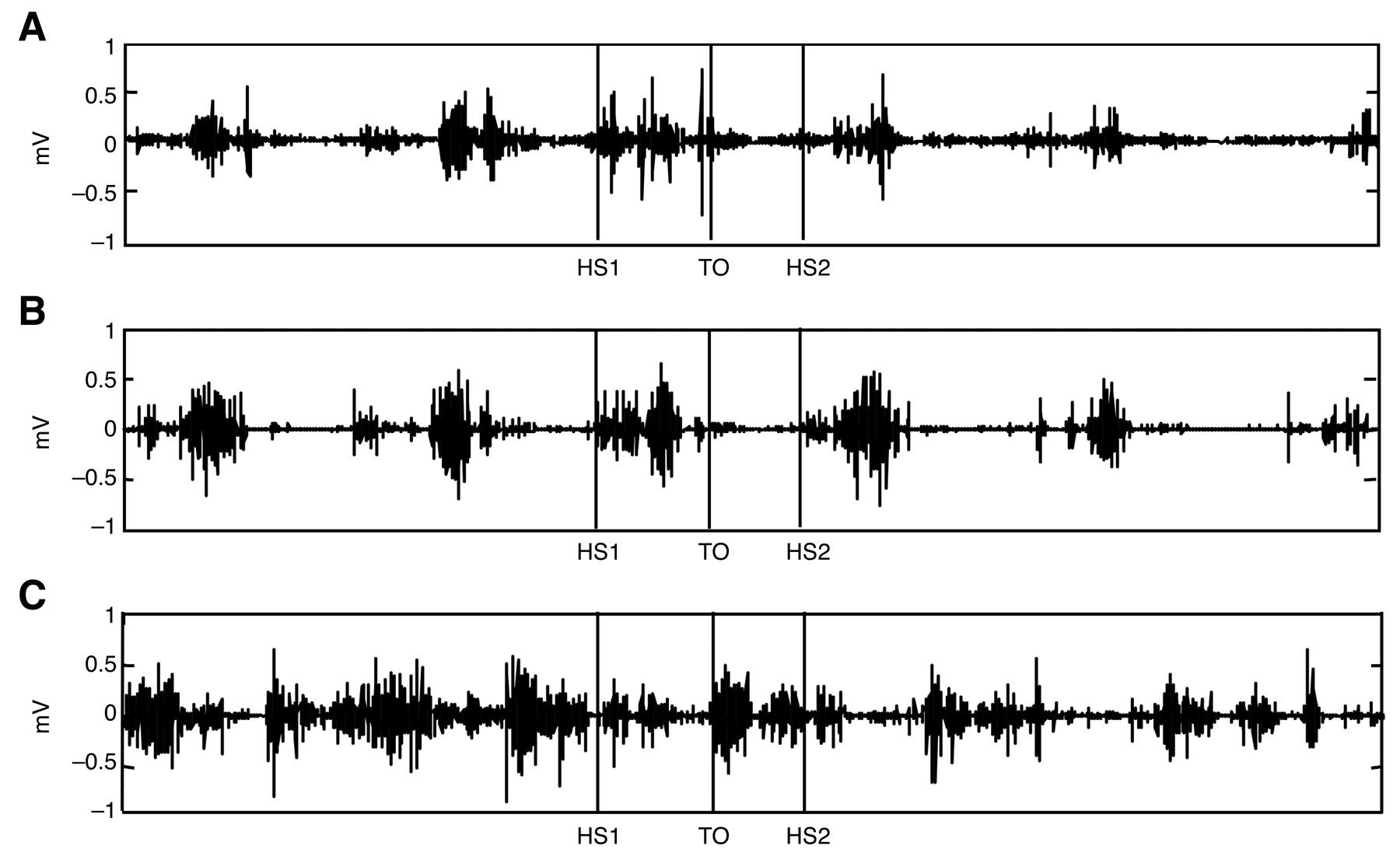
In most cases, pre-activation of the peroneal muscles was already present at heel strike, with the peroneal muscles in co-contraction with the tibialis anterior. In some patients there was late activation of the gastrocnemius muscle during the stance phase, whereas in others this muscle was pre-activated, contributing to a pattern of co-contraction with the tibialis anterior and peroneal muscles in the loading response and mid-stance phases. The latter pattern was particularly evident in the RA group (Fig. 2). The patient with hip arthrodesis did not show substantial differences from other patients.

Discussion

The main objectives of TAR are to eliminate pain and to maintain good foot and ankle function during activities of daily living. It is desirable to have an ankle prosthesis with the same life expectancy as a hip or knee prosthesis. Despite the numerous TAR designs available, there are still no ankle prostheses that can produce general clinical results comparable to those of arthrodesis. Recent reviews of the TAR literature[2,12,15,21] show that the most common causes of failure are loosening with lowering and misalignment of prosthetic components, joint instability, conflict between the prosthetic components and the periarticular structures, malleolar fractures, the formation of heterotopic bone, joint movement restriction, infection, and peroneal tenosynovitis. The unsatisfactory results of ankle prostheses may be due to scarce knowledge about ankle biomechanics, especially the role of the ligaments.[2326,3335]
Table 1 . Comparison of Gait Variables Between Control and Total Ankle Replacement Groups 
Japma 98 00019 g003
In the literature, much attention has been given to assessing ankle prostheses clinically and radiographically,[4,5,9,11,13,16,17,3640] but instrumental functional evaluation is just as important. In fact, gait analysis can highlight functional patterns of motion with respect to muscular activity and joint loading and motion that are not addressed by traditional static clinical examination. Unfortunately, very few studies have performed such analyses. Demottaz et al[28] assessed 21 ankles by means of clinical, radiographic, and gait analyses with a follow-up of 14.7 months and showed weakness of plantar flexor muscles, altered articular excursion of the ankle, greatly altered time–distance parameters, and the presence of pain with weightbearing. Brodsky et al[27] assessed the differences during gait between the preoperative and postoperative status of 11 patients treated with the STAR ankle prosthesis at a follow-up of 1.5 years. They found a statistically significant improvement in several parameters, especially walking speed, stride length, and functional articular excursion. Dyrby et al[41] found that at a mean follow-up of 7.6 months, TAR patients had a significantly greater ankle dorsiflexion external moment compared with their preoperative status, indicating improved function at the ankle joint. As a whole, the previous gait analysis studies on TAR patients have revealed a slightly more physiologic pattern of the time–distance parameters and of ankle kinematics and kinetics compared with preoperative evaluation. The persistence of pain and a number of other unphysiologic parameters support the need for additional studies, particularly studies that focus on electromyographic muscle activation patterns.
Table 2. Comparison of Gait Variables Between Control, Osteoarthritis, and Rheumatoid Arthritis Groups 
Japma 98 00019 g004
Figure 1. Three important ankle variables over the gait cycle as measured by gait analysis in three repetitions in a typical patient with rheumatoid arthritis. The gray bands represent corresponding patterns in the control population. A, Rotation of the ankle in the sagittal plane (dorsiflexion/plantarflexion); B, ankle moment in the sagittal plane (dorsiflexion/plantarflexion moment); C, ankle moment in the frontal plane (eversion/inversion moment). Positive values represent dorsiflexion and eversion; negative values, plantarflexion and inversion. %BW × h indicates percentage of body weight times height.
Japma 98 00019 g001
The results of our study of ten patients at nearly 3 years’ follow-up compared with a control population are similar to those reported previously. Some gait abnormalities persist after TAR, such as reduced walking speed and decreased ankle joint range of motion. These are probably associated with the reduced plantarflexion at toe-off and consequently during swing. Electromyography-based analysis revealed anomalies in the activation pattern of the gastrocnemius and peroneus longus muscles, often pre-activated in initial stance together with tibialis anterior, that probably accounted for the need to stabilize the ankle during weightbearing. The reduced activity of the gastrocnemius muscle in terminal stance should be considered along with the reduced dorsiflexion moment at push-off. Although electromyographic abnormalities were reported in OA patients owing to muscle atrophy,[42] these abnormalities are mostly evident in RA patients. Various hypotheses can be proposed as to the possible causes of this deficit, such as a protective gait due to a previously structured motor scheme related to pain, failure of plantar flexor muscles,[43] and functional stiffness of the replaced joint due to altered biomechanics or lack of proprioception. Although in some patients this pattern can result from the persistence of mild or moderate pain, altered muscular activation strategies and co-contraction aimed at joint stabilization in pain-free patients may be associated with modified biomechanics of the replaced joint, leading to distorted proprioception from residual articular and periarticular structures. Therefore, the etiology of reduced movement in the replaced joint during gait may be considered multifactorial.
Figure 2. Typical raw electromyographic signals for the peroneus longus (A), gastrocnemius (B), and tibialis anterior (C) muscles. Heel strike (HS) and toe-off (TO) instants are depicted by vertical bars.
Japma 98 00019 g002
This study was limited by the sample size of the patient population. Because of the small number of patients and the very small design differences between the two TAR prostheses analyzed, we could not explore differences between them. Large differences were not expected because the two designs have the same main biomechanical characteristics (ie, a flat tibial component, a naturally convex talar component, and a fully conforming meniscal bearing). Although our series was small, most alterations found in patients with RA were attributable to the nature of this disease, producing the typical “shuffle” with dramatically reduced plantarflexion at toe-off and slow gait.[44] Previous studies[4446] on walking patterns in patients with RA have demonstrated a reduced walking speed, a shortened stride length, and an increased stance period, in line with the results of the present study. A recent evaluation of the effects of loss of metatarsophalangeal joint mobility on gait in patients with RA[47] showed a correlation between the reduction of metatarsophalangeal dorsiflexion range and the reduction of walking speed and stride length. Metatarsophalangeal joints are the most involved joints of the foot-ankle complex in RA, causing metatarsalgia that frequently results in a bilateral flat-footed antalgic type of gait.[44,47] Associated stiffness and everted subtalar joint during gait have also been reported.[45,48,49] All of these findings could contribute to the more severe gait abnormalities found in RA patients with TAR.

Conclusion

The present study showed that TAR yields satisfactory, but not outstanding, general functional results at nearly 3 years’ follow-up. Recovery of ankle joint kinematics, functional range of motion, and adequate stability were found in most of the patients analyzed, although with limitations. These results from gait analysis highlight the importance of integrating in vivo measurements with the standard clinical assessments of TAR patients while they perform motor tasks of daily living and the importance of exploring the functional outcome over time. In addition to wear and component fixation-related problems, the ability of the prostheses to restore adequate mobility at the replaced joint and comfortable patterns of motion at the lower limb should be addressed. The prosthetic device is assessed thoroughly within the ligamentous and muscular apparatus of the joint and in conjunction with the main adjacent joints. These more complete assessments would also help in testing new TAR designs, relevant surgical techniques, and postoperative rehabilitation programs.

Financial Disclosure

None reported.

Conflict of Interest

None reported.

References

  1. Buechel FF, Pappas MJ, Iorio LI: New Jersey low contact stress total ankle replacement: biomechanical rationale and review of 23 cementless cases. Foot Ankle Int 8: 27, 1988.
  2. Giannini S, Leardini A, O’Connor JJ: Total ankle replacement: review of the design and of current status. J Foot Ankle Surg 6: 77, 2000.
  3. Kofoed HA: “A New Total Ankle Joint Prosthesis,” in Material Sciences and Implant Orthopaedic Surgery, Vol 1, ed by R Kossowsky, N Kossowsky, p 75, Martinus Nijhoff, Dordrecht, the Netherlands, 1986.
  4. Anderson T, Montgomery F, Carlsson A: Uncemented STAR total ankle prostheses: three to eight-year follow-up of fifty-one consecutive ankles. J Bone Joint Surg Am 85: 1321, 2003.
  5. Buechel FF Sr, Buechel FF Jr, Pappas MJ: Ten-year evaluation of cementless Buechel-Pappas meniscal bearing total ankle replacement. Foot Ankle Int 24: 462, 2003.
  6. Buechel FF, Pappas MJ: Survivorship and clinical evaluation of cementless, meniscal-bearing total ankle replacement. Semin Arthroplasty 3: 43, 1992.
  7. Kofoed HA, Sorensen TS: Ankle arthroplasty for rheumatoid arthritis and osteoarthritis: prospective long-term study of cemented replacements. J Bone Joint Surg Br 80: 328, 1998.
  8. Murnaghan JM, Warnock DS, Henderson SA: Total ankle replacement: early experiences with STAR prosthesis. Ulster Med J 74: 9, 2005.
  9. Natens P, Dereymaeker G, Abbara M, et al: Early results after four years experience with the S.T.A.R. uncemented total ankle prosthesis. Acta Orthop Belg 69: 49, 2003.
  10. Valderrabano V, Hintermann B, Dick W: Scandinavian total ankle replacement: a 3.7-year average follow up of 65 patients. Clin Orthop Relat Res 424: 47, 2004.
  11. Wood PL, Deakin S: Total ankle replacement: the results in 200 ankles. J Bone Joint Surg Br 85: 334, 2003.
  12. Bauer G, Eberhardt O, Rosenbaum D, et al: Total ankle replacement: review and critical analysis of the current status. J Foot Ankle Surg 2: 119, 1996.
  13. Easley ME, Vertullo CJ, Urban WC, et al: Total ankle arthroplasty. J Am Acad Orthop Surg 10: 157, 2002.
  14. Saltzman CL: Total ankle arthroplasty: state of the art. Instr Course Lect 48: 263, 1999.
  15. Saltzman CL, McIff TE, Buckwalter JA, et al: Total ankle replacement revisited. J Orthop Sports Phys Ther 30: 56, 2000.
  16. Schill S, Biehl C, Thabe H: Ankle prostheses: mid term results after TPR and STAR prostheses. Orthopade 27: 183, 1998.
  17. Takakura Y, Tanaka Y, Sugimoto K, et al: Ankle arthroplasty: a comparative study of cemented metal and uncemented ceramic prostheses. Clin Orthop 252: 209, 1990.
  18. Wood PL, Clough TM, Jari S: Clinical comparison for two total ankle replacements. Foot Ankle Int 21: 546, 2000.
  19. Feldman MH, Rockwood J: Total ankle arthroplasty: a review of 11 current ankle implants. Clin Podiatr Med Surg 21: 393, 2004.
  20. Gould JS, Alvine FG, Mann RA, et al: Total ankle replacement: a surgical discussion: part I. Replacement systems, indications, and contraindications. Am J Orthop 29: 604, 2000.
  21. Gould JS, Alvine FG, Mann RA, et al: Total ankle replacement: a surgical discussion: part II. The clinical and surgical experience. Am J Orthop 29: 675, 2000.
  22. Stengel D, Bauwens K, Ekkernkamp A, et al: Efficacy of total replacement with meniscal-bearing devices: a systematic review and meta-analysis. Arch Orthop Trauma Surg 125: 109, 2005.
  23. Leardini A, O’Connor JJ, Catani F, et al: Kinematics of the human ankle complex in passive flexion: a single degree of freedom system. J Biomech 32: 111, 1999.
  24. Leardini A, O’Connor JJ, Catani F, et al: The role of the passive structures in the mobility and stability of the human ankle joint: a literature review. Foot Ankle Int 21: 602, 2000.
  25. Reggiani B, Leardini A, Corazza F, et al: Finite element analysis of a total ankle replacement during the stance phase of gait. J Biomech 39: 1435, 2006.
  26. Leardini A, Catani F, Romagnoli M, et al: Total ankle replacement: rationale and history of the designs and recent advances. Minerva Ortop 53: 135, 2002.
  27. Brodsky JW, Pollo FE, Baum BS: “Gait Analysis Results after STAR Total Ankle Arthroplasty,” in 5th European Foot and Ankle Society Congress Proceedings, European Foot and Ankle Society, Montpellier, France, 2004.
  28. Demottaz JD, Mazur JM, Thomas WH, et al: Clinical study of total ankle replacement with gait analysis: a preliminary report. J Bone Joint Surg 61: 976, 1979.
  29. Garde L, Kofoed H: Meniscal-bearing ankle arthroplasty is stable: in vivo analysis using stabilometry. J Foot Ankle Surg 2: 137, 1996.
  30. Mazur JM, Schwartz E, Simon SR: Ankle arthrodesis: long-term follow up with gait analysis. J Bone Joint Surg 61: 964, 1979.
  31. Root ML, Orien WP, Weed JH, et al: Biomechanical Examination of the Foot, Vol 1, Clinical Biomechanics Corp, Los Angeles, 1971.
  32. Benedetti MG, Catani F, Leardini A, et al: Data management in gait analysis for clinical applications. Clin Biomech 13: 204, 1998.
  33. Leardini A, Catani F, Giannini S, et al: Computer-assisted design of the sagittal shapes for a novel total ankle replacement. Med Biol Eng Comput 39: 168, 2001.
  34. Leardini A, Moschella D: Dynamic simulation of the natural and replaced human ankle joint. Med Biol Eng Comput 40: 193, 2002.
  35. Leardini A, O’Connor JJ, Catani F, et al: A geometric model of the human ankle joint. J Biomech 32: 585, 1999.
  36. Boltom-Maggs BG, Sudrow RA, Freeman MAR: Total ankle arthroplasty: a long term review of London Hospital experience. J Bone Joint Surg Br 67: 78, 1985.
  37. Conti SF, Wong YS: Complications of total ankle replacement. Clin Orthop 391: 105, 2001.
  38. Helm R, Stevens J: Long-term results of total ankle replacement. J Arthroplasty 1: 27, 1986.
  39. Pyevich MT, Saltzman CL, Callaghan JJ, et al: Total ankle arthroplasty: a unique design: two to twelve year follow-up. J Bone Joint Surg Am 80: 1410, 1998.
  40. Tsao A, Mintz L, Mcrae CR, et al: Failure of the porous- coated anatomic prosthesis in total knee arthroplasty due to severe polyethylene wear. J Bone Joint Surg Am 75: 19, 1993.
  41. Dyrby C, Chou LB, Andriacchi TP: Functional evaluation of the Scandinavian Total Ankle Replacement. Foot Ankle Int 25: 377, 2004.
  42. Valderrabano V, von Tscharner V, Nigg BM, et al: Lower leg muscle atrophy in ankle osteoarthritis. J Orthop Res 24: 2159, 2006.
  43. Perry J: “Ankle and Foot Gait Deviations,” in Gait Analysis: Normal and Pathological Function, p 185, Slack, New York, 1992.
  44. O’Connel PG, Siegel KL, Kepple TM, et al: Forefoot deformity, pain and mobility in rheumatoid and non-arthritic subjects. J Rheumatol 25: 1681, 1998.
  45. Keenan MA, Peabody TD, Gronley JK, et al: Valgus deformities of the feet and characteristics of gait in patients who have rheumatoid arthritis. J Bone Joint Surg Am 73: 237, 1991.
  46. Khazzam M, Long JT, Marks RM, et al: Kinematic changes of the foot and ankle in patients with systemic rheumatoid arthritis and forefoot deformity. J Orthop Res 25: 319, 2007.
  47. Laroche D, Pozzo T, Ornetti P, et al: Effects of loss of metatarsophalangeal joint mobility on gait in rheumatoid arthritis patients. Rheumatology 45: 435, 2006.
  48. Woodburn J, Nelson KM, Siegel KL, et al: Multisegment foot motion during gait: proof of concept in rheumatoid arthritis. J Rheumatol 31: 1918, 2004.
  49. Woodburn J, Helliwell PS, Barker S: Three-dimensional kinematics at the ankle joint complex in rheumatoid arthritis patients with painful valgus deformity of the rearfoot. Rheumatology 41: 1406, 2002.