An average of 350 new cases of spindle cell sarcoma are diagnosed in the United States each year.[
1] Spindle cells comprise a variety of different tumor subtypes, including leiomyosarcoma, myofibroblastic sarcoma, fibrosarcoma, atypical fibroxanthoma, malignant fibrous histiocytoma, and neurofibrosarcoma. Eight percent of spindle cell sarcomas are leiomyosarcomas, which arise mostly in adults, with a peak occurrence between 40 and 60 years of age and an incidence slightly greater in males than in females.[
2,
3] Only 21 cases of leiomyosarcoma in both the foot and ankle have been reported in the literature since 1936.[
4] Some were metastatic lesions and not primary tumors. Some of these studies included upper- and lower-extremity lesions together or the lower extremity altogether, including the foot.
A large proportion of leiomyosarcomas are in the lower extremities (45%), but they can occur almost anywhere in the body (uterus, 25%; head and neck, 8%; upper extremities, 8%; small intestine, 5%; stomach, 5%; and other, 4%).[
5–
7] Cutaneous leiomyosarcomas tend to arise from the arrector pili muscles on extensor surfaces or from the smooth muscle surrounding sweat glands.[
8] Epithelioid leiomyosarcomas are different than cutaneous leiomyosarcomas and tend to occur in the linings of the uterus, gastrointestinal tract, pleura, and veins.[
9] Subcutaneous leiomyosarcomas arise from smooth muscle in the linings of arteries and veins.[
8] This study focuses on the cutaneous form of leiomyosarcoma.
Fifty percent of cutaneous leiomyosarcoma cases recur, and the resulting tumor is usually deeper and more atypical. A purely cutaneous tumor can recur with extension into the subcutaneous layer. A metastatic rate of 40% is seen on subcutaneous extension, with the most common site of metastasis being the lungs.[
3,
10] Younger patients, small tumor size, superficial depth, and distal limb location are associated with an improved prognosis.[
11,
12] Race and sex have little or no effect on prognosis.[
8] Overall 5-year survival for leiomyosarcoma is 65%.[
6,
8,
10,
13] The prognosis for patients with purely cutaneous leiomyosarcomas (90% survival) is much better than that for patients with noncutaneous leiomyosarcomas (42% survival) or other types of spindle cell sarcoma (50% survival). However, recurrent cutaneous leiomyosarcomas often extend into subcutaneous tissue, at which time the prognosis drastically worsens (40% survival).
This article presents a case of cutaneous leiomyosarcoma discovered in a patient’s great toe. We sought to disclose the unusual location and presentation to encourage other clinicians to consider oncologic features in differential diagnoses.
Case Report
A 31-year-old man presented with paronychial pain involving the medial border of his right hallux. The patient first noticed pain 10 months earlier and was treated with partial nail avulsion of the offending border in the emergency department 3 months earlier. He was given a prescription for cephalexin, which he took for 1 week as directed and completed. He soaked his foot as directed in warm soapy water and followed up with his primary-care physician 1 month later. The patient continued to complain of pain and a nonhealing wound with clear reddish yellow drainage. The primary-care physician inspected the wound and removed a jagged, irregularly shaped piece of nail from the nail groove. Aluminum chloride hexahydrate (Drysol, Person & Covy, Inc, Glendale, California), bacitracin, and a dry sterile dressing were applied. The patient was given a prescription for amoxicillin-clavulanate potassium (Augmentin; GlaxoSmithKline, Research Triangle Park, NC), which he took for 1 week as directed and completed. He again soaked his foot as directed in warm soapy water. When the pain did not improve, the patient was referred to us by the primary-care physician for total nail avulsion and matrixectomy. The patient’s medical history is significant only for hypertension and keloid formation. He is allergic to penicillin and codeine.
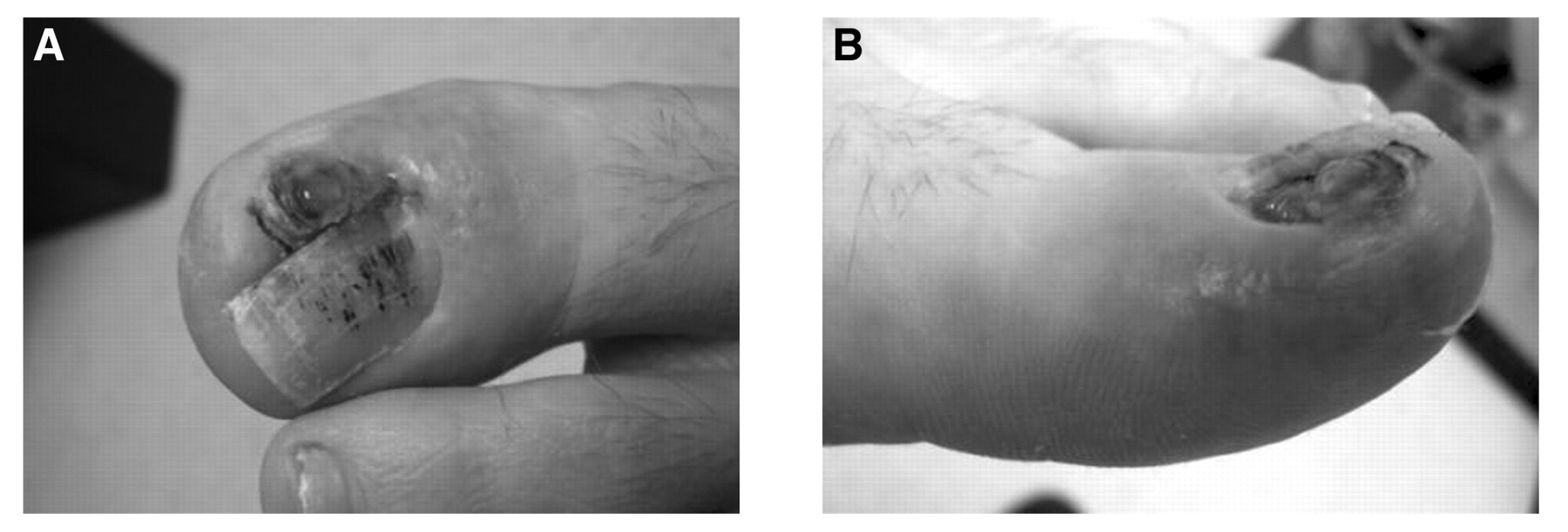
Physical examination revealed an edematous and erythematous left hallux, particularly around the medial nail groove. There was a large wound with active serosanguineous drainage and crusting just medial to the groove (
Fig. 1). There were no nail spicules in the wound. Dorsalis pedis and posterior tibial pulses were weakly palpable, and the skin temperature was cool. Capillary filling time was less than 2 sec. Pedal hair growth was noted, and there was no lower-extremity edema. Examination revealed no acute musculoskeletal or neurologic pathology. Plain radiographs were obtained to rule out osteomyelitis. Radiographic examination showed no osteolytic process, no fracture, preserved joint space, normal bone density, and some soft-tissue edema.
Total nail avulsion with chemical matrixectomy was performed in the left hallux. Typical podiatric wound-care modalities were used, but the wound was noted to be highly suggestive of atypical tissue. The granulomatous tissue was removed and was sent as a specimen for pathologic examination. The size of the specimen was 1.8 × 0.8 × 0.4 cm.
The initial pathology report suggested Kaposi’s sarcoma. Subsequent examination revealed a diagnosis of spindle cell sarcoma consistent with leiomyosarcoma.
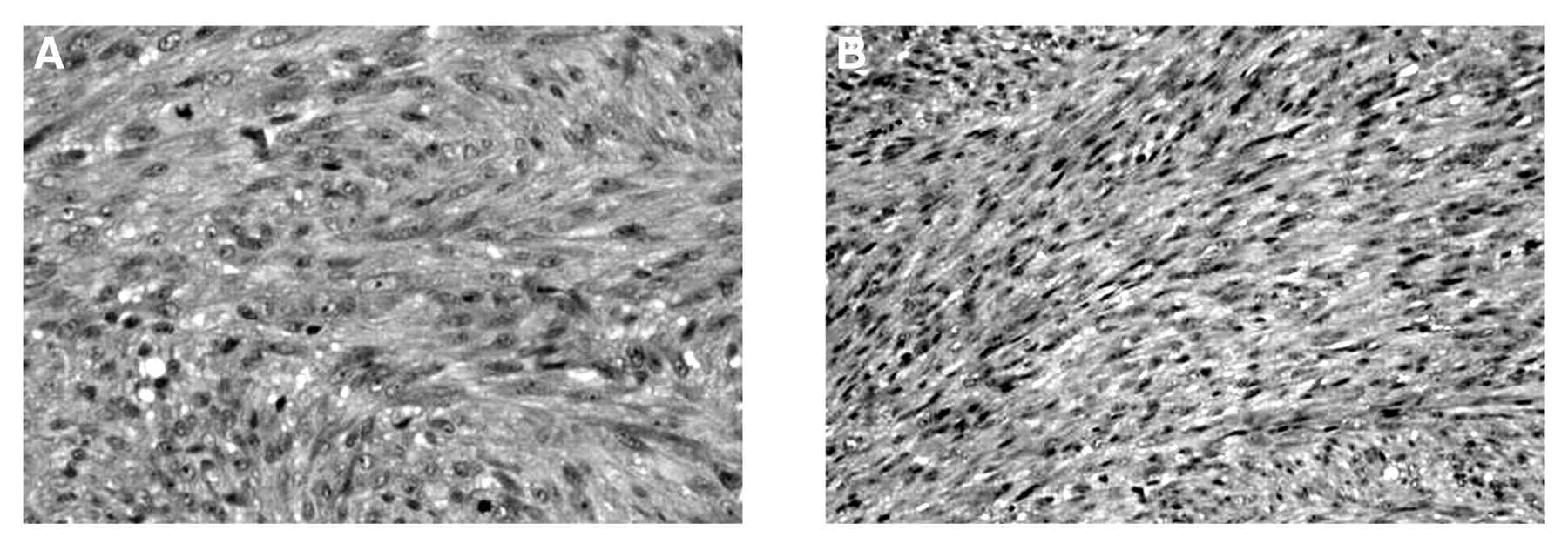
Figure 2A shows the skin margin and the ulcerated tumor. Spindle-shaped cells have the typical darkly staining cigar-shaped blunted nuclei and paranuclear vacuoles of smooth muscle.(
Fig 2B) Rare mitoses are present. There is some granulation tissue with evidence of inflammation, but the spindle cells are regular, arranged in intercrossing fascicles. Little pleomorphism or necrosis is seen, and less than 25% of the visible cells are mitotic figures.
Additional immunohistochemical analysis performed by the pathology department of Roswell Cancer Institute revealed that the specimen was positive for smooth muscle actin and muscle-specific actin (HHF-35) and negative for desmin, caldesmon, S-100, CD34, HMB-45, Alk-1, and pancytokeratin (AE 1/3). Collagen deposition was rare; smooth muscle was abundant.
Figure 1.
Anterior (A) and lateral (B) views of the patient’s great toe at initial assessment.
Figure 1.
Anterior (A) and lateral (B) views of the patient’s great toe at initial assessment.
Figure 2.
Histologic analysis of the tumor reveals mitotic figures, indicating malignancy (A), and intercrossing bundles of fascicles, indicating smooth muscle origin (B) (H&E, × 100). The spindle cells have darkly stained cigar-shaped nuclei. Paranuclear vacuoles, the white areas to the side of the nuclei, can also be seen.
Figure 2.
Histologic analysis of the tumor reveals mitotic figures, indicating malignancy (A), and intercrossing bundles of fascicles, indicating smooth muscle origin (B) (H&E, × 100). The spindle cells have darkly stained cigar-shaped nuclei. Paranuclear vacuoles, the white areas to the side of the nuclei, can also be seen.
A diagnosis of spindle cell sarcoma was confirmed as low-grade leiomyosarcoma. However, the tumor was excised with positive margins. Amputation of the hallux was then performed, and the patient received adjuvant therapy. He will undergo magnetic resonance imaging of the surgical site and computed tomography of the chest periodically for the next 5 years.
Discussion
Most patients with cutaneous leiomyosarcoma present with pain, but a small percentage report burning, itching, or no complaint. Patients are more often male than female and tend to be aged 40 to 60 years, although the present patient was a 31-year-old man. Clinically, leiomyosarcoma is a fleshy mass ranging from pink or red to tan or blue. It may crust, ulcerate, or hemorrhage.[
8] The present patient had a history of a painful ingrown nail and previous attempted nail avulsions. His mass was a fleshy pink/red and had ulcerated. The periungual pain he perceived as “ingrown nail pain” may have been aggravated or even caused by the pressure of the ulcerated mass on the nerves innervating the nail border. The location in the toe is very rare, but the rarity of pedal cutaneous leiomyosarcoma overall is such that it is difficult to compare the frequency of specific pedal locations.
The specific etiology of spindle cell sarcoma remains unknown. However, cytogenic abnormalities exist in most patients. More than 90% of patients with spindle cell sarcoma have a t(X;18) translocation mutation of transcription regulator genes.[
14] The
SYT gene at 18q11.2 is translocated with the
SSX1 or
SSX2 gene at Xp11.[
15] This translocation is associated with the overall morphology of the tumor.[
16] Involvement with the
SSX2 gene is a better prognostic factor than involvement with
SSX1. Research has focused on the frequency of chromosome regions with the tumor suppressor genes
TP53 on 17p and
NF1 on 17q in spindle cell sarcoma.[
13] Regarding the specific spindle cell subtype leiomyosarcoma, there is allelic instability on chromosome 9, specifically, 9p24 at D9S230.[
17] Also, loss of 13q14-q21 with gain of 5p14-pter may be linked to worse prognosis.[
18] Trauma may contribute to pathogenesis, as is suspected in this case.
Identification typically occurs histologically using hematoxylin and eosin stain under low- and medium-power magnification.[
19] High-power magnification allows for grading of the tumor by visualizing the number of mitotic figures in the field, indicating cell division, and the degree of differentiation of the tissue.[
19] More aggressive tumors exhibit less differentiation of tissue. Histologically, leiomyosarcomas have spindle cells with darkly staining cigar-shaped nuclei and paranuclear vacuoles. Nucleoli are obscure, and mitotic figures are present. Aggressiveness is determined by the degree of differentiation. Low-grade leiomyosarcomas exhibit cells that are mostly similar in appearance. There are well-differentiated spindle cells arranged in intercrossing bundles or fascicles. Little or no necrosis is present, and there are fewer than two mitotic figures of every ten cells in the field.[
20] High-grade tumors exhibit gross pleomorphism, necrosis, and many mitoses. Some studies[
21] report that even with poor histologic prognostic factors, cutaneous leiomyosarcomas have a low rate of recurrence. Other studies[
3] report worse prognoses with metastases in 25% of cases. The present patient’s histology slides exhibited two to three mitotic figures per ten cells, with well-differentiated spindle cells in intercrossing bundles, leading to the assessment of a lower-grade leiomyosarcoma.
On diagnosis, treatment consists of wide-margined excision of the mass.[
21] There is some controversy regarding the sensitivity of the sarcoma to radiation and the effect of chemotherapy on the long-term survival rate.[
20] Improved survival rates were reported by Ladenstein et al,[
22] who used doxorubicin and cyclophosphamides. However, cyclophosphamides have been associated with an increased risk of bladder cancer attributable to acrolein, a cytotoxic metabolite excreted in the urine.[
23] Also, Chidiak et al[
24] report little therapeutic efficacy with liposomal doxorubicin; they also suggest a correlation between older age and the skin toxicity of doxorubicin. Treatment relies on surgical excision. Surgical complications generally include infection, wound breakdown, contamination along fascial planes, neurologic or vascular injury, hematoma, seroma, and anesthesia-related complications.[
22] An alternative to wide resection is amputation, especially when a large area of tumor-free margins cannot be obtained.[
13,
20] Noncutaneous leiomyosarcoma is treated more aggressively; one case of calcaneal leiomyosarcoma was treated with a below-the-knee amputation.[
25]
Owing to the low metastatic rate, cutaneous leiomyosarcoma is treated less aggressively, with marginal to wide excision in the case of a toe requiring amputation. Postoperative care involves clinical examination, magnetic resonance imaging of the surgical site, and computed tomography of the chest. It has been suggested that the patient be rescanned every 3 months for the first 2 years and then every 6 months for the next 3 years.[
20,
21] Two years after amputation of the great toe, the present patient has had no recurrence of symptoms, and his imaging scans have been clear.
Conclusion
Although leiomyosarcoma is a rare tumor, early diagnosis is crucial. Masses in the foot are generally discovered sooner than those in more proximal locations, in part because of foot irritation with weightbearing and shoe wearing and the relative prominence of joints. Difficulty arises with the resemblance of leiomyosarcoma to more common diagnoses in the foot, such as plantar fibroma, lipoma, other soft-tissue tumors, and, now, pyogenic granuloma. The clinician must remain vigilant in the pursuit of thorough differentiation and accurate diagnosis.