Next Article in Journal
Foot Health Training Guide for Long-Term Care Personnel
Previous Article in Journal
Intraosseous Ganglion of the Talus Treated with the Talonavicular Joint Approach Without Exposing the Ankle Joint
 
 
Journal of the American Podiatric Medical Association is published by MDPI from Volume 116 Issue 1 (2026). Previous articles were published by another publisher in Open Access under a CC-BY (or CC-BY-NC-ND) licence, and they are hosted by MDPI on mdpi.com as a courtesy and upon agreement with American Podiatric Medical Association.
Article

Abnormal Proximal Fifth Metatarsal and Os Vesalianum Pedis

by
Hakan Boya
1,
Haluk H. Oztekin
1 and
Ozal Ozcan
2
1
Department of Orthopedics and Traumatology, Baskent University, Faculty of Medicine, Zübeyde Hanim Practice and Research Center, Izmir, Turkey 06490
2
Department of Orthopedics and Traumatology, Buca Medical Center, Izmir, Turkey
J. Am. Podiatr. Med. Assoc. 2007, 97(5), 428-429; https://doi.org/10.7547/0970428
Published: 1 September 2007
To the Editor:
Abnormal foot bones can be observed as incidental radiographic findings and may have a congenital or developmental origin. Many asymptomatic accessory ossicles can also exist in the foot. We present a case of a fifth metatarsal with an abnormal tuberosity demonstrating unique features similar to those of os vesalianum pedis.

Case Report

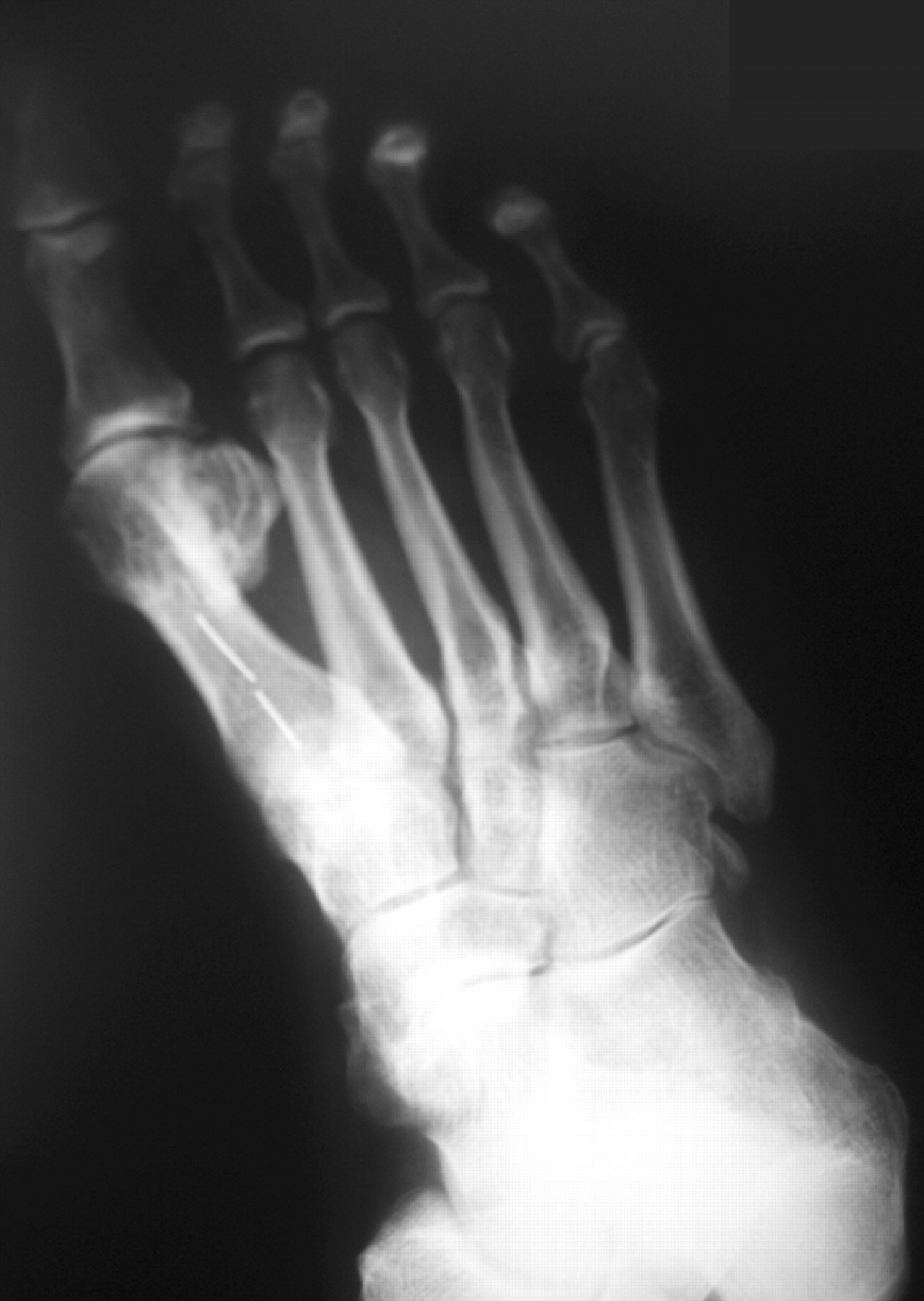
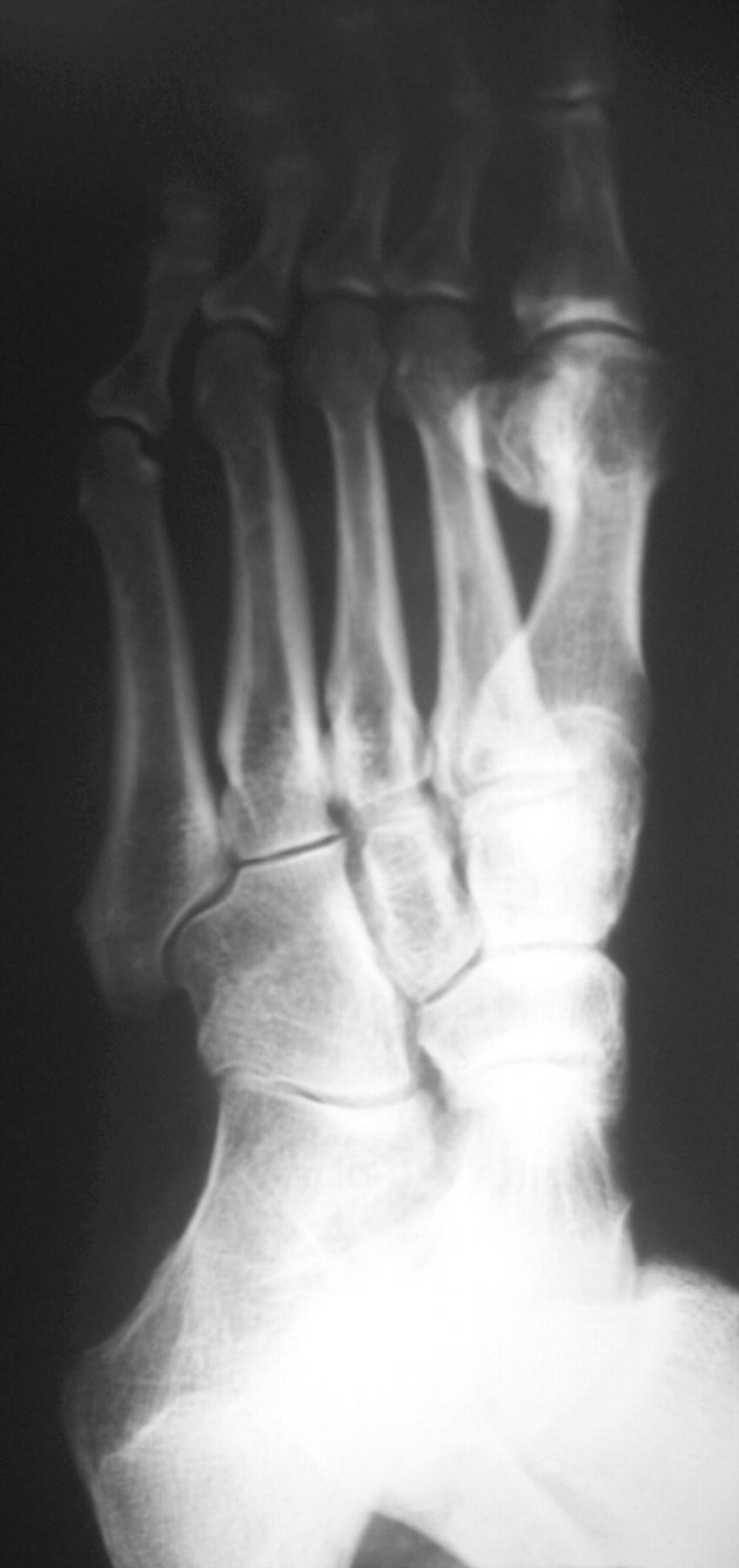
A 52-year-old woman presented to the outpatient clinic of Orthopedics and Traumatology, Baskent University, Zübeyde Hanim Hospital, Izmir, Turkey, with the complaint of left heel pain. There was no history of trauma, and a detailed physical examination revealed a normal foot and ankle with mild tenderness at the sole of the rearfoot. A lateral oblique radiograph showed an abnormal tuberosity of the fifth metatarsal (Fig. 1). The tuberosity was unusually long, and there was a distinct articulation between the tuberosity and the lateral aspect of the cuboid bone. The same radiographic findings were observed in the asymptomatic right foot (Fig. 2).

Discussion

Many accessory bones can be found in the human foot, one of which is os vesalianum pedis. Accessory bones of the foot are considered to be developmental anomalies.[1] Various etiologic factors have been reported, including existence of an independent element in cartilage before calcification; misclassification as tendon bones; an independent ossification center; and existence of an unrecognized pathologic condition.[2]
We previously presented a case of os vesalianum pedis that was separated from the adjacent proximal fifth metatarsal by a thin, horizontally oriented, radiolucent line that likely represented synchondrosis.[3] Because of these unique features, the case was considered a “developmental variant.” There was an articulation between this ossicle and the cuboid bone.
Articulation with the cuboid bone, bilateral presentation, and absence of clinical symptoms characterized the present case as well as our previously presented case of os vesalianum pedis. In the present case, however, no radiolucent line separating the abnormal tuberosity from the fifth metatarsal was observed radiographically. This pathology seems to be a “developmental variant” of the proximal fifth metatarsal. Os vesalianum pedis and abnormal proximal fifth metatarsal may have a similar etiology. To our knowledge, this is the first report of this abnormality at the proximal region of the fifth metatarsal in a patient who had no pain in that region.
Financial Disclosures: None reported.
Conflict of Interest: None reported.

References

  1. O’Rahilly R: A survey of carpal and tarsal anomalies. .J Bone Joint Surg Am35::626. ,1953. .
  2. Coughlin MJ: “Sesamoids and Accessory Bones of the Foot,” in Surgery of the Foot and Ankle, ed by MJ Coughlin, RA Mann, 7th Ed, p 437, CV Mosby, St Louis. ,1999. .
  3. Boya H, Ozcan O, Tandogan R, et al: Os vesalianum pedis. .JAPMA95::583. ,2005. .
Figure 1. Lateral oblique radiograph showing an abnormal tuberosity of the left fifth metatarsal.
Japma 97 00428 g001
Figure 2. Lateral oblique radiograph showing an abnormal tuberosity of the right fifth metatarsal.
Japma 97 00428 g002