Infrared thermometry is a noncontact, noninvasive technology used to monitor dermal skin temperatures in pathophysiologic conditions, such as peripheral neuropathy, soft-tissue injury, and bone fracture. Plantar ulceration commonly occurs in neuropathic feet with deformity and abnormal pressures.[
1-
3] Before any signs of skin breakdown or ulceration, localized skin temperature often increases, accompanied by inflammation likely caused by infection, neuropathic bone fracture, or repetitive stress.[
4-
7] Temperature monitoring has been proved to be effective for preventing foot complications in individuals at high risk.[
8-
11] A temperature change of more than 2°C compared with the surrounding skin or a contralateral site has been shown to be a positive indicator of an underlying pathologic condition of the plantar foot.[
12-
14] Manual palpation is widely used to detect temperature differences but with no reliability in subtle changes less than 6°C.[
15] Infrared thermometry has been shown to be an effective adjunctive tool for assessing a temperature change of clinical relevance.[
7-
11,
13,
16]
Infrared thermometry has been used by foot-care providers for nearly 3 decades. General-use handheld thermometry instruments are available locally or via the Internet through electronic specialty stores or temperature-measurement supply stores for less than $50. The decreased size and cost of handheld units make it feasible to implement infrared thermometry in a foot-care clinic. The purpose of this study was to compare the accuracy and reliability of nine commercially available handheld infrared thermometry instruments and to determine the essential features that would make an infrared thermometer useful for clinical application.
Materials and Methods
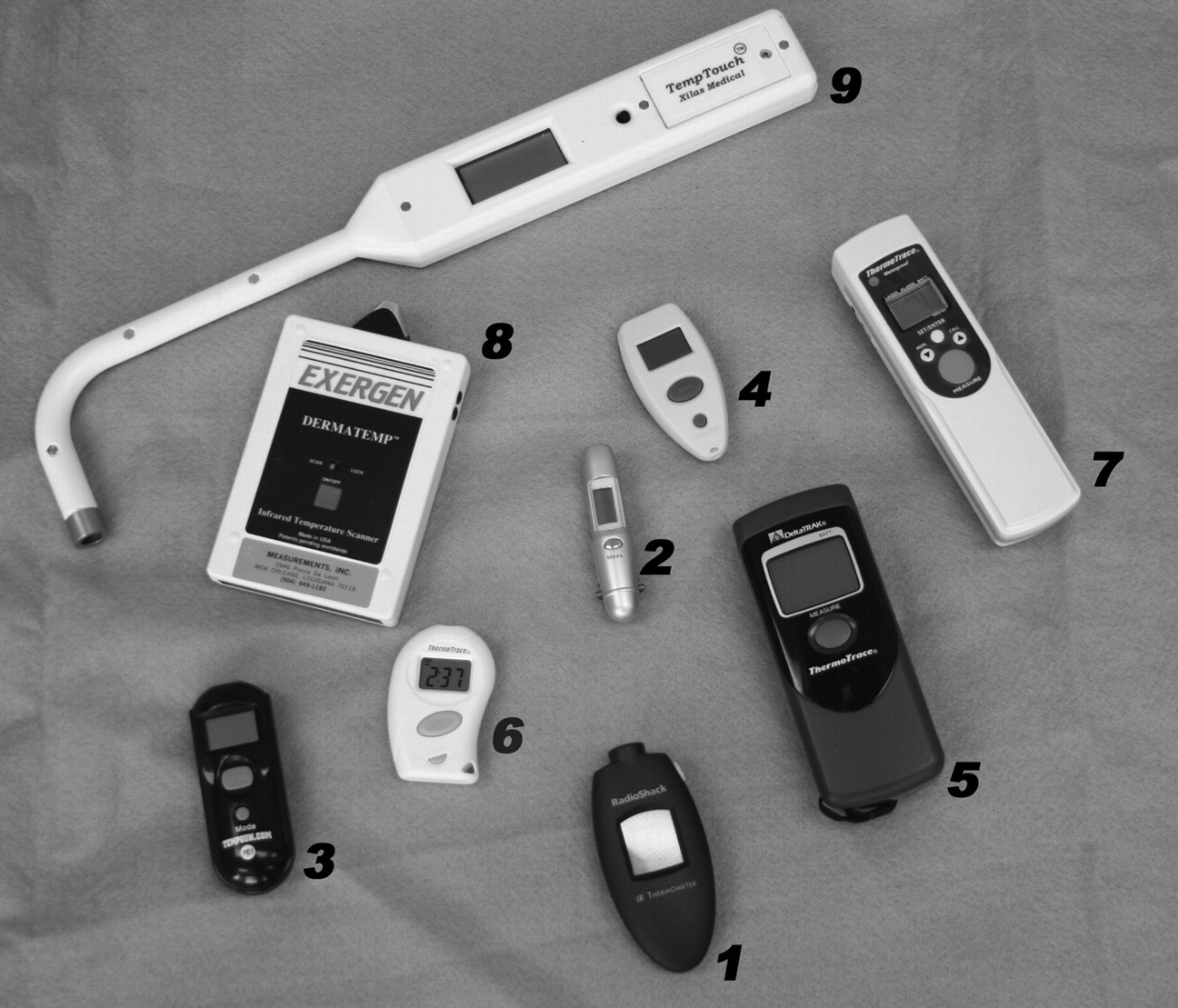
Nine infrared thermometer instruments were chosen in this study to represent a general selection of sizes, features, availability, and price ranges (
Table 1,
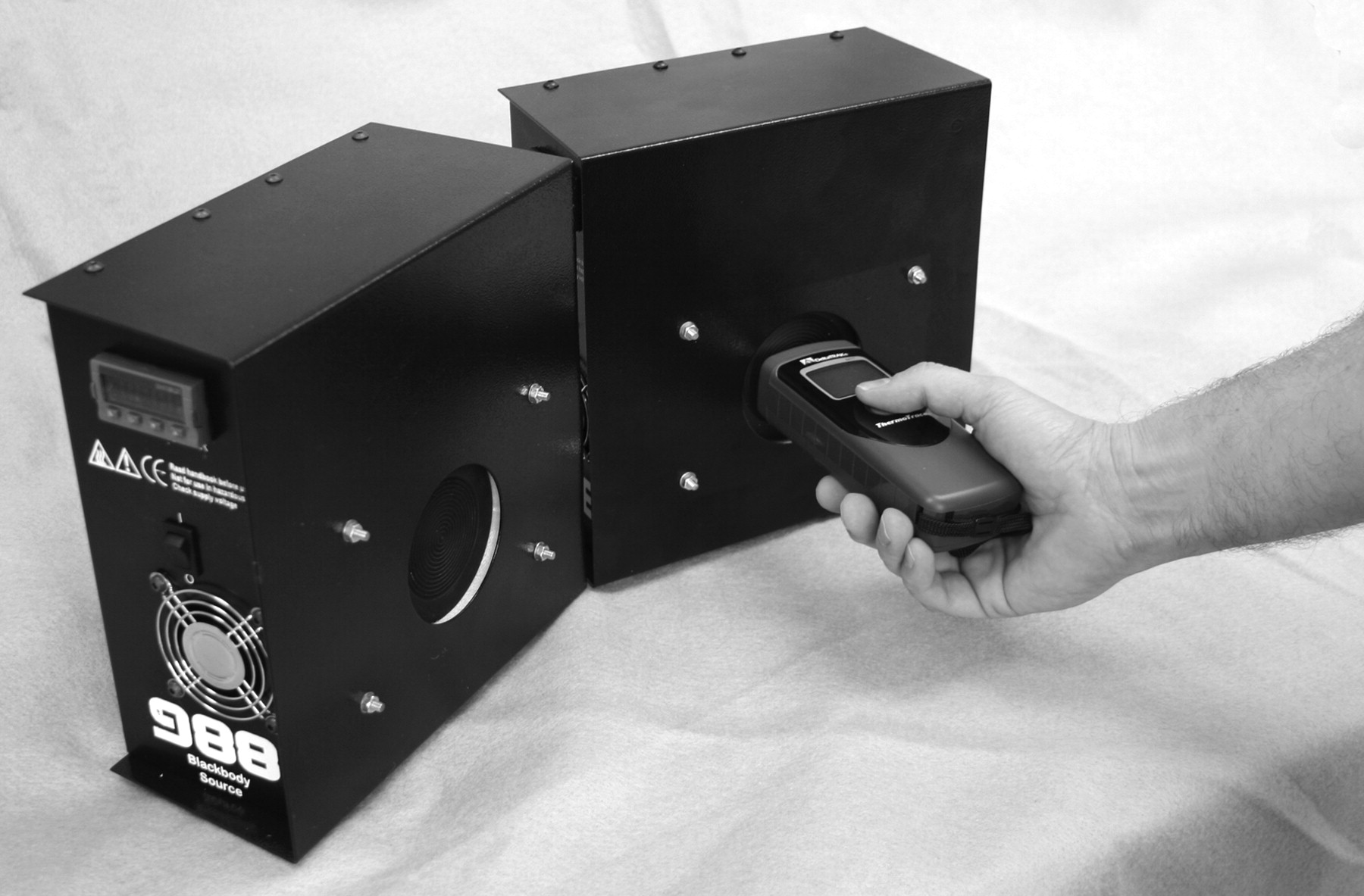
Fig. 1). Two blackbody calibration units (model 988; Isotech North America, Williston, Vermont), designated as unit 1 and unit 2, were placed 7 inches apart on the laboratory benchtop (
Fig. 2).
Table 1.
Manufacturer Names and Model Numbers of the Instruments Used in This Study
Table 1.
Manufacturer Names and Model Numbers of the Instruments Used in This Study
Figure 1.
Nine handheld infrared thermometers of different sizes, features, availability, and price ranges: 1, Radio Shack; 2, Radiant TN-006C; 3, Tempgun PE1; 4, Radiant TN-153; 5, DeltaTRAK ThermoTrace 15004; 6, DeltaTRAK ThermoTrace Mini 15031; 7, DeltaTRAK ThermoTrace 15006; 8, Exergen DT-1000; and 9, TempTouch.
Figure 1.
Nine handheld infrared thermometers of different sizes, features, availability, and price ranges: 1, Radio Shack; 2, Radiant TN-006C; 3, Tempgun PE1; 4, Radiant TN-153; 5, DeltaTRAK ThermoTrace 15004; 6, DeltaTRAK ThermoTrace Mini 15031; 7, DeltaTRAK ThermoTrace 15006; 8, Exergen DT-1000; and 9, TempTouch.
Figure 2.
Blackbody units placed side by side to measure the temperature differential using a handheld infrared thermometer.
Figure 2.
Blackbody units placed side by side to measure the temperature differential using a handheld infrared thermometer.
To establish a criterion, units 1 and 2 were set to 27°C, and a three-temperature average was recorded from both units using the nine randomly selected infrared thermometry instruments. Next, unit 2 was set to 29°C. Temperature readings for all nine instruments were recorded from unit 1 to unit 2 using a randomly selected infrared thermometer. This procedure was repeated three times for each of the nine infrared thermometry instruments. The same randomized procedure was performed for each infrared thermometer with unit 2 set to 31°C and repeated at 33°C, keeping unit 1 set at 27°C. With unit 1 held constant at 27°C, another set of data was collected following the same procedure for all instruments except that temperatures were recorded first from unit 2 and then from unit 1 for the three temperature ranges 33°, 31°, and 29°C (
Table 2). The instruments were held as near as possible to the surface of the units without making contact, resulting in a 2- to 3-mm standoff. The order of instrument testing for each condition was randomly assigned. The temperature change for each trial was calculated, and a three-trial mean was determined.
Table 2.
Physiologic Temperature Conditions Tested in Different Directions for Measurement Using Infrared Thermometer Devices
Table 2.
Physiologic Temperature Conditions Tested in Different Directions for Measurement Using Infrared Thermometer Devices
Measurements for each instrument for all conditions were made by two testers to determine intertester variations. Tester 1 (J.G.F.) and then tester 2 (D.B.) made all measurements and recordings for all conditions. The testers were blinded to temperature values during measurement, and recordings were made by viewing the instrument’s liquid crystal display. Mean temperature change (nominally 0°, 2°, 4°, and 6° C) of the two testers using nine infrared thermometers on seven measurement conditions were compared using a general linear model (SAS Institute Inc, Cary, North Carolina). A Scheffe test was used for post hoc comparisons (P < .05). Pearson correlation coefficients were used to compare the reliability of temperature measurements made by two testers using nine instruments. Post hoc comparisons were made between conditions 1 and 6, conditions 2 and 5, and conditions 3 and 4 to determine whether instrument measurements were affected by temperature direction and whether there was a difference when measuring from an area of higher to lower compared with lower to higher temperature.
Response time, the time from button press to the first temperature reading, was obtained using a flexible switch (model MA-153; Motion Lab Systems, Baton Rouge, Louisiana) placed between the infrared thermometer and the tester’s finger. The 15-mm-diameter, 0.25-mm-thick switch was interfaced with a laptop computer using a data-acquisition device (model NI USB-6009; National Instruments, Austin, Texas) and customized timing software (LabView 7.1; National Instruments). Twenty-five response-time measurements were obtained for each infrared thermometer by pressing the button/switch and releasing immediately on temperature readout on the instrument’s liquid crystal display. Response time was not obtained using instrument 9. Descriptive statistics were used to compare instrument specifications, including distance-to-spot ratio, minimum spot size, sensor diameter, display resolution, emissivity, and cost.
Results
Analysis using a general linear model showed differences in temperature change among instruments (
P < .001) and between testers (
P = .0247).
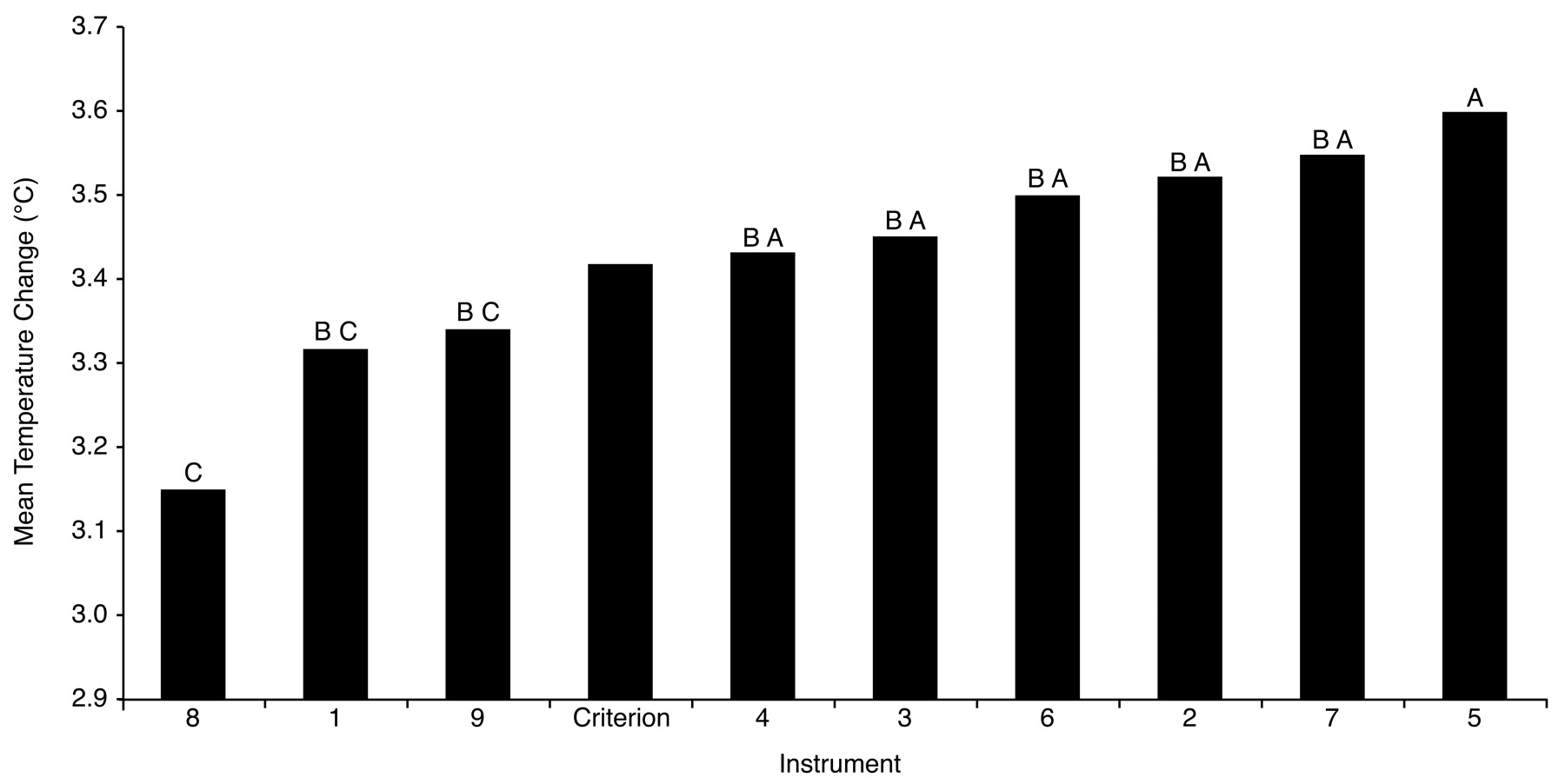
Post hoc comparisons showed that mean ± SD temperature change recorded using instrument 5 (3.61° ± 0.04° C) was higher than that using instruments 9 (3.34° ± 0.04° C), 1 (3.33° ± 0.04° C), and 8 (3.14° ± 0.04° C) (
P < .05), and mean ± SD temperature change recorded using instrument 8 (3.14° ± 0.04° C) was lower (
P < .05) than that using instruments 4 (3.44° ± 0.04° C), 3 (3.45° ± 0.04° C), 6 (3.50° ± 0.04° C), 2 (3.52° ± 0.04° C), and 7 (3.55° ± 0.04° C) (
Fig. 3).
Post hoc comparison showed that the mean ± SD temperature change recorded by tester 1 (3.46° ± 0.02° C) was higher than that by tester 2 (3.40° ± 0.02° C) (
P < .05).
Post hoc comparison showed no difference in temperature change recorded from the opposite temperature direction: conditions 1 and 6, 2 and 5, and 3 and 4 (
Table 2). Pearson correlation coefficients (>0.989) showed high measurement reliability between temperature change measurements made by the two testers using the nine instruments (
Table 3).
Discussion
Statistical analysis showed differences in temperature change using instruments 5 and 8. These differences in temperature change were small (<0.5°C) but could affect decision making in clinical practice if these two instruments were used to compare temperature. In practice, however, the same instrument would be used to measure temperature change between feet or between areas of the same foot, and measurements of temperature change among the instruments used in this study have very small variability (standard error among instruments = 0.04). A difference in temperature change was also found between testers. This difference was also very small (0.06°C) and would not be large enough to cause a different interpretation of temperature change between clinicians.
The DeltaTRAK ThermoTrace 15004 (instrument 5) and the Exergen DT-1000 (instrument 8) are the models currently used in our clinic. Both units are several years old and are no longer manufactured under those model numbers. The DeltaTRAK ThermoTrace 15006 (instrument 7) is the successor to the DeltaTRAK ThermoTrace 15004. The current Exergen model, the DT-1001, is the successor to the DT-1000. The TempTouch (instrument 9) is ergonomically designed specifically for plantar foot dermal temperature measurement by the patient rather than the clinician, which is why it was eliminated from the response-time analysis. The remaining units are manufactured for general use over a wide temperature range rather than the narrow physiologic range examined in the study.
The blackbody units were placed on a benchtop 7 inches apart to replicate the distance the contralateral limb, used as a physiologic control, would be from the involved limb. Dermal temperatures are usually bilaterally symmetrical, allowing for contralateral comparison between the two sites. Because temperature difference is the key clinical factor, climate control of the environment is not necessary as long as the patient or, in this case, the blackbody units are exposed to the same ambient conditions.
Figure 3.
Post hoc comparison of mean temperature differences among handheld thermometers. The criterion or true mean temperature difference was not included in the statistical analysis. See the legend to Figure 1
for the names of the thermometers associated with each number. Note A > B > C;
P < .05.
Figure 3.
Post hoc comparison of mean temperature differences among handheld thermometers. The criterion or true mean temperature difference was not included in the statistical analysis. See the legend to Figure 1
for the names of the thermometers associated with each number. Note A > B > C;
P < .05.
The four control temperatures (27°, 29°, 31°, and 33° C) emitted from the blackbodies in this study were considered realistic physiologic values from which all of the infrared thermometers in this study were examined. To eliminate bias created by repeating the same order of a procedure, the nine infrared thermometry instruments were tested in random order for each temperature change.
Table 3.
Pearson Correlation Coefficients (N = 14) of the Nine Handheld Infrared Thermometers Tested
Table 3.
Pearson Correlation Coefficients (N = 14) of the Nine Handheld Infrared Thermometers Tested
Instruments 5 and 8, which showed the poorest accuracy, were the older models. Older infrared sensor electronics could have affected the performance of these instruments. However, the small statistically significant margin still allows confident use of any of the tested infrared thermometry instruments in the clinical setting. In addition, although a difference was determined between testers, the margin (0.06°C) is clinically insignificant.
There were no statistically significant differences in temperature change outcomes regarding temperature direction. This observation indicated no biasing effect in the infrared electronics at the physiologic temperature range tested.
Response time was recorded to determine the time from pressing the button to viewing a settled temperature reading on the instrument’s liquid crystal display. This was accomplished by placing a 15-mm-diameter, 0.25-mm-thick contact switch between the first tester’s finger and the infrared thermometer. On pressing the infrared thermometer button, the switch started timing the event until a temperature was displayed, at which point the button (and switch) was released, indicating the elapsed time in hundredths of seconds. Mean response times are reported for comparison in
Table 4.
The instrument’s field of view is called the distance-to-spot ratio. A 1:1 distance-to-spot ratio is desirable for a clinical instrument and is usually a standard feature on the less expensive units. This means that the sensor samples a circular area with a diameter equal to the distance between the sensor and the target. Therefore, the closer to the target, the smaller the sampling area. A physical constraint to the smallest possible sampling area is determined by the diameter of the infrared thermometer sensor, which ranged from 2 to 13.2 mm, hand measured using a metric scale. A larger-diameter sensor is less desirable because a small hotspot may get averaged out in a larger field of view. A 2- to 3-mm standoff from the skin surface is recommended. Distance-to-spot ratio information is clearly stated on the specifications of the instrument.
With a temperature difference of greater than or equal to 2°C being clinically significant, a display resolution of 0.1°C accuracy is desirable. The round-off error of anything with less resolution (eg, 0.5°C) added to instrument inaccuracy could cause a false-negative result, which could be harmful to the patient.
A laser option built into the infrared thermometry unit is not advised. Because the laser is located adjacent to and not in the center of the infrared sensor, what is indicated by the laser point location is not what is being measured. This offset could incorrectly reference the area of highest temperature, producing a false-negative result for the temperature change. The DeltaTRAK ThermoTrace 15006 (instrument 7) was equipped with a laser pointer approximately 13 mm off center. If used on the right great toe, for example, the sensor would be measuring off the toe.
An infrared thermometer measures temperature by means of emissivity, a constant related to the thermal radiation given by an object. When considering a clinical instrument, fixed emissivity, as opposed to adjustable emissivity, is suggested because temperature differential negates this feature. This, too, is standard on the less expensive units. The features and specifications discussed that have clinical importance were compiled for comparison (
Table 4).
Conclusion
Through comparative statistical analysis benchtop testing, this study demonstrated that an inexpensive handheld infrared thermometer is as effective as a more expensive dermal thermometer for use in a foot-care clinic. The essential features of a handheld unit—a 1:1 distance-to-spot ratio field of view, a sensor diameter less than or equal to 5 mm, a display resolution of 0.1°C, no built-in laser pointer, and fixed emissivity—are usually standard in the inexpensive models. Further research is needed to validate these benchtop findings through clinical trials with patients.
Table 4.
Features and Specifications of the Handheld Infrared Thermometry Instruments That Have Clinical Importance
Table 4.
Features and Specifications of the Handheld Infrared Thermometry Instruments That Have Clinical Importance