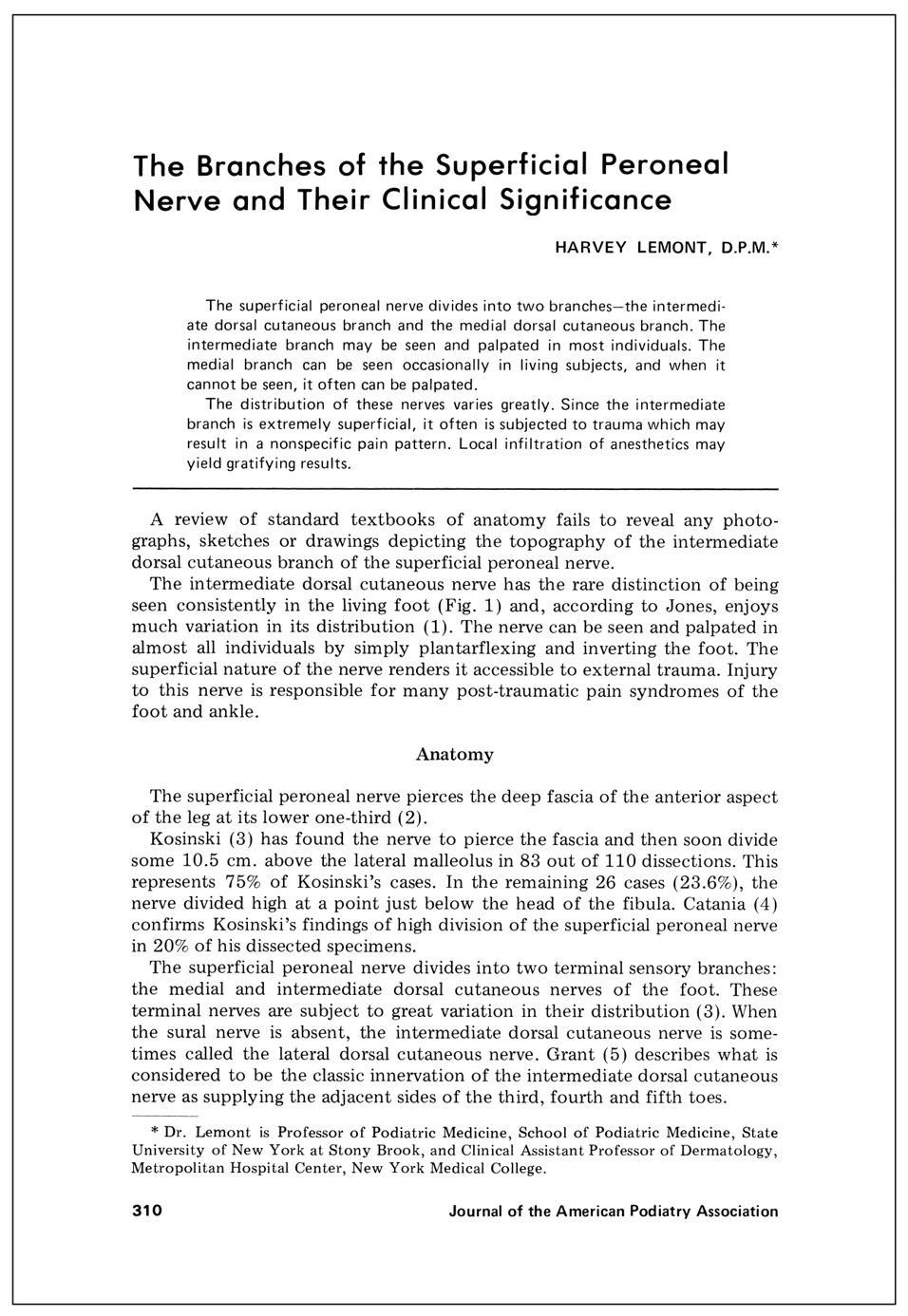
The Branches of the Superficial Peroneal Nerve and Their Clinical Significance



References
- Grant JCB, Basmajian JV: Grant’s Method of Anatomy: By Regions, Descriptive and Deductive, 10th Ed, p 272, Williams & Wilkins, Baltimore, 1980.
- Lemont H, Hernandez A: Recalcitrant pain syndromes of the foot and ankle: evaluation of the lateral dorsal cutaneous nerve. JAPA62: 331, 1972.
- Izzo K, Sridhara CR, Rosenholtz H, Lemont H: Sensory conduction studies of the branches of the superficial peroneal nerve. Arch Phys Med Rehabil62: 24, 1981.
- Lemont H: “Foot Disorders,” in Merck Manual of Geriatrics, 3rd Ed, ed by MH Beers, R Berkow, sec. 7, chap. 56, Merck Research Laboratories, Whitehouse Station, NJ, 2000.
- Lemont H, Cullen RW: Compression of the superficial peroneal nerve secondary to sleeping and sitting positions. JAPA74: 450, 1984.
- Lemont H: A simplified nerve block to control postoperative foot pain. JAPA68: 193, 1978.
© 2007 American Podiatric Medical Association
Share and Cite
Lemont, H. The Branches of the Superficial Peroneal Nerve and Their Clinical Significance. J. Am. Podiatr. Med. Assoc. 2007, 97, 319-324. https://doi.org/10.7547/0970319
Lemont H. The Branches of the Superficial Peroneal Nerve and Their Clinical Significance. Journal of the American Podiatric Medical Association. 2007; 97(4):319-324. https://doi.org/10.7547/0970319
Chicago/Turabian StyleLemont, Harvey. 2007. "The Branches of the Superficial Peroneal Nerve and Their Clinical Significance" Journal of the American Podiatric Medical Association 97, no. 4: 319-324. https://doi.org/10.7547/0970319
APA StyleLemont, H. (2007). The Branches of the Superficial Peroneal Nerve and Their Clinical Significance. Journal of the American Podiatric Medical Association, 97(4), 319-324. https://doi.org/10.7547/0970319