


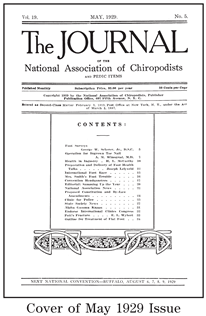
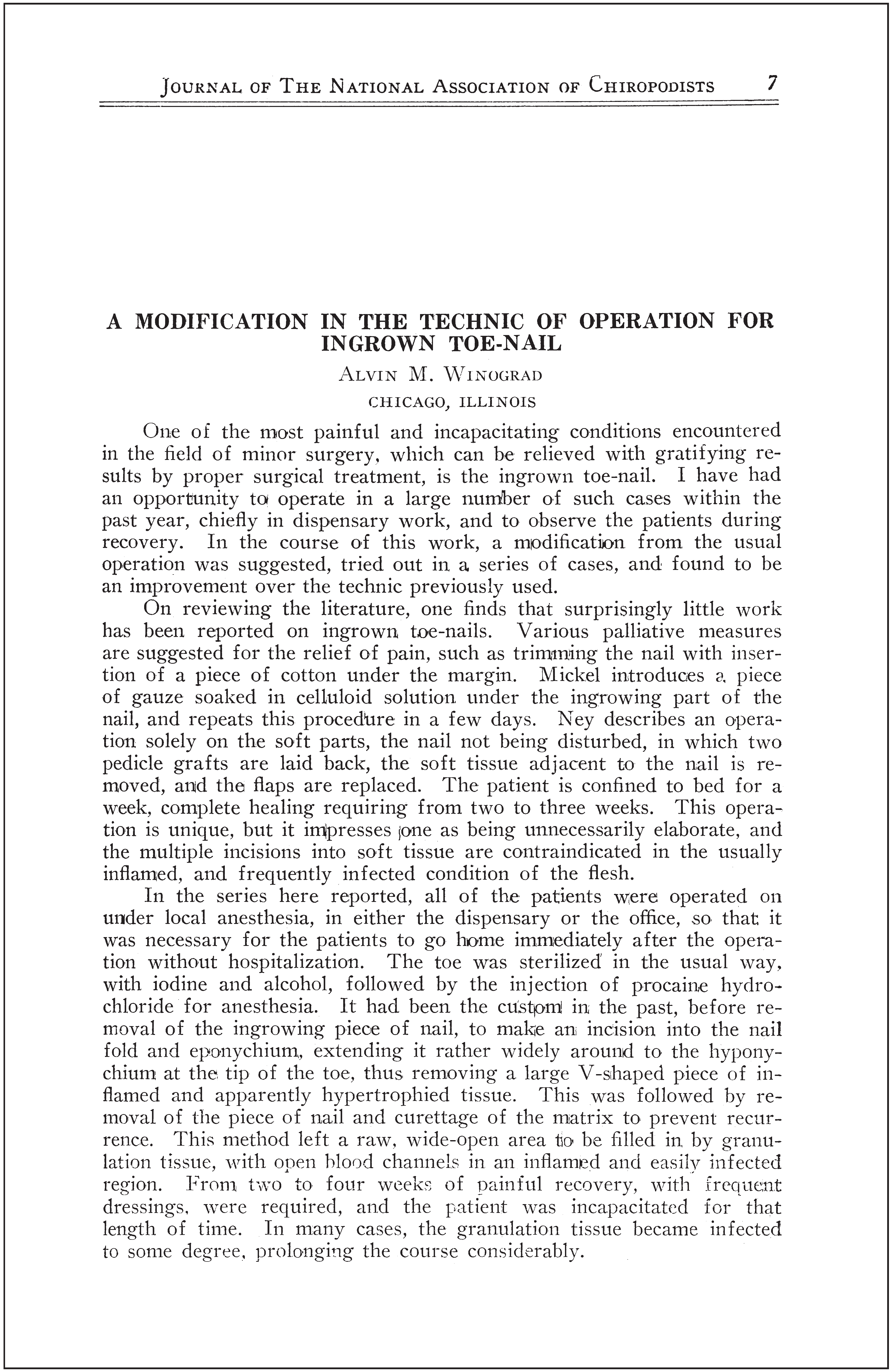
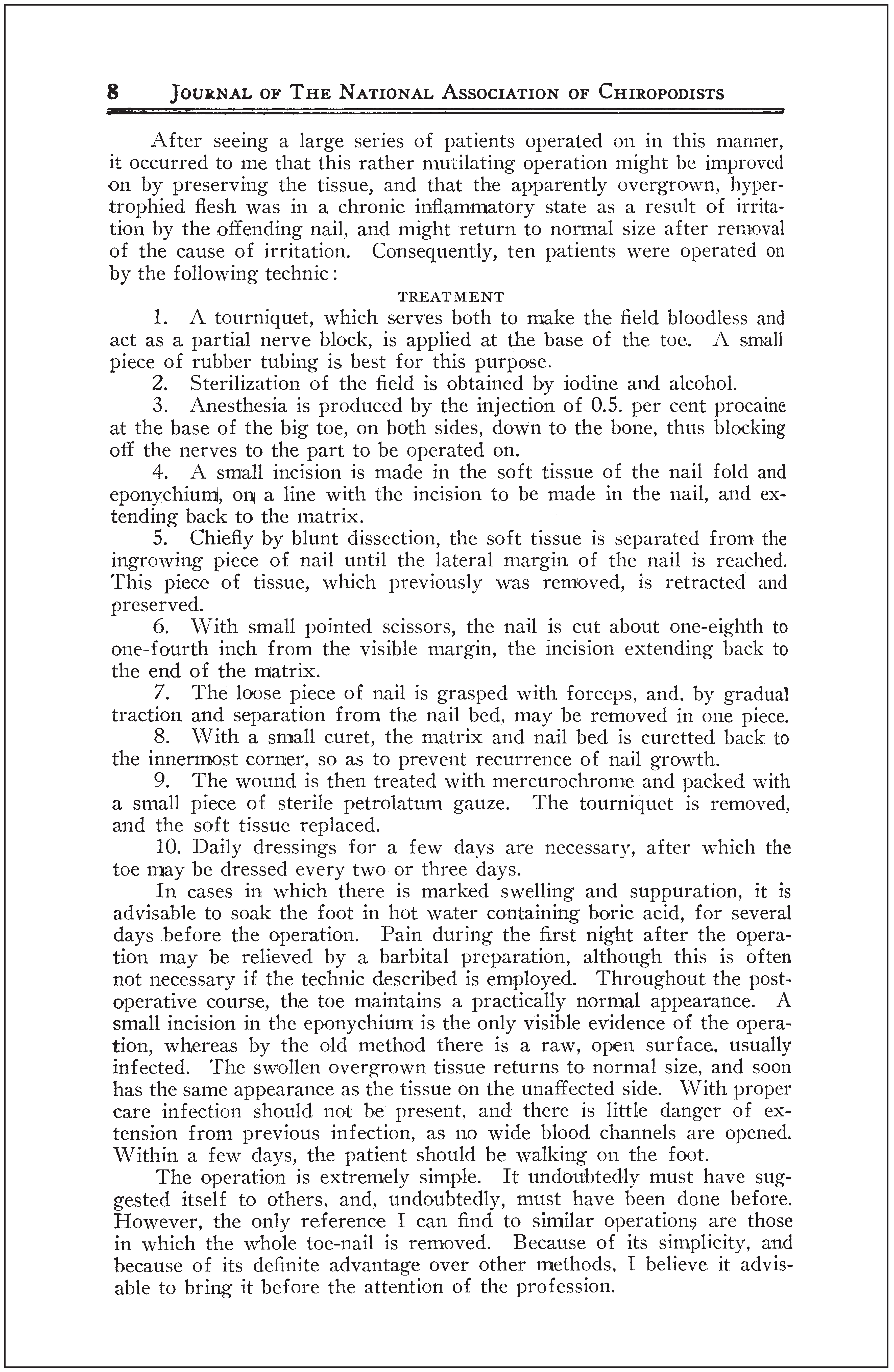
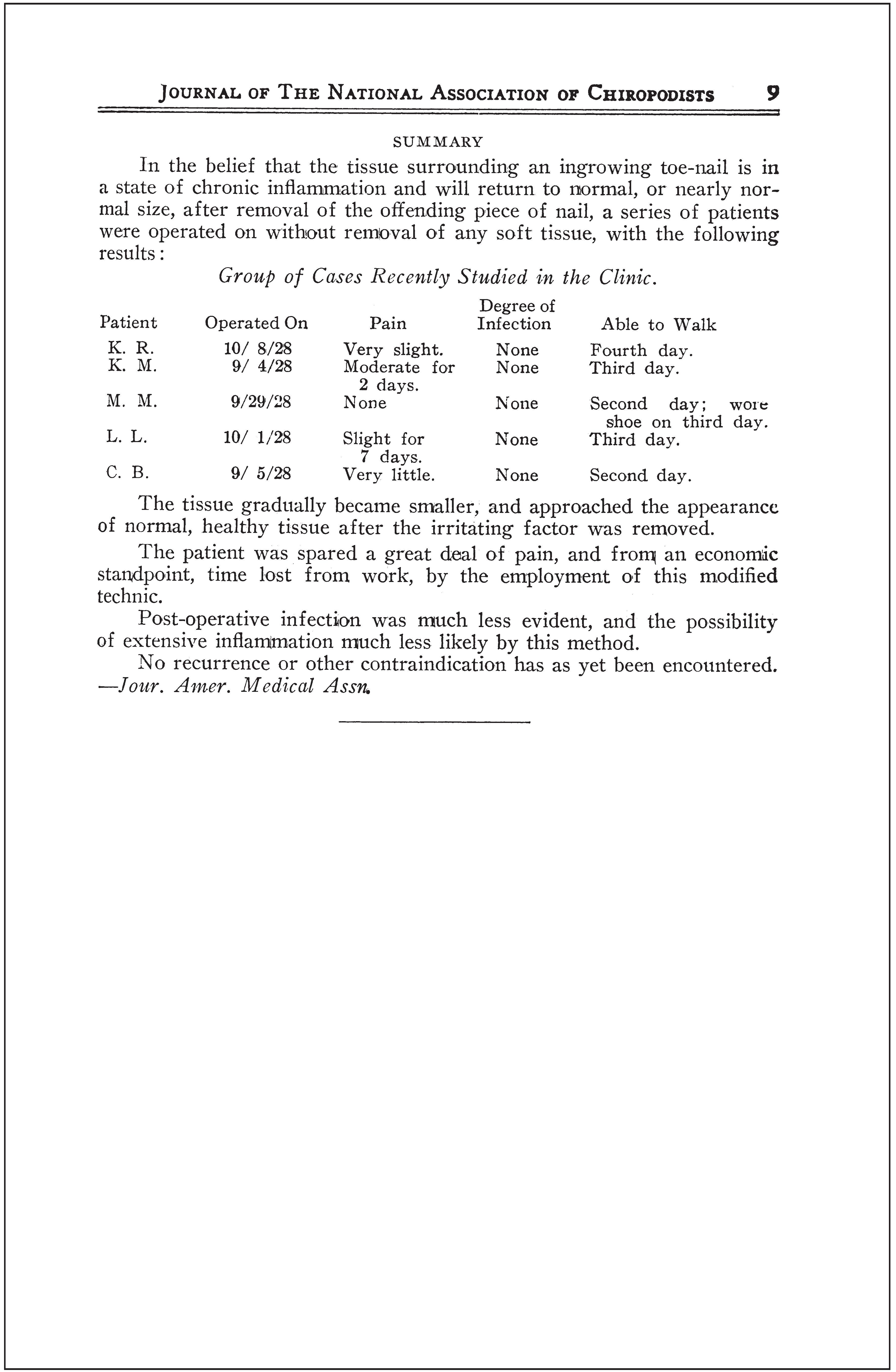
The “Winograd operation” for ingrown toe-nail has been an enduring procedure since it was first described in 1929. However, the procedure has been modified significantly since Alvin Winograd first described it, and the operation performed today bears little resemblance to the original version. In this article, Winograd describes making a small incision in the soft tissue of the nail fold and eponychium, in line with the toenail incision, back to the matrix. Using small scissors, the nail is cut and the ingrown portion of the nail is removed. The nail bed and matrix are then curetted and the incision is painted with merbromin and packed with petrolatum gauze. Dressing changes are performed until the incision heals. The soft tissue surrounding the nail is not removed; Winograd believed that it would return to normal shortly after the offending nail portion was removed.
In his 1939 textbook Diseases of the Foot, Emil Hauser[1] provides an illustrated version of the in-grown toenail procedure but with a single suture in the proximal incision. In 1945, C.J. Heifetz[2] described the procedure with the use of a scalpel rather than a curet for removal of the matrix. In his 1947 textbook The Foot and Ankle, Philip Lewin[3] provides a similar description of a surgical nail procedure, but this time there is an illustration of a soft-tissue skin wedge re-section as well as the proximal suture.
When I was first taught the Winograd procedure in the early 1970s, it was described as wedge resection of soft tissue, partial nail avulsion, sharp matrixectomy, and suture closure.[4,5] Since that time, this incorrect description of the Winograd operation has appeared in numerous publications, and it is always described as a wedge resection procedure. I even wrote a textbook chapter on nail procedures that included nice illustrations and clinical surgical photographs of the “Winograd procedure,” which, again, was not the original procedure described by Winograd but the one that evolved from it.[6] Sorry, Dr. Winograd, but I will probably still use your name in association with this nail procedure, which will continue to be a popular procedure for ingrown nails for some time to come.
References
- HAUSER E: Diseases of the Foot; WB Saunders: Philadelphia, 1939.
- HEIFETZ, C.J. Operative management of ingrown toenail. J Missour Med Assoc 1945, 42, 213. [Google Scholar]
- LEWIN P: The Foot and Ankle; Lea & Febiger: Philadelphia, 1947.
- SUPPAN, R.J. Podiatric Surgery, Ohio College of Podiatry; Cleveland, 1967. [Google Scholar]
- AMBERRY, T.R. “Foot Surgery,” in Principles and Practice of Podiatry, ed by F Weinstein, p 138; Lea & Febiger: Philadelphia, 1968. [Google Scholar]
- DOCKERY, G.L. “Nails,” in McGlamry’s Comprehensive Textbook of Foot and Ankle Surgery,, 3rd Ed; Banks, A.S., Downey, M.S., Martin, D.E., Eds.; Lippincott Williams & Wilkins: Philadelphia, 2001; p. 203. [Google Scholar]
© 2023 American Podiatric Medical Association