Lower-extremity overuse injuries are prevalent in female athletes [
1,
2,
3,
4,
5,
6]. Nontraumatic injuries of the knee extensor mechanism, stress fractures of the lower leg and foot [
1,
3], and medial tibial stress syndrome [
7,
8] are especially frequent overuse injuries in female athletes, including female basketball players [
1,
3,
5,
6]. For example, one study [
6] reported that overuse injuries of the knee extensor mechanism made up 19.6% of all injuries and 33.2% of knee injuries in female athletes. Basketball was the second most common sport in which female athletes experienced a lower-extremity stress fracture [
1,
3].
Despite the prevalence of lower-extremity overuse injuries in female basketball players, the etiology of these injuries is not clear [
9,
10]. Issues related to overtraining, muscle imbalances, loss of flexibility, and foot posture have been hypothesized as factors in the genesis of injury. However, there have been no studies designed to identify ways in which to lower the rate of lower-extremity overuse injury in female basketball players. Studies involving military personnel have shown that foot orthotic devices are effective for preventing lower-extremity overuse injury. Reductions in stress fractures [
11], medial tibial stress syndrome [
12,
13], and total overuse injuries [
13] have been reported. It seems that several types of foot orthotic devices (soft custom, soft over-the-counter, semirigid custom, and semirigid over-the-counter) may be effective in reducing overuse injuries in a military population [
12,
13,
14].
The purpose of this study was to determine whether the use of foot orthotic devices affects the incidence of lower-extremity overuse injury in a group of intercollegiate female basketball players.
Materials and Methods
Subjects
A total of 132 female basketball players at a single university participated in this study between 1993 and 2004. Athletes studied between 1993 and 1996 did not receive foot orthotic devices (control group), whereas those studied between 1996 and 2004 wore foot orthotic devices for all basketball-related activities and agreed to wear the foot orthotic devices during participation throughout their career (treatment group). An institutional review board at East Carolina University, Brody School of Medicine, and the University Medical Center of Eastern North Carolina approved this research. Because of the retrospective nature of the study, the institutional review board determined that written informed consent was not necessary. Subject characteristics are shown in
Table 1.
Lower-extremity overuse injuries were determined by a review of athletic department injury records. All of the injury records were created and maintained by the athletic trainer responsible for women’s basketball. For an injury to qualify for this study, the athlete had to miss at least one practice or game as a result of an overuse injury of the foot, lower leg, or knee extensor mechanism. All overuse injuries of the foot, lower leg, and knee extensor mechanism were included in this study (ie, stress fractures, tendinitis, plantar fasciitis, and chondromalacia patellae). Injury records were totaled for each year of the study (
Table 2).
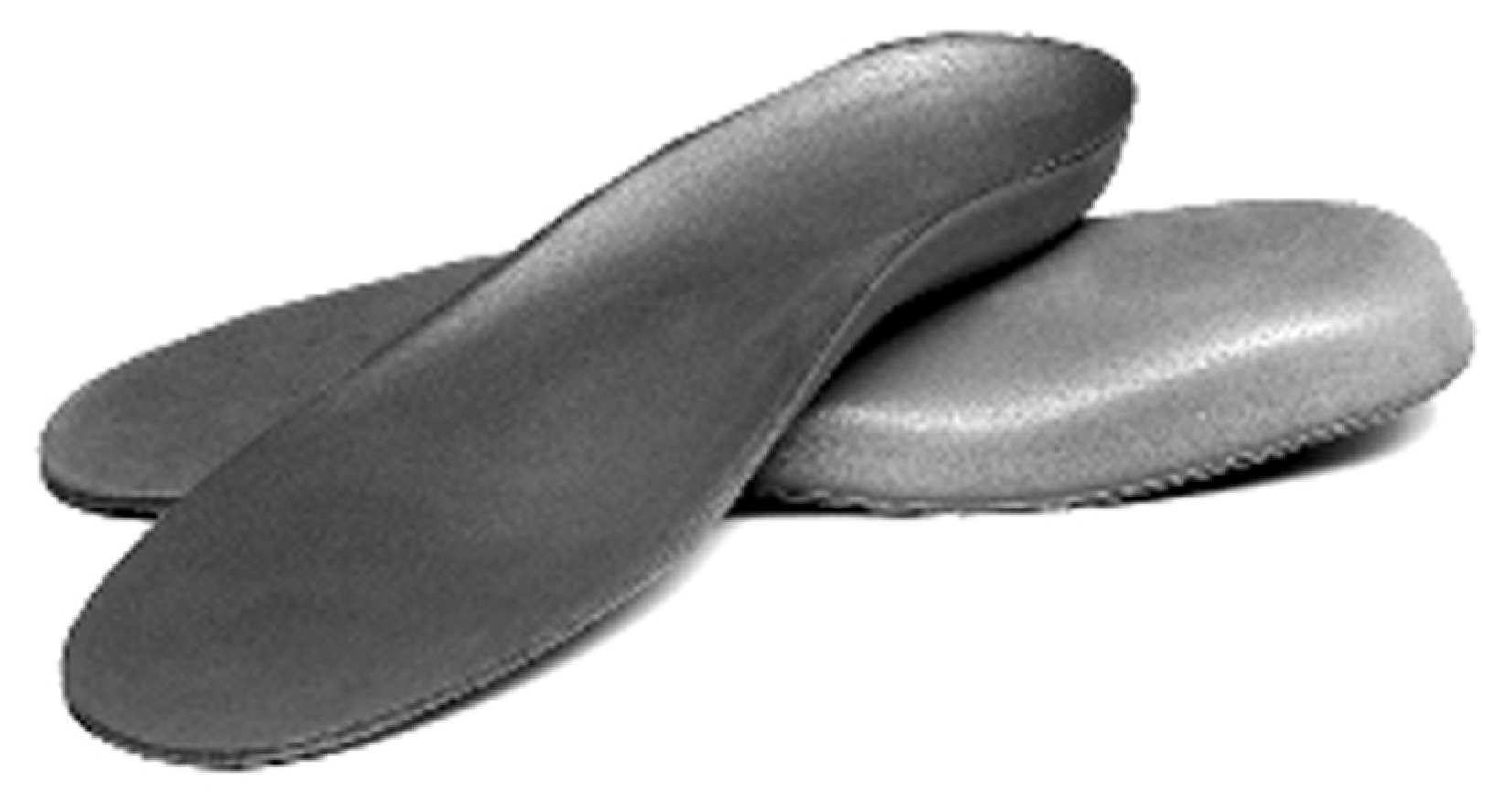
The foot orthotic device consisted of a mediumdensity (35-durometer) ethyl vinyl acetate shoe insert (Blue EVA; Foot Management, Pittsville, Maryland) (
Fig. 1). The inserts were given to each player according to their foot size in the preseason each year. Each player was asked to wear the foot orthotic device during all basketball activities. In an effort to ensure foot orthotic device use, the athletic trainer primarily assigned to women’s basketball questioned players regarding their foot orthotic device use throughout each season. Players were advised to frequently observe their foot orthotic device for signs of wear such as holes in the medial forefoot. Most athletes used two to three pairs of foot orthotic devices per season. Returning athletes received a new pair of foot orthotic devices at the beginning of each new season. No athletes were known to be noncompliant. All of the foot orthoses were purchased by the athletic department.
Data Analysis
A
t test was used to determine whether there were differences in age, height, weight, and body mass index (the weight in kilograms divided by the square of the height in meters) between the two groups of athletes. If there were differences in any of the anthropometric measures, a
post hoc test was performed to determine whether these values affected injury rates. The Wilcoxon signed rank and log-rank tests for event data and the Cox proportional hazards regression model were used [
15]. The SAS version 9.0 procedures LIFE-TEST and PHREG were used for the analysis [
16].
The number of exposures, players × exposures, lower-extremity overuse injury rate per 1,000 athlete exposures, and number of lower-extremity overuse injuries per year were used as criteria for comparing athletes. The number of subjects for each year of the study was calculated by counting the number of female basketball players on the roster at the end of each year. The athletic department’s compliance officer records were used to determine the number of exposures during the 11 years of athletic participation. An exposure was defined as one athlete in one practice or game in which she was exposed to the possibility of a lower-extremity overuse injury. Players × exposures was the number of players times the number of exposures. To normalize the injury data, the number of lower-extremity overuse injuries is expressed per 1,000 exposures.
To further compare athletes who wore a foot orthotic device (treatment group) with those who did not (control group), an incidence density ratio was computed [
17]. The incidence density ratio allows for a comparison when the number of exposures between groups is unequal. This comparison is computed by dividing the injury rate for athletes in the control group by that for athletes in the treatment group. Statistical significance in this study was set at
P < .05.
Results
Anthropometric Measures
There were no differences in the age and height of the athletes between the control and treatment groups. Athletes in the control and treatment groups had different values for weight (P = .002) and body mass index (P = .003); however, the differences had no effect on the lower-extremity overuse injury rate. Neither the Wilcoxon signed rank test nor the log-rank test indicated a significant association of weight or body mass index with the incidence of lower-extremity events (P = .88 for weight and P = .82 for body mass index based on the Wilcoxon signed rank test). The P values for the log-rank test were identical (P = .74). The Cox regression model coefficients for weight and body mass index indicated that there was no impact on lower-extremity events (P = .52 for weight and P = .75 for body mass index).
Lower-Extremity Overuse Injury Rates
Table 2 shows the lower-extremity overuse injuries for each year of the study. The number of players, number of exposures, players × exposures, and injury rates for all of the athletes are listed in
Table 2. The incidence density ratio for all of the lower-extremity overuse injuries was 1.19, which was not significant (
P = .44). Although there was no statistically significant difference between the groups, athletes who used foot orthotic devices were 1.19 times as likely to sustain an injury compared with those who did not use foot orthotic devices.
Injury Location
Table 3 shows the specific locations of lower-extremity overuse injuries for each year of the study. Incidence density ratios for the foot (1.74), lower leg (1.28), and knee extensor mechanism (0.74) were not significant. The treatment group was 1.74 times as likely to sustain a foot injury, 1.28 times as likely to sustain a lower-leg injury, and 0.74 times as likely to sustain a knee extensor mechanism injury. Therefore, despite variations in the number of injuries, athletes who wore foot orthotic devices were no less likely to sustain an injury to the foot, lower leg, or knee extensor mechanism than those who did not wear a foot orthotic device.
Discussion
The present study does not provide evidence of a difference in injury rates between athletes who wore foot orthotic devices and those who did not. This result was unexpected for two reasons. First, foot orthotic devices are thought to be an effective method of treatment for lower-leg and foot pathology [
12,
14]. In addition, foot orthoses have been shown to modify the mechanics of gait, including decreasing the amount of tibial internal rotation and improving the timing of subtalar joint motion in conjunction with tibial internal rotation, which may contribute to overuse injury [
16,
18,
19,
20]. Second, it has been shown that foot orthotic devices can be used to decrease injury rates in military recruits [
11,
12,
13,
14]. However, the primary mode of movement in the previously mentioned studies, including military basic training, is forward gait. Although basketball players run forward, this activity also includes other movements more conducive to injury, such as stopping, side-to-side movement, twisting, cutting, jumping, and landing. It could be hypothesized from the military studies previously mentioned that foot orthotic devices would be helpful in reducing the injury rates of individuals in sports in which running, cutting, and jumping are predominant activities. Despite the theoretical foundation for using foot orthotic devices as a preventive measure, this study does not provide evidence of a difference in injury rates.
The type of foot orthotic device used in this study may explain the lack of difference in the injury rates—that is, the orthosis was not sufficiently rigid to alter lower-extremity movement. However, the literature does not seem to support this argument. Brown et al [
21] and McPoil and Cornwall [
22] reported no lower-extremity kinematic differences in comparison of accommodative and rigid foot orthotic devices. In addition, several authors [
22,
23,
24,
25] have shown that accommodative foot orthotic devices are effective in the treatment of patellofemoral disorders, and McPoil and Cornwall [
26] proposed that accommodative foot orthotic devices can result in biomechanical changes. Nevertheless, the present study does not support the use of accommodative foot orthotic devices for injury prevention.
The retrospective nature of this study may also help explain the observed results. During the study period there were coaching changes. Differences in coaching style, training intensity, and training duration could have affected the results. However, training volume does not seem to be a factor in injury frequency. The coaches were limited in the numbers of games and practices by National Collegiate Athletic Association (NCAA) Division I regulations. The average number of exposures per year was 1,492 in athletes who wore foot orthoses, compared with 1,489 in controls.
The compliance of the athletes in wearing the foot orthotic device must also be questioned. The athletic trainer in charge of women’s basketball observed and questioned athletes regarding their foot orthotic device use, but there was no way to obtain complete assurance that athletes wore their foot orthotic devices 100% of the time they were participating in basketball.
The relatively small sample size must also be considered a limitation of this study. Even though the study spanned 11 years, the control group comprised only 36 players across 3 years, and the treatment group consisted of only 96 players across 8 years.
Conclusion
Although foot orthotic devices have been used to treat and prevent lower-extremity overuse injury, this study did not find a difference in the injury rates of athletes who did versus did not wear foot orthotic devices. Therefore, this study does not support the use of accommodative foot orthotic devices to reduce lower-extremity overuse injury rates in female basketball players.