Accurate Nomenclature for Forefoot Nerve Entrapment. A Historical Perspective
Abstract
Historical Considerations
I trod upon quite a large stone which rolled from under my foot, causing me to slip, throwing my entire weight upon the forward foot; though not falling, I found my right foot injured; the pain was intense and accompanied by fainting sensations. With considerable difficulty I reached the valley of the Grindenwald, where for hours I endured great suffering. After this I found it impossible to wear a shoe even for a few moments, the least pressure inducing an attack of severe pain. At no time did the foot or toe swell or present any evidence of having been injured. During the succeeding five years the foot was never entirely free from pain, often my suffering has been very severe, and coming on in paroxysms. I have been able only to wear a very large shoe, and only for a limited apace of time, invariably being obliged to remove it every half hour or so, to relieve the foot. Much of the time I have gone without any covering except a stocking, and even at night have suffered intensely; slight pressure of the finger on the tender spot causes the same sensations as wearing a shoe.
Morton’s surgical treatment of this patient was described as follows:… the neuralgia was unquestionably located in and about the head and phalanx of the fourth toe; even the slightest pressure or handling could not be tolerated. The paroxysms of suffering which the doctor had, forcibly reminded me of those cases of severe facial neuralgia which I had several times seen in the second branch of the fifth pair of nerves.
After etherization, I made a longer incision than in the other operations, on the upper and outer side of the fourth metatarsal bone, the shaft of which was divided rather more than half an inch beyond the head of the bone; the base of the first phalanx was also removed; the toe was then found to be so isolated that at Dr. Hunt’s suggestion it was removed; the adjacent soft parts were dissected away to insure the excision of all the surrounding nerve branches, the wound was brought together with silver wire, and dressed with dry charpie. Dr. Alison was so well on the third day that he left for his home in Maryland.
Morton operated on three patients with chronic disease for whom “no other treatment except complete excision of the irritable metatarsophalangeal joint with the surrounding soft parts will be likely to prove permanently successful.” In the other two patients, the pathology showed normal nerves and joints. Of the other patients, one was too “infirm” to have surgery, whereas the others were treated with “vigorous local blood-letting, anodyne applications, with long-continued rest, until all sensitiveness of the joint has disappeared.”… the nervous structures were all healthy, as proved by microscopic examination; the only abnormal condition I found was a small abrasion upon the articular surface of the fourth metatarsal with the phalanx, not sufficient it would seem, to account for the excruciating pain the doctor suffered.
Morton observed that of his 15 patients, 12 were female and that “it would appear the affection is not so uncommon, only that, as a distinct disease, it has not heretofore been noticed.” Eight of the patients had a “direct history of injury to the joint of the fourth toe. In three or four cases it originated from shoe-pressure; and in the remainder no cause for the pain was assigned.” Morton carried out cadaver dissections in male and female feet to attempt to understand the etiology of this problem. He concluded the following:It has been in my left for thirty years, it is a painful condition. The pain is in and about the joint of the fourth toe, with occasional attacks of intense suffering, when the pain extends to the knee, and if my shoe is not instantly removed when that attack comes on, the pain reaches the hip. … It seems that the least pressure will produce the same result. … My eldest sister has been similarly affected still longer than myself, but in her right foot, same toe and joint. Two of my friends suffer in like manner at the present time. In one of the two cases, the pain is relieved by placing the foot on the ground with the shoe off, and thus spreading the toes.
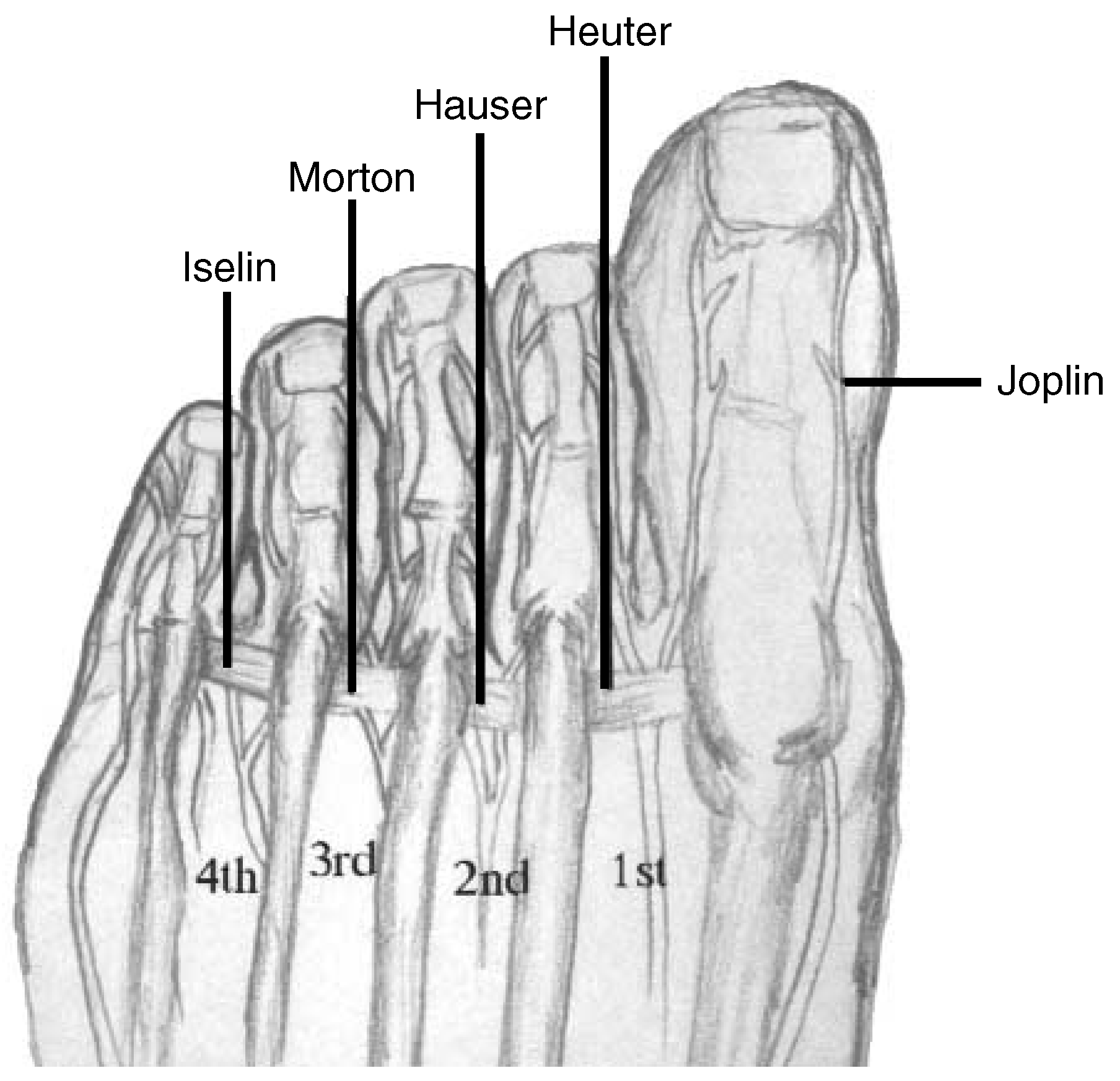
Morton includes an anatomy drawing from Henle in which the medial plantar nerve contributes a branch to the lateral plantar nerve to form the common plantar nerve to the fourth (not the third) web space. Except for this reference to a medical illustrator, Morton’s manuscript has no references.The peculiar position which the fourth metatarsophalangeal articulation bears to that of the fifth, the great mobility of the fifth metatarsal, which by lateral pressure is brought into contact with the fourth, and lastly, the proximity of the digital branches of the external plantar nerve, which are, under certain circumstances, liable to be bruised by, or pinched between the fourth and the fifth metatarsals, may be ascribed the neuralgia in this region.
He concluded that “the interdigital neuroma is a traumatic or inflammatory lesion, or both. It is the result of a mechanical disturbance of the foot and is usually associated with abnormalities of the foot.” Hauser described 116 “lesions” in 96 women and 4 men.… persistent pain between two digits, the pain is worse with weight-bearing and characteristically, removal of the shoe gives some relief; at times, there is paresthesia or numbness in the toes; there is always tenderness with pressure over the lesion; and occasionally, a tumor is palpable.
The pathology demonstrated in his Figure 2, termed an interdigital neuroma, is correctly identified histologically as demonstrating “perineural fibrosis” and is not a true neuroma. Hauser’s operative technique is of interest:About 60 percent of the patients were between ages 40 and 60 years. The lesion occurred between the second and third toes in 52 percent of the patients and between the third and fourth toes in 44 percent of the patients. The other four percent occurred between the fourth and fifth toes. Eighteen patients had two lesions on the same foot, and in 14, there was a lesion in each foot.
A pneumatic cuff is placed around the thigh. A general anesthesia is used. … A small transverse incision is made of the involved interspace. The incision is elongated, proximally on the fibular side and distally on the tibial side. This permits a closure which will allow the skin to be lengthened. The tumor is readily exposed. The thickened branches of the digital nerves are carefully demonstrated. The branches are divided, and the tumor is dissected free. The thickened nerve is then traced between the metatarsal heads. To facilitate this, a special spreader is utilized, forcing the metatarsal heads apart for visualization of the thickened nerve. The nerve is divided proximal to the metatarsal heads. Frequently, the toes on either side of the neuroma are contracted. There is a dorsal extension at the metatarsal-phalangeal joint. After removal of the tumor, the contracted toes on each side of the interspace are corrected. … An incision is made through one-half of the tendon on one side and a second incision, dividing one-half of the tendon on the opposite side, is made 1 to 2 centimeters distally.
The only reference included in Hauser’s paper was to his own book, but it was not a specific reference to any given statement in the book.… symptoms and signs similar to those seen where there is a reflex irritation and stimulation of the sensory nerves. Treatment for this condition consisted of whirlpool baths, massage, repeated blocking of the superficial nerve with Novocain, and continuation of the use of corrective shoes. It took from six months to one year to obtain complete relief of the symptoms.
After I had explained to the patient how simple it would be to excise this superficial sensory nerve under ankle block anesthesia, she said she would like to try it. The operation was just as easily performed as predicted, the convalescence uneventful, and the patient completely relieved.
Discussion
The article by Dewberry et al. [49] contains data from their own clinical series and from the study by Kite [50], which is similar to this and appears in Table 2, which documents the frequency of compression of the interdigital nerves. Another article that shows the problem related to use of the word neuroma is the case report in 1972 by Levi et al. [51], in Hebrew, which shows a fracture of the fifth metacarpal on radiographs. However, the patient had symptoms in the web space between the third and fourth toes and had the interdigital nerve of that web space resected and reported as Morton’s neuroma. Finally, it seems that Hoadley [52], in 1893, was the first to resect the interdigital nerve to the third web space and call it a neuroma. His work has been quoted by Bickel and Dockerty [53] in 1947 as follows:… the frequency with which these problems occur in various locations is greatest between the 3rd and 4th digits, next, between the 4th and 5th digits, occasionally between the 1st and 2nd (especially in hallux valgus with displaced lateral sesamoid bone), and least commonly between the 2nd and 3rd digits. This is not just my own personal experience but is a composite opinion of most of the people with whom I have discussed this.[48]
In 1893 Hoadley reported data on 6 cases of metatarsalgia. In one of his cases (II), in which the condition failed to respond to conservative treatment, he performed operation. His findings were significant. Unfortunately for patients suffering from this condition these findings were not generally known for nearly 5 decades. In the case in question Hoadley exposed the digital branches of the lateral plantar nerve to the fourth toe and found a small neuroma. He then resected the nerve. “A prompt and perfect cure” was obtained. He expressed the opinion that if operation was advisable, excision of the nerve was simpler and recovery prompter than excision of the metatarsophalangeal joint as advised by Morton.
Conclusion
Acknowledgment
References
- Michele, A.A.; Kreuger, F.J. Plantar heel pain treated by countersinking osteotomy. Milit. Surg. 1951, 109, 259. [Google Scholar] [CrossRef]
- Duvries, H.L. Heel spur (calcaneal spur). Arch. Surg. 1957, 74, 536. [Google Scholar] [CrossRef]
- Savastano, A.A. Surgical neurectomy for the treatment of resistant painful heel. R. I. Med. J. 1985, 68, 371. [Google Scholar]
- Lemont, H.; Ammirati, K.M.; Usen, N. Plantar fasciitis: a degenerative process (fasciosis) without inflammation. J. Am. Podiatr. Med. Assoc. 2003, 93, 234. [Google Scholar] [CrossRef]
- Furey, J.G. Plantar fasciitis: the painful heel syndrome. J. Bone Joint Surg. Am. 1975, 57, 672. [Google Scholar] [CrossRef] [PubMed]
- Barrett, S.L.; Day, S.V.; Brown, M.G. Endoscopic plantar fasciotomy for chronic plantar fasciitis/heel spur syndrome: surgical technique: early clinical results. J. Foot Ankle Surg. 1991, 30, 568. [Google Scholar]
- Kinley, S.; Franconce, S.; Calderone, D.; et al. Endoscopic plantar fasciotomy versus traditional heel spur surgery: a prospective study. J. Foot Ankle Surg. 1993, 32, 595. [Google Scholar] [PubMed]
- Barrett, S.L.; Day, S.V.; Pignetti, T.T.; et al. Endoscopic plantar fasciotomy: a multi-surgeon prospective analysis of 652 cases. J. Foot Ankle Surg. 1995, 34, 400. [Google Scholar] [CrossRef]
- Tomczak, R.L.; Haverstock, B.D. A retrospective comparison of endoscopic plantar fasciotomy to open plantar fasciotomy with heel spur resection for chronic plantar fasciitis/heel spur syndrome. J. Foot Surg. 1995, 34, 305. [Google Scholar] [CrossRef]
- Benton-Weil, W.; Borelli, A.H.; Weil, L.S., Jr.; et al. Percutaneous plantar fasciotomy: a minimally invasive procedure for recalcitrant plantar fasciitis. J. Foot Ankle Surg. 1998, 37, 269. [Google Scholar] [CrossRef]
- Lundeen, R.O.; Aziz, S.; Burks, J.B.; et al. Endoscopic plantar fasciotomy: a retrospective analysis of results in 53 patients. J. Foot Ankle Surg. 2000, 39, 208. [Google Scholar] [CrossRef]
- Woelffer, K.E.; Figura, M.A.; Sandberg, N.S.; et al. Five-year follow-up results of instep plantar fasciotomy for chronic heel pain. J. Foot Ankle Surg. 2000, 39, 218. [Google Scholar] [CrossRef] [PubMed]
- Hendrix, C.L.; Jolly, G.P.; Garbalosa, J.C.; et al. Entrapment neuropathy: the etiology of intractable chronic heel pain syndrome. J. Foot Ankle Surg. 1998, 37, 273. [Google Scholar] [CrossRef] [PubMed]
- Goecker, R.M.; Banks, A.S. Analysis of release of the first branch of the lateral plantar nerve. J. Am. Podiatr. Med. Assoc. 2000, 90, 281. [Google Scholar] [CrossRef]
- Weil, L.S., Sr. Heel pain syndrome: will it ever end? J. Foot Ankle Surg. 2000, 39, 207. [Google Scholar] [CrossRef]
- Dellon, A.L. Deciding when heel pain is of neural origin. J. Foot Ankle Surg. 2001, 40, 341. [Google Scholar] [CrossRef] [PubMed]
- Rose, J.D.; Malay, D.S.; Sorrento, D.L. The results of neurosensory testing of the medial calcaneal and medial plantar nerves in patients with plantar heel pain. J. Foot Ankle Surg. 2003, 42, 173. [Google Scholar] [CrossRef]
- Morton, T.G. A peculiar and painful affection of the fourth metatarsophalangeal articulation. Am. J. Med. Sci. 1876, 71, 37. [Google Scholar] [CrossRef]
- King, L.S. Note on the pathology of Morton’s metatarsalgia. Am. J. Clin. Pathol. 1946, 1, 124. [Google Scholar] [CrossRef][Green Version]
- Lassman, G.; Lassman, H.; Stockinger, I. Morton’s metatarsalgia: light and electron microscopic observations and their relations to entrapment neuropathies. Virchows Arch. A 1976, 370, 307. [Google Scholar] [CrossRef]
- Graham, C.E.; Graham, D.M. Morton’s neuroma: a microscopic evaluation. Foot Ankle 1984, 5, 150. [Google Scholar] [CrossRef]
- Gautier, G. Thomas Morton’s disease: a nerve entrapment syndrome. Clin. Orthop. 1979, 142, 90. [Google Scholar] [CrossRef]
- Dellon, A.L. Treatment of Morton’s neuroma as a nerve compression: the role for neurolysis. J. Am. Podiatr. Med. Assoc. 1992, 82, 399. [Google Scholar] [CrossRef]
- Barrett, S.L.; Pignetti, T.T. Endoscopic decompression for intermetatarsal nerve entrapment: the EDIN technique: preliminary study with cadaveric specimens: early clinical results. J. Foot Ankle Surg. 1994, 33, 503. [Google Scholar]
- Vito, G.R.; Talarico, L.M. A modified technique for Morton’s neuroma: decompression with relocation. J. Am. Podiatr. Med. Assoc. 2003, 93, 190. [Google Scholar] [CrossRef] [PubMed]
- Dellon, A.L. Treatment of recurrent metatarsalgia by neuroma resection and muscle implantation: case report and algorithm for management of Morton’s “neuroma”. Microsurgery 1989, 10, 256. [Google Scholar] [CrossRef]
- Banks, A.S.; Vito, G.R.; Giorgini, T.L. Recurrent intermetatarsal neuroma: a follow-up study. J. Foot Ankle Surg. 1996, 86, 299. [Google Scholar] [CrossRef]
- Wolfort, S.; Dellon, A.L. Treatment of recurrent neuroma of the interdigital nerve by neuroma resection and implantation of proximal nerve into muscle in the arch. J. Foot Ankle Surg. 2001, 40, 404. [Google Scholar] [CrossRef] [PubMed]
- Joplin, R.J. The proper digital nerve, vitallium stem arthroplasty and some thoughts about foot surgery in general. Clin. Orthop. 1971, 76, 199. [Google Scholar] [CrossRef] [PubMed]
- Heuter: Cited by Vogel, F.C.W. Klinik der Gelenkkrankheiten; Leipzig, Germany, 1877; p. 339. [Google Scholar]
- Hauser, E.D. Interdigital neuroma of the foot. Surg. Gynecol. Obstet. 1971, 133, 265. [Google Scholar]
- Iselin, I.T. Wachtumsbeschwerden zur zeit dur Knochernen Entwicklung der tuberositas metatarsi quinto. Deutsch. Zeit. Chir. 1912, 117, 529. [Google Scholar]
- Civinini, F. Su di un gangliare rigonfiamento della pinata del plede. Mem. Chir. Archiespedale Pistola 1835, 4. [Google Scholar]
- Durlacher, L. A Treatise on Corns, Bunions, the Diseases of Nails, and the General Management of the Feet; Simpkin, Marshall: London, UK, 1845; p. 52. [Google Scholar]
- Canale, S.T.; Williams, K.D. Iselin’s disease. J. Pediatr. Orthop. 1992, 12, 90. [Google Scholar] [CrossRef] [PubMed]
- Hauser, E.D.W. Diseases of the Foot, 2nd ed.; WB Saunders: Philadelphia, PA, USA, 1950. [Google Scholar]
- Caporusso, E.F.; Fallat, L.M.; Savoy-Moore, R. Cryogenic neuroablation for the treatment of lower extremity neuromas. J. Foot Ankle Surg. 2002, 41, 286. [Google Scholar] [CrossRef] [PubMed]
- Dellon, A.L.; Aszmann, O.C. Treatment of dorsal foot neuromas by translocation of nerves into anterolateral compartment. Foot Ankle 1998, 19, 300. [Google Scholar] [CrossRef]
- Kim, J.; Dellon, A.L. Pain at the site of tarsal tunnel incision due to neuroma of the posterior branch of the saphenous nerve. J. Am. Podiatr. Med. Assoc. 2001, 91, 109. [Google Scholar]
- Kim, J.; Dellon, A.L. Calcaneal neuroma: diagnosis and treatment. Foot Ankle Int. 2001, 22, 890. [Google Scholar] [CrossRef]
- Novak, C.B.; Van Kleit, D.; Mackinnon, S.E. Subjective outcome following surgical management of lower-extremity neuromas. J. Reconstr. Microsurg. 1995, 11, 175. [Google Scholar] [CrossRef]
- Levitsky, K.A.; Alman, B.A.; Jevesvar, D.S.; et al. Digital nerves of the foot: anatomic variations and implications regarding the pathogenesis of interdigital neuroma. Foot Ankle 1993, 14, 208. [Google Scholar] [CrossRef]
- Betts, L.O. Morton’s metatarsalgia: neuritis of the fourth digital nerve. Med. J. Aust. 1940, 1, 514. [Google Scholar] [CrossRef]
- Kay, D.; Bennett, G.L. Morton’s neuroma. Foot Ankle Clin. 2003, 8, 49. [Google Scholar] [CrossRef]
- Weinfeld, S.B.; Myerson, M.S. Interdigital neuritis: diagnosis and treatment. J. Am. Acad. Orthop. Surg. 1996, 4, 328. [Google Scholar] [CrossRef]
- Marini, A.; Zecchini, F. Metarsalgia di Morton o di Civinini-Morton? Chirurgia Piede 1989, 13, 59. [Google Scholar]
- Volpe, A.; Melanotte, P.L.; Torresin, P.; et al. Le sindromi canalicolari del pied: eziopatogenesi ed anatomia parologica. Chirurgia Piede 1989, 13, 7. [Google Scholar]
- Sandel, R.K. Morton’s neuroma of second toe. J. Am. Podiatr. Assoc. 1958, 48, 116. [Google Scholar]
- Dewberry, J.W.; Christian, J.D., Jr.; Becton, J.L. Morton’s neuroma. J. Med. Assoc. Ga. 1973, 62, 144. [Google Scholar] [PubMed]
- Kite, H.J. Morton’s toe neuroma. South. Med. J. 1966, 59, 20. [Google Scholar] [CrossRef]
- Levi, M.; Zalenlenfreund, M.; Maor, P.; et al. Morton’s neuroma after fracture. Harefuah (In Hebrew) 1972, 83, 202. [Google Scholar]
- Hoadley, A.E. Six cases of metatarsalgia. Chicago Med. Rec. 1893, 5, 32. [Google Scholar]
- Bickel, W.H.; Dockerty, M.B. Plantar neuromas, Morton’s toe. Surg. Gynecol. Obstet. 1947, 84, 111. [Google Scholar]
- Bradford, E.H. Metatarsal neuralgia, or Morton’s affection of the foot. Boston Med. Surg. J. 1891, 2, 52. [Google Scholar] [CrossRef]
- Morton, T.S.K. Metatarsalgia (Morton’s painful affection of the foot) with an account of six cases cured by operation. Ann. Surg. 1893, 17, 680. [Google Scholar]
- McElvenny, R.T. The etiology and surgical treatment of intractable pain about the fourth metatarsophalangeal joint (Morton’s toe). J. Bone Joint Surg. 1943, 25, 675. [Google Scholar]
- Mulder, J.D. The causative mechanism in Morton’s metatarsalgia. J. Bone Joint Surg. Br. 1951, 33, 94. [Google Scholar] [CrossRef] [PubMed]
- Bateman, J.E. Trauma to Nerves in Limbs; WB Saunders: Philadelphia, PA, USA, 1962; p. 63. [Google Scholar]
- Reed, R.J.; Bliss, B.O. Morton’s neuroma: regressive and productive intermetatarsal elastofibrosis. Arch. Pathol. 1973, 95, 123. [Google Scholar] [PubMed]
- Jahss, M.H. Disorders of the Foot; WB Saunders: Philadelphia, PA, USA, 1982; p. 1034. [Google Scholar]
- Mann, R.A.; Reynolds, J.C. Interdigital neuroma: a critical clinical analysis. Foot Ankle 1983, 3, 238. [Google Scholar] [CrossRef]
- Miller, S.J. Morton’s Neuroma: A Syndrome. In Comprehensive Textbook of Foot Surgery; McGlamry, E.D., Ed.; Williams & Wilkins: Baltimore, MD, USA, 1987; p. 38. [Google Scholar]
- Friscia, D.A.; Strom, D.E.; Parr, J.W.; et al. Surgical treatment for primary interdigital neuroma. Orthopedics 1991, 14, 669. [Google Scholar] [CrossRef]


| Clinical Diagnosis | ICD-9 Code | Surgical Procedure | CPT Code |
|---|---|---|---|
| Interdigital nerve compression | 355.6 | Neurolysis, foot, open | 64704 |
| Endoscopic | 64704-22 | ||
| Interdigital neuroma | 355.6 | Neuroma resection | 64784 or 28080 |
| With muscle implantation | Add 64787 | ||
| Recurrent neuroma | 355.6 | Neuroma resection | 64784 |
| With muscle implantation | Add 64787 |
| Patients (%) | |||
|---|---|---|---|
| Kite [50], 1996 | Hauser [31], 1971 | Dewberry et al. [49], 1973 | |
| Web Space | (n = 105) | (n = 116) | (n = 35) |
| Second | 11 | 52 | 7.2 |
| Third | 89 | 44 | 88.0 |
| Fourth | 0 | 4 | 4.8 |
| Date | Author | Terminology Used | Pathology | Treatment |
|---|---|---|---|---|
| 1835 | Civinini [33] | Gangliare rigonfiamento | Nerve swelling | None |
| 1845 | Durlacher [34] | NA | NA | NA |
| 1870 | Heuter [30] | “Exostosis of first metatarsophalangeal joint” changed to “hallux valgus” | Bone | Osteotomy |
| 1876 | Morton [18] | Metatarsalgia of fourth toe | Bone | Excise joint (amputate toe) |
| 1891 | Bradford [54] | Metatarsal neuralgia, Morton’s affection of the foot | Bone | NA |
| 1893 | Morton [55] | Metatarsalgia, Morton’s affection of the foot | Bone | Excise joint (amputate toe) |
| 1893 | Hoadley [52] | Metatarsalgia | Nerve | Neurectomy |
| 1912 | Iselin [32] | Traction apophysitis, fifth toe | Bone | None |
| 1940 | Betts [43] | Morton’s metatarsalgia | Neuritis | Neurectomy (plantar) |
| 1943 | McElvenny [56] | Metatarsalgia | Neuritis | Neurectomy (dorsal) |
| 1946 | King [19] | Morton’s metatarsalgia | Sclerosing neuritis | Neurectomy |
| 1950 | Hauser [36] | Morton’s disease | Bone or nerve compression | None given |
| 1951 | Mulder [57] | Morton’s metatarsalgia | Metatarsal bursa | Neurectomy |
| 1958 | Sandel [48] | Morton’s neuroma of second toe | Nerve lesion | Neurectomy |
| 1962 | Bateman [58] | Morton’s neuroma | Nerve lesion | Neurectomy |
| 1966 | Kite [50] | Morton’s toe neuroma | Nerve lesion | Neurectomy |
| 1971 | Hauser [31] | Interdigital neuroma, second web | Nerve lesion | Neurectomy |
| 1971 | Joplin [29] | Proper digital nerve, first toe | Perineural fibrosis | Neurectomy |
| 1972 | Levi et al. [51] | Morton’s neuroma | Neuroma | Neurectomy |
| 1973 | Reed and Bliss [59] | Morton’s neuroma | Elastofibroma | Neurectomy |
| 1973 | Dewberry et al. [49] | Morton’s neuroma | Nerve injury | Neurectomy |
| 1979 | Gautier [22] | Thomas Morton’s disease | Nerve compression | Neurolysis |
| 1982 | Jahss [60] | Morton’s neuroma | Nerve lesion | Neurectomy |
| 1983 | Mann and Reynolds [61] | Interdigital neuroma | Neuroma | Neurectomy |
| 1987 | Miller [62] | Morton’s neuroma | Nerve lesion | Neurectomy |
| 1991 | Friscia et al. [63] | Primary interdigital neuroma | Neuroma | Neurectomy |
| 1992 | Dellon [23] | Morton’s neuroma | Nerve compression | Neurolysis |
| 1996 | Weinfeld and Myerson [45] | Interdigital neuritis | Nerve compression | Neurolysis |
| 2003 | Kay and Bennett [44] | Morton’s neuroma | Perineural fibrosis | Neurectomy or neurolysis |
| 2005 | Larson et al. (present article) | Compression of interdigital nerve | Nerve compression | Neurolysis |
© 2005 American Podiatric Medical Association
Share and Cite
Larson, E.E.; Barrett, S.L.; Battiston, B.; Maloney, C.T.; Dellon, A.L. Accurate Nomenclature for Forefoot Nerve Entrapment. A Historical Perspective. J. Am. Podiatr. Med. Assoc. 2005, 95, 298-306. https://doi.org/10.7547/0950298
Larson EE, Barrett SL, Battiston B, Maloney CT, Dellon AL. Accurate Nomenclature for Forefoot Nerve Entrapment. A Historical Perspective. Journal of the American Podiatric Medical Association. 2005; 95(3):298-306. https://doi.org/10.7547/0950298
Chicago/Turabian StyleLarson, Ethan E., Stephen L. Barrett, Bruno Battiston, Christopher T. Maloney, and A. Lee Dellon. 2005. "Accurate Nomenclature for Forefoot Nerve Entrapment. A Historical Perspective" Journal of the American Podiatric Medical Association 95, no. 3: 298-306. https://doi.org/10.7547/0950298
APA StyleLarson, E. E., Barrett, S. L., Battiston, B., Maloney, C. T., & Dellon, A. L. (2005). Accurate Nomenclature for Forefoot Nerve Entrapment. A Historical Perspective. Journal of the American Podiatric Medical Association, 95(3), 298-306. https://doi.org/10.7547/0950298