A definitive etiology of the Charcot neuropathic foot is still lacking. However, it is known that Charcot’s arthropathy can have devastating ramifications in the affected patient. [
1] In many instances, what begins as simple increased temperature, swelling, and rubor of a neuropathic extremity proceeds to complete bony collapse of the foot, refractory ulceration, and consideration for amputation. [
2] The fact that, in many instances, there is no evidence of preceding trauma and that the circulation is intact further confounds the mechanism of destruction. [
3]
Previous research by one of us (W.P.G.) using an electron microscope showed physical changes in Achilles tendons harvested from patients with diabetic Charcot’s foot. [
4] Pathologic changes from advanced glycation end products are evident using electron microscopy. The microscopic findings revealed an increased packing density of collagen fibrils, decreased fibril diameter, and abnormal fibril morphology compared with non-Charcot’s diabetic controls. This may indicate a structural change in the tendon due to diabetes mellitus. [
5] The microscopic differences in the diabetic Charcot Achilles tendon could be a source of development of Charcot’s arthropathy.
The effects of diabetes mellitus on the organs and tissues of many diabetic patients can be described as the same types of changes usually associated with aging. Many diabetic patients develop cataracts, joint stiffness, and arteriosclerosis, which are conditions usually associated with the elderly. [
5,
6]
The goal of this study was to determine whether patients with Charcot’s changes in the foot also demonstrate functional, structural, and physical differences regarding elasticity and tensile strength of the Achilles tendon secondary to the glycation of the Achilles tendon. The difference in elasticity potential would translate into a functional difference in the dynamics of gait, as evidenced by early heel-off and increased forefoot pressures. Differences in tensile strength may be expressed functionally as failure of the Achilles tendon through rupture or early failure through rupture of other foot ligaments.
The Achilles tendons in Charcot’s patients were chosen on the basis of clinical findings of a marked equinus component, with altered gait and structural collapse of the foot. In this Charcot population, there was evidence of decreased tensile strength, which would be expressed clinically as ligamentous weakness across the joints of the foot. The elasticity data (Young’s modulus) collected show decreased elasticity consistent with limitation of motion at the ankle. We term this finding diabetic tendo Achillis equinus.
Materials and Methods
Tendon Sampling
The senior author (W.P.G.) obtained a portion of the Achilles tendon from patients who underwent a surgical procedure to lengthen the Achilles tendon. All of the Charcot foot Achilles tendon samples were harvested from diabetic patients without a history of concomitant pathologic conditions that could damage the tendon (eg, infection, gangrene, and autoimmune disorders). The tendon sample was obtained from the myotendinous junction in all cases, as part of the Z-lengthening of the tendon; hence the sample was typically centrally harvested from the tendon. Samples of tendon were full thickness from the end of the tendon to the midline, measuring an average of 3.0 cm. After harvest, the tissue sample was placed in normal sterile saline, frozen at –80 °C, and held for approximately 1 week before mechanical testing was performed. A total of 29 tendons were obtained, 20 with confirmed Charcot’s neuroarthropathy (as verified by magnetic resonance imaging and bone scanning) and 9 control tendons. The diagnosis of Charcot’s diabetic neuroarthropathy was made on the basis of a history of diabetes mellitus with neuropathy and clinical findings of foot edema or calor or fracture dislocation of the foot with a history of injury. Neuropathy was diagnosed clinically with failure to perceive a 5.07 monofilament, diminished or absent vibratory sensation, absent ankle reflex, or electromyographic or nerve conduction velocity evidence of peripheral neuropathy. The specific tendons used as controls were chosen on the basis of information in the donor’s social and behavioral history file. The controls consisted of cadaveric Achilles tendons free of diabetes mellitus, Charcot’s foot, metabolic disease, and visible injury. The cadaveric tendons used in the study were supplied by Lifenet, a Virginia Beach, Virginia, organ and tissue procurement agency.
Mechanical Testing
Immediately on removal, the tendon samples were placed in a container, covered with physiologic saline, and transported to the testing laboratory on wet ice. Tissue samples that were not tested within 24 hours of removal were placed in a mechanical freezer at –80 °C until the time of testing. The frozen samples were thawed in saline before testing. Before testing, all samples were cleaned of excess fat and soft tissue using blunt dissection techniques. To minimize dehydration, the tendons were stored in saline solution.
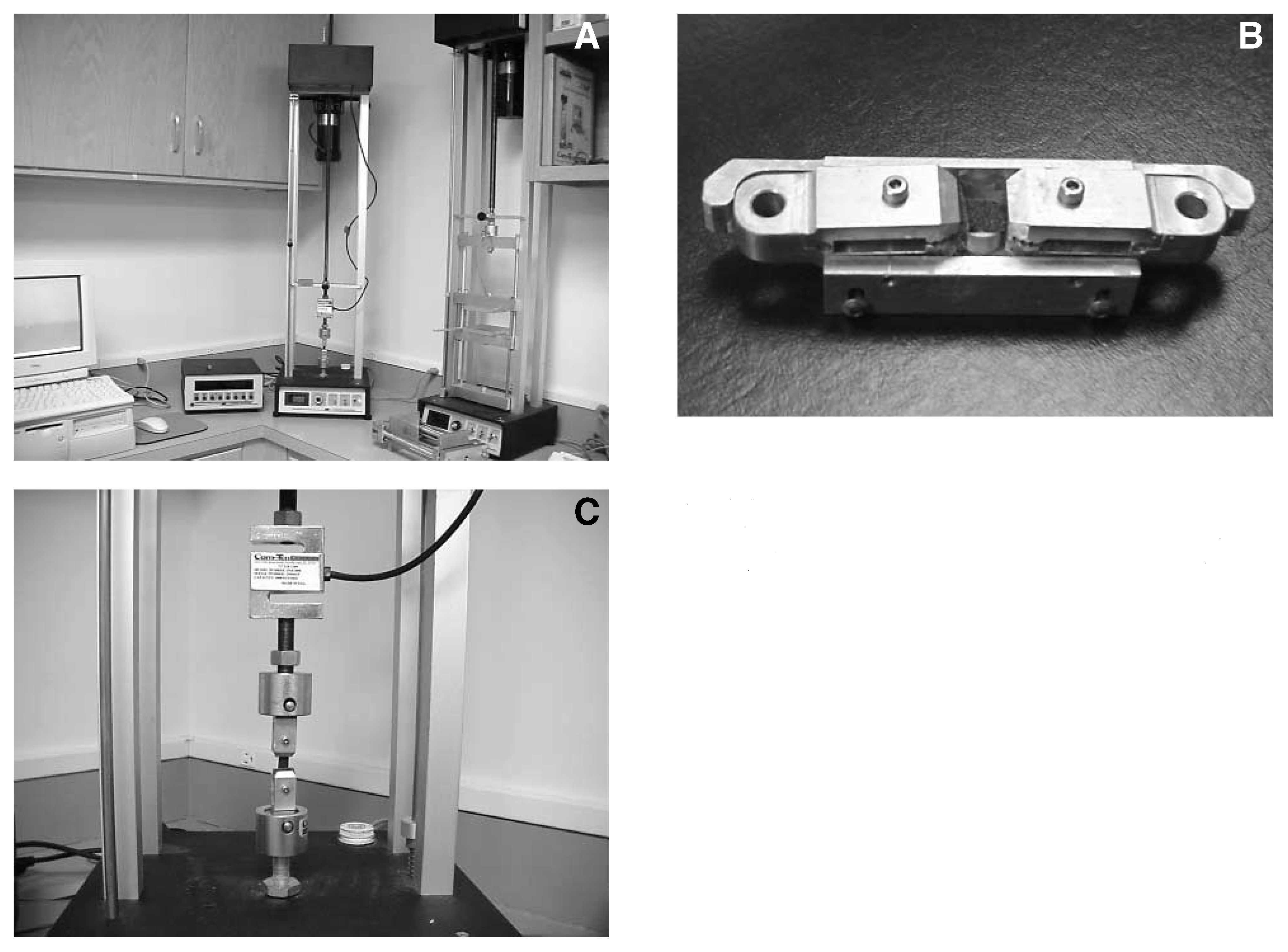
The physical dimensions of the tissue sample were measured at three locations along the length of the tendon using a calibrated micrometer (Mitutoyo Corp, Kawasaki, Japan). The three values were averaged and used in the calculation of the cross-sectional area. Each tendon sample was capped 5 mm from each end with 400-grade polishing paper. Methyl methacrylate glue was applied to the paper just before the addition of the sample. Using a Com-Ten Biomechanical Testing Instrument (Com-Ten Industries, Pinellas Park, Florida), the capped and glued tendon sample was placed in specially designed holding clamps and tightened on the polishing paper/tendon area only. Given the small size of the tendon sample, the laboratory developed a specially designed clamping system (
Figure 1). This system ensured that the tendons were securely fixed into the jaws of the clamp to prevent the tissue from slipping. A small preload was applied to the tissue (20 N) to obtain a consistent gauge length measurement. Each tendon was loaded to failure after five preconditioning cycles, in which the tissue was stretched from 0 to 20 N at a strain rate of 10% per second. During the testing procedure, the tendon sample was sprayed with saline to keep the tissue moist.
Results
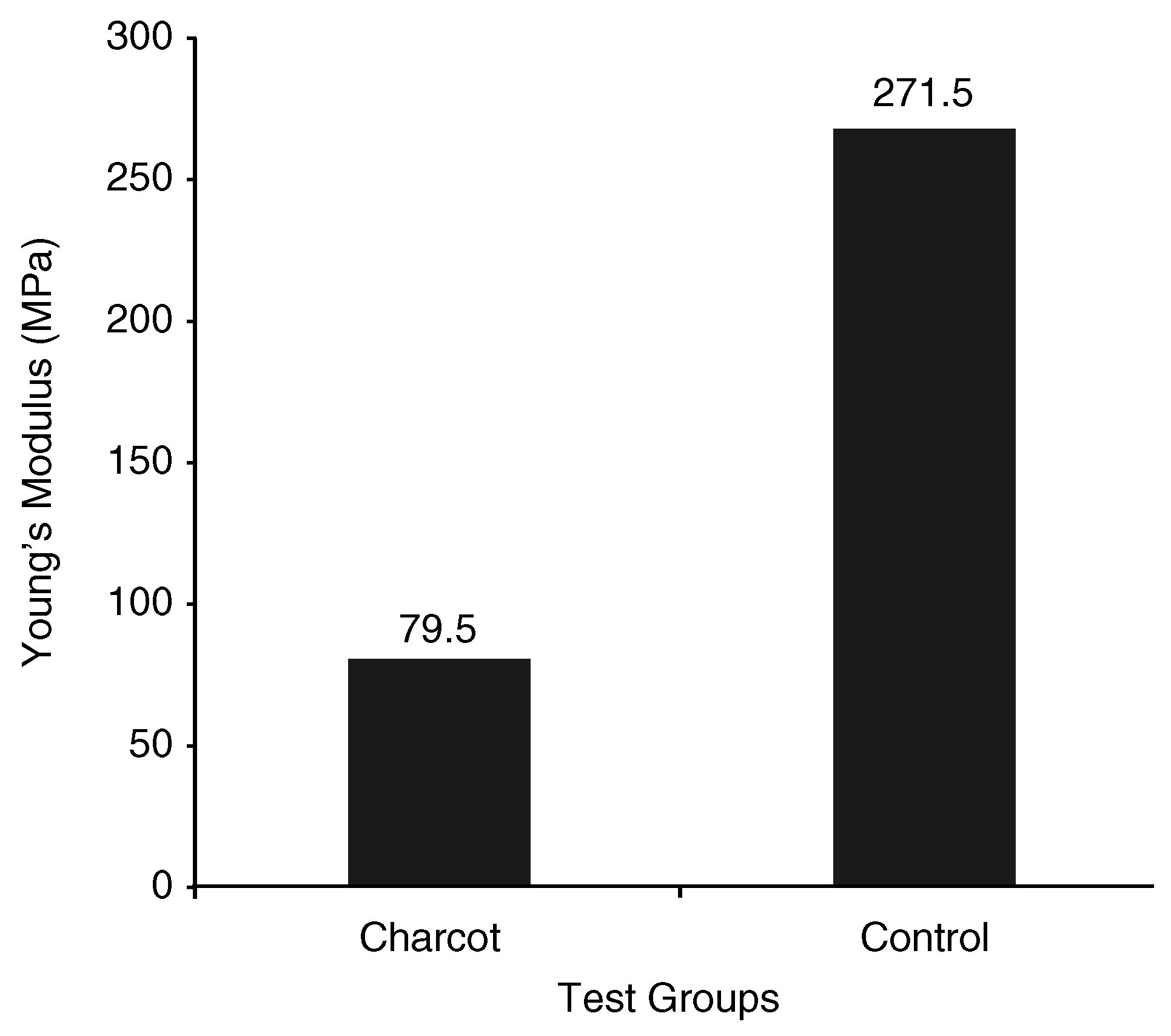
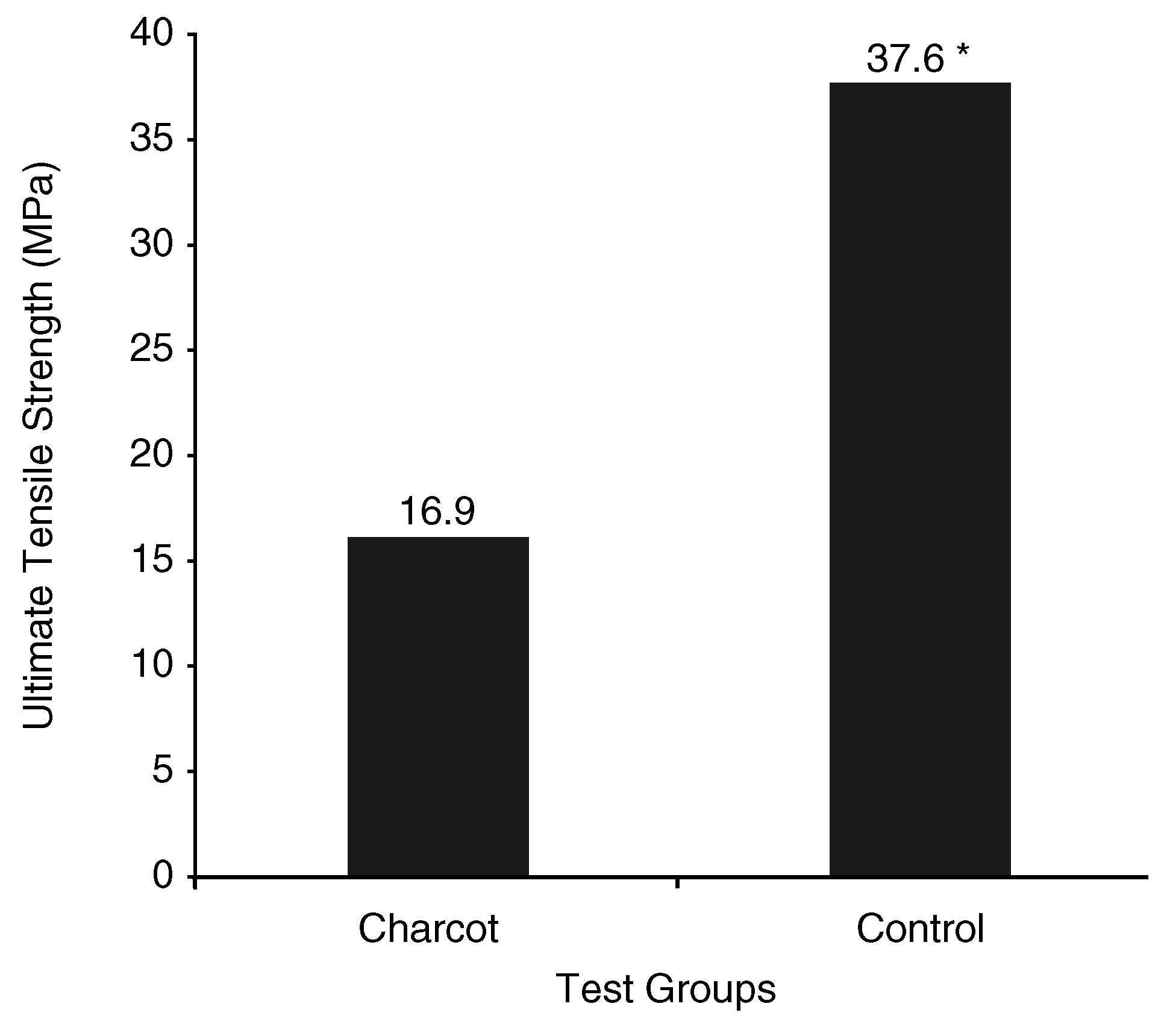
Mechanical evaluation was carried out on the control and Charcot tendon samples. The properties evaluated for each tendon—ultimate tensile strength at break and the Young’s modulus—are shown in
Figure 2 and
Figure 3. There were significant differences between the Charcot group and the controls in both parameters, which were analyzed using the MannWhitney nonparametric statistical test model.
Young’s modulus was calculated using the slope of the elastic portion of the stress/strain curve. The mean ± SD modulus value for the Charcot group (79.5 ± 48.1 MPa) was significantly lower than that for the controls (271.5 ± 86.2 MPa) (
Figure 2). Comparing the tensile strength of the tendons at break, the Charcot group (16.9 ± 11.2 MPa) had a significantly lower mean ± SD value than the control group (37.6 ± 28.3 MPa) (
Figure 3).
Discussion
The results of this research can be correlated with findings from previous investigations that reveal significant physical and functional changes in the tendons of patients with Charcot’s diabetic foot. [
4,
5,
6,
7] Physical changes were evident in the previous study that demonstrated electron microscopic evidence of the cross-linkage of collagen fibers evident in the diabetic Charcot Achilles tendon. [
4] Although the cause of these changes remains unproved, an increasing number of researchers suggest that nonenzymatic glycosylation may be the cause. [
4,
5,
7,
8,
9]
A study [
10] documenting functional changes compared ankle joint range of motion between diabetic patients with neuropathy and age-matched controls. The study showed less dorsiflexion at the ankle in diabetic neuropaths than in controls (
P < .001). Interestingly, stiffness of passive motion was not found to be present. The authors suggested that the results indicate that diabetic patients with neuropathy have “short” plantar flexor muscles. This was seen as a “decreased excursion (length change capability) of the plantarflexor muscle groups.” They suggested that this may imply that stretching exercises of the plantar flexor muscles in this population are futile to accomplish lengthening.
We can extrapolate these experimental results to patients with Charcot’s diabetic foot because they can help explain this phenomenon. First, the decreased elasticity of the Achilles tendon found in this investigation would manifest itself initially as the equinus deformity that is a constant finding in the diabetic neuropathic Charcot foot. Second, the decreased tensile strength of the tendon, which is composed of collagen bundles, can be seen clinically in Charcot’s foot as a ligament failure. Ligaments are also composed of the same fibers (collagen) as the Achilles tendon. Midfoot (Lisfranc’s) joints are held together primarily ligamentously. Here, decreased tensile strength of collagen can result in failure of Lisfranc’s and other ligaments, with resultant fracture dislocation of midfoot joints of an insensate foot subjected to severe equinus forces.
Finally, a study [
9] investigated the role of collagen in determining bone mechanical properties. To our knowledge, this is the first study to demonstrate a direct relationship between the integrity of the bone collagen network and the mechanical integrity of the bone. When bone collagen was denatured by heat, bone toughness at first minimally decreased. Then, with denaturing of 60% of bone collagen, accelerated bone denaturation occurred. Bone can be described as natural composite material, composed of a hard mineral phase (hydroxyapatite) and a collagen matrix (90% type 1 collagen). [
8,
9] Additional studies [
11] link the orientation of collagen fibers to mechanical properties of bone. Increased age has been shown to correlate with decreases in bone toughness, along with collagen denaturation and cross-links. [
9,
11] Bone with denatured collagen demonstrates markedly decreased toughness and increased susceptibility to fracture. In diabetic patients with Charcot’s foot, the pathologic fractures may represent this loss of toughness due to collagen pathology from glycosylation.
Conclusion
The Achilles tendon remains the most powerful deforming force in the foot when pathologically shortened. In nondiabetic patients, a short Achilles segment produces the physical pathologies of overpronation compensation, including digital and metatarsal deformities, with attendant painful symptoms (corns and calluses); collapse of the long arch and, eventually, degenerative joint disease ensue. In the diabetic population with peripheral neuropathy, short Achilles tendons are consistently seen in conjunction with diabetic ulceration and Charcot’s arthropathy.
This study adds pathologic elasticity and tensile strength to the previous electron microscopic findings of altered collagen structure found in the Achilles tendons of patients with Charcot’s foot. The increasing evidence of Achilles tendon pathology in this diabetic population suggests that a new clinical entity can be proposed at this time to reflect these findings.
Equinus has been described as being caused by tightness of the gastrocnemius and/or the soleus muscle. We propose that a new entity, diabetic tendo Achillis equinus, be added to the medical vocabulary as the proper descriptor for a mechanism that seems to be closely associated with aberration of motion secondary to altered tissue ultrastructure, resulting in alteration of normal strength and elasticity. The relationship of altered collagen of tendon, ligament, and bone requires further investigation as the etiology of diabetic Charcot’s neuroarthropathy.