Melorheostosis, from the Greek words
melo (member) and
rhein (flow),[
1–
3] is a rare, nonhereditary disorder of unknown etiology causing hyperostosis.[
4,
5] The extracortical areas of long and short bones are primarily affected, with the skull, spine, and ribs least commonly affected.[
1] The earliest evidence of this condition dates to nearly 1,500 years ago, when a prehistoric skeleton was discovered in Alaska.[
6,
7] Lester[
7] reports the finding of this skeleton in an Ipiutak burial ground in Point Hope, Alaska. Of primary significance was the identification of a solid column of bone on the lateral side of the right fibula. Roentgenograms revealed the column of bone to be dense, irregular cortical bone on one side of the diaphysis with the “flowing candle wax” appearance commonly seen with melorheostosis.
The condition was first described in 1922 by Léri and Joanny.[
8] In 1987, Werner and Scheimer[
9] reported approximately 300 cases of melorheostosis. In 1996, Moreno Alvarez et al[
4] reported over 200 cases, with 17 of those presenting with linear sclerodermatous changes.
Clinically, the skin and subcutaneous tissues may be affected by fibrosis.[
2,
10] This results in joint contracture, stiffness, and pain. It is not uncommon to see flexion contractures of the hip and knee, tight Achilles tendon, equinovarus foot deformity, varus and valgus foot deformities, and overlapping, curved, or swollen toes.[
9,
11,
12] A thickened or contracted plantar fascia,[
11,
12] rearfoot varus, genu valgum, and limb-length discrepancy may also be present.[
9,
11] In children, the most common presenting complaint is not pain, but joint stiffness and limb-length discrepancy with possible angular deformities.[
13]
Radiographically, extracortical hyperostosis is seen. Because this hyperostotic condition can resemble dripping, melting wax,[
14–
17] the term
flowing hyperostosis has also been applied.[
1,
10] This waxy appearance is more common in adults, while children generally present with a streakiness of the long bones or a spotted or patchy hyperostosis.[
3] The condition is considered monostotic if it affects only one bone, monomelic if it affects one limb, and polyostotic if it involves multiple bones.[
18] Melorheostosis is usually unilateral, but bilateral involvement and involvement of more than one extremity on the same side can occur.[
2,
10] A study of 14 children by Younge et al[
3] reported endosteal sclerosis evident as streakiness on radiographs, as well as mottling or patchy hyperostosis.
Many different bone conditions can mimic the radiographic presentation of melorheostosis, but melorheostosis can present concomitantly with these other conditions. Osteopoikilosis can present as patchy or spotted sclerotic densities similar to the presentation of melorheostosis in a child. Osteopetrosis is a hereditary disorder that manifests as excessive calcification of bones with a marble-like appearance.[
5] Other conditions that must be ruled out include arthrogryposis multiplex congenita (increased density in the metaphysis), isolated bone callus from a healed fracture, osteopathia striata (Voorhoeve’s disease), scleroderma, neurofibromatosis, hemangiomas, tuberous sclerosis, dysplasia epiphysealis hemimelica, and hypertrophic osteoarthropathy.[
2,
5,
11,
13,
19]
Various etiologies have been proposed, including congenital causes as well as infectious, neurologic, hereditary, vascular, and inflammatory disorders.[
5,
9] None have been proven, but the pathogenesis suggests a failure in intramembranous and, to a lesser extent, endochondral ossification.[
18] In 1968, Campbell et al[
1] proposed a congenital theory in which the disease began early in embryonic life prior to formation of limb buds. In 1979, Murray and McCredie[
20] suggested that melorheostosis was caused by a sclerodermal abnormality.[
21] This meant that areas of bone innervated by a spinal sensory nerve might have been injured, resulting in “bone scarring” along its distribution.[
18]
Conservative therapy includes passive and active manipulation and serial casting. The children in the study of Younge et al[
3] showed resistance to such treatment. Surgical treatments range from soft-tissue releases and lengthenings to osteotomies, fusions, epiphysiodesis, and amputation. Because of fibrotic changes in the skin and subcutaneous tissues, these tissues do not stretch with growth of the limb, and deformity usually recurs. Therefore, complete tenotomies supplemented with bracing during periods of growth are recommended. These procedures may also be performed once the child reaches skeletal maturity.
Case Report
A 10-year-old boy, accompanied by his parents, presented to the pediatric orthopedic clinic at the University of California, San Francisco. The size difference between his two feet, with the right being shorter and smaller than the left, was the primary concern. According to his parents, his feet were the same size at birth, with the size difference noted when the boy was about 3 years old. No treatment was sought at that time. By the time he was 9 years old, finding appropriate footwear was problematic. His shoe size was 6 on the left and 4 on the right. The child reported no pain, stiffness, or difficulty in walking. He stated that his back bothered him on occasion but that the discomfort never interfered with his activities.
The birth history revealed a full-term, vaginal birth. The boy began walking at age 12 months, and all other milestones occurred on time. A toe crossover involving the right third metatarsal over the second was present at birth. The child had no illnesses or allergies, was not taking any medications, and had no prior hospitalizations.
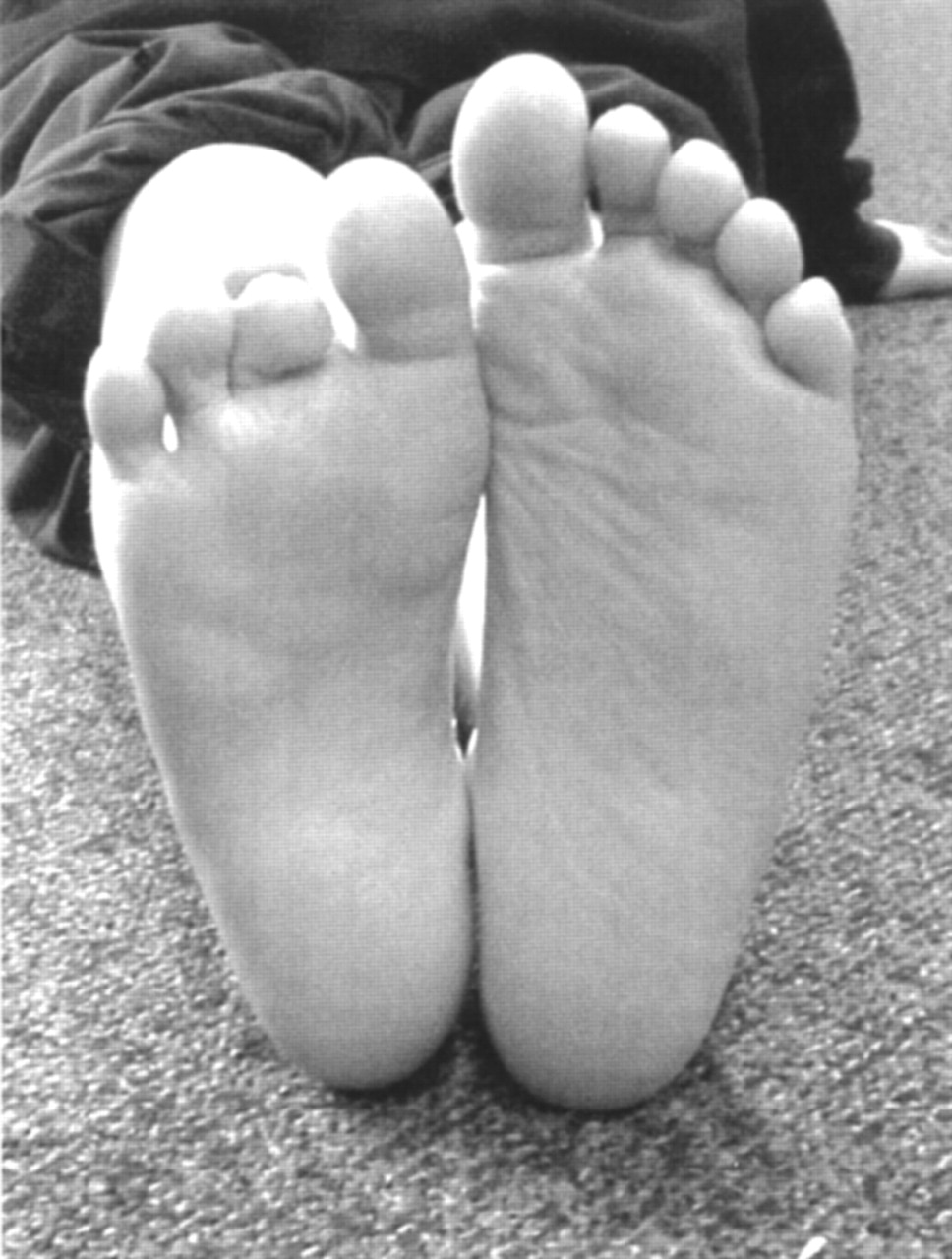
Examination of the right foot showed that it was shorter than the left by 1.25 inches (Fig. 1
) and a crossover involving the third toe was present. There was decreased subtalar joint range of motion in both pronation and supination and a gastrocnemius equinus of less than 5°. The foot was in a supinated position with a cavus arch and an elevated heel upon weightbearing. A mild flexion contracture was noted at the knee, which was unable to fully extend. Hip flexion and extension were within normal limits. The right hip was lower than the left; when measured with wood blocks under the right foot, it evened out at
1/8 inch. A forefoot valgus deformity of 2° to 3° was observed bilaterally.
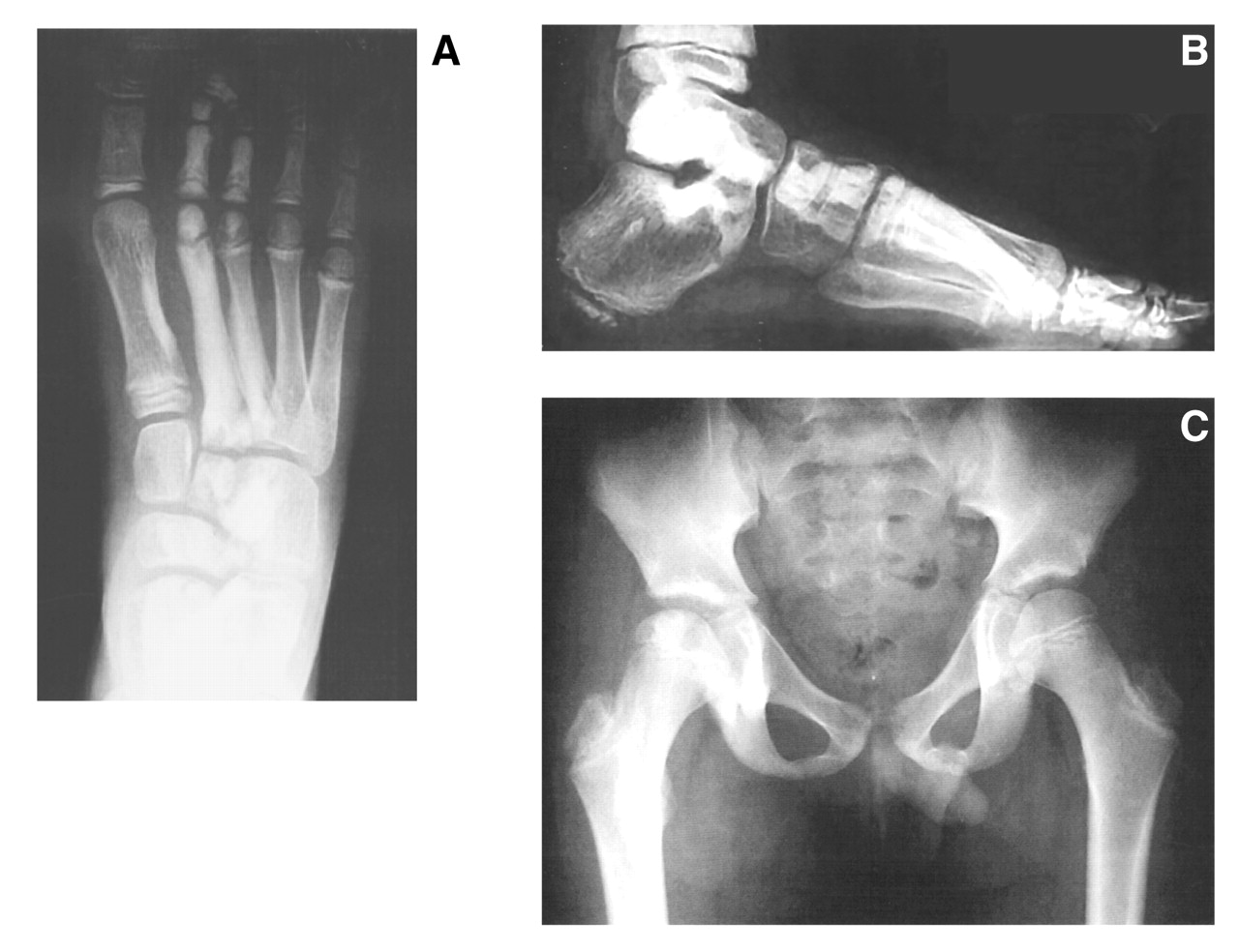
Radiographs of both feet were obtained, which showed sclerosing changes involving the metatarsals and lesser tarsal area on the right side (Fig. 2A and B
). Radiographs of the hips and legs showed sclerosing changes in a linear distribution (streaking, not flowing) in the right lower extremity. Involved structures were the ischium; femoral head, neck, and diaphysis (Fig. 2C
); and fibular diaphysis and epiphysis. The right and left upper extremities, left lower extremity, and spine were normal.
Figure 1 .
Photograph showing size difference between right and left feet.
Figure 1 .
Photograph showing size difference between right and left feet.
Figure 2 .
Anteroposterior (A) and lateral (B) radiographs showing increased sclerosis in multiple metatarsal and tarsal bones. C, Anteroposterior radiograph of the pelvis showing increased sclerosis in the ischium and femur on the right side.
Figure 2 .
Anteroposterior (A) and lateral (B) radiographs showing increased sclerosis in multiple metatarsal and tarsal bones. C, Anteroposterior radiograph of the pelvis showing increased sclerosis in the ischium and femur on the right side.
Magnetic resonance imaging of the spine was ordered to rule out any impingement of the cord that might be contributing to the cavus and equinus deformity. The results were negative, although a mild spina bifida occulta at the S1 segment was considered an incidental finding. A genetics consultation was ordered, which with subsequent testing revealed no known genetic disorders. The genetics specialists offered a provisional diagnosis of melorheostosis versus dysplasia epiphysealis hemimelica, both of which are nonhereditary conditions.
The child was given an initial prescription for custom-molded supramalleolar orthoses with a 1/8-inch lift (entire length of shoe) on the right. The child had multiple physical therapy sessions and serial casting of his right knee and ankle to increase extension and dorsiflexion, respectively. He continued a home physical therapy program implemented to compensate for anticipated further tightening and contracture due to future growth spurts. Although both contractures improved somewhat, a gastrocnemius recession was performed to bring the heel to the ground. A new supramalleolar orthosis, molded to the new foot position, with a 1/8-inch lift and a 3° forefoot valgus post was dispensed. No surgeries have yet been planned for the hamstrings of the knee or the crossover toe deformity. An epiphysiodesis for limb-length discrepancy is not indicated in cases where the discrepancy is less than 2 cm.
Discussion
A good correlation exists between the findings in this case presentation and the literature on melorheostosis. The child had all of the classic findings of joint stiffness and contracture, foot deformities, and radiographic changes. The radiographs revealed a streaking, sclerosing, hyperostotic appearance rather than the flowing, waxy pattern common in adults. Typically, contracture, stiffness, or deformity, rather than pain, is the presenting symptom.
Although neurologic manifestations have led to a proposed neurogenic origin of melorheostosis, the mild spina bifida occulta found on magnetic resonance imaging in this case was considered incidental, as no clinical evidence of spina bifida was observed on the lower back. Nevertheless, it is possible that this finding was related to the condition.
Clinicians should maintain a high index of suspicion for melorheostosis when evaluating a child with joint stiffness, contracture, or deformity. Greater awareness of the disorder and its manifestations could result in recognition of a higher incidence of melorheostosis than is currently reported in the literature.