

Cooling the Foot to Prevent Diabetic Foot Wounds. A Proof-of-Concept Trial
Abstract
Research Design and Methods
Results
Discussion
Conclusion
References
- WORLD HEALTH ORGANIZATION: Diabetes estimates and projections [World Health Organization Web site]. Available online: http://www.who.int/ncd/dia/database4.htm (accessed on 14 October 2003).
- HUSE, D.M.; OSTER, G.; KILLEN, A.R.; et al. The economic costs of non-insulin-dependent diabetes mellitus. JAMA 1989, 262, 2708. [Google Scholar] [CrossRef]
- ARMSTRONG, D.G.; LAVERY, L.A.; QUEBEDEAUX, T.L.; et al. Surgical morbidity and the risk of amputation due to infected puncture wounds in diabetic versus nondiabetic adults. South Med J 1997, 90, 384. [Google Scholar] [CrossRef] [PubMed]
- PECORARO, R.E.; REIBER, G.E.; BURGESS, E.M. Pathways to diabetic limb amputation: basis for prevention. Diabetes Care 1990, 13, 513. [Google Scholar] [CrossRef]
- REIBER, G.E.; PECORARO, R.E.; KOEPSELL, T.D. Risk factors for amputation in patients with diabetes mellitus: a case control study. Ann Intern Med 1992, 117, 97. [Google Scholar] [CrossRef]
- PALUMBO, P.J.; MELTON, L.J. “Peripheral Vascular Disease and Diabetes,” in Diabetes in America,; Harris, M.I., Hamman, R.F., Eds.; National Institutes of Health: Bethesda, MD, 1985. [Google Scholar]
- BRAND PW: “The Diabetic Foot,” in Diabetes Mellitus: Theory and Practice,, 3rd Ed; Ellenberg, M., Rifkin, H., Eds.; Medical Examination Publishing: New York, 1983; p. 803. [Google Scholar]
- BRAND PW: “The Insensitive Foot (Including Leprosy),” in Disorders of the Foot and Ankle,, 2nd Ed; Jahss, M., Ed.; WB Saunders: Philadelphia, 1991; p. 2170. [Google Scholar]
- BRAND PW: “Other Insensitive Foot Types Similar to Diabetes,” in Management of the Diabetic Foot; Ma, B., Ed.; Williams & Wilkins: Baltimore, 1987. [Google Scholar]
- MANLEY, M.T.; DARBY, T. Repetitive mechanical stress and denervation in plantar ulcer pathogenesis in rats. Arch Phys Med Rehabil 1980, 51, 171. [Google Scholar]
- ARMSTRONG DG: Infrared dermal thermometry: the foot and ankle stethoscope. J Foot Ankle Surg 1998, 37, 75. [CrossRef]
- ARMSTRONG, D.G.; LAVERY, L.A.; LISWOOD, P.J. ET AL: Infrared dermal thermometry for the high-risk diabetic foot. Phys Ther 1997, 77, 169. [Google Scholar] [CrossRef] [PubMed]
- ARMSTRONG, D.G.; LAVERY, L.A. Monitoring neuropathic ulcer healing with infrared dermal thermometry. J Foot Ankle Surg 1996, 35, 335. [Google Scholar] [CrossRef] [PubMed]
- ARMSTRONG, D.G.; LAVERY, L.A. Monitoring healing of acute Charcot’s arthropathy with infrared dermal thermometry. J Rehabil Res Dev 1997, 34, 317. [Google Scholar]
- LAVERY, L.A.; HIGGINS, K.R.; HOLGUIN, D.; et al. Home skin temperature monitoring reduces the incidence of diabetic foot complications. Diabetes 2002, 51 (suppl 1), 1039–P. [Google Scholar]
- GABAY C, KUSHNER I: Acute-phase proteins and other systemic responses to inflammation. N Engl J Med 1999, 340, 448. [CrossRef]
- JURKOVICH, G.J.; PITT, R.M.; CURRERI, P.W. ET AL: Hypothermia prevents increased capillary permeability following ischemia-reperfusion injury. J Surg Res 1988, 44, 514. [Google Scholar] [CrossRef] [PubMed]
- TISHERMAN, S.A.; RODRIGUEZ, A.; SAFAR, P. Therapeutic hypothermia in traumatology. Surg Clin North Am 1999, 79, 1269. [Google Scholar] [CrossRef] [PubMed]
- BELITSKY, R.B.; ODAM, S.J. HUBLEY-KOZEY C: Evaluation of the effectiveness of wet ice, dry ice, and cryogenic packs in reducing skin temperature. Phys Ther 1987, 67, 1080. [Google Scholar] [CrossRef]
- CHESTERTON, L.S.; FOSTER, N.E.; ROSS, L. Skin temperature response to cryotherapy. Arch Phys Med Rehabil 2002, 83, 543. [Google Scholar] [CrossRef] [PubMed]
- KIRKWOOD BR: Essentials of Medical Statistics; Blackwell, Oxford, 1988.
- BAZZETT HC: The effect of heat and cold on the blood volume and circulation. JAMA 1938, 111, 1841. [CrossRef]
- MORSI E: Continuous-flow cold therapy after total knee arthroplasty. J Arthroplasty 2002, 17, 718. [CrossRef]
- YOUNG, A.J.; SAWKA, M.N.; EPSTEIN, Y. ET AL: Cooling different body surfaces during upper and lower body exercise. J Appl Physiol 1987, 63, 1218. [Google Scholar] [CrossRef]
- SAWADA, S.; ARAKI, S.; YOKOYAMA, K. Changes in cold-induced vasodilatation, pain and cold sensation in fingers caused by repeated finger cooling in a cool environment. Ind Health 2000, 38, 79. [Google Scholar] [CrossRef][Green Version]
- FEIGIN, V.; ANDERSON, N.; GUNN, A. ET AL: The emerging role of therapeutic hypothermia in acute stroke. Lancet Neurol 2003, 2, 529. [Google Scholar] [CrossRef]
- DALTON DIETRICH, W.; KULUZ, J.W. New research in the field of stroke: therapeutic hypothermia after cardiac arrest. Stroke 2003, 34, 1051. [Google Scholar] [CrossRef] [PubMed][Green Version]
- MONTANER J: Editorial comment: cooling matrix metalloproteinases to improve thrombolysis in acute ischemic stroke. Stroke 2003, 34, 2171. [CrossRef][Green Version]
- KABON, B.; BACHER, A. SPISS CK: Therapeutic hypothermia. Best Pract Res Clin Anaesthesiol 2003, 17, 551. [Google Scholar]
- JIAN, S.; YONGMING, Q.; ZHIHUA, C. ET AL: Feasibility and safety of moderate hypothermia after acute ischemic stroke. Int J Dev Neurosci 2003, 21, 353. [Google Scholar] [CrossRef]
- YENARI, M.A.; ZHAO, H.; GIFFARD, R.G. ET AL: Gene therapy and hypothermia for stroke treatment. Ann N Y Acad Sci 2003, 993, 54. [Google Scholar] [CrossRef]
- Krieger, D.W.; De Georgia, M.A.; Abou-Chebl, A.; et al. Cooling for acute ischemic brain damage (cool aid): an open pilot study of induced hypothermia in acute ischemic stroke. Stroke 2001, 32, 1847. [Google Scholar] [CrossRef] [PubMed]
- HALE, S.L.; KLONER, R.A. Myocardial hypothermia: a potential therapeutic technique for acute regional myocardial ischemia. J Cardiovasc Electrophysiol 1999, 10, 405. [Google Scholar] [CrossRef] [PubMed]
- FELBERG, R.A.; KRIEGER, D.W.; CHUANG, R. ET AL: Hypothermia after cardiac arrest: feasibility and safety of an external cooling protocol. Circulation 2001, 104, 1799. [Google Scholar] [CrossRef]
- DIXON, S.R.; WHITBOURN, R.J.; DAE, M.W.; et al. Induction of mild systemic hypothermia with endovascular cooling during primary percutaneous coronary intervention for acute myocardial infarction. J Am Coll Cardiol 2002, 40, 1928. [Google Scholar] [CrossRef]
- FRYKBERG, R.G.; LAVERY, L.A.; PHAM, H. ET AL: Role of neuropathy and high foot pressures in diabetic foot ulceration. Diabetes Care 1998, 21, 1714. [Google Scholar] [CrossRef]
- ARMSTRONG, D.G.; BOULTON, A.J. Continuous Internet-based activity monitoring provides a surrogate marker for nocturnal polyuria in persons with diabetes mellitus at high risk for foot ulceration. Diabet Med 2002, 19, 1034. [Google Scholar] [CrossRef] [PubMed]
- ARMSTRONG, D.G.; LAVERY, L.A.; KIMBRIEL, H.R.; et al. Activity patterns of patients with diabetic foot ulceration: patients with active ulceration may not adhere to a standard pressure off-loading regimen. Diabetes Care 2003, 26, 2595. [Google Scholar] [CrossRef]
- ARMSTRONG, D.G.; NGUYEN, H.C.; LAVERY, L.A. ET AL: Offloading the diabetic foot wound: a randomized clinical trial. Diabetes Care 2001, 24, 1019. [Google Scholar] [CrossRef] [PubMed]
- ARMSTRONG, D.G.; LAVERY, L.A.; VAZQUEZ, J.R.; et al. Clinical efficacy of the first metatarsophalangeal joint arthroplasty as a curative procedure for hallux interphalangeal joint wounds in persons with diabetes. Diabetes Care 2003, 26, 3284. [Google Scholar] [CrossRef] [PubMed]
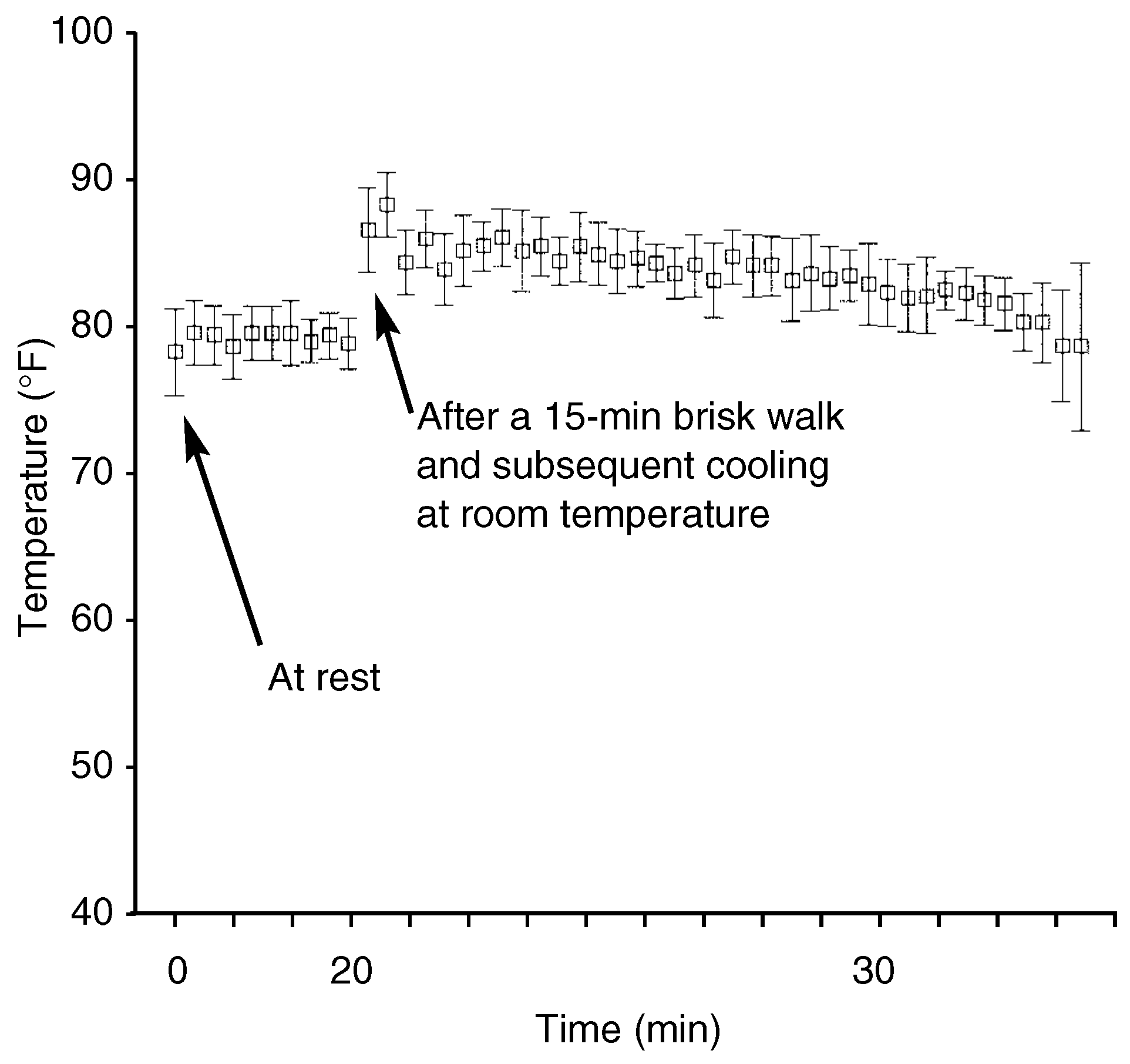
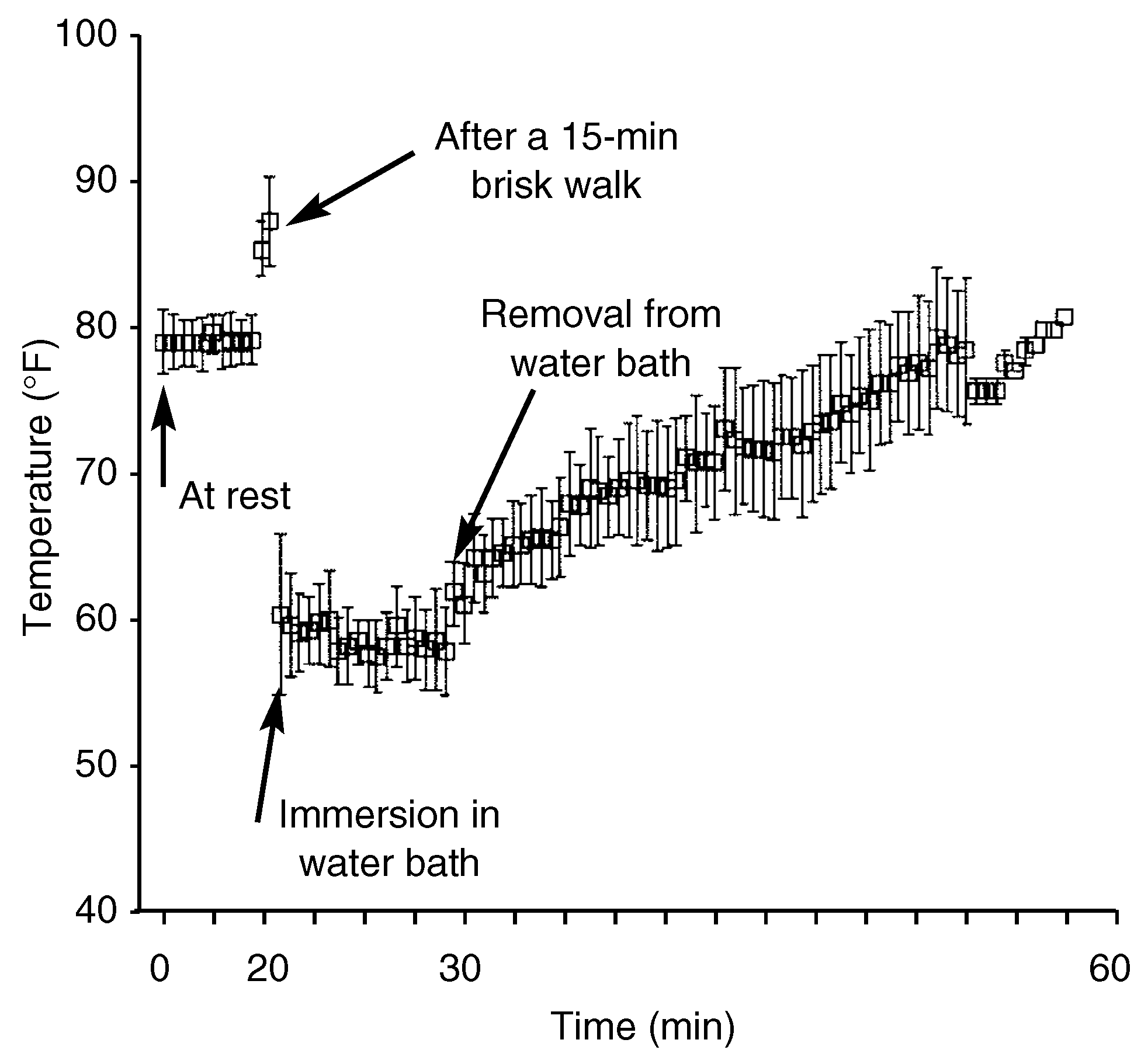
© 2005 American Podiatric Medical Association
Share and Cite
Armstrong, D.G.; Sangalang, M.B.; Jolley, D.; Maben, F.; Kimbriel, H.R.; Nixon, B.P.; Cohen, I.K. Cooling the Foot to Prevent Diabetic Foot Wounds. A Proof-of-Concept Trial. J. Am. Podiatr. Med. Assoc. 2005, 95, 103-107. https://doi.org/10.7547/0950103
Armstrong DG, Sangalang MB, Jolley D, Maben F, Kimbriel HR, Nixon BP, Cohen IK. Cooling the Foot to Prevent Diabetic Foot Wounds. A Proof-of-Concept Trial. Journal of the American Podiatric Medical Association. 2005; 95(2):103-107. https://doi.org/10.7547/0950103
Chicago/Turabian StyleArmstrong, David G., Melinda B. Sangalang, David Jolley, Frank Maben, Heather R. Kimbriel, Brent P. Nixon, and I. Kelman Cohen. 2005. "Cooling the Foot to Prevent Diabetic Foot Wounds. A Proof-of-Concept Trial" Journal of the American Podiatric Medical Association 95, no. 2: 103-107. https://doi.org/10.7547/0950103
APA StyleArmstrong, D. G., Sangalang, M. B., Jolley, D., Maben, F., Kimbriel, H. R., Nixon, B. P., & Cohen, I. K. (2005). Cooling the Foot to Prevent Diabetic Foot Wounds. A Proof-of-Concept Trial. Journal of the American Podiatric Medical Association, 95(2), 103-107. https://doi.org/10.7547/0950103

