Freiberg’s infraction is a relatively rare osteochondrosis that manifests in the metatarsal heads. An osteochondrosis is a disturbance of osteogenesis and chondrogenesis in a region of skeletal growth involving an epiphysis or an apophysis. This condition was originally described in 1914 by Freiberg,[
1] who presented six cases of infraction of the second metatarsal head that he attributed to trauma, hence the term
infraction. This entity has also been called Köhler’s second disease, Panner’s disease, eggshell fracture, metatarsal flat head, metatarsal epiphysitis, osteochondritis deformans metatarsojuvenilis, juvenile metatarsophalangeal osteochondritis, and malakopathy.[
2] Gauthier and Elbaz[
3] found that the second metatarsal head is involved 68% of the time and is by far the most commonly affected metatarsal. The third metatarsal is involved in 27% of cases, and bilateral involvement is present in 6.6% of cases. This disease is more common in females, with onset typically during the teenage years.
Case Report
A 24-year-old woman presented to Arizona Foot Specialists, Tucson, with a history of progressively worsening pain in the right forefoot region during the past 2 to 3 years. She denied a history of trauma to the foot. The pain had not improved with conservative measures, such as shoe modifications and anti-inflammatory medications. On examination, the right second metatarsophalangeal joint was limited to 15° of dorsiflexion, with a bony block at the end of the range of motion that was fairly painful. The enlarged metatarsal head was palpable and tender dorsally and plantarly. The dorsal ledge of the base of the proximal phalanx was prominent. No significant swelling or callous deformities were noted. Radiographs revealed flattening of the metatarsal head, with dorsal subluxation of the base of the proximal phalanx on the metatarsal head.
We elected to perform a hemi-implant procedure for this joint because of the patient’s eagerness to return to her previous activity level. Postoperatively, the patient was limited to partial weightbearing in a surgical shoe, with gradual transition to athletic shoes over 2 to 3 weeks. Several months after the procedure, her joint range of motion had improved to approximately 45° of dorsiflexion. The patient did not have any pain at the surgical site, and she had no activity limitations.
Etiology
The exact etiology of Freiberg’s disease remains a mystery, but trauma and vascular compromise are the most popular theories. Other etiologic factors include infection, embolic obstruction, biomechanics (rigidity of central rays), shoes, and constitutional factors such as hormonal abnormalities, growth disturbances, and family history; many clinicians believe that the etiology is multifactorial.[
4,
5] Stanley et al[
6] conducted a study of the etiologic factors of Freiberg’s disease in a group of 31 females aged 11 to 18 years. They found that the dominant foot was involved 36% of the time, the disorder coincided with trauma only 15% of the time, an equal number of the subjects were very active as were inactive, none of the subjects wore high-heeled shoes, and most subjects did not have any increased pressure of the metatarsal head (76%). The longest metatarsal was predominantly affected 85% of the time.
Clinical Symptoms
Patients with Freiberg’s disease present with symptoms that may be suggestive of other foot problems. The appearance of such symptoms in an adolescent girl should raise suspicion for Freiberg’s disease. Patients are likely to have localized pain of the forefoot centered at the affected joint that may or may not coincide with a traumatic event. Pain is usually exacerbated with weightbearing, with pain likely to occur on palpation and range of motion of the affected joint. Effusion may surround the involved joint. Differential diagnoses include metatarsal stress fracture, metatarsophalangeal joint synovitis/capsulitis, extensor or flexor tendinitis, metatarsophalangeal joint collateral ligament injury, metatarsalgia/overload, fracture or dislocation, juvenile rheumatoid arthritis or Still’s disease, and inflammatory periostitis.[
7,
8]
Conservative Care
Omer[
9] described two phases of conservative treatment for osteochondrosis in general: an initial phase of protected mobilization followed by a phase of gradual return to functional activity. Some authors[
10–
15] advise cast immobilization with or without the aid of crutches in the acute phase and a reduction in activity. Immobilization is often followed by the application of padding or various orthoses. Other conservative options include local injections, nonsteroidal anti-inflammatory drugs, and physical therapy.[
8,
13,
16–
18] There is no consensus as to the most appropriate conservative care for this entity.
Radiographic Assessment
The pathologic staging system for Freiberg’s disease developed by Smillie[
19] consists of five stages. The first stage involves a fissure fracture of the epiphysis. The contour of the articular surface is altered in stage 2. In stage 3, the central portion of the articular surface sinks into the head after further resorption. The plantar articular cartilage remains intact. In stage 4, a loose body forms. Stage 5 involves an arthritis with flattening and deformity of the metatarsal head.
Surgical Care
There is no consensus regarding the surgical treatment of this condition, with numerous procedures reported in the literature. Freiberg,[
1] in his original article, described the removal of loose bodies in the affected joint. Smillie[
15] described elevating the depressed articular fragment with a cancellous bone graft. Some authors[
20,
21] have suggested resection of the metatarsal head or the base of the proximal phalanx. Gauthier and Elbaz[
3] described a dorsiflexion osteotomy of the metatarsal head. Kaplan and Cohen,[
22] in 1976, were the first to describe the use of a double-stemmed Silastic implant (Dow Corning Wright, Arlington, Tennessee) for Freiberg’s disease. More recently, Hayashi et al[
23] described the new surgical technique of osteochondral plug transplantation for late-stage Freiberg’s disease.
Although many of these techniques may be beneficial to the patient, some require a high level of technical expertise or leave limited opportunities for future revision. A surgical procedure that has been commonly used in the first metatarsophalangeal joint for more than 40 years has recently become available for use in the lesser metatarsophalangeal joints. The Biopro titanium hemi-implant (Biopro, Port Huron, Michigan) may allow for resolution of chronic symptoms, and it often restores the range of motion of the affected joint.
Titanium Hemi-implant Technique
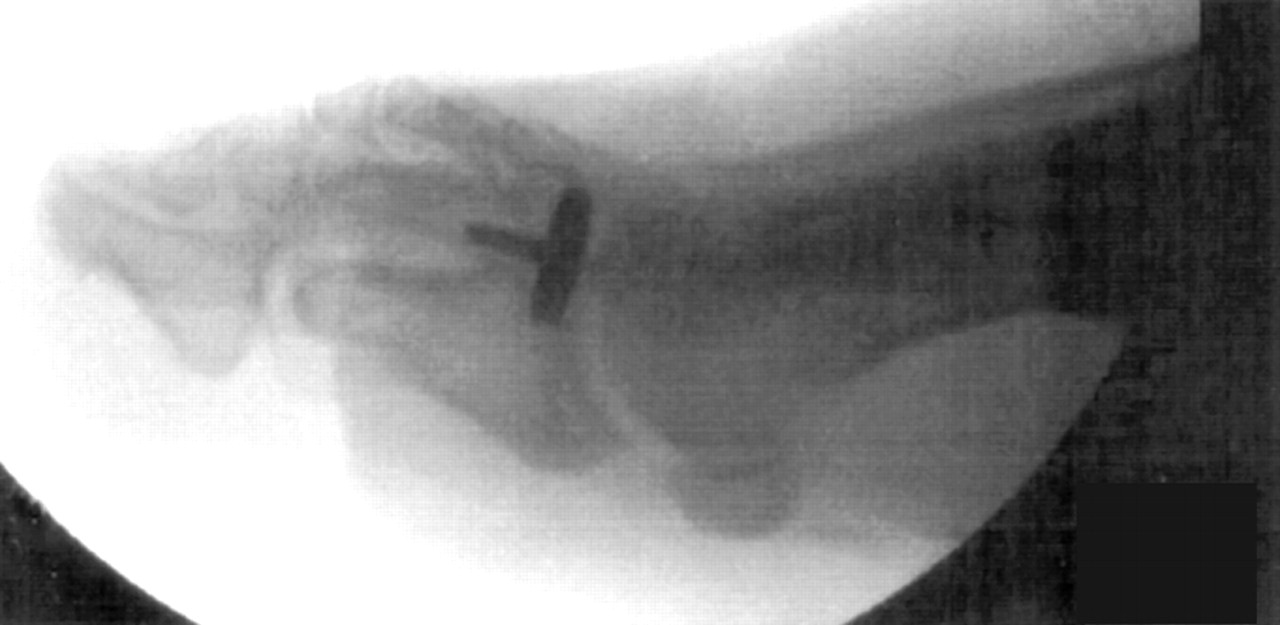
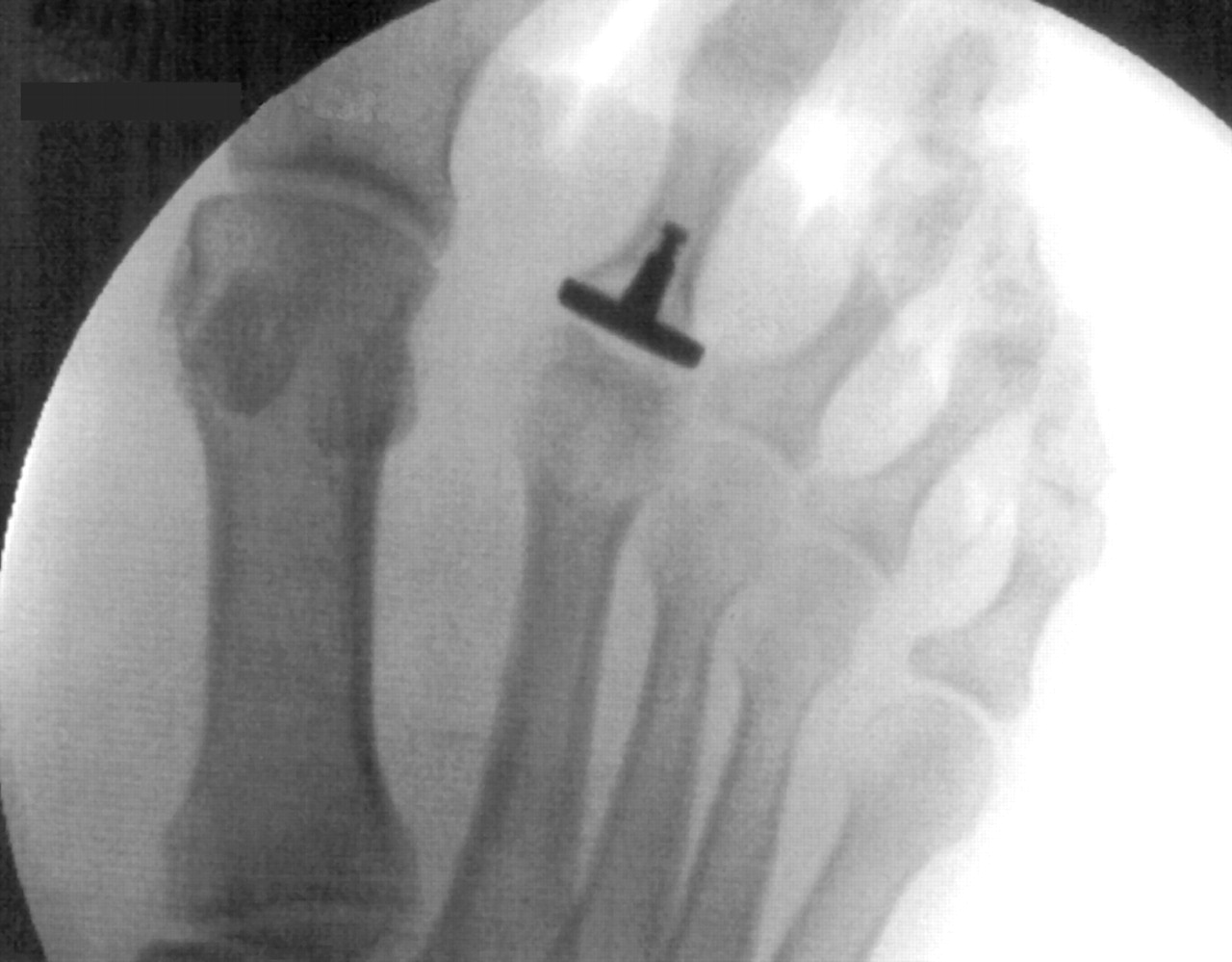
A 3-cm incision is made directly over the metatarsophalangeal joint. Careful dissection is performed to avoid all neurovascular structures. The extensor tendon is identified, mobilized, and retracted laterally. A linear capsular incision is made directly over the center of the metatarsophalangeal joint to allow for visualization and exposure to the medial and lateral aspects of the metatarsal head. Approximately 1 to 2 mm of the base of the proximal phalanx is resected using an oscillating saw. This varies from case to case based on the amount of subluxation of the joint. However, overaggressive resection must be avoided to minimize the loss of intrinsic stability of the joint. An elevator is inserted beneath the metatarsal head to further free soft-tissue adhesions and the flexor plate. On exposure of the metatarsal head, a rotary bur is used to remodel the metatarsal head. The wound area should then be flushed with normal saline. A sizer is used to determine the appropriate-sized implant. A puncher is used to properly place the implant at the phalangeal base. A trial sizer is inserted to assess the fit of the implant. Once the implant sizer is determined to be appropriate, a reamer is tapped into the proximal phalanx. The titanium implant is inserted and is then assessed for an appropriate fit (
Figure 1 and
Figure 2). The capsule and skin are closed, and a light compressive dressing is applied. Patients are limited to partial weightbearing with a postoperative shoe following the procedure, and they may progress to athletic shoes 2 to 3 weeks after surgery.
Discussion
Historically, excision of the affected metatarsal head with or without syndactylization has been advocated; however, this may lead to problems such as progressive hallux valgus, transfer metatarsalgia, and shortening of the toe. Joint replacement, typically with a Silastic implant, requires destruction of the metatarsal and proximal phalanx joint surfaces. The major potential problem is prosthetic failure; other potential difficulties are transfer metatarsalgia, synovitis, and infection. Metatarsal head debridement may preserve length and function but may not restore range of motion. Metatarsal osteotomies may result in malposition, malunion, osteonecrosis, and transfer lesions. Several authors[
3,
24–
26] have suggested that good results can be obtained with many of these procedures, but no single procedure has prevailed as the procedure of choice.
We do not believe that the titanium hemi-implant is necessarily the procedure of choice for the treatment of Freiberg’s disease. There is such variation within this entity, and such a diverse patient population, that advocating a single procedure with little data to support this choice would be unwise. We chose to use this technique to help restore range of motion, correct dorsal subluxation, reduce healing time, and reduce the potential for transfer lesions. We believe that there are insufficient long-term data to determine this technique’s effectiveness and its complication rate. Potential complications may include floating toe, implant loosening, bone resorption, infection, and hardware irritation.
Conclusion
The hemi-implant surgical procedure is relatively simple to perform and may provide significant restoration of joint function and relief of symptoms. This procedure does not alter the metatarsal parabola, thus minimizing the likelihood of transfer lesions, and it allows for more aggressive surgical procedures to be performed in the future. The hemi-implant procedure may also prove to be a viable alternative for a subluxated or dislocated lesser metatarsophalangeal joint. We look forward to further work in this area to assess outcomes associated with this technique.