A common complication following either total loss of the nail plate or trauma to the distal tuft of the great toe is the development of a ski-slope or clubbing deformity primarily involving the distal labial nail fold and occasionally the medial and lateral labial nail folds. [
1] When all three labial nail folds are involved, the great toe has the appearance of a sunken nail within the hypertrophied distal, medial, and lateral labial nail folds. In addition to the resultant cosmetic deformity, pain can occur with ambulation, which is worsened with closed-toed shoes. Although this deformity is commonly seen in practice, little has been written about its surgical treatment.
The only surgical procedures mentioned in the literature for treating this deformity are 1) the terminal Syme amputation, originally credited to Hukill [
2] and revived by Lapidus [
3] (complete excision of the nail plate, matrix, and bed; the distal, medial, and lateral labial nail folds; and the distal half of the distal phalanx); and 2) distal skin plasty, as described by Bouché [
1] (a terminal elliptic incision perpendicular to the distal labial nail fold that advances the dorsal aspect of the distal tuft in a plantar direction, providing relief to the distal labial nail fold from the nail plate), which is a modification of the DuVries [
4] skin plasty (an elliptic incision perpendicular to the medial or lateral labial nail fold that advances the dorsal aspect of the respective nail folds in a plantar direction, providing relief to the nail fold from the nail plate). Although both of these techniques seem to be successful in relieving the pain associated with the distal nail plate protruding into the distal labial nail fold, the cosmetic deformities resulting from these procedures (such as bulbous stump, foreshortened toe, and contour deformity) are of concern.
To our knowledge, there have been no previous publications describing the use of a buried adipofascial flap to correct the ski-slope, sunken-nail deformity in the toe or finger. The reconstruction consists of two procedures in the case of a normal, salvageable toenail and three procedures in the case of a deformed, nonsalvageable toenail. In either scenario, all procedures are performed as a single-stage operation in one surgical session. The first procedure consists of surgical nail plate avulsion and complete germinal nail matrixectomy to permanently remove the deformed, nonsalvageable toenail, as described originally by Quenu [
5] and popularized by Zadik. [
6] This step is not performed when the toenail is normal and salvageable. Second, an adipofascial flap is raised, using the techniques previously described for use in the finger, [
7–
11] from the plantar tuft of the great toe and is based on the terminal branches of the medial digital proper artery and accompanying veins. Finally, the distal phalanx is remodeled to accept the buried adipofascial flap, which is brought from plantar to dorsal and interposed between the dorsal aspect of the distal phalanx and the overlying nail bed.
Case Report
A 23-year-old man was referred to our institute. He complained of a deformed right great toe that had sustained an untreated traumatic crush injury 3 years earlier and multiple attempts at chemical nail matrixectomy [
12] in a 1-year period. The matrixectomies failed to relieve his pain, which occurred when he wore closed-toed or steel-toed shoes and when he walked for prolonged periods; both were required for his work as an air-conditioning and heating installation technician.
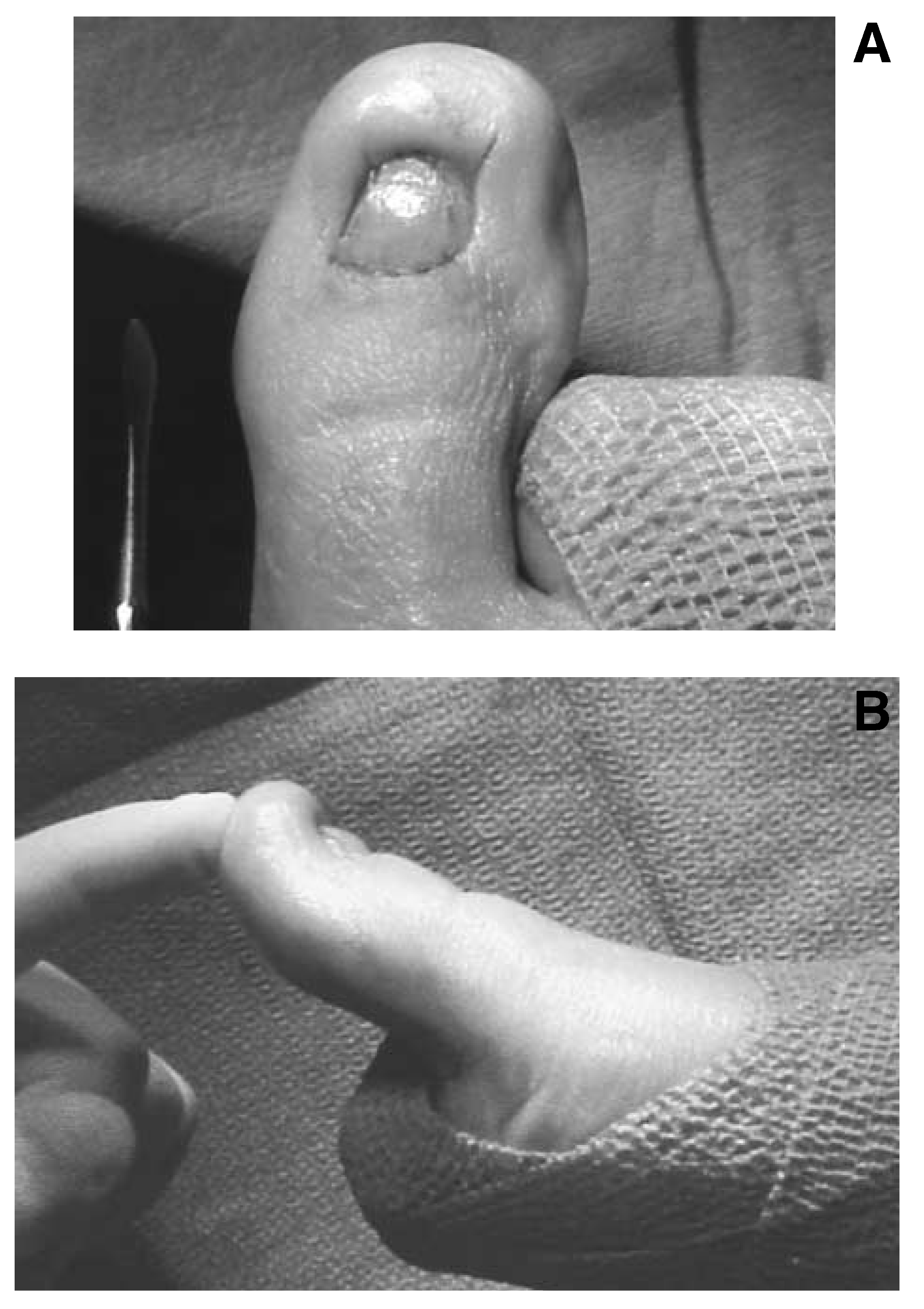
On clinical examination, the great toe nail appeared to have been pushed into the soft tissues of the toe and resembled a sunken nail invaginated within the surrounding labial nail folds. We considered this to be a deformed, nonsalvageable toenail (Fig. 1A
). In addition, the distal labial nail fold was elevated above the level of the terminal nail plate and was unstable in that distal-to-proximal pressure on the labial nail fold, as occurs during normal gait, resulted in a much larger volume of plantar toe pulp being elevated above and into direct contact with the terminal nail plate (
Fig. 1B). [
1] The patient was instructed to wear extra-depth shoes, and a circumferential silicone pad was used to relieve the pressure; however, these modalities failed to provide any measurable relief. The following surgical interventions were discussed: 1) repeated total nail matrixectomy, [
12] 2) distal skin plasty, [
1] 3) terminal Syme amputation, [
2,
3] and 4) reconstruction with a Zadik [
6] matrixectomy and buried adipofascial flap. Owing to his age, occupation, severity of symptoms, and considerably deformed, nonsalvageable toenail, the patient elected surgical reconstruction.
Figure 1.
A, Dorsal view of the right great toe nail demonstrating the sunken-nail appearance and the deformed nail plate. B, Lateral view of the great toe nail with distal-to-proximal pressure being applied demonstrating the unstable ski-slope deformity and the volume of elevated distal labial nail fold relative to the nail plate. The lesser toes have been flexed and secured with adhesive dressings to facilitate great toe dissection without adjacent digit interference.
Figure 1.
A, Dorsal view of the right great toe nail demonstrating the sunken-nail appearance and the deformed nail plate. B, Lateral view of the great toe nail with distal-to-proximal pressure being applied demonstrating the unstable ski-slope deformity and the volume of elevated distal labial nail fold relative to the nail plate. The lesser toes have been flexed and secured with adhesive dressings to facilitate great toe dissection without adjacent digit interference.
Under intravenous sedation and regional field block infiltration of local anesthetic without epinephrine using ankle tourniquet hemostasis, the entire great toe nail plate was avulsed, with great care taken to ensure preservation of the underlying nail bed. A Zadik [
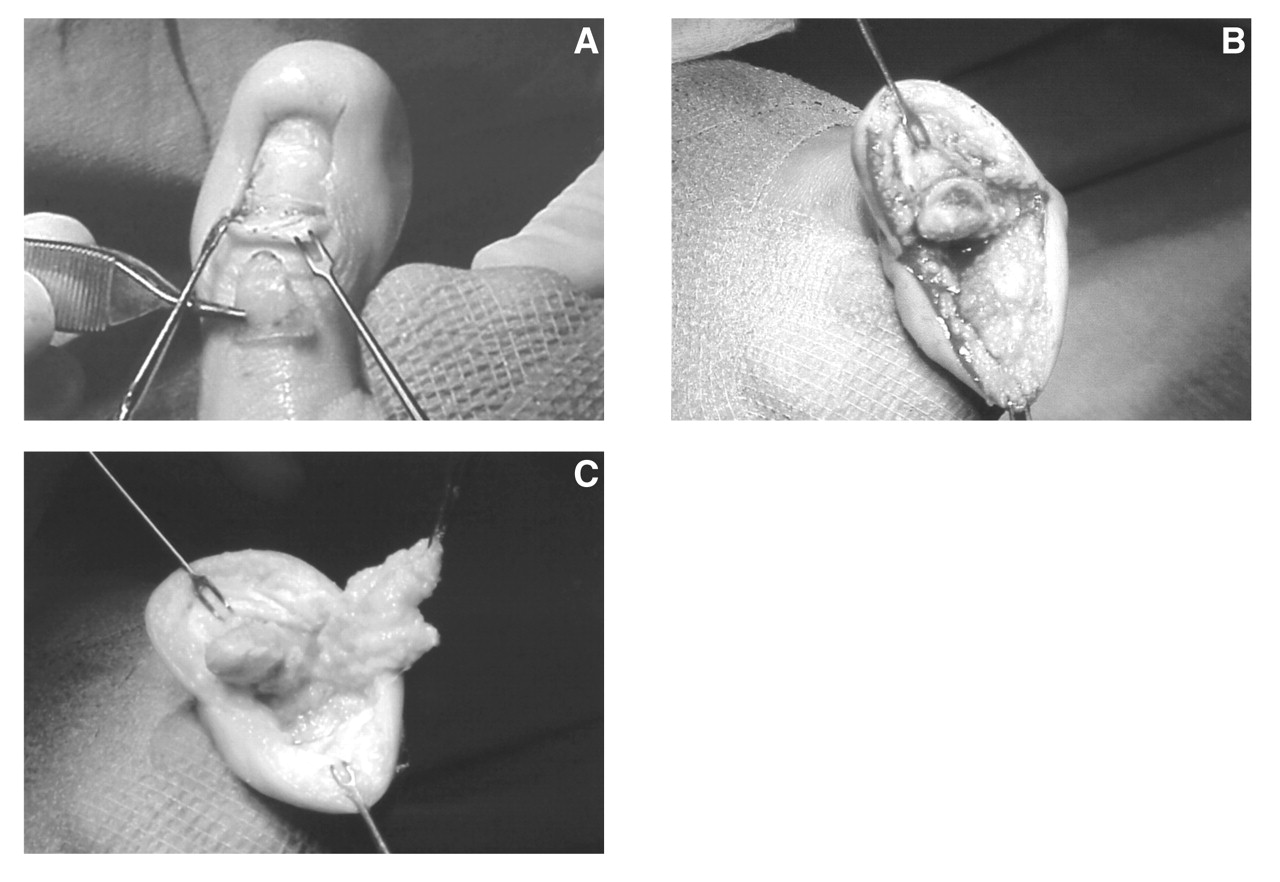
6] matrixectomy was then performed through two incisions made at the medial and lateral margins of the proximal labial nail folds, and the entire width of the proximal eponychium was elevated to expose the underlying germinal nail matrix, which was completely excised; the remaining tissue was subjected to thermal cautery to ensure complete resection of the germinal nail matrix (Fig. 2A
). [
13] Next, a longitudinal incision was made circumferentially around the distal tuft of the great toe, which was dissected down to the distal phalanx, and the resultant dorsal nail bed flap and plantar toe pulp flap were raised full thickness off of the distal phalanx, which was exposed along its distal two-thirds (Fig. 2B
). An adipofascial flap was raised, from lateral to medial, using techniques previously described for use in the finger, [
7–
11] from the central one-third of the plantar tuft of the great toe, making certain that the flap would be large enough to completely cover the dorsal surface of the distal phalanx and the undersurface of the nail bed (Fig. 2C
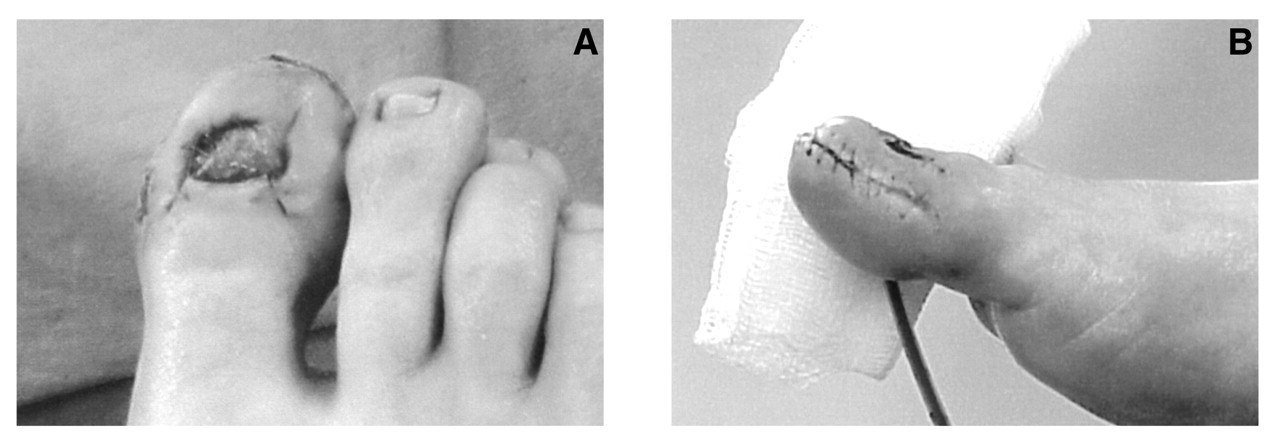
). The adipofascial flap was based on the terminal branches of the medial digital proper artery and accompanying veins, which were identified with a Doppler probe and marked preoperatively. The distal phalanx was then remodeled using power instrumentation, with slightly more bone resected medially than dorsally or laterally to accept the buried adipofascial flap, which had been brought from plantar to dorsal and interposed between the dorsal aspect of the distal phalanx and the overlying nail bed. The tourniquet was deflated, hemostasis was obtained with bipolar cautery, and the viability of the adipofascial flap, dorsal nail bed flap, plantar toe pulp flap, and distal phalanx was assessed, with excellent vascular inflow and lack of venous congestion being readily apparent. The adipofascial flap was sutured to the periosteum along the lateral aspect of the distal phalanx, with multiple absorbable sutures and a small, nonsuction, silicone drain placed. The dorsal nail bed flap and the plantar toe pulp flap were then reapproximated using several buried absorbable sutures to eliminate any dead space and afford close apposition of the deep tissues. Finally, a running “baseball” absorbable suture was applied to reapproximate the skin edges, and a compression dressing was applied (Fig. 3
).
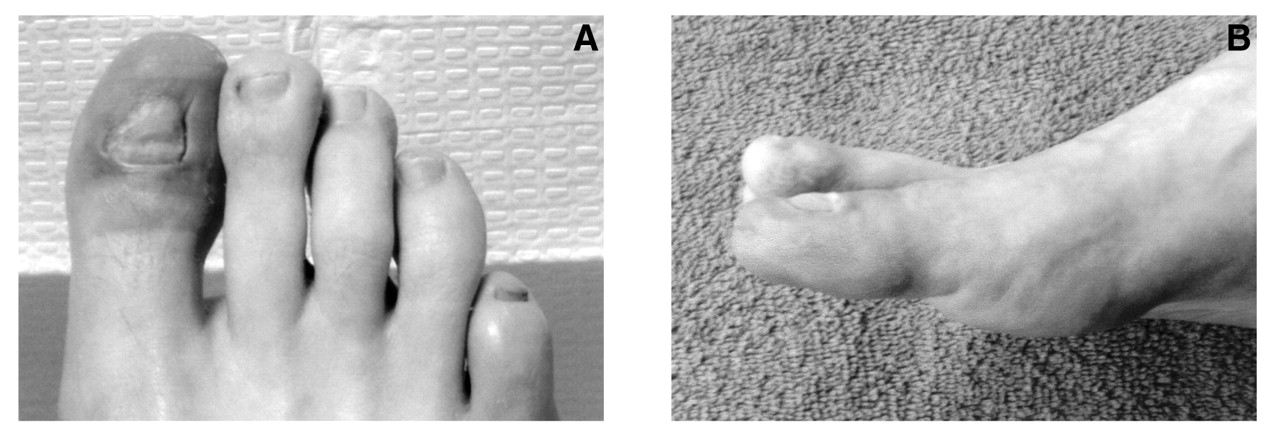
The drain was removed on the third postoperative day, and the patient was allowed to return to usual bathing, including the surgical site. The patient remained nonweightbearing for 7 days and was gradually transitioned out of a postoperative surgical shoe and into his usual shoe during the next 7 days. Complete resolution of his initial pain occurred within the first 3 weeks following surgery. The substantial improvement in the cosmetic appearance of the great toe obtained the day of surgery was maintained without recurrence of the ski-slope, sunken-nail deformity, plantar contour deformity from the flap harvest site, or nail regrowth during the ensuing 12 months despite the patient’s labor-intensive occupation (Fig. 4
).
Figure 2.
A, Dorsal view following total nail avulsion (held in forceps) and complete matrixectomy after elevation of the proximal eponychium (held in skin hooks); B, en face view of the great toe following development of a dorsal nail bed flap and a plantar toe pulp flap, with the remodeled distal phalanx in the center; C, en face view of the great toe following elevation of the medially based adipofascial flap from the plantar toe pulp (held in forceps).
Figure 2.
A, Dorsal view following total nail avulsion (held in forceps) and complete matrixectomy after elevation of the proximal eponychium (held in skin hooks); B, en face view of the great toe following development of a dorsal nail bed flap and a plantar toe pulp flap, with the remodeled distal phalanx in the center; C, en face view of the great toe following elevation of the medially based adipofascial flap from the plantar toe pulp (held in forceps).
Figure 3.
Dorsal (A) and lateral (B) views of the right great toe immediately following total nail matrixectomy and buried adipofascial flap interposition. Note the improved toe contour and correction of the ski-slope and sunken-nail deformities.
Figure 3.
Dorsal (A) and lateral (B) views of the right great toe immediately following total nail matrixectomy and buried adipofascial flap interposition. Note the improved toe contour and correction of the ski-slope and sunken-nail deformities.
Figure 4.
Dorsal (A) and lateral (B) views of the right great toe 12 months after total nail matrixectomy and buried adipofascial flap interposition. Note the maintained improved toe contour and correction of the ski-slope and sunken-nail deformities without the presence of any inclusion cyst formation or partial nail regrowth.
Figure 4.
Dorsal (A) and lateral (B) views of the right great toe 12 months after total nail matrixectomy and buried adipofascial flap interposition. Note the maintained improved toe contour and correction of the ski-slope and sunken-nail deformities without the presence of any inclusion cyst formation or partial nail regrowth.
Discussion
Although seemingly benign, abnormality of the great toe nail in the form of a ski-slope, sunken-nail deformity can be a debilitating problem in a young person with a labor-intensive occupation. In this situation, the combination of procedures we described allows for 1) permanent removal of the deformed nail plate through matrixectomy, although the nail plate and the germinal matrix can be maintained if substantial deformity is not present; 2) maintenance of digital length since no soft-tissue or osseous resection has occurred at the distal aspect of the great toe; and 3) correction of the ski-slope, sunken-nail deformity through elevation of the nail bed to the level of the surrounding labial nail folds by using buried adipofascial flap interposition. In addition, these procedures are quick and easy to perform, are based on reliable vasculature, and require no specialized equipment beyond loupe magnification. However, the combination of these procedures is more aggressive than simply performing a total matrixectomy, [
12] distal skin plasty, [
1] or terminal Syme amputation [
3] and should probably not be used in an older individual with a sedentary lifestyle for whom this would be purely a cosmetic procedure.
The potential disadvantages include 1) inclusion cyst formation or partial nail regrowth if the germinal matrix is not completely excised, [
13] 2) partial or complete necrosis of the adipofascial flap if it is not meticulously raised and handled, 3) hematoma or seroma formation if inadequate hemostasis is obtained before wound closure or if a drain is not used, and 4) plantar contour deformity of the great toe pulp resulting from the harvesting of the adipofascial flap. Although we believe that these are truly potential disadvantages since they are almost entirely related to technical error rather than procedure design flaws, the combination of procedures described should not be undertaken lightly. Should the adipofascial flap or skin edges necrose, a large defect with exposed bone could result, which would be a devastating complication potentially requiring a formal great toe amputation. The potential for a symptomatic plantar contour defect also exists, which could create a painful gait pattern that would not be easily accommodated with insoles or shoe modifications. For these reasons, we believe that this combination of procedures should be reserved for the most severe nail deformities in young, healthy patients without other medical conditions. Furthermore, the patient should have an easily identified vascular supply to the great toe that can be verified preoperatively with a Doppler probe. As developing the adipofascial flap itself requires loupe magnification and delicate dissection and tissue handling, we believe that it should be performed only by surgeons experienced in this very specialized procedure and in each of the techniques used.