Rationale
There have been several recent innovations in the development of Web-based teaching and learning materials at the California School of Podiatric Medicine at Samuel Merritt College (formerly the California College of Podiatric Medicine). A computerized student-patient encounter log system was implemented in 2001–2002 to document podiatric medical students’ diagnostic and treatment procedures, and it was described in a previous publication. [
1] The neuroscience program at the California College of Podiatric Medicine was supported by a dedicated intranet site, and the biochemistry faculty used an asynchronous discussion group to facilitate student learning. [
2] At other institutions, Web-based interactive student-advisement systems have been designed to improve the effectiveness and efficiency of student academic advisement. [
3] In addition, other schools also are beginning to use handheld computers to record student-patient encounters during various clerkships. [
4,
5]
Despite the rapid increase in the use of technology at all levels of medical education, little is known about the level of computer literacy among podiatric medical students and students in other health-care professions. Data on the level of computer knowledge and skills among podiatric medical students are necessary so that podiatric medical colleges can develop effective computer-based learning programs for students in different class years. Information about computer literacy will make it possible to develop computer orientation programs for first-year podiatric medical students and for students in other class years. Moreover, faculty in the basic sciences and in clinical training programs require information about podiatric medical students’ level of computer literacy to develop curricula that are suitable for their varying levels of computer literacy.
A variety of studies of students in the health-care professions have evaluated how adept students are at using Web-based learning materials, computer software and hardware, and other computer-based instructional technologies. This article reviews three issues related to computer literacy among these students: their level of computer knowledge and skills, the frequency of student computer use, and the computer experiences of podiatric medical students. Following is a discussion of the literature accumulated in the past decade related to these three issues. It should be noted that, in this rapidly expanding field, these findings may not be entirely accurate even at the time of this writing.
Students’ Level of Computer Knowledge and Skills
Since the 1990s, various surveys have shown that students in the health-care professions differed in their level of computer knowledge and skills. Asgari-Jirhandeh and Haywood [
6] surveyed all Edinburgh University medical students and found that students gave themselves an average computer knowledge score of 4.19 on a scale from 0 to 10. Ray and Hannigan [
7] surveyed the level of computer literacy in a cohort of 140 undergraduate dental students at an Irish university dental school and discovered that 51% viewed themselves as having poor expertise in using basic computer hardware and software. In a study of 140 first-year medical and dental students, Gouveia-Oliveira et al [
8] established that 14% of these students rated their computer literacy as negligible and 49% as deficient.
A variety of researchers have evaluated possible correlates of computer literacy among students in the health professions. Studies throughout the 1990s found gender differences in computer knowledge and skills, with men consistently showing greater computer literacy than women. Gouveia-Oliveira et al [
8] found that female medical and dental students’ self-reported computer illiteracy (77%) was almost twice that of male students (39%). In a questionnaire survey of computer knowledge and skills of medical students at Monash University in Australia, Kidd et al [
9] reported that male medical students had greater computer literacy than female medical students, especially among those in their sixth year of medical school. It is thought that gender differences in cognitive styles may be associated with gender differences in computer literacy.
Researchers also have analyzed levels of perceived computer literacy among students in different class years. In their study of computer literacy in all first-, fourth-, and sixth-year medical students, Kidd et al [
9] found that first-year medical students had greater perceived computer knowledge and skills than sixth-year medical students.
Frequency of Computer Use
Results of recent studies have shown that most students in the health-care professions use computers. In fact, Asgari-Jirhandeh and Haywood [
6] discovered that only 2% of the medical students surveyed had not used a computer in the previous year. On the basis of a survey of computer literacy of medical students at the University of North Carolina, Chapel Hill, Sancho et al [
10] reported that 80% of the students used computers, whereas Gouveia-Oliveira [
8] showed that 96% of first-year medical and dental students surveyed had used a computer previously and that 59% reported regular use of a computer.
These reports of increased computer use contrast with earlier survey findings of the frequency of computer use among medical, dental, and nursing students at Glasgow University in Scotland. Jones et al [
11] noted that 20% of students surveyed had not used a computer during the past year and that 16% regarded themselves as complete neophytes with respect to computers.
Other studies have examined possible predictors of frequency of computer use. For example, Sancho et al, [
10] in their study of medical students at the University of North Carolina, Chapel Hill, discovered gender differences in the frequency of computer use. The authors reported that male students had more computer experience than female students.
Other factors, such as access to computers, [
5] lack of computer training, [
5,
6,
9] and level of anxiety, [
9] seem to have influenced computer use among students in the health professions.
Types of Computer Experiences
Although most students in the health professions now use computers, it is unclear whether they do more than just use them on a limited basis, such as using e-mail programs. A study by Ray and Hannigan [
7] found that most of 140 undergraduate dental students in their sample had never used word-processing, spreadsheet, or computer graphics programs.
Asgari-Jirhandeh and Haywood [
6] reported that e-mail was the most frequently used computer application among medical students at Edinburgh University in Scotland, and in a study of computer experience, Sancho et al
10] discovered that although 80% of the medical students in their sample reported using computers, less than 30% used general-application software. Moreover, use of computer-based medical literature databases or computer laboratories was rare among these students.
Researchers have also explored predictors of the type of computer use. Sancho et al [
10] discovered gender differences among students in terms of different types of computer uses. Male medical students had more experience than female medical students using general computer applications, online medical database search programs, computer laboratories, and other computer applications. These gender differences did not seem to relate to student age, academic performance, or course.
Survey of Computer Literacy at the California School of Podiatric Medicine
To our knowledge, there have been no previous surveys of computer literacy among podiatric medical students. Research is needed to document the level of computer literacy of podiatric medical students, who increasingly will be relying on computer software and hardware in their basic science education and clinical training. These data can be used to add or modify medical informatics instruction for podiatric medical students. Increasing computer literacy will be necessary so that podiatric medical students will be better prepared for their residency training and as lifelong learners in clinical practice. A research proposal was submitted to the Human Subject Review Board of the California School of Podiatric Medicine and received exempt status.
Survey Instrument
The survey was designed to measure the level of self-reported knowledge of computers and the Internet and the frequency of using different computer applications. The survey also assessed factors associated with podiatric medical students’ level of self-reported computer knowledge and computer use. A review of the literature revealed gender differences in computer literacy among students in the health professions. Our study was designed to determine whether there are gender differences in self-reported knowledge of and skills in computers and the Internet.
It is widely reported in the research literature that computer literacy may vary by the student’s class year. Our investigation examined the possible association between class year and self-reported computer knowledge. The literature review also revealed that the degree of computer literacy may influence students’ participation in different computer experiences. Therefore, our investigation was designed to assess the possible relationship between perceived computer literacy and the use of different computer applications.
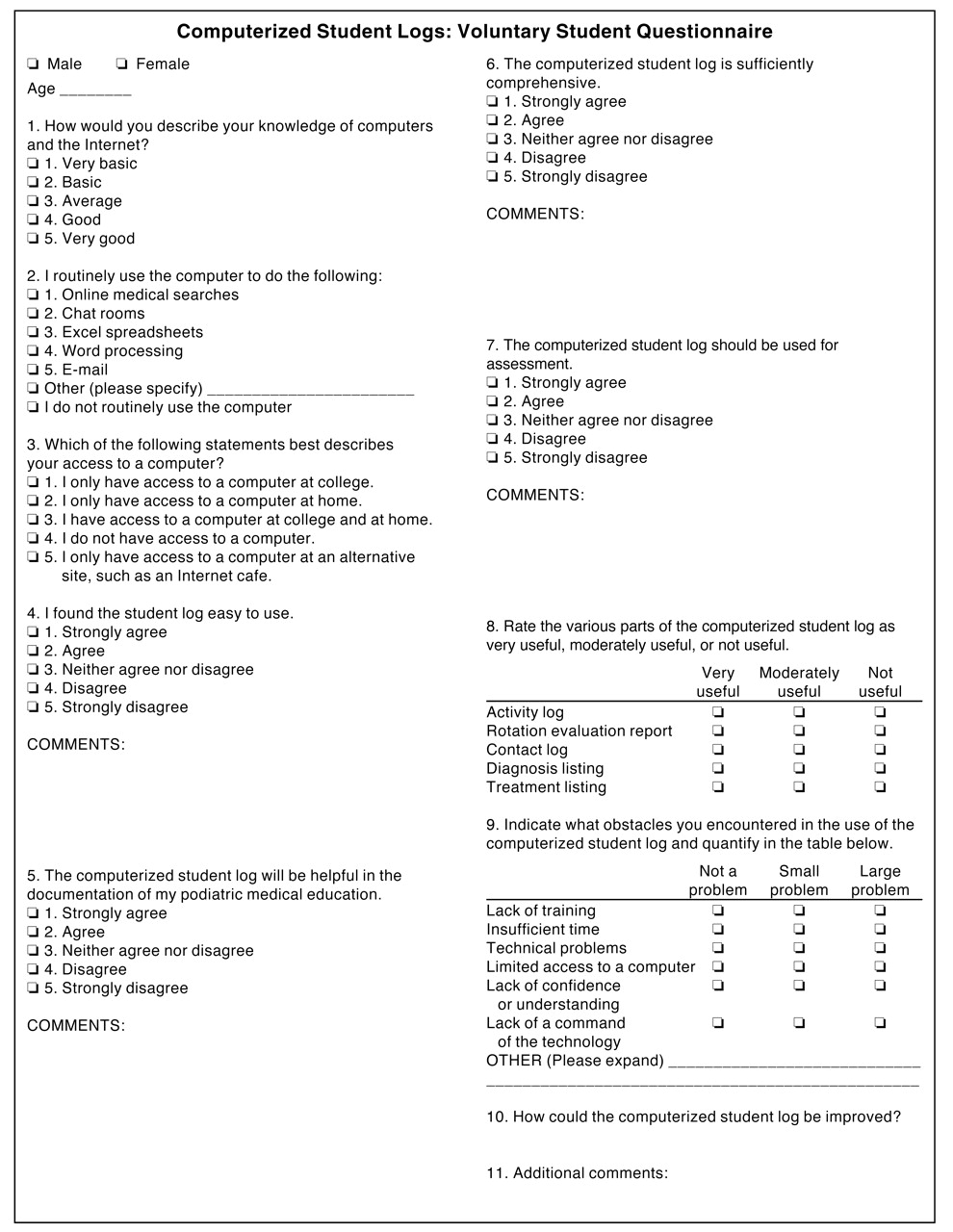
A short questionnaire consisting of 11 questions (32 items) was developed to measure podiatric medical students’ computer literacy and experiences with a newly developed computerized student-patient encounter log system. [
1] Regarding computer literacy, the questionnaire measured students’ self-reported computer knowledge and skills as well as their use of different computer programs and technology. In addition, the questionnaire requested information about students’ gender and class year.
The questionnaire item that dealt with self-reported computer literacy was an ordinal variable. Students were asked to rate their knowledge of computers and the Internet on a 5-point scale from “very basic” to “very good.” All other questionnaire items that dealt with different types of computer uses had closed-ended responses and were classified as categorical variables. For example, students were asked to answer “yes” or “no” regarding whether they routinely use spreadsheet computer applications.
Questionnaire items were developed on the basis of a review of the literature on computer literacy among students in the health professions. After the questionnaire items were designed, the questionnaire was formatted so that different domain areas, eg, self-reported computer knowledge and skills, would be covered in separate sections. The questionnaire was designed and formatted so that students could complete it in less than 5 min.
The newly developed questionnaire was then pretested with six students at the California School of Podiatric Medicine who would not participate later in the final survey. Questionnaire items and formatting were refined on the basis of these pretest results. The questionnaire is shown in
Figure 1.
Sample
A random sample of class sessions at the California School of Podiatric Medicine was selected, and a sample of 66 podiatric medical students was obtained from these class sessions. At the beginning of the class sessions, students were told about the goal of the survey and that the survey results would be presented in an anonymous form only. Students were asked to complete the questionnaire on a voluntary basis and were told that completing the questionnaire would have no adverse effect on their grade in the course. The survey response rate was 83%.
Study Variables
In this study, there were two dependent variables: 1) self-reported knowledge of computers and the Internet and 2) routine use of different computer software and technology. The independent variables were gender and class year.
Data Analysis
Data entry and cleaning were performed using the Systat computer data-analysis program (version 9, SPSS Science, Chicago, Illinois). Cross-tabulations and correlational procedures were performed. First, one-way cross-tabulations were completed of key variables related to students’ 1) demographic and academic characteristics, 2) knowledge of computers and the Internet, and 3) routine use of different computer software and technology.
A two-way cross-tabulation of gender and level of self-reported knowledge of computers and the Internet also was obtained. A cross-tabulation of students’ class year and level of self-reported knowledge and computer experience was performed. Cross-tabulations were calculated to measure the possible association between students’ level of self-reported knowledge of computers and the Internet and routine use of different types of computer software and technology. In addition, a cross-tabulation between gender and routine use of different computer software and technologies was calculated. Pearson χ2 procedures tested the statistical significance of the cross-tabulations.
Results
Demographic and Academic Characteristics
Table 1 contains data on the demographic and academic characteristics of the podiatric medical students in the sample. Seventy percent of the podiatric medical students surveyed were men, and 30% were women (χ
21 = 10.24;
P < .001). With regard to class year, 47% were sophomores, 50% were juniors, and 3% were seniors (χ
22 = 27.36;
P < .001).
Table 1.
Demographic and Academic Characteristics of 66 Podiatric Medical Students.
Table 1.
Demographic and Academic Characteristics of 66 Podiatric Medical Students.
Self-reported Computer Knowledge and Skills
Data on self-reported computer knowledge and skills are given in
Table 2. Most of the students surveyed (53%) rated their knowledge of computers as either good or very good (χ
24 = 15.51;
P < .004). Of these students, 30% reported that their knowledge of computers and the Internet was good, and 23% rated their knowledge as very good. Twenty-nine percent of the students surveyed rated their knowledge as average, and 14% perceived themselves as being at a basic level. Only 5% of the students considered their computer knowledge to be very basic.
Table 2.
Podiatric Medical Students’ Self-reported Computer and Internet Knowledge.
Table 2.
Podiatric Medical Students’ Self-reported Computer and Internet Knowledge.
Regarding possible predictors, there were no gender differences in the students’ self-reported computer knowledge. However, the results showed that class year was associated with self-reported knowledge of computers and the Internet (
Table 3). A larger percentage of students in their sophomore year (68%) reported good or very good computer knowledge than students in their junior year (39%) (χ
21 = 3.84;
P < .05).
Table 3.
Association Between Podiatric Medical Students’ Self-reported Computer Knowledge and Class Year (Juniors and Seniors).
Table 3.
Association Between Podiatric Medical Students’ Self-reported Computer Knowledge and Class Year (Juniors and Seniors).
Types of Computer Software and Technology Routinely Used
Table 4 gives the types of computer software and technology routinely used by podiatric medical students. Overall, 97% of the podiatric medical students surveyed reported that they routinely use computers for various purposes, whereas 3% indicated that they do not routinely use a computer (χ
21 = 58.24;
P < .001). Most students surveyed (97%) reported that they routinely use e-mail programs (χ
21 = 58.24;
P < .001), followed by word-processing programs (83%) (χ
21 = 29.33;
P < .001) and online medical databases (66%) (χ
21 = 6.79;
P < .009). Thirty-one percent of the students in the sample reported that they routinely use computer spreadsheet programs (χ
21 = 9.62;
P < .002), and a smaller percentage (11%) routinely used the computer to participate in chat rooms (χ
21 = 40.02;
P < .001).
Table 4.
Types of Computer Software or Technology Routinely Used by Podiatric Medical Students.
Table 4.
Types of Computer Software or Technology Routinely Used by Podiatric Medical Students.
Analysis of the questionnaire data revealed gender differences in one type of computer use (
Table 5). Female podiatric medical students were more than twice as likely as male students to report that they routinely use the computer for spreadsheet applications (χ
21 = 5.02;
P < .03).
Table 5.
Association Between Podiatric Medical Students’ Gender and Routine Use of Spreadsheet Computer Programs.
Table 5.
Association Between Podiatric Medical Students’ Gender and Routine Use of Spreadsheet Computer Programs.
The relationship between self-reported knowledge of and skills in computers and the Internet and different types of computer uses also was analyzed. Podiatric medical students with good or very good self-reported computer knowledge were more likely to report that they routinely use word-processing programs (χ21 = 6.43; P < .02), spreadsheet computer applications (χ21 = 7.95; P < .01), and online medical database search programs (χ21 = 4.10; P < .05).
Discussion
The present results differ from those of previous studies in that podiatric medical students in the sample were more likely to rate their computer literacy as good or very good. Moreover, podiatric medical students surveyed were more likely to report routine use of computers in general and in terms of specific software applications, such as e-mail and word-processing programs, than in previous investigations.
However, consistent with findings from other investigations, a lower percentage of podiatric medical students in this sample reported routine use of online medical database search programs and spreadsheet computer programs. Another important finding is that self-reported good or very good computer knowledge among podiatric medical students is positively correlated with routine use of word-processing programs, spreadsheet software, and online medical database applications. Therefore, developing effective medical informatics training programs can increase podiatric medical students’ computer literacy and thus their use of these important computer applications.
Another interesting finding is that female podiatric medical students in our sample were much more likely to report routine use of spreadsheet programs than male podiatric medical students. Gender differences in cognitive styles and preferences may influence the frequency of using certain computer applications among female and male students.
The present findings differ from previous investigations that found that male students in the health professions tended to have more experience with computers than female students. Moreover, the present study’s finding of a lack of gender differences in self-reported computer knowledge differs from previous research, which found that male students in the health professions reported higher levels of computer literacy than female students. These results suggest that gender differences in computer knowledge and experience can be eliminated, especially as female and male students obtain equal access to computers and training in medical informatics.
Finally, class year is correlated with podiatric medical students’ self-reported computer knowledge. Students in different class years may have different levels of computer training and exposure to computers, which influence their self-reported computer knowledge. These results support the findings of Kidd et al [
9] that first-year medical students had greater computer skills than sixth-year medical students.
Conclusion
Findings from other studies have indicated that increased access to computers and medical informatics training will increase medical students’ computer knowledge and skills. Having data on podiatric medical students’ level of computer literacy provides a road map for implementing medical informatics curricula and increasing access to computer hardware and software at podiatric medical colleges.