Routine screening for microalbuminuria, neuropathy, and retinopathy is now common in both adult and adolescent diabetes mellitus clinics. However, although limited joint mobility in the foot, plantar callus, and high peak plantar pressures are known to place individuals at risk for developing serious foot problems, screening for these abnormalities has been largely restricted to adults.
In adolescents with type 1 diabetes mellitus, limited joint mobility has been found at the subtalar and first metatarsophalangeal joints,[
1] but examination for high peak plantar pressure and plantar callus has not been undertaken. The early detection and elimination of high peak plantar pressure and callus may prevent these younger individuals from developing serious foot problems as adults. This is the first study to assess young people with diabetes for these abnormalities and evaluate methods of reducing these risk factors.
Delbridge et al[
2] and Mueller et al[
3] were the first to question why some people with diabetic neuropathy develop plantar ulcers while others do not. They found a relationship between limited joint mobility and neuropathic ulceration in the feet of adults with diabetes and concluded that limited motion of the subtalar joint interfered with the foot’s ability to absorb shock and transfer forces efficiently during gait. The advent of sophisticated pressure-analysis equipment encouraged more in-depth and quantitative investigations of factors that predispose the adult diabetic foot to neuropathic ulceration. A direct relationship between high plantar pressure and neuropathic ulceration has been found.[
4,
5,
6,
7] Other studies have suggested that the presence of plantar callus plays an important role in neuropathic ulceration.[
8,
9] Young et al[
8] found that plantar callus elevates plantar pressure by acting as a foreign body, and in a prospective study Murray et al[
9] found that the presence of callus was highly predictive of subsequent ulceration.
The deleterious effect of high peak plantar pressure and plantar callus on the diabetic foot has motivated many researchers to evaluate interventions to reduce or eliminate these factors. Various cushioning materials and thermoplastic orthoses have been successfully employed to reduce plantar pressure and callus in adults with diabetes.[
10,
11,
12,
13,
14]
This study examined whether plantar pressure, pressure–time integral, and the occurrence of plantar callus differ between adolescents with and without diabetes. It also examined the pressure-reducing effects of PPT cushioning (Langer Biomechanics Group, Deer Park, New York), custom-made orthoses, and the combination of both in adolescents with diabetes.
Materials and Methods
The study group of 211 adolescents with type 1 diabetes (97 boys, 114 girls) was recruited from the Diabetes Complications Assessment Clinic at The Children’s Hospital at Westmead, Sydney, New South Wales, Australia. The median age was 15.2 years (interquartile range, 13.5 to 16.7 years). The median duration of diabetes was 5.9 years (interquartile range, 3.8 to 9.9 years). The control group consisted of 57 adolescents without diabetes (27 boys, 30 girls) with a median age of 15.6 years (interquartile range, 13.8 to 16.4 years). The control subjects were not relatives of study participants with diabetes or first-degree relatives of other controls. Control and diabetic subjects with any known form of arthritis or joint disease at the time of assessment were excluded from the study, as these diseases may have affected pressure analysis. Subjects with acutely painful conditions, which may have affected gait, were also excluded.
All of the subjects or their parents gave informed consent, and the ethics committees of The Children’s Hospital at Westmead and the University of Western Sydney approved the study. The same examiner (A.C.D.) took all pressure measurements and fabricated all of the orthoses. Peak pressure and pressure– time integral over the entire plantar surface of the foot were evaluated using the Pedar in-shoe pressure-measurement system (Novel Gmbh, Munich, Germany) with a sampling rate of 50 Hz. High peak plantar pressure was defined as more than 2 SDs above the mean for the controls, as suggested by Cavanagh and Ulbrecht[
15] in 1994. Only the most affected foot was used for evaluation (the foot with the highest peak pressure or highest pressure–time integral). As variability between left and right feet was noted, using the mean of both would have eliminated subjects with only one foot at risk. Callus was defined as any diffuse area of evenly thickened skin; its presence and position on the foot were noted. Callus was not removed at any time.
A lifetime hemoglobin A1c (HbA1c) value was calculated for the diabetic subjects by taking the median of all previous HbA1c assessments. The median number of HbA1c assessments was 12 (interquartile range, 7 to 19), and the median lifetime HbA1c value was 8.6% (interquartile range, 7.8% to 9.3%). The nondiabetic HbA1c range is 4% to 6%.
Full-foot plantar pressure was evaluated while subjects walked at a self-regulated pace along a 10 × 2.5-m walkway covered with a low-pile carpet. Clarks Detroit extra-depth school shoes (Clarks Shoes Ltd, Kew, Victoria, Australia) and thin nylon hosiery were supplied by the examiner. Four steps from the left and right feet were used for evaluation. Subject speed was not dictated, as controlled speed is not representative of normal gait,[
16] but it was evaluated by examining the contact time for each subject.[
11] Repeatability of the method used for pressure analysis was evaluated by assessing eight nondiabetic subjects five times each during two testing sessions. The type (3,1) intraclass correlation coefficient (ICC) for peak plantar pressure was 0.92, and the ICCs for pressure– time integral and contact time were 0.84 and 0.93, respectively.
Interventions were evaluated in 17 diabetic subjects who had high peak plantar pressure but no callus and in 17 diabetic subjects who had callus with or without high peak plantar pressure. None of the nondiabetic subjects were evaluated in this phase of the study. The diabetic subjects who were tested had nonweightbearing plaster of Paris neutral casts taken for both feet.[
17,
18] Semirigid orthoses were fabricated from low-density polyethylene with intrinsic forefoot posting, 0° rearfoot posting, and 18- to 20-mm heel cupping. Full-foot plantar pressures were reexamined approximately 10 days after the orthoses were issued to allow the individuals to become acclimatized to them. The no-intervention full-foot plantar pressures were reexamined, and then each subject was assessed using three interventions: flat, 3-mmthick PPT cushioning alone, custom-made orthoses alone, and 3-mm PPT cushioning under the orthoses. The reexamination of no-intervention plantar pressures was done first and then the three interventions were tested in random order to eliminate period effect. Twenty-three of the 34 diabetic subjects who had used custom-made orthoses for 1 year and 67 diabetic subjects who had not used any intervention had no-intervention plantar pressure reassessed after 12 months, and the results were compared with their initial no-intervention plantar pressure.
Statistical Analysis
The SAS software package (SAS Institute Inc, Cary, North Carolina) was used to analyze data. The mean and two-sample t-test were used to compare continuous variables between the diabetic and control groups when the distribution of data was normal; the median and the Wilcoxon rank sum test were used otherwise. A χ2 test was used to evaluate associations between categorical data. Interventions were analyzed using a one-way repeated measures analysis of variance. Results were further analyzed by post hoc tests (multiple comparisons with the Bonferroni adjustment) to determine differences between means for each intervention. The two-tailed paired t-test was used to compare no-intervention peak plantar pressure measured during the initial examination with the measurements taken after 12 months when the distribution of data was normal; the Wilcoxon signed rank test was used otherwise. The significance level was set at α = .05 or below.
Results
The median highest peak plantar pressure for the entire diabetic group was 40 N/cm2 (interquartile range, 34 to 49 N/cm2) and for the control group was 42 N/cm2 (interquartile range, 37 to 50 N/cm2). The median highest pressure–time integral for the entire diabetic group was 53.5 N/cm2·s (interquartile range, 46.3 to 63.5 N/cm2·s) and for the control group was 53.3 N/cm2·s (interquartile range, 45.7 to 60.4 N/cm2·s. No significant difference was found between the two groups.
High Peak Plantar Pressure and Plantar Callus
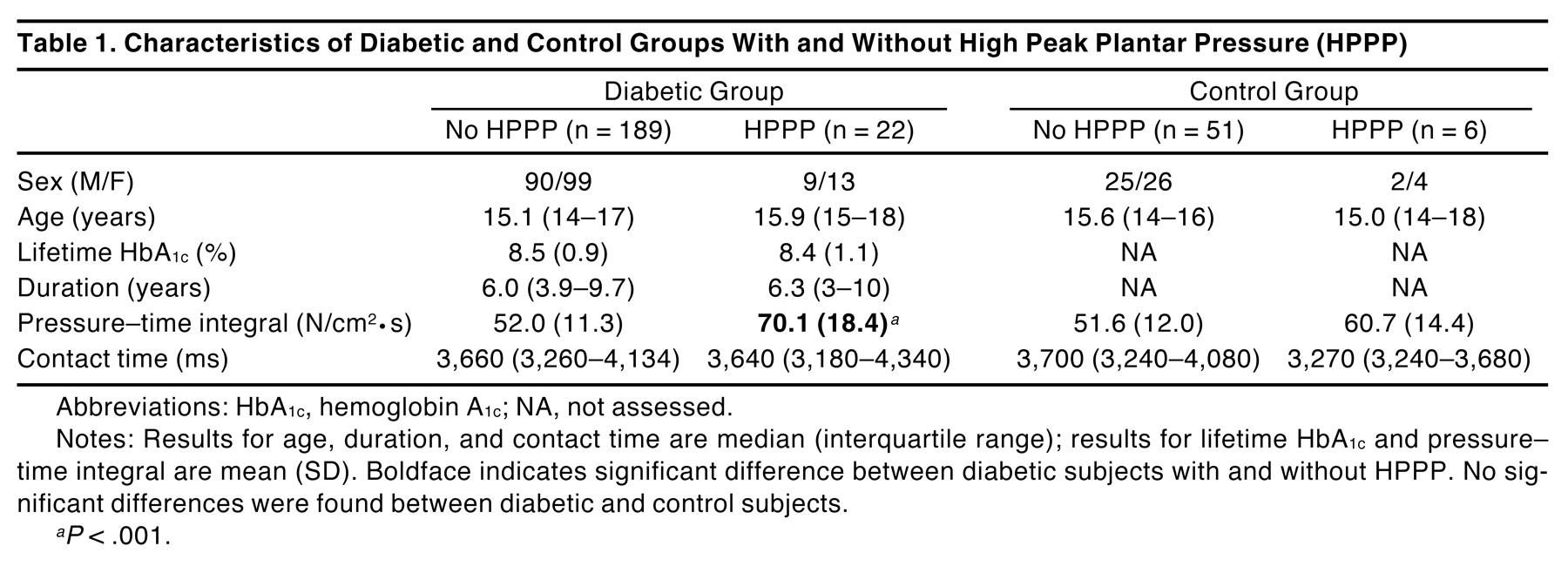
High peak plantar pressure equated to 59 N/cm2 or above. Twenty-two diabetic subjects and six controls had high peak plantar pressure on at least one foot. Only pressure–time integral showed a significant difference between diabetic subjects with and without high peak plantar pressure (P < .001). No significant variations were found for controls with or without high peak plantar pressure. No significant differences were found between diabetic subjects with high peak plantar pressure and controls with high peak plantar pressure (Table 1).
Thirty-nine diabetic subjects and 12 control subjects had plantar callus. Diabetic subjects with plantar callus had significantly higher peak plantar pressure and pressure–time integral (P < .001), had longer contact time, were significantly older, and had a longer duration of diabetes than diabetic subjects without callus (P < .05). Only peak plantar pressure was significantly higher in control subjects with plantar callus compared with controls without plantar callus (P = .04). No significant differences were found between diabetic and control subjects with plantar callus (Table 2).
Interventions
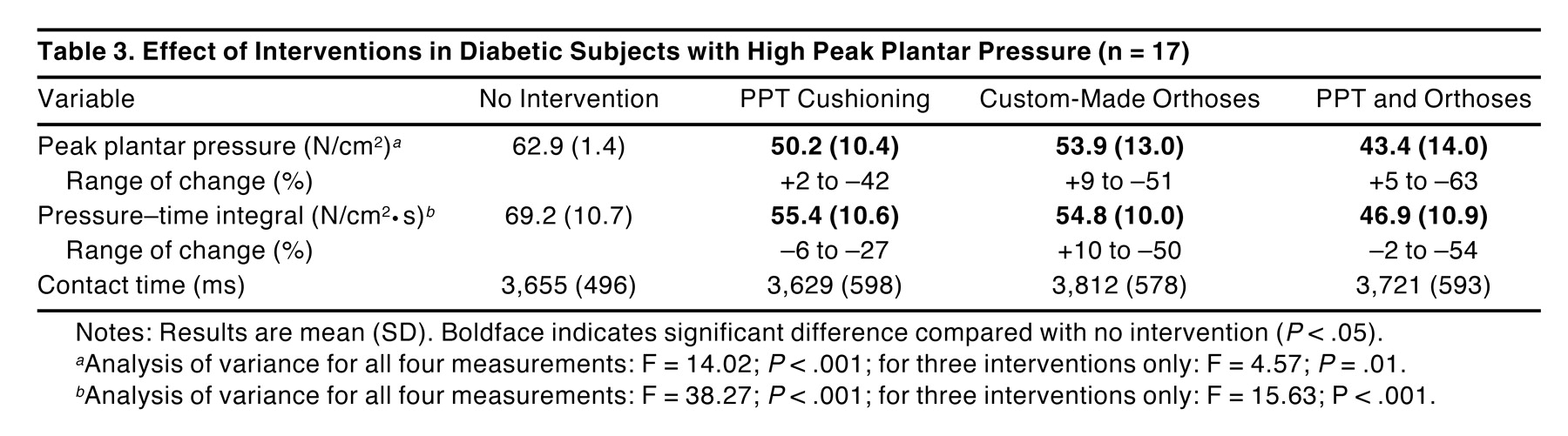
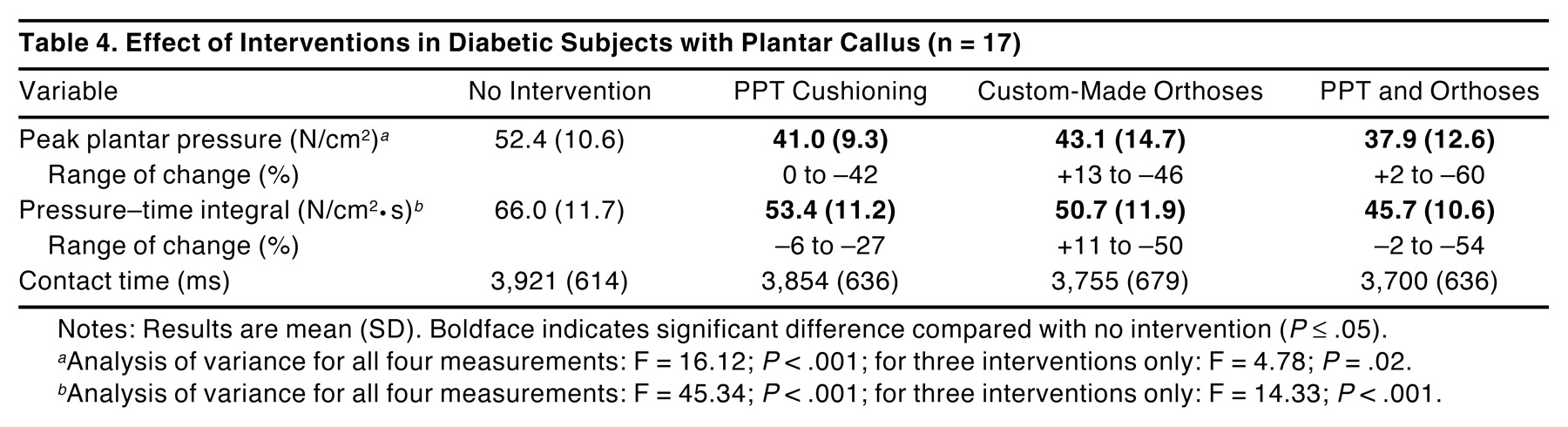
Seventeen diabetic subjects with high peak plantar pressure and 17 diabetic subjects with plantar callus volunteered to participate in the interventional phase. No nondiabetic controls were evaluated with interventions. Post hoc analyses for both the high peak plantar pressure and callus groups showed a significant reduction in peak pressure from the no-intervention condition with cushioning alone (P = .001), orthoses alone (P = .05), and cushioning and orthoses together (P < .001). A reduction in pressure–time integral was also found in the high peak plantar pressure and callus groups using all three interventions (P < .005). Contact time did not change significantly in either group. Compared with no intervention, the change in peak plantar pressure and pressure–time integral using the three interventions ranged from an increase of 13% to a decrease of 63% (Tables 3 and 4).
Only one subject with high peak plantar pressure showed a change in position of highest pressure from the plantar hallux area to the plantar metatarsal area; this change occurred using the combination of interventions. Only one subject with callus showed a change in position of highest pressure from the plantar metatarsal area to the plantar calcaneal area; this change occurred using cushioning and the combination of interventions.
The comparisons of one intervention with another for the high peak plantar pressure and callus groups showed: 1) cushioning versus orthoses: no significant difference for peak plantar pressure or pressure–time integral (P > .05) in either group; 2) combination versus orthoses: significantly reduced peak plantar pressure and pressure–time integral (P < .05) in both groups; 3) combination versus cushioning: significantly reduced pressure–time integral (P < .001) in the high peak plantar pressure group only.
Twelve-Month Follow-up of Diabetic Subjects With and Without Orthoses
A significant reduction in no-intervention peak plantar pressure occurred in diabetic subjects who used custom-made orthoses for 12 months (P = .0003). Diabetic subjects not fitted with orthoses showed no significant variation over the 12-month period (Table 5). Six of the 23 diabetic subjects who had used custom-made orthoses for 12 months had plantar callus at the initial examination; two of the six did not have plantar callus after 12 months. Seven of the 67 diabetic subjects who had not used orthoses had plantar callus at the initial examination; all seven still had plantar callus after 12 months.
Discussion
High peak plantar pressure and plantar callus, which have been found to be extremely important when evaluating the propensity of adults with diabetes to develop serious foot problems, are already present in many young people with diabetes. Comparisons of young people with diabetes with nondiabetic controls showed that plantar callus and high peak plantar pressure are not increased in those with diabetes. Bevans and Bowker[
19] also found that plantar callus was no more common in adults with diabetes than in nondiabetic controls. These anomalies can therefore be considered nondiabetic risk factors; that is, although the incidence of high peak plantar pressure and callus is no higher in diabetic subjects than in nondiabetic controls, these anomalies place individuals with diabetes at greater risk of future foot problems. These nondiabetic risk factors therefore can be seen in a similar light as ill-fitting footwear: although ill-fitting footwear is not a complication of diabetes, its effect on the neuropathic diabetic foot can be devastating and should be rectified as soon as possible.
The intragroup comparison between those with and without high peak plantar pressure for both the diabetic and control subjects produced some expected results. As high peak plantar pressure is not a direct complication of diabetes, no association with HbA1c levels and duration of diabetes was found. The only significant difference between those with and without high peak plantar pressure was in pressure– time integral, which reached statistical significance only in the group with diabetes.


The intragroup comparison of diabetic subjects with and without plantar callus again showed similarities with the corresponding nondiabetic controls. Diabetic subjects with plantar callus were significantly older and had a longer duration of diabetes, higher peak plantar pressure, higher pressure–time integral, and longer contact time than those without callus. This same trend was seen in the control group but did not reach statistical significance. Further evaluations of relationships between plantar callus, high peak plantar pressure, and other complications of diabetes, such as limited joint mobility and neuropathy, may shed light on why these abnormalities were significant only in the group with diabetes. These investigations are currently under way.
Many investigators have tested various pressurereducing modalities,[
10,
11,
12,
13,
14] but none have made direct comparisons between cushioning and custom-made orthoses. This study found that using 3-mm flat PPT cushioning (average, 20% reduction) or custom-made orthoses (average, 15% reduction) could reduce peak plantar pressure, but that the greatest reduction in peak plantar pressure (average, 27% reduction) was obtained by placing 3 mm of PPT cushioning under the custom-made orthoses.
Significant reductions in peak plantar pressure and pressure–time integral were achieved using all three interventions, but not all of the subjects responded in the same manner. Subject-specific and unsystematic responses to interventions have been found in a study by Stacoff et al,[
20] although that study examined changes in foot kinematics rather than plantar pressures. In the current study, the percent change in peak plantar pressure ranged from an increase of 13% to a decrease of 63%. In a clinical setting, using cushioning, orthoses, or both cannot guarantee a reduction in peak plantar pressure. Some subjects had an increase in peak pressure when using one of the interventions but responded to a different intervention. These variations may be due to test– retest variability, but the use of any single modality should be considered a starting point. Individual monitoring with pressure-analysis equipment should produce the best clinical results.
Close scrutiny of pressure–time integral responses to interventions reveals a slightly different picture. While the percent change in pressure–time integral using various modalities ranged from an increase of 11% to a decrease of 54%, only one subject with high peak plantar pressure and one with plantar callus had an increase in pressure–time integral using any of the interventions. If the aim is to reduce the pressure–time integral, any of these modalities can be used with a greater degree of confidence than if the aim is to reduce peak plantar pressure.
Subjects with diabetes tested 12 months after initial evaluation showed some interesting changes. Diabetic subjects who had been using orthoses for 12 months had a significant reduction in peak plantar pressure when reassessed without the orthoses. Diabetic subjects who had not used orthoses showed no significant change in the same period. Pressure–time integrals for diabetic subjects using orthoses also decreased, but the reduction did not reach statistical significance; pressure–time integrals in diabetic subjects who had not used orthoses were virtually unchanged. The variations between those with and without orthoses indicate that some functional changes were occurring in the group who used orthoses, at least temporarily. The orthoses may cause changes in the muscle activation system, or there may be changes in joint capsule and ligamentous structures. Whatever the mechanism of change, the reduction in mean peak plantar pressure from 54 to 42 N/cm2 and in median pressure–time integral from 60 to 53 N/cm2·s and the elimination of plantar callus in two subjects must be viewed as positive changes. Further evaluation is needed to confirm whether these changes are short- or long-term, but if they are long-term, these relatively unobtrusive devices may reduce the risk of future foot problems for these individuals. Although the long-term effects of using simple cushioning insoles were not assessed in this study, they should also be investigated.
The examinations of various treatment modalities were all undertaken at the individuals’ self-regulated pace. Some studies indicate that speed should be regulated when comparing one intervention with another,[
11,
21] but this method has some intrinsic problems. Regulation of walking speed requires that subjects use a treadmill or have their walking pace timed, both of which interfere substantially with the subjects’ normal walking pattern. Some changes in the gait pattern will occur even under perfect conditions.[
22] Dictating speed may result in an inaccurate picture of the effects of various interventions in everyday life. Even if an intervention is efficacious at a regulated pace, this may not be the case during normal gait. Dictating speed may also disguise some of the effects of various interventions, such as increasing or decreasing subjects’ speed.
If the subjects’ mass (in this case, body mass) and area (in this case, foot size) remain unaltered, then the only factor that will increase or decrease pressure (other than the intervention used or postural instability) is the speed at which the subject walks. This is a direct consequence of the two equations F = MA (where F is force, M is mass, and A is acceleration) and P = F/a (where P is pressure, F is force, and a is area). The time the foot is in contact with the ground will vary with speed, so assessing contact time should give a good indication of variations in subjects’ walking speed during consecutive examinations.
Changes in contact time during examination of various interventions demonstrated that in most cases subjects walked slightly faster, although this was not statistically significant. Subjects involved in the 12-month follow-up assessment also showed minor variations in contact time. Those who had used orthoses walked slightly faster than in the initial examination, while those who had not used orthoses walked slightly slower. Thus, theoretically, the reductions in peak plantar pressure and pressure–time integral found in this study would have been more significant had speed been regulated.
Conclusion
This study found no significant difference in peak plantar pressure, pressure–time integral, or plantar callus between adolescents with and without diabetes. It also found that three interventions (cushioning, orthoses, and the combination of both) could significantly reduce peak plantar pressure and pressure–time integral. The monitoring of various pressure-reducing modalities was undertaken to determine whether they could be relied on to reduce peak plantar pressure and pressure–time integral. The overwhelming message regarding this aspect of the study is that reliance should not be placed on any single modality for pressure reduction across the entire population. This finding emphasizes the importance of assessment using pressure-analysis equipment as an integral component of the clinical decision-making process when managing people with diabetes.
Effective use of appropriate pressure-reducing modalities has direct and obvious financial implications for ulcer prevention in adults and reduction in lower-limb amputations. This study found that peak plantar pressure and pressure–time integral could be reduced effectively with various interventions. This does not mean that all young people with diabetes who have high plantar pressure or plantar callus should be subjected to long-term use of orthoses or cushioning. However, appropriate treatment when one or more of these abnormalities is associated with early neuropathic change may prevent plantar ulceration in these individuals. Young people with diabetes who display high peak plantar pressure or callus should be targeted to have regular checks for neuropathy. If it were possible to prevent the progression of neuropathy into adulthood, the risk of future foot problems for these individuals would be greatly reduced. In the case of those with plantar callus, appropriate treatment should also include a recommendation that individuals receive regular podiatric medical care for callus removal, a practice that has been proven to immediately reduce peak plantar pressure.[
8]