The low-Dye strap has long been used by foot-care specialists to temporarily control pronation of the foot and, thereby, to diagnose and treat pronatory sequelae such as sinus tarsi syndrome, plantar fasciitis, posterior tibial tendinitis, and muscle fatigue.[
1-
3] The relief of symptoms associated with these syndromes after application of a low-Dye strap usually translates into long-term success with the use of permanent pronatory-control devices, such as custom-made functional foot orthoses. In addition to its diagnostic value, the low-Dye strap also has value as a short-term treatment modality for pronatory sequelae.[
1] The strap is used effectively to control pronation in athletes and in individuals with isolated “overuse syndromes” such as plantar fasciitis.[
1,
2]
Although the low-Dye strap is used routinely to diagnose and treat pronatory pathologic conditions, the exact effects of this strapping technique and the mechanisms by which the strap provides pronatory relief are not well documented.[
1] Lynch et al,[
2] in a study comparing the individual effectiveness of three types of conservative therapy for plantar fasciitis, found that mechanical treatment using low-Dye strapping and orthoses was more effective than anti-inflammatory medication and accommodative therapy. However, this study did not explain the direct effects of mechanical therapy on the foot. Several studies have provided information concerning the direct effects of taping on ankle motion, but no such studies exist for the foot.[
4-
8] Additionally, one study[
3] examined the effect of low-Dye strapping on plantar pressures during the stance phase of gait, showing that the low-Dye strap causes a shift in plantar pressures away from the medial column in flexible pes planus feet, but this study did not address specific aspects of foot motion affected by the strap.
The central purpose of this study was to establish the specific mechanical effects of the low-Dye strap on the pronatory foot. Within this context, the specific aim of this study was to assess the effect of the low-Dye strap on three distinct pronation-sensitive mechanical attributes of the foot in the weightbearing state: calcaneal eversion, first metatarsophalangeal joint range of motion, and medial longitudinal arch height.
Often in podiatric medicine, as with other medical specialties, treatment modalities are used without the profession or its practitioners having knowledge of the exact mechanisms by which the modality renders relief. If there is a general understanding concerning a treatment modality and the modality fulfills the two cardinal prerequisites of safety and efficacy, then the additional knowledge of exact mechanisms is usually given low priority. However, knowledge of exact mechanisms of action provides practitioners with greater confidence in the use of the modality. This confidence will increase the acceptance and appropriate use of the modality and will provide needed justification for its use within the current and future climate of managed care.
Use of the low-Dye strap to control pronation of the foot and provide relief from pronatory sequelae can be included under the parameters mentioned previously. Although this modality is used by many podiatric practitioners to help diagnose pronatory sequelae and to provide temporary relief from these pathologic conditions, it is done without knowledge of the exact mechanical effects of the strap on the pronatory foot. This study aimed to prospectively establish these effects and, thereby, to provide practitioners and managed-care professionals with the confidence necessary to accept this diagnostic and treatment modality on a widespread basis.
Materials and Methods
General Methods and Sample
This study used random sampling of individuals and specific inclusion and exclusion criteria to build an appropriate subject population (N = 22). These subjects were informed of all of the parameters of this study and were made aware of their rights as experimental subjects. Informed consent to participate in the study was obtained. For each subject, a target foot was established, and weightbearing measurements of calcaneal eversion, first metatarsophalangeal joint range of motion, and medial longitudinal arch height were made in the target foot before and after application of a low-Dye strap. The data were then analyzed to establish the effect of the low-Dye strap on each of the three mechanical entities.
Inclusion Criteria
To be included in this study, a target foot must have displayed a certain degree of excessive flexible subtalar joint pronation and a certain degree of medial column collapse. In other words, a foot must have displayed a mild increase in calcaneal eversion away from the perpendicular position, a mild decrease in first metatarsophalangeal joint range of motion, and a mild reduction in medial longitudinal arch height on weightbearing.
Exclusion Criteria
In general, feet that took on a supinated position during weightbearing were excluded from this study. All feet that displayed a very low or negative degree of calcaneal eversion, a very high degree of first metatarsophalangeal joint range of motion, and a very stable medial longitudinal arch height on weightbearing were excluded. Feet that displayed an everted resting calcaneal stance position and reduced medial longitudinal arch height due to pathologic conditions such as severe ankle equinus, rigid forefoot varus, tarsal coalition, congenital vertical talus, degenerative joint disease of the rearfoot or midfoot, or neurogenic peroneal muscle spasm were also excluded. These criteria were established for the purpose of eliminating feet known to have negative treatment outcomes using the low-Dye strap. By eliminating these types of feet, the number of confounding independent variables was reduced. Also, all subjects with a history of type 1 or type 4 hypersensitivity reactions to the adhesive spray, athletic tape, or marking pens were excluded from the study. Finally, all subjects with concomitant cutaneous fungal, bacterial, or viral infections of the target foot or a history of psoriatic skin disease anywhere on the body were excluded. These criteria were established to eliminate any undue harm to experimental subjects.
Treatment Modality
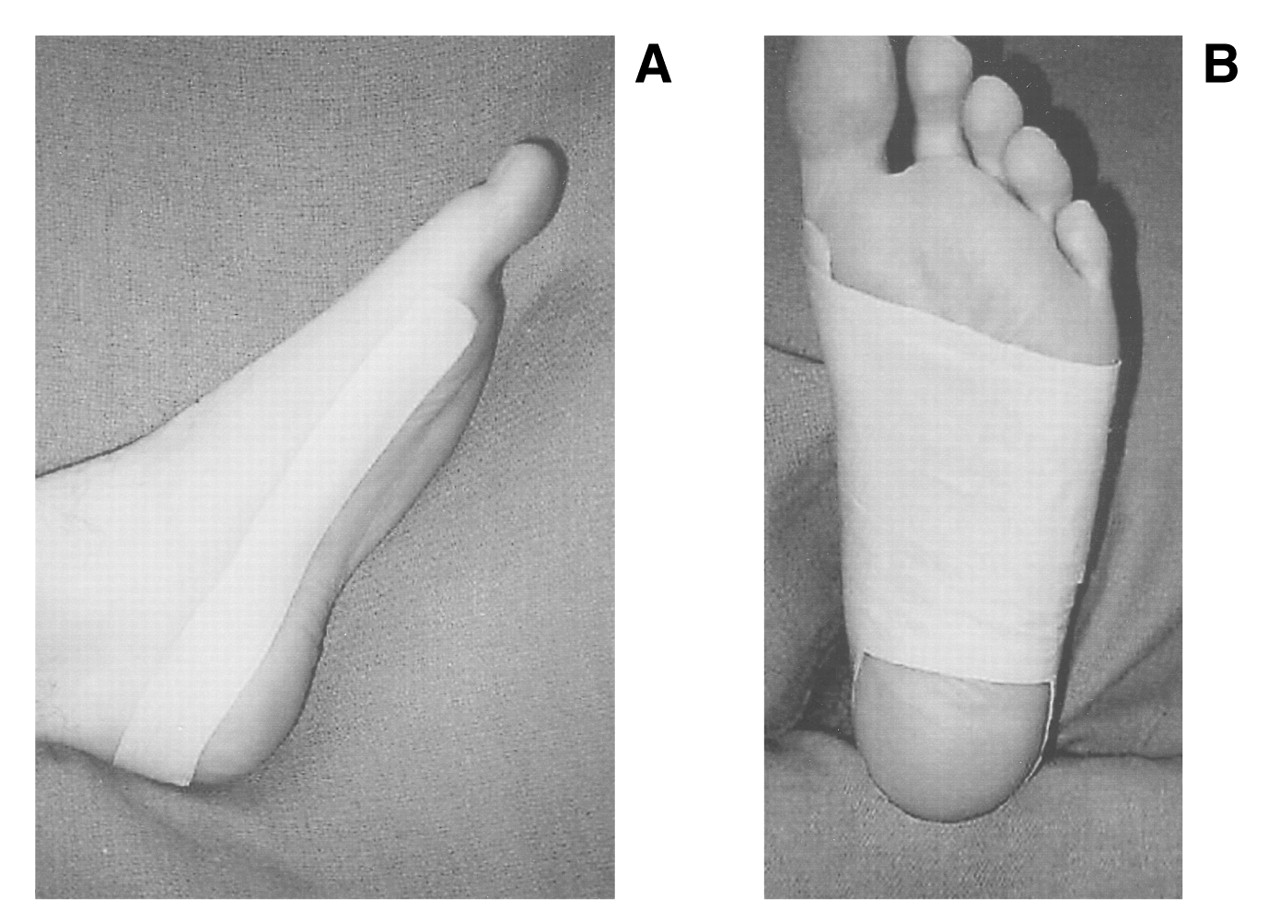
Each subject had the low-Dye strap applied to the target foot. In the manner shown in
Figure 1, the same investigator (J.M.W.) performed the strap application for all subjects. The technique used was a traditional version of strap application. Initially, adhesive spray was applied to the plantar, medial, and lateral skin of the target foot (excluding the skin of the toes). Single-sided adhesive athletic tape strips (1 and 3 inches) were used. With the subtalar joint in the neutral position, the midtarsal joint maximally pronated around the oblique axis, and the first ray maximally plantarflexed, two overlapping 1-inch tape strips were applied with tension from the lateral aspect of the head of the fifth metatarsal around the posterior aspect of the calcaneus to the plantar medial aspect of the head of the first metatarsal. Then, three overlapping 3-inch tape strips were applied along the plantar aspect of the foot from an area just distal to the medial tubercle of the calcaneal tuberosity to an area just proximal to the metatarsal heads. Finally, one additional 1-inch tape strip was applied in the same manner as the first two 1-inch strips, ensuring that the subtalar joint was in the neutral position, the midtarsal joint was maximally pronated around the oblique axis, and the first ray was maximally plantarflexed.
Data Collection
The dependent variables in this study were 1) calcaneal eversion in the weightbearing state, 2) first metatarsophalangeal joint range of motion in the weightbearing state, and 3) height of the medial longitudinal arch in the weightbearing state. These variables were measured in the target foot before and after application of the low-Dye strap. The measurements recorded before application of the low-Dye strap served as the control measurements for each subject. All measurements were made by the same investigator (K.A.).
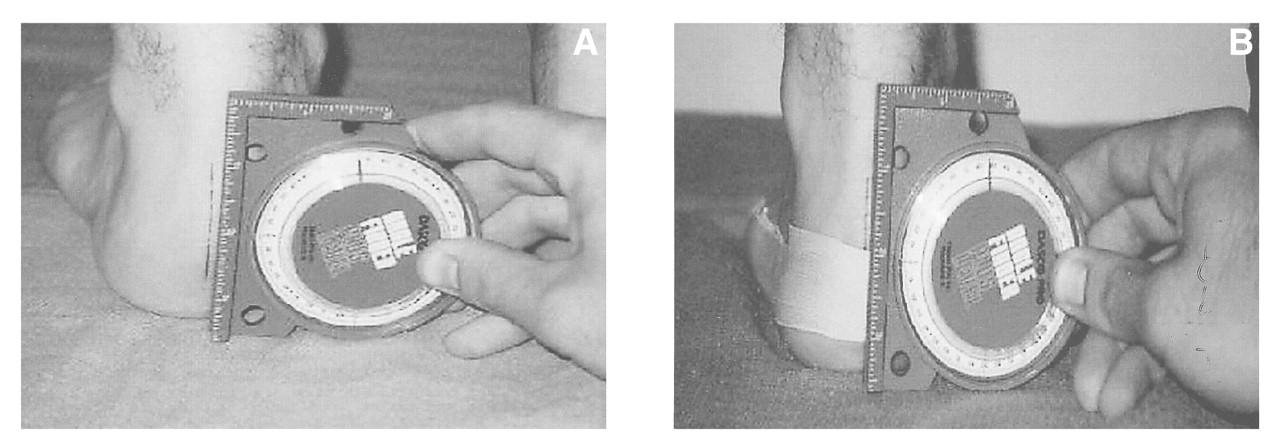
Calcaneal Eversion. The amount of calcaneal eversion in the weightbearing state was measured using the resting calcaneal stance position, which was measured using the vertical bisection of the calcaneus. The bisection was determined by palpating the four corners of the posterior tuberosity of the calcaneus and establishing the midpoint between the upper two corners and the midpoint between the lower two corners. After drawing of the calcaneal bisection on the subject’s skin, the subject was allowed to stand in a resting position. Using the Angle Finder Plus Level (Dasco Pro Inc, Rockford, Illinois), the deviation of the calcaneal bisection from the perpendicular bisection to the ground was measured. The same measurement was made after application of the low-Dye strap (
Figure 2).
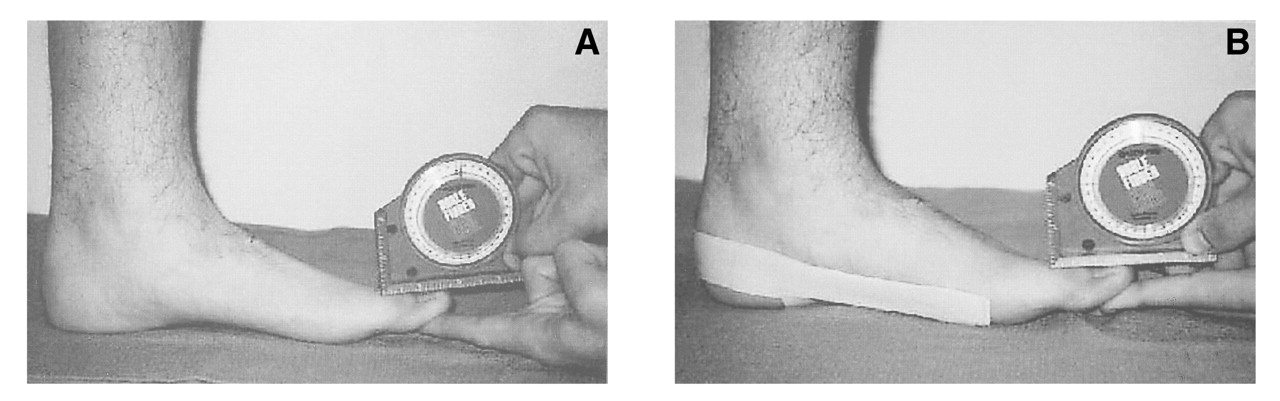
First Metatarsophalangeal Joint Range of Motion. First metatarsophalangeal joint range of motion in the weightbearing state was also measured using the Angle Finder Plus Level. With the subject standing in a resting position, the hallux was grasped at the level of the proximal phalanx and was elevated to the end of the range of motion of the first metatarsophalangeal joint. The Angle Finder Plus Level was placed on the dorsal aspect of the hallux before and after manual elevation of the hallux. The difference between the two readings was recorded as the number of degrees of first metatarsophalangeal joint motion in the weightbearing state. The same measurement was made after application of the low-Dye strap (
Figure 3).
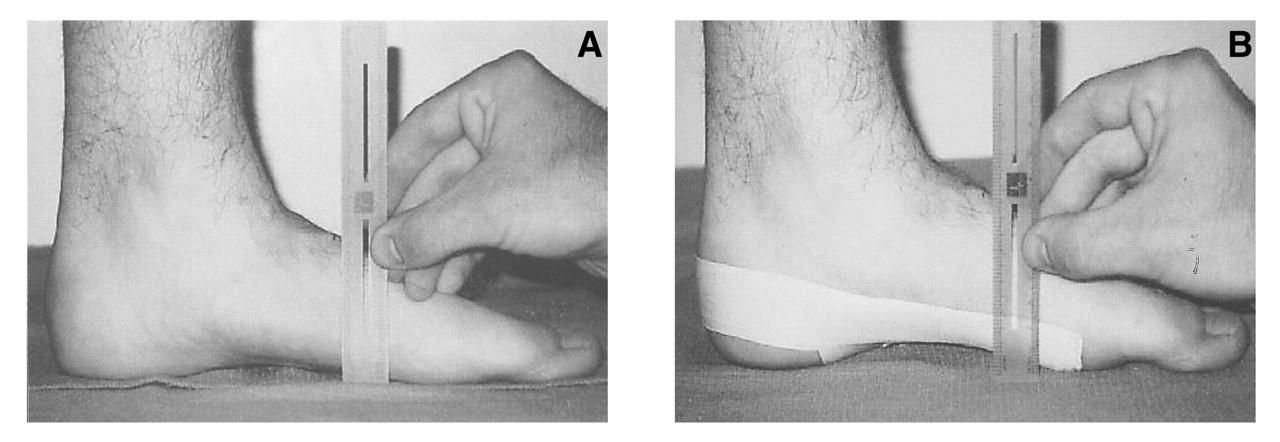
Medial Longitudinal Arch Height. The height of the medial longitudinal arch in the weightbearing state was measured using palpation and identification of bony landmarks. The most dorsal aspect of the medial cuneiform bone was established as the ceiling of the medial longitudinal arch, and the ground was established as the floor. With the subject standing in a resting position, the most dorsal aspect of the medial cuneiform bone was identified using palpation. Using a tractograph, the height of the medial longitudinal arch was measured from its ceiling to its floor. The same measurement was made after application of the low-Dye strap (
Figure 4).
Data Analysis
For each subject, the weightbearing measurements of resting calcaneal stance position, first metatarsophalangeal joint range of motion, and medial longitudinal arch height recorded before and after application of the low-Dye strap were compared. The prestrap and poststrap differences for each of the three variables were tabulated and subjected to Student’s t-test analysis for the determination of statistical significance (P < .05).
Results
Table 1 summarizes resting calcaneal stance position measurements. The mean calcaneal position before strap application was 3.591° everted. This value was converted to a mean of 1.000° inverted by application of the low-Dye strap. The difference between these means was statistically significant (
P < .0005).
Table 2 contains first metatarsophalangeal joint range-of-motion measurements. Mean range of motion before application of the strap was 24.773°. Mean range of motion after application of the strap was 31.818°. The difference between these means was also statistically significant (
P < .028).
Medial longitudinal arch height measurements are displayed in
Table 3. Mean arch height before application of the strap was 57.832 mm. Mean arch height after application of the strap was 60.910 mm. Although the arch height after strap application was greater than that without the strap, the difference was not statistically significant (
P < .057).
Discussion
The low-Dye strap is a commonly used diagnosis and treatment modality for pronatory pathologic conditions. Knowledge of the mechanisms of action of the strap would increase confidence in its use as an antipronation and anti–pronatory sequelae tool. The results of this study provide evidence that the low-Dye strap effectively controls calcaneal eversion and thus subtalar joint pronation in the weightbearing state. The results also suggest that the strap effectively increases dorsiflexory first metatarsophalangeal joint range of motion in the weightbearing state. Finally, the data suggest that the strap may work to increase the weightbearing height of the medial longitudinal arch.
By controlling pronation at a proximal level such as the calcaneus, it can be theorized that the strap is able to indirectly reduce distal pronatory stresses or sequelae exerted throughout the foot. This may allow the strap to act as a comprehensive pronatory control device. By stabilizing the height of the medial longitudinal arch, the strap displays its ability to help resist excessive dorsiflexion of the medial column and first ray during forefoot loading. Ultimately, medial arch stabilization reduces degenerative forces in the joints of the medial column and first ray.
Barrett[
9] described an increase in first metatarsophalangeal joint dorsiflexory motion with proximal plantar fascial release. It has been demonstrated in this study that use of the low-Dye strap can increase first metatarsophalangeal joint motion. It can be theorized that this effect is due to the strap’s ability to stabilize the first ray during forefoot loading and to take tension out of the plantar fascial slip inserting into the first metatarsophalangeal joint sesamoid apparatus.