Osteoarthritis is a degenerative disease that affects articular cartilage and the adjacent bone. It has a multifactorial etiology, and its progression varies in speed and degree of severity. Age, biomechanics, heredity, trauma, and joint stress are among the factors that contribute to the osteoarthritic process.[
1-
8] Overall, there is an interaction between a systemic predisposition to osteoarthritis and local biomechanical factors.[
9] The articular cartilage provides a smooth, gliding surface for the articulating components of a joint. It consists of three noncalcified zones (superficial, middle, and deep) and a calcified zone located adjacent to the subchondral bone. The subchondral plate consists of the calcified cartilage and subchondral bone.
Progression of the degenerative changes in both cartilage and bone can lead to the loss of use of the affected joints due to pain and rigidity. Little is known, however, about the factors that initiate the disease process or cause its progression, or about the precise cause-and-effect relationship between the pathologic bone and cartilage changes.[
10,
11] Both cartilage degeneration and associated pathologic bone changes, such as osteophytosis and sclerosis, have been well documented in end-stage disease of synovial joints.[
12-
17] In fact, conflicting data about the relationship between bone and cartilage changes in osteoarthritis have been reported.[
18-
24] Although most studies examine either the local trabecular bone or the subchondral compact bone immediately beneath the cartilage, or a combination of the two, the subchondral region may have the closest interaction with the overlying articular cartilage.
Pedley and Meachim[
25] observed that subchondral plate stiffening is associated with early cartilage changes in the patella when there is known progression to cartilage degeneration. Radin and Rose[
26] hypothesized that heterogeneity in subchondral bone stiffness across the joint leads to gradients in stress placed on the overlying cartilage. These gradients were hypothesized in shear stresses that can initiate the degeneration of the overlying articular cartilage with resulting anabolic and catabolic responses from the chondrocytes. With continued loading, the end result is failure of cartilage integrity.
There is disagreement, however, as to whether cartilage degeneration precedes bony changes, such as increased density or subchondral plate thickening, or if changes in the subchondral bone are necessary for the progression of cartilage damage once damage is initiated. In studies of the osteoarthritic hand[
16] and knee,[
17] subchondral changes (including sclerosis and osteophytosis) were observed prior to joint space narrowing on radiographic examination. However, these later-stage cartilage changes do not address the issue of initiation of the degenerative process.
Numerous animal models have been used in an attempt to determine how the degenerative process begins. In the rabbit impulsive loading model of osteoarthritis, Radin et al[
27] found that early bone changes preceded articular cartilage changes. In contrast, Dedrick et al[
19] found that mild histologic changes in the cartilage of anterior cruciate–deficient dogs preceded significant subchondral thickening. This observation led them to suggest that thickening of the subchondral plate is not essential for the initial development of osteoarthritis, but may be necessary for its progression.
It has been reported that there is no correlation between bone mineral density, as detected by dual energy x-ray absorptiometry, and articular cartilage degeneration on the head of the first metatarsal.[
28] However, a significant gender by grade interaction was detected by peripheral quantitative computed tomography, in which a positive correlation between bone density and cartilage degeneration was found in the left metatarsal in the male sample but not in the female sample. It was therefore concluded that microscopic investigations were warranted to detect bone changes on a more discrete level, such as the subchondral plate.
The goal of the present study was to determine the association between articular cartilage degeneration and subchondral plate thickness and porosity on the head of the first metatarsal. The first metatarsal was chosen because it is a component of the first metatarsophalangeal joint, which is second only to the knee in prevalence of degenerative changes in the joints of the lower extremity.[
29]
Materials and Methods
Specimens
The study sample consisted of 96 formalin-preserved cadaveric metatarsals from 20 men and 28 women ranging in age from 44 to 86 years (mean, 75 years). The metatarsals were obtained from medical school gross anatomy laboratories and the Gift of Hope Organ and Tissue Donor Network (with institutional approval). All specimens were screened for exclusion for prolonged immobilization as well as endocrine, metabolic, or other disorders affecting articular cartilage or bone. Additional screening for exclusion due to bone pathologies (other than osteoarthritis) was done through radiographs.
To better visualize the presence of fibrillation and fissuring, India ink was applied to the cartilage surface and gently wiped off, with ink remaining only in the crevices. The metatarsals were then graded for cartilaginous[
29] and osteophytic changes separately as follows: grade 0, smooth, glassy appearance; grade 1, superficial fibrillation, with shallow pits or grooves and/or small blisters affecting the articular cartilage in the absence of changes in articular surface geometry; grade 2, deep fibrillation and fissuring; grade 3, extensive fibrillation and fissuring and erosion of less than 30% of the articular cartilage surface down to subchondral bone; and grade 4, erosion of 30% or more of the cartilage surface down to subchondral bone. Osteophytes at the cartilage/bone margin were graded according to the following scale: grade 0, absence of osteophytes; grade 1, 1% to 24% coverage; grade 2, 25% to 49% coverage; grade 3, 50% to 74% coverage; and grade 4, coverage of 75% or more.
Specimen Processing
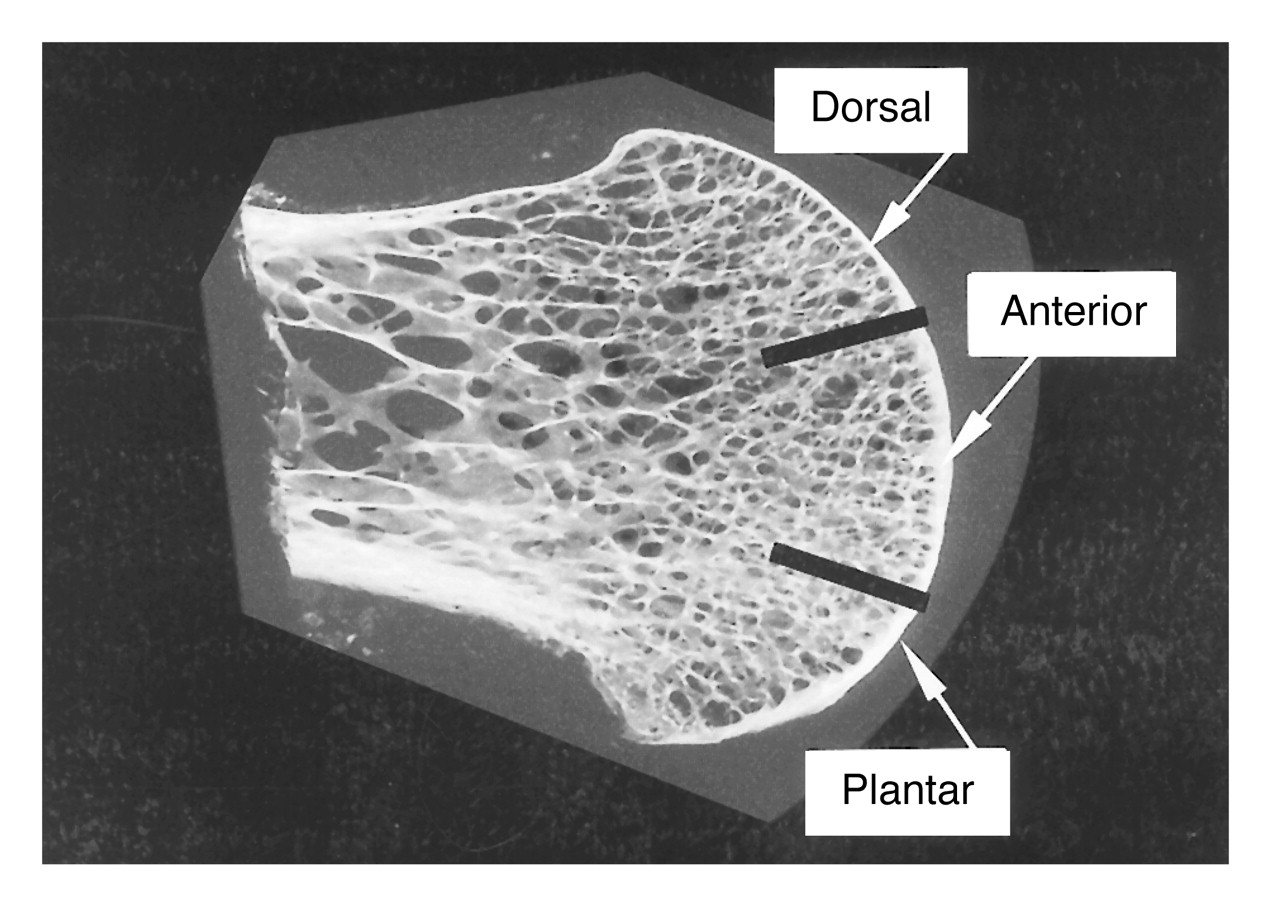
The head of each metatarsal was removed from the whole bone, fixed in 10% formalin (in the case of fresh specimens), hemisected, dehydrated in a graded series of ethanol, cleared in xylene, and embedded in methylmethacrylate. Four 0.75-mm sections were taken from the median face of each of the original midsagittal planes and attached to a plastic slide (median face down). The sections were then carbon-coated with a TB 500 TEMCARB Carbon Coater (BioRad Microscience Division, Cambridge, Massachusetts), and backscatter scanning electron microscopy (BS-SEM) imaging was carried out with a scanning electron microscope (model 840A, Japanese Electrical Optical Ltd, Peabody, Massachusetts) at 25 kV, a beam current of 100 μA, a working distance of 15 mm, and a magnification of ×30. The BS-SEM images were stored digitally and analyzed with an image-analysis system (Image-Pro, version 3.0 for Windows, Media Cybernetics, Silver Spring, Maryland) and measured for subchondral plate thickness on the dorsal, anterior, and plantar articular surfaces (as represented by dividing the articular surface into three equal regions) of each section of the metatarsal head.
Figure 1 shows a representative radiograph of a methylmethacrylate-embedded sagittal section from one of the metatarsals with the subchondral plate labeled in the three anatomical regions. Porosity was calculated as the percentage of uncalcified area within the subchondral plate.
Statistical Analysis
Analysis of variance and nonparametric correlations were conducted to determine if subchondral plate thickness and porosity and ratios of subchondral plate thickness in adjacent regions of a section were correlated with the grade of articular cartilage degeneration, age, gender, and osteophyte grade. Statistical significance was set at P ≤ .05.
Results
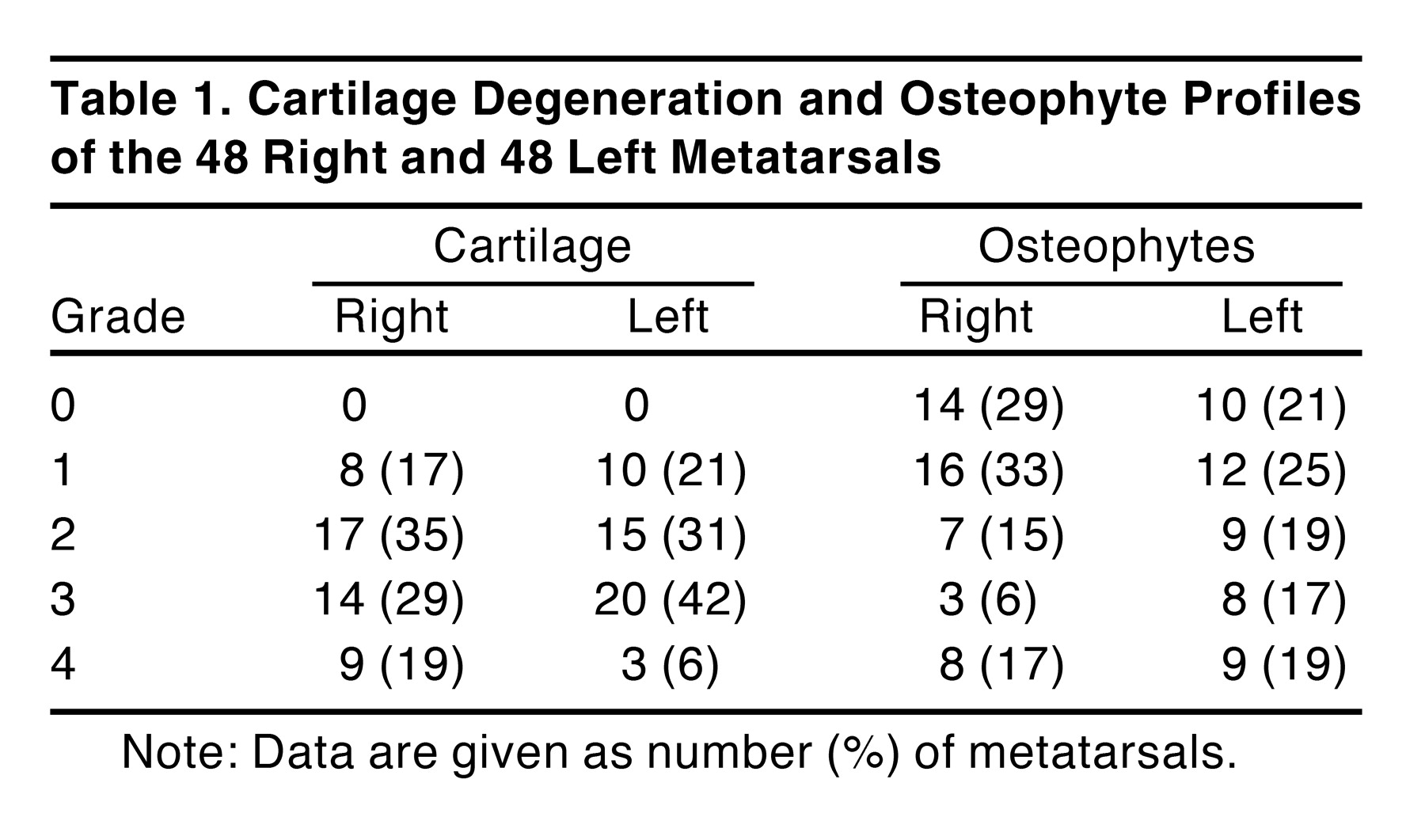
Table 1 shows the cartilage degeneration and osteophyte grade profiles of the metatarsals. None of the metatarsals displayed completely normal-appearing cartilage, with the lowest grade being 1. Overall, cartilage grades 2 and 3 represented the highest percentage within the sample. Osteophyte grades ranged from 0 to 4, with the greatest representation in grade 1.
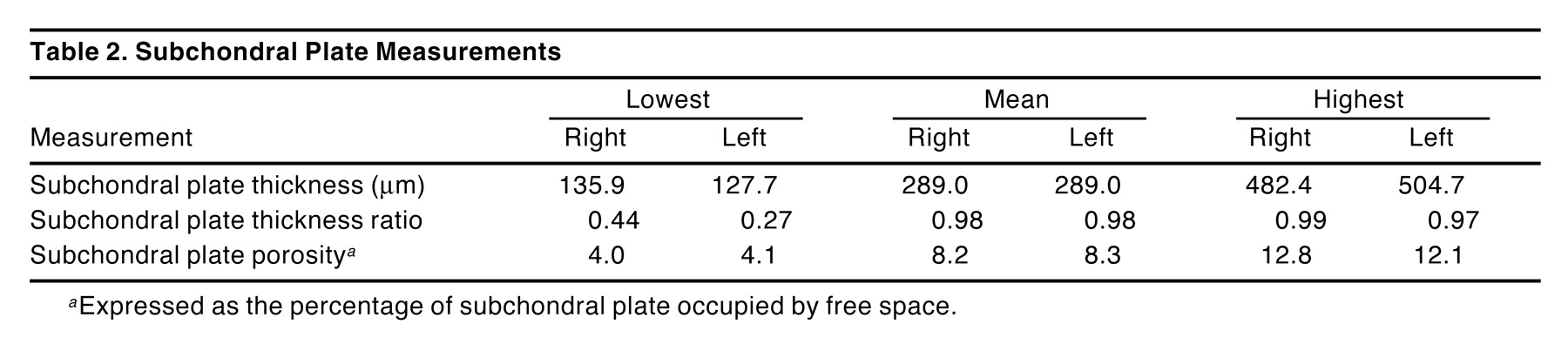
No correlation was found between subchondral plate thickness or porosity and age of donor, grade of cartilage degeneration, or grade of osteophytosis. Ratios of cartilage thickness between adjacent regions of the metatarsal head (ie, medial to lateral, plantar to anterior, anterior to dorsal) ranged from 0.27 to 0.99 (or approximately 1:4 to 1:1). No correlations were found between ratios of subchondral plate thickness in adjacent regions and grade of cartilage degeneration. Subchondral plate porosity ranged from 4.0% (in a 57-year-old woman) to 12.8% (in an 87-year-old woman) with means of 8.2% and 8.3% for the right and left metatarsals, respectively (
Table 2).
No significant difference was found between right and left metatarsals with regard to grade of cartilage degeneration or osteophytosis. A significant difference was found between men and women in the average subchondral plate thickness across the metatarsal head, with men displaying the thicker plate (
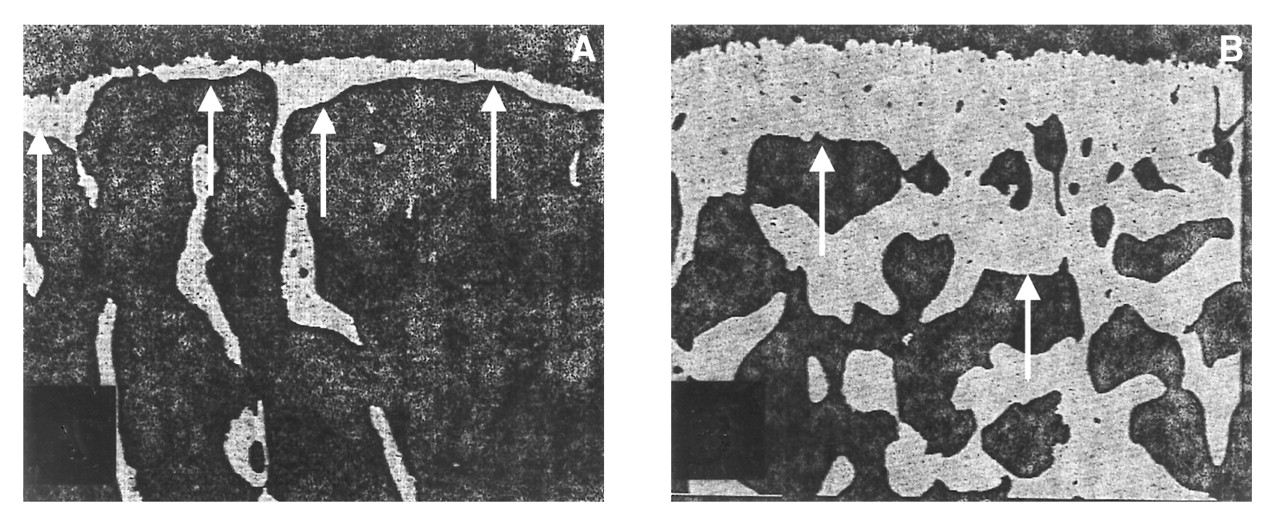
P = .042). Average subchondral plate thickness across a single metatarsal head varied from 127.8 μm in a 78-year-old woman (
Fig. 2A) to 504.7 μm in a 74-year-old man (
Fig. 2B), with a mean of 289.0 μm (
Table 2).
Twenty-five donors had equal grades of cartilage degeneration on the left and right metatarsals (referred to here as symmetrical), while 23 donors had unequal grades (asymmetrical). Within the subset of 23 asymmetrical donor pairs, when the subchondral plate was thicker on the metatarsal with greater cartilage degeneration (in 12 pairs, or approximately 50% of the samples), this metatarsal also had the higher grade of osteophytosis. This was not the case for the symmetrical pairs, in which the thicker subchondral plate had no association with the degree of osteophytosis.
Figure 1.
Radiograph of a representative methylmethacrylate-embedded sagittal section from a metatarsal head. The three anatomical regions into which each subchondral plate was subdivided for individual porosity and thickness measurements are labeled.
Figure 1.
Radiograph of a representative methylmethacrylate-embedded sagittal section from a metatarsal head. The three anatomical regions into which each subchondral plate was subdivided for individual porosity and thickness measurements are labeled.
Table 1.
Cartilage Degeneration and Osteophyte Profiles of the 48 Right and 48 Left Metatarsals
Table 1.
Cartilage Degeneration and Osteophyte Profiles of the 48 Right and 48 Left Metatarsals
Table 2.
Subchondral Plate Measurements
Table 2.
Subchondral Plate Measurements
Discussion
The purpose of the present study was to investigate the relationship between subchondral plate thickness and the degree of cartilage degeneration on the head of the first metatarsal bone. This articular component of the first metatarsophalangeal joint of the foot is particularly prone to the degenerative and painful effects of osteoarthritis.[
29,
30] These lesions are well characterized by cartilage degeneration on the anterior and plantar aspects of the articular surface and by the presence of osteophytes at the cartilage/bone margin, leading to a partial or total loss of mobility at the joint. In the present study, neither subchondral plate thickness, porosity, nor osteophytosis was correlated with the grade of articular cartilage degeneration observed on the metatarsal head. The only significant relationship was with gender, with men having greater subchondral plate thickness than women (
P = .042).
The authors measured the subchondral plate, consisting of both the subchondral bone and calcified cartilage, in relation to the degree of articular cartilage degeneration. It has been suggested that the calcified cartilage layer should be considered an integral component of the subchondral plate in the evaluation of the association between subchondral tissues and articular cartilage degeneration,[
31] as Johnson[
32] showed that tidemark advancement, leading to thinning of the articular cartilage, results in increased mechanical stress in the cartilage. Other studies have also associated the advancement of the zone of calcified cartilage with thinning of the overlying cartilage[
33] and with joint space loss.[
34]
Figure 2.
Examples of backscatter scanning electron microscopy images from two extremes of subchondral plate (arrows) thickness measurements (×30): A, 78-year-old woman with an extremely thin plate (127.8 μm); B, 74-year-old man with a relatively thick plate (504.7 μm).
Figure 2.
Examples of backscatter scanning electron microscopy images from two extremes of subchondral plate (arrows) thickness measurements (×30): A, 78-year-old woman with an extremely thin plate (127.8 μm); B, 74-year-old man with a relatively thick plate (504.7 μm).
The subchondral plate was studied across the head of the metatarsal and examined individually in three separate regions (dorsal, anterior, and plantar) within two midsagittal sections. The findings of this study demonstrate that there was no correlation between the total mean subchondral plate thickness or porosity from any of the anatomical regions measured and the grade of articular cartilage degeneration. Furthermore, no significant correlation was found between the subchondral plate thickness or porosity in any one sagittal section or topographic region of the metatarsal head and grade of articular cartilage degeneration. Porosity of bone, as a reflection of the amount of bone within a given region, is an important consideration because this parameter also provides information about the quality of the bone beneath the cartilage. However, the current data do not support the hypothesis that a thicker and less porous subchondral bone would be less able to absorb forces and therefore would distribute those forces to the overlying articular cartilage and cause cartilage degeneration.
The study sample did not include any specimens with perfectly normal-appearing cartilage (grade 0), but this is typical of an adult population in which fibrillation is considered a normal feature of the synovial joint.[
35]
Although this donor population was elderly, it has been previously shown that the thickness and density of the subchondral bone of the human knee joint, as measured on radiographs, show no correlation with age, gender, grade of osteoarthritis, body weight, or body mass index (the weight in kilograms divided by the square of the height in meters).[
24] The current study also found no correlation between age and subchondral plate thickness; however, it is possible that with a mean age of 75 years such a correlation would not be found because of the lack of full representation of all age groups within the sample.
There is a possibility of sampling error in the study because measurements were made on midsagittal and near-midsagittal sections of the metatarsal head. It should be emphasized, however, that all cartilage degeneration observed spanned an area that included at least a portion of the midsagittal region of the metatarsal head from which the sections were taken.
In a review of the involvement of subchondral mineralized tissue in osteoarthrosis, Burr and Schaffler[
31] concluded that changes in the subchondral tissue are not required for initiation of cartilage fibrillation, but may be necessary for progression. Furthermore, only changes in bone and calcified cartilage close to the joint were deemed significant to the disease. However, in a study of naturally occurring osteoarthritis in cynomolgus macaques, Carlson et al[
18] found thickening of the subchondral plate prior to any degenerative changes in the articular cartilage. The plate was particularly thickened in the medial tibial plateau, where cartilage changes were the most severe. In view of the conflicting results of this work and the present study, it must be asked whether the association between subchondral bone thickness and cartilage degeneration is joint-specific.
Because of the suggestion of Radin and Rose[
26] that initiation of cartilage fibrillation is caused by steep stiffness gradients in the subchondral bone, the current authors chose to pay particular attention to ratios between subchondral plate thickness in adjacent regions of the metatarsal head in relation to the grade of cartilage degeneration. However, this analysis also revealed no correlation with grade of cartilage degeneration. Thus neither a thicker subchondral plate nor a differential in subchondral plate thickness across an articular surface was related to degradation of the overlying cartilage.
Viewing the data from a different angle, it was found that when comparing the two metatarsals of a single individual, the metatarsal with the thicker subchondral plate always had the higher grade of osteophytosis. In this context, then, the two conditions appear to be linked at some level. Perhaps this is a reflection of an overall bone response, rather than simply an issue of subchondral plate thickness.
Indeed, the 1993 Framingham Study[
36] concluded that femoral bone mineral density among women was higher in those with osteophytosis of the knee, and bone mineral density was not necessarily associated with joint space narrowing. Osteophytosis may be a reparative process, or perhaps a redistribution response to changes in weightbearing, stress distribution, or microfractures.[
37-
39]
To address the issue of thickened subchondral bone leading to early cartilage degeneration, such as fibrillation, the authors compared the subchondral plate thickness in donors with different grades of cartilage degeneration on the right and left metatarsals (asymmetrical). If one considers the suggestion by Burr and Schaffler[
31] that changes in subchondral mineralized tissues are not needed for initiation of cartilage fibrillation, but may be necessary for progression, it follows that the side with early signs of cartilage degeneration should have a thinner subchondral plate than the side with more severe signs. The current study data, however, showed no significant difference in subchondral plate thickness between asymmetrical pairs, even when the difference between the left and right elements was two grades or more.
Conclusion
No correlation was found between subchondral plate thickness or porosity and the degree of overlying articular cartilage degeneration in this sample of first metatarsals. These results for the first metatarsal agree with those of Yamada et al[
24] for the distal femur; those authors stated that increases in subchondral bone thickness are not associated with increases in cartilage degeneration. This may imply that the relationship between local pathologic bone changes and cartilage degeneration is joint-specific or that subchondral bone changes do not cause osteoarthritis.