Next Article in Journal
The Publications of APMA
Previous Article in Journal
Introduction
 
 
Journal of the American Podiatric Medical Association is published by MDPI from Volume 116 Issue 1 (2026). Previous articles were published by another publisher in Open Access under a CC-BY (or CC-BY-NC-ND) licence, and they are hosted by MDPI on mdpi.com as a courtesy and upon agreement with American Podiatric Medical Association.
Article

2002 Podiatric Practice Survey. Statistical Results

by
Al Fisher Associates, Inc
406 New Mark Esplanade, Rockville, MD 20850-2735
J. Am. Podiatr. Med. Assoc. 2003, 93(1), 67-86; https://doi.org/10.7547/87507315-93-1-67
Published: 1 January 2003

Abstract

This report presents the results of analyses of statistical data from 2,955 members of the American Podiatric Medical Association who responded to the 2002 Podiatric Practice Survey, conducted in April through May 2002.

Background

The American Podiatric Medical Association (APMA) designed the 2002 Podiatric Practice Survey to collect updated information on the podiatric practices and income of its membership. The 2002 survey is the third in a series of APMA member surveys of podiatric practice. Previous surveys were conducted in 1996 and 1998.
Surveys of podiatric practice have a long but intermittent history. Early surveys of podiatrists were administered by the US government in 1970 and 1974 (National Center for Health Statistics, 1978). APMA conducted the first all-member survey in 1984 (Skipper and Pippert, 1985). In 1992, the American Association of Colleges of Podiatric Medicine (AACPM) conducted a stratified sample survey of the net income data of full-time podiatric physicians (McNevin, 1993). The 1996 Podiatric Practice Survey (Al Fisher Associates, Inc, 1996) provided estimates of 1995 practice income for all members as well as data on current student loan debt, member practice characteristics, educational background, board certification, and demographic variables.
The 1998 Podiatric Practice Survey (Al Fisher Associates, Inc, 1998) updated the results of the 1996 survey. It provided data on 1997 practice income for all members, as well as information on practice experience, educational background, board certification, continuing medical education (CME), student loan debt, staff hospital privileges, and demographic variables.
The 2002 Podiatric Practice Survey repeated core questions on income and podiatric practice from the 1996 and 1998 surveys. New questions were included on foot conditions treated, history and physical (H&P) examinations, and sources of practice income, including health plans, managed care, Medicare, and Medicaid.
The 2002 survey had four major objectives:
1) To allow members to compare practice arrangements and income
2) To provide the colleges of podiatric medicine with student loan indebtedness information so that they may analyze student loans as a function of projected future income
3) To establish income data for legal issues affecting the profession
4) To help the APMA answer questions from health and managed-care organizations, prospective podiatry students, and other interested parties about the practice of podiatric medicine and physician income.

Methods

Data-Collection Instrument

A two-page, 30-question survey form was designed by the APMA to collect information on the following topics:
1) General practice information (practice arrangements, size, ownership/employee status, location, and experience)
2) Educational background (dates of graduation from colleges of podiatric medicine, podiatric residency programs completed, amount of student loan indebtedness at graduation and at present, and professional podiatric organizations with which members are board eligible or certified)
3) Practice experience in 2001 (weeks worked, hours worked per week, average number of patient visits per week, percentage of each working day spent treating patients as opposed to administration, foot conditions treated, H&P examinations performed, and the number of hospitals at which members have various types of staff privileges)
4) Practice income in 2001 (total gross income, total net income, sources of practice income, changes in net income from 2000 to 2001, and reasons for those changes)
5) Demographic data (member age, gender, and ethnic background).
Most of the responses to the questions were precoded to facilitate member response and expedite data processing. The survey was anonymous. The data-collection instrument appears in Appendix A.

Sample

The entire active membership of the association was surveyed (N = 9,392) to ensure adequate representation in categories with fewer members.

Administration

The survey was included in an APMA Alert sent by mail on April 8, 2002. A response date of May 15, 2002, was specified. A postage-paid business reply envelope was included to increase response. To encourage response, members received an advance announcement by e-mail and a reminder e-mail, and another APMA Alert announcement was made in April. A special attempt was made to increase participation by younger members.
By June 3, 2002, the actual cutoff date of the survey, 2,955 completed questionnaires had been received. The overall response rate for the survey was 31.5% (Table 1). All of the 2,955 respondents provided information about their years of practice experience. Slightly higher response rates were obtained from more experienced members: 32.9% of members with 10 or more years’ experience responded, compared with 27.8% of members with less than 10 years’ experience.

Results

General Practice Information

Information was obtained on current practice arrangements, practice ownership status, practice location, and years of practice experience of APMA members.
Primary Practice Arrangement. Solo practice was the primary arrangement of most respondents in 2002 (56.6%) (Table 2). Other respondents practiced primarily in a partnership or group practice setting (37.1%): 15.1% practiced in a partnership, 16.5% in a podiatric medical group, and 5.5% in a multispecialty group. The remaining 6.3% of respondents practiced in other settings: health maintenance organizations (HMOs) (0.9%), the Department of Veterans Affairs (VA) or military service (1.2%), multiple arrangements (0.8%), or “other” (3.3%). Only two respondents were retired (0.1%). Over time, the percentage of members in podiatric medical groups has increased while the percentage of solo practitioners has decreased. Age was related to member practice arrangements. Solo practitioners tended to be older (average age: 47.0 years), while younger members were more likely to be in group practice, ie, partnerships (43.4 years), podiatric medical groups (44.0 years), or multispecialty groups (41.3 years). Members who practiced in the VA or military service had an average age of 45.7 years. Members in HMOs averaged 44.8 years of age.
Practice Size. Most podiatric practices were small. Members in partnership arrangements reported a median of 2.0 physicians in their practice, while members in podiatric medical groups reported a median of 3.0 physicians. Much higher numbers of physicians were reported by members who practiced in multispecialty groups (median: 35.75 physicians) or HMOs (median: 100.0 physicians).
Practice Ownership Status. Most respondents in private practice were owners (82.1%) rather than employees (13.9%) or independent contractors (3.6%). A few members reported more than one status (0.4%). Results were similar in 1998, when 80.0% were owners, and in 1996, when 82.2% were owners.
Practice Location: State and Region. The distribution of respondents by US Census region was as follows: 28.2% Northeast, 23.6% Midwest, 29.9% South, and 18.3% West. Respondents practiced in all 50 states, as well as the District of Columbia and Puerto Rico.
Practice Location: Urban, Rural, or Suburban. In 2002, as in 1998 and 1996, most respondents practiced in either an urban or a suburban area, as opposed to a rural area. In 2002, 31.8% of respondents practiced in an urban area and 48.3% practiced in the suburbs. Only 15.7% of respondents practiced in a rural area. The remainder practiced in more than one setting (4.2%).
Years of Practice Experience. Most respondents had between 3 and 19 years of experience practicing podiatric medicine (56.5%). Only 7.5% had fewer than 3 years of experience, and 36.0% had 20 or more years of experience.

Educational Background

Information was obtained about the graduation dates of APMA members from colleges of podiatric medicine and completion of podiatric residency programs. The current amounts of their student loan indebtedness were determined for comparison with their student loan debts at graduation. Board certification status was also determined.
Colleges of Podiatric Medicine. Most respondents in the 2002 survey graduated from a podiatric medical college between 1976 and 1995 (69.0%). The remaining respondents graduated before 1976 (16.7%) or after 1995 (14.3%).
Podiatric Residency Programs. Most respondents (90.2%) reported having completed residency programs in the 2002 survey. This represents an increase from 1998 (89.5%) and 1996 (87.2%). In 2002, 66.3% reported completing podiatric surgical residency (PSR) programs, as did 64.9% in 1998 and 61.4% in 1996. Another 23.9% reported completion of other residency programs in the 2002 survey. Only 9.8% indicated that they had not completed any podiatric residency program. Some of these respondents were older members who began practicing podiatric medicine before these residency programs existed.
The 2002 respondents completed the following podiatric medicine residency programs in surgery: PSR-12 (40.5%), PSR-24 (19.8%), and PSR-24+ (6.0%) (Table 3). Another 8.3% completed a preceptorship. Fewer respondents completed the following programs: rotating podiatric residency (RPR) (6.2%), podiatric orthopedic residency (POR) (2.4%), and primary podiatric medicine residency (PPMR) (1.7%).
Some 3.3% completed a residency program other than those listed in the survey, eg, a program in the military service. Another 2.1% of respondents completed multiple programs.
Practice experience was strongly related to completion of podiatric residency programs in each survey (Table 4). In 2002, most members with 35 or more years of practice experience had not completed a residency program (63.2%), but the majority of members with less than 35 years of experience had done so. For example, 100% of members with 0 to 2 years of experience have completed a residency, as have 99.7% of members with 3 to 5 years’ experience and 100% with 6 to 9 years’ experience. Surgical residency rates also varied with experience and were much higher among members with less than 20 years of experience (70% to 86%).
Amounts of Student Loan Indebtedness at Graduation. Most respondents reported some amount of original student loan indebtedness at graduation in the 2002 survey (84.5%), as was the case in the 1998 survey (83.5%). About half of the respondents had an original student loan indebtedness of $50,000 or less (50.7%). Another 20.5% had outstanding student loans of between $50,001 and $100,000. However, 28.7% had a total student loan indebtedness in excess of $100,000.
Table 5 provides detailed information on the original student loan indebtedness of the survey respondents in 1998 and 2002. Debt at graduation was not determined in 1996. The average amount of student loan debt at graduation for respondents in 2002 was $60,702, compared with $57,367 in 1998. The median amount was $45,000 in each survey.
Current Amounts of Student Loan Indebtedness. In the 2002 survey, 36.9% of respondents reported some amount of current student loan indebtedness as of December 31, 2001. Most respondents had no current student loan indebtedness (63.1%), although most had debt at graduation.
Table 6 provides detailed information on the student loan indebtedness of APMA members in the surveys conducted from 1996 to 2002. The average current student loan debt in 2002 was $35,865, compared with $41,571 in 1998 and $38,735 in 1996. However, the median amount was $0 in each year since most members had no current debt.
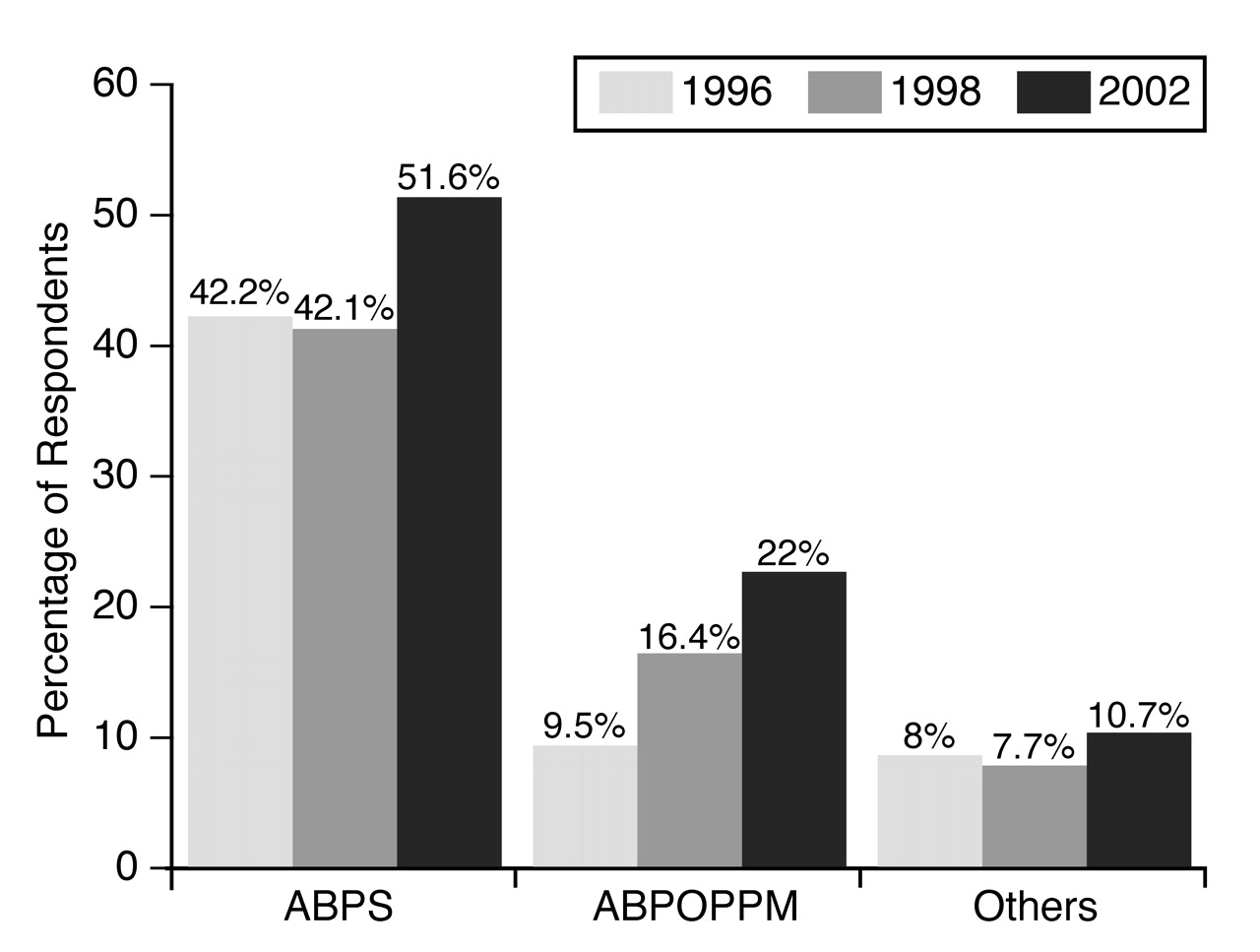
Board Certification. In 2002, most respondents were board certified by either the American Board of Podiatric Surgery (ABPS) (51.6%) or the American Board of Podiatric Orthopedics and Primary Podiatric Medicine (ABPOPPM) (22.0%). Some 10.3% were certified by both organizations. Some respondents were board certified by an organization other than ABPS or ABPOPPM (10.7%). Only 36.8% were not certified by any organization.
The survey determined both board eligibility and certification. For ABPS, 19.5% reported being eligible, in addition to the 51.6% who were board certified. For ABPOPPM, 5.0% reported being eligible, in addition to the 22.0% who were board certified.
Gender and experience were important factors in board certification. Male members were much more likely to be board certified by ABPS (55.8%) than female members (30.6%). In contrast, far more female members were eligible for ABPS certification (36.4%) than male members (15.3%). Female members were as likely to be board certified by ABPOPPM (22.4%) as male members (22.6%). However, female members were more likely to be board eligible for ABPOPPM (11.2%) than male members (3.7%).
Summary. The rates of completion of podiatric residency programs have increased over the past three surveys. In addition, the percentage of respondents who completed surgical residency programs increased markedly, while the percentage who completed other programs declined.
The 2002 survey provided a recent estimate of the percentage of members with student debt at graduation (84.5%). The survey also showed that most members reduced or eliminated their student debt, although 36.9% still carried debt in 2002.

2001 Practice Experience

The survey examined the practice of podiatric medicine in 2001 in detail. APMA members were queried as to the number of weeks worked in 2001, the average number of hours worked each week, patient visits per week, and the percentage of time spent treating patients each day, as well as the most common foot conditions treated by members and the extent of staff privileges at hospitals. Issues involving H&P examination restrictions were also examined.
The Practice of Podiatric Medicine in 2001. Most active respondents practiced podiatric medicine in 2001 (99.3%), as in 1997 (99.0%), and 1995 (97.0%).
Weeks Practicing Podiatric Medicine in 2001. Most respondents who practiced podiatric medicine in 2001 worked 46 weeks or more (91.9%). Another 5.1% worked 40 to 45 weeks, and only 3.1% worked fewer than 40 weeks.
Age was a factor in the number of weeks worked in 2001. Members aged 35 to 64 years worked more weeks than members under age 35 or over age 64. Gender was also a statistically significant factor in the number of weeks worked. In 2001, female members worked 47.1 weeks on average, compared with 48.6 weeks for male members.
Hours per Week Spent Practicing Podiatric Medicine in 2001. Most respondents who practiced podiatric medicine in 2001 practiced between 30 and 59 hours per week on average (79.3%), as was the case in 1997 (77.5%) and 1995 (79.1%). Another 10.2% worked more than 60 hours a week in 2001. Only 10.5% practiced fewer than 30 hours per week in 2001. The average number of hours worked per week in 2001 was 41.8.
Age was a major factor in the number of hours worked per week. The most hours worked per week in 2001 were reported by members under the age of 35 (44.3 hours), followed by members aged 35 to 44 (43.7 hours). Hours worked per week declined for members after age 44. Members older than 64 averaged 25.3 hours per week in 2001.
Patient Visits per Week in 2001. A large increase was found in the number of patient visits per week in 2001. The average number of patient visits per week in 2001 was 101.4, compared with 93.5 in 1997 and 92.0 in 1995. The median number of patient visits per week increased to 100.0 visits per week in 2001 from the 90.0 visits per week found in 1995 and 1997. Most respondents who practiced podiatric medicine in 2001 had a caseload of between 60 and 139 patient visits per week (65.1%), more than were found in 1997 (59.7%) and 1995 (57.8%). Another 16.0% had fewer than 60 patient visits per week in 2001, while 18.9% saw 140 or more patients per week.
The age of the respondent was related to the number of patient visits per week in 2001 and 1997. In both surveys, the relationship was curvilinear. In 2001, members aged 35 to 64 had the most patient visits per week (averaging more than 100 visits per week). In contrast, members under age 35 reported 80.9 patient visits per week, while members older than 65 averaged 61.9 visits per week.
Percentage of the Working Day Spent Treating Patients and in Administration in 2001. In 2001, respondents spent on average 77% of their time treating patients and 23% of their time completing administrative duties. (The median percentages were 80% patient care and 20% administration.) Most respondents in 2001 spent 50% to 99% of their working day treating patients (93.9%). Only 3.4% spent less than half of their time treating patients, while 2.7% spent 100% of their time treating patients.
In 1997, most respondents spent 50% to 99% of their working day seeing patients (91.7%). The average percentage of the day spent seeing patients in 1997 was 73.3%, and the median percentage was 75.0%.
The Most Common Foot Conditions Treated. The most common foot conditions treated by the survey respondents are detailed in Table 7. The most prevalent conditions seen were heel pain and plantar fasciitis (44.8%), fungal nails (23.9%), ingrown toenails (8.9%), and other nail problems (9.9%). While 87.5% reported one of these four conditions as the most common condition treated, another 12.5% cited 17 other conditions. Diabetic foot care was cited by 4.4% of respondents, while 1.8% cited ulcers and wound care, 1.6% cited corns and calluses, and 1.1% cited bunions. Less than 1% of the respondents cited each of the other conditions.
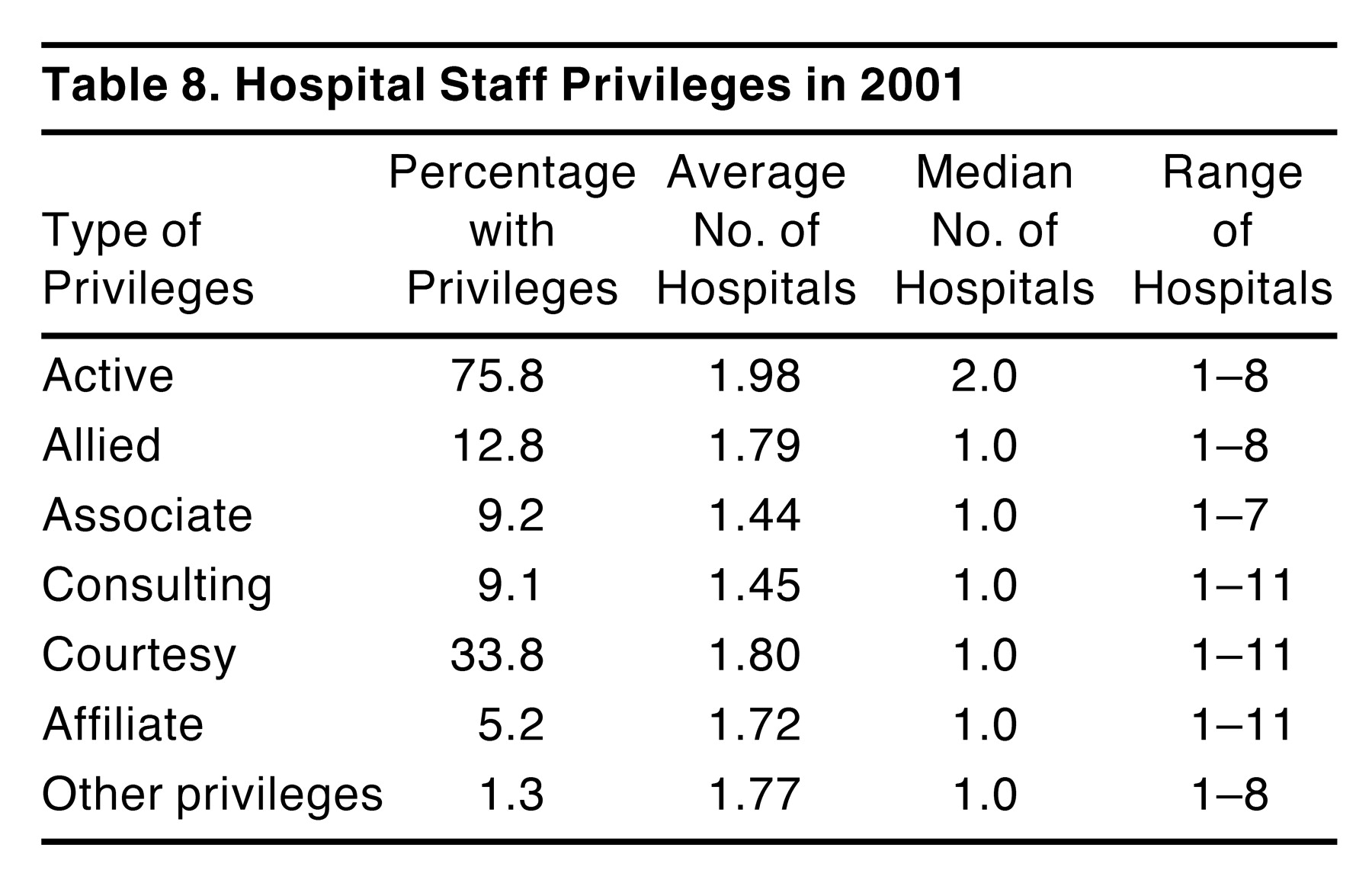
Hospital Staff Privileges in 2001. Members were queried about hospital staff privileges in 2001 (Table 8). Most respondents enjoyed staff privileges of some type at one or more hospitals (95.0%). The majority reported having active privileges in 2001 (75.8%). Of those with active privileges in 2001, the average number of hospitals where they had these privileges was 1.98 (median: 2 hospitals). In 2001, the second most frequently held privileges were courtesy privileges (33.8%). Most members had staff privileges at no more than 1 or 2 hospitals, but a few reported privileges at as many as 11 hospitals.
The Performance of H&P Examinations. Most members never perform their own complete H&P examinations for inpatient admissions (78.4%). In contrast, 21.6% independently perform their own complete H&P examinations for inpatient admissions either always (7.7%) or sometimes (13.9%). Many members were unsure as to whether they were restricted by state or federal laws from performing complete H&P examinations for inpatients (41.7%). While 30.4% said that they were restricted, 27.8% said that they were not.
Summary. Members seemed to work a little harder in 2001 than they did in 1997 and 1995. For example, they reported more patient visits per week in 2001 (101.4 visits per week) than in 1997 (93.5 visits per week) and 1995 (92.0 visits per week), and the median number of visits increased to 100.0 visits per week from 90.0 in 1997 and 1995. These increases are noteworthy because patient visits per week predict income—the more visits, the higher the practice income.
Patient visits per week were related to member age. Higher numbers were reported by members aged 35 to 64 years. Lower numbers were reported by members younger than 35 or older than 64. Hours worked per week decreased with age, while the percentage of time spent treating patients increased.

2001 Physician Income

The survey requested information from APMA members on both their net and gross income for the reference year of 2001. The base for these analyses was active members who practiced podiatric medicine in 2001.
Gross Income in 2001. The average gross income for 2001 was $276,680, slightly higher than in 1997 ($254,488) and 1995 ($251,570). However, the median gross income in each survey was the same at $225,000. Almost half of the respondents reported total gross incomes for 2001 between $100,001 and $300,000 (45.8%). Another 18.3% reported gross incomes of $100,000 or less. In contrast, 35.9% reported total gross incomes of more than $300,000. Only 4.9% had gross incomes in 2001 of less than $50,000. At the other extreme, 12.1% grossed more than $500,000 and 4.0% enjoyed a total gross income of more than $700,000 in 2001. Table 9 provides complete details on the number and percentage of respondents in each category of total gross income for 2001, 1997, and 1995.
Best Predictors of 2001 Total Gross Income. The best predictor of gross income was the number of patient visits per week reported by the respondent. In order of selection, the best factors for predicting gross income were 1) patient visits per week, 2) ABPS board certification, and 3) ownership of practice.
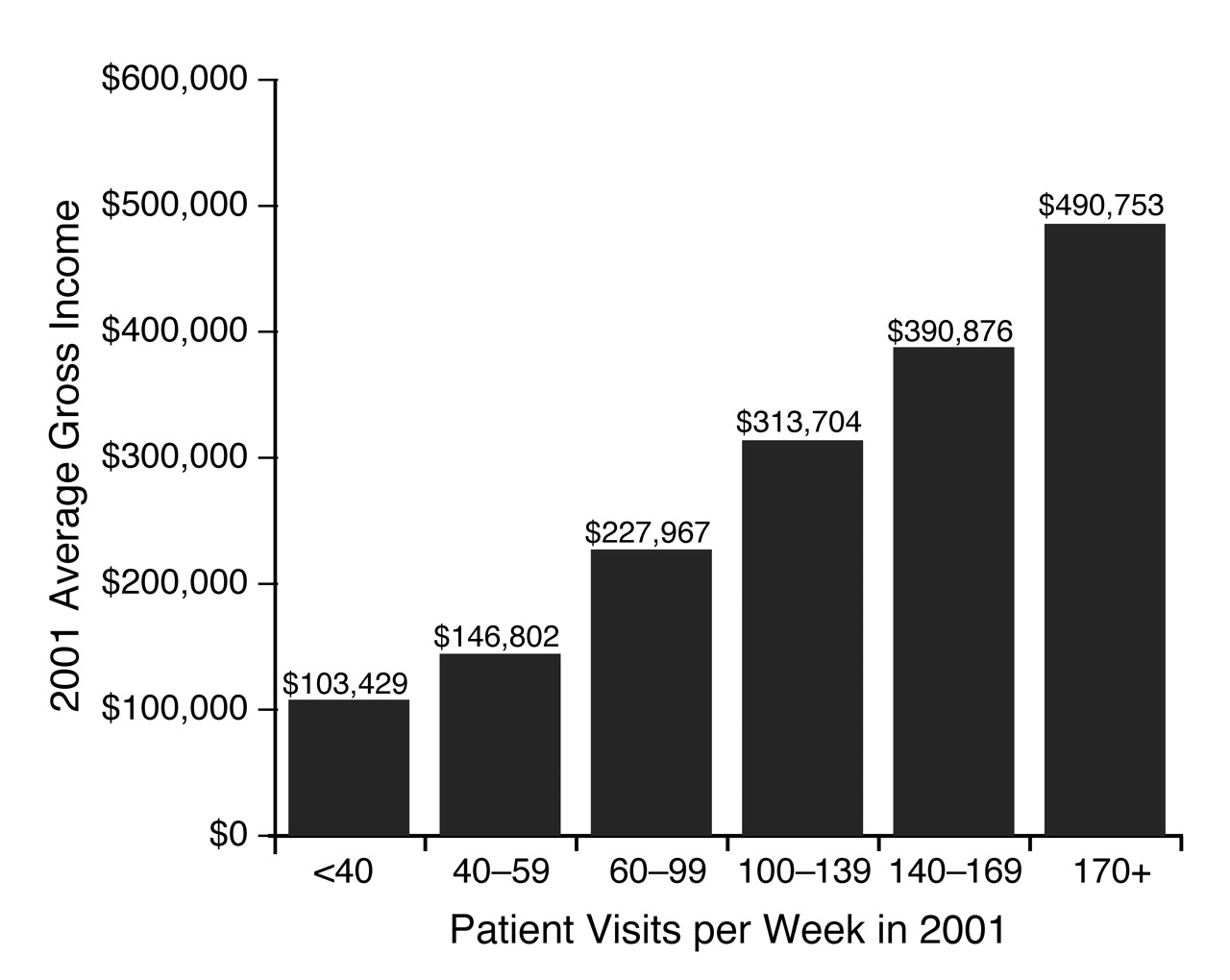
Figure 1 illustrates the relationship of patient visits per week to total gross income in 2001. The typical APMA member had 100 patient visits per week in 2001. Members with fewer patient visits had much lower gross incomes than members who saw more patients per week. Patient visits per week were also the best predictor of gross income in 1995 and 1997. The addition of the second factor (ABPS board certification) significantly improved the prediction of gross income.
About 52% of respondents were ABPS certified in 2001. Board-certified members averaged much higher gross incomes ($351,061) than members who were not board certified ($203,514).
Practice ownership was the third best predictor of gross income. Owners averaged $303,157, compared with $187,537 for nonowners.
Additional Factors in 2001 Total Gross Income. Geographic location was a significant factor in the total gross income reported by members for 2001. Differences in gross income among the US Census regions were statistically significant, although wide variation was found among states in a given region. Members in the Northeast ($256,171) and West ($282,804) averaged lower gross incomes than members in the South ($295,104) and Midwest ($291,589).
Net Income in 2001. The average net income for 2001 was $134,415, up considerably from $110,631 in 1997 and $108,156 in 1995. Moreover, the median net income increased to $112,500 in 2001, compared with $87,500 in 1995 and 1997.
The majority of respondents reported total net incomes for 2001 between $50,001 and $150,000 (53.7%). Another 14.5% reported incomes of $50,000 or less. In contrast, 31.8% reported total net incomes in excess of $150,000. Only 2.8% of respondents had net incomes of less than $15,000 in 2001, while 2.9% had net incomes of $15,000 to $25,000. At the other extreme, 18.8% reported a total net income of $200,000 or more in 2001, and 5.7% earned more than $300,000. Table 10 provides complete details on the number and percentage of respondents in each category of total net income for 2001, 1997, and 1995.
Best Predictors of 2001 Total Net Income. In order of selection, the best factors for predicting net income for 2001 were 1) patient visits per week and 2) ABPS board certification.
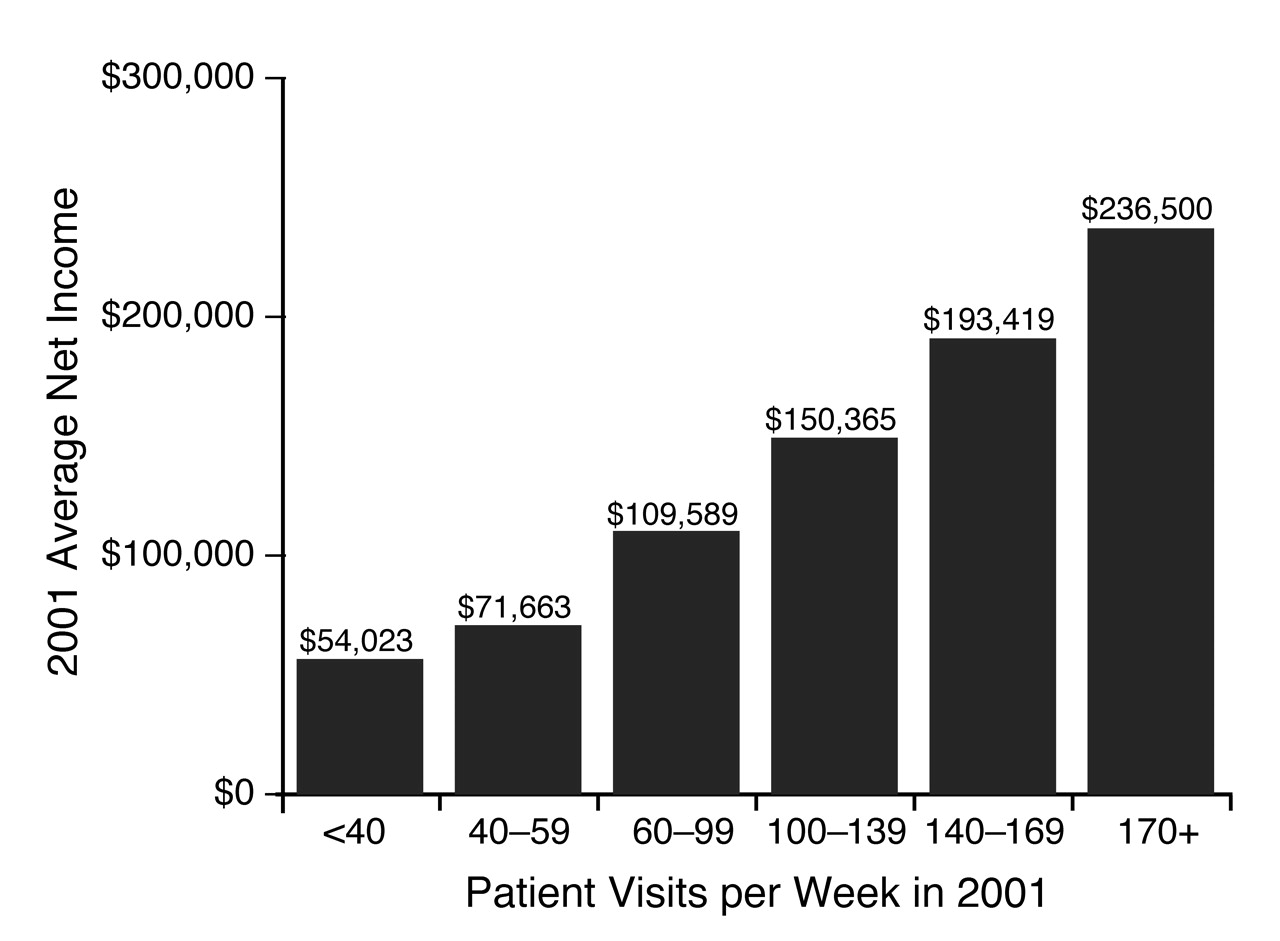
The direct relationship of patient visits per week to total net income in 2001 is shown in Figure 2. The typical APMA member had 100 patient visits per week in 2001. Figure 2 illustrates that members with fewer patient visits earned far less than members who saw more patients per week. There was a strong positive relationship between patient volume and earned net income in 2001, just as there was in 1995 and 1997.
Addition of the second factor (ABPS board certification) significantly improved the prediction of net income. Approximately 52% of APMA members were ABPS certified in 2001. Board-certified members averaged much higher net incomes ($168,732) than members who lacked ABPS certification ($99,594). This finding implies that ABPS certification was an important factor in earned income.
The interactive effects of patient visits and ABPS certification on net income were substantial (Table 11). Members who were ABPS certified achieved much higher net incomes at each level of patient volume. The difference in net income was more than $35,000 for those who saw fewer than 40 patients per week ($83,372 for those certified versus $48,263 for those neither certified nor eligible). For those who saw more than 170 patients per week, the difference was more than $40,000 ($248,082 for those certified versus $201,278 for those eligible and $207,186 for those neither eligible nor certified).
Additional Factors in 2001 Total Net Income. Geographic location was a factor in net income for members in 2001. Differences in net income among the US Census regions were statistically significant, although considerable variation was found among the states in any given region. Members in the Northeast ($128,798) and West ($131,339) had lower average net incomes than members in the South ($142,112) and Midwest ($140,239).
Net Income and Practice Size. Net income increased with the size of the practice for both partnerships and podiatric medical groups (Table 12). Average net income rose as the number of physicians in a group increased. Average net income decreased for partnerships with more than ten physicians, but the number of observations was very small (N = 6). Average net income also decreased to $149,038 for podiatric medical group practices with more than ten physicians. These data were based on 27 respondents. There were too few respondents in multispecialty groups to provide reliable data for practices with fewer than 11 physicians.
Earnings of Beginning Podiatrists. The net income of recent graduates was determined as an indication of entry-level pay or earnings for use by new graduates and employers. There were 83 respondents with 0 to 1 year of experience in this survey. Their median net income was $37,500, compared with $112,500 for all respondents. The top 25% of recent graduates earned $62,500, while the bottom 25% earned only $20,000. The same findings were obtained in 1997.
Net income levels for recent graduates were directly related to the length of their surgical residency program. Average net incomes were $26,711 for those who completed PSR-12, $50,978 for PSR-24, and $51,250 for PSR-24+. Median net income levels were $20,000 for PSR-12, $37,500 for PSR-24, and $62,500 for PSR-24+.
Changes in Net Income: 2000 to 2001. Respondents who practiced podiatric medicine in 2001 were asked whether their net income had changed from 2000 to 2001. Results were mixed, but more respondents reported that their net incomes increased from 2000 to 2001 (56.4%) than reported that their net incomes decreased (22.1%). Another 21.5% described their 2000 and 2001 net incomes as “about the same.” There were more respondents who reported an increase in income from 2000 to 2001 (56.4%) than there were respondents who reported an increase in income from 1994 to 1995 (53.6%), or 1996 to 1997 (47.4%). Conversely, fewer respondents reported a decrease in income from 2000 to 2001 (22.1%) than did respondents from 1994 to 1995 (25.3%) and 1996 to 1997 (30.6%). The percentage of respondents who reported no change was almost identical in each survey (21.1% from 1994 to 1995, 22.0% from 1996 to 1997, and 21.5% from 2000 to 2001).
Why did net income change? Two different methods were used to determine possible reasons for the observed changes in net income from 2000 to 2001. First, each member who reported a change from 2000 to 2001 was asked, “Did your income change due to voluntary actions?” Members who reported a change were given a short list of possible reasons for consideration. Second, practice and demographic variables in the survey were cross-tabulated against changes in income to identify related factors.
Were changes in income voluntary? Among members whose incomes increased from 2000 to 2001, most said that this resulted from changes that they had made (66.9%). Only 32.6% stated that the increase was due to circumstances beyond their control. A few said “both” (0.4%).
Very different results were found for members whose incomes decreased from 2000 to 2001. Only 15.9% said that this decrease resulted from changes that they made, while most attributed the decrease to circumstances beyond their control (82.5%). Again, a few said “both” (1.6%).
Reasons for changes in income. Members provided the reasons for their changes in income from 2000 to 2001 by responding to a list of possible factors. The primary reasons for an increase in income from 2000 to 2001 were a change in patient volume (44.3%) and a change in the mix of services (10.7%). In contrast, the primary reasons for a decrease in income from 2000 to 2001 were a change in reimbursement (44.3%) and the impact of managed care (11.4%).
Best predictors of changes in total net income from 2000 to 2001. An analysis was performed to determine which factors best predicted the observed changes in net income for APMA members from 2000 to 2001.
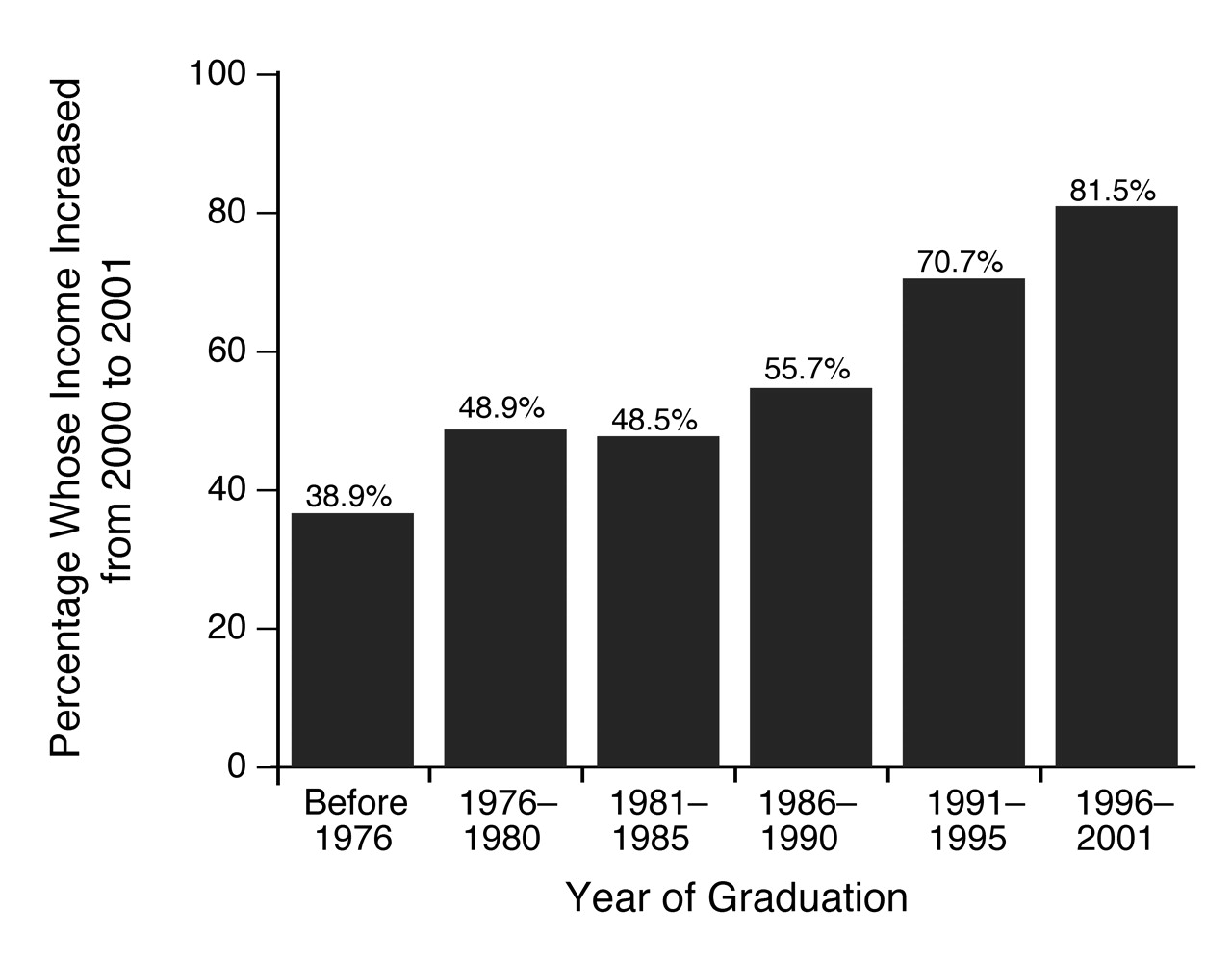
This attempt met with limited success. The date of graduation from a college of podiatric medicine was the only factor that predicted a change in net income from 2000 to 2001, and its correlation was low. Figure 3 illustrates the relationship of the year of graduation to the reported increase in net income from 2000 to 2001. The relationship between the year of graduation and an increase in net income from 2000 to 2001 is positive, meaning that more recent (younger) graduates were more likely than older, more experienced graduates to experience an increase in income on a yearly basis.
Additional Findings. Changes in net income from year to year necessarily reflect changes in practice status such as those experienced by recent graduates (younger members) who begin practice after residency and still carry large student loan debts. For example, younger members are more likely to be employees than owners of their own practice, and they are more likely to receive pay increases or raises. Increased income was reported by 69.1% of employees, compared with 53.3% of owners and 59.1% of independent contractors.
Younger members were more likely to have completed PSR programs of longer duration, and they were more likely to report increases in net income from 2000 to 2001 related to the length of their surgical residency. Increases in income were experienced by those completing a PSR-12 (54.6%), PSR-24 (66.0%), and PSR-24+ (71.9%). Also, younger members are less likely to be certified by ABPS or other organizations. Hence increases in net income were reported more frequently by members who were eligible for certification but not yet board certified (74.1%) than by members certified by ABPS (54.3%).
Sources of Income. The 2002 survey examined the sources of income received by podiatrists. On average, members reported receiving most of their net income from Medicare (38.6%), HMOs (21.6%), and fee-for-service arrangements (18.8%). Members obtained smaller percentages of their income from self-pay (7.4%) and Medicaid (5.7%). Members obtained even less income from capitation (1.8%). They derived 5.9% of their income from other sources.
On average, members in solo practice reported obtaining 41.7% of their net income in 2001 from Medicare, compared with 30.0% for members in multispecialty groups. Members in partnerships or podiatric group practice derived about 37% of their income from Medicare. In contrast, members in multispecialty groups obtained 28.8% of their income from HMOs, compared with 18.6% for solo practitioners. Members in partnerships or podiatric group practice derived about 25% of their income from HMOs.
Differences were found in net income sources by US Census region. For example, HMO income (26%) and Medicare income (42%) were higher in the Northeast region (especially New England) than in other regions. In contrast, fee-for-service income was highest in the Midwest (23%) and Western regions (21%) and lowest in the Northeast (14%).
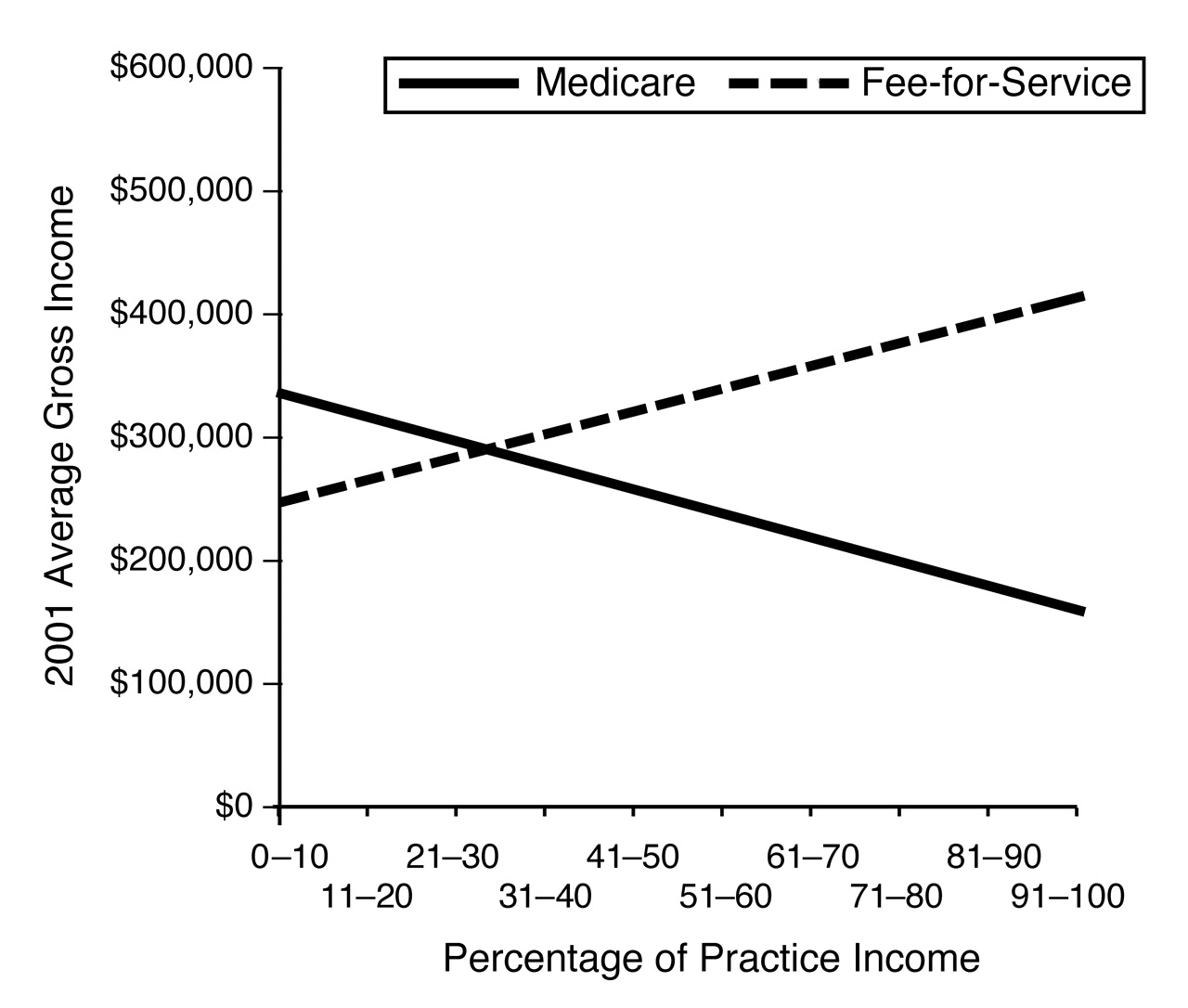
Additional Analyses. Two sources of income had a common impact on members’ income for 2001 (Fig. 4). Both gross and net income increased with each additional percentage of income derived from fee-for-service arrangements, while these income levels decreased with each additional percentage of income derived from Medicare.
Managed Care. Managed care, excluding Medicare and Medicaid, constituted 40% or less of the 2001 income of most APMA members (57.3%). Indeed, many members said that managed care comprised no more than 0% to 20% of their practice (31.2%). While 41.0% claimed that managed care contributed 41% to 99% of their practice, only 1.7% received 100% of their practice income from managed care.
Although percentage differences were small, statistically significant differences were found among the US Census regions in the percentage of managed-care income. Thus managed care constituted 40% or less of the 2001 income of 53.8% of APMA members in the Northeast, 56.8% in the South, 59.1% in the Midwest, and 59.6% in the West.
Health Plans. Members were asked to identify and rank their “Top 6” health-insurance plans, excluding Medicare and Medicaid, in terms of the volume of patients they treat. The highest-ranked plan had the highest volume, while the lowest-ranked plan had the lowest volume. A list of five major insurers was provided for convenience. Members had far more patient coverage with some health plans in 2001 than with others. The vast majority (88.4%) received income from Blue Cross/Blue Shield (average rank of 1.69, where 1.0 is the most patients). In contrast, 70.5% received income from CIGNA (average rank: 3.70), 72.6% received income from United Health Plan (average rank: 3.12), and 71.8% received income from Aetna/US Healthcare (average rank: 3.35). Far fewer members (41.7%) received income from Humana (average rank: 4.62). Only 44.2% received income from any other health plan (average rank: 2.98).
The plan with the most number one rankings (highest patient volumes) was Blue Cross/Blue Shield (ranked first by 65.2%). Other insurance plans trailed Blue Cross/Blue Shield by a considerable margin: CIGNA (ranked first by 2.6%), United Health Plan (ranked first by 9.0%), Aetna/US Healthcare (ranked first by 6.0%), and Humana (ranked first by 2.2%). In addition, a highly diverse group of other health plans were ranked first by 15.0%.
Other Health Plans. While members cited hundreds of health plans other than the five plans listed, only a few were mentioned with much frequency: Oxford, GHI, Health Net, MAMSI/MDIPA, PHCS, and Tufts. Between 44 and 135 of the 2,955 respondents cited each of these plans as a source of income. Remaining plans cited by fewer than 40 members each included Tricare, PHS, MVP, Health America, Keystone, Pacificare, Kaiser Permanente, PPOM, Medica, Coventry, AVMED, Geisinger, and Health Link.
Ratio Analyses: Net Income versus Gross Income in 2001. The extent to which APMA members translated gross incomes into net incomes in 2001 was estimated. Net and gross incomes were analyzed for members who reported data on both measures so that comparisons could be made on an individual basis.
For respondents in total, the median ratio of net to gross income for 2001 was 0.50, a constant for 1997, 1995, and all prior studies. The average ratio of net to gross income for 2001 was 0.56, compared with 0.52 in 1997 and 0.51 in 1995. For 2001, half of the values fell between 0.31 and 0.50, as was the case in 1997 and 1995.


Demographic Data

Age. In 2002, most respondents were between 35 and 54 years of age (68.9%), as was the case in 1998 (62.2%) and 1996 (60.7%). In 2002, 15.4% were younger than 35 while 15.7% were older than 54. The average age of active members was 44.9 in 2002, compared with 41.8 in 1998 and 41.6 in 1996. The median age rose to 45 in the 2002 survey, up from 40 years of age in 1996 and 1998. In 2002, members ranged in age from 27 to 82.
Gender. In 2002, most respondents were male (86.6%), compared with 85.5% in 1998 and 86.7% in 1996. Female members comprised 13.4% in 2002, compared with 14.5% in 1998 and 13.3% in 1996.
Age was a major factor in the gender of respondents. Younger members were much more likely to be female than older members. In 2002, 26.7% of members younger than 35 were women. In contrast, women comprised only 1.0% of members older than 65 in 2002. In 1998, 23.7% of members under 35 were women.
Ethnic Background. In 2002, 90.2% of respondents were white (non-Hispanic); this rate was 90.5% in 1998 and 91.3% in 1996. In 2002, 3.7% were Asian/Pacific Islanders and 1.2% were black. Hispanic/Latino respondents made up 1.8% of total respondents, and 1.4% were American Indian/Native American. Another 1.5% considered themselves to have an ethnic background other than the categories listed, and a few had multiple ethnic backgrounds (0.2%).
Summary. In 2002, most APMA members were young, male, and white (non-Hispanic). The 1996 and 1998 surveys showed the same results. The most notable change from 1998 to 2002 was the increase in age (and experience) of the membership. Both average age and median age increased from 1998 to 2002. Respondents moved into older age groups while the percentage of younger members decreased. Members younger than 35 decreased from 27.6% in 1998 to only 15.4% in 2002. Other changes were minor. The percentage of female members was 13.3% in 1996, 14.5% in 1998, and 13.4% in 2002. The percentage of nonwhite members increased from 8.7% in 1996 to 9.5% in 1998 and 9.8% in 2002.

Discussion

The Productivity of Podiatric Physicians in 2001

One impressive finding from this survey was the high level of practice activity reported retrospectively by active respondents for 2001:
• 91.9% practiced 46 weeks or more
• 67.8% averaged 40 or more hours per week practicing podiatric medicine
• 84.0% averaged 60 or more patient visits per week
• 69.3% spent more than 75% of their working day treating patients.
These figures are important because net income and gross income were highly correlated to measures of practice intensity. This correlation is particularly strong for patient visits per week.
Changes in member net income from 1998 to 2002 were evaluated by comparing the practice and demographic characteristics of respondents in the 2002 survey with the results of previous APMA member surveys. Four trends were noted:
1) A recent increase in years of experience of the membership and a decrease in the percentage of less experienced members
2) A continuing increase in the workload of the membership, especially in the number of patient visits per week
3) An increase in the percentage of ABPS-certified respondents
4) A continuing decrease in the percentage of members engaged in solo practice and a commensurate increase in the percentage engaged in group practice.
Each trend is discussed below with its implications for practice income.

Trends in Years of Practice Experience

Members were more experienced in 2002 than in 1998 and 1996. Members averaged 16.1 years of experience in 2002, and the median amount of experience was 15.0 years. In 1998, members averaged 13.0 years of experience, and the median amount of experience was 11.0 years. In 1996, members averaged 12.9 years of experience, and the median amount of experience was 10.0 years. The increase in net income found in the 2002 survey may be partially attributed to a more experienced membership; experienced members reported higher incomes than their less experienced colleagues.

Trends in Number of Patient Visits per Week

A major change has occurred since 1984 in the number of patient visits per week. In 1984, 19.6% saw 100 to 150 patients per week (Skipper and Pippert, 1985), compared with 24.0% in 1995, 38.7% in 1997, and 44.2% in 2001. In contrast, 30.0% had less than 50 patient visits per week in 1984. This was the case for only 24.1% of podiatrists in 1995, 16.0% in 1997, and 10.5% in 2001.
The substantial increase in number of patient visits over time is also illustrated by comparing the median number of visits per week in 1970 (71 visits) and 1974 (77 visits), as reported by the National Center for Health Statistics (1978), with the median number of visits in 1995 (90 visits), 1997 (90 visits), and 2001 (100 visits). Patient visits per week increased by 41% from 1970 to 2001. Increased net income found in 2001 may be partially attributed to members seeing more patients per week in 2001 than in previous years; as the number of patient visits per week increases, so does a member’s income.

Trends in ABPS Certification

The ABPS certification rate for respondents in 2002 (51.6%) was much higher than in 1998 (42.1%) and 1996 (42.2%) (Fig. 5). Net income was much higher for ABPS-certified members than for members not certified by ABPS. The increase in net income found in the 2002 survey may be partially attributed to the increase in ABPS-certified members; members who are board certified have higher incomes than those who are not.

Trends in Podiatric Practice Arrangements

The practice of podiatric medicine has evolved over time from primarily solo practice arrangements to a mix of solo practice, group practice, and other practice arrangements. In 1970, 86.5% of podiatrists were in solo practices (Health Resources and Services Administration, 1986). Historic data compiled by the APMA indicated a decrease in the percentage of podiatric physicians engaged in solo practice from 80.7% in 1974, to 71.1% in 1984, and 68.9% in 1992 (Caro and Kilczewski, 1996). By 1996, only 60.5% were solo practitioners, and that figure decreased to 58.0% in 1998.
The present survey found that 56.6% of respondents were primarily engaged in solo practice. While most APMA members are still engaged in solo practice, the increase in alternative practice arrangements is noteworthy. In 2002, 15.1% practiced primarily in a partnership, while 22.0% were engaged in group practice. The remaining 6.3% had other practice arrangements.
The increasing percentage of podiatrists employed in a group practice arrangement is especially noteworthy. Only 2.4% were in a group practice in 1974, but this increased to 5.4% by 1984 (Skipper and Pippert, 1985) and 11.8% in 1992 (McNevin, 1993). By 1996, 16.1% were in a group practice, and by 1998, 20.3%. By 2002, 22.0% of the members were engaged in a group practice (16.5% in a podiatric medical group and 5.5% in a multispecialty group).
The largest increase in recent practice arrangements (from 1996 to 2002) occurred in podiatric medical groups. The percentage of podiatrists in these groups increased from 12.2% in 1996 to 16.5% in 2002. In contrast, the percentage of podiatrists in partnerships has changed only slightly over time, with no obvious trend.
The percentage of podiatrists in a multispecialty group practice has remained fairly constant from 1996 to 2002. The percentage of podiatrists in other practice arrangements such as HMOs and the federal government has also been relatively small and stable. Since 1974, about 1% of podiatrists have been employed in HMOs and another 1% in military service or the VA.
Increased net income in 2001, versus 1997 and 1995, may be partially attributed to more members working in group practices than in previous years; members in group practice arrangements have higher incomes than members in other practice arrangements.

Additional Trends in the Productivity of Podiatric Physicians in 2001

The average number of hours that podiatrists worked per week increased from 38.2 hours per week in 1970 (National Center for Health Statistics, 1978) to 42.2 hours per week in 1995 and 42.5 hours per week in 1997 before declining slightly to 41.8 hours per week in 2001.

Trends in the Completion of Podiatric Residency Programs

Far more APMA members completed residency programs in the recent survey than in the past. Rates of completion were 90.2% in 2002, 89.5% in 1998, and 87.2% in 1996, as compared with 76.3% in 1992 and 44.6% in 1984.

Future Income Opportunities for APMA Members

What are the long-term earning prospects for APMA members? Member income is governed by several factors in addition to practice intensity. One major determinant of income potential is practice arrangement. Members in private practice arrangements earned the highest average incomes in 2001 (Table 13). Among these respondents, members in podiatric medical groups, partnerships, and multispecialty groups earned higher net incomes, while solo practitioners and members in HMOs or federal government organizations reported lower net incomes.
The present survey indicated that younger and less experienced members were more likely than older members to be in group practices. Conversely, older and more experienced members were more likely to be in solo practice. These practice arrangements could presage higher incomes in the future for today’s younger members because of the earning patterns in various practice settings. Indeed, much higher earnings were found for members in group practices and partnerships than for members in solo practice, regardless of experience.
Income increased dramatically with experience. In 2001, members in solo practice with less than 3 years of experience averaged only $56,981, whereas members with 10 to 14 years of experience averaged $127,651. Members in podiatric group practice with fewer than 3 years’ experience averaged $64,239, while those with 10 to 14 years’ experience averaged $161,282.
Among members in multispecialty group practice, those with fewer than 3 years’ experience averaged $93,182, while those with 10 to 14 years’ experience averaged $181,361. Members in partnerships with fewer than 3 years’ experience averaged $64,375, while those with 10 to 14 years’ experience averaged $174,755.
Additional analyses revealed that net income was lower for members who practiced in organizational settings such as HMOs, the military service, and the VA. These findings suggest that opportunities for income growth are much better for members who choose to practice in private practice settings, such as solo practice, group practices, and partnerships, than for members in organizations, such as HMOs, the military service, and the VA. This was the case in 2001, 1997, and 1995.

Changes in Net Income from 2000 to 2001

A short-term analysis of changes in income from 2000 to 2001 provided an alternative view of earning potential. In the short term, more of the members who practiced in organizational settings reported an increase in net income from 2000 to 2001 than did members in private practice settings. Thus 71% of the members in the military service and the VA reported an increase in net income from 2000 to 2001. The widespread increase in net income in the military service and VA was also found in previous surveys and may be attributed to a regularly scheduled pay raise. An increase in net income from 2000 to 2001 was reported by 64% of the members who practiced in HMOs. Increases in net income from 2000 to 2001 were reported by far fewer podiatrists who worked in solo practice (52%), podiatric group practice (59%), partnerships (61%), and multispecialty groups (63%).

Trends in Net Income by Years of Experience: 1995 to 2001

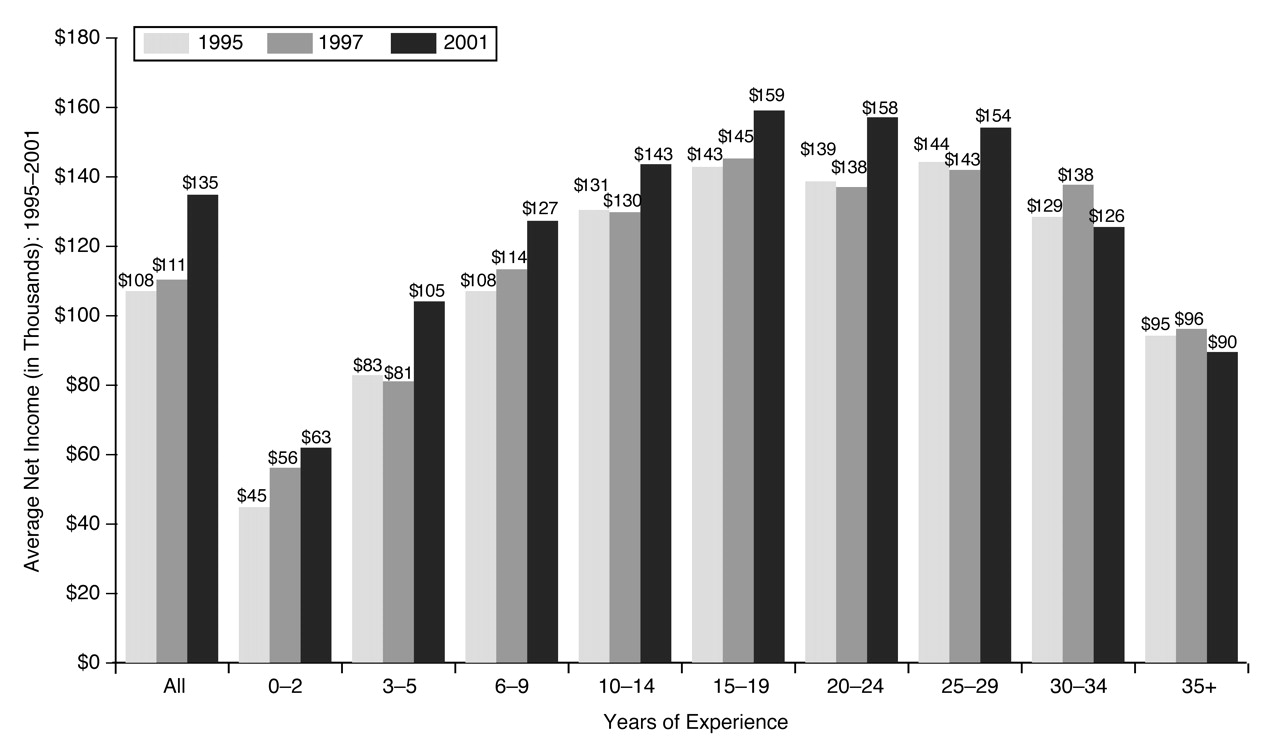
The present survey estimated 2001 average net income as $134,415, considerably higher than in 1995 ($108,156) and 1997 ($110,631) (Fig. 6). Moreover, the median net income was $112,500 in 2001, compared with $87,500 in 1995 and 1997. The same methodology was used to measure net income in 1995 and 1997, so direct comparisons could be made of changes in income overall and for each category of practice experience. These data are based on the income reported by all respondents. An additional analysis measured only members who worked full time in 2001.

Net Income by Experience for Members Working More Than 30 Hours per Week: 1991 to 2002

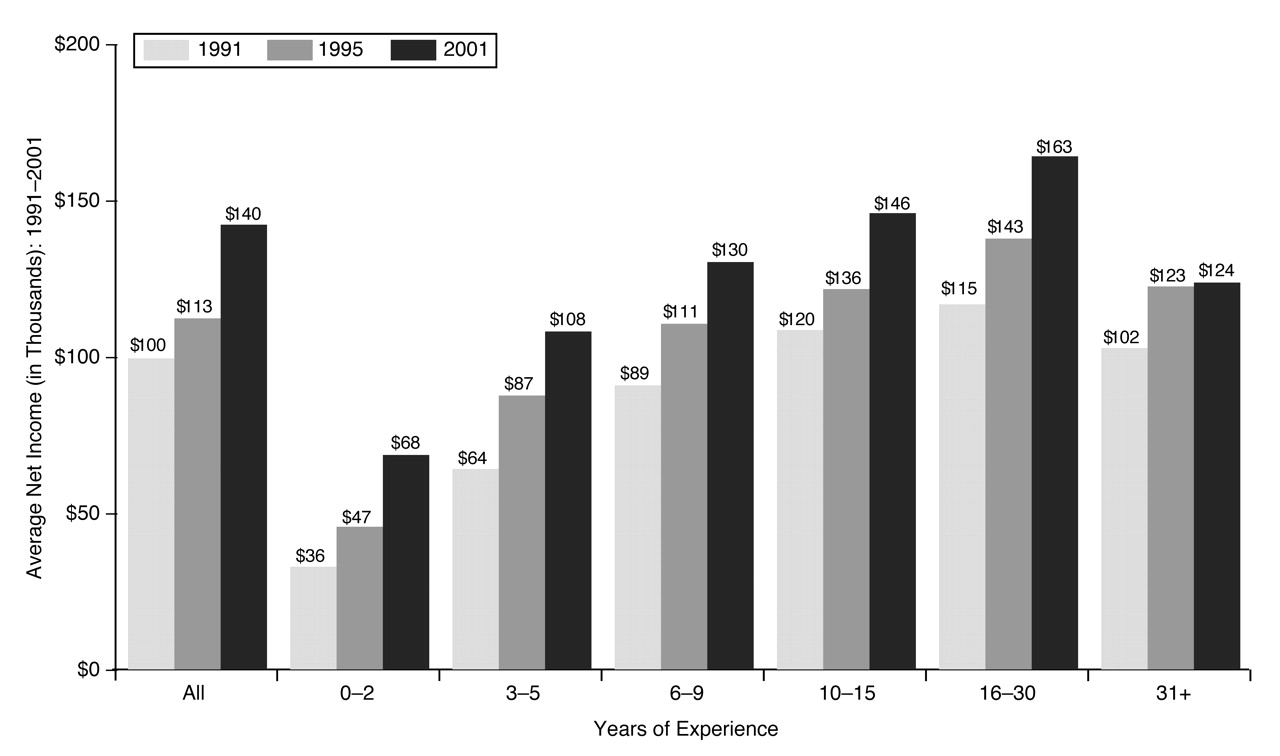
In 1991, net income for members who worked 30 or more hours per week averaged $35,578 for those with less than 3 years of experience but increased to $119,674 for those with 10 to 15 years of experience (McNevin, 1993). The average net income for all podiatric physicians in that survey was $100,287.
The 1991 estimate was different from the 1995, 1997, and 2001 estimates. Net income data from the 2002, 1998, and 1996 surveys were based on all respondents who practiced in the reference year. For a direct comparison with the 1992 AACPM survey, the data from these surveys were repercentaged to exclude APMA members who worked less than 30 hours per week since their net income data were not collected in 1991.
In the present survey, the average 2001 net income for respondents who worked more than 30 hours per week was $140,335 (Fig. 7). This compares with the average 1997 net income of $115,657 and the average 1995 net income of $112,771.
In the 1996 to 2002 surveys, net income peaked for members with 16 to 30 years’ experience. In the present survey, net income peaked at $162,773 for members with 16 to 30 years’ experience. These estimates compare with peak earnings of $119,674 for podiatric physicians with 10 to 15 years’ experience in 1991, as found in the AACPM survey (McNevin, 1993).
In each survey, net income was lowest among respondents with fewer than 3 years of experience (0 to 2 years). In 1991, these younger podiatric physicians averaged $35,578. APMA members with 0 to 2 years of experience averaged $47,432 in net income in 1995, $60,614 in 1997, and $67,685 in 2001.

Net Income by Years of Experience: 1982 to 2001

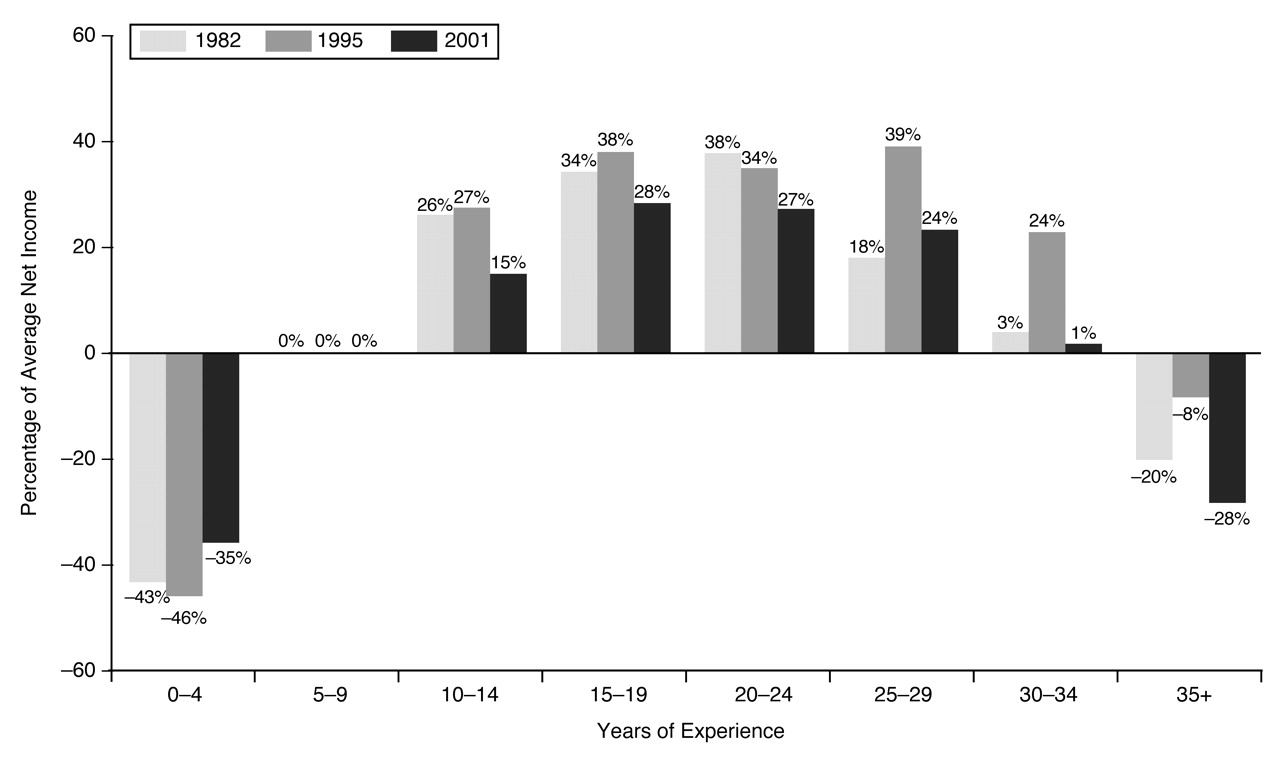
In each survey, members with fewer than 5 years of experience earned substantially less than members with 5 to 9 years of experience (Fig. 8). At the other extreme, members with more than 35 years of experience earned less than their younger colleagues. In each survey, net income was highest for members with 10 to 29 years of experience. This range is the peak earning period for podiatrists. Members with 30 to 34 years of experience earned relatively less in 2001 than in 1995, with amounts more similar to the findings in 1982. In addition, APMA members with 35 or more years of experience are now earning lower net incomes than they did in 1995. The numbers for 2001 are once again similar to those for 1982.
Income by Location: Urban, Suburban, Rural

Net and gross incomes in 2001 differed significantly by the practice location of respondents. Members who practiced in suburban areas reported higher net and gross incomes than members who practiced in urban or rural areas. This was also the case in 1997.
In 2001, members in suburban areas averaged gross incomes of $291,928. This gross amount was $15,000 higher than incomes reported in urban areas, and $38,500 higher than incomes reported in rural areas. Members in rural areas averaged $253,406 in gross income, while members in urban areas averaged $276,789.
Members in suburban areas averaged net incomes of $139,755 in 2001. This net income was $6,000 higher than the amount earned in urban areas and $12,000 higher than the amount earned in rural areas. Members in urban areas averaged $133,506 in net income, while members in rural areas averaged $127,480.

Net Income and Student Loan Indebtedness

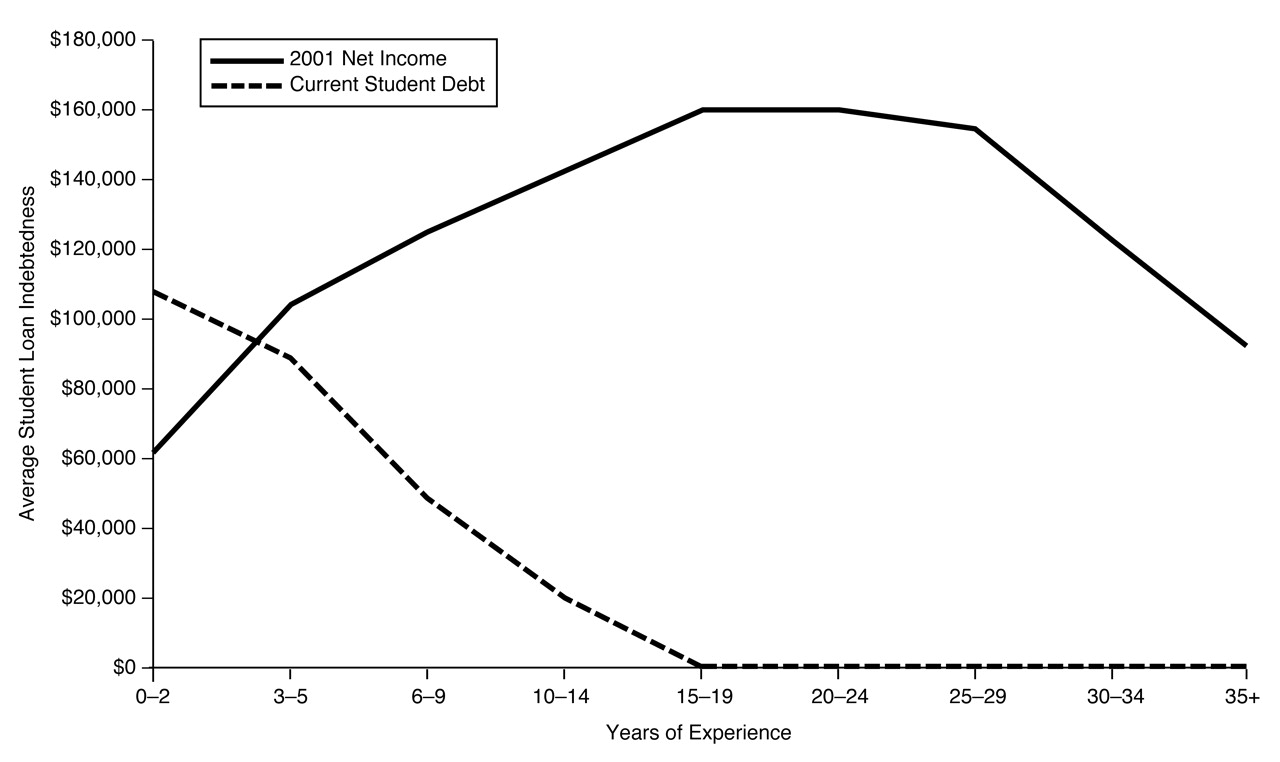
Student loan indebtedness declined with age and experience as former students reduced their debts. At the same time, net incomes generally increased with age and experience (Fig. 9).
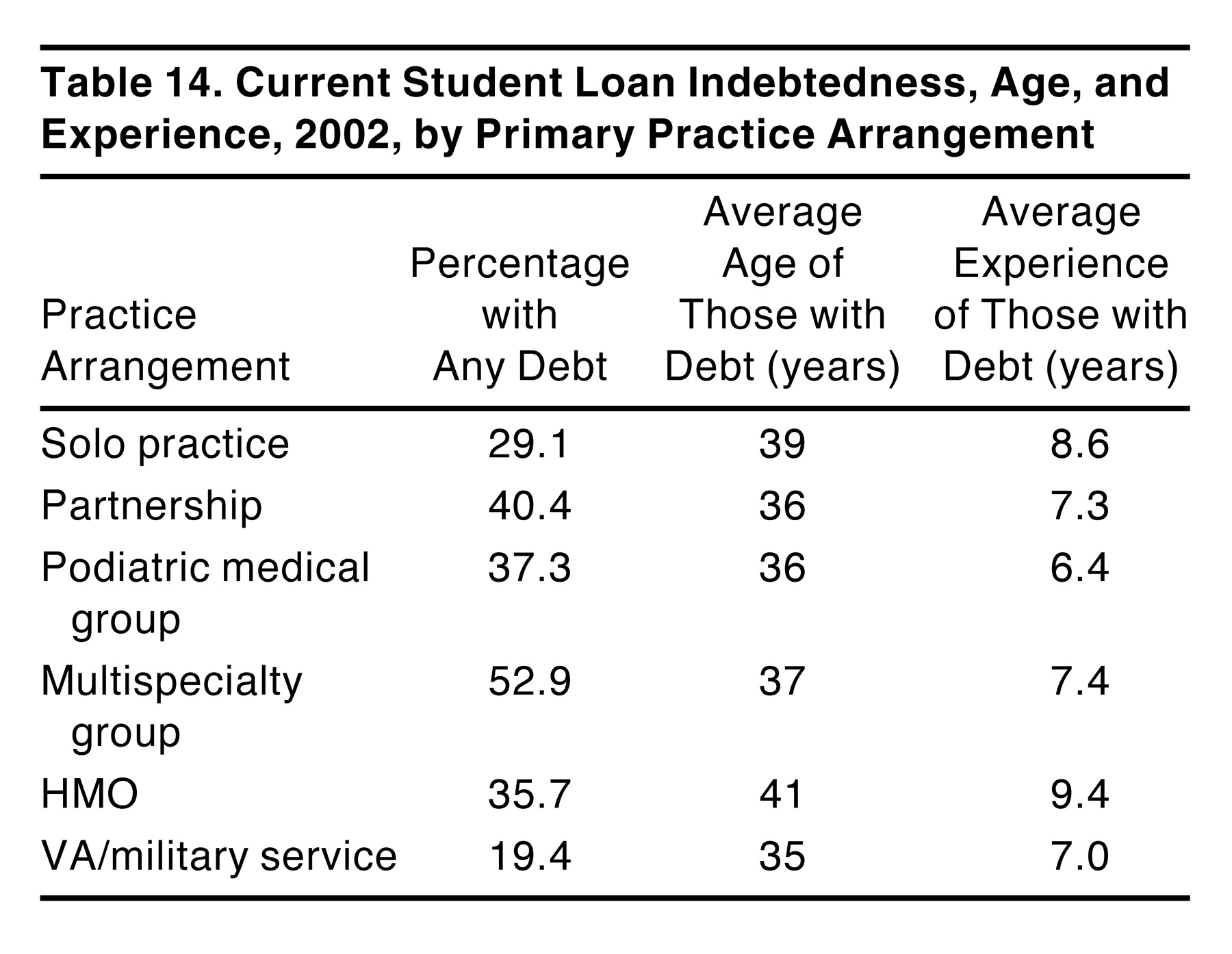
The total amount of current student loan indebtedness in 2002 exceeded annual (2001) net income for respondents with less than 3 years of experience. Annual net income increased markedly thereafter, and most members retired their student loans after 15 to 19 years of practice. There is a break-even point at which debt in 2002 and net income in 2001 are about the same. This occurs about 3 to 5 years after members begin their practice. Net income increased rapidly thereafter, while outstanding student loan balances declined. Student debt varied for members in different practice arrangements, reflecting their age and experience (Table 14).
Respondents in solo practice tended to be older than respondents in other private practice settings, with fewer members in debt from student loans (29.1%). The average age of solo practitioners with outstanding student loans was 39 years, and they averaged 8.6 years of experience.
A different pattern was found for respondents who practiced in group settings such as partnerships and podiatric medical groups. Respondents in partnerships tended to be younger than solo practitioners, and 40.4% were in debt from student loans. The average age of podiatrists in partnerships with outstanding student loans was 36 years, and they had 7.3 years of experience on average. Respondents in podiatric medical group practice also tended to be younger than solo practitioners, and 37.3% were in debt from student loans. The average age of podiatric group practitioners with outstanding student loans was 36 years, and they had 6.4 years of experience on average. Respondents in multispecialty group practice also tended to be much younger than solo practitioners, and 52.9% were in debt from student loans. In 2002 and 1998, 52.9% was the highest percentage found. Their average age was 37 years, and they averaged 7.4 years of experience.
Members in the VA or military service were young (average age: 35), but this category had the lowest percentage with current student debt (19.4%). They averaged 7 years of experience.

Trends in the Demographic Characteristics of APMA Members

Age. Respondents to the present (2002) survey were older than those in previous surveys, averaging 44.9 years of age, compared with 41.8 years of age in 1998 and 41.6 years of age in 1996. In 1992, US podiatric physicians were on average 42 years of age (Caro and Kilczewski, 1996). Podiatrists averaged 43 years of age in 1984 (Skipper and Pippert, 1985), but the average was much higher in 1970 and 1974. Podiatrists had a median age of 51 years in both the 1970 and 1974 surveys (National Center for Health Statistics, 1978). Skipper and Pippert (1985) attributed the decline in average age to the large influx of younger members that occurred between 1974 and 1984. Perhaps the trend toward younger members has reversed itself, as indicated by the increased years of experience found for the total membership in 2002.
Gender. Little change was found in the gender composition of the APMA membership. Men were 86.6% of the respondents in 2002, 85.5% in 1998, and 86.7% in the 1996 survey. However, the number of women represented has increased substantially since 1974. About 4% of the members were female in 1984 (Skipper and Pippert, 1985) and 1974 (National Center for Health Statistics, 1978). By 1992, it was estimated that 8% of all podiatric physicians were female (Caro and Kilczewski, 1996), and that figure increased to 13.3% in 1996 and 14.5% in 1998. The current estimate of 13.4% female members is similar to the rate in 1996.
Female enrollment in medical schools has increased in recent years, and the APMA has observed a concomitant increase in female membership as younger members join the association. In this survey, members younger than 45 were much more likely to be female (20%) than members older than 45 (6.6%).
Ethnic Background. Most of the 2002 survey respondents were white (non-Hispanic) (90.2%), as has been the case in all previous surveys. The percentage of white members was 96.3% in 1974 (National Center for Health Statistics, 1978), 96.6% in 1984 (Skipper and Pippert, 1985), and 95.3% in 1992 (McNevin, 1993). However, the percentage of whites in 1996 (91.3%) was significantly less than in 1992, and the 1998 value was lower still.

Appendix A: Data-Collection Instrument

Japma 93 00067 a001Japma 93 00067 a002

References

  1. Caro EA, Kilczewski C: Graphs and Maps: Summary of Information on Foot and Ankle Problems, Foot Care and Podiatric Physicians, American Podiatric Medical Association, Bethesda, MD, February 1996.
  2. Al Fisher Associates, Inc: 1996 Podiatric Practice Survey: statistical results. JAPMA86: 576, 1996.
  3. Al Fisher Associates, Inc: 1998 Podiatric Practice Survey: statistical results. JAPMA88: 576, 1998.
  4. Health Resources and Services Administration: Fifth Report to the President and the Congress on the Status of Health Personnel in the United States, Health Resources and Services Administration (HPR 0906767), chap. 7, Springfield, VA, 1986.
  5. McNevin AJ: AACPM Income Survey, American Association of Colleges of Podiatric Medicine, Rockville, MD, September 1993.
  6. National Center for Health Statistics: Trends in the Podiatric Profession: A Comparative Study of 1970 and 1974 Survey Data, National Center for Health Statistics (PHS 79-1816), Hyattsville, MD, November 1978.
  7. Skipper JK Jr, Pippert JM: Report to the American Podiatric Medical Association: National Survey of Podiatrists and Podiatric Practice—1984, Virginia Polytechnic Institute and State University, Blacksburg, VA, 1985.
Figure 1. Average gross income for 2001 by patient visits per week.
Japma 93 00067 g001
Figure 2. Average net income for 2001 by patient visits per week.
Japma 93 00067 g002
Figure 3. Changes in net income from 2000 to 2001 by year of graduation.
Japma 93 00067 g003
Figure 4. Percentage of 2001 gross income derived from two major sources.
Japma 93 00067 g004
Figure 5. Changes in board certification from 1996 to 2002 (active members).
Japma 93 00067 g005
Figure 6. Net income by years of experience, 1995 to 2001 (active members).
Japma 93 00067 g006
Figure 7. Net income by years of experience, 1991 to 2001 (podiatrists in full-time practice: more than 30 hours per week).
Japma 93 00067 g007
Figure 8. Net income by years of experience as a percentage of average net income, 1982 to 2001 (active members).
Japma 93 00067 g008
Figure 9. Student loan indebtedness and 2001 net income by years of experience (active members).
Japma 93 00067 g009
Table 1. 2002 Response Rates by Years of Practice Experience
Japma 93 00067 i001
Table 2. Primary Podiatric Practice Arrangements: 2002, 1998, and 1996
Japma 93 00067 i002
Table 3. Type of Residency Program Completed: 2002, 1998, and 1996
Japma 93 00067 i003
Table 4. Completion of Residency Programs in Podiatric Medicine by Years of Practice Experience, 2002
Japma 93 00067 i004
Table 5. Original Student Loan Indebtedness at Graduation: 2002 and 1998
Japma 93 00067 i005
Table 6. Current Student Loan Indebtedness: 2002, 1998, and 1996
Japma 93 00067 i006
Table 7. Most Common Foot Conditions Treated by Respondents, 2002
Japma 93 00067 i007
Table 8. Hospital Staff Privileges in 2001
Japma 93 00067 i008
Table 9. Total Gross Income: 2001, 1997, and 1995
Japma 93 00067 i009
Table 10. Total Net Income: 2001, 1997, and 1995
Japma 93 00067 i010
Table 11. 2001 Net Income by Patient Volume and ABPS Board Certification Status
Japma 93 00067 i011
Table 12. 2001 Net Income for Selected Practice Arrangements by Practice Size
Japma 93 00067 i012
Table 13. Average Gross and Net Income, 2001 and 1995, by Primary Practice Arrangement
Japma 93 00067 i013
Table 14. Current Student Loan Indebtedness, Age, and Experience, 2002, by Primary Practice Arrangement
Japma 93 00067 i014