A schwannoma is a benign tumor arising from the Schwann cell. Theoretically, a schwannoma can arise from any peripheral nerve, and case reports abound in the literature describing these tumors in virtually every conceivable peripheral nerve.[
1] There have been few case reports, however, of this tumor arising in the foot.[
2,
3,
4,
5,
6,
7,
8] Although there have been reports of multiple schwannomas related to a single upper-extremity nerve,[
9,
10] multiple schwannomas of different nerves,[
11,
12] and multiple schwannomas (schwannomatosis) that must be differentiated from forms of neurofibromatosis,[
13,
14,
15] there has never been a case reported of multiple schwannomas in a single foot. Traditionally, pain in a peripheral nerve tumor has been considered a sign of malignant degeneration.[
1] Malignant schwannomas, although more infrequent than benign schwannomas, have been reported in the foot.[
16,
17] However, because the peripheral nerves in the foot pass through the tarsal tunnel and beneath the intermetatarsal ligament, pain associated with nerve compression may be mistaken for malignant degeneration in a benign tumor. Furthermore, if a schwannoma of a common plantar digital nerve is resected, the proximal end of the nerve may form a painful, true neuroma that would simulate a tumor recurrence. The case report presented here serves as an opportunity to review strategies related to benign peripheral nerve tumors in the foot in light of current concepts of peripheral nerve reconstruction.
Case Report
A 32-year-old man was referred for podiatric consultation because of bilateral foot pain. He had localized pain in the plantar aspect between the second and third metatarsal heads on the right foot and between the first and second metatarsal heads on the left foot. The symptoms and physical examination findings were consistent with bilateral interdigital neuromas.
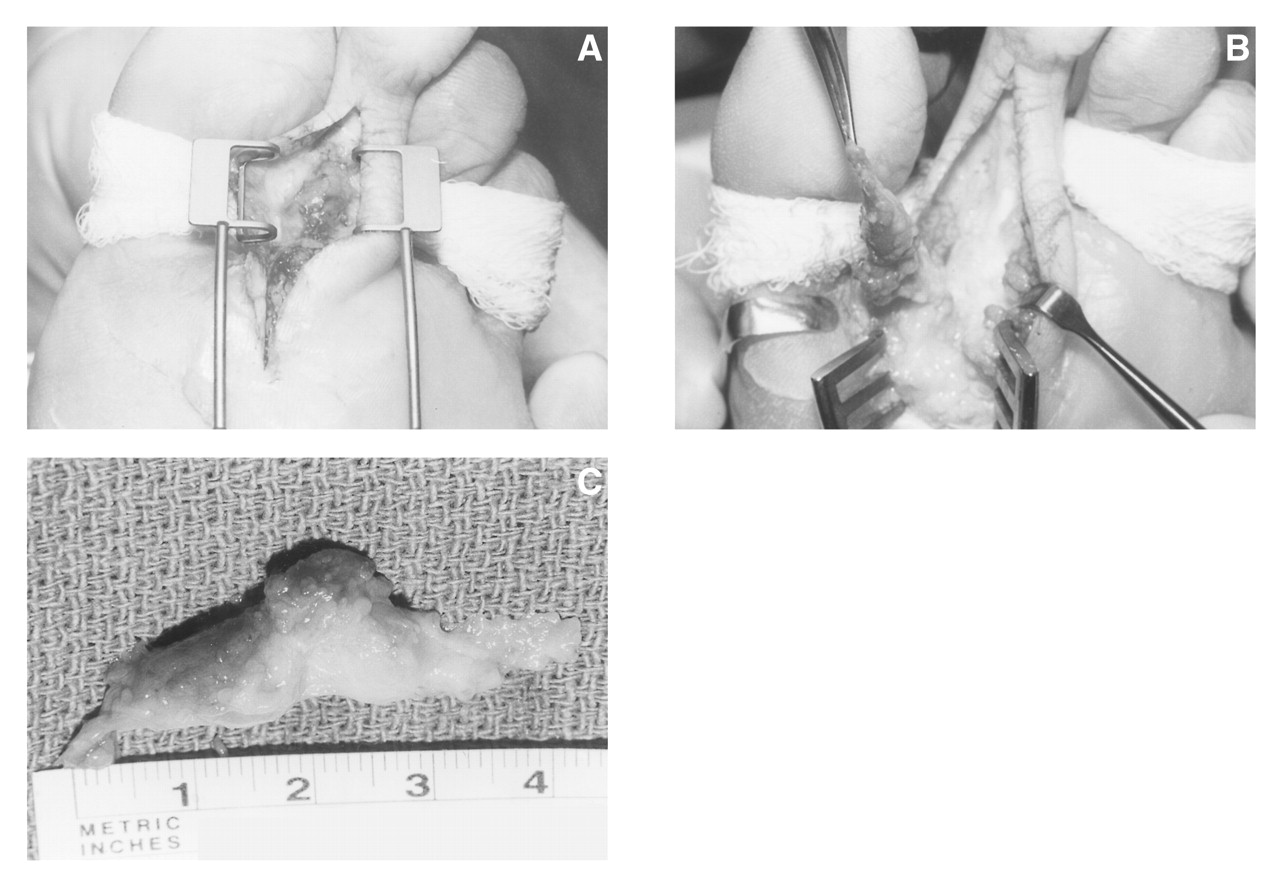
The tumor of the left first and second web space was treated through a plantar web space splitting incision on January 15, 2000. A neural tumor was identified on and resected from the medial digital nerve of the second toe (
Fig. 1). The pathology report demonstrated a benign schwannoma. On March 18, 2000, the tumor of the right second and third web space was resected through a plantar approach (
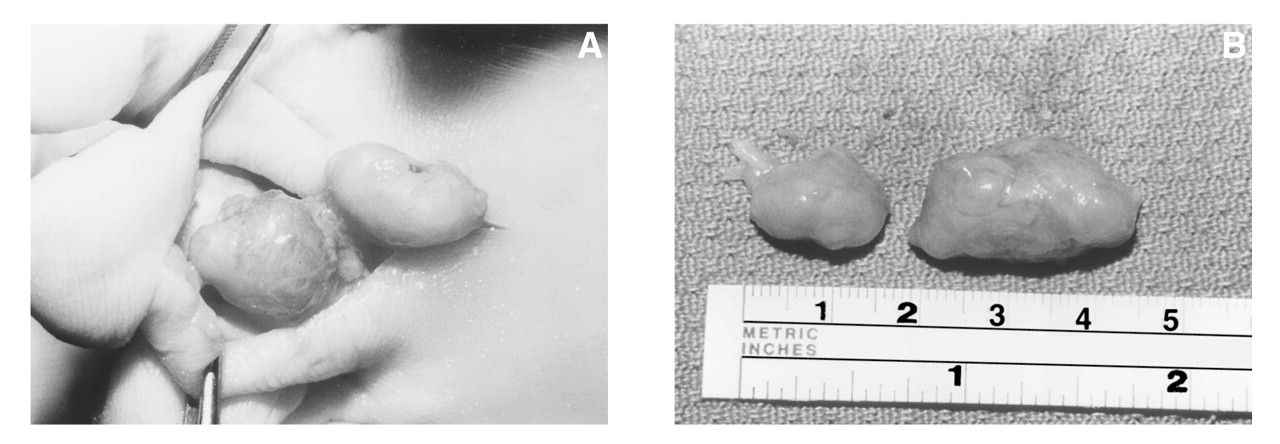
Fig. 2). The pathology report demonstrated a benign schwannoma.
Figure 1.
A, Dissection of the painful mass along the medial aspect of the left second toe; B, the mass completely involved the digital nerve; C, the mass was resected, leaving the proximal end of the nerve in the web space between the first and second toes.
Figure 1.
A, Dissection of the painful mass along the medial aspect of the left second toe; B, the mass completely involved the digital nerve; C, the mass was resected, leaving the proximal end of the nerve in the web space between the first and second toes.
Figure 2.
A, Dissection of the painful mass along the right third toe; B, the mass, which involved the entire digital nerve, was resected, leaving the proximal end of the nerve in the web space between the second and third toes.
Figure 2.
A, Dissection of the painful mass along the right third toe; B, the mass, which involved the entire digital nerve, was resected, leaving the proximal end of the nerve in the web space between the second and third toes.
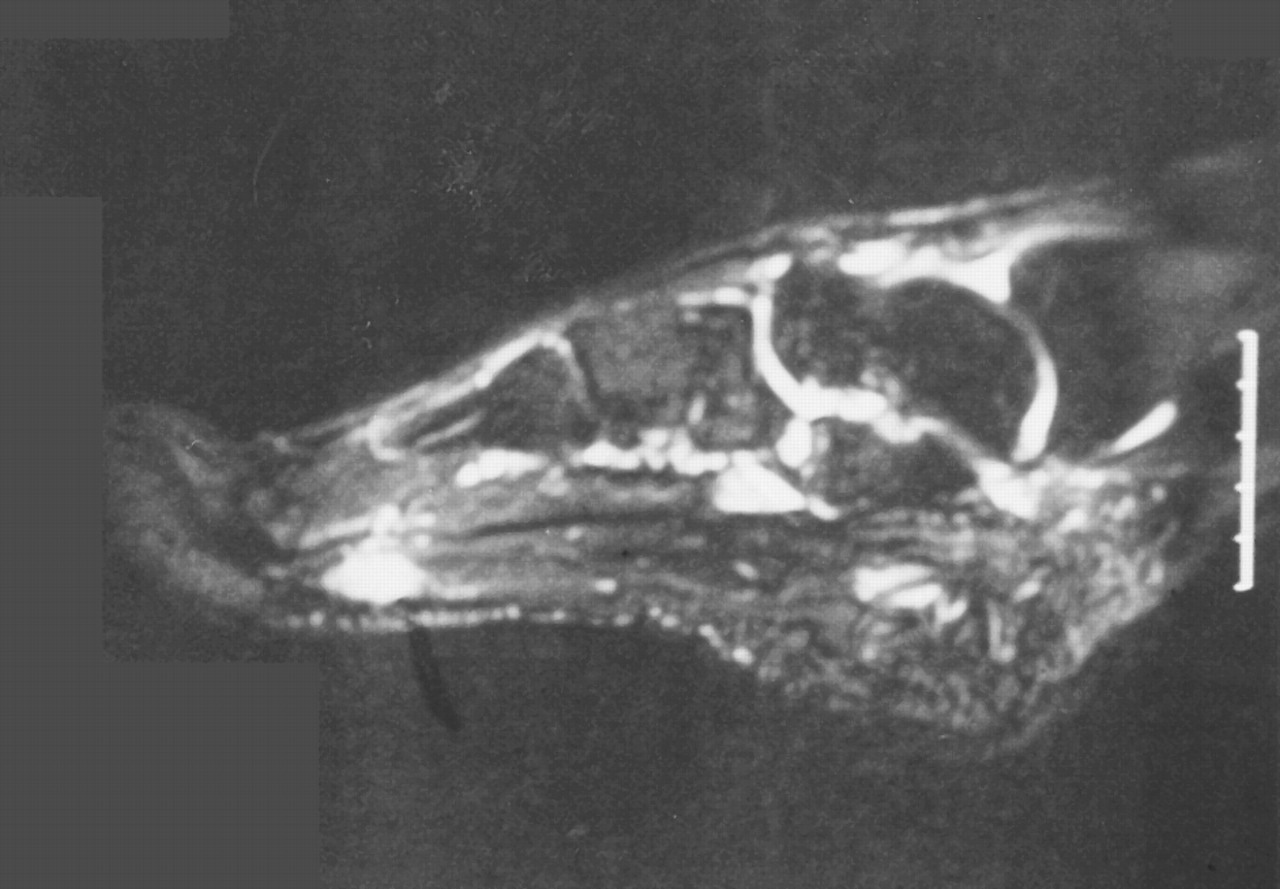
In August 2000, the patient began to have pain in the left foot and ankle after prolonged standing at work. He also experienced pain beneath the right third metatarsal head and beneath the left second metatarsal head. Magnetic resonance imaging (MRI) demonstrated a mass on the left foot consistent with a recurrent tumor or a neuroma (
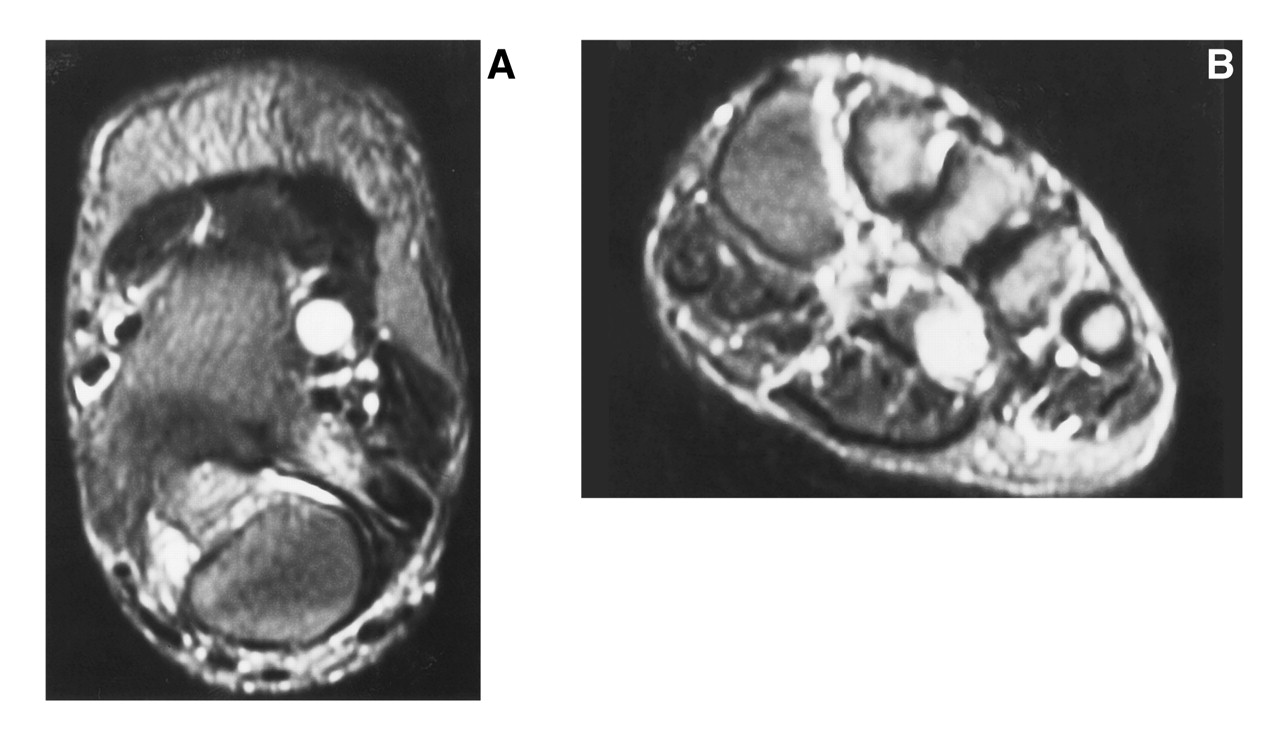
Fig. 3) and a diffuse region of increased signal near the third metatarsal head on the left foot consistent with a diffuse recurrent tumor or a neuroma. In addition, MRI showed two more tumors in the left foot—one in the region of the tarsal tunnel and one in the plantar aspect of the foot adjacent to the flexor brevis muscle (
Fig. 4). The MRI scans did not demonstrate a small, nonpainful mass that the patient had identified on the dorsolateral aspect of his left foot, and the radiologist could not suggest a tissue type for the mass.
Figure 3.
Magnetic resonance image demonstrating the recurrent painful neuroma of the left first and second web space.
Figure 3.
Magnetic resonance image demonstrating the recurrent painful neuroma of the left first and second web space.
Figure 4.
Magnetic resonance images demonstrating the presence of a neural tumor in the tarsal tunnel region (A) and another tumor in the porta pedis (B).
Figure 4.
Magnetic resonance images demonstrating the presence of a neural tumor in the tarsal tunnel region (A) and another tumor in the porta pedis (B).
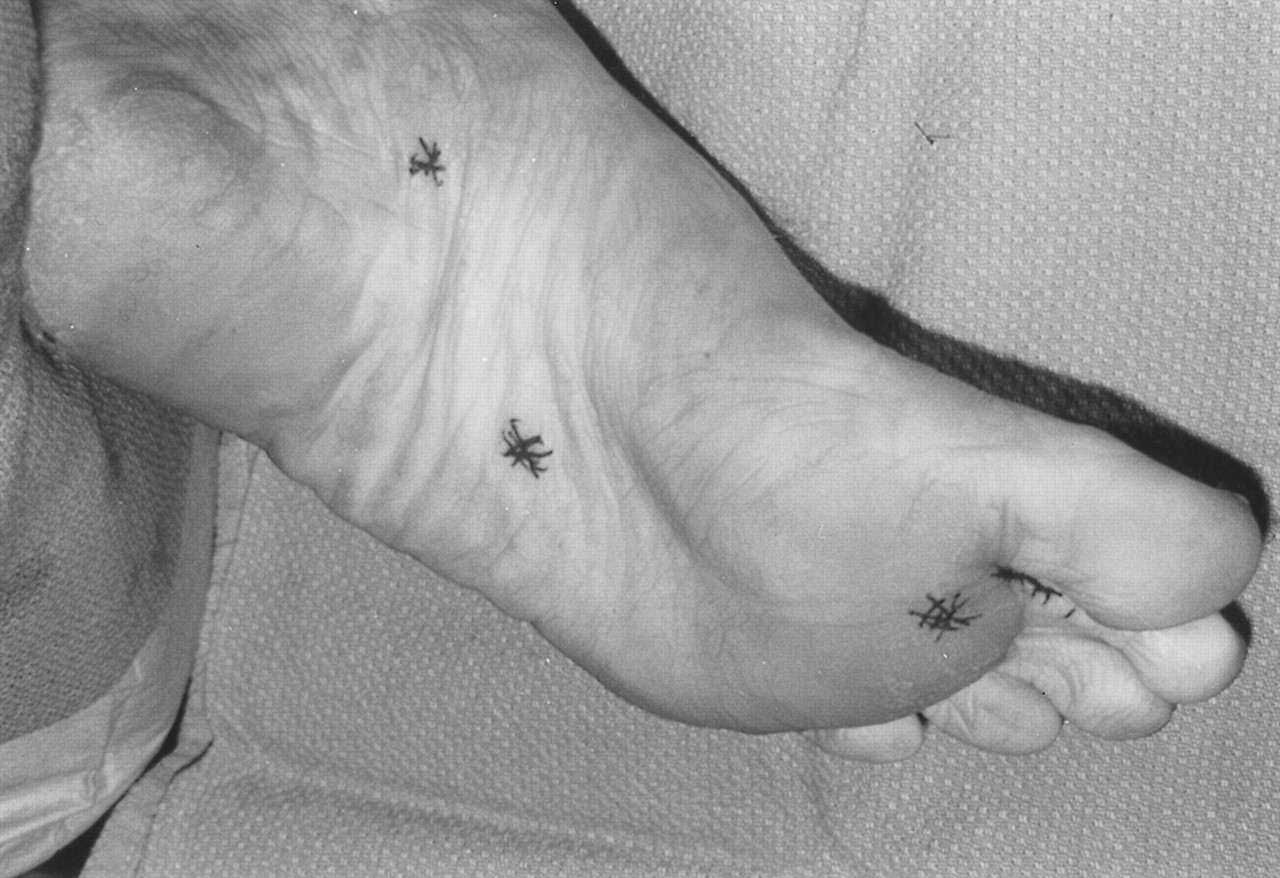
Physical examination in September 2000 demonstrated findings consistent with a recurrent Morton’s neuroma at the left first and second web space (
Fig. 5) and at the right second and third web space. There was tenderness in the distal left tarsal tunnel in the region of the medial plantar nerve beneath the abductor hallucis muscle and deep within the central aspect of the plantar region of the foot. These two latter areas were thought to be related to the MRI locations of the two new tumors (
Fig. 4). The patient had identified a small mass overlying the dorsal aspect of the left fifth toe in an area where his shoe would rub. This tumor was not painful when palpated.
Figure 5.
Examination of the left foot demonstrated positive Tinel’s signs over the neuroma of the interdigital nerve in the first and second web space, in the porta pedis, and over the distal tarsal tunnel (asterisks).
Figure 5.
Examination of the left foot demonstrated positive Tinel’s signs over the neuroma of the interdigital nerve in the first and second web space, in the porta pedis, and over the distal tarsal tunnel (asterisks).
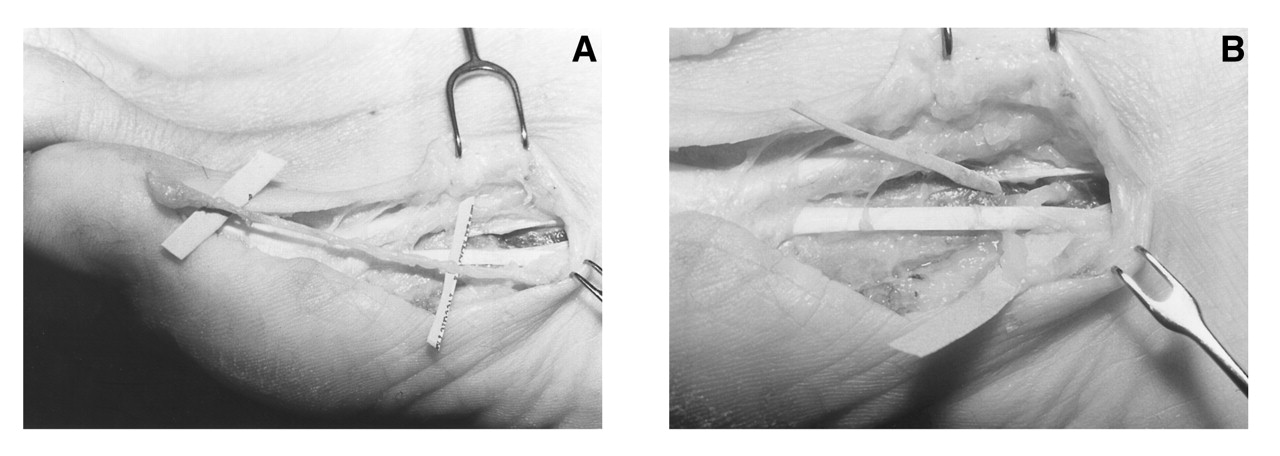
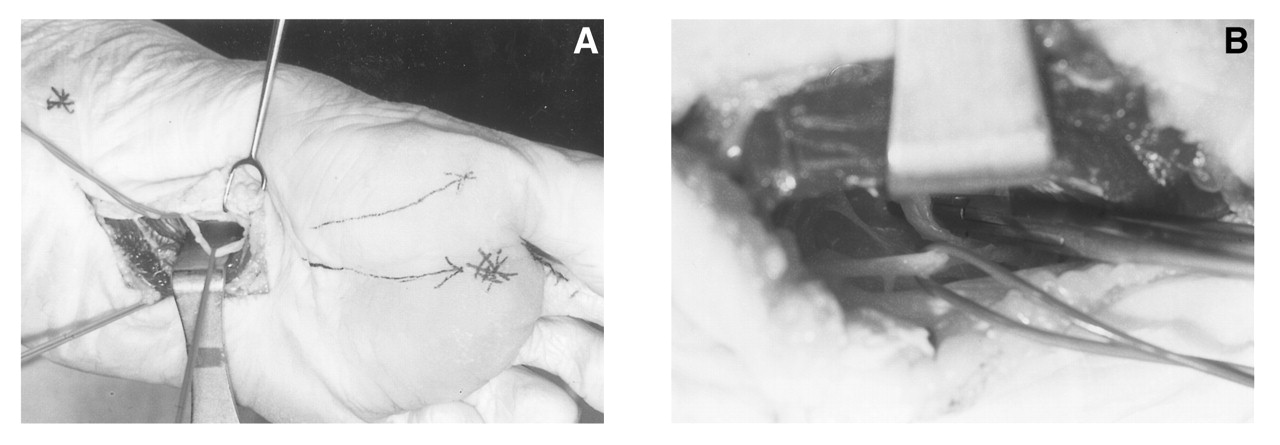
On November 7, 2000, the left foot was explored in surgery. A neural tumor identified over the dorsal aspect of the fifth toe was resected, and the proximal end of the nerve, which may have represented a terminal branch of the sural nerve, was implanted into the dorsal intrinsic muscle of the fourth and fifth web space (
Fig. 6). Through a plantar incision in the nonweightbearing portion of the foot, an incision was made that permitted identification of the common plantar digital nerve to the first and second web space. This nerve was resected to denervate the true neuroma that had formed at the site of the distal tumor resection from the first surgery. The proximal end of this nerve was implanted into the adductor hallucis muscle in the arch (
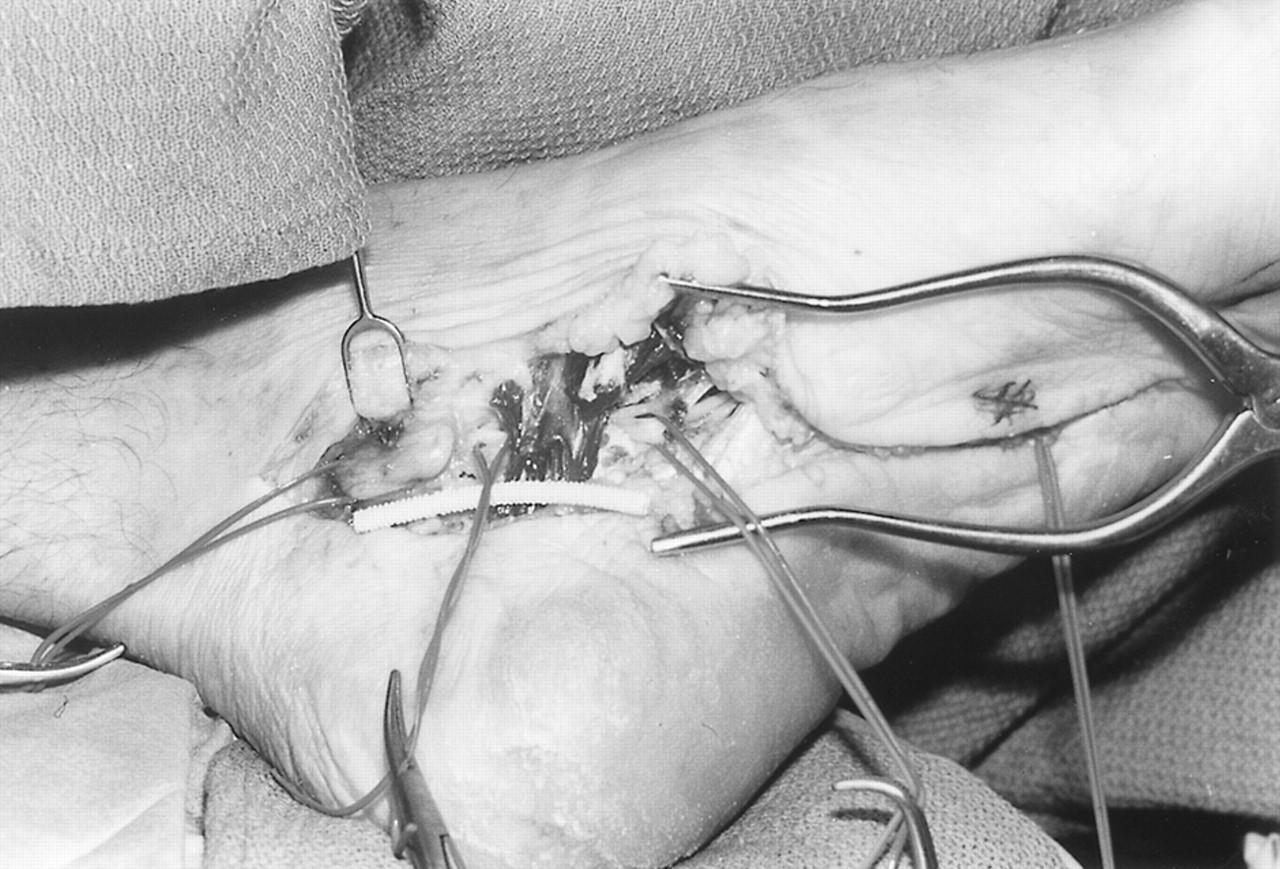
Fig. 7). The tarsal tunnel was opened, and the medial and lateral divisions of the posterior tibial nerve were identified. These divisions were followed distally by opening the roof of the medial and lateral plantar tunnels. However, no tumor was noted in these regions. Working proximally toward the medial and lateral plantar tunnels from the plantar incision, the two schwannomas were identified. The largest, within the lateral plantar nerve adjacent to the flexor brevis muscle, dissected easily from the fascicles within the nerve trunk and could be resected without endangering the intact fascicles. In contrast, the tumor within the medial plantar nerve could not be separated from a fascicle within the tumor. It was elected to resect the tumor and reconstruct the 1.3-cm defect using a bioabsorbable nerve conduit (Neurotube, NeuroRegen LLC, Bel Air, Maryland) to preserve function and prevent another painful neuroma (
Fig. 8).
Figure 6.
A, Schwannoma of the distal left sural nerve presenting over the proximal phalanx of the fifth toe; B, after resection of the tumor, the proximal end of the nerve is implanted into the extensor digitorum brevis muscle.
Figure 6.
A, Schwannoma of the distal left sural nerve presenting over the proximal phalanx of the fifth toe; B, after resection of the tumor, the proximal end of the nerve is implanted into the extensor digitorum brevis muscle.
Figure 7.
A, Intraoperative view of the dissection of the left common plantar digital nerve to the first and second web space, the source of the interdigital metatarsalgia; B, after resection of this nerve, the proximal end is implanted into a muscle in the arch of the foot.
Figure 7.
A, Intraoperative view of the dissection of the left common plantar digital nerve to the first and second web space, the source of the interdigital metatarsalgia; B, after resection of this nerve, the proximal end is implanted into a muscle in the arch of the foot.
Figure 8.
The schwannoma of the medial plantar nerve in the porta pedis was identified beneath the muscles but could not be dissected easily from the fascicles. After resection of the tumor with the fascicle, a bioabsorbable neural conduit was placed as an interpositional interfascicular reconstruction of the neural deficit. The neural conduit is shown before cutting it to length and placing it in the medial plantar nerve.
Figure 8.
The schwannoma of the medial plantar nerve in the porta pedis was identified beneath the muscles but could not be dissected easily from the fascicles. After resection of the tumor with the fascicle, a bioabsorbable neural conduit was placed as an interpositional interfascicular reconstruction of the neural deficit. The neural conduit is shown before cutting it to length and placing it in the medial plantar nerve.
On January 18, 2001, the painful right neuroma of the second and third web space was approached through a plantar incision and resected, and the proximal end of the common plantar digital nerve was implanted into the adductor hallucis muscle in the arch of the foot.
On follow-up examination in May 2001, the patient had excellent pain relief in both feet. He had anesthesia in the web spaces that had been innervated by the resected Morton’s neuromas. He had no intrinsic muscle atrophy. The dorsolateral aspect of the left foot, where a nonpainful neuroma had been excised and the proximal end had been implanted into the extensor brevis muscle, was not painful and had an associated area of decreased sensation to moving touch that extended toward the fifth toe. His incisions were not painful. He wore his usual shoes for everyday activities, and at work he wore work boots without discomfort.
Discussion
The authors’ treatment of this patient with multiple schwanommas is reported in an effort to provide an approach to this problem that is consistent with current concepts of peripheral nerve surgery. For example, management of the patient with a benign neural tumor of the foot is not often discussed. Some recent textbooks[
18,
19,
20] related to foot and ankle surgery make no mention of this tumor. Two other recent textbooks both state that a schwannoma should be removed from the nerve without sacrificing the nerve but disagree about whether the presentation of the tumor is “painless . . . with neurologic symptoms lacking”[
21] or is a “discrete tender nodule . . . [manifesting] pain with pressure.”[
22] None of these textbooks offer guidance as to whether the symptoms manifested by the tumor may be related to secondary nerve compression syndromes or what action to take if the tumor occurs near the terminal portion of a sensory nerve, a situation that would be analogous to a Morton’s neuroma.
The patient in this case report had recurrent pain in the plantar aspect of each foot after resection of what was believed to be a Morton’s neuroma. It was clear when the pain developed that the initial pain was due to a schwannoma that developed in the typical location for a Morton’s neuroma. This site is now understood to be an area of chronic nerve compression.[
23] Because a schwannoma arises from the connective tissue covering of the axon, it is usually possible to remove the tumor and to preserve function of the nerve in which the tumor arose. However, if a schwannoma exists on a digital nerve in the interdigital space, it is reasonable to resect it and to accept the loss of sensation that will occur in that web space. This usually would be considered an acceptable functional loss. However, it can be anticipated that if pain occurs in this region postoperatively, the surgeon must decide whether this pain signifies a recurrent tumor or a painful neuroma. An appropriate treatment for a painful neuroma in this location is resection of the neuroma, as this is the pain-generating site,[
24] and implantation of the proximal end of the nerve into a muscle. Muscle implantation changes the microenvironment of the regenerating nerve and has proven to be a successful treatment for the painful neuroma.[
25,
26,
27] This approach, adapted from the upper extremity, has proven successful in the management of painful neuromas of the foot.[
28,
29] It was for these reasons that the proximal end of the common plantar digital nerve was implanted into the adductor hallucis muscle in this patient. It is suggested, therefore, that should a schwannoma be identified in the interdigital space, the appropriate course would be to resect the tumor and implant the proximal end of the nerve into muscle. This approach should avoid the clinical problem of deciding whether postoperative pain after tumor resection is due to recurrent tumor or a painful stump neuroma.
This case report demonstrates the value of including MRI in the work-up of a patient with a schwannoma in an extremity. A case can be made that MRI of the brain should be performed to determine the presence of vestibular schwannomas (acoustic neuromas). If one or more such schwannomas are present, the patient probably has type 2 neurofibromatosis. If there are multiple schwannomas related to a single peripheral nerve or its branches, the patient may have what is currently termed schwannomatosis.
It may not be technically possible to remove a schwannoma without sacrificing a portion of the neural tissue from which it arises. Although a schwannoma should “shell out” of the larger nerve, leaving intact fascicles behind, fascicles may be resected either deliberately or inadvertently. If the surgeon is aware that sacrifice of a fascicle or fascicles of critical function will occur or has occurred during tumor removal, it should be emphasized that it is now possible, and therefore appropriate, to reconstruct the fascicles. Usually these tumors are less than 3 cm long in the foot, and in that situation, the nerve can be reconstructed using a bioabsorbable nerve conduit (the Neurotube).[
30] This conduit, made from polyglycolic acid, was approved by the US Food and Drug Administration for use in the United States in March 1999 after a randomized prospective study of its use proved it to be significantly more successful than a nerve repair or an autologous nerve graft in restoring sensory nerve function in the hand for defects measuring up to 3 cm long.[
31] The first use of the Neurotube to reconstruct a painful digital neuroma-in-continuity has recently been reported.[
32]
The pain in this patient must be understood in the context of a tumor growing in a site of known nerve compression. Schwannomas have been reported that are painless and that are more than 5 or 6 cm long. They are usually growing in a “quiet” site, such as the sciatic nerve in the midthigh or the ulnar nerve proximal to the elbow. Even a 1-cm tumor growing within the tunnels distal to the laciniate ligament are in a position to cause signs of chronic nerve compression, such as paresthesia or pain, when acute axonal loss begins to occur. In the patient described here, the four medial ankle tunnels were decompressed at the time the tumors of the medial and lateral plantar nerves were approached. It is suggested that any known site of anatomical narrowing be decompressed at the time of the tumor surgery; if the tumor is within the tight region, the decompression is therapeutic, and if the tumor is proximal or distal to the site, then the decompression will prevent postoperative swelling from causing compression.[
33,
34,
35,
36]