The incidence of diabetes mellitus in Asians worldwide is growing, and an increase of two to three times the current rate is projected by 2010.[
1] The World Health Organization has estimated that the number of diabetic patients will increase from 135 million in 1995 to 300 million in 2025; 80% of this increase is expected to occur in Asia and other developing countries.[
2] Studies[
3,
4,
5,
6] of migrant Asians living in the United States have indicated a prevalence of diabetes mellitus in this population higher than in native populations and twice as great as in whites; nevertheless, a steady increase in incidence in Asian countries has been reported. According to Cockram,[
7] the Western Pacific region contains 30 million diabetic individuals, predominantly with type 2 diabetes mellitus, with this population estimated to double by 2025.
In China alone, the prevalence of diabetes mellitus and impaired glucose tolerance tripled between 1980 and 1994, and the rate of newly diagnosed cases has surpassed that in the United States, with an estimated 20 million people with diabetes mellitus in 2000.[
8]
The “westernization” and “industrialization” of these ethnic groups has led to altered lifestyles, giving rise to risk factors previously nonexistent in Asians. The environmental changes resulting from this westernization have led to an increase in the consumption of dietary fat and an associated decrease in physical activity, resulting in risk factors responsible for diabetes mellitus, such as increased visceral adiposity, insulin resistance, and β cell dysfunction levels resulting in insulin deficiency.[
5,
7,
9]
In 1990, the number of people of Asian descent living in the United States exceeded 7 million. This population is ethnically diverse, with most being of Chinese, Filipino, Japanese, Asian Indian, Korean, or Vietnamese ancestry.[
3] As the number of newly diagnosed cases continues to rise, the complications associated with diabetes mellitus will also become more evident. This is especially true in a population unfamiliar with the disease, its evolution, and its systemic effects.
The authors evaluated the comorbidities associated with diabetes mellitus in an Asian American population with podiatric symptoms living in southern California’s Orange and Los Angeles counties. This study examined the general medical condition of this diabetic population in the presence of pedal problems and the significant role of the podiatric physician in screening for foot and other systemic complications.
Research Design and Methods
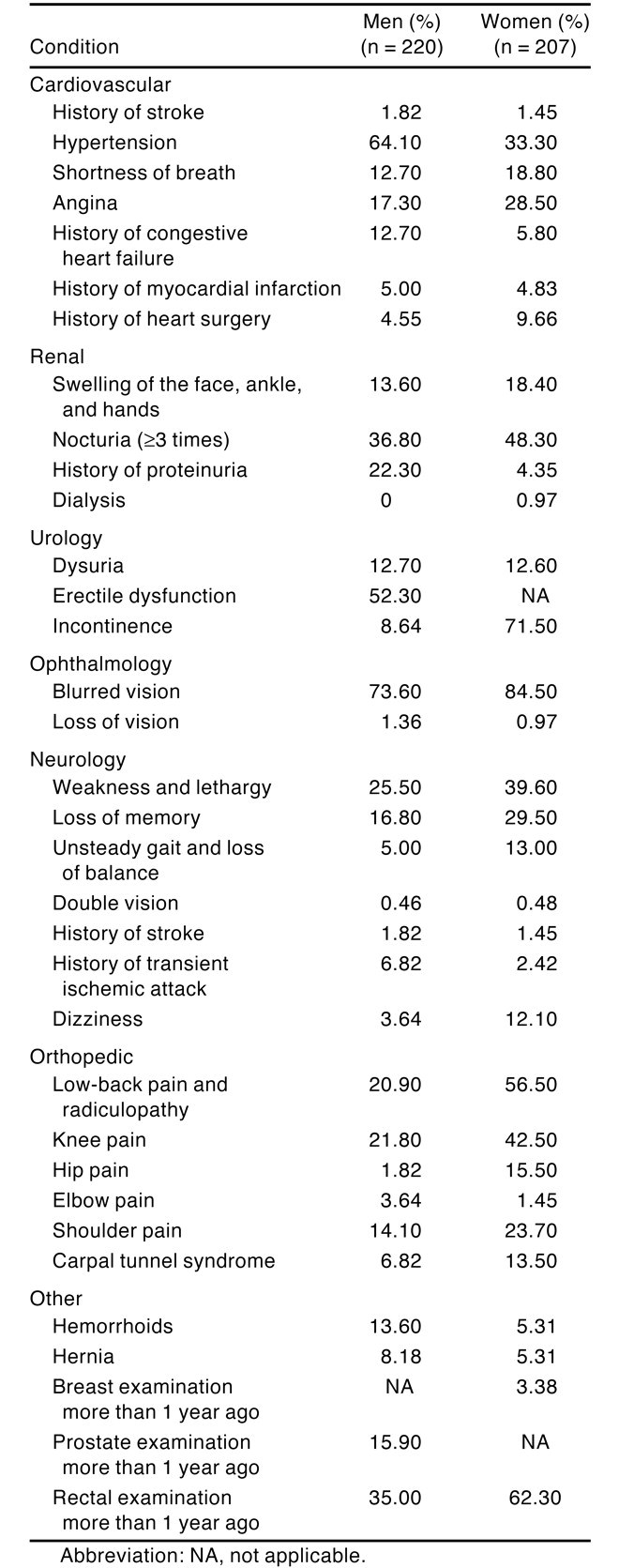
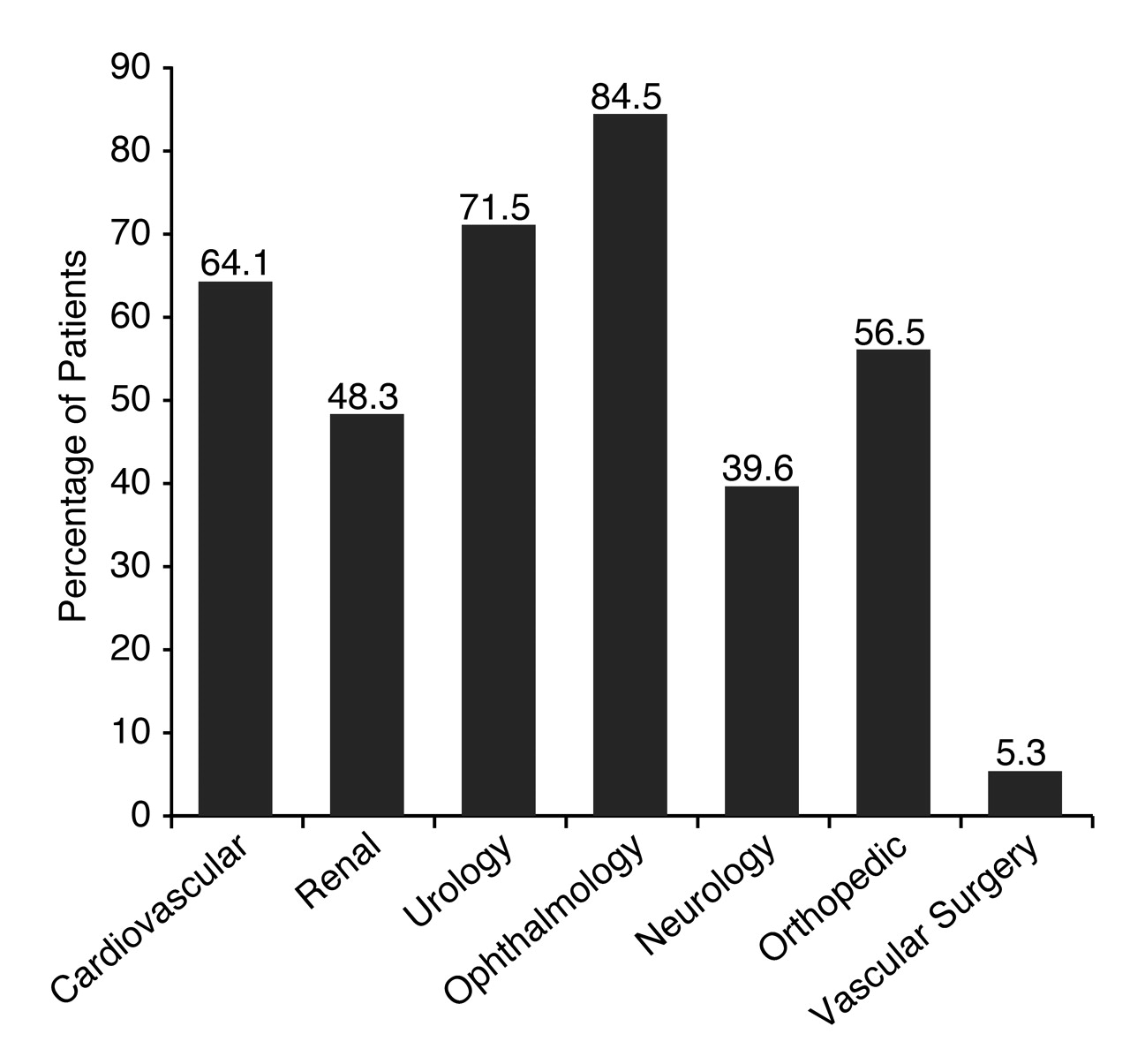
A random review was conducted of 427 Asian patients with a history of diabetes mellitus evaluated and treated for foot complications between January 1, 1997, and November 1, 2000. All patients presented with podiatric complaints to the Diabetic Foot Care Center of Coastal Communities Hospital in Santa Ana, California. During the initial consultation, each patient was screened for nonpedal complications associated with diabetes mellitus by means of a detailed review of systems (
Fig. 1,
Table 1).
Figure 1.
Review of systems for 427 patients with diabetes mellitus. Vascular surgery includes patients who needed immediate limb-salvage vascular surgery because of symptoms consistent with severe rest pain and physical signs of impending gangrene.
Figure 1.
Review of systems for 427 patients with diabetes mellitus. Vascular surgery includes patients who needed immediate limb-salvage vascular surgery because of symptoms consistent with severe rest pain and physical signs of impending gangrene.
Table 1.
Review of Systems for 427 Patients with Diabetes Mellitus
Table 1.
Review of Systems for 427 Patients with Diabetes Mellitus
The patients’ record of current medication use verified the diagnosis of diabetes mellitus. According to the criteria set forth by the World Health Organization, a random blood glucose measurement greater than or equal to 200 mg/dL or a fasting glucose level greater than or equal to 126 mg/dL was additional verification.[
10]
For patients with neuritic complaints in the foot, a diagnosis of sensory neuropathy was made based on symptoms described as “burning,” “ant-crawling sensation,” and “numbness” involving the lower extremity and foot. A 5.07, 10-g Semmes-Weinstein monofilament at the plantar aspect of the foot and digits was used to assess the lack of protective sensation and confirm the presence of sensory neuropathy.[
11,
12,
13]
In patients strongly suspected of having ischemia who complained of foot and leg pain either during ambulation or at rest, the diagnosis of peripheral vascular disease was made if the ankle-brachial index was less than 0.9. In addition, the following clinical signs consistent with peripheral vascular disease were used as criteria: 1) absence of palpable pedal pulses, 2) prolonged capillary bed return with compression of the distal aspect of the toes, 3) pallor on elevation and rubor on dependency of the limb, 4) scant digital hair, and 5) variance in skin temperature to touch.[
14]
In the presence of neuropathy or peripheral vascular disease, the criteria used to classify a foot at high risk for ulceration were 1) bony prominences, 2) musculoskeletal alterations in the normal anatomy of the foot, and 3) postoperative sequelae, especially after an amputation. The clinical findings meeting these criteria were bunions, hammer toes, corns, calluses, and Charcot’s osteoarthropathy. Other foot deformities included in this category were ingrown toenails and dystrophic mycotic nails, macerated interspaces, and severe tinea pedis.
The review of systems performed consisted of questions about symptoms pertinent to the following fields: podiatry, cardiovascular, renal, peripheral vascular disease, ophthalmology, urology, and neurology. Orthopedic conditions unrelated to diabetes mellitus were also evaluated (
Fig. 1,
Table 1).
Results
Of the 427 patients, 220 were men and 207 were women. The mean ± SD age of the men was 68.1 ± 4.2 years (range, 52 to 82 years) and of the women was 67.2 ± 7.1 years (range, 58 to 84 years). The most predominant ethnic groups were Koreans and Vietnamese. The mean ± SD duration of diabetes mellitus was 7.4 ± 3.7 years for men (range, 1 to 16 years) and 9.1 ± 4.1 years for women (range, 1 to 18 years).
Of 220 men, 161 (73.2%) had type 2 diabetes and 59 (26.8%) had type 1 diabetes. Of 207 women, 171 (82.6%) had type 2 diabetes and 36 (17.4%) had type 1 diabetes. The mean ± SD number of years living in the United States was 10.6 ± 7.5 years for men and 11.4 ± 7.1 years for women.
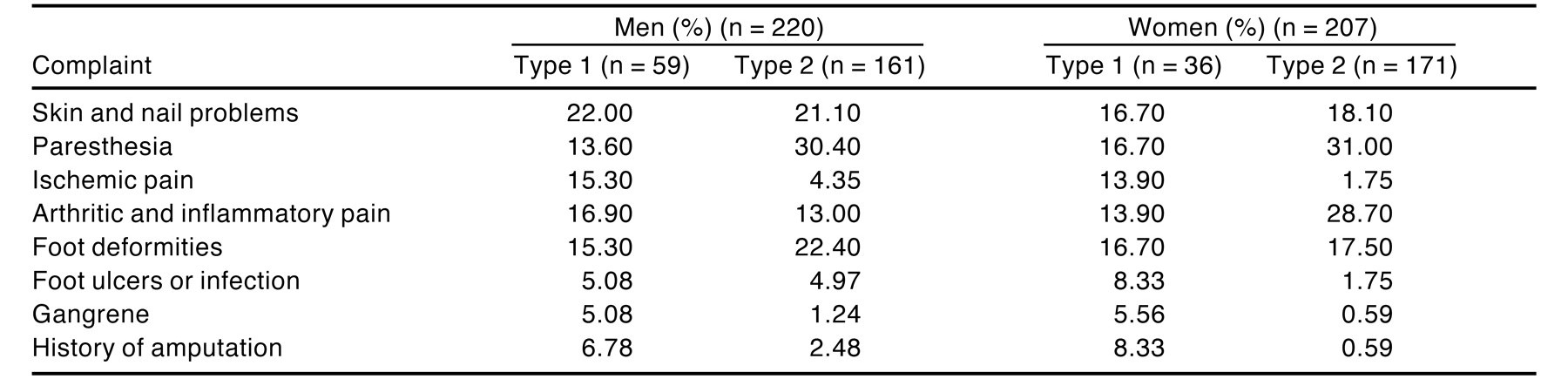
The average number of podiatric complaints per patient was 2.4 ± 1.1 (range, 1 to 4) (
Table 2). Involvement of pedal lesions with neuropathic and ischemic causes differed by sex and type of diabetes mellitus, and they are categorized accordingly in
Table 2. Paresthesia associated with diabetic neuropathy was the most common foot complication in all patients and in men and women with type 2 diabetes mellitus (30.4% and 31.0%, respectively). Individuals with type 2 diabetes mellitus were at greatest risk of developing foot deformities according to the criteria previously described, with 22.4% of men and 17.5% of women developing a structural change in the intrinsic musculature of the foot. The at-risk foot in patients with type 1 diabetes mellitus was identified in 9 men (15.3%) and in 6 women (16.7%). Foot ulceration and gangrene were more common in patients with type 1 diabetes mellitus than in those with type 2 diabetes mellitus; overall, type 1 diabetic women had the highest incidence of foot ulcers (8.33%), gangrene (5.56%), and history of amputation (8.33%).
Table 2.
Chief Podiatric Complaints in 427 Patients with Diabetes Mellitus
Table 2.
Chief Podiatric Complaints in 427 Patients with Diabetes Mellitus
Onychocryptosis, onychomycosis, and tinea pedis were the most prevalent pathologic conditions affecting the nails and integument of the foot (men with type 1 and type 2 diabetes mellitus, 22.0% and 21.1%, respectively; women with type 1 and type 2 diabetes mellitus, 16.7% and 18.1%, respectively).
In the review of systems (
Table 1), the authors identified an average of 2.7 ± 0.7 systems for men and 2.4 ± 0.8 systems for women as problems. A current or past history of tobacco abuse was reported in 97.0% of men and 2.0% of women. The three most common nonpedal complaints in men were blurred vision (73.6%), hypertension (64.1%), and erectile dysfunction (52.3%). In women, blurred vision (84.5%), incontinence (71.5%), and low-back pain with radiculopathy-like symptoms (56.5%) were the three most significant findings.
Discussion
The prevalence of systemic complications in the Asian population studied seemed to closely parallel the most commonly reported morbidity of diabetes mellitus in the US population. Although pedal complaints related to distal peripheral neuropathy were the primary reasons these patients sought podiatric care, the involvement of coronary artery disease and retinopathy in this population was highly evident.[
15,
16]
Hypertension and smoking, two of the most significant risk factors for heart disease, were evident in men. The astonishing sex difference in smoking prevalence (93.0% of men and 2.0% of women) probably results from cultural factors in native Asian countries, where smoking is more acceptable among men than among women. The most notable sex differences in the cardiovascular system were for hypertension and chest pain. The higher rate of hypertension in men was perhaps due to the presence of other contributing risk factors, such as tobacco use. Women related a greater history of chest pain, but its etiology in patients without a clear antecedent of myocardial infarction was not determined. In diabetic patients, 30% of myocardial infarctions occur in the absence of pain.[
17] These findings may be indicative of this silent presentation, where the reported incidence was slight and very similar for men and women.
Findings indicative of retinopathy were prevalent as well, equally affecting women (84.5%) and men (73.6%), and it was the most common systemic complication found. These findings are not surprising given that other studies have reported that after a 15-year history of diabetes mellitus, 97% of type 1 diabetic patients and 80% of type 2 diabetic patients have retinopathy.[
15]
Erectile dysfunction and incontinence were the most significant urologic findings in men and women, respectively. Slightly more than half of the men had a history of erectile dysfunction, making it the third most common finding in the systems review. Incontinence was present in 71.5% of women and was the second most common finding. Autonomic neuropathy is known to be responsible for genitourinary and gastrointestinal tract disturbances in diabetic patients, with impotence affecting approximately 13% of type 1 diabetic men and 8% of type 2 diabetic men.[
15]
The presence of neuropathy and peripheral vascular disease in the diabetic foot poses a serious risk of ulceration, infection, and amputation. Foot infections are the leading cause of hospitalization in the diabetic population,[
18] and ulcers are the single most common precursor to lower-extremity amputation.[
19]
The presence of potentially devastating structural changes must be identified before the foot is seriously compromised. There was a small difference in the prevalence of foot deformities between type 1 and type 2 diabetic men (15.3% and 22.4%, respectively). For women, these deformities were found more frequently in the type 2 diabetic group (17.5%) than in the type 1 diabetic group (16.7%). The most significant finding was that only 3.2% of all patients had any previous knowledge or understanding of the risks of foot infection, ulceration, and amputation secondary to diabetes mellitus.
Conclusion
The incidence of diabetes mellitus in native and migrant Asian populations is progressing at epidemic proportions. This population, once practically exempt from this condition, is succumbing to the effects of global westernization and other environmental and social risks leading to diabetes mellitus.
The podiatric physician plays a vital role in the health care of all diabetic patients and is often the first to diagnose diabetes mellitus and its foot complications. For this reason, it is crucial to be able to recognize other possible systemic complications and make appropriate referrals.