Onychocryptosis is usually considered a minor condition, but it can be a source of considerable discomfort.[
1] Although several different etiologic theories have been proposed, including improperly trimmed nails, tight or badly shaped shoes, abnormal nail shape, heredity, and congenital factors,[
2,
3,
4,
5,
6,
7] evidence suggests that the most probable cause is a combination of these factors.[
6] The rarity of onychocryptosis in people who do not wear shoes makes extrinsic pressure an important factor in the development of the disorder.[
6]
The tendency to develop some forefoot disorders, such as hallux valgus, hallux rigidus, sesamoiditis, and metatarsalgia, has been associated with certain foot types.[
8] The present study was undertaken after a careful review of the literature revealed no studies concerning the relationship between foot type and the development of onychocryptosis.
Materials and Methods
The study population consisted of 512 patients admitted to the Department of Orthopedics of Dokuz Eylül University Hospital in İzmir, Turkey, with complaints other than forefoot problems. The study was limited to skeletally mature cases; therefore, patients younger than 18 years of age were not included. The study was approved by the Special Modular Study Committee of the Dokuz Eylül University School of Medicine.
The feet were classified according to digital and metatarsal formulas. Three types of feet were identified by the digital formula: the Greek foot, in which the first toe is shorter than the second toe; the Egyptian foot, in which the first toe is longer than the second toe; and the squared foot, in which the first toe is the same length as the second toe. Three types of feet were identified by the metatarsal formula: the index plus/minus type, in which the first metatarsal is equal in length to the second; the index minus type, in which the first metatarsal is shorter than the second; and the index plus type, in which the first metatarsal is longer than the second. The determination of metatarsal type was made by palpating the heads of the first and second metatarsals by at least two of the authors. Anteroposterior radiographs were taken to determine foot type in cases without consensus. Nine types of feet were identified by combining the digital and metatarsal formulas.[
8]
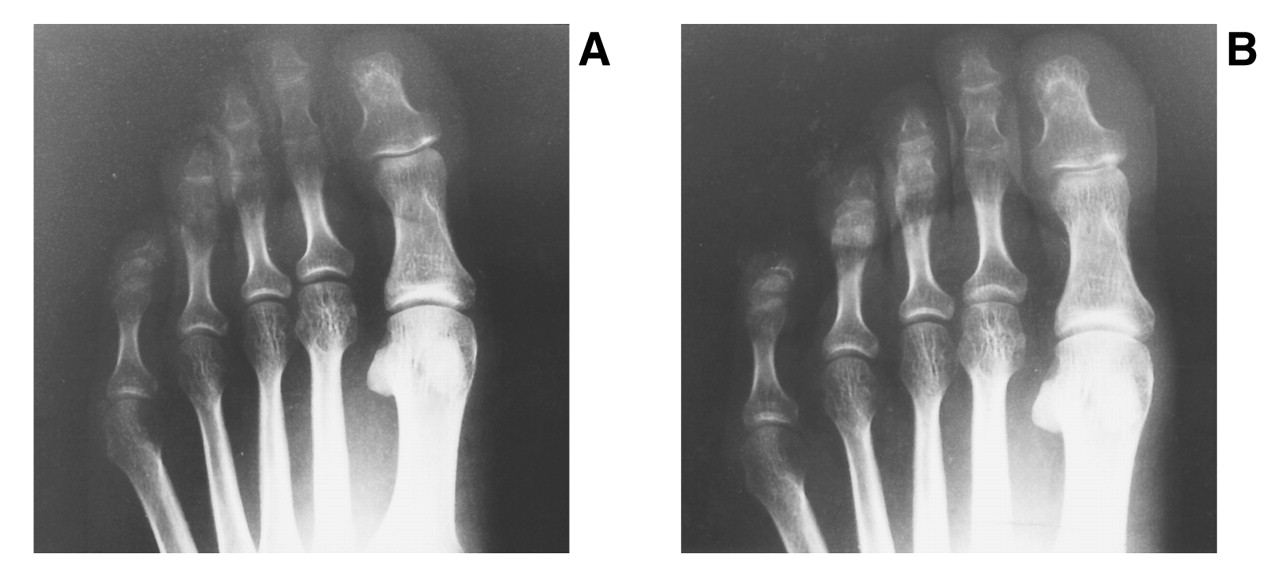
The presence of onychocryptosis or any history of the disorder was recorded. Forefoot problems were also noted, especially mild clawing of the lesser toes. Anteroposterior radiographs of each type of foot were taken in standard fashion and again after binding the first and second toes together in an effort to simulate a tight shoe. The radiographs enabled the authors to check the reliability of the assessment of foot types by palpation (
Fig. 1).
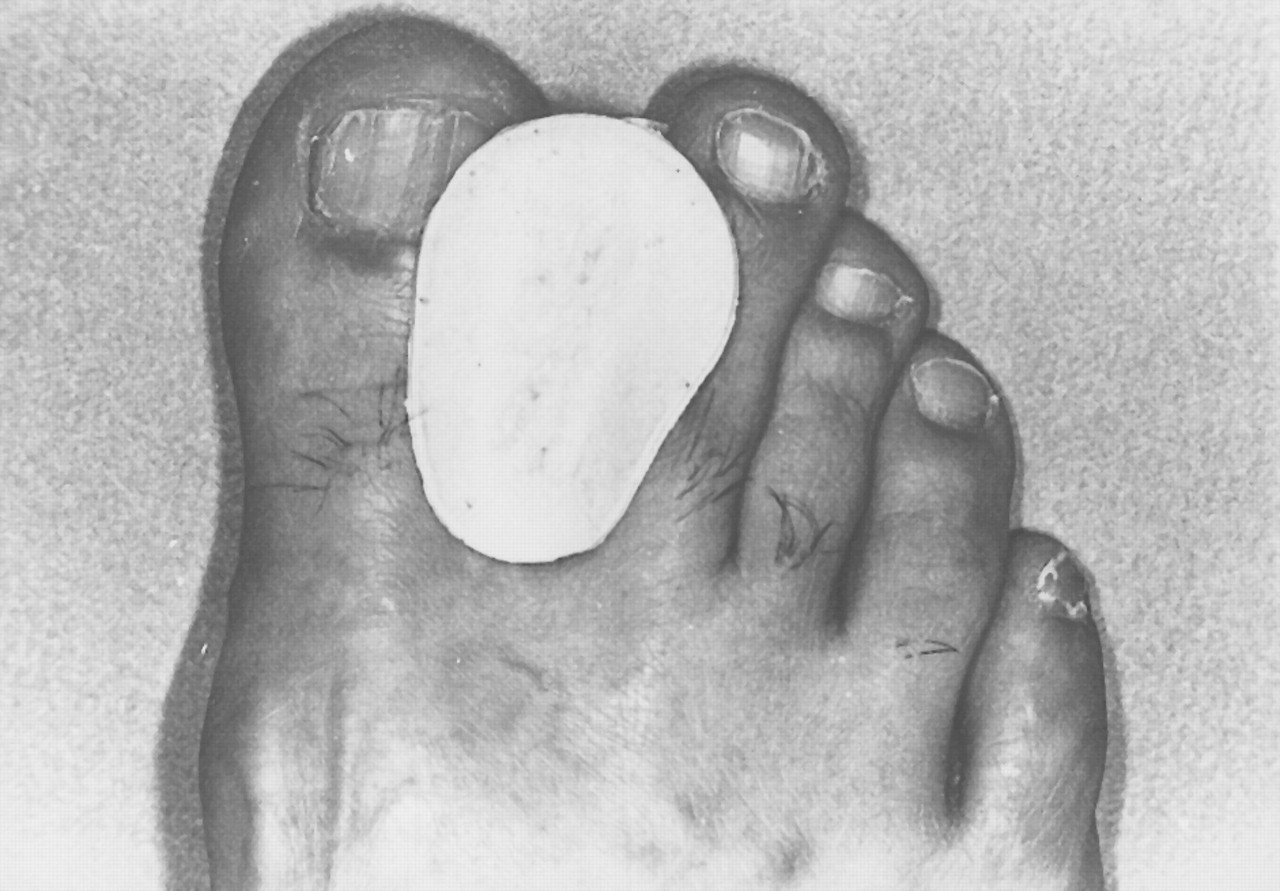
Fourteen consecutive patients with onychocryptosis were treated by placing a toe spacer, which is used in the treatment of hallux valgus, between the first and second toes (
Fig. 2). Ten of the patients had stage I onychocryptosis with mild erythema, swelling, and tenderness along the lateral nail fold, and four had stage II onychocryptosis with abscess formation.[
2,
6] Treatment was discontinued when a squared nail with corners protruding distal to the hyponychium was achieved. Patients with stage II onychocryptosis also received an oral broad-spectrum antibiotic for 1 week.
Results
Of the 512 cases surveyed, 209 had the Greek foot type, 157 had the Egyptian type, and 146 had the squared type by the digital formula. When the cases were classified by the metatarsal formula, 247 had the index plus/minus foot type, 225 had the index minus type, and 40 had the index plus type. The distribution of the cases according to the combination of both formulas is displayed in
Table 1. About one-quarter (n = 124) of the cases had evidence or a history of onychocryptosis.
When the prevalence of onychocryptosis by foot type was examined, the Greek index minus and squared index minus types displayed the highest prevalence, with 33.9% and 35.1% of such feet affected, respectively. Sixty-two cases had mild clawing of the lesser toes; 75% (n = 39) of these had the Greek foot type. These subjects were all female, and none had onychocryptosis.
Assessment of foot type using anteroposterior radiographs was in accordance with the assessment of foot type by palpation. When radiographs were taken after binding the first and second toes together, the enlargement of bony structures of the second toe at the distal interphalangeal level moved toward the distal enlargement of the distal phalanx of the first toe only in squared and Greek index minus feet (
Fig. 1).
In all 14 patients with onychocryptosis treated by inserting a toe spacer between the first and second toes, a squared nail with corners protruding distal to the hyponychium was achieved in 17 to 22 days. All of the patients experienced slight discomfort at the metatarsophalangeal level of the first toe during the treatment period.
Discussion
Although several etiologic factors have been proposed for onychocryptosis, the condition can be summarized as a breakdown in the balanced system of forces acting on the nail and the toe.[
5] The condition is rare in people who do not wear shoes, with the most likely explanation being the absence of extrinsic pressure. Within the confines of the shoe toe box, the first toe is pushed toward the second toe, resulting in pressure against the lateral border of the nail.[
5,
6] This counterpressure of the second toe is expected to be less in the Egyptian foot type, in which the second toe is shorter than the first toe. This study supports that hypothesis in that a low correlation was found between the Egyptian foot type and the development of onychocryptosis. In the present study, a high correlation was found between the development of onychocryptosis and the Greek and squared index minus feet. More counterpressure of the second toe is expected in these feet, in which the second toe is at least as long as the first toe. As shown in the radiograph with binding of the first and second toes, the enlargement of the second toe at the distal interphalangeal level moves toward the distal enlargement of the distal phalanx of the first toe. More pressure at this level prevents normal nail growth. With flexion of the lesser toes, this counterpressure vanishes and the lateral edge of the first nail is freed. Mild clawing of the lesser toes was found in approximately 10% (62/512) of the cases, and none exhibited onychocryptosis.
The fact that the patients treated with a toe spacer healed supports the hypothesis that counterpressure of the second toe is a factor in the development of onychocryptosis. Some discomfort or pain at the metatarsophalangeal joint may be anticipated with this treatment.
The results of the present study contradict the findings of Viladot[
8] in two respects. First, Viladot rarely found pathologic changes in the forefoot of the Greek foot type, while in the present study, the Greek index minus foot showed a high prevalence of onychocryptosis. Second, the majority of cases in the Viladot study had the Egyptian foot type (69%), followed by the Greek type (22%) and the squared type (9%).[
8] The corresponding percentages in the present study were 30%, 41%, and 29%, respectively. When the feet were classified by the metatarsal formula, Viladot found 56% index minus, 28% index plus/minus, and 16% index plus,[
8] whereas the corresponding percentages in the current study were 44%, 48%, and 8%, respectively. These results suggest that more surveys should be conducted in different communities.
Conclusion
The results of this study show that the Greek index minus and squared index minus foot types are most strongly associated with the development of onychocryptosis, which is probably due to the counterpressure of the second toe. The results also suggest that a toe spacer between the first and second toes may be effective in the treatment of stage I onychocryptosis, but the current study was small and randomized trials are mandatory to confirm this finding.