To the Editor:
Erythromelalgia is a painful disorder of the feet and sometimes the hands characterized by burning, edema, calor, and erythema. The condition is exacerbated by heat and is relieved by cooling and elevating the affected extremities. The attacks are often seasonal in nature, with an increased prevalence in the warmer months.[
1] The differential diagnosis should include the recovery phase of frostbite, the hyperperfusion stage of Raynaud’s phenomenon, reflex sympathetic dystrophy, causalgia, and Fabry’s disease.
Erythromelalgia is divided into primary and secondary categories. Primary erythromelalgia is not associated with any other disease process. Diagnostic criteria that have been proposed for primary erythromelalgia include painful extremities with all of the associated physical findings; symmetrical nature of disease; attacks associated with or exacerbated by dependency, warmth, or activity; relief with elevation or cooling of the extremities; lack of response to medical therapy; and no associated cause.[
2] Primary erythromelalgia is a bilateral process that tends to involve the lower legs rather than just the toes and soles of the feet.[
1]
Secondary erythromelalgia is caused by a multitude of factors including myeloproliferative diseases, polycythemia vera, essential thrombocythemia, agnogenic myeloid metaplasia, myelofibrosis, and chronic myelogenous leukemia.[
1] Secondary erythromelalgia has also been attributed to hypertension, venous insufficiency, rheumatoid arthritis, gout, lichen sclerosus et atrophicus, vasculitis, pernicious anemia, spinal cord disease, systemic lupus erythematosus, and certain drugs (nifedipine, bromocriptine, verapamil, nicardipine, and pergolide). The disease process is often asymmetrical. Aspirin relieves symptoms for most patients, and this response has been considered to be pathognomonic.[
1,
2] Secondary erythromelalgia occurs in 3% to 65% of patients with myeloproliferative disorders. Myeloproliferative diseases with thrombocythemia are responsible for 20% of the cases of erythromelalgia. Alleviation of the symptoms usually occurs when the underlying myeloproliferative disorder is treated and a normal platelet count is achieved.[
1] Erythromelalgia often occurs a median of 2.5 years before the myeloproliferative disorder, so blood work should be periodically performed once the diagnosis of erythromelalgia is made.[
1,
2]
Various pathophysiologic causes of erythromelalgia have been proposed. No histopathologic changes occur with primary erythromelalgia. Pathologic signs present with secondary erythromelalgia include arteriolar intimal proliferation with thrombotic occlusions secondary to platelet aggregation.[
3] Some researchers suggest that both hypoxia and hyperemia occur in the disease process with high levels of arteriovenous shunting in the extremities.[
4]
Case Report
A 46-year-old woman was referred to the author’s office by her primary-care physician with a chief complaint of “excruciating pain in all ten toes” that began 8 years earlier. The patient related that burning discomfort occurred after prolonged use of footwear and with exposure to warmth and that the pain was relieved by elevating and icing the feet for extended periods of time. Multiple oral medications were tried by the primary-care physician without relief of pain. No history of pregnancy or new medication was associated with the onset of the pain. The patient’s medical history was significant for Hodgkin’s disease (diagnosed 16 years previously, currently in remission), anemia, asthma, and hypothyroidism. Her current medications consisted of conjugated estrogen, thyroxine, albuterol, loratadine, and ipratropium. There was no history of tobacco or alcohol use. A review of systems was negative except for the previously mentioned problems.
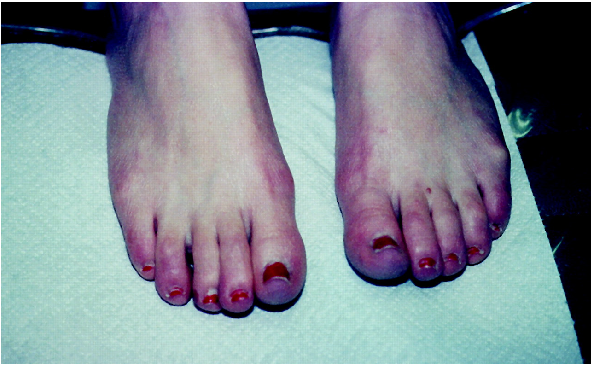
Physical examination revealed palpable dorsalis pedis and posterior tibial pulses bilaterally. All of the toes were extremely warm to the touch with severe rubor on dependency and return to normal color with elevation (
Figure 1). Physical examination was otherwise unremarkable, and noninvasive vascular studies were within normal limits. Blood work revealed an elevated platelet count of 495 × 103/μL (reference range, 150–400 × 103/μL).
Within 2 days of the initiation of aspirin therapy, 325 mg orally once daily, the patient reported total relief of pain for the first time in 8 years. Open-toed shoes were recommended for the warmer months when possible. Interestingly, no improvement of the coloration of the digits was noted at subsequent follow-up examinations.
Discussion
Treatment of primary erythromelalgia is often unsatisfactory. The disease is often unrelenting in nature and not amenable to aspirin therapy. Most cases are untreatable; however, a small measure of relief has been obtained with nitroprusside and methysergide.[
1] Some evidence suggests that serotonin (5-hydroxytryptamine) may be involved in the disorder, as serotonin antagonists such as methysergide and pizotyline have proven successful in several cases. Venlafaxine hydrochloride and sertraline hydrochloride have been used with good results as well. Platelet function, vasoconstriction, and vasodilatation are all controlled by 5-hydroxytryptamine, which may explain the success of these drugs. They certainly represent a viable treatment option for cases refractory to traditional treatment.[
5]
The standard of treatment for secondary erythromelalgia is 500 mg of aspirin per day. Aspirin prevents platelet aggregation through an irreversible inhibition of cyclo-oxygenase; the effect usually lasts for days. In contrast, indomethacin causes a reversible inhibition of cyclo-oxygenase, providing only 24 hours of relief. The ischemia associated with the disorder is resolved within days after the initiation of aspirin therapy and platelet survival time is increased. It appears that active platelet prostaglandin metabolism is required, as no relief is obtained with other antiplatelet drugs such as sodium salicylate, sulfinpyrazone, and dipyridamole, which have no effect on cyclo-oxygenase.[
3]
Podiatric physicians should be aware of this uncommon disorder and its associations with other disease processes that may not be readily apparent on initial presentation.