The Two Philosophical Approaches: Qualitative and Quantitative Research
This, the broadest classification of research approach, is usually based on the nature of the clinical question and the type of questions to be addressed by the project. Qualitative research attempts to verify or generate a theory gleaned from gathering broad descriptive information in a natural setting. As such, it is often also referred to as naturalistic research. Quantitative research is different in that the aim is to answer a specific research question by showing statistical evidence under a strict set of guidelines. Quantitative approaches include typical experimental research, which we see often in the medical literature (
Bailey, 1997). The broad differences between qualitative and quantitative approaches are presented in
Table 1.
It is important to note that qualitative and quantitative methods are not necessarily mutually exclusive, nor are they inherently contradictory in nature. Many techniques, such as interviews and surveys may approach a problem from either a qualitative or a quantitative perspective or in some cases, a mix of the two. Indeed, a research question may be asked primarily in a qualitative manner to identify issues key to an individual, and then tested on a group in a quantitative manner to ascertain whether this proposition applies to a larger population. As such, it is important to appreciate each approach, and to identify their respective strengths and limitations. Neither a qualitative nor a quantitative approach is inherently superior, but one may be clearly more suited to certain circumstances. Once again, an understanding of the applications and limitations of each of the major research methods is essential for the participating researcher but is also important to the reader of the resulting published research.
As was outlined previously, qualitative research can be broadly defined as a type of investigation in which there is attention to the social or environmental context that frames the research question. In qualitative research, it is common for the initial research question to be broad, or for it to be defined or refined by results of incoming data. Quantitative research is sometimes erroneously described as that involving numbers, and qualitative research that which does not. In reality this distinction is over-simplistic, as there are examples of both types of research successfully breaking with this convention.
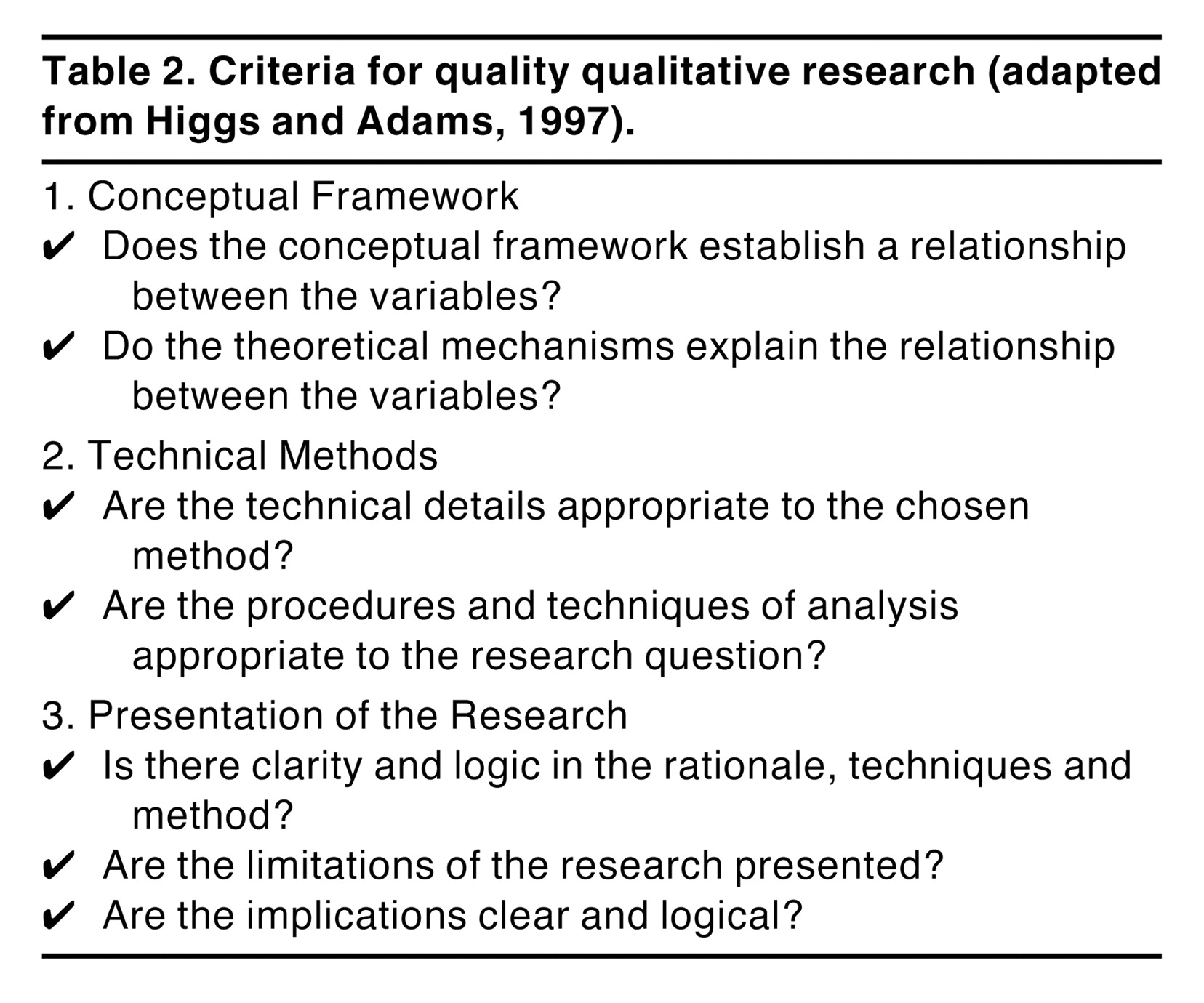
It is unfortunate that qualitative research has gained a sometimes poor reputation among members of the scientific community. In part, this is based on the labeling of much poor quantitative research as ‘merely qualitative’ or ‘too qualitative’. This need not be the case. Within any experimental model there can exist both rigorous and less rigorous research, and the same will hold true for quantitative and qualitative methods. It follows therefore, that any good qualitative research must follow some basic formalised and set criteria. Dwyer (1996), quoted in Higgs and Adams (
1997) identifies three key criteria to identify high quality, qualitative research. These are presented as a checklist in
Table 2.
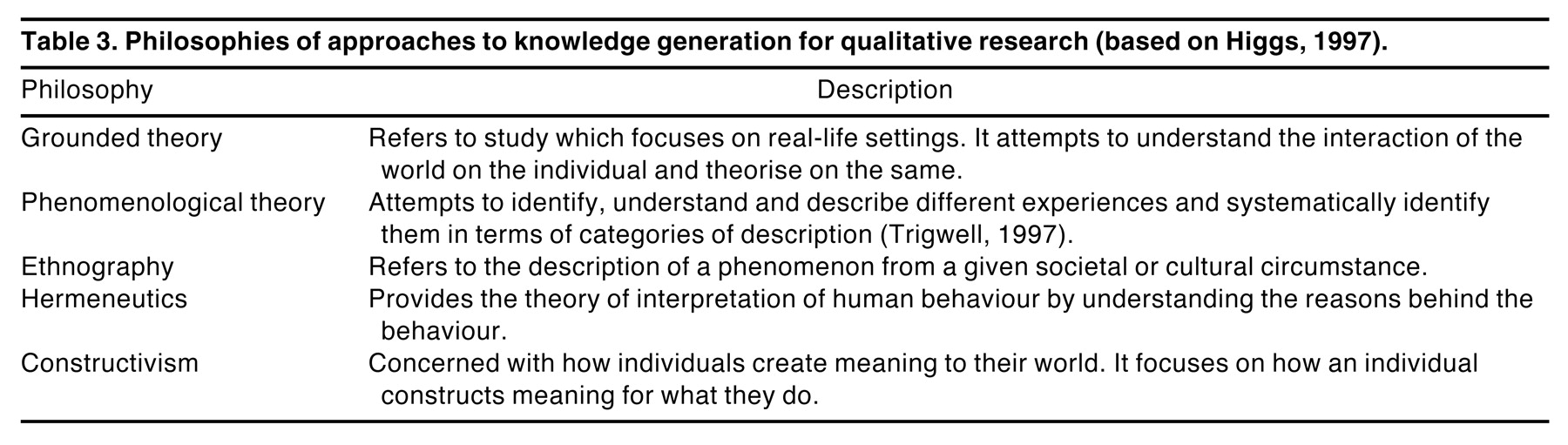
Qualitative research is based on generating knowledge. It is often referred to as gathering contextually ‘rich’ knowledge, in that the information gathered will inform in detail, but without necessarily attempting to generalise to a population. The interpretation of knowledge is in turn, based on different philosophies of how knowledge is generated. These different philosophies are described in
Table 3.
The techniques used to evaluate the information based on the philosophy of knowledge are wide and varied. The most common techniques include structured observation, interview techniques and survey methods.
Whereas qualitative research usually focuses on understanding a problem in its broader context (sometimes called the inductive approach), the more quantitative, deductive approach involves a process of breaking a problem or phenomenon into its component parts and then analysing the parts to predict the function of the whole. Within the conventional scientific paradigm the deductive model tends to predominate. It is arguable as to whether this is for better or for worse.
The process of deduction has been defined as follows (after
Spilker, 1996).
Theories are formulated, derived from the inductive/qualitative process as outlined above, or from simple observation. (The theories are usually based on the classification of factors within a phenomenon, and the later refinement of these observations into testable hypotheses.)
The hypotheses are then subjected to testing under controlled conditions (the crux of the scientific process) and are duly either verified or falsified.
Where a hypothesis is verified through experimentation the theory builds.
Where hypotheses are found to be insupportable in experimentation, the theory is either revised and re-evaluated, or if no consistency can be found it may be discarded entirely.
Approaches in Practice
Unless we suggest that podiatry has no roots in science, then it follows that we need to subject our practice to the rigours of the scientific process in some form, either qualitatively or quantitatively. This can be a hard road to follow, but a good scientific clinical research profile is probably the key to developing the credibility of the profession—and there are no short cuts.
The subsequent pages focus mainly on the quantitative approach, however it is important to reiterate that many of the qualitative or inductive techniques may be equally applicable, or even more applicable in certain circumstances. Sometimes the boundaries are purely artificial and become blurred, hence surveys, interviews and structured observation can all contain a quantitative element, just as epidemiology can be qualitative in some applications.
Structured observation. Structured observation occurs where an individual is observed in a formal manner, and behaviour or other outcomes are recorded. The fundamental principle of structured observation is that the research does not intervene or manipulate the conditions of the study. All information is gathered from observing and analysing the situation. Observational studies are advantageous in that they are generally easier, faster and less expensive than experimental studies. However, as the researcher has less control over the conditions, there are limitations in how broadly the conclusions can be applied.
Interview techniques. Several forms of interview may be applied to an investigation. These range from one-on-one interviewing to a large group approach. The advantages of the interview are obvious: rapport is developed between the researcher and the participant, and questions or responses may be clarified or followed up. Interviews may be face-to-face or over the phone, with face-to-face interviews offering the additional advantage of allowing the researcher to observe non-verbal cues and sense confusion or lack of comprehension on behalf of the participant. The limitations of interviewing are the time required to set up and conduct the interviews, transcription, and the difficulty in interpretation of the information.
Interviews may be structured, where a formal sequence of events and wording of questions are followed; or unstructured, where the procedure is less prejudged and questions asked will in part depend on the responses from earlier questions. In unstructured interviews, the onus of responsibility lays with the researcher to search for the questions that address the research objective.
Unstructured interviews are often used in pilot studies to develop parameters for a study (
Bailey, 1997). Such interviews allow the researcher to explore topics which may not have been considered prior to the development of a questionnaire but which transpire to be relevant to the sample of respondents. Unstructured interviews are also useful when exploring difficult or sensitive topics as they allow for personal reflection and individual responses.
There are several structured group interview techniques, including Functional Analysis Workshops (
Folch-Lyon and Trost, 1981;
Morgan, 1992;
Murphy et al, 1992) and Nominal Group Techniques (
McKenna, 1992). Each type of interview has a specific aim in questioning a group of participants who have been sampled from a particular population. Clearly, the selection of each requires careful consideration.
Survey methods. Surveys are an inexpensive and relatively fast way of gathering information from a large population, where information is sought either through written or verbal questioning. Surveys must be developed with consideration to the objective of the study and must be unambiguous, non-directive (or non-leading) and relevant. Also with any survey methods, it is crucial that the population is clearly defined and appropriately sampled.
Clearly there are significant problems with any research that relies solely on self-reporting. Participants must understand the question, have the appropriate responses available to them and answer honestly. In analysing any questionnaire, the interpretation and analysis of the information collected must be undertaken judiciously and conclusions must be drawn with care (
Bailey, 1997). Survey technique is one area where the methodology has become highly developed, but is also an area where many novices believe that questions can be simply made up on the spot. As with all forms of research, the ‘rules’ associated with survey techniques exist for good reason. Often a short time spent with a primer text would help most people avoid making elementary and avoidable mistakes when planning a questionnaire.
Epidemiological Studies. Epidemiological studies usually form the first stage in developing a new area of theory and research. This type of study provides baseline information about the natural history of the disease process, and the distribution of the disease or disorder through a population in which we might be considering an intervention (
Polgar and Thomas, 1995). This description then provides a benchmark against which we can start to measure the effects of some of our interventions. So fundamental is the role of good epidemiology that the questions addressed in an early epidemiological study are sometimes called the ‘Cardinal Questions’ (
Abramson, 1990), reflecting their role in underpinning the majority of the subsequent research process. Good epidemiological data is lacking in many areas of podiatry and more work in this area would be a tremendous asset to the podiatry profession.
Epidemiological surveys may be simply descriptive or they may attempt to provide a deeper, analytical insight into the nature of a problem. The types of epidemiological study can be broadly summarised under one of three headings: descriptive, analytical or longitudinal epidemiological surveys.
(a) Descriptive epidemiological surveys themselves come in two forms, cross-sectional and longitudinal (
Abramson, 1990). In cross-sectional studies, a snapshot of a disorder is taken to identify features such as incidence and prevalence. In a longitudinal survey a sample of a population with a disorder is followed over a period of time in order to describe its changing features and natural history.
(b) Analytical epidemiological surveys are used to compare the features of two groups or populations in order to describe features of commonality or difference (
Abramson, 1990;
Polgar and Thomas, 1995). These are usually cross-sectional or repeated cross-sectional in nature.
(c) Longitudinal epidemiological surveys, whether descriptive or analytical, can be undertaken either prospectively or retrospectively, that is either by identifying a cohort in advance and following it for a period of time, or identifying differentiating features in a group and tracing the history back using available information.
Evaluative clinical research. Logically, evidence-based practice will be most valuable when the research which is intended to inform practice is undertaken specifically with clinical outcomes in mind. The area of evaluative clinical research has grown enormously in the last ten years and includes a variety of approaches from case reports to randomised clinical trials. The majority of evaluative or experimental clinical approaches involve a series of common stages (
Polgar and Thomas, 1995). These include:
Identifying the trend to be explored
Identifying a population in which to test for an effect
Selecting an appropriate sample and assigning them to groups
Administering an intervention
Measuring the effects of the intervention.
Within this framework there is some flexibility, and there are a variety of designs which can be employed in putting together an experimental study. It is important for the prospective researcher to have utilised the most appropriate design for a given situation. However, it is the reader, not the researcher who holds the key. The knowledgeable reader should carefully appraise the appropriateness of the method chosen and should be prepared to draw their own, informed conclusions. The degree to which they refute, or concur with the researcher’s choice should affect the degree of faith they will place in the results. The natural extension of this is that such informed consumerism will rightly affect the extent to which the results are permitted to influence future practice.
In the previous reprint in this series (JAPMA Vol 92, No 2, February 2002), Keenan and Redmond proposed a hierarchy of evidence adapted from Guyatt et al (
1995). The rationale for this proposed hierarchy is developed from weakest to strongest, in the subsequent pages.
Case reports. Case reports can vary from a rudimentary report on the findings with an unusual patient to a prelude to an experimental study. Case reports are usually illustrative, providing an example of a presentation or a management protocol and descriptively outlining the vagaries of the case. They are usually anecdotal rather than experimental in design. Case reports provide an important first step in bringing new ideas or approaches to the attention of the profession, and are a great way to become involved in publishing for the first time.
It should be remembered however, that the role of case reports in informing changes in practice is limited by the lack of formal evaluation involved in the process. The goal of a case report is to encourage recognition of similar experiences not to provide definitive evidence of the effectiveness of a particular management approach. The discerning practitioner should not usually consider changing their practice solely on the information presented in a case report.
Cross-sectional surveys. As previously mentioned, cross-sectional surveys describe a method for gaining a picture of a population at a specified time. Such methods are useful in establishing disease frequency and distribution, and while cause and effect cannot be ascertained using cross-sectional designs they yield important information about the association between exposures and disease (
Torrence, 1997). Although they are limited, cross-sectional surveys are generally quickly completed, cost efficient and easy to administer.
Single Subject Experimental Design (SCED). SCED is similar to other scientific research methodologies whereby a series of measures (eg of pain) are taken over time. It too requires the same attention to logical design and control as other methodologies. However, SCED is usually reserved for conditions that are relatively rare or difficult to research. Further, SCED encourages assessment of individual responses to treatment, a point which is generally overlooked in larger trials (
Ottenbacher, 1986). In addition, SCED may be used to pilot treatments on a few patients, thus focusing the research question and protocol, before moving on to large, expensive trials.
Usually data is collected by taking measures during different phases: for example, measurement is taken during a baseline phase where no treatment is offered, then treatment is introduced and further measurement made. There are many different routes after these initial phases including returning to the baseline condition or changing to a new treatment to compare the effect of different treatments (
Kazdin, 1982). A multiple baseline design can also be used either across subjects or across conditions (
Portney and Watkins, 1993). While the data collected is usually graphed for visual analysis, researchers can also use some statistical analysis to supplement the visual inspection methods (
Kazdin, 1982;
Ottenbacher, 1986).
SCED has been criticised in the past because the results cannot be used to draw conclusions that can be generalised to the population as a whole. Its main purpose as a methodology, however, is to assess the effect(s) of an intervention on an individual. To gain ‘generaliseability’ the researcher must conduct the research on many individuals. However, if many individuals are suitable to be studied, it would be more appropriate to use a different methodology, such as a randomised controlled trial.
Case-control designs. Case-control studies, either retrospective or cross-sectional, compare a sample group with a group known to have been spared the intervention or condition under investigation. This type of design is employed where the sample is either small, as may be the case with rare conditions, or where the sample would not be available for the duration of a full prospective study. Case-control designs are particularly useful for identifying trends when the effects of an intervention may be difficult to predict in advance. They often appear attractive to the novice researcher because they can be cheaper and easier to implement than some other methods. However, this form of study is for a number of reasons methodologically less than ideal. In particular the lack of randomisation leads to the potential for the introduction of biasing factors such as selectivity.
An example of a case-control study would be to retrospectively determine the effect of having worn foot orthoses (for a different condition) on subsequent incidence of arthritis of the knee, or heel spur formation. In such a study, the incidence of arthritis or heel spur in a group of long-term orthoses wearers could be evaluated against the incidence found in a group of non-orthoses wearers. Due to the lack of randomisation, the cases and controls must be carefully matched to ensure that the one variable under investigation is the sole, or at least the primary factor responsible for the difference between the case and its control. The data yielded from case-control studies should be treated with some caution (
Abramson, 1990;
Bland, 1995;
Greenhalgh, 1997).
Cohort studies. Cohort studies can be described as an evaluative study that follows the same group of subjects over time. These are used prospectively to assess the natural history of a disease process. In a cohort study a sample is identified as having a suspected causal factor and then followed over a prolonged period in order to determine whether they go on to develop symptoms or a disease process. This contrasts with most types of design where the study is undertaken on groups of subjects who have already demonstrated the disease process.
Cohort studies are often used to describe the incidence of disorders that may be relatively uncommon in a normal population, and so may involve large numbers of participants. This, coupled with the long duration of most studies can cause problems relating to drop outs and non-compliance. In podiatry a number of cohort studies are currently needed in order to clarify the natural history of disorders such as metatarsus adductus and to provide information about the underlying causative factors for pathologies such as cavoid and planus foot types (
Bland, 1995;
Greenhalgh, 1997).
Randomised Controlled Trials (RCTs) (after
Bland, 1995;
Polgar and Thomas, 1995;
Spilker, 1996;
Greenhalgh, 1997). The underlying premise of the RCT is the employment of randomisation procedures to objectively assign subjects either to active treatment, or to control states of no treatment or a placebo treatment in a prospective study. The randomisation process, if properly conducted, results in the minimisation of bias and makes the RCT a good, robust method for evaluating clinical treatments. As such, a well-executed RCT is generally regarded as being the gold standard for experimental design. Variations on the RCT include multi-centre RCTs, where the data is collated over a number of different locations or institutions to exclude local effects; and the so called ‘mega trials’ where very large numbers of cases (typically many thousands) are evaluated in order to produce high quality data on the effects of a treatment.
Control groups. The utilisation of a control group is probably the single most important factor affecting the ‘believability’ of a study. This is because difference between the active treatment and the control is the real key to how effective a treatment is. If the two groups are appropriately similar in every way (because of a good randomisation protocol) except for the treatment, then there is a good chance that any difference is solely because of the treatment—rather than factors such as resolution over time.
If the control group is made up of participants receiving either no treatment at all, or a disguised dummy (placebo) treatment, then the trial is known as a ‘causal’ or ‘explanatory’ trial. In this kind of trial all of the effect is expected to be due to the active treatment. Sometimes however, usually for ethical reasons, a treatment under investigation will be evaluated against an existing benchmark treatment of known efficacy. These are known as ‘pragmatic trials’. In this case, the key is whether the new treatment performs better or worse than the existing benchmark. In either case it is essential that the allocation to the treatment or control groups should be properly randomised so as to avoid bias.
Note: A common short-cut, involving the comparison of the results of a group following treatment with the results obtained from the same group before treatment does not constitute ‘control’. In a case such as this, at least some of the difference between the two sets of results may have occurred for reasons other than the treatment, eg straightforward disease progress over the time of the study. The results of studies employing this type of method must be treated with caution—they are not of the same standard as a proper RCT.
Randomisation. Randomisation is useful because it removes the potential for bias in allocating the participants to the various treatment or control groups in a study. Another useful effect is that in a large enough sample, factors that could interfere with the data (confounders) should be roughly equally distributed between all of the treatment and control groups. It is not then necessary to eliminate all confounding factors because although they may add ‘noise’ to the data, they are less likely to systematically skew results one way or the other.
Randomisation requires a larger sample than some techniques (such as explicitly matched pairs) because the technique relies on the weight of numbers to ensure the likelihood of the groups being similar in make-up. In the case of randomised studies, the larger the sample, the greater the likelihood that the various confounders will cancel out. Hence randomised studies usually require at least 30 participants in each treatment or control group to ensure a good chance of the groups being relatively homogenous. Studies based on groups of less than 30 should be viewed with some scepticism, while studies based on hundreds or thousands of participants will more usually be considered important. The concepts of sample size and statistical ‘power’ will be developed in the third paper in this series.
Meta-analyses. Meta-analysis is a method of systematically combining or pooling the results from multiple RCTs where methods and the study samples are compatible with one another. The data from a number of trials may be pooled in raw form to create a large and more powerful data set, or the previously interpreted results from the trials may be averaged. The resulting information thus represents a synthesis of the output of a number of independent RCTs, and can enhance the credibility of the overall analysis. In addition to the data presentation, the author of a meta-analysis usually makes some attempt to summarise the features of the individual studies included in the analysis. This often aids the inexperienced reader in understanding the process of critically evaluating the research (
Spilker, 1996;
Greenhalgh, 1997).
The meta-analyst will also attempt to present data from different studies in a consistent manner. Again this can help the inexperienced reader in identifying what information is considered most relevant in the often confusing mass of data presented in scientific papers. There are however, some disadvantages to using meta-analysis, these include: non-comparable or poorly comparable data in the individual studies; publication and selection bias in the identification of the component articles; data quality; and methodological flaws in the component studies.
Systematic reviews (after
Droogan and Song, 1996;
Greenhalgh, 1997;
Hunt and McKibbon, 1997). Prior to the advent of techniques such as the systematic review, summaries and reviews (now called ‘illustrative’ reviews) could often be rather hit and miss. The literature was often incompletely reviewed and where papers were discussed, this could sometimes occur in a somewhat journalistic manner, for example describing the overall features of an area of research, rather than evaluating the research against specific criteria. Of particular concern is the tendency toward so called ‘exclusion bias’, where the reviewer overemphasises papers supporting his or her ‘story’ and de-emphasises difficult or contradictory literature.
The techniques employed in systematic reviews have been developed in order to address these criticisms. Systematic reviews are summary reports based on a rigorous and predetermined methodological approach to identifying and reviewing all relevant literature in an area. They are based on an explicit statement of objectives, materials, methods, sources and resources as criteria against which the credibility of a paper or series of papers can be judged. Thus the role of the systematic reviewer is to identify the best available evidence and to present the information in such a way as to inform the practitioner of the current state of the art. This is an important role, because the substantial recent increase in publication in the medical literature—running at more than two million biomedical articles per year, according to Droogan and Song (
1996)—and the move towards evidence-based health care have led to huge demands on practitioners to keep up with recent developments.
Where there is an abundance of good trial data, as is the case in many branches of medicine, the convention is to include in a systematic review, only information from good quality RCTs—with almost all other types of study being excluded. This approach is seen by some as perhaps being too hard-line, particularly where RCTs may not be the most appropriate method for an area of evaluation. In the case of a profession like podiatry where there are painfully few RCTs in any area, excluding all non-RCTs from a review could be seen as ‘throwing the baby out with the bath water’. In this case it is usual to specify lesser, but equally strict criteria as to what ‘evidence’ will be included in the review. The credibility of the particular method is then used to assign a weighting to the applicability of the information therein.
Systematic reviews are complicated and resource intensive to produce and are the subject of a series of methodological developments in their own right. One singular advantage of systematic reviews is that they are usually pathology or symptom based, and so offer tremendous potential for podiatry, a profession where there are areas in which we have a great deal more to offer than most other disciplines may wish to believe.