Chronic wound care requires a thorough evaluation of extrinsic, intrinsic, and wound environment factors that may impair tissue repair. Extrinsic factors include pressure reduction and relief, appropriate compression, selection of special footwear, patient compliance, and social and environmental factors. Intrinsic factors include medications, concomitant medical problems, vascular status, and therapies directly affecting cellular activity, such as those that occur with radiation therapy. The wound environment is addressed by direct intervention, including cleansing, debridement, dressing selection, and prescription of advanced therapies such as growth factors and skin replacements.
General recommendations for approaching and treating chronic wounds are provided by national guidelines.[
1,
2,
3] Standardized procedures for treating various wound etiologies and for using new technologies, including growth factors and tissue replacements, should be developed, reviewed, and approved by the institution providing care.
The goal of a standardized procedure is to provide general guidelines to treatment that are reproducible and provided at optimal cost. The varying backgrounds of clinicians and caregivers should not prevent them from following similar paths to providing care that is consistent for patients with wounds of similar etiologies.
“Standardize” is defined as “to compare with or conform to a standard,” while a “standard” is defined as “something established as a measure or model to which other similar things should conform. . . .[”
4] Standardized procedures entail creating a written generalized guideline to which all health-care providers can conform to provide reproducible cost- and outcome-effective treatment. The initial step in standardizing procedures for any treatment center or institution is to conduct a meeting of all key wound care decision makers. National policies and guidelines for the treatment of chronic wounds should be made available to all attendees.
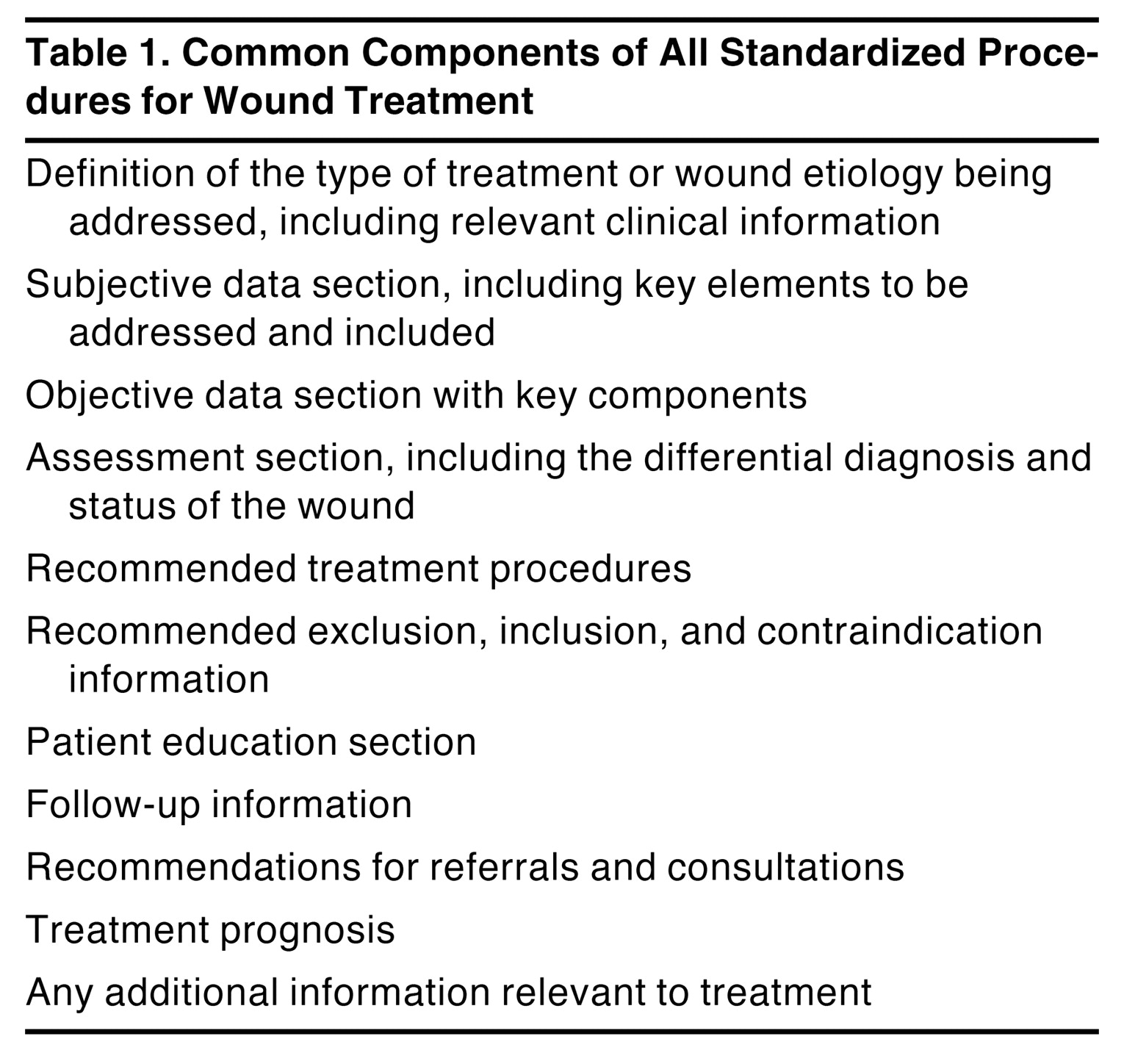
Standardized procedures may vary depending on the type of treatment or the wound etiology. Components common to all standardized procedures are listed in
Table 1. Specific types of treatment and product recommendations should be established by the committee, keeping in mind that the goal of treatment is the most appropriate care on the basis of the patient’s needs and the standard of community practice.
Table 1.
Common Components of All Standardized Procedures for Wound Treatment
Table 1.
Common Components of All Standardized Procedures for Wound Treatment
The following recommended standardized protocol for the use of Regranex Gel (Ortho-McNeil Pharmaceutical, Inc, Raritan, New Jersey) on chronic wounds was adapted from the University of California San Diego Medical Center, Regional Burn Center, Wound Treatment and Research Center as well as Wound Consultants, Inc’s (WCI) (Denver, Colorado) wound treatment protocols.
Recommended Standardized Protocol for Regranex Gel
Growth factors are complex proteins released by cells that may stimulate cell migration (chemotaxis), cell proliferation (mitosis), angiogenesis, production and degradation of the extracellular matrix, and the production of growth factor by other cells. Growth factors are also classified as cytokines; other proteins classified as cytokines include interleukins, tumor necrosis factor-alpha, interferons, and colony-stimulating factors. The name of a specific growth factor, platelet-derived growth factor (PDGF) for example, may not be indicative of its origin or function, as growth factors may be named for their first cell of origin, the original target cell, or their first function discovered by the scientist. Approximately 100 growth factors have been identified, and many of them are active in wound repair. Growth factors found in wound healing include, but are not limited to, PDGF, fibroblast growth factor, transforming growth factor-beta, epidermal growth factor, and insulin-like growth factor.
Growth factors are released from cells and may communicate through endocrine, paracrine, autocrine, or juxtacrine mechanisms. At the wound site, the growth factor is released from a cell and may bind to receptor sites on the same cell or other cells. Once receptor site binding occurs, a cell transduction pathway is initiated. Intracellular enzymes and gene expression are activated, resulting in a change in cellular activity, protein synthesis, and cell proliferation. Growth factors have the ability to coordinate regulated and interrelated processes, and they may alter wound healing by affecting cells in the wound environment.
Growth factors differ from conventional dressings. Dressings and other wound-covering devices may provide an optimal environment conducive to wound healing yet lack the activity of growth factors, which may stimulate healing and moderate outcomes.
Growth factors are soluble mediators that may be affected by the wound environment. Many articles in the medical literature discuss recent findings relevant to growth factor activity and function. It is important to note that growth factor activity may be negatively or positively affected by the presence of other growth factors, the number and types of receptors available, the stage of injury, intrinsic factors, and numerous extrinsic influences. Of particular importance to growth factor function are the presence of necrotic tissue, levels of bacterial colonization, and enzymatic activity in a wound.
Regranex Gel (becaplermin) is a recombinant human platelet-derived growth factor (rhPDGF-BB) manufactured for topical administration. It is produced by recombinant-DNA technology by insertion of the gene for the B chain of PDGF into the yeast Saccharomyces cerevisiae. Regranex Gel is a nonsterile, low-bioburden, preserved, sodium carboxymethylcellulose-based topical gel that contains the active ingredient becaplermin as well as other inactive ingredients. The biological activity of Regranex Gel is similar to that of endogenous PDGF. Endogenous PDGF may be produced by platelets, monocytes, macrophages, endothelial cells, fibroblasts, or smooth muscle cells. Endogenous PDGF is also chemotactic and mitogenic. PDGF may stimulate extracellular matrix deposition and activate neutrophils, macrophages, and fibroblasts.
Regranex Gel is indicated in the prescribing information for the treatment of lower-extremity diabetic neuropathic ulcers that extend into the subcutaneous tissue or beyond and have an adequate blood supply. Regranex Gel increases the incidence of complete healing of diabetic ulcers when used as an adjunct to, and not a substitute for, good ulcer care practices, which include initial sharp debridement, pressure relief, and infection control. The clinician should refer to the package insert for manufacturer-recommended dosing and prescription.
The WCI Wound Treatment Manual[
5] suggests Regranex Gel be used on most recalcitrant and problematic wounds, including, but not limited to, wounds of pressure, venous, diabetic, iatrogenic, and postsurgical etiology. However, this use is entirely at the discretion of the individual clinician, and it is recommended that each patient be individually and thoroughly evaluated to determine the risk
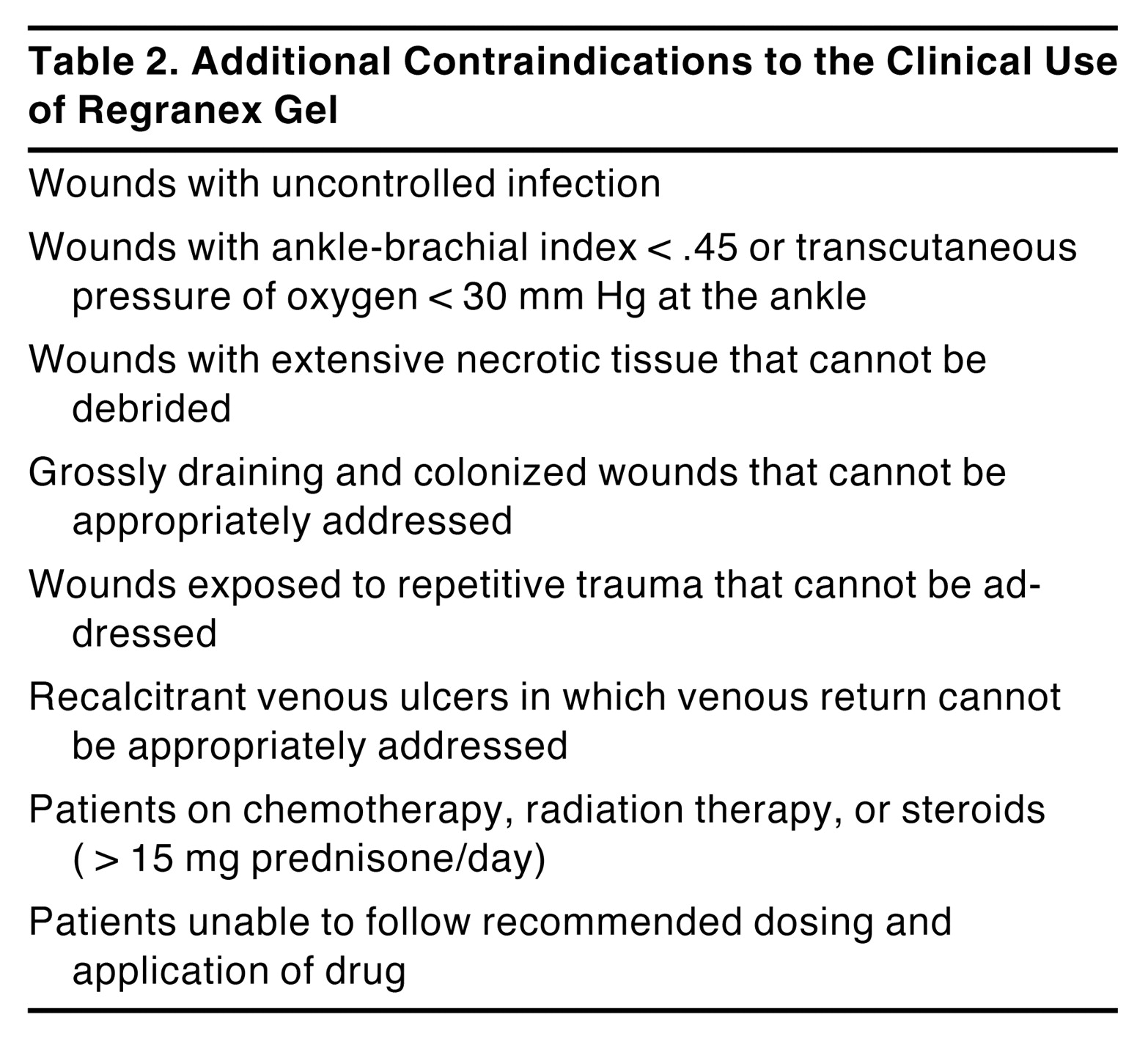
versus benefits of the clinician exercising the right to choose this growth factor as a treatment drug. Regranex Gel is contraindicated in patients with known hypersensitivity to any of its components as well as in patients with known neoplasm(s) at the site of application. All clinicians should read the product insert and prescribing information before using this drug. A suggested list of contraindications not provided in the manufacturer’s package insert is presented in
Table 2.
Table 2.
Additional Contraindications to the Clinical Use of Regranex Gel
Table 2.
Additional Contraindications to the Clinical Use of Regranex Gel
Necrotic tissue may delay wound closure by precluding epithelialization, granulation, or contraction of the wound, and by acting as a medium for bacterial growth. Whenever possible and indicated, all necrotic and nonviable tissue should be removed from the wound. A clean, vascular granulating wound bed is the ideal environment for the application of growth factors. Based on the patient’s vascular status, age, wound status, concomitant medications, and overall medical condition, the clinician should determine whether the patient is a candidate for debridement.
Infection must always be addressed and appropriately controlled prior to the application of growth factors. Heavily colonized or grossly contaminated wounds may have a negative effect on the action of growth factors.
High levels of enzymatic activity, repetitive trauma, and infection are associated with the inflammatory phase of wound repair. Enzymes are important in breaking down necrotic and unwanted wound tissue. However, continued activity may contribute to delayed closure and wound chronicity. Topical enzymes, which are used to assist with wound debridement, may have a negative effect on growth factors when applied in vivo. It is recommended that a wound be thoroughly debrided and enzymatic activity terminated prior to the prescription and use of growth factors.
Methods
The following protocols are suggested for the treatment of problematic wounds that have remained unresponsive to appropriate levels of care.
The patient history should be reviewed for trauma; previous surgery, including previous graft or flap procedures; revascularization; cancer; diabetes; noncompliance; emboli; radiation therapy to the affected area; immunosuppressive diseases; and concomitant diseases. The patient must have a chronic wound, which is defined as being present for at least 2 weeks and unresponsive to appropriate care for the wound etiology.
One or more of the following problems impeding wound closure may be or may have been present: inappropriate pressure reduction; inappropriate footwear; suboptimal levels of compression for venous disease; chemotherapy or radiation therapy; incomplete wound debridement; cytotoxic cleansers and agents, such as povidone-iodine, hydrogen peroxide, or Dakin’s solution, or inappropriate wound dressings or treatments; local-tissue hypoxia; chronic, uncontrolled inflammation or dermatitis; or extensive hyperkeratosis.
A complete vascular assessment is recommended. All peripheral, popliteal, and femoral pulses should be checked. A noninvasive or subsequent invasive vascular test may be required if pulses cannot be found with Doppler ultrasonography or if the pulses are weak. The ankle-brachial index and transcutaneous pressure of oxygen or blood flow should be determined.
The skin should be assessed for temperature, general appearance, periwound appearance, degree of cyanosis, degree of dependent rubor (if applicable), presence or absence of hair, appearance of nails, and overall skin status. The wound should be assessed for size, depth, location, wound base appearance, amount and type of drainage, amount of necrotic tissue, and degree of bacterial presence. One or more of these findings may be noted.
The assessment of patients to determine if they are candidates for growth factor includes a differential diagnosis to determine whether the ulcer etiology has been determined and appropriately addressed, and an assessment of the wound status prior to the application of growth factor.
A differential diagnosis should be made for vasculitic, diabetic, and venous conditions, as well as whether the wound is traumatic in origin, postsurgical, drug induced, or pressure induced.
Wound status should be checked for infection or degree of contamination or colonization; blood (oxygen) perfusion to the wound site; appearance of the wound bed (degree or percentage of viable tissue); amount of necrotic tissue present; and exposure of deep structures such as muscle, bone, capsule, tendon, and fascia.
Sharp debridement should always be given primary consideration. Conservative debridement with enzymes, autolysis, or mechanical means may be considered when this is not possible. Excessive or uncontrolled bleeding must be addressed before the drug is applied. The wound should be thoroughly flushed with a noncytotoxic cleanser, such as sterile saline or water, prior to drug application.
The Regranex Gel should be applied in a thin layer, approximately the thickness of a dime, over the wound surface. Highly to moderately exudating wounds may be covered with a slow-absorbing hydrocellular foam that is cut to extend approximately 1 cm beyond the wound edges or with a nonadhering dressing. Dry to low-exudating wounds may be covered with a saline-moistened gauze. Dressings may be changed daily or every other day in low-exudating wounds. Patients who live in a low-humidity environment may require more frequent moist dressing changes on dry or low-exudating wounds. More frequent, daily changes may be required on very high-exudating wounds.
Regranex Gel should be applied daily or at least once every 2 days. For patients with venous disease requiring sustained compression, such as paste bandages or multilayered wraps that are applied weekly, there is no contraindication to a weekly application of growth factors. There are no studies demonstrating the efficacy of weekly growth factor application. CircAid (CircAid Medical Products, Inc, San Diego, California) offers an excellent means of compression that can be removed daily to facilitate the application of growth factor.
Other treatment recommendations include determining which dressings are most easily tolerated and applied by the patient, and who will apply the drug most effectively (patient, family member, or visiting caregiver). The frequency of dressing changes most appropriate for the patient must also be determined.
The following exclusions are recommended: patients who have yet to receive appropriate levels of care; patients currently responding to their prescribed treatment regimen; patients who are candidates for revascularization; patients whose infection has not been appropriately treated; patients with venous disease unable to tolerate compression; repetitive trauma that cannot be eliminated or reduced; patients currently on drugs that interfere with wound closure; and wounds that cannot be adequately debrided.
Patients must be educated on appropriate dressing and drug application. Appropriate compression or footwear also must be considered to protect the area from further trauma. Patients should receive nutritional guidance and information on proper hydration, the need for a daily foot check for patients with diabetes (using mirror for assistance when necessary), and glucose monitoring.
It is extremely important to inform the patient whenever a drug is used for an indication other than that provided by the manufacturer. Chart documentation must include information stating that the patient was fully informed of the drug’s approved indication along with justification for the clinician’s off-label use. Clinicians also should include a statement clarifying why this off-label use is of potential benefit, the reason for that benefit, and what other options are available. Clinicians who recommend off-label use are relying on their clinical judgment and exercising their choice, and they should be responsible and held accountable for their actions.
Patients treated with growth factors should be seen weekly, more often if this is indicated by ulcer etiology or the patient’s medical status. Wounds should be kept from desiccating. Debridement should be performed whenever necrotic tissue, debris, excessive fibrotic tissue, nonviable tissue, or hyperkeratotic tissue is present. Vascular and surgical consultations are recommended when conservative care is not indicated.
The anticipated time to wound closure is indefinite and based on other factors affecting prognosis. These include, but are not limited to, size, location, duration, and depth of wound, and the overall medical status of patient. Clinical studies suggest that a significant decrease in time to closure and improved treatment outcomes may be attained by the appropriate addition of a growth factor to a treatment regimen that includes good care.
The use of Procuren has not been included or discussed in this protocol. Procuren is not an FDA-approved or FDA-regulated manufactured or prescription drug. WCI does not make recommendations on its inclusion in a treatment protocol.
Clinicians are ultimately responsible for treatment decisions that are based on the individual needs of their patients. Standardized procedures are an indication that the clinician attempted to follow the best possible treatment and appropriate standard of care based on community practice, national guidelines, and standardized procedures compiled by a panel of wound care experts. Following a standardized procedure does not guarantee that a patient will never take legal action. It does significantly reduce their chance of winning a case, however, as suggested by Goebel and Goebel,[
6] who concluded that the implementation of, and compliance with, practice guidelines for pressure ulcer prevention affect medical malpractice litigation. National guidelines[
1,
2,
3] support the benefits of standardized procedures in assisting with standardized and reproducible care while deterring legal action.
Conclusion
Development and implementation of standardized treatment procedures for the treatment of chronic wounds assist with establishing reproducible cost- and outcome-effective treatment. Regardless of the medical specialty of the health-care provider, standardization of treatment guidelines provides a means of providing quality care and avoiding conflicting orders. Guidelines are most effective when they are based on national guidelines; scientific literature from well designed randomized, controlled, and blinded studies; and evidenced-based published information from scientific forums, congresses, and meetings. Local practices, anecdotal remedies, and treatments that provide no evidence of benefit are not acceptable for establishing appropriate levels of patient care. The development of guidelines for any institution providing ongoing care of the patient with chronic wounds reduces the risk of legal complications and ensures the best possible outcomes.