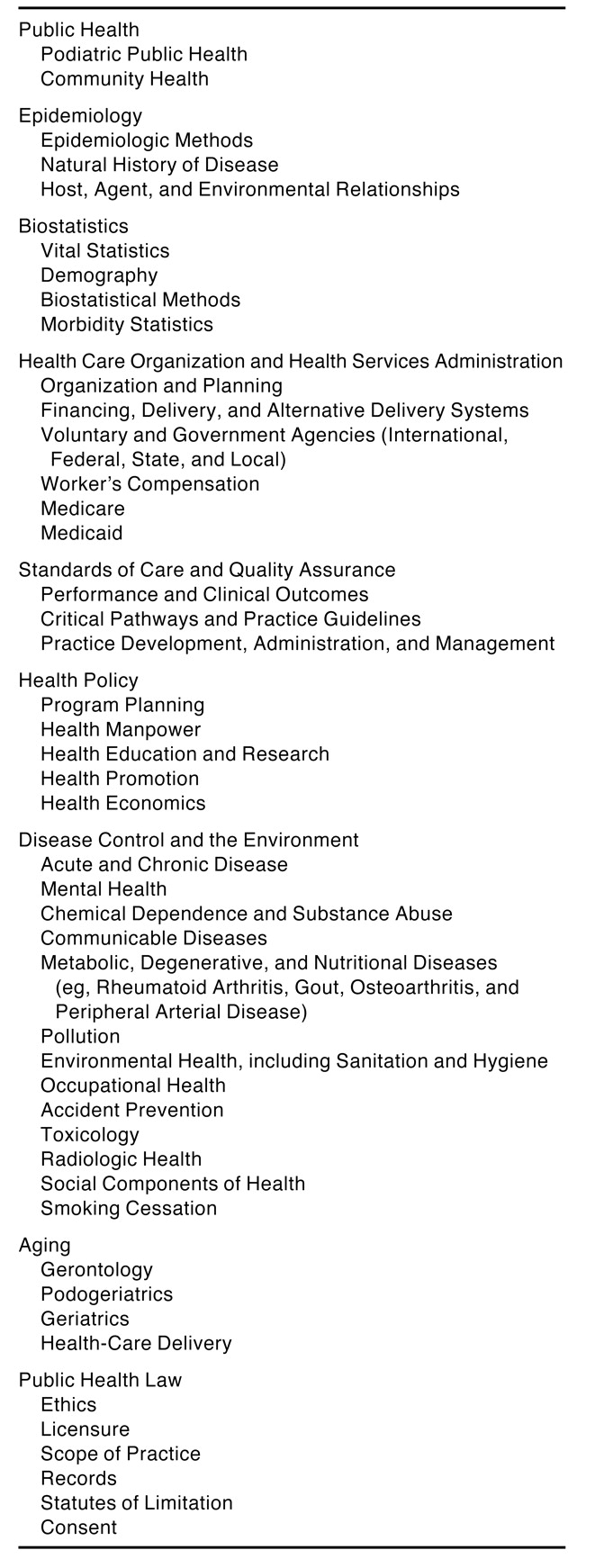
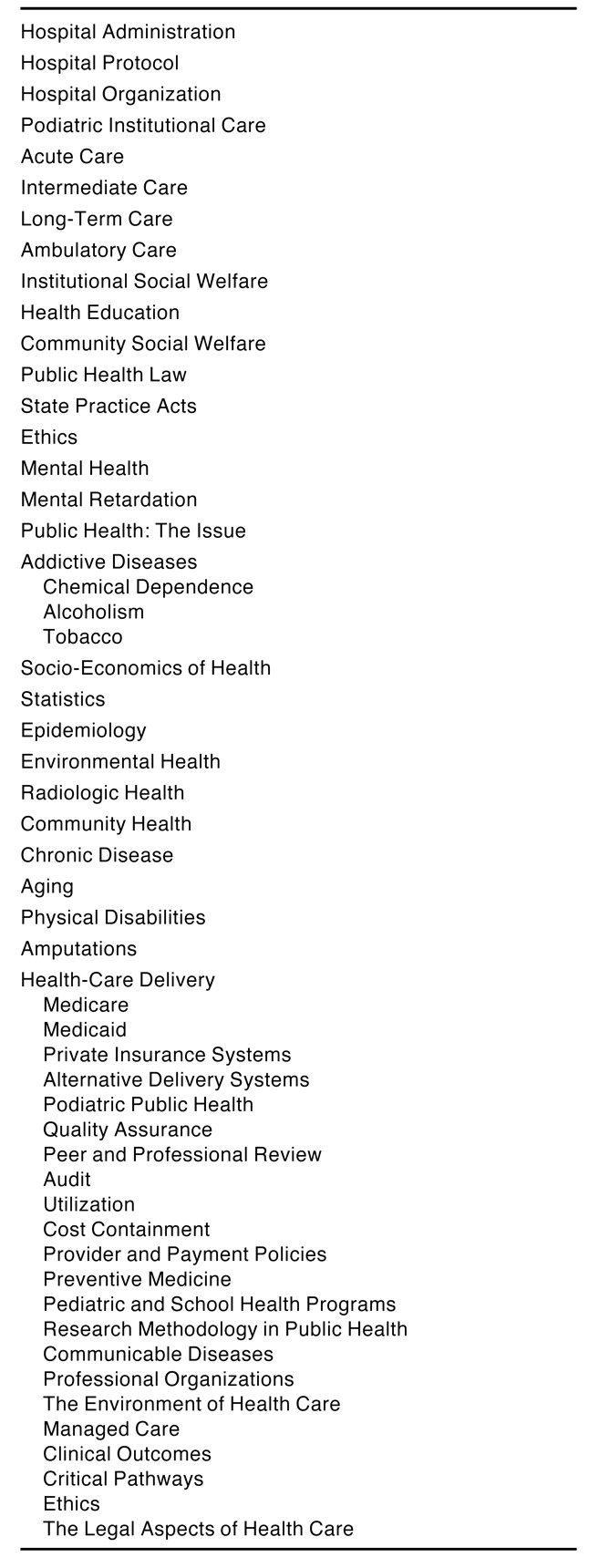
The Department of Community Health at Temple University was established in 1970. The activities of the department were expanded in 1990 to include aging and, in 1998, to provide an additional focus on health policy related to podiatric medicine. The department offers courses in research design, gerontology, geriatrics, community health, law and ethics, and professional development. The Department of Community Health’s broad objectives are summarized as follows:
1. Clear understanding of the major concepts of community health and modern podiatric public health.
The Doctor of Podiatric Medicine at the first professional degree level should have a basic fund of knowledge that relates to health-care delivery and preventive services.
Rationale: The health-care system mandates a need for all practitioners to have a basic understanding of the components of health-care delivery and preventive services. The special knowledge of elements such as biostatistics, epidemiology, health education, substance abuse, communicable diseases, chronic diseases, social services, health-care administration, environmental health, radiologic health, mental health, health-care financing, ethics, quality, and cost containment are examples of this area of need. Knowledge is vital to permitting new practitioners to become a part of the health-care system, particularly as new methods of delivery evolve.
2. Appreciation of public health and its relationship to the profession of podiatric medicine.
The Doctor of Podiatric Medicine at the first professional degree level needs to gain an understanding of the importance of the profession and the need for involvement at the policy-making levels of health-care delivery.
Rationale: Recognition that through the process of law, podiatric medicine has achieved a high level of recognition as the primary provider of foot-care services. The categories dealing with prevention, education, research, and administration need to be understood. The organizational structure of the profession also needs to be identified and explored, as does the profession’s relationships to government and other related agencies in the delivery of health care.
3. Understanding of the attitudes and practices of the public and the profession that prevent many people from receiving adequate podiatric care.
The Doctor of Podiatric Medicine at the first professional degree level must understand the delivery mechanisms for podiatric care.
Rationale: Practice development, health-care delivery, health-care financing, ethical concerns, cost containment, and preventive services provide a focus of knowledge. The ability to provide high-quality services, within accepted norms of quality, cost, and reimbursement, are critical issues for the future. Included in these concepts are the elements of podiatric medicine and the law, which deal with state practice acts, state and federal regulations, reimbursement, fraud and abuse, ethics, and institutional as well as community responsibilities.
4. Ability to convey podiatric health information to individuals and to the public in clearly understandable terms.
The Doctor of Podiatric Medicine at the first professional degree level must be able to communicate information to the public and patients whom he or she serves.
Rationale: The ability to provide health information and education are the first components of prevention. Understanding the needs of special population groups, such as the elderly, diabetic patients, and the mentally challenged, for example, provide a focus of information and open new opportunities for visibility and involvement in the health-care community. The methods to complete these tasks are a vital need for future health-care practitioners.
5. Understanding of the private practice responsibilities in the community as a citizen, a podiatrist, and an active participant in public health activities.
The Doctor of Podiatric Medicine at the first professional degree level must accept his or her role as a responsible member of the health-care community.
Rationale: By providing information on practice development, ethics, and community relationships, new podiatric professionals can understand their role in health-care delivery. The focus for the most part is now on private practice, but as the health-care system evolves and changes and new methods of delivery and financing surface, practitioners may need to change their method of care to a more public health–oriented methodology, [
1] including the military, Department of Veterans Affairs, and other group or practice locations. Practitioners must be ready to take their existing knowledge, gain new information, and adapt their methods to ensure the delivery of podiatric medical care to the American public.
6. Management of institutional and professional representation and consultation to appropriate community agencies, programs, and institutions in the area of community and podiatric public health.
The Doctor of Podiatric Medicine at the first professional degree level must be able to function in a manner compatible with and supportive of other health-care services and programs.
Rationale: As the health-care system evolves, the delivery of podiatric care will require more involvement with community agencies that are population or disease oriented, such as those dealing with aging and diabetes. Program needs will also focus on at-risk populations, with diabetes and aging again serving as good examples. The level of care provided in hospitals, long-term care facilities, special-care facilities, rehabilitation centers, special program focus centers, and community health center programs all represent examples of future needs. Future practitioners need to understand the current knowledge and methods as well as understand methods to gain new information and adapt to changes in health-care delivery.
7. An understanding of aging as an issue of health and society and the clinical care associated with aging.
The Doctor of Podiatric Medicine at the first professional degree level must understand the components of gerontology and clinical geriatrics.
Rationale: The number of older people living in the United States is projected to reach 50 million in the next century. Given that 90% of older patients will develop some form of foot problem and will require foot care, an understanding of the components of aging is essential. These components include gerontology; the social systems that are in place for the older population; the clinical care needs of the older population; and the mechanisms to educate the public, other professionals, and the podiatric profession. Recognizing that the changes in the Medicare law that occurred in 1967 place podiatric medicine on an equal footing with other health professions, this vital social and clinical service will form an even greater role in future delivery of health care.
8. A responsibility to provide research related to community health and aging; to develop scientific literature related to the public health/community health field that demonstrates the need for and relationship of podiatric medicine to the health-care system; and to remain involved in the development of health policy.
The Doctor of Podiatric Medicine at the first professional degree level must understand the need for research and the development of appropriate scientific publications that have an impact or interact with health-care delivery.
Rationale: As the health-care system has changed, and as it continues to change, there is a clear need to document, demonstrate, and gather data, and to publish that data to support and justify the need for podiatric services as a primary component of health care. The research effort should focus on educating students, professionals in all disciplines, and the public at large. The concepts of health promotion and health education form a significant component of such activities. In addition, the need for outcome studies demonstrating the quality and appropriate elements of service are essential. These efforts demonstrate an immediate focus in the fields of aging (geriatrics/gerontology), diabetes mellitus, and arthritis, which have all been identified as critical areas of health care during the next 30 years.
9. A responsibility to become involved in community-based and system-based patient care.
The Doctor of Podiatric Medicine at the first professional degree level must gain an understanding of how podiatric services can be provided under many different forms of health-care delivery, as well as how podiatric services can be integrated into the system of care.
Rationale: Newer forms of patient management, including managed care, institutional care, and primary care, clearly indicate that in the future services will be provided to patients and reimbursed in many ways. These may include fee-for-service, capitation, or employment in various forms of health-care delivery systems. Future practitioners must understand the system and be prepared to function as a component of all forms of delivery. The Department of Community Health should be involved in external programs with a community, institutional, and/or government/agency focus to provide that understanding. Involvement in the delivery of care also supports the research and literature component in the issues of measurement of quality, outcome, and education.
The Dual DPM-MPH Program at Temple University
The public health perspective is increasingly relevant to clinical fields in which population-based research and health behavior models assist in the application of preventive health services. Clinically trained professionals are discovering that the Master’s of Public Health (MPH) degree opens new career opportunities and enhances mobility within their chosen fields. Dual degrees with the MPH are now available in collaboration with the Temple University School of Medicine (MD-MPH), the School of Podiatric Medicine (DPM-MPH), the School of Social Administration (MSW-MPH), and Philadelphia’s College of Osteopathic Medicine (DO-MPH). Students must apply separately to each degree program, and admission into the MPH program for a dual degree is contingent upon admission into medical/osteopathic/podiatric/social administration schools.
On December 22, 1999, Temple University Graduate School approved a joint degree program between its Department of Health Studies and School of Podiatric Medicine that combines didactic, field studies, and clinical education at the graduate level (ie, beyond the first professional degree level). The program was established similar in structure to other dual degree programs established at Temple University for medicine, osteopathic medicine, and dentistry. It also permits six semester hours of elective credit for courses offered in the Department of Community Health, Aging and Health Policy at the School of Podiatric Medicine.
The Rationale for the Dual Degree Program
The US Department of Labor projects that health-related disciplines will be among the 20 fastest growing fields of the 21st century. The Department of Health Studies at Temple University is positioned to take advantage of these growth trends because of its emphasis on health, wellness, and disease prevention, and its commitment to educate and train students to work in health-related careers. The department is dedicated to enhancing the health and quality of life of the public, including those at the greatest risk for chronic and debilitating health problems and poor quality of life associated with disease, injury, or disability.
The potential activities and career development for health studies graduates with a dual degree is excellent, and it is driven by the following long-term trends: the aging of the population; the need for cost containment in medical care; the importance of disease prevention through the environmental and behavioral changes related to acquired immunodeficiency syndrome (AIDS), violence, substance abuse, and diet; and the recognition that play, recreation, and leisure are critical to good health and quality of life.
Temple University’s School of Podiatric Medicine and Department of Health Studies have developed a dual degree program in which students of podiatric medicine can obtain an MPH degree while they complete the DPM program. The degree combination was designed to attract quality students who not only seek to become leaders in today’s health-care system, but who also can find new opportunities in relation to prevention and public health. Offering this combined program also permits Temple University to retain its students for this program, rather then having them apply to other institutions for this specialized educational opportunity.
Background
In 1969, podiatric medicine began its formal relationship with the APHA. At that same time, the American Podiatry Association established a Council on Public Health to bring into focus the contributions the profession could make to society by addressing not only clinical issues but also the social, behavioral, and environmental factors that influence health care and clinical practice. Guidelines were developed that focused on prevention issues and, especially, health education as the first precept of prevention. Working together, in 1972 the APHA and APMA founded the Podiatric Health Section of the APHA. In 1974, the deans of the schools of public health approved for the APHA’s Education Council recognition of the DPM degree as a doctoral degree equivalent to MD, DO, DDS, and DMD for admission to schools of public health at the graduate level. Since that time, several members of the profession have gone on to obtain MPH degrees. The most recent document identifying the need for podiatric medicine in public health was developed by a special commission in 1997 [
12] and supported by APHA and its Mini-Grant Program. The special commission’s report identified service demands, population data, epidemiologic analyses, and health strategies. Research and funding opportunities were identified that emphasized prevention and the potential complications that surface with chronic diseases such as diabetes mellitus, arthritis, peripheral arterial disease, and the future needs of an aging population.
Temple University always has had a focus on community outreach; in the future, planning and evaluation leadership skills will be essential for appropriate programs, and a combined degree with an emphasis on health education is a key element. Graduates from colleges and schools of podiatric medicine have sought postdoctoral public health training in schools of public health. The Temple University program, which has combined programs with Temple University School of Medicine and Philadelphia’s College of Osteopathic Medicine, would offer the same time frame and activity for the School of Podiatric Medicine, in a manner compatible with and supportive of the existing program. Students would follow the same courses as now exist in these other two programs.
Temple University’s MPH Program
Temple University’s MPH in Community Health Education is accredited by the Council on Education for Public Health (CEPH). The 45 semester-hour degree is designed to provide students with a working knowledge of the organization, administration, and economics of public and private health-care settings; an understanding of the relationship of knowledge, attitudes, and behavior to public health; the skills to plan and implement programs using appropriate educational strategies to improve health behavior and service delivery; and the capacity to evaluate health education programs. A foundation of biostatistics and epidemiology provides students with the capacity to use the scientific literature of public health and medicine effectively. As a part of the program, students complete an in-depth community fieldwork practicum in one of a wide range of approved local health agencies.
Most courses are scheduled to meet student needs. The fieldwork practicum is the capstone experience of the MPH educational program. Unlike traditional internships, the fieldwork project includes practical experience in community settings and the application of research methods, and it helps students to achieve their personal career goals. The objective of the fieldwork project is to provide students with the opportunity to apply the theory and skills, particularly research skills, learned in the classroom. Particular skills targeted include reviewing and critiquing research literature, managing background data, selecting appropriate interventions based on theory and previous evaluation activities, planning and implementation of a formal project, developing tools and systems necessary for project completion, collecting and analyzing data, and acquiring management and interpersonal skills. Recent prior field placements have included the Philadelphia Department of Health, the Health Promotion Council, Family Planning of Southeastern Pennsylvania, the Maternity Care Coalition, Physicians for Social Responsibility, and Main Line Health Systems, Inc.
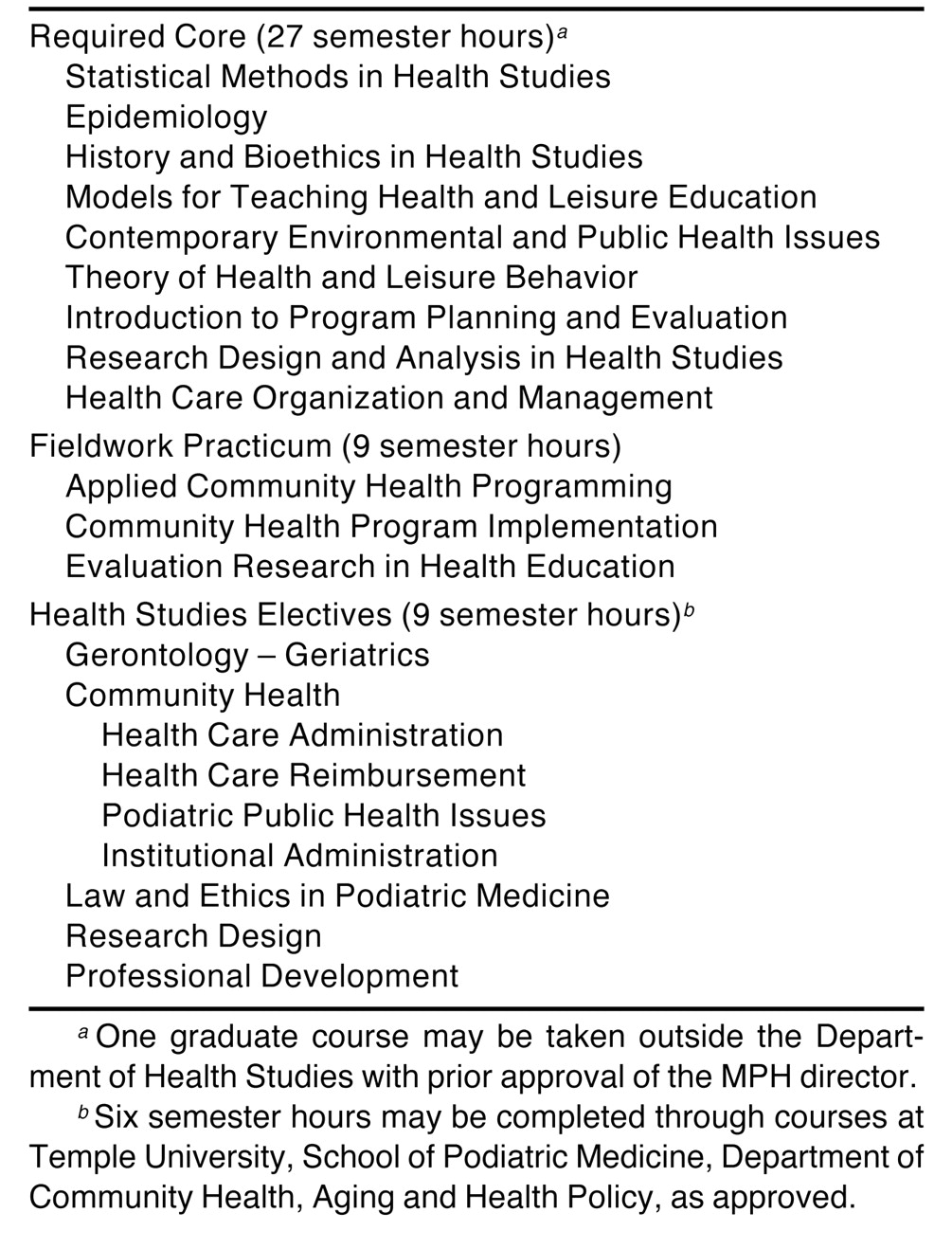
The degree program requires a 45 semester-hour program, of which 27 semester hours (9 courses) are required core courses; 9 semester hours are electives (6 from the School of Podiatric Medicine); and 9 semester hours are the fieldwork-practicum in conjunction with field placement (
Table 3).
Table 3.
Temple University’s MPH Program
Table 3.
Temple University’s MPH Program
Dual Degree Program Curriculum
The curriculum for the combined DPM-MPH program interweaves the curriculum in podiatric medicine and public health so that students add only one year to their School of Podiatric Medicine education. The modifications would blend perfectly to ensure that the students successfully meet the demands of both programs and are able to complete their education in a timely manner.
The first-year curriculum at the School of Podiatric Medicine would remain in place and add the following MPH courses: Environmental Health (spring) and History and Philosophy (summer). The second-year curriculum at the School of Podiatric Medicine would remain in place with the following MPH course additions: Epidemiology (fall) and Program Planning (spring).
The third year would be spent in the MPH program and include courses in Biostatistics, Models for Teaching, Research Methods, Theories of Human Behavior, and Health Administration. The fieldwork experience would also be completed. The student would return to the School of Podiatric Medicine in June of the third year to complete the initial clinical assignments, which would be followed by the final two years of education.
Modifications to the MPH Curriculum
Podiatric medicine students would begin their MPH curriculum as outlined above. The MPH degree would be awarded after completion of the degree requirements, and the DPM would be awarded following completion of the requirements at the School of Podiatric Medicine.
Benefits of the Dual DPM-MPH Program
Through the combined effort, the program can serve as a platform for the development of policy, educational enrichment, and externally funded programs. The program provides Temple University students with access to knowledge and skills in a joint effort that presents significant opportunities for the future. The ability to respond to the changing health-care system with an increased knowledge of health education, organization, administration, and the economics of public and private care settings, as well as understanding the relationship of knowledge, attitudes, and behavior to public health, are important elements for health-care delivery in the future. The skills to plan and implement programs using appropriate educational strategies to improve health care and delivery and the capacity to evaluate outcomes are critical areas for the future. A foundation in biostatistics and epidemiology provides an increased capacity to understand and provide leadership in the nation’s future health-care system.
Temple University has demonstrated a university-wide acceptance of podiatric medicine and has provided an opportunity to help ensure the stability of podiatric medicine as a key element in the health of our citizens. The inclusion of this educational effort through the Department of Health Studies in the Graduate School at Temple University has been augmented with the development of the Center for Public Health at Temple University, the Center for Frontier Sciences, and the projected development of a School of Public Health at Temple University. The Institute on Aging has also included the School of Podiatric Medicine as an equal partner in health policy development and planning.