Aerobic dance has been a popular form of exercise in Australia for the past two decades. Francis et al [
1] stated that aerobic exercise was popular because of its beneficial effects on the cardiorespiratory system as well as its psychophysiological benefits.
Aerobic classes have undergone numerous changes in format to accommodate people of various fitness levels since Jacki Sorenson first introduced dance routines to music in 1969. Classes are now categorized according to the intensity levels of their routines. These classes are classified as low- or high-impact aerobic dance, and they are further subdivided into five or six types. Low-impact classes have such names as Hi/Lo, Cardioshape, and New Body Step Aerobics; some of the high-impact classes are called Cross Trainer Aerobics or Step Aerobics. The major difference between low- and high-impact aerobic dance is that one foot is always in contact with the floor in low-impact aerobic dance. In high-impact aerobics, there is a period of total unweighting of both feet during most movements. [
2] The lower extremity experiences different forces during low- and high-impact movements, and vertical ground reaction forces have been reported to be between 0.98 and 2.7 times body weight during high-impact aerobics. [
2-
5] A typical aerobics class lasts for 1 hour, with 5- to 10-minute warmup and cool-down periods, leaving approximately 40 minutes of impact work at various levels.
Since 1985, lower-extremity aerobic dance injuries have been reported to be as high as 80% of participants. [
1,
6-
10] The injury rate may be indicative of the high-impact forces that aerobic dance movements produce over a period of time. [
9] The most common sites of injury are the legs, feet, ankles, knees, and hips. [
1,
6-
10] Janis [
9] noted that 36.8% of respondents reported injuries occurring from the head to the lower back, and 72.9% reported injuries occurring at the knee and below. Injuries to the foot, which includes the toes, arch, heel, and the ankle, were reported by 48.2% of respondents. The lower leg was the next highest site of injury at 39.8%, followed by the knee at 25.6%. [
9] During high-impact aerobics, 37.8% of respondents reported injuries, while 24.2% were reported injured doing low-impact aerobics.
It was anticipated that the rate of injury might have decreased over the years, as a result of better education and more awareness of suitable footwear. The educational level of aerobic dance instructors has improved greatly during the last decade, and the techniques taught are designed to reduce the number and severity of injuries. The increase in the number of accredited course providers in Australia may improve professional standards within the industry. Education focuses on increasing awareness of proper techniques, footwear, facilities, and conditions to prevent possible injuries to instructors and students. Floor surfaces and footwear design are thought to contribute to the prevalence of aerobic dance injuries. [
1,
6] Furthermore, aerobic instructors are required to be registered fitness leaders with the Australian Fitness Accreditation Council and must attend regular workshops to maintain registration. Currently, the aerobics industry in Australia lacks statistical data on injury types and rates among aerobic instructors (Ian Grainger, Chief Executive Officer, Fitness NSW, personal communication, October 29, 1999), and it is not known if changes in the education system, footwear, or floor surfaces have had any effect on the incidence or type of injury.
In the present study, instructors of aerobic dance, rather than students, were chosen to complete the questionnaire because it was assumed that the instructors would have a higher level of participation and expertise in aerobic dance. Previous questionnaires [
1,
6-
10] have investigated aerobic dance injury rates and types, and the factors relating to the injuries reported. Return rates were reported to be 50% to 86%. Most questionnaires in previous studies were collected at health or fitness centers after classes had been completed; questionnaires in one study were completed and collected at a workshop. In a study returned by mail, participation was reported to be more than 50%. [
6] The number of female respondents has been reported to be as high as 90%, and the respondents have remained predominately female. [
1,
6-
10]
The current study was conducted to determine the types of injuries occurring to the lower extremity and to ascertain the current injury rate. The purpose of this study was to enable further investigation into the causes leading to injuries to aerobic dance instructors. Information was obtained on the number and types of injuries, the types of classes taught, the frequency of activity levels, footwear worn, and treatments sought for lower-extremity injuries.
Materials and Methods
A confidential questionnaire was distributed with a stamped, self-addressed, return envelope to 18 centers in the Sydney metropolitan area. Approximately 1 month after the questionnaire was distributed, a follow-up letter was sent to each center requesting the return of the completed questionnaire. The questionnaire was based on previously reported questionnaires. [
1,
6-
10] Approval for the project was obtained from the Human Ethics Committee at the University of Sydney, New South Wales.
The following information about the respondents was requested on the questionnaire:
1) Age, height, weight, and gender.
2) Career length in aerobic dance instruction.
3) Type and frequency of classes taught per day and per week. Classes were categorized as high impact, low impact, step, or circuit.
4) Type of footwear worn. Footwear was categorized as aerobic, cross-trainer, tennis, or running shoes.
5) Injury sites, including knee, leg, ankle, foot, and toenails. The respondents were asked to specify the injury sustained: for the leg, shin splints or stress fracture; for the foot, stress fracture/arch pain/muscular strain.
6) The type of treatment sought and type of practitioner consulted. The respondents were asked what type of treatment was received and whether the treatment was effective. Practitioners were categorized as general practitioner, specialist physician, physiotherapist, podiatric physician, or other (respondents were asked to specify).
7) The length of time aerobics was not performed due to the injury.
8) Whether any self-treatment program was entered into if an injury occurred, but advice was not sought from a health professional.
9) Injuries sustained before beginning aerobic dance instruction.
10) Other physical activities in which the respondents were involved.
Results
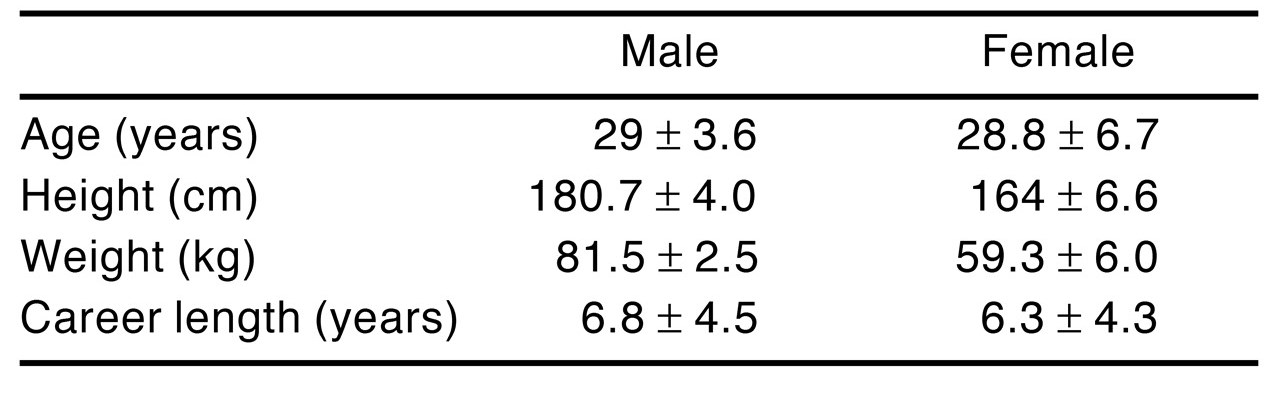
Seventy of 190 questionnaires were returned, representing a return rate of 37%. Eighty percent of respondents were female. The age range for all subjects was 19 to 50 years. Height ranged from 150 to 185 cm, and weight ranged from 41 to 85 kg. The average career length (± SD) for the respondents was 6.3 (±4.3) years. Details for all subjects are listed in
Table 1.
Table 1.
Profile of Subjects (Mean ± SD) (n = 70).
Table 1.
Profile of Subjects (Mean ± SD) (n = 70).
Class type was divided into low impact, high impact, step, or circuit. The types of classes taught most frequently per week were low impact (192), step (122), circuit (113), and high impact (108). Of the respondents who taught only one type of class per week, two reported low-impact classes; one reported a high-impact class; and nine taught circuit classes. Of the respondents, 26% taught all of the types of classes listed, and 61% taught a combination that included low- and high-impact classes and a step or circuit class. Furthermore, 70% of instructors taught 7.8 (± 1.91) classes per week, and 30% taught more than 10 classes (average, 14.3 ± 5.54). On a daily basis, 16% of the aerobic instructors taught at least three classes, 14.3% taught four classes, and 44% taught only one class per day.
The most popular shoes worn by the respondents were the cross-trainers (66%), followed by aerobic shoes (39%), running shoes (13%), and tennis shoes (2.9%). Some instructors indicated that they wore different shoes depending on the type of class.
Seventy-seven percent of respondents had at least one injury. These injuries were either new injuries (105.7%) or an aggravation of a prior injury (21.5%). Some injuries sustained before beginning aerobic dance instruction were the result of playing net ball (9%) or tennis (3%), or as a result of a motor-vehicle accident (4%). Other physical activities that had led to previous injuries were kick boxing, bodybuilding, water-skiing, the long jump, rock climbing, running, and in-line skating. The most common site of the new injuries incurred as a result of aerobic dance instruction was the leg (52.9% of respondents), followed by the foot and ankle area (32.8% of respondents). The number of prior and current injuries are listed in
Table 2. Some respondents (16%) had multiple injuries; therefore, the percentage columns of
Table 2 total to more than 100%.
Table 2.
Summary of Injuries Sustained (n = 70).
Table 2.
Summary of Injuries Sustained (n = 70).
Injuries to the leg were predominantly shin splints (55%), with some stress fractures to the tibia and anterior tibial pain. The problems experienced in the foot (11.4% of respondents) were mainly plantar fasciitis (7%) and a small number of stress fractures. Sprains accounted for 25% of the ankle injuries. Knee injuries consisted of medial knee pain, “clicking” knees, maltracking patella, and weak knees.
Of the respondents, 52.8% sought medical advice for injuries from various health professionals. Professionals consulted included physical therapists (30%), podiatric physicians (22.8%), general practitioners (11.4%), and massage or sports therapists (8.6%). In the most severe injuries, two of the instructors required surgery: one to remove a spur that developed after a stress fracture in the foot, which was in plaster for 6 weeks; and another for a tendon release due to patella tendinitis.
The percentage of instructors who sustained an injury but did not seek professional assistance to relieve the pain or symptoms was 38.5%. These instructors, however, implemented a self-treatment program, which included ice, rest, and taping. Pain or symptom relief was experienced by 4% who regularly changed their footwear. Of the respondents, 41.4% took a rest break of 1 week to 5 months; 4.3% decreased the number of classes taught; and 54.3% had no time off. Treatment received from a physical therapist or podiatric physician was unsuccessful in 4% of the cases.
In addition to aerobic dance instruction, most respondents were involved in other sporting activities. Some instructors (24.3%), however, were only involved in aerobic dance. The most common other activities listed were running (24.3%), weight training (12.4%), and swimming (15.7%). Twenty-two percent were involved in other activities, such as squash, tennis, dancing, triathlons, water sports, rock climbing, cycling, football, weight training, Tai Chi, martial arts, net ball, or hockey.
Discussion
The current study investigated the types of injuries occurring to the lower extremity in aerobic dance instructors. The study had a response rate of 37%, and the injury rate reported was 77%, which is comparable to rates in studies conducted since 1985. [
1,
6-
10] Since aerobic dance was first introduced, the number and types of injuries to the lower extremity have remained constant. This injury rate may be indicative of the repetitive nature of the activity performed and the constant impact of forces experienced by the lower extremity during class. [
3] Forces experienced during aerobic dance, and running and jumping activities, have been reported to yield forces of up to three times body weight. [
2-
5]
The most common injury sites reported are listed in
Table 2; 52.9% of respondents reported injury to the leg, 32.8% to the foot and ankle, and 20% to the knee. Previous studies have reported the ankle and foot area as having the highest injury rate, followed by the leg and the knee. [
7,
9] Some injuries, such as knee pain, torn ligaments or hamstrings, sprains, shin splints, and stress fractures, were sustained in previous sporting activities and may have been aggravated by teaching a large number of aerobic classes, which was defined as more than three classes per day.
In this study, approximately 14.3% of the instructors taught four classes per day, and 30% of instructors taught more than 10 classes per week. The low-impact classes were taught more frequently; the high-impact classes registered the lowest number of classes taught per week. Other types taught were step and circuit classes. Aerobic classes have changed from high-impact routines in the 1980s to a variety of classes that combine low- and high-impact movements in the 1990s. [
9] It should be noted that 76% of the respondents in the present study were also involved in other sporting activities, such as weight training, swimming, and running, which are likely to place stress on joints, ligaments, and muscles.
Footwear choices and personal comments reported by the respondents reflect their awareness of the type of shoe necessary for the level of activity they perform on a daily basis. The instructors had a preference for the cross-trainers (66%), followed by the aerobic shoe (39%). An appropriate shoe is extremely important, as footwear lacking shock absorption and motion control properties has been linked to lower-extremity injuries. [
11,
12] The shoe worn for high-impact activities should provide adequate support and stability for the ankle, flexibility at the midfoot, and adequate shock absorption, especially for landings, propelling, and jumping, which are common movements in aerobic routines. [
11]
Injuries were treated by a number of health professionals, and the treatments provided were reported to be effective at the time of injury. Approximately 4% of the 52.8% who sought medical or allied health services said that the treatment provided by the physical therapist or podiatric physician made no difference, but that a rest break relieved the pain. Some injuries were severe enough to require time off from instructing (41.4%) from 1 week to 5 months; however, 54.3% did not take any time off and 4.3% decreased the number of classes taught.
Finally, it is notable from all of the studies that the number of male participants in aerobic dance is extremely low. In the current study, the number of male and female respondents was similar to previous studies conducted. In previous studies, the percentage of female respondents (instructors and students) was 95%, [
1] and 98% of instructors and 85% of students were female. [
7] In the current study, 80% of the respondents were female. No explanation for the low numbers of male respondents in any of the surveys has been provided. Garton and Muller [
13] conducted a survey of 100 males and concluded that men needed greater encouragement to participate in aerobic classes.
Limitations of the current study include the response rate, selection and information bias, and the interpretation of the questions by the respondents. The response rate was moderate (37%), despite the follow-up letter sent after 1 month. A disadvantage of a mail-in questionnaire is that a response cannot be secured immediately; therefore, the rate of return can be much lower than expected. [
14,
15] Reported response rates can be as high as 90% to 100%; however, they seldom exceed 50% and rates of 15% to 50% are fairly common. [
14] Torrence [
15] found the return rate for mail-in surveys to be 30% to 60% even though they are easy to do. In mail-in surveys, respondents are self-selected and it can be assumed that a person with a history of an injury is more likely to remember the event and therefore more likely to respond to a mail-in questionnaire and to return it. The class types taught were categorized broadly into high- or low-impact classes. A difficulty experienced in developing the questionnaire was differentiating between high- and low-impact class categories. Since there is no standard classification of class type, it was difficult to use specific names of classes as these differ widely (Ian Grainger, personal communication, October 1999). There could be up to four or five different classes within each category (high- or low-impact classes). The results obtained in this study, therefore, represent the instructors’ perception of the intensity level of the classes they taught.
Conclusion
This study suggests that the number of injuries occurring to the lower extremity has remained constant over time, and that the site and type of injury are similar to those found in other studies conducted since the 1980s. Some injuries were prior injuries (21.5% of respondents) that were aggravated by participation in aerobic dance classes.
Evident from the respondents’ answers is that low-impact classes are taught more frequently, but injuries are still occurring to the lower extremity, regardless of the type and intensity levels of classes. It is difficult to substantiate previous claims of reported injury rates. In order to investigate the causes of the injury rate, further research is needed on the kinetics and kinematics of the lower extremity during high- and low-impact aerobic dance routines.