Although the Internet offers many medical resources for health-care professionals, students, and consumers, keeping abreast of new World Wide Web sites and tracking the address changes of established sites can be very time-consuming. This report is intended to update information about Web sites of particular relevance to podiatric medical physicians and students that were presented and reviewed in previous articles [
1–
3]. New sites have been added, and some older ones that appear not to have been updated have been omitted. All Uniform Resource Locators (URLs) have been made current as of the time of this writing.
As stated in previous articles in this series, it is important to carefully screen all Web sites according to one’s own standards of quality. The author has attempted to highlight excellent sites in this series of articles, but each reader must judge their usefulness on an individual basis. The author welcomes correspondence from readers who have found other Web sites that are useful to podiatric physicians or students and will consider presenting them in future updates in this series.
Web Search Tools
Several Web search tools are listed in
Table 1. This list is just a sampling of the many excellent search instruments that are available free on the Internet. The newer search sites offer some advanced capabilities that may prove especially helpful to those attempting to find information on the Web. One such useful feature is the sorting of search results into a number of folders. This type of folder arrangement can save time and make searching for information easier.
“Metasearch” tools are becoming increasingly popular. The term “metasearch” indicates that the search software sends a query to multiple Internet search tools and reports the results, in an integrated manner, from all responding locations [
4]. A commonly used synonym for metasearch engine is metacrawler. For those interested in learning more about Internet search tools, one major site worth exploring is Search Engine Watch, which is hosted by Internet.com, located in Darien, Connecticut.
Many of the Web search tools now offer the option of clicking on a section near a search result to find other similar sites. This feature may be labeled “similar sites,” “related sites,” “find similar pages,” or another term, depending on the particular search facility being used. This feature allows one to take advantage of the “intelligence” of the search software to find additional pages of interest.
Many of the search tools allow the user to conduct multimedia searches. AltaVista (AltaVista Co, Palo Alto, California) offers an “image” tab on its main search page. From here one can find photos, graphics, and buttons or banners in color, black and white, or both. One can be quite selective in the choice of image type by checking the appropriate boxes on the search screen. Typing “foot ulcer” (including the quotation marks) and checking only the “photos,” “black and white,” and “color” boxes yielded six photographs of foot ulcers at the touch of the search button when the author submitted this query. It is important to be aware that any graphic or other work (such as digital video clips, sound files, animation files, etc), even though freely available and easily downloaded from the Internet, may be protected by copyright law.
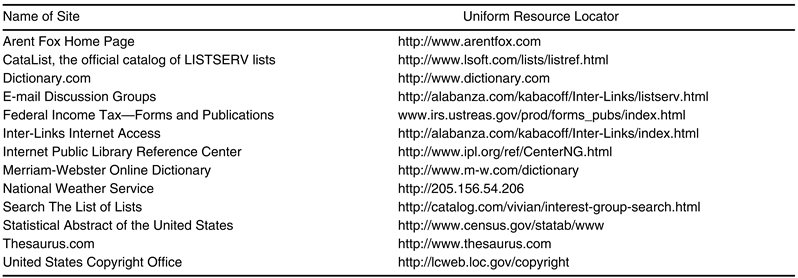
The United States Copyright Office Web page at the Library of Congress site contains practical information about copyright law. The Arent Fox Home Page, created by Arent Fox, a technology and information law firm in Washington, DC, offers information concerning legal issues involving the Internet and medical practice. From the Arent Fox page one can select “E-Health and Telemedicine” from the “Featured Areas” button to get legal information concerning telemedicine. The URLs for these Web pages are presented in
Table 2.
A few of the newer search tools enable the user to submit a query in the form of a question with naturallanguage sentence structure. Ask Jeeves (Ask Jeeves, Inc, Emeryville, California) is one such search engine. This type of search facility is particularly good for people who would rather not bother to remember how to construct a search using the sophisticated rules of Boolean logic, truncation, phrase searching, and proximity searching.
Ranking of sites by the number of visits to them or by the number of other sites that offer links to them may place the “best” sites higher in the result list and therefore make them more likely to be seen by the searcher. Google (Google, Inc, Mountain View, California) is one such search tool that ranks a site by the number of Web pages linking to that site. Direct Hit (Direct Hit Technologies [a subsidiary of Ask Jeeves, Inc], Natick, Massachusetts), is an example of a search tool that ranks results by the number of visitors to a given site and by the amount of time they spend there.
Special features of the Dogpile (Go2Net, Inc, Seattle, Washington) search tool can be very useful. Searching for “foot ulcer” will provide the user with many sites from several Internet search facilities. Additionally, at the bottom of the list of results is a section titled “Are you looking for:” that contains links for “Ulcers,” “Pictures of Foot Ulcers,” and others. Clicking on “Pictures of Foot Ulcers” allows the user to view several Web sites containing images of foot ulcers. These suggestions for alternative search strategies may facilitate the quest for information on the Internet.
General Medical Web Sites
Table 3 presents a listing of selected general medical sites on the Web. CliniWeb International is produced by Oregon Health Sciences University in Portland. This site is interesting for several reasons, one being that it enables the user to enter medical search terms in any of several different languages, including German, French, and Spanish. Once a word or phrase is entered, it is matched to appropriate MeSH (Medical Subject Headings) terms, from which one can click to view results. MeSH, a product of the National Library of Medicine (NLM), located in Bethesda, Maryland, is the system of controlled vocabulary used in MEDLINE. The results that are presented by the search engine might be links to already formatted PubMed MEDLINE searches or to carefully selected Web pages dealing with the chosen MeSH term. The formatted search link takes one directly to a PubMed search screen that has the appropriate terms pretyped and the appropriate search limits preselected. The search is run automatically so that the results are presented on the screen for immediate inspection. This useful feature is a tremendous time-saver. The ability to use controlled medical vocabulary to find Web sites can greatly facilitate a search by increasing the specificity of the results. This site focuses on information that would be useful to healthcare-profession students and practitioners.
The Countway Web Resources page, maintained by the Countway Library of Medicine of Harvard Medical School in Boston, offers a variety of biomedical Web resources. The Hardin Meta Directory of Internet Health Sources, produced by the Hardin Library of the Health Sciences at the University of Iowa in Iowa City, also offers a very current directory structure of links to Internet medical resources.
Virtual Hospital is a service of University of Iowa Health Care, University of Iowa, in Iowa City. Created in 1992 as a digital health-sciences library, it uses Internet resources to provide useful medical reference materials to both health-care providers and consumers. This very useful Web library provides access to hundreds of books and brochures, including more than 350 peer-reviewed digital texts and booklets. This popular site receives about 6 million visits per month. Many of the textbooks available contain superb illustrations.
HealthWeb is a well-indexed resource that provides links to specific, evaluated information resources on the Web. Librarians and information professionals are responsible for the content of this site. Each link is accompanied by a short narrative summary describing the site’s main features. HealthWeb is a collaborative project of the health-sciences libraries of the Greater Midwest Region of the National Network of Libraries of Medicine and the Committee on Institutional Cooperation.
MEDLINE Searching
Although there are many Web sites that let one search the MEDLINE database, it is probably sufficient to be able to access PubMed or Internet Grateful Med, both produced by the NLM. Both of these access points offer no-cost searching of the available databases. Internet Grateful Med provides the ability to search MEDLINE as well as other special NLM databases devoted to specific topics such as acquired immunodeficiency syndrome, bioethics, history of medicine, toxicology, health-services research, space medicine, and others. Access to OLDMEDLINE is also available. This database contains Index Medicus records from 1960 to 1965, a time period that is not covered by the standard MEDLINE database.
PubMed has special links to molecular biology databases of DNA and protein sequences and 3-D structure data. Both the PubMed and Internet Grateful Med search systems offer ample help with finding appropriate MeSH search terms and in limiting results in order to customize them to the needs of the user. PubMed offers the additional capability of conducting “Clinical Queries Using Research Methodology Filters.” Both of these sites warrant personal investigation.
Podiatric Medical Web Sites
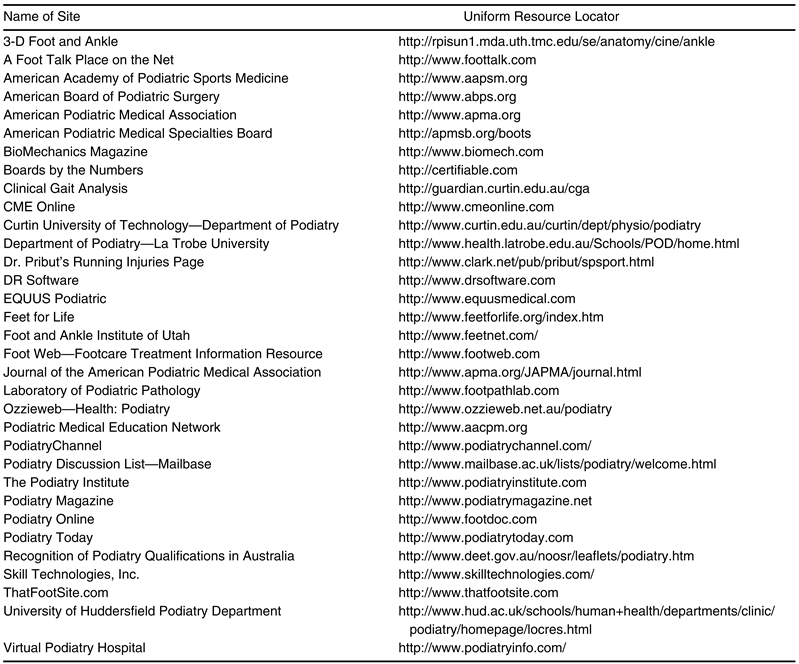
Table 4 contains a listing of selected podiatric medical Web sites. Podiatry Online, a site that has been previously mentioned in this series of articles, has continued to augment and update its many wonderful features. One of these is the ability to choose a language into which all subsequent information is translated. This is accomplished by choosing one of five languages in the “Podiatry Online Goes Global” area of either the Doctor Portal page or the Patient Portal page. This site, maintained by Podiatry Online, Inc, located in Delray Beach, Florida, is an extremely valuable resource that is well worth visiting. It has a very comprehensive list of Web resources of particular relevance to foot health and podiatric medicine.
The Society of Chiropodists and Podiatrists, located in London, is responsible for the Feet for Life site. This site provides much information for the healthcare consumer and is a potentially useful site to which to refer patients wishing to learn more about foot health and common foot disorders. Another excellent site that the practitioner may wish to recommend to patients is PodiatryChannel. Designed primarily for the health-care consumer, this site is owned by Healthcommunities.com, Inc, located in Northampton, Massachusetts. Finally, Virtual Podiatry Hospital, a product of Feet For Life Centers and Mid-West Podiatry Associates, located in St Louis, Missouri, is another Web page designed primarily for the layperson. Many common foot disorders are described, with some textual descriptions accompanied by high-quality illustrations.
The Department of Podiatry of the Curtin University of Technology, located in Shenton Park, Australia, hosts a well-constructed Web site. One special feature at this site is the Podiatric Encyclopedia. This is a regularly updated online encyclopedia of podiatric conditions and treatments. Many of the articles are accompanied by excellent illustrations. Also in Australia, the Department of Podiatry at La Trobe University, located in Bundoora, Victoria, hosts a Web page that includes a link to their Podiatric Image Library. Additional links are also available.
For those with a particular interest in pathology, there is an excellent tutorial on the topic of onychomycosis at the site of the Laboratory of Podiatric Pathology, located in Philadelphia. Profusely illustrated with microscopic sections, this tutorial is well worth viewing.
Podiatry Magazine is based in Mid Glam, England. Podiatry Magazine International, Inc, and Podiatry Online Co UK are the copyright holders. This site contains a news area, a podiatric event page, and a podiatric discussion forum. Many useful links to other resources are also provided. Also based in England is ThatFootSite.com. Maintained in Manchester, this site provides access to discussion forums for professionals and students, information of interest to podiatric professionals, and the ability to open an email account, among other features. This Web resource page also offers the ability to subscribe to email news updates.
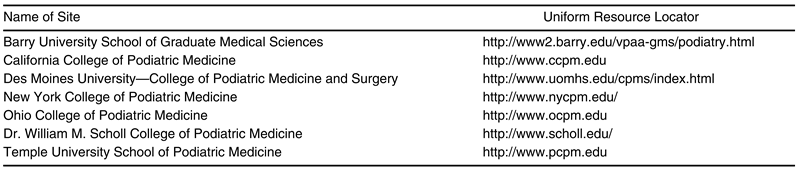
Table 5 is a listing of the podiatric medical colleges in the United States. Each of these contains a wealth of information about the individual institution, continuing education, and the field of podiatric medicine and surgery.