Next Article in Journal
Giant Cell Tumor of Tendon Sheath in the Toe
Previous Article in Journal
A Conceptual Model for a Geriatric Syllabus for Podiatric Medicine
 
 
Journal of the American Podiatric Medical Association is published by MDPI from Volume 116 Issue 1 (2026). Previous articles were published by another publisher in Open Access under a CC-BY (or CC-BY-NC-ND) licence, and they are hosted by MDPI on mdpi.com as a courtesy and upon agreement with American Podiatric Medical Association.
Case Report

Minocycline-Induced Cutaneous Hyperpigmentation

by
WARREN S. Joseph
and
MARC A. Sabo
J. Am. Podiatr. Med. Assoc. 2000, 90(5), 268-269; https://doi.org/10.7547/87507315-90-5-268
Published: 1 May 2000
To the Editor:
Cutaneous hyperpigmentation has been reported as an uncommon complication associated with minocycline therapy [1,2,3]. Most cases have been reported in patients undergoing extended therapy with large cumulative doses of the drug, generally more than 40 g [1,2,4,5,6]. Although most cases appear to be dose-related, there have been infrequent reports of hyperpigmentation after only a few weeks of therapy and cumulative doses as small as 4.2 g. These reports cast doubt on attempts to correlate pigmentary disturbance directly to drug dose [7,8].
Minocycline has consistently been associated with three distinct hues of cutaneous pigmentation: blueblack, blue-gray, and muddy brown [5,8,9]. The blueblack and blue-gray or “slate-colored” pigmentations have been reported to occur in sites of prior inflammation or previously uninvolved skin as a result of minocycline metabolite deposition [5,8,10]. The muddy brown pigmentation, or the “muddy skin” syndrome, has been associated with increased melanization and sun exposure [9]. In the cases not associated with melanin abnormality (ie, blue-black and blue-gray pigmentation), the pigment deposits have been shown to contain high concentrations of iron and calcium [3,4,6]. These pigmentary changes have previously been mistaken for hemosiderosis, stasis dermatitis, emboli infarcts, cyanosis, and bruising [2,4,5,11,12]. Most cutaneous discolorations were observed to gradually fade, at least somewhat, within months after the cessation of therapy [2,4,5,6,8,12]. Time to resolution appears to be linked to the degree of pigmentation and may be more than a year if there is extensive involvement [2].

Case Report

In March 1998, a 60-year-old man with diabetes mellitus who had been a long-time patient at the authors’ facility for care of repeated bouts of neuropathic ulceration and cellulitis presented with a dorsal ulceration of his right fifth digit. Debridement revealed that the ulcer extended to the head of the proximal phalanx. A small amount of pus was expressed and cultured; it subsequently grew methicillin-resistant Staphylococcus. Radiographs displayed osteolytic changes at the head of the proximal phalanx consistent with acute osteomyelitis. Owing to the patient’s repeated refusal of surgical intervention and intravenous antibiotic therapy, minocycline was prescribed for chronic suppression. During a July 1998 follow-up visit, the patient expressed concern regarding a new “blackish” discoloration of his left leg.
The patient’s medical history was significant for type 1 diabetes mellitus of more than 55 years’ duration, peripheral vascular disease, coronary artery disease, angina, retinopathy, hypercholesteremia, and osteoarthritis. His medications included minocycline (100 mg daily), insulin, quinapril, atenolol, pentoxifylline, simvastatin, and aspirin. He reported allergy to sulfa drugs as well as a hypersensitivity to adhesive tape. His surgical history included appendectomy (1970), popliteal–to–dorsalis pedis lower-extremity bypass graft (1994), partial amputation of the left hallux (1994), and coronary artery bypass graft (1997). The patient was very active, was an avid surfer, and spent much time outdoors.
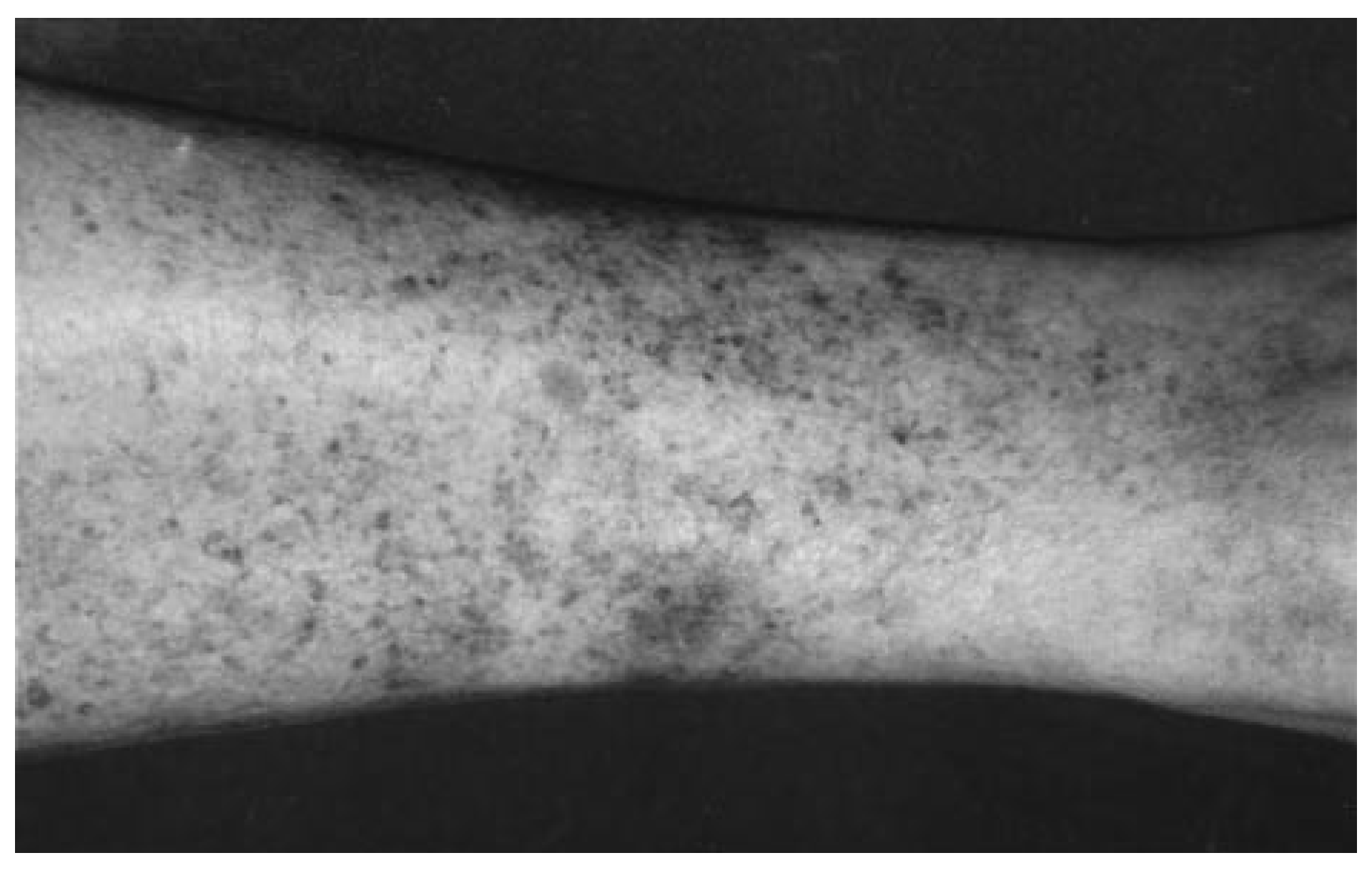
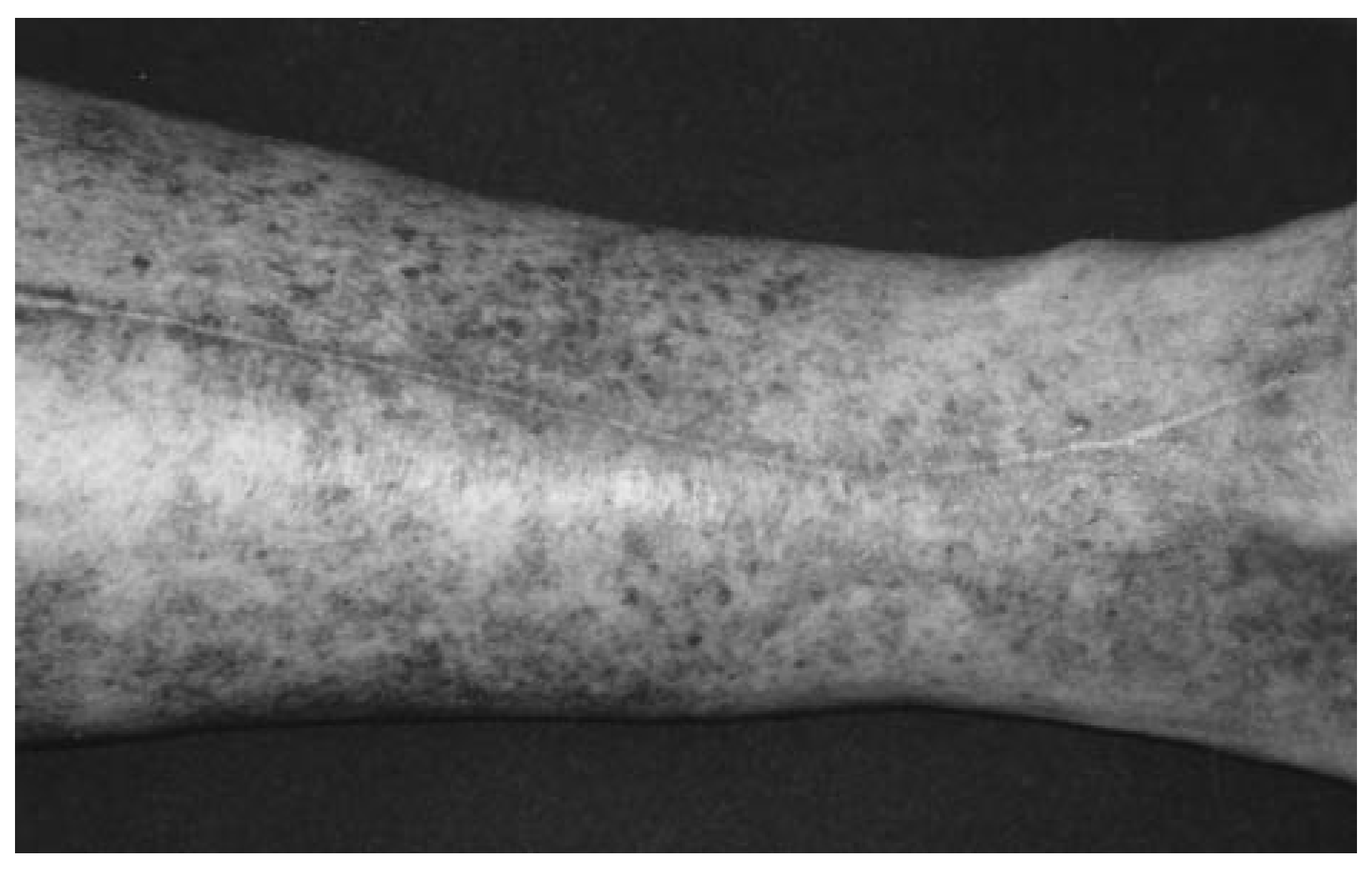
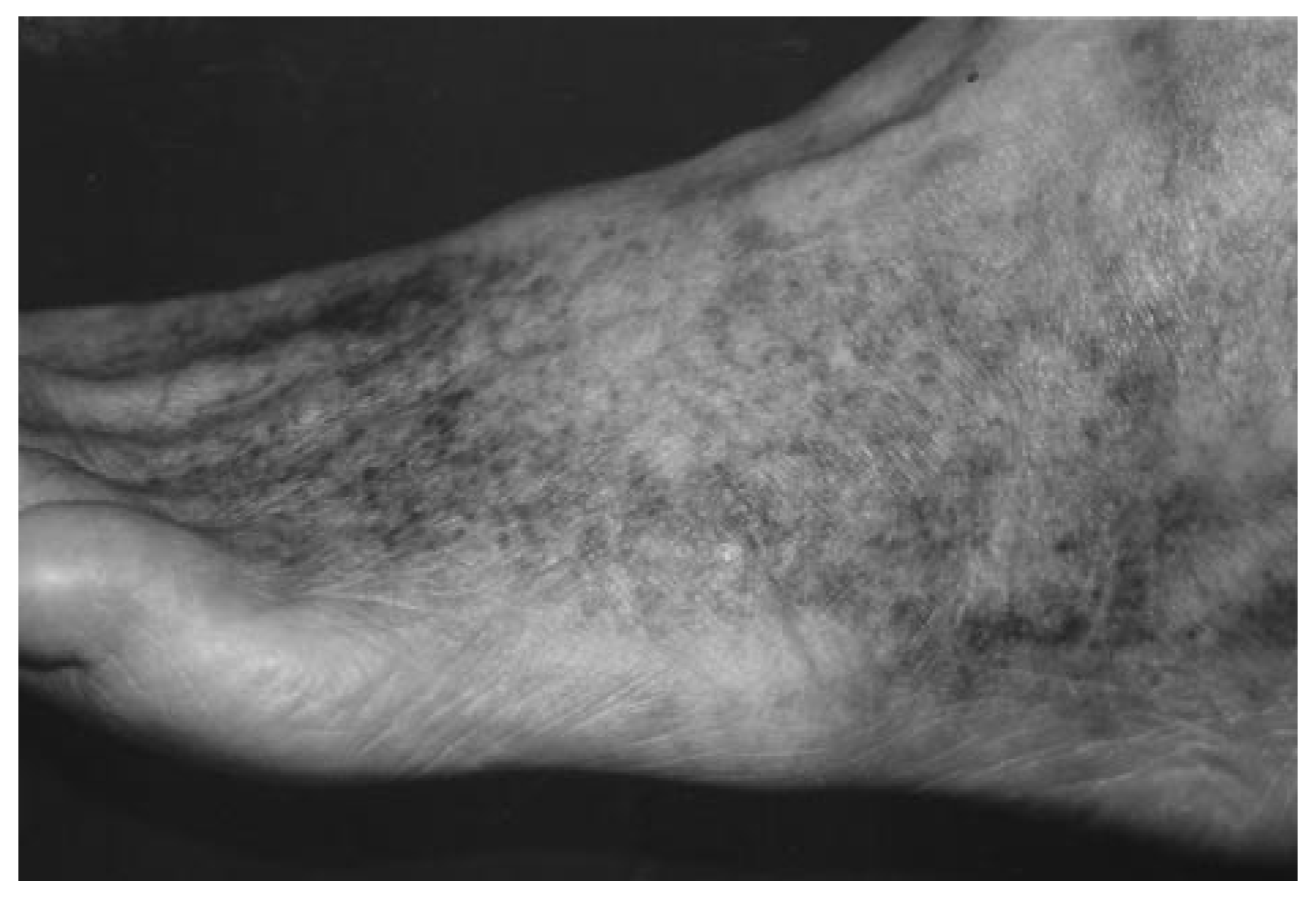
Physical examination revealed palpable common femoral and weakly palpable pedal pulses, with the latter undetectable with a Doppler probe. The bypass graft was patent by Doppler insonation. Diffuse dark black-gray pigmentation was present on both extremities (Fig. 1, Fig. 2 and Fig. 3), with greater involvement of the left leg (Fig. 1). Areas of focal pigmentary consolidation were noted, especially about the saphenous vein harvest site of the left leg (Fig. 1). This pigmentation was macular and diascopic-negative. Laboratory studies revealed normal values for liver enzymes, complete blood count with differential, and erythrocyte sedimentation rate.
The areas of pigmentation continued to expand and intensify following their discovery in July 1998. The patient was advised that this color change was probably a result of the minocycline therapy, yet he chose to continue therapy. Confirmatory skin biopsy was refused. Minocycline therapy was discontinued in March 1999. The leg pigmentation faded significantly following discontinuation of the drug.

Discussion

In the case presented, the intensely focused slate-colored hyperpigmentation surrounding an old surgical scar suggests minocycline-induced pigmentation at a site of prior inflammation. Although the patient refused confirmatory biopsy, the timing and presentation of this disturbance in relation to implementation of minocycline therapy indicate the classically described drug-induced change. Also, extensive questioning of the patient by the authors failed to reveal other obvious causes of the hyperpigmentation. The fading of the pigmentation following cessation of therapy provides further evidence of a causal relationship.
Most cases of minocycline-induced pigmentation have occurred after prolonged drug use with a large cumulative dose. [2,7] In this case, discoloration was first noted after only approximately 4 months and a cumulative load of about 12 g. The authors offer this case presentation as an addition to the scarce reports of pigmentation after short-term, low-cumulative-dose minocycline therapy. In conjunction with the prior reports, this case casts doubt on the notion that this pigmentary disturbance is a purely dose-dependent phenomenon.

References

  1. PEPINE, M; FLOWERS, F; RAMOS-CARO, F. Extensive cutaneous hyperpigmentation caused by minocycline. J Am Acad Dermatol 1993, 28, 292. [Google Scholar] [CrossRef] [PubMed]
  2. ANGELONI, V; SALASCHE, S. ORTIZ R: Nail, skin and scleral pigmentation induced by minocycline. Cutis 1987, 40, 229. [Google Scholar] [PubMed]
  3. GORDON, G; SPARANO, B. IATROPOULOS M: Hyperpigmentation of the skin associated with minocycline therapy. Arch Dermatol 1985, 121, 618. [Google Scholar] [CrossRef] [PubMed]
  4. SATO, S; MURPHY, G; BERNHARD, J; et al. Ultrastructural and x-ray microanalytical observations of minocycline related hyperpigmentation of the skin. J Invest Derma- tol 1981, 77, 264. [Google Scholar] [CrossRef] [PubMed]
  5. RIDGWAY, H; SONNEX, T; KENNEDY, C. ET AL: Hyperpigmentation associated with oral minocycline. Br J Dermatol 1982, 107, 95. [Google Scholar] [CrossRef] [PubMed]
  6. MCGRAE J, ZELICKSON A: Skin pigmentation secondary to minocycline therapy. Arch Dermatol 1980, 116, 1262. [CrossRef]
  7. MASHIMO, K; KATO, Y; SAITO, R. Laboratory and clinical investigations on minocycline. Chemotherapy 1970, 18, 339. [Google Scholar]
  8. FENSKE, NA; MILLNS, JL; GREER, KE. Minocycline-induced pigmentation at sites of cutaneous inflammation. JAMA 1980, 244, 1103. [Google Scholar] [CrossRef] [PubMed]
  9. SAUER, G. “Muddy skin” from minocycline. Schoch Letter 1979, 29, 3. [Google Scholar]
  10. ARGENYI, Z; FINELLI, L; BERGFELD, W; et al. Minocyclinerelated cutaneous hyperpigmentation as demonstrated by light microscopy and electron microscopy and x-ray energy spectroscopy. J Cutan Pathol 1987, 14, 176. [Google Scholar] [CrossRef] [PubMed]
  11. LUI, T; MAY, N. Pigmentary changes due to long-term minocycline therapy. Cutis 1985, 35, 244. [Google Scholar]
  12. KORBOL, M; SCHREIER, S; VALMASSY, R. Minocycline associated cutaneous discoloration. JAPMA 1986, 76, 87. [Google Scholar] [CrossRef] [PubMed]
Figure 1. Intense hyperpigmentation of the left leg with focal consolidation about the surgical scar from prior saphenous vein harvest.
Japma 90 00268 g001
Figure 2. Diffuse hyperpigmentation of the right leg.
Japma 90 00268 g002
Figure 3. Extension of pigmentation disturbance to the lateral and dorsal aspects of the left foot.
Japma 90 00268 g003