The evaluation and management of hallux abducto valgus have remained relatively unchanged since 1974, when Laporta et al [
1] reported on the standardization of x-ray evaluation of the patient with this disorder. The radiographic angles used to determine the presence of an abductory malorientation of the distal first metatarsal articular surface are the hallux abductus angle, the distal articular set angle, and the proximal articular set angle. The hallux abductus angle is formed by a line representing the bisection of the shaft of the first metatarsal and a line representing the bisection of the shaft of the proximal phalanx. The proximal articular set angle is the angle formed between a line representing the effective articular surface of the first metatarsal head and a perpendicular to a line representing the bisection of the shaft of the first metatarsal. The distal articular set angle is formed from a line representing the effective articular surface of the base of the proximal phalanx and a perpendicular to a line representing the bisection of the shaft of the proximal phalanx. These lines are used to determine whether the joint is congruous, deviated, or subluxed and define the type of deformity: positional, structural, or combined.
In congruous joints, the proximal articular set angle and the distal articular set angle are parallel. In deviated joints, the proximal articular set angle and the distal articular set angle are not parallel, and the lines cross somewhere outside the joint. In subluxed joints, the proximal articular set angle and the distal articular set angle are not parallel, and they cross in the joint space. In a positional deformity, the sum of the proximal articular set angle and the distal articular set angle is less than the hallux abductus angle, and the joint is either deviated or subluxed. A structural deformity occurs when the sum of the proximal articular set angle and the distal articular set angle is equal to the hallux abductus angle; the joint is congruous; and the proximal articular set angle, the distal articular set angle, or both are abnormal. The combined deformity exhibits components of both positional and structural deformities: the proximal articular set angle, the distal articular set angle, or both are abnormal, and the sum of the proximal articular set angle and the distal articular set angle is less than the hallux abductus angle [
1,
2,
3,
4,
5,
6].
The proximal articular set angle and distal articular set angle are important in determining the appropriate corrective procedure at the first metatarsophalangeal joint [
2]. These angles have been generally accepted as the standard measurements by the podiatric medical community in evaluating cartilage deviation in hallux abducto valgus surgery [
3]. To be worthwhile, these values should demonstrate consistency, including consistency across evaluators interpreting the radiographs. Furthermore, the values determined from the radiographs should be consistent with intraoperative measurements. However, the literature indicates significant variability in measurement of the proximal articular set angle.
In 1985, Shechter and Doll [
7] reported that the proximal articular set angle measurement could be misleading in determining the angular correction needed in hallux abducto valgus, and they therefore introduced a new angle. Sullivan et al [
8] showed significant variation in measurements of the proximal articular set angle using multiple radiographs. Fox and Firshein [
9] demonstrated variation in measurements of the proximal articular set angle using one radiograph with many evaluators, but made no intraoperative comparison. Amarnek et al [
2] reported that the transverse plane proximal articular set angle measured intraoperatively was an average of 7° greater than its radiographic counterpart. This may be the most accurate representation of the true proximal articular set angle measurement to date. The authors undertook the current study with the belief that the next step in testing the variability of the proximal articular set angle is to use one radiograph, one intraoperative measurement, and multiple radiographic evaluators.
Materials and Methods
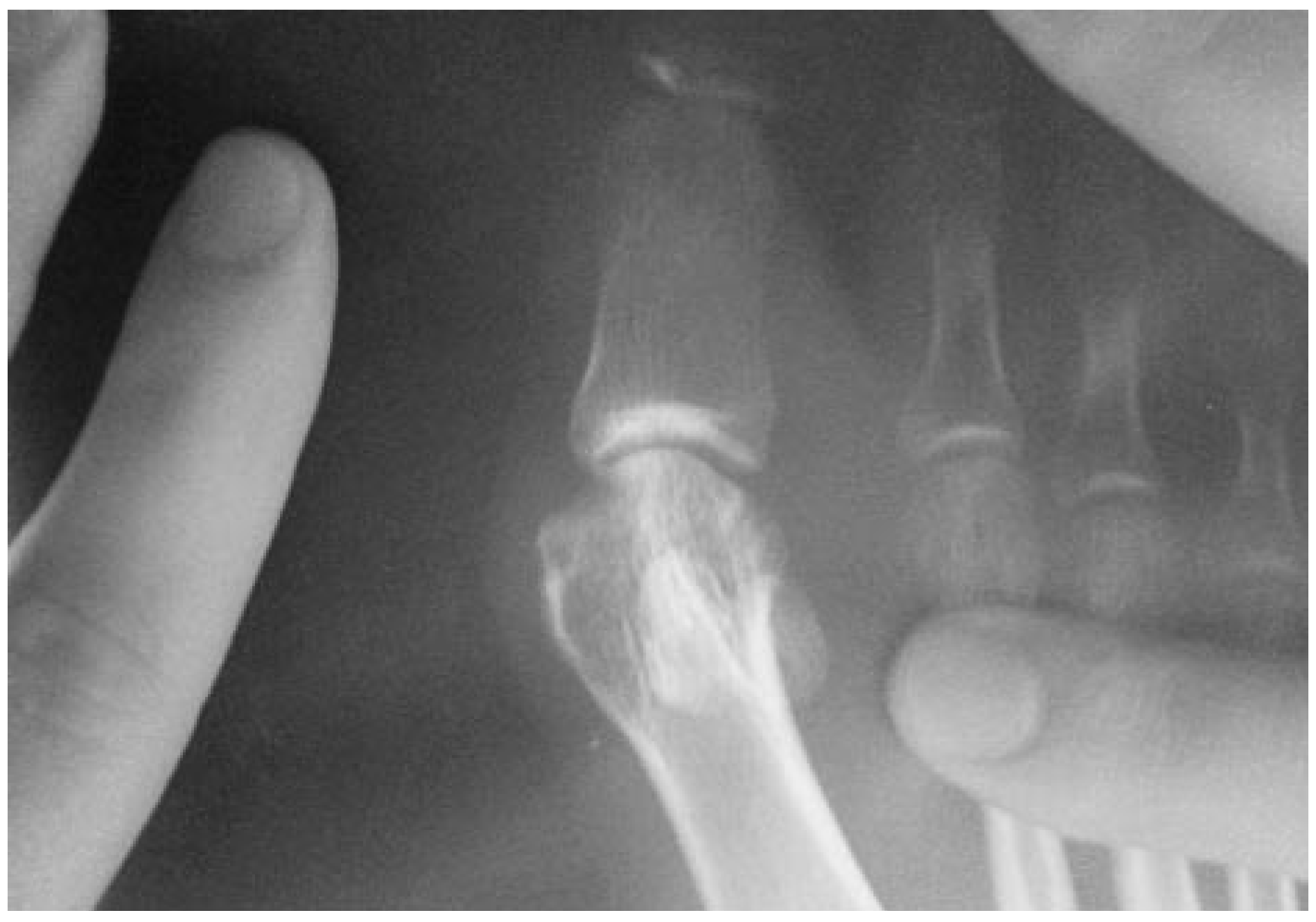
To limit the number of variables, the authors determined that only one patient should participate in the study; a patient scheduled for future hallux abducto valgus surgery was selected. A standard weightbearing, anteroposterior radiograph was taken in the angle and base of gait, and the nameplate was removed (
Figure 1). Write-on transparency film measuring 8
1/
2 × 11 inches was obtained for overlays, and permanent markers in three different colors were obtained. Six attending physicians, 4 residents, and 16 thirdyear students from the College of Podiatric Medicine and Surgery in Des Moines, Iowa, were asked to measure the proximal articular set angle, and each was asked to write his or her result on an overlay. The overlays were then collected and color-coded by group. All of the participants used the same protractor, and no time limits were imposed. One of the authors (L.N.L.) was present during all of the measurement procedures.
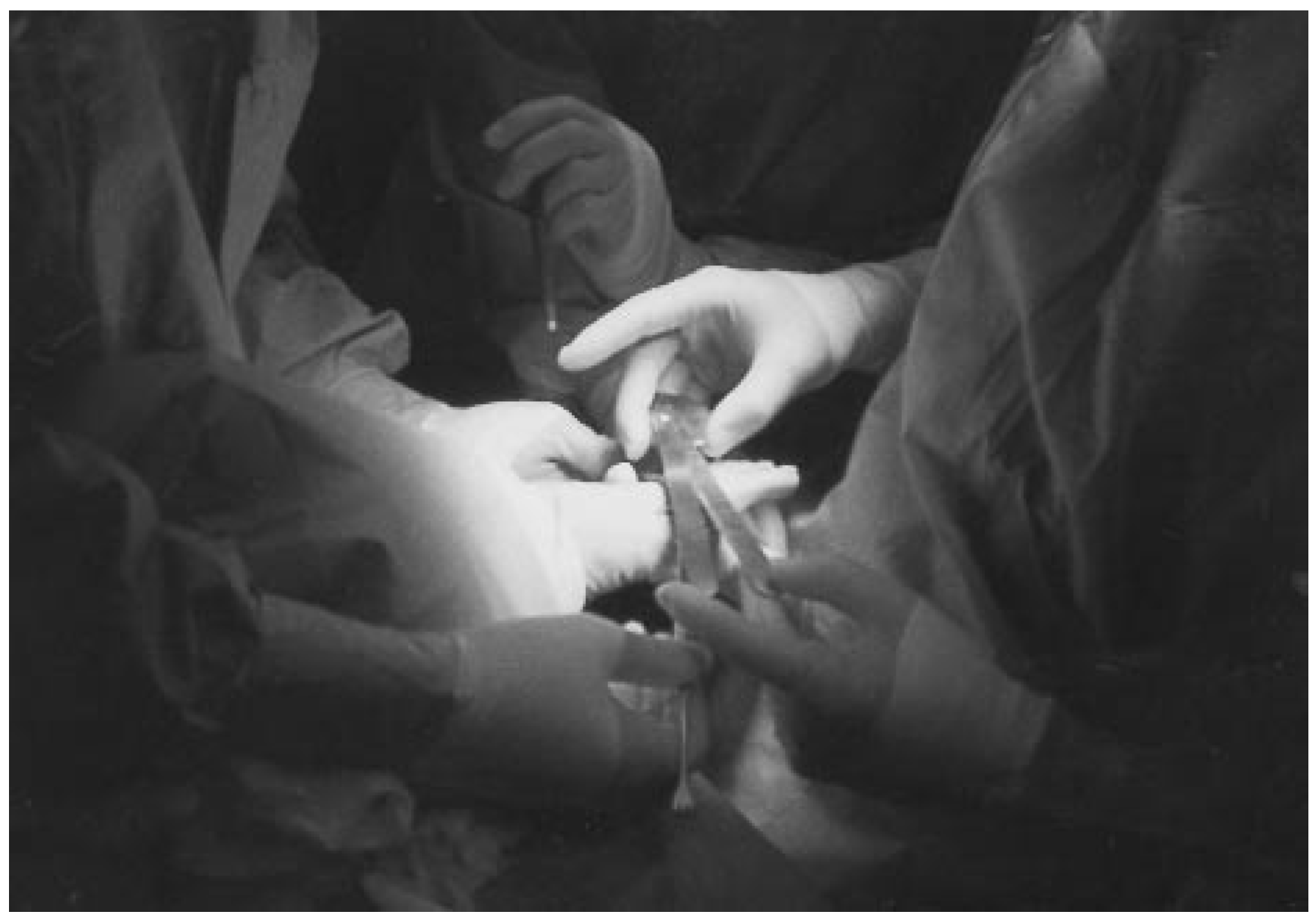
The surgery was performed and the proximal articular set angle was measured with a sterilizable stainless steel protractor. A surgical marker was used to mark a line on the dorsum of the first metatarsal head that was perpendicular to the long axis of the first metatarsal. One arm of the protractor was held parallel to this line while the other arm was placed parallel to the effective articular cartilage, and the measurement was taken. This result was compared with the radiographic measurement results. The mean radiographic measurement, standard deviation, and difference from the intraoperative measurement were then analyzed. A chi-square test and Student’s t-test were performed to determine significance of the results.
Case Presentation
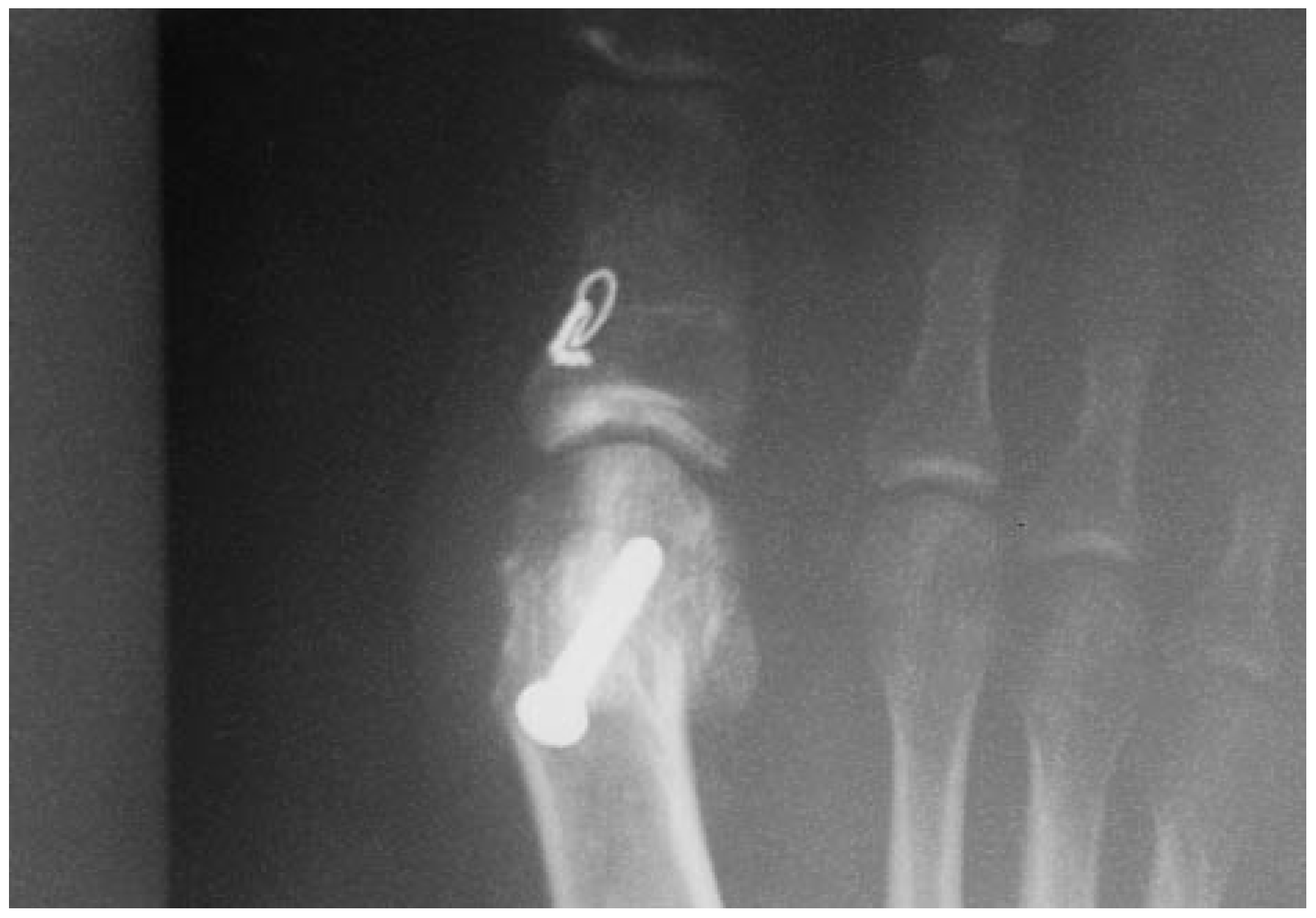
The patient selected for the study was a 30-year-old woman who presented with a painful metatarsophalangeal joint medial eminence that was irritated by wearing tight shoes and high heels. The hallux was deviated laterally and in valgus position. The bunion progression had occurred only during the last few years and was recalcitrant to conservative treatment. The preoperative assessment showed a slightly increased intermetatarsal angle and an increased proximal articular set angle measurement radiographically. Preoperatively, it was decided to perform an Austin bunionectomy with Akin osteotomy or a bicorrectional Austin procedure, with the choice being made on the basis of the intraoperative measurement of the proximal articular set angle. A dorsolinear incision was made in the normal fashion for a head procedure, and anatomical dissection was performed until the first metatarsophalangeal joint was exposed. The proximal articular set angle measurement was performed as stated in the Materials and Methods section of this article and determined to be 11°. An Austin bunionectomy with Akin osteotomy was performed. No proximal articular set angle correction was undertaken in this case (
Figure 2 and
Figure 3).
Results
The six attending physicians on the clinical staff of the College of Podiatric Medicine and Surgery had a mean radiographic measurement of 20.75° for the proximal articular set angle, with a range of 14° to 30°. The standard deviation was 5.7°, and there was a difference of 9.75° between the mean radiographic measurement and the intraoperative measurement.
The four residents from the College of Podiatric Medicine and Surgery had a mean of 21.25°, with a range of 14° to 30°, a standard deviation of 7.5°, and a difference of 10.25° from the intraoperative measurement.
The 16 third-year students from the College of Podiatric Medicine and Surgery had a mean of 18.86°, with a range of 3.5° to 32°, a standard deviation of 7.2°, and a difference of 7.86° from the intraoperative measurement.
Statistical analysis was performed by means of a chi-square test and a t-test. The chi-square test was used to determine the probability that all of the evaluators would overestimate the intraoperative value. The t-test was used to determine whether there was a significant difference between the residents’ and students’ values versus the physicians’ values. A chisquare value of 1.86 was computed, which did not exceed the P value of 5.989 for the 95% confidence limit. The calculated probability that all of the evaluators would overestimate the intraoperative value was only 60.5%. The result of the t-test for the attending physicians’ mean versus the residents’ mean was 0.600, indicating that 60.9% of the residents’ measurements are within the confidence interval. The t-test value for the attending physicians’ mean versus the students’ mean was found to be 0.536, indicating that 64.6% of the students’ measurements are within the confidence interval.
Discussion
The difficulty in evaluating the proximal articular set angle and the distal articular set angle is really a difficulty in defining what is and is not effective articular cartilage. The hallux abductus angle is measured by bony landmarks, which makes it an inherently more accurate measurement. The proximal articular set angle and the distal articular set angle are measured indirectly, by subchondral bone. The subchondral bone may not truly represent the effective articular cartilage. The authors believe that it is false to assume that the subchondral plate is a direct reflection of viable cartilage. The cartilage on the medial aspect of the first metatarsal, although no longer articulating, is still potentially effective.
The statistical analysis demonstrated that the measurements taken were not grouped in a statistically significant distribution; this agrees with findings previously presented in the literature. The authors believe that the variance indicated by the standard deviation, coupled with the consistent tendency to overmeasure the proximal articular set angle radiographically, shows that a better way of evaluating the malorientation of the first metatarsophalangeal joint is needed.
Conclusions
The authors presented the case of a 30-year-old woman with a painful bunion deformity and compared the intraoperative proximal articular set angle measurement with the measurements of three groups of radiographic evaluators: attending physicians, residents, and third-year students. The results indicated a high degree of variation across the three groups of evaluators.
The authors conclude that the only accurate proximal articular set angle and distal articular set angle measurements that can be made are the intraoperative measurements.
The natural progression of this ever-evolving controversy is to conduct a multipatient, multievaluator study that includes intraoperative measurements of both the proximal articular set angle and the distal articular set angle. The authors hope to contribute to such a study in the future.