To the Editor:
Often, diagnosis of foot and ankle soft-tissue pathology requires magnetic resonance imaging (MRI). Although MRI findings can be very accurate, they are not conclusive. The foot and ankle surgeon should be well versed in interpreting MRI films; however, diagnosis and treatment should not be entirely dependent on MRI findings. Following is a case report of a posterior tibial tendon rupture in which clinical diagnosis prevailed over MRI findings.
Case Report
A 53-year-old waitress presented to the Kern Hospital Foot and Ankle Clinic in Warren, Michigan, with chronic pain in the arch of her right foot of 4 months’ duration. Her symptoms appeared after she slipped on a wet floor and subsequently hit her foot on a booth in the restaurant where she worked. Initially, the patient did not seek medical attention. She chose to “stay off of it” by limiting her activity. After she returned to work 4 days later, the foot was still painful. However, the patient continued working for the next 4 months. At the time of presentation to the Kern Hospital Foot and Ankle Clinic, she reported that the right foot had become increasingly symptomatic and that she “couldn’t take it any longer.” The patient reported pain with ambulation and stated that she had noticed that her right foot was “getting flatter.”
On initial physical examination, swelling was noted along the medial aspect of the right foot. On palpation, marked pain was identified at the navicular tuberosity and proximally along the course of the posterior tibial tendon. Manual muscle testing was within normal limits; however, pain was noted with plantarflexion and inversion against resistance. The patient was unable to stand with her feet in normal base of gait and could not rise up on the ball of her right foot. When the patient was observed from behind, the classic “too many toes” sign was noted. There was marked calcaneal eversion in the calcaneal stance position. Examination revealed intact neurologic and vascular systems. Weightbearing anterosuperior x-rays revealed mild talonavicular divergence. The lateral view displayed a decreased calcaneal inclination angle. There was no avulsion fracture of the navicular tuberosity.
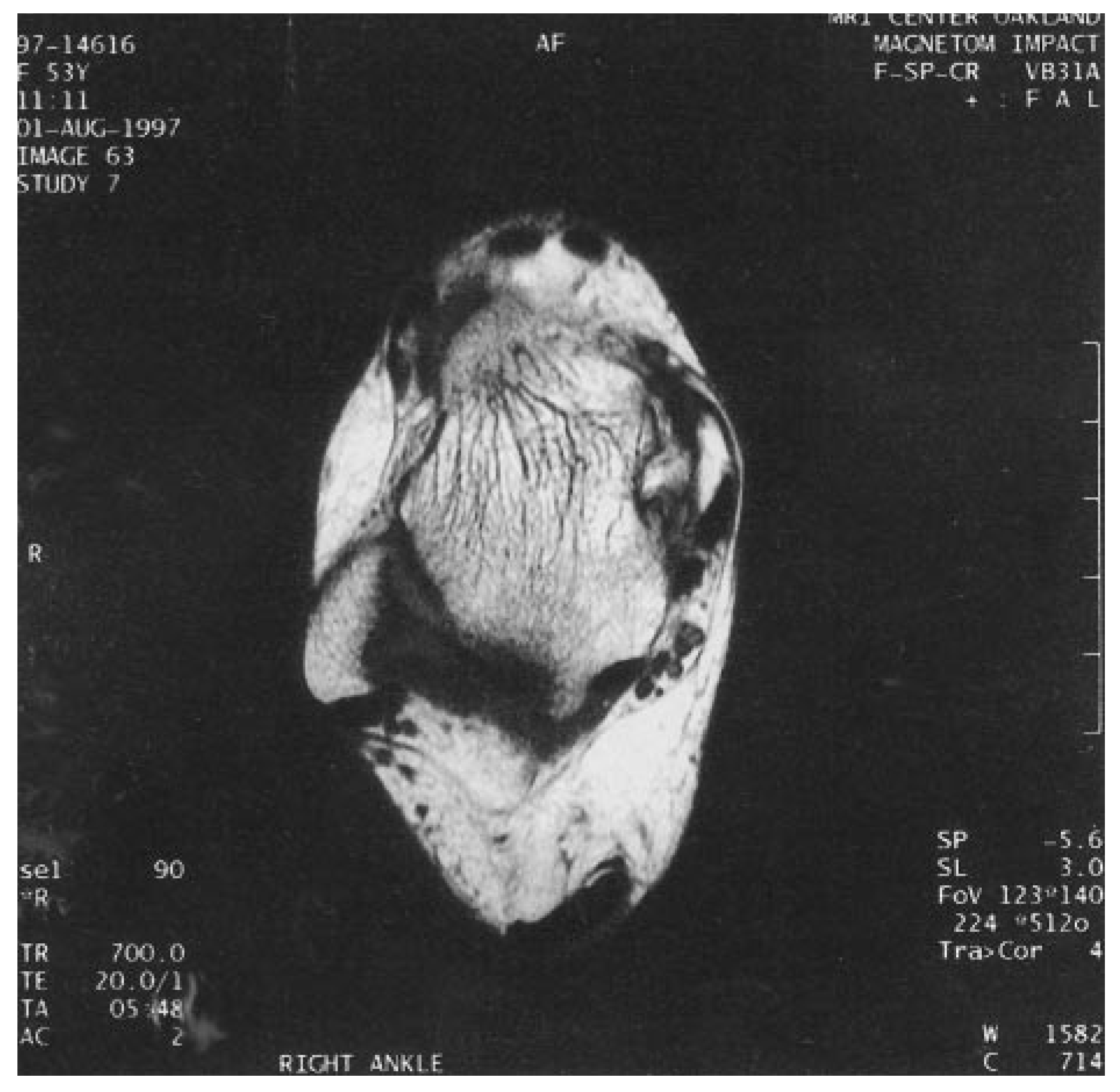
The diagnosis was tibialis posterior tendon dysfunction. Initial treatment consisted of nonweightbearing in a short-leg cast and oral anti-inflammatory medication. At a follow-up evaluation 2 weeks later, symptoms were unrelieved. The patient was again placed in a nonweightbearing short-leg cast and told to continue taking the oral anti-inflammatory medication. Third-party approval for MRI was delayed. Therefore, for the next 2 months, treatment remained conservative. When approval was finally obtained, an MRI study was ordered. The authors requested 2-mm cuts of sagittal and axial views with the foot perpendicular to the leg and attention directed to the posterior tibial tendon. The MRI scan was read as “negative for any abnormalities.” The quality of the image was deemed unsatisfactory, and a second image of higher resolution was obtained. This second image was also interpreted as negative for any abnormality of the right posterior tibial tendon (
Fig. 1).
At this point, the patient had become very depressed and frustrated with her progress. She repeatedly stated that all she wanted was to “get back to work and walk without such severe pain.” Considering the location and extent of her pain, the authors remained confident that the patient had significant pathology of the right posterior tibial tendon. After extensive consultation with the patient, surgery was scheduled with the intent of repairing a clinically diagnosed rupture of the posterior tibial tendon.
Surgery was performed under regional anesthesia with the use of a pneumatic tourniquet. It was noted upon exposure that the tendon was not round or cordlike, but flattened and wider than normally seen. Two gross longitudinal tears were present. The first tear measured approximately 1.5 cm in length and was just proximal to the tendinous insertion at the navicular tuberosity. The second tear was found to be just inferior to the medial malleolus and measured 2.0 cm in length. After the tendon edges were skived with a #15 blade, both tears were repaired primarily using 5-0 PDS (Ethicon, Inc, Somerville, New Jersey) suture material. Postoperatively, the patient was placed in a short-leg cast and instructed to remain nonweightbearing for 4 weeks. At 4 weeks after surgery, the patient was placed in a CAM Walker (Zinco Industries, Inc, Pasadena, California) for 2 weeks of nonweightbearing, followed by 2 weeks of weightbearing. The patient was then cast for and dispensed a pair of functional orthoses. Twelve months after surgery, the patient was walking without pain.
Discussion
Of all of the tendons that pass about the ankle joint, the posterior tibial tendon is the one most commonly affected by pathology such as tendinitis, rupture, and tenosynovitis. [
1] Rupture of the posterior tibial tendon was first reported by Key [
2] in 1953. Although the use of MRI in diagnosing and treating ruptures of the posterior tibial tendon is clearly valuable, it is not foolproof. It is important to rely on past clinical experience as well as patient history and physical examination findings in the event that rupture of the posterior tibial tendon fails to show up on MR images. In this particular case, the patient’s psychological well-being was greatly affected by the MRI results. After the second negative image, the patient became depressed and at times felt the need to justify the extent of her symptoms. Following the surgical discovery and repair of the rupture, the patient’s attitude drastically changed for the better, arguably aiding in her recovery. It has been the authors’ experience that MRI, as well as other diagnostic modalities, is inconsistent in diagnosing posterior tibial tendon pathology. Extensive evaluation of the patient’s symptoms is therefore essential in making a diagnosis and formulating a treatment plan.