Darier and Ferrand [
1] are usually credited with first establishing dermatofibrosarcoma protuberans as a distinct clinicopathologic entity in 1924; however, Sherwell [
2] and Taylor [
3] may have independently described the neoplasm as early as 1890. In 1925, Hoffman [
4] introduced the term “dermatofibrosarcoma protuberans,” which has remained the preferred name for this tumor. Dermatofibrosarcoma protuberans is classified as a fibrohistiocytic tumor of intermediate malignancy.
Dermatofibrosarcoma protuberans is a rare tumor that constitutes less than 0.1% of all malignancies and slightly more than 1% of all soft-tissue sarcomas [
5]. The incidence has been estimated at 0.8 cases per 1 million people per year [
6] .Dermatofibrosarcoma protuberans occurs most commonly in early to middle adult life, usually between the ages of 20 and 50. However, it can occur at any time from birth through the 80s. The tumor is relatively rare in children; only 27 cases have been reported in patients younger than 16 years of age [
7,
8,
9,
10].
The most common location of dermatofibrosarcoma protuberans is the skin of the trunk; approximately 50% to 60% of the tumors arise in this area [
5,
8,
9] Dermatofibrosarcoma protuberans occurs in almost equal proportions on the most proximal aspect of both the lower and upper extremities and in the head and neck area [
11] Relatively few cases have been reported in the foot. In 1980, Berlin [
12] performed a comprehensive analysis of all tumor-like lesions occurring on the foot; he completely updated the analysis in 1995 [
13] He found that dermatofibrosarcoma protuberans was seen in only 1 case, in an adult, out of 2,720 lesions (0.037%) found on the foot [
12] and 12 times, also in adults, out of 5,802 cases (0.21%) of fibrous and histiocytic tumors and lesions of the foot [
13]. Rabinowitz et al [
14] reviewed the literature and found that 14.8% of the 27 reported cases of pediatric dermatofibrosarcoma protuberans arose on the hands and feet. They attributed the higher rate of occurrence on the hands and feet in children to the higher frequency of trauma to the hands and feet in people younger than 16 years of age.
Etiology
A definite etiologic agent for dermatofibrosarcoma protuberans has yet to be established [
15]. The most commonly discussed factor is prior trauma to the affected region. Taylor and Helwig8 identified trauma as the causative agent in 16.5% of the 115 cases they reviewed. The question of a causal relationship between trauma and dermatofibrosarcoma protuberans is raised by several remarkable cases of tumors arising in surgical scars [
16], in old burn scars [
17], and at the site of multiple immunizations [
18]. Dermatofibrosarcoma protuberans has also been found in association with acanthosis nigricans [
19], long-term arsenic exposure [
20], acrodermatitis enteropathica [
21], and pregnancy [
8]. Recent cytogenic studies have revealed dermatofibrosarcoma protuberans tumor cells with chromosomal abnormalities, another possible etiologic factor [
22].
Clinical Appearance
Dermatofibrosarcoma protuberans initially appears as an asymptomatic, indurated plaque that may be violaceous, reddish brown, or flesh-colored. Initially, the lesion appears as a small, slow-growing macule. As the tumor grows, it becomes protuberant and may become multinodular. The nodules are usually white throughout, but they can appear brownish because of the hemosiderin deposits, or they may be partly red if fresh blood has infiltrated them as a result of repeated trauma. Palpation reveals a firm, irregularly shaped tumor that adheres to the overlying skin but is freely movable over deep tissues [
23].
Dermatofibrosarcoma protuberans lesions are usually firm and rubbery on palpation. Most lesions are painless, which explains why patients usually wait an extended time before seeking treatment.
Dermatofibrosarcoma protuberans tumors can become so large (20 to 30 cm) that they have the potential to ulcerate and bleed. They can become physically disfiguring and may interfere with regular activities of daily living. It is when this occurs that most patients seek medical attention. In one study, which reviewed 39 cases of dermatofibrosarcoma protuberans, the time from initially noting the lesion to seeking treatment ranged from 1 month to 49 years [
5].
Pathology
Dermatofibrosarcoma protuberans arises in the dermis and is composed predominantly of a dense, uniform array of cells with spindle-shaped nuclei embedded in varying amounts of collagen. Recurrent or long-standing tumors may invade fascia, striated muscle, and bone [
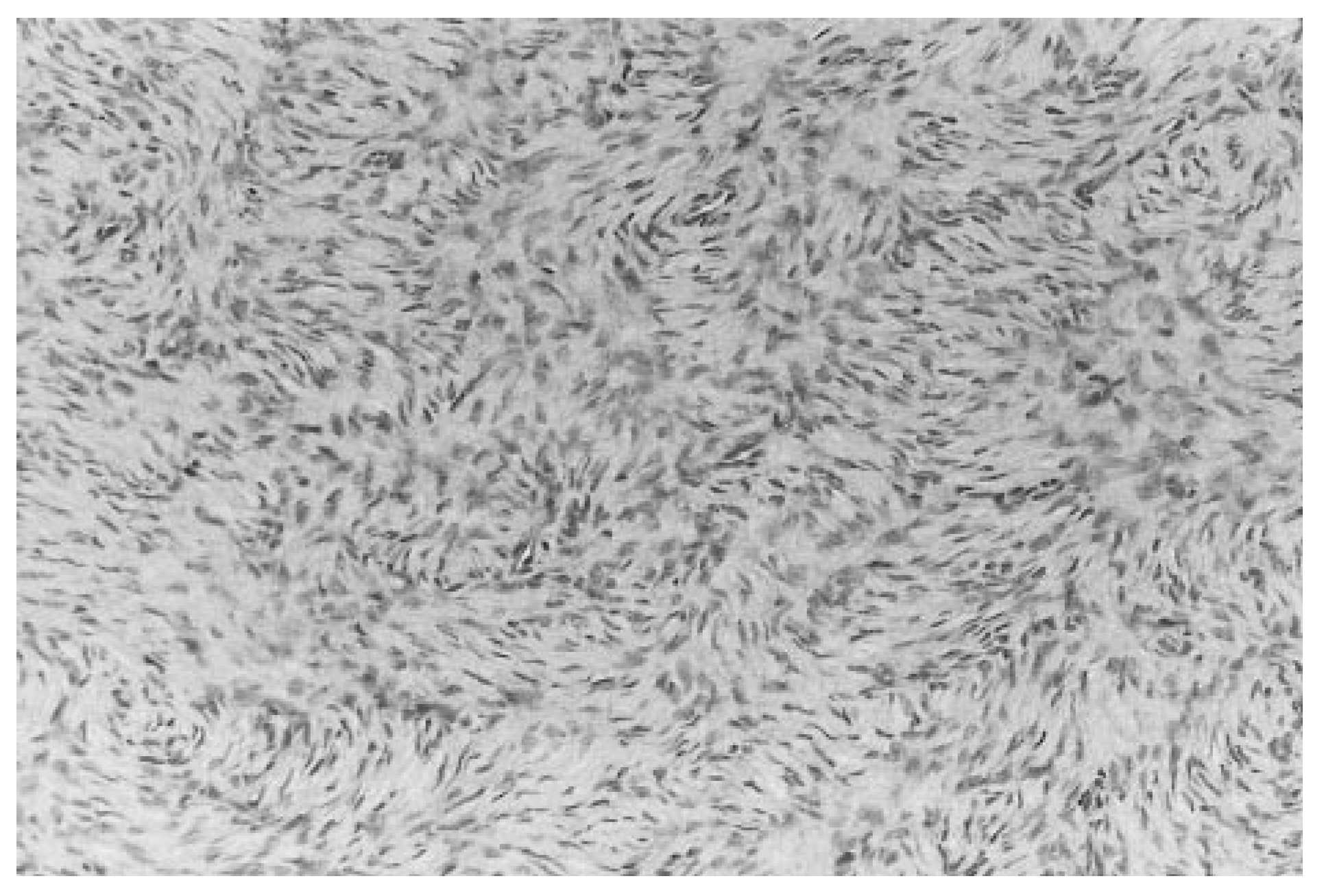
24]. The tumor cells are typically arranged into irregular, interwoven fascicles, resulting in a storiform (mat-like) pattern resembling spokes around an empty hub of a wheel [
25]. This storiform or cartwheel pattern is pathognomonic for dermatofibrosarcoma protuberans. Other names for the storiform pattern include twisted strip, whirligig, stellate, whirled, spiral nebula, rosette-like, and star-burst cartwheel [
6,
17,
26]. Cystic changes, dilated vascular spaces, and hemorrhage are sometimes present, but necrosis and angiolymphatic invasion are rare [
3].
Radiographic Appearance
The radiographic appearance of dermatofibrosarcoma protuberans is typically that of an unmineralized, nodular soft-tissue mass involving the skin and subcutaneous adipose tissue [
27]. Computed tomography scans or magnetic resonance images are useful in showing the location of the lesion, the relation of the lesion to underlying structures, and the lesion’s distinct lobular or nodular architecture. Radiographs show a soft-tissue mass or soft-tissue swelling without evidence of bone involvement or calcification. Arteriograms can show mild-to-moderate hypervascularity, and bone scintigrams can show increased accumulation of tracer in the blood-flow and blood-pool images, according to Kransdorf and Meis-Kindblom [
27].
Treatment
The treatment of choice for dermatofibrosarcoma protuberans is surgical excision with wide surgical margins to remove the entire tumor. Surgical margins of 3 cm or more beyond the tumor border are currently recommended when standard surgery is used for excision of the tumor [
17]. Most authors recommend the Mohs tissue-sparing procedure for excision of dermatofibrosarcoma protuberans. The Mohs surgical technique allows the surgeon to conserve as much normal tissue as possible while still completely removing the tumor. Mohs micrographic surgery enables the surgeon to map the location of all tissue that has been removed and microscopically examine the deep and lateral margins of a horizontally sectioned excisional specimen [
28]. In a wide excision using the Mohs technique, a surgical margin measuring 2.5 cm through deep fascia was used in order to completely eradicate dermatofibrosarcoma protuberans [
29]. Parker and Zitelli [
29] demonstrated with the use of the Mohs surgical technique that tumors measuring less than 2 cm may be safely excised with a 1.5-cm margin, as opposed to the 2.5-cm margin needed for the larger tumors. Jimenez et al [
30] studied immunohistochemical techniques as an adjunct to Mohs surgery in the treatment of dermatofibrosarcoma protuberans. They found that immunohistochemical staining of Mohs surgical sections with CD34 brought the margins of the tumor clearly into focus. Prophylactic regional lymphadenectomy is unwarranted because the tumor rarely metastasizes (5% of cases). When it does, it primarily metastasizes hematogenously to the lungs rather than to regional lymph nodes [
31].
Radiation therapy has gained widespread use as an adjunct to surgery in the management of microscopic residual disease in cases of inadequately excised lesions or as primary therapy when complete resections would entail severe cosmetic disfigurement or functional loss. There is no role for chemotherapy in the treatment of localized dermatofibrosarcoma protuberans because the tumor primarily recurs locally and the risk of metastasis is so low. Some authors believe that chemotherapy should be reserved for metastatic dermatofibrosarcoma protuberans [
3,
31].
Patients who have been treated for dermatofibrosarcoma protuberans should be examined frequently because of the possibility of recurrence. Follow-up examination is recommended every 3 to 6 months during the first 3 postoperative years, and then annually thereafter for life.
Case Report
A 7-year-old boy was brought to St. Mary Hospital in Hoboken, New Jersey, by his mother because he was complaining of increasing pain in his left foot. The patient’s mother noticed a “lump” on the dorsum of the left foot; the lump had been increasing in size during the preceding year. The lesion had been very tender on palpation and in footwear. The mother related a history of trauma to the foot—a heavy chair fell on his left foot—when the child was 11 months old. The patient was examined and treated at the time of injury. The patient’s medical and surgical history was unremarkable. He was not taking any medications and had no known allergies.
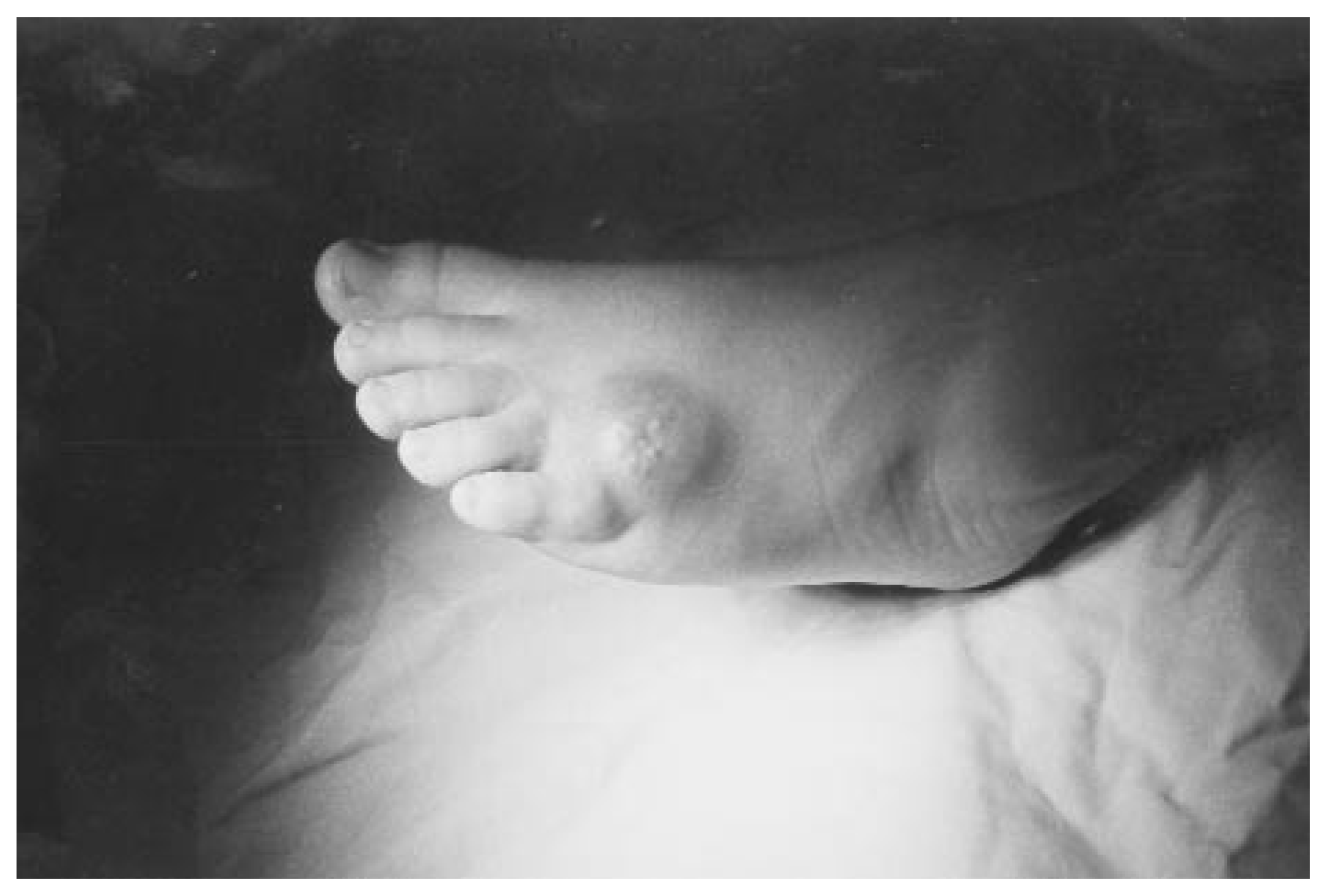
Physical examination revealed a well-developed, well-nourished, and alert child. Evaluation of the lower extremity revealed that his neurovascular status was intact, with palpable dorsalis pedis and posterior tibial pulses. Dermatologic examination revealed a soft-tissue mass on the dorsolateral aspect of the left forefoot, along with partial extension into the base of the fifth digit (
Fig. 1). The mass measured 4.0 × 3.5 cm. It was multilobulated and elevated; it had a purplish, mottled appearance and was not ulcerated. The mass was exquisitely tender on palpation. It could not be transilluminated and was not fluctuant. The overlying skin was smooth, shiny, tight, and slightly atrophic with decreased turgor. Musculoskeletal examination revealed that the tumor appeared not to involve the extensor tendons to the fourth and fifth digits. The mass was attached firmly to its overlying skin and was freely movable over the deeper tissues.
Figure 1.
Clinical appearance of the left foot on initial presentation. Note the partial extension of the tumor into the base of the fifth digit.
Figure 1.
Clinical appearance of the left foot on initial presentation. Note the partial extension of the tumor into the base of the fifth digit.
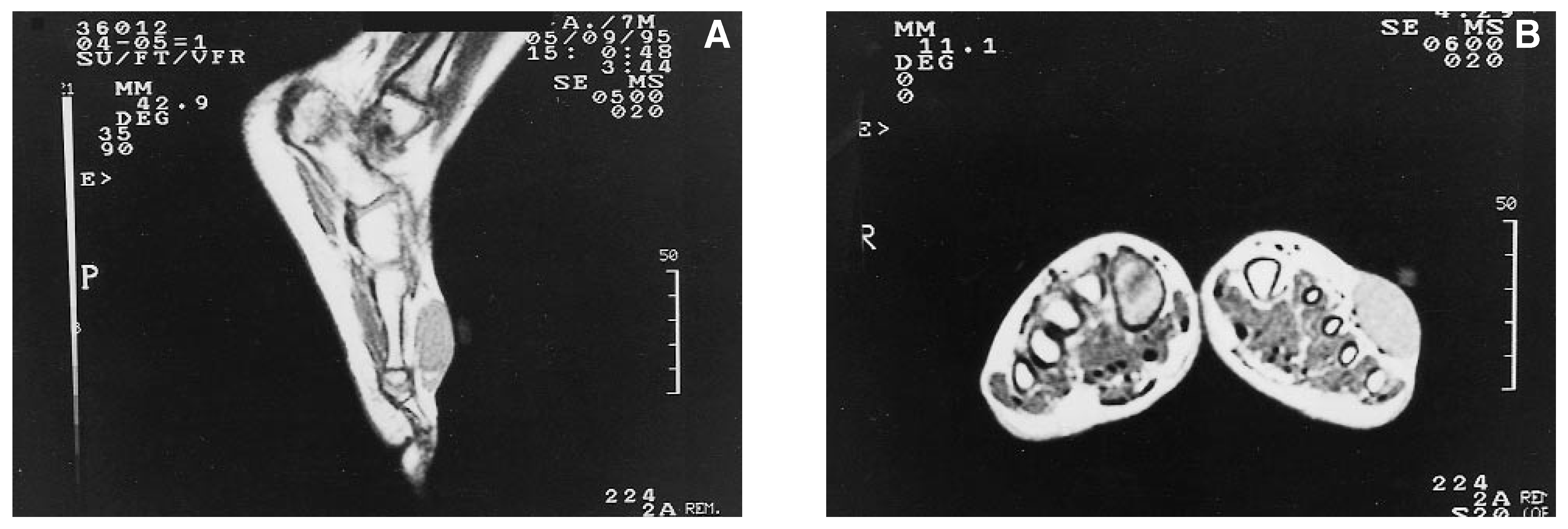
Routine radiographic evaluation showed a moderate degree of soft-tissue swelling on the dorsolateral aspect of the left foot. There were no signs of periosteal reaction or osseous involvement. Magnetic resonance images revealed a subcutaneous mass with smooth borders and homogeneous characteristics (
Fig. 2). The signal characteristics were more indicative of a solid mass than of a cyst. The differential diagnosis initially included a large fibrolipoma, a fibroma, or possibly a ganglionic cyst.
Figure 2.
Sagittal (A) and axial (B) magnetic resonance images revealing a subcutaneous mass with smooth borders and homogeneous characteristics.
Figure 2.
Sagittal (A) and axial (B) magnetic resonance images revealing a subcutaneous mass with smooth borders and homogeneous characteristics.
Following preoperative laboratory studies, the patient underwent an incisional biopsy of the soft-tissue tumor under intravenous sedation and local anesthesia on an outpatient basis. Microscopic examination of the tissue submitted for biopsy revealed a proliferative, spindle-shaped-cell lesion, consistent with dermatofibrosarcoma protuberans (
Fig. 3).
Figure 3.
The tumor cells are typically arranged into irregular, interwoven fascicles, resulting in a storiform pattern resembling spokes around an empty hub of a wheel (H&E, ×50).
Figure 3.
The tumor cells are typically arranged into irregular, interwoven fascicles, resulting in a storiform pattern resembling spokes around an empty hub of a wheel (H&E, ×50).
Upon receipt of the biopsy results, it was decided to admit the patient to the hospital. Consultations with an orthopedic oncologist, a pathologist, and a plastic surgeon were also scheduled. The team of physicians on the case agreed that an excisional biopsy should be performed. The second procedure employed the Mohs surgical technique, with a wide excision with an intraoperative frozen section performed. All of the margins of the tissue were examined and no tumor tissue was found. Intraoperatively, partial extension of the malignancy into the base of the fifth digit was noted. It was decided that amputation of the digit was necessary in order to ensure complete excision of the tumor. Following wide excision, the defect was covered with a free myocutaneous flap from the shoulder region.
The postoperative course was uneventful. The patient is being followed annually to check for any signs of recurrence.
Summary
The authors have described a rare case of dermatofibrosarcoma protuberans occurring on the left foot of a 7-year-old boy. Dermatofibrosarcoma protuberans is found most commonly in patients between the second and fifth decades, and occurs most often on the trunk and proximal extremities. Clinicians should be alerted to include dermatofibrosarcoma protuberans in the differential diagnosis of any soft-tissue tumor in the foot. Once diagnosed, this lesion must be treated aggressively with wide-margin excision to prevent recurrence.