Heel pain is a common complaint of patients who present with foot and ankle pathology. Sources of heel pain include disorders of skin, tendon, fascia, nerve, and bone. A diagnosis with objective documentation is often difficult to make in these cases. Making the correct diagnosis is even more challenging when the radiographic examination yields unremarkable or nonspecific findings. In this situation, the diagnosis may be obscure, missed, or unduly delayed. This may lead to unnecessary or inappropriate treatment or, unfortunately, to progression of a lesion that could have been easily dealt with at an earlier stage.
Magnetic resonance imaging (MRI) is an effective modality for evaluating the pathologic condition causing heel pain [
1,
2,
3,
4,
5,
6]. Magnetic resonance imaging allows visualization in multiple planes, is free of ionizing radiation, and provides high-resolution images that aid in determining the location of pathology. This is routinely accomplished with T1-weighted proton-density imaging, T2-weighted spin-echo sequences, and short tau inversion recovery (STIR) imaging. Magnetic resonance imaging is fairly nonspecific but is very sensitive in the detection and extent of involvement of bone and soft-tissue pathology. When surgical intervention is required, MRI is extremely valuable in determining anatomical location and in surgical staging.
Case 1
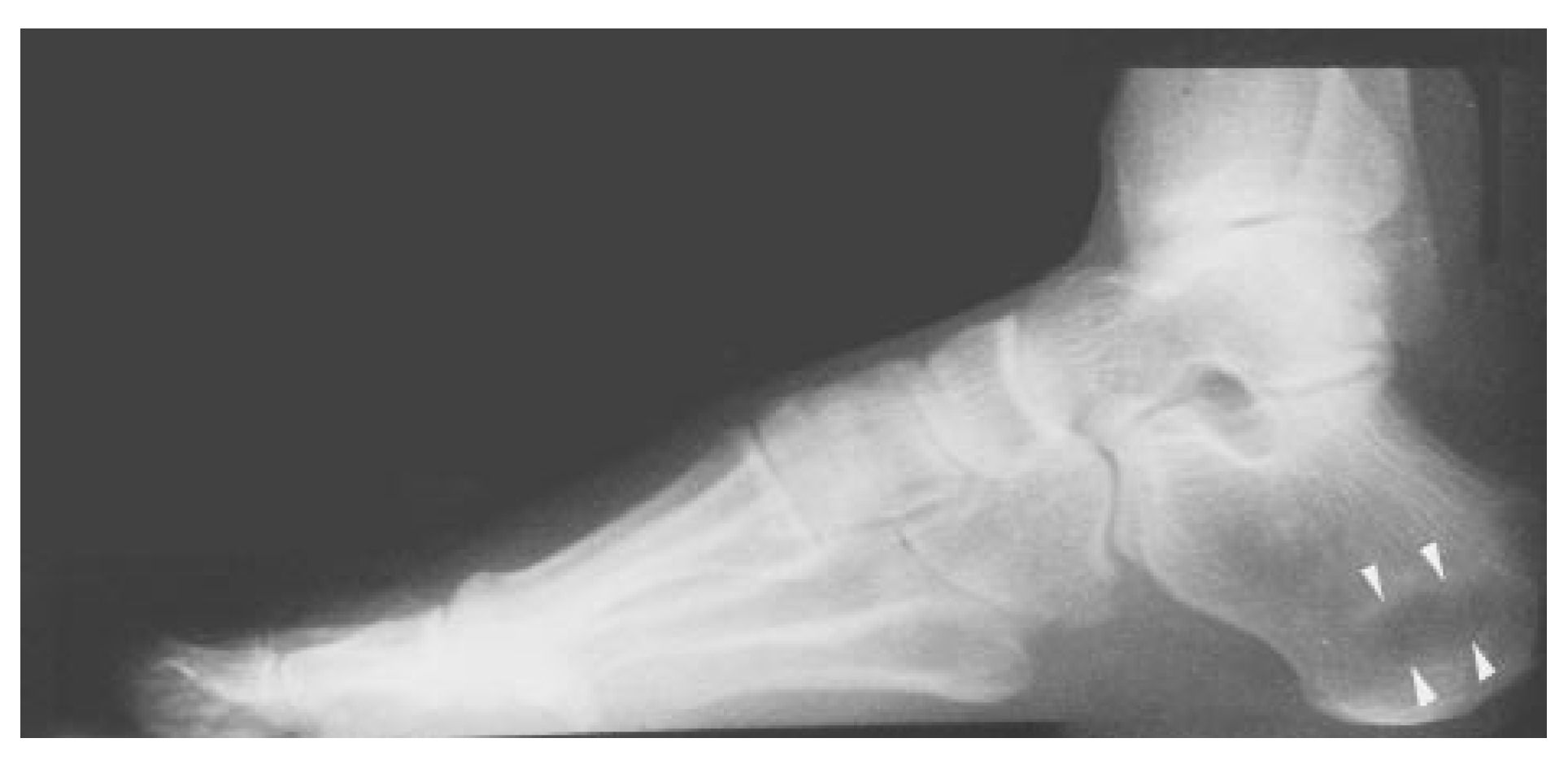
A 43-year-old moderately obese woman complained of a sharp stabbing sensation at the posterior aspect of her left ankle. The pain had an insidious onset 3 weeks before presentation, was constant, and was exacerbated by any weightbearing activity. The patient was employed as a maintenance apprentice, which required her to stand on concrete floors 8 hours per day. An otherwise normal history was obtained. Initial radiographic examination of the left foot in several projections demonstrated an ill-defined primary lytic lesion in the calcaneal body. Two separate well-defined cystic lesions were present at the posterosuperior aspect of the calcaneal tuberosity (
Figure 1). Upon physical examination, moderate-tosevere pain with lateral and medial calcaneal wall compression was elicited. The patient provided a radiograph in multiple projections of her left foot that had been taken 4 years earlier by another podiatric physician. Examination of the earlier radiograph revealed cystic lesions at the posterosuperior calcaneal tubercle only.
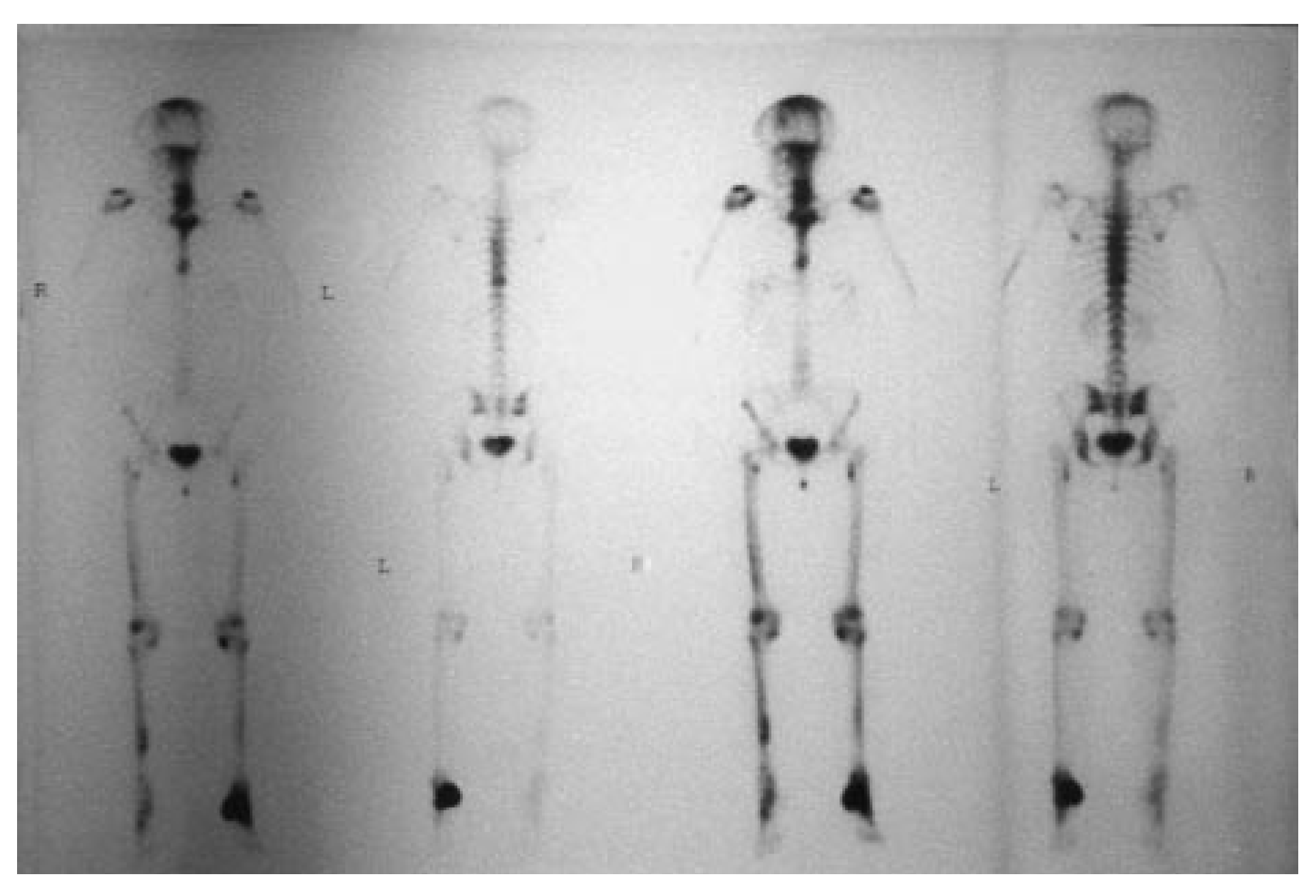
A 25-mCi technetium-99 whole-body bone scan was performed. A three-phase scan was also performed on the lower extremities. There was significantly increased uptake in the left calcaneal body on all phases. The bone scan also revealed areas of focal uptake along the lesser trochanter bilaterally, the left medial tibial plateau, and the right tibial diaphysis (
Figure 2). The subtle areas of increased uptake were thought to represent the altered biomechanics of the patient’s gait that occurred to compensate for the painful left heel.
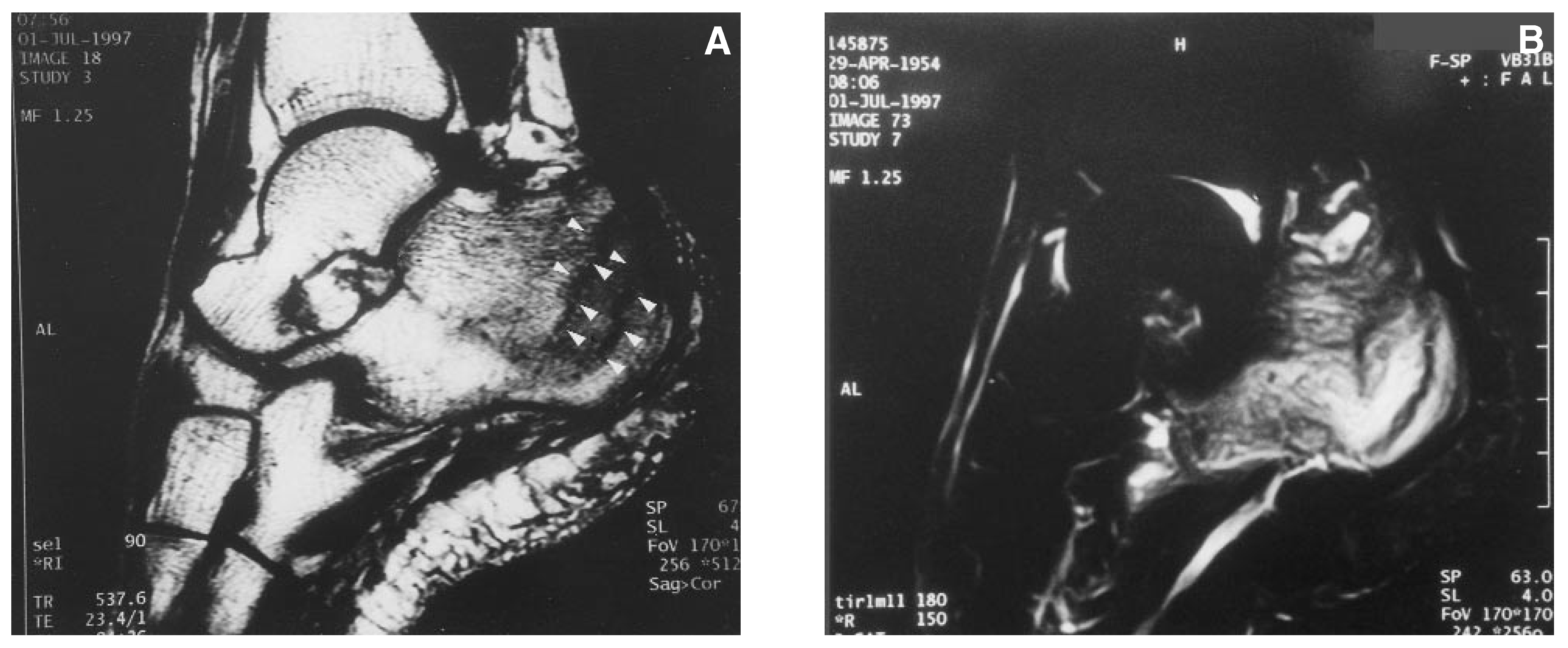
Magnetic resonance imaging of both ankles was performed. Multiple sagittal T1-weighted, STIR, and axial proton-density images with T2-weighted images were obtained. In the region that appeared abnormal on the bone scan, there was a diffuse decrease in signal on T1-weighted images with a diffuse increase in signal consistent with marrow edema on all T2-weighted, proton-density, and STIR images. This was most apparent when compared with other tarsal and lesser tarsal marrow signals on the STIR images. There are two well-defined linear areas of low signal best demonstrated on T1-weighted images that are perpendicular to the calcaneal axis and traverse the body of the calcaneus (
Figure 3). This is consistent with a calcaneal stress fracture. The right ankle study demonstrated subtle hypertrophy of the plantar fascia.
Case 2
A 28-year-old woman described a chronic, dull pain at the plantar medial aspect of her right heel. The patient had noticed an increase in the amount of soft tissue at this location 11/2 years before presentation, with a gradual increase in size of the area and discomfort thereafter. Previous treatment consisted of orthopedic evaluation, which resulted in the patient’s being told that this was a pain she would have to live with. On clinical examination increased soft tissue was observed at the medial aspect of the right heel. Fluctuation was felt during deep palpation. Radiographs taken of the right foot in multiple projections demonstrated a normal foot examination. No phleboliths were present.
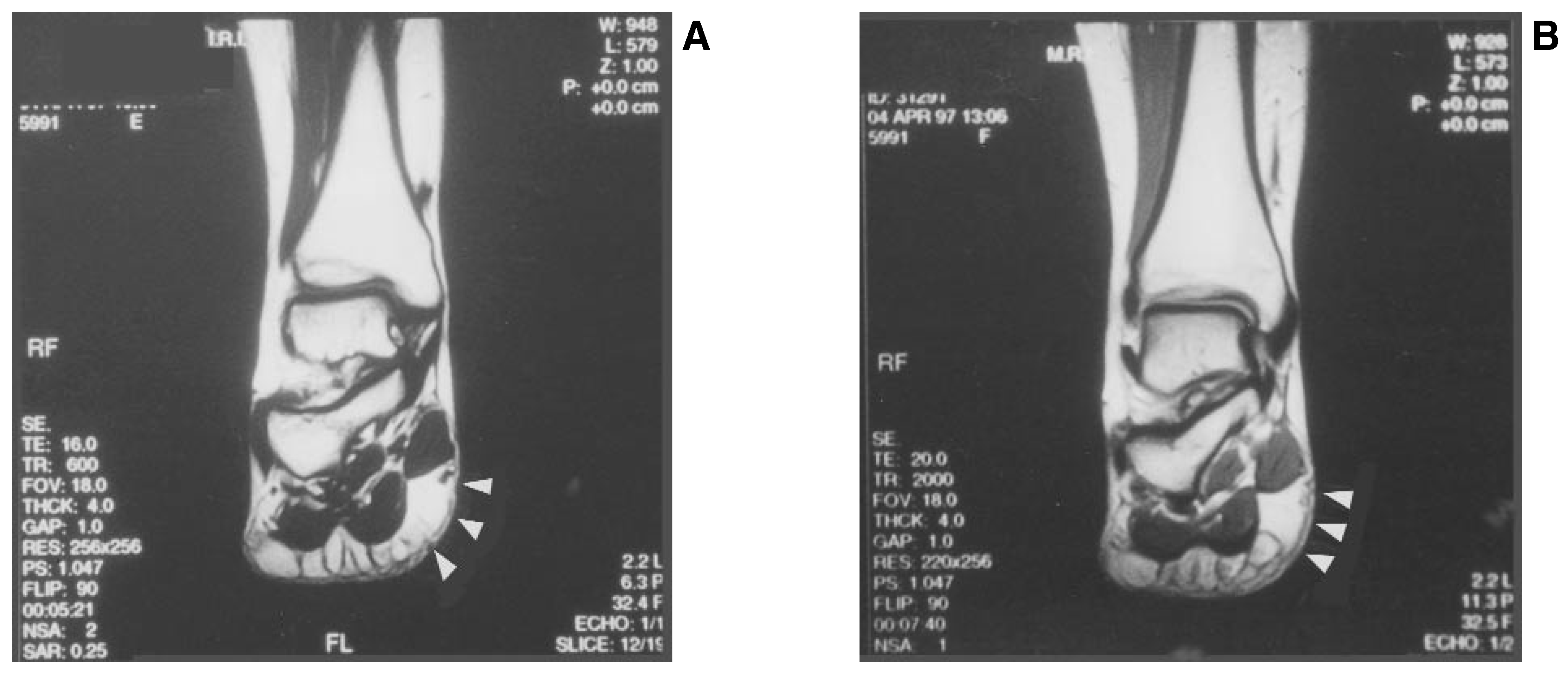
Magnetic resonance imaging of the right foot was performed. T1-weighted, proton-density, and T2-weighted image sequences were obtained in the sagittal, axial, and coronal planes. Short tau inversion recovery axial and coronal images were also obtained (
Figure 4). This examination revealed a fluid-filled mass or joint effusion at the anterolateral aspect of the tibiotalar joint consistent with a ganglionic cyst or synovial cyst. A type I posterior tibial tendon rupture was identified at the tendinous insertion of the navicular tuberosity. There was a soft-tissue mass at the plantar medial aspect of the heel whose heterogeneous increased signal was consistent with that of subcutaneous tissue on all sequences. There were discrete areas of hyperintensity and hypointensity within the soft-tissue mass. The areas of hyperintensity were of greatest signal, as expected, on the T2-weighted and STIR images.
The soft-tissue mass, which extended distally to the level of Lisfranc’s joint (
Figure 4A), was in apposition, with no apparent violation, to the abductor hallucis muscle and the flexor digitorum brevis muscle. The soft-tissue mass was excised
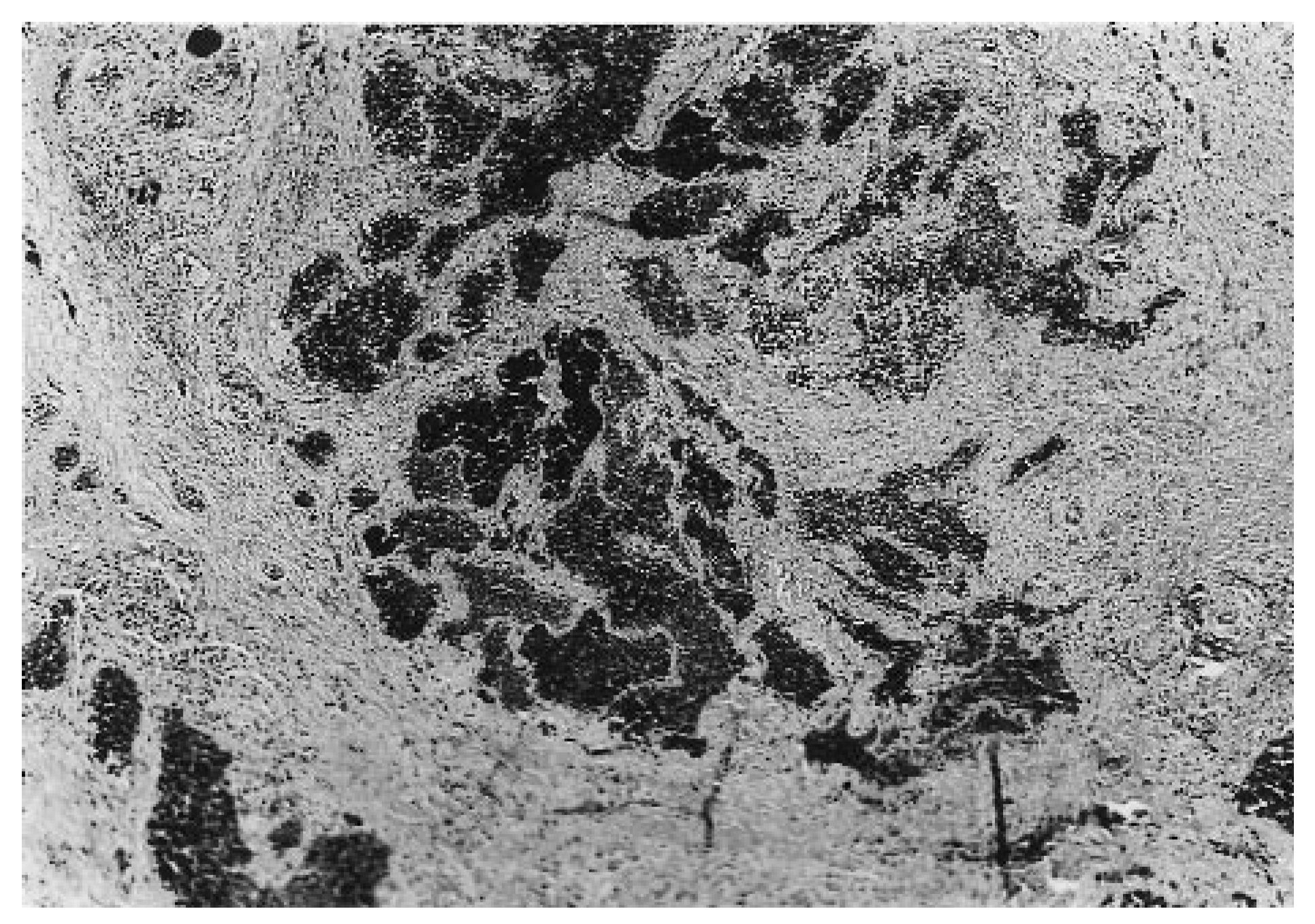
in toto and the patient had an unremarkable postoperative course. The surgical pathology report demonstrated findings consistent with a capillary hemangioma (
Figure 5).
Discussion
Capillary hemangioma usually occurs in the third or fourth decade of life and is equally distributed between men and women [
7]. The study by Kransdorf [
7] of 39,179 soft-tissue lesions in 38,484 patients during a 10-year period showed a 7.6% incidence of whole-body hemangiomas; 347 of the lesions were capillary hemangiomas throughout the body, with 20 located in the foot or ankle. The usual area of occurrence was the medial plantar aspect of the foot, deep in the subcutaneous tissue, in apposition to muscle and potentially infiltrative to bone [
2].
Radiographic evaluation may show increased softtissue mass or calcified phleboliths. However, when encountered in the foot or ankle, the calcified phleboliths may be difficult to discern or may be missed entirely. A capillary hemangioma demonstrates fairly consistent features on MRI [
2,
8,
9]. The T1-weighted images show slightly increased intermediate-to-high signal intensity compared with skeletal muscle because of the fibrofatty content of the lesion. The T2-weighted images generally show internal septa or serpiginous tubules of high signal intensity bordered by low-signal septa. This represents slow-moving blood within the vascular spaces. Magnetic resonance imaging is sensitive and moderately specific for capillary hemangioma of the foot and ankle depending on anatomical location and age of the patient.
The calcaneal stress fracture represents a partial or complete fracture of bone after repetitive, chronic microtrauma. This process begins with osseous remolding, followed by reabsorption and rarefaction [
10]. Eventual focal trabeculation microfracture progresses to a linear stress fracture. A patient can present with a description of intense yet nonspecific pain localized to the rearfoot. The soft tissues at the heel may be mildly increased in mass. The only objective finding may be pain during medial and lateral compression of the calcaneal wall.
In cases of acute stress fracture, radiographic evaluation commonly yields unremarkable or nonspecific findings. Initially, an area of slight reabsorption may be present within the body of the calcaneus. Later findings may include a sclerotic band running from the posterosuperior tubercle into the body of the calcaneus perpendicular to the trabecular pattern. A three-phase scintigraphic bone scan is more sensitive than, but not as specific as, a radiographic examination for the detection of a calcaneal stress fracture. Increased uptake at the area of concern would be seen in all three phases.
Magnetic resonance imaging has been reported to be not only very sensitive but highly specific in the identification of a stress fracture [
1,
11,
12]. The T1-weighted imaging demonstrates a relatively heterogeneous linear band of hypointensity to the marrow fat signal. Surrounding marrow edema and hemorrhage appear as decreased signal intensity on T1-weighted images that becomes isointense to hyperintense to the marrow fat signal on T2-weighted images. This signal intensity is seen most dramatically in STIR imaging. This edema is reported to be most prominent when MRI is performed within 3 weeks of the onset of symptoms [
2]. Magnetic resonance imaging in this case of calcaneal stress fracture was more sensitive and specific than radiographic examination, and as sensitive as and more specific than a three-phase scintigraphic bone scan.
Conclusion
Magnetic resonance imaging was used to detect the causes of heel pain—a calcaneal stress fracture and a capillary hemangioma—in the two cases presented in this report. Magnetic resonance imaging evaluation has been shown in this case presentation to be sensitive for the detection of pathology and has been shown to demonstrate moderate specificity. In a situation of nonspecific or conflicting findings from other imaging modalities, however, the findings of MRI can be diagnostic.